Browse by category

Introduction: What APQP Means in Modern Manufacturing
A large share of launch problems do not start on the production line—they start months earlier in unclear requirements, weak process planning, and missed cross-functional reviews. In automotive and broader manufacturing, Advanced Product Quality Planning (APQP) gives teams a structured way to prevent those failures before SOP, when fixes are still cheaper and faster. That matters because late design or process changes can cost 10 to 100 times more than catching the same issue earlier, a pattern widely recognized in quality management and product development.
If you are a quality manager or product engineer, APQP is not just a customer requirement checklist. It is a disciplined planning approach that connects product design, process design, risk analysis, validation, and launch control so the factory is ready before volume ramps up. Instead of discovering capability gaps during trial builds or after shipment, teams use APQP to surface them while there is still time to act.
In this article, we will explain the five phases of APQP, the core tools used in each stage, how APQP and PPAP work together, and how to run the process without spreadsheet confusion.
How APQP Works and Why It Matters
APQP Is a Cross-Functional Planning System
APQP is a cross-functional planning framework that brings together customer requirements, product engineering, manufacturing engineering, purchasing, supplier quality, and production planning before the start of production. The goal is simple: make sure the product can be built repeatedly at the required quality, cost, and timing, not just designed correctly on paper.
In practice, APQP connects decisions that are often made too late or in isolation. A customer drawing change affects tolerance stack-up, which may affect tooling, gage strategy, inspection frequency, and supplier capability. If those links are managed early, teams reduce late engineering changes, trial build delays, and launch escapes that are expensive to correct after production begins.
Framework vs. Phase-Gated Process
One source of confusion is that some teams describe APQP as a broad quality planning philosophy, while others describe it as a formal five-phase operating model. Both views are valid. As a framework, APQP is the discipline of translating customer and business requirements into controlled product and process decisions; as a phase-gated process, it gives teams a practical structure for reviews, deliverables, and launch approval.
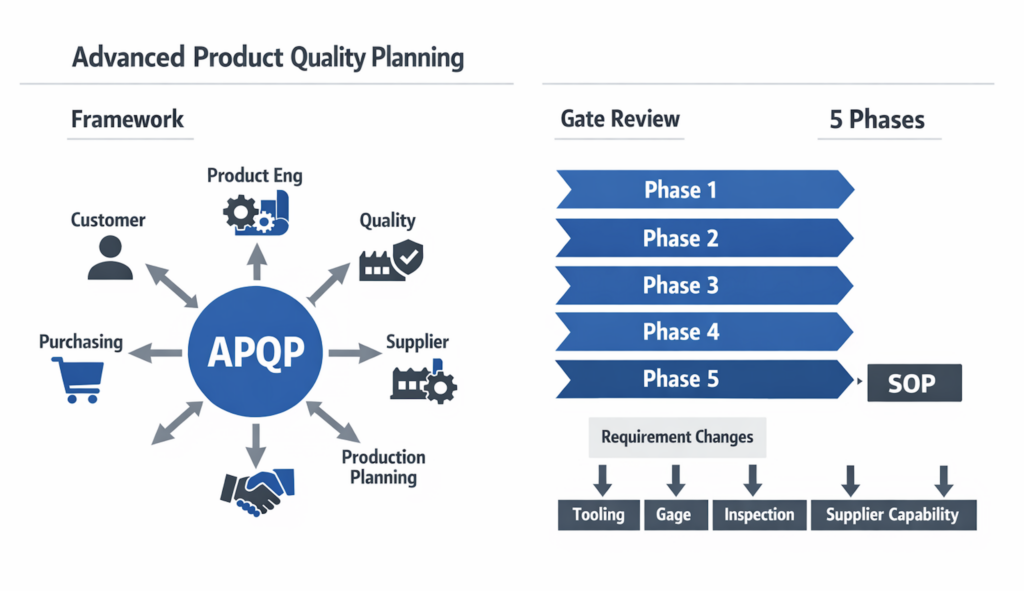
In most manufacturing environments, APQP becomes useful only when the framework is tied to named phases, owners, deadlines, and evidence. Without that structure, teams may agree on quality objectives but still miss tooling readiness, capability studies, or control plan completion.
Why APQP Matters Before SOP
The period before SOP is where risk is cheapest to remove. Industry quality studies have long shown that the cost of correcting a defect rises sharply as it moves from design to production to the field, with many manufacturers using the rule of thumb that post-launch issues can cost 10 to 100 times more than problems prevented during planning. APQP matters because it forces risk review before those costs multiply.
For an OEM launching a new stamped bracket assembly, APQP helps confirm that the design intent can be manufactured at takt, that incoming material variation is understood, and that assembly fixtures can hold required tolerances. For a Tier 1 supplier molding an interior trim component, it helps ensure tooling trials, dimensional checks, appearance criteria, and operator work instructions are aligned before customer submission. In both cases, the process reduces the chance that SOP becomes the first real validation event.
Why OEMs, Suppliers, and Other Manufacturers Use It
In automotive, APQP is strongly associated with IATF-driven customer expectations, but the logic applies more broadly. Electronics, industrial equipment, medical device components, and consumer goods manufacturers all face the same launch risks: unclear requirements, immature processes, weak supplier coordination, and poor change control. APQP gives those businesses a repeatable way to manage launch readiness across functions.
For OEMs, the benefit is visibility across the supply chain and a clearer basis for gate decisions. For suppliers, APQP creates a structured method to meet customer timing while controlling internal risk. For general manufacturers outside automotive, it acts as a disciplined launch management model even when customers do not explicitly require the APQP label.
The 5 Phases of APQP for New Product Launch
To make the phases of advanced product quality planning easier to follow, use one practical example: a supplier preparing to launch a new stamped and welded seat bracket for an automotive OEM. The product looks simple on paper, but the launch still depends on drawing clarity, tool readiness, welding consistency, measurement capability, and customer approval timing. That is exactly why APQP works best as a sequence, not a checklist.
In practice, APQP moves from business and customer requirements to design definition, then to manufacturing process design, then to validation, and finally to launch control and feedback. Each phase has different owners, different outputs, and different risks if handoffs are weak. If you are learning how to implement APQP, this phase-by-phase view is what turns the framework into an operating plan.
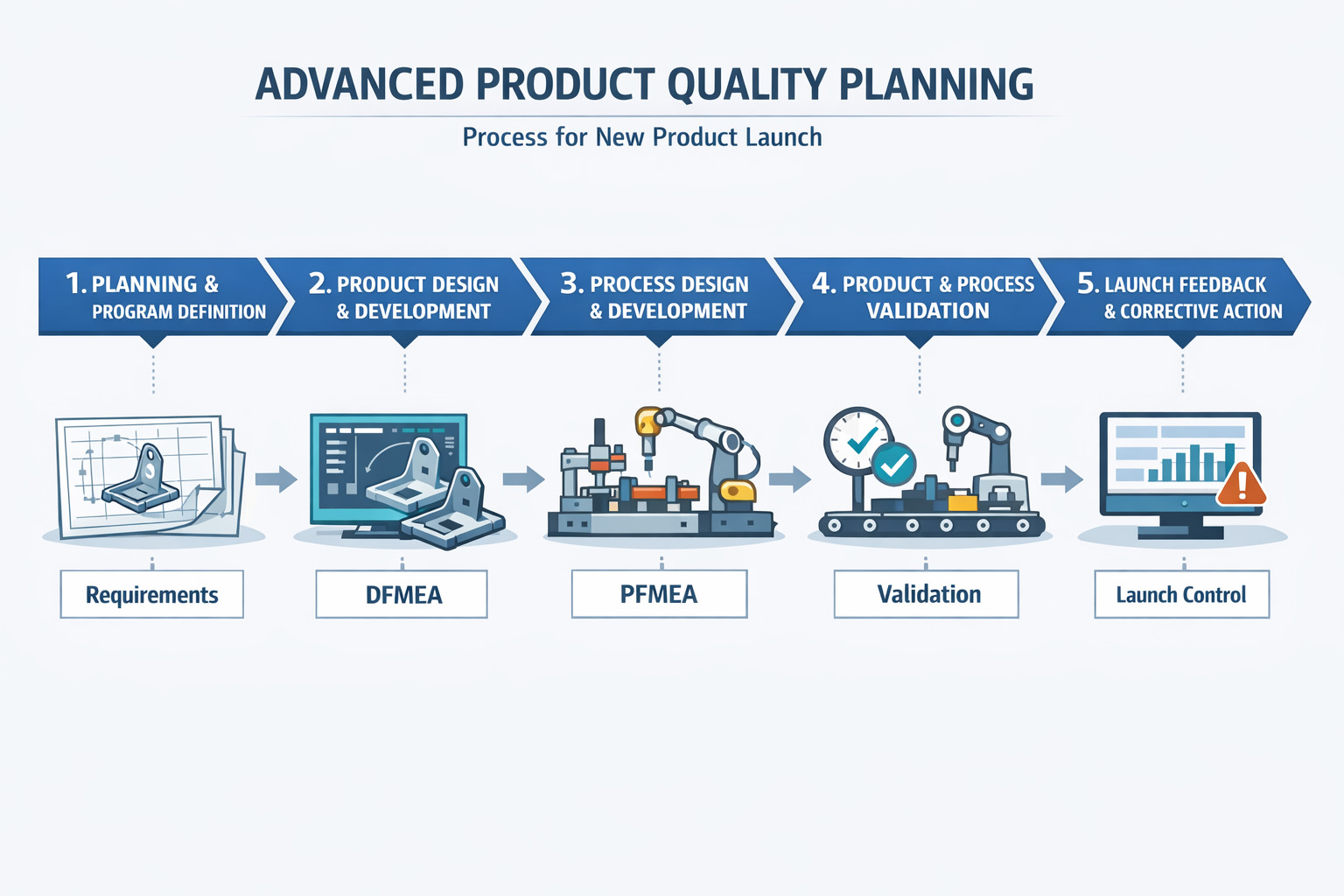
Phase 1: Planning and Program Definition
The objective of Phase 1 is to translate customer expectations into a realistic launch plan. Typical owners are the program manager, quality manager, product engineer, and sales or customer liaison, with input from purchasing and operations. Key deliverables usually include the voice of customer summary, preliminary bill of materials, timing plan, quality targets, special characteristics list, and initial risk assumptions.
In the seat bracket example, this is where the team confirms load requirements, corrosion expectations, annual volume, packaging needs, and OEM milestones. A common failure point is treating the customer print as complete when critical details are still open, such as welding standards or gauge strategy. That early ambiguity often becomes a late APQP delay.
Phase 2: Product Design and Development
Phase 2 focuses on whether the product design can meet function, safety, compliance, and manufacturability requirements. Product engineering usually leads, while quality, tooling, supplier quality, and in some cases the customer’s engineering team review and challenge the design. Typical outputs include design FMEA, design verification plans, drawing release status, material specifications, and prototype results.
For the bracket launch, engineers may discover that one bend radius increases springback risk and makes dimensional control harder after welding. Catching that issue here is far cheaper than correcting hard tooling later. The main failure point is weak cross-functional review, especially when product design decisions are made without enough process input.
Phase 3: Process Design and Development
Once the design is stable enough, the team defines how the part will actually be made at the required volume and quality level. Manufacturing engineering and quality usually own this phase, supported by maintenance, tooling, logistics, and supplier teams. Common deliverables include the process flow diagram, PFMEA, control plan, workstation instructions, equipment requirements, and gauging plan.
In the running example, the team maps coil receipt, blanking, forming, welding, coating, inspection, and packing. They also identify that weld fixture location is a high-risk variable and add preventive controls before trial builds. Many APQP projects fail here because the process is documented too late or copied from a similar part instead of being built for the actual risk profile.
Phase 4: Product and Process Validation
Phase 4 tests whether the designed process can repeatedly produce conforming parts under near-production conditions. Quality, production, manufacturing engineering, and metrology teams are heavily involved, and the customer may review formal submission evidence. Deliverables typically include trial run results, capability studies, measurement system analysis, production control plan confirmation, and the PPAP package.
This is also where how APQP and PPAP work together becomes practical: APQP manages the preparation, while PPAP is part of the proof that readiness is real. In the bracket example, a trial run may show Cpk on a critical hole location below target, forcing fixture adjustment before submission. The main failure point is confusing a successful sample build with a validated production process.
Phase 5: Launch, Feedback, and Corrective Action
The final phase starts at SOP, not after everything is “done.” Production, quality, and program leadership monitor launch stability through scrap, first-pass yield, customer complaints, delivery performance, and reaction-plan execution. Outputs include launch containment records, corrective actions, lessons learned, and updates to FMEA and control plans based on real production data.
For the seat bracket, the first two weeks may reveal occasional weld spatter affecting coating appearance, even though dimensional results pass. A disciplined APQP team treats that as structured feedback, not an isolated shop-floor issue. That is how APQP moves from project readiness to stable, repeatable production.
Core APQP Tools
Once the phases of APQP are clear, the next question is practical: which tools make each phase work on the factory floor and in supplier coordination? APQP is not a single document. It is a structured management system supported by risk, validation, measurement, and control tools that translate requirements into repeatable production conditions. In practice, teams use these tools to identify failure modes early, define controls before launch, and generate evidence that the process can meet customer expectations consistently.
APQP Tools That Control Risk Across Development and Launch
The first group of tools is used to prevent problems before they reach production. DFMEA supports product design reviews by ranking potential design failure modes based on severity, occurrence, and detection. A motor housing team, for example, may use DFMEA to flag a high risk of seal leakage caused by tolerance stack-up, then redesign the groove profile before tooling is cut. That is why DFMEA belongs early in APQP: it reduces expensive design changes later.
PFMEA takes the same logic into manufacturing execution. Instead of asking how the design may fail, it asks how the process may create defects, such as wrong torque, missing components, or incorrect curing time. A plastics molding supplier might identify inconsistent cooling as a cause of warpage, then add temperature monitoring and response limits before pilot production. This is one of the clearest examples of how to implement APQP in operational terms: convert risk analysis into preventive process controls.
A process flow diagram connects the whole process in sequence, from incoming material to packing and shipment. It gives engineering, production, and quality the same view of where value is added, where inspection occurs, and where rework or scrap can appear. From that flow, teams build the control plan, which defines what characteristic is controlled, how it is measured, sample size, reaction plan, and who owns the check. If the phases of advanced product quality planning are explained well, this linkage should be visible: flow defines the steps, PFMEA identifies the risks, and the control plan translates them into shop-floor actions.
MSA, SPC, and the Evidence of Process Readiness
Risk controls alone are not enough if the measurement system is unreliable or the process is unstable. Measurement System Analysis (MSA) verifies that gauges, fixtures, and inspection methods are repeatable and reproducible, because a poor gauge can hide actual variation or trigger false rejects. In many industries, a gage R&R result below 10% is generally considered acceptable, while results above 30% usually require improvement before critical decisions rely on the data.
Statistical Process Control (SPC) then monitors whether the process stays in control over time. Control charts, capability indices such as Cp and Cpk, and trend analysis help teams distinguish common-cause variation from special-cause problems that require action. For many customer-specific requirements, a preliminary Cpk of 1.67 may be expected during validation, while ongoing production may be managed at 1.33 or above, depending on the characteristic and industry standard. These tools move APQP from planning intent to measurable launch evidence.
Where the Main Deliverables Appear Across the APQP Process
Across the full APQP cycle, deliverables appear in a logical sequence rather than all at once. DFMEA is concentrated in product design, PFMEA and process flow diagrams are developed during process design, and control plans, MSA, SPC studies, and capability evidence mature during validation and launch preparation. PPAP consolidates these outputs near launch as the formal readiness checkpoint between development and serial production.
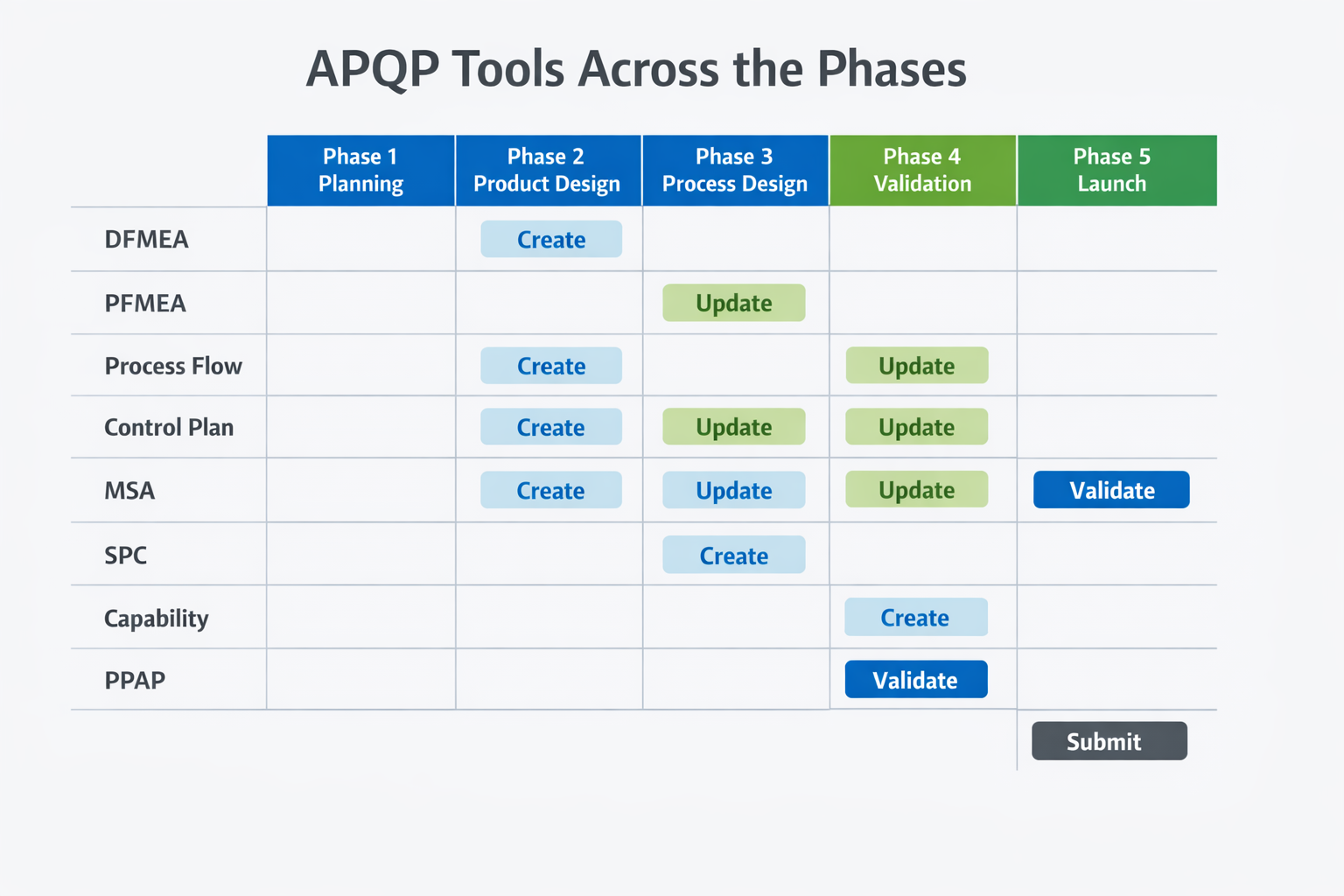
For quality managers and product engineers, the takeaway is straightforward: APQP is only as strong as the discipline behind its core tools. When each tool is created at the right phase, updated as changes occur, and linked to approval decisions, launch risk becomes visible and manageable.
How to Implement APQP Without Spreadsheet Chaos
Knowing the phases of APQP is not the same as running them well. In practice, APQP breaks down when teams manage timing, approvals, and evidence across email threads, local files, and separate supplier trackers. If you want to know how to implement APQP without creating administrative drag, the answer is to treat it as an operating system for launch readiness, not just a document checklist. A realistic rollout starts with clear ownership, phase-based deliverables, and visible decision gates.
To make this concrete, consider a supplier preparing a new electronic control module for an OEM launch. The quality manager owns the overall APQP plan, product engineering owns design outputs, manufacturing engineering owns process readiness, purchasing coordinates supplier submissions, and plant leadership signs off each gate. That structure sounds obvious, but many projects fail because responsibilities stay implied rather than assigned. Before any launch meeting, every deliverable should have one accountable owner, one due date, and one approval path.
Define Ownership by Phase and Deliverable
Start by mapping deliverables to the five APQP phases instead of storing them in one master spreadsheet tab. For the control module project, phase-one outputs may include customer requirements, timing plans, and risk assumptions, while later phases add DFMEA updates, PFMEA, control plans, validation records, and run-at-rate evidence. This is where the phases of advanced product quality planning explained earlier become operational: each phase should end with a short list of required outputs, not a vague status label. If a document does not support a gate decision, it should not sit in the core APQP tracker.
Next, define what “done” means for each deliverable. A PFMEA is not complete because someone uploaded a file; it is complete when the latest revision is reviewed, linked to the current process flow, and approved by the right functions. The same rule applies to supplier inputs such as material certifications, tooling readiness reports, and capability studies. This prevents the common situation where a team reports 90% completion but still cannot pass a gate review.
Build Approval Gates Around Decisions
Many APQP programs hold regular meetings but still miss launch risks because approvals are informal. Each gate should answer a specific question: Are design risks reduced enough to freeze the product, is the process ready for validation, or can the team move to launch with documented exceptions? For the control module example, the process validation gate should require evidence that key dimensions, test methods, operator instructions, and reaction plans align. A gate without entry criteria quickly becomes a calendar event instead of a control point.
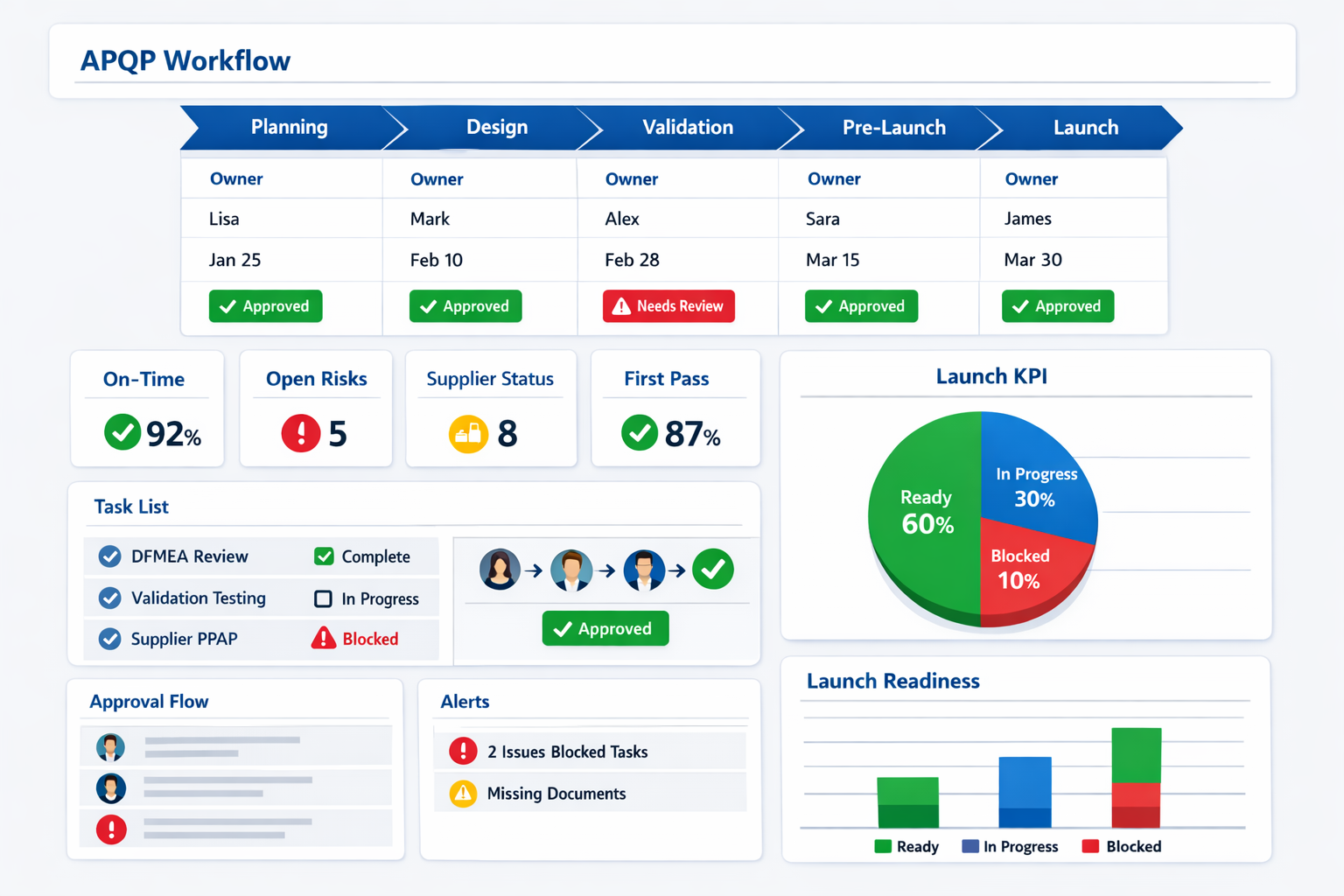
The ideal digital APQP workflow starts when a deliverable or action item is created, assigned to an owner, and tied to a phase and due date. It then routes for review, captures comments and revision history, escalates overdue items, links validation evidence, and updates launch dashboards automatically when approvals are complete or blocked. Instead of asking teams to rebuild status manually, the workflow should show which items are awaiting action, which are approved, and which risks still prevent release.
Control Deadlines, Supplier Inputs, and Readiness KPIs
Once gates are defined, track execution through a small set of launch-readiness metrics. Useful KPIs include on-time deliverable completion, open high-severity risks, supplier submission status, first-pass approval rate, and validation closure before SOP.
A digital model is more effective than spreadsheets because it controls versioning, approvals, and traceability in one place. With Jodoo, manufacturers can build no-code APQP workflows that assign owners by phase, route gate approvals, centralize FMEA and control plan records, collect supplier inputs through forms, and monitor launch KPIs on real-time dashboards. That gives quality managers and product engineers a clearer way to implement APQP without losing control in the final weeks before launch.
Conclusion: Use Jodoo to Digitize APQP Projects and Launch with More Confidence
Advanced Product Quality Planning works best when it is treated as an operating system for launch readiness, not just a checklist of documents. The five phases give teams a clear structure, but the real value comes from controlling handoffs, approvals, deadlines, risks, and evidence at each gate. When that discipline is missing, even strong design and process work can break down during launch.
That is why many manufacturers move APQP out of spreadsheets, email threads, and shared folders into a single digital workflow. With a no-code manufacturing platform like Jodoo, you can build phase-gate approvals, assign owners, track milestone dates, centralize DFMEA, PFMEA, and control plan records, and keep cross-functional teams aligned from engineering through production and supplier quality. Instead of chasing document versions, your team can focus on readiness, capability, and corrective action.
If you want a more controlled way to manage APQP projects and new product launches, Jodoo gives you a practical path without heavy custom development. You can start with one workflow, one launch team, or one product family and scale from there. Start a free trial or book a demo to see how Jodoo can support your next launch with better visibility and fewer surprises.