Browse by category

Introduction: Why Confined Space Safety Is a High-Stakes Issue in Manufacturing
Confined space incidents are still among the most serious events in manufacturing because a single mistake can turn routine maintenance into a fatal emergency within minutes. OSHA and other safety bodies have long shown that many confined space fatalities involve not only entrants, but also would-be rescuers who enter without proper controls. For safety officers and maintenance managers, that makes confined space safety more than a compliance topic. It is a live operational risk tied to shutdown timing, permit accuracy, and supervisor control.
In real plants, the challenge is rarely just identifying the space. The harder part is ensuring isolation is complete, gas testing is valid, contractors follow site rules, attendants know their roles, and every handoff is documented under audit pressure. These problems become more visible during turnarounds, tank cleaning, mixer repairs, pit inspections, and vessel entries, where production urgency can compete with safe entry discipline.
This article breaks the topic into practical steps. First, it explains what qualifies as a confined space in manufacturing and which spaces become permit-required. Then it walks through the main hazards, the step-by-step entry procedure, and the documentation controls that matter on the plant floor.
What Counts as a Confined Space in Manufacturing—and Which Spaces Are Permit-Required
Definition of a Confined Space
In manufacturing, a confined space is not just any small or enclosed area. Under OSHA-aligned criteria, it is a space that is large enough for a worker to enter, has limited or restricted means for entry or exit, and is not designed for continuous occupancy. That definition covers many routine plant assets, including storage tanks, vessel interiors, utility pits, silos, dust collectors, large mixers, and sections of ductwork.
The key point is that a confined space is defined by its physical characteristics first, not by whether work happens there every day. A stainless steel blending tank may be entered only during cleaning, and a cable pit may be opened only during maintenance, but both can still meet the definition.
The Difference Between a Confined Space and a Permit-Required One
Not every confined space is permit-required. A space becomes a permit-required confined space when it contains, or has the potential to contain, serious hazards such as a dangerous atmosphere, engulfment risk, inwardly converging walls, or any other recognized safety or health hazard that could trap, injure, or kill an entrant. This distinction matters because OSHA permit-required confined space requirements apply to the hazard profile, not just the shape of the space.
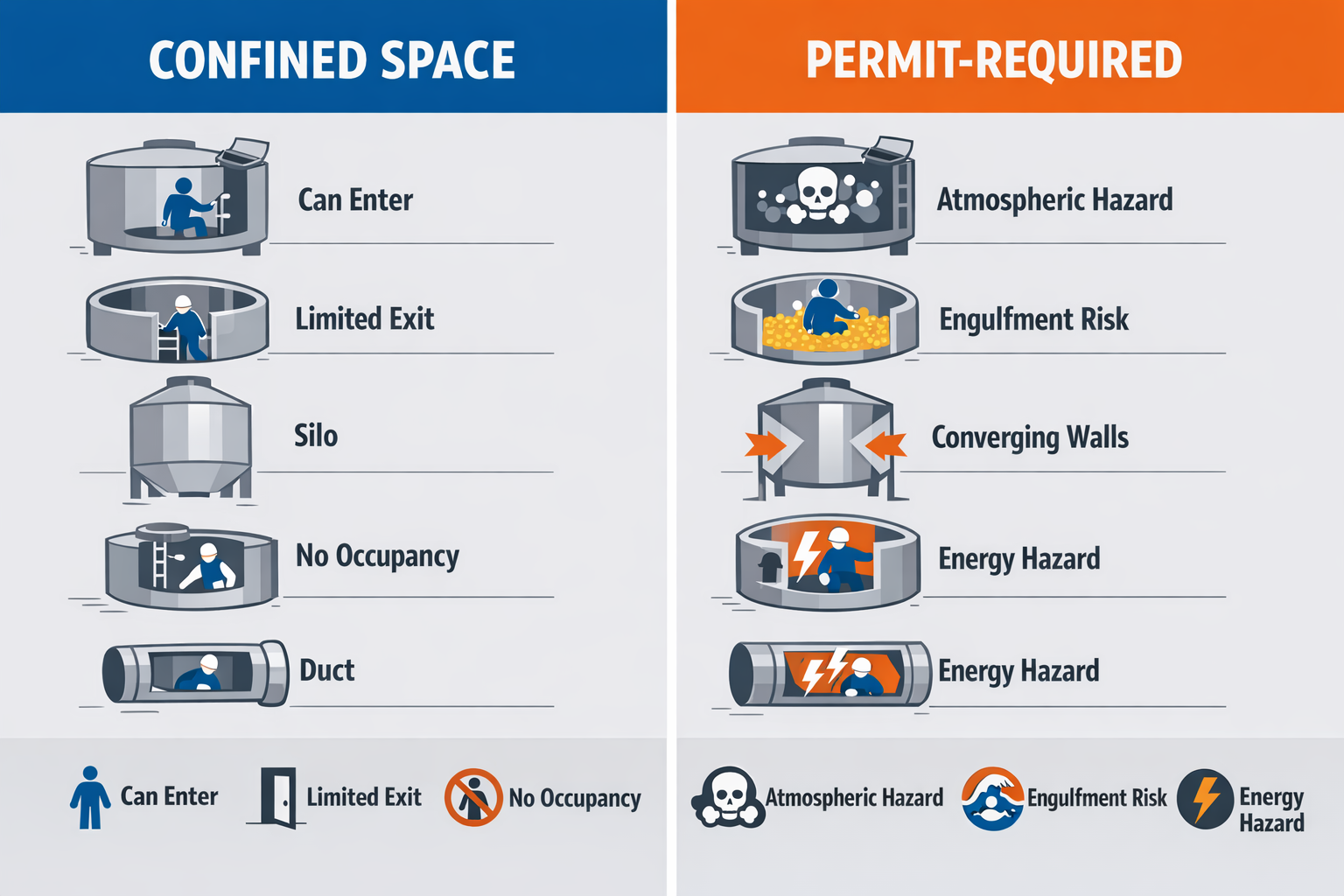
A clean valve pit with stable air, no energized equipment, and no flooding risk may be classified as a non-permit confined space after assessment. The same pit becomes permit-required if it can collect toxic vapors, lose oxygen, or fill unexpectedly from a process leak. In other words, the hazards associated with confined spaces are the deciding factor for classification.
Common Manufacturing Examples
A flour silo is a confined space because entry is restricted and the space is not designed for occupancy. It becomes permit-required when there is a risk of engulfment, combustible dust, or oxygen deficiency. A wastewater wet well may also require a permit because hydrogen sulfide and methane can accumulate even when the space appears idle.
A ribbon mixer in a food plant is another good example. If maintenance staff must enter for inspection, it is a confined space; if the agitator, residual product, or cleaning chemicals create serious hazards, it is permit-required. Similarly, ductwork large enough for personnel entry may remain non-permit during fabrication, but become permit-required in service if fumes, dust buildup, heat, or difficult rescue access are present.
Two spaces that look nearly identical can require different controls based on process conditions, residues, connected lines, and stored energy. A newly installed process vessel before commissioning may present few hazards beyond access constraints, while the same vessel in active production may contain vapors, product buildup, and isolation risks. That is why classification must be based on actual conditions at the time of entry, which is also the starting point for deciding how to safely enter a confined space.
The Main Hazards Associated With Confined Spaces on the Plant Floor
Consider a maintenance team entering a stainless process tank during a scheduled shutdown to replace an agitator seal and inspect internal welds. The tank has been drained, but it previously held solvent-based product and is connected to mixers, transfer lines, and a heated jacket. This is where hazard review becomes practical: the team is not just asking whether the space is dangerous, but which specific hazards associated with confined spaces could injure entrants before the job is complete.
Atmospheric Hazards Come First
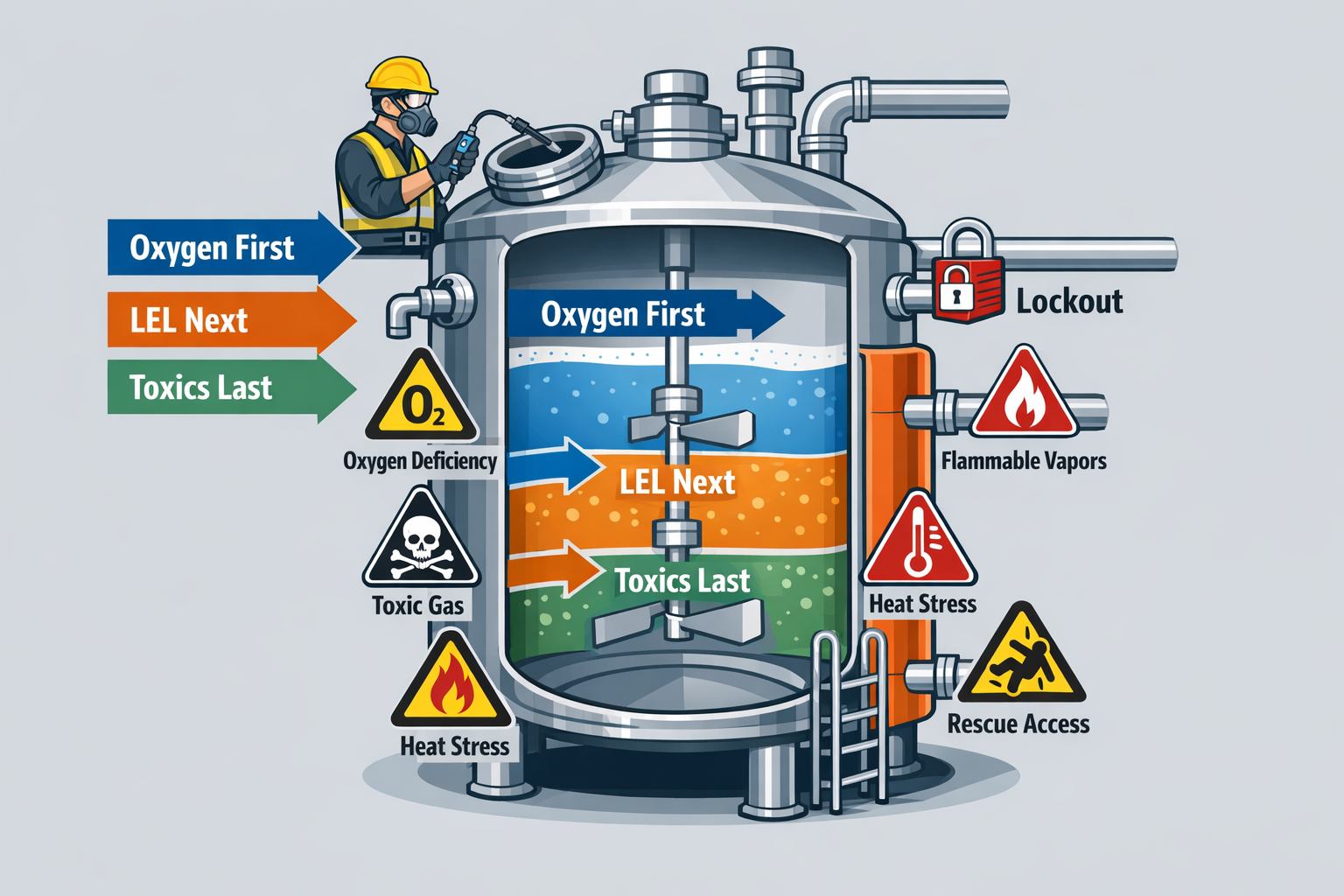
In most fatal confined space incidents, the atmosphere is the first threat to evaluate because it can disable a worker within seconds. Inside our process tank, residual vapors from the last batch, oxygen deficiency from purging, or toxic decomposition gases from cleaning chemicals can all create unacceptable conditions. Before anyone thinks about how to safely enter a confined space, the entry team should prioritize pre-entry testing for oxygen concentration, flammable gases or vapors, and toxic contaminants in that order, with readings taken at multiple levels because gases stratify.
Engulfment and Material Release Risks
Once atmospheric conditions are checked, the next question is whether anything can surround, bury, or trap the entrant. In a process tank, engulfment may come from incoming liquid, cleaning solution, foam, or even loose product residue released from internal surfaces during maintenance. If connected lines are not positively isolated, a mistaken valve operation upstream can refill the vessel while workers are inside.
This is why hazard evaluation has to include the full process, not just the physical interior of the tank. A vessel that appears empty can still expose entrants to sudden inflow from transfer pumps, automated dosing systems, or gravity-fed lines. For safety officers, this is often the point where a simple entry becomes clearly high-risk and demands tighter controls.
Mechanical, Electrical, and Thermal Energy
The agitator itself adds another layer of risk. Stored mechanical energy, unexpected startup, energized level sensors, and electrical circuits for lighting or instrumentation can all injure entrants if lockout steps are incomplete. In tanks with steam or hot-water jackets, residual heat can also raise internal temperatures enough to cause heat stress, burns, or reduced decision-making during longer tasks.
Slip, Fall, and Rescue Constraints
Finally, the physical layout affects both routine movement and emergency response. Our entrant may need to climb through a narrow manway, descend a vertical ladder, and work on a wet, curved surface with limited footing and poor visibility. A minor slip can become serious when rescue access is restricted, communication is interrupted, or the worker cannot be removed quickly without specialized equipment.
That is why confined space risk assessment must consider not only the hazard itself, but how fast help can reach the entrant. Many plant teams focus on entry controls and underestimate retrieval difficulty until a drill exposes the gap. The next step is to convert these hazards into a disciplined entry procedure.
OSHA Permit-Required Confined Space Requirements
Isolate Energy and Prepare the Space
Under OSHA permit-required confined space requirements, entry starts before anyone approaches the opening. In a process tank, that means shutting down and locking out agitators, pumps, steam lines, chemical feeds, and any connected conveyors or valves that could introduce energy or material during the job. Blanking, bleeding, disconnecting, or double-block-and-bleed isolation may be necessary if line contents could re-enter the space. The entry supervisor should confirm that isolation is complete and that the space has been cleaned or drained enough to support inspection and testing.
Follow the Full Entry Workflow Before Anyone Goes In
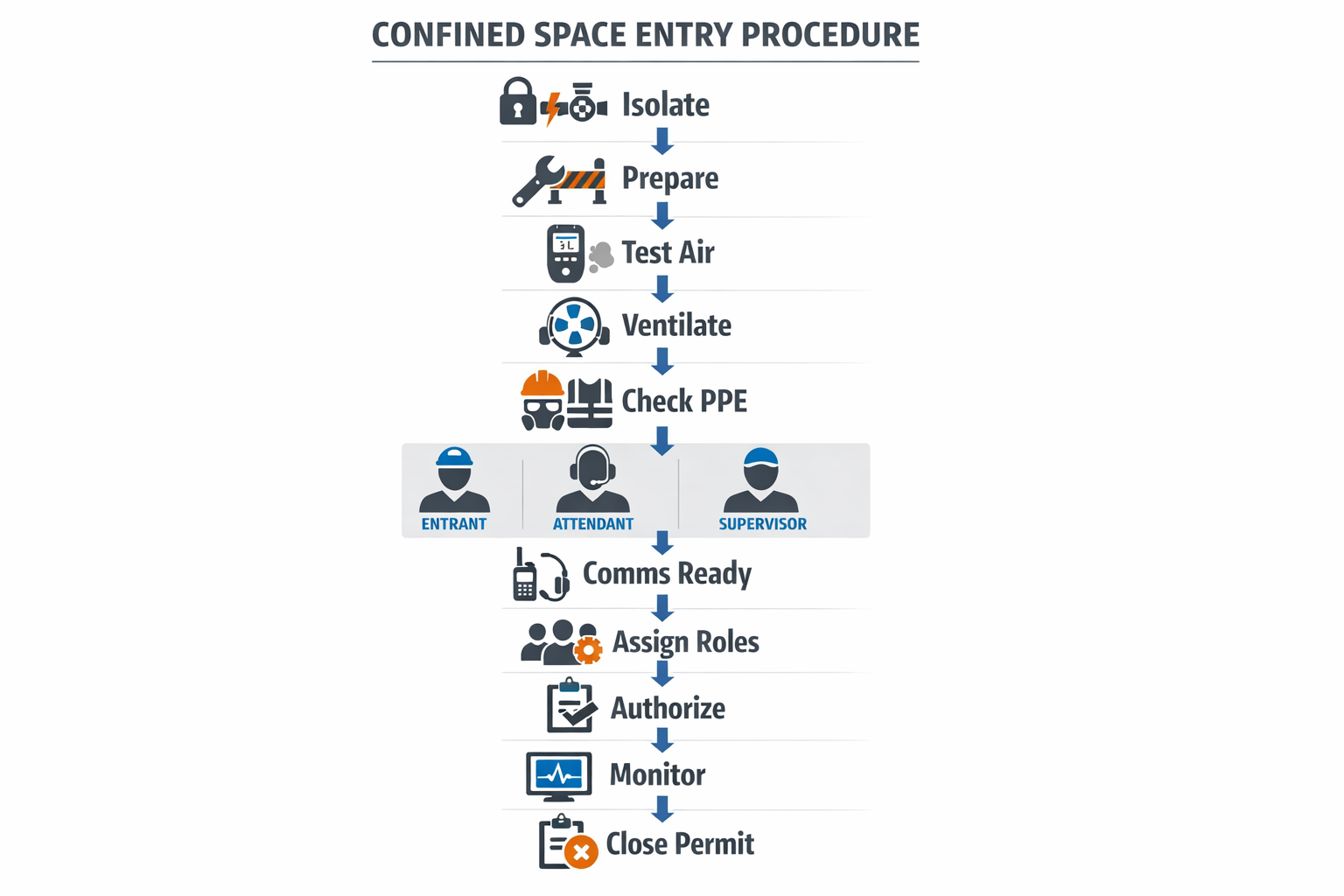
The sequence to enter a confined space is straightforward but non-negotiable: isolate energy, prepare the space, test the atmosphere, ventilate, verify equipment and communications, assign roles, authorize entry, monitor conditions, and document exit. This workflow matters because most fatal confined-space events involve either atmospheric change, uncontrolled energy, or an attempted rescue without proper controls. OSHA expects acceptable entry conditions to be established before entry, not corrected after a worker is already inside.
Test the Atmosphere and Establish Acceptable Entry Conditions
Pre-entry gas testing must be completed from outside the space where possible, using a calibrated instrument and a documented sequence. The normal order is oxygen first, then flammable gases or vapors, then toxic contaminants, because oxygen deficiency or enrichment can distort the seriousness of other readings. In the tank example, readings should be taken at multiple levels because stratification is common, especially after cleaning chemicals or solvent residue have been present. The permit should record exact readings, time of test, tester name, and the acceptable-entry limits used by your facility.
Ventilate, Verify PPE, and Confirm Communications
Forced-air ventilation should be started early enough to stabilize the atmosphere, not just provide a last-minute purge. If the work introduces fumes through welding, coating, or chemical cleaning, ventilation capacity must match the task, and continuous monitoring may be required even after acceptable pre-entry readings are achieved. PPE selection should reflect the actual job hazard assessment, including gloves, eye protection, retrieval equipment, fall protection, and respiratory protection where required. Before entry, the team should also verify radios, hand signals, or line-pull communication methods so the attendant can maintain reliable contact.
Assign Roles, Plan Rescue, and Authorize Entry
OSHA separates responsibilities for entrants, attendants, and the entry supervisor for a reason. Entrants perform the work and leave immediately if conditions change; attendants remain outside, track everyone inside, prevent unauthorized entry, and initiate emergency response; the supervisor verifies that all controls are in place and authorizes the permit. Rescue planning must be specific to the space, the access point, and the likely emergency, with retrieval systems ready where feasible. A permit is valid only when these roles, emergency contacts, and rescue arrangements are clearly documented.
Monitor Conditions and Close the Permit Correctly
Entry control does not end when the first worker steps inside. Conditions must be monitored throughout the job, especially if hot work, sludge disturbance, or residual chemicals could create new hazards associated with confined spaces. When the work is complete, exact entry and exit times, personnel count, final status, and any abnormal condition should be recorded before the permit is canceled. That closeout record is essential for both compliance and the next shutdown review.
How to Digitize Confined Space Entry With Jodoo
Where Manual Confined Space Permits Break Down
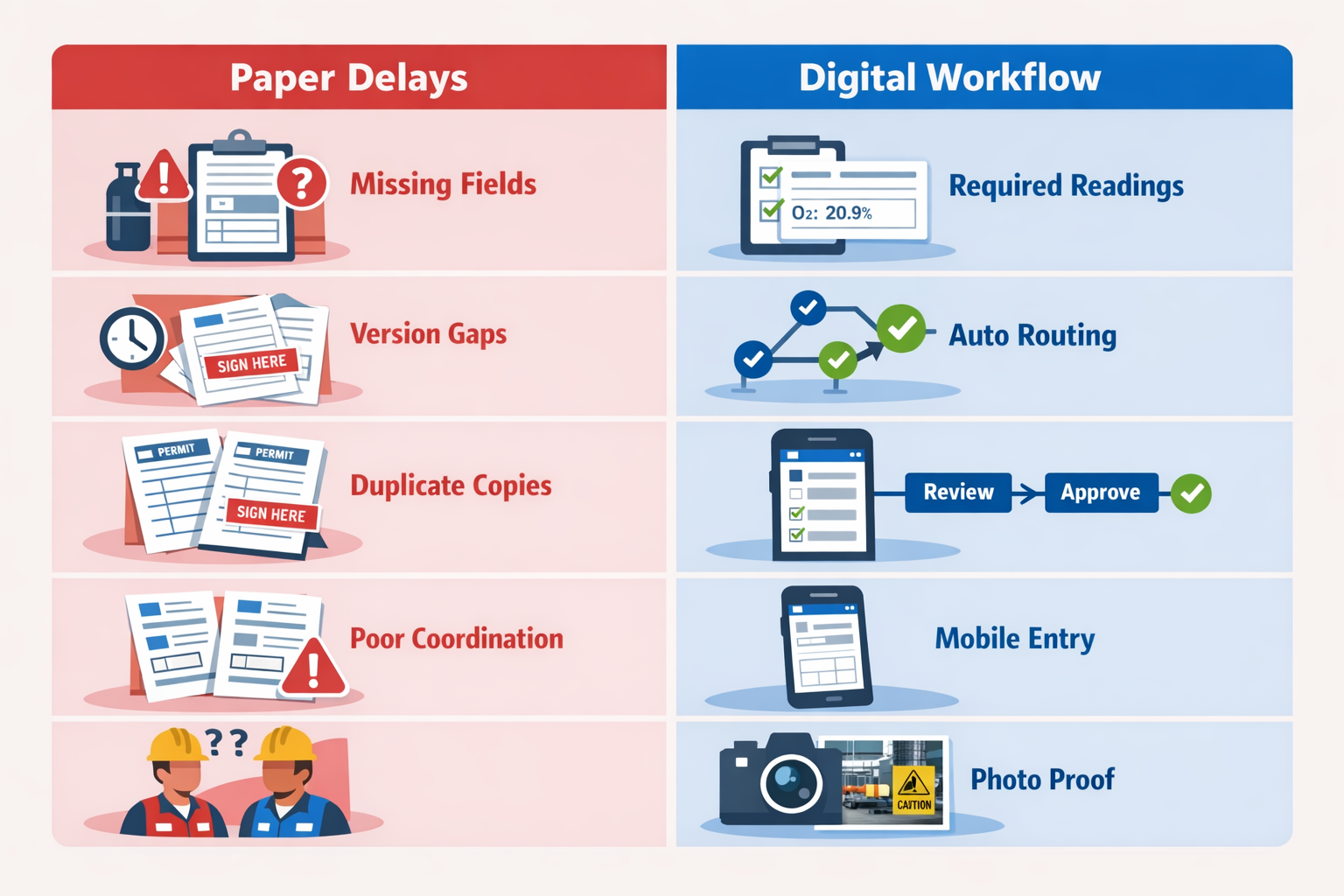
Most paper permit systems fail at the exact points where confined space control depends on timing and accuracy. A form may require oxygen, LEL, and toxic gas readings, but if a technician writes them down after entry or leaves one field blank, the record still circulates.
Approval delays are another common failure point, especially during shutdowns or weekend maintenance. A boiler inspection team may complete isolation and ventilation, then wait 30 minutes for a supervisor to physically sign a permit, even though the gas test window is already aging. If conditions change, the permit may still look valid on paper, which undermines the procedure for how to safely enter a confined space.
Paper also performs poorly when multiple parties are involved. In contractor work, the host employer, maintenance planner, area supervisor, and attendant may each hold a different version of the same permit package. That makes it harder to confirm training status, rescue contact details, and whether hazards associated with confined spaces were reviewed with everyone before entry.
How Jodoo Digitizes the Entry Workflow
A digital workflow closes those gaps by forcing the sequence instead of assuming people will follow it. With Jodoo, you can build a confined space entry form that requires pre-entry gas readings, lockout confirmation, PPE checks, rescue verification, and entrant names before the permit can move forward. Conditional rules can stop submission if a reading is outside acceptable-entry conditions or if a required attachment, such as a gas monitor photo, is missing.
The approval path can then be routed automatically by role. For example, a sanitation team entering a mixing vessel can submit from a mobile device, trigger supervisor review, and notify the attendant only after authorization is complete. That reduces lag, creates clear handoffs, and gives safety teams a cleaner control point than a paper stack moving between departments.
Digital records are especially useful when work crosses shift boundaries or plant locations. If a contractor enters a wastewater pit during a multi-day project, Jodoo can log who entered, who exited, when atmospheric rechecks were completed, and whether the permit was suspended or closed. Instead of chasing clipboards, the maintenance manager can see status in real time.
Role-based access also helps separate responsibilities without losing visibility. Contractors can be limited to their assigned permit forms, while internal supervisors and safety officers retain authority to review, approve, or revoke entries. That structure supports tighter contractor control without slowing plant work.
Searchable records matter during audits, incident reviews, and trend analysis. Jodoo stores timestamped approvals, comments, reading histories, signatures, and closure data in one place, so teams can retrieve a permit by area, date, contractor, or equipment ID in seconds. That is far more reliable than reconstructing events from paper forms filed by shift or building.
Dashboards add another layer of control by turning permit data into operational visibility. Safety teams can track open entries, overdue permit closures, missing gas-test attachments, or repeat entries into high-risk spaces across the site. Over time, that helps plants spot process weaknesses earlier and standardize confined space execution instead of only documenting it after the fact.
Conclusion: Standardize Confined Space Safety and Approvals With Jodoo
Confined space safety in manufacturing comes down to four basics done consistently: correct classification, clear hazard identification, disciplined permit-required entry control, and complete documentation. If any one of those breaks down, the risk rises fast—especially during maintenance shutdowns, cleaning work, or contractor entry. That is why strong confined space programs rely not just on written procedures, but on execution that holds up across shifts, departments, and sites.
For safety officers and maintenance managers, the real challenge is consistency under pressure. Gas readings must be captured before entry, isolations must be verified, roles must be assigned, and permits must be closed with accurate records. Paper systems often make that harder by slowing approvals, creating gaps in traceability, and leaving critical entry data buried in binders or scattered across spreadsheets.
Jodoo helps manufacturers turn confined space control into a mobile, auditable workflow. As a no-code lean manufacturing platform, it can support digital permit forms, approval routing, timestamped logs, role-based access, and searchable records without heavy IT development. You can start a free trial or book a demo to see how it fits your plant.