Introduction: What a Manufacturing Execution System Really Solves on the Factory Floor
A production line can miss its hourly target, consume extra material, and trigger a late shipment before management even sees the problem. That is why interest in a manufacturing execution system keeps rising, especially among mid-size manufacturers that can no longer rely on paper travelers, whiteboards, and disconnected spreadsheets. In many factories, the gap is not ERP-level planning but real-time shop floor execution: knowing what is running, what is delayed, which batch was used, and where quality issues started.
Imagine a production manager at an automotive parts plant who has to explain why OEE dropped on the night shift, while maintenance logs sit in one file and quality checks in another. Or think about an electronics assembler trying to trace a component issue across multiple work orders after a customer complaint. These are exactly the types of factory-floor problems MES software is designed to solve: production visibility, traceability, work-in-progress control, and faster response to exceptions.
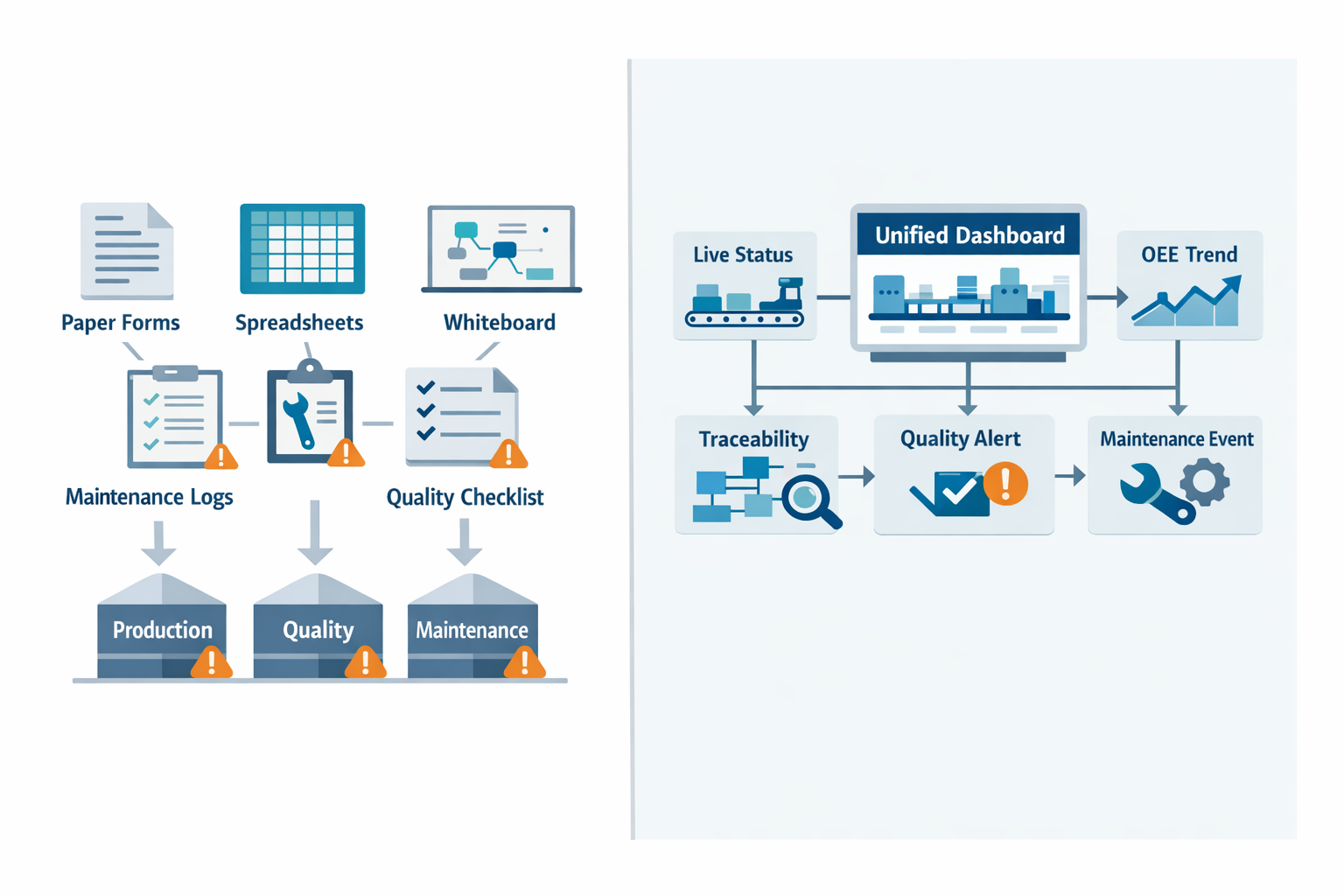
But here is the real question: do you need a full MES, or would a faster, more flexible digital operations system solve the same bottlenecks with less cost and complexity? In this article, we will break down what MES actually does, where it fits, where it becomes too heavy, and what alternatives mid-size manufacturers should consider.
The Operational Pain Points That Push Manufacturers to Consider MES Software
Manufacturers rarely start looking for a manufacturing execution system because they want new software for its own sake. The search usually starts when daily operations become too dependent on manual coordination, and small gaps begin to affect output, delivery reliability, and traceability. At that point, leaders are not just comparing tools; they are asking whether their current mix of spreadsheets, whiteboards, and paper records can still support growth. That is often the moment when MES software, a broader production management system, or a more flexible digitization approach enters the discussion.
Spreadsheet-Driven Scheduling Starts Creating Daily Firefighting
In many mid-sized plants, production scheduling still lives in Excel, shared drives, and supervisor phone calls. That may work when the product mix is stable, but it breaks down once you add frequent changeovers, rush orders, or shifting labor availability. A planner updates one version of the schedule, a line leader works from another, and maintenance is not informed until a bottleneck has already formed.
Imagine a production manager at a garments factory running short lead-time export orders across multiple sewing lines. If one fabric batch arrives late or one line falls behind target, the impact can ripple through cutting, sewing, finishing, and packing within hours. Without real-time execution data, rescheduling becomes reactive, and the plant loses capacity not because machines are idle all day, but because decisions are made too late to protect throughput.
Paper Travelers Make Traceability Slow and Unreliable
Paper travelers are still common in batch and discrete manufacturing because they seem simple and familiar. The problem is that handwritten records are hard to verify, easy to misplace, and difficult to analyze at scale. When a supervisor needs to trace who processed a lot, when a hold was released, or where a deviation started, paper turns a 10-minute check into a half-day investigation.
This becomes critical in food manufacturing, where lot traceability and process discipline directly affect compliance and recall readiness. If a sauce producer needs to track ingredient lots, mixing times, temperature checks, and packaging runs, paper logs create too many blind spots between receiving, production, QA, and warehouse teams. One missing sheet or unreadable entry can delay root-cause analysis and increase the financial impact of a containment action.
Weak WIP Visibility Hides Bottlenecks Until Orders Slip
A common trigger for evaluating manufacturing execution system features is poor visibility into work-in-progress. Many plants know what was planned and what was shipped, but they do not have a reliable live view of what is actually happening between those two points. As a result, bottlenecks stay hidden until queue times increase, overtime rises, or customer delivery dates are already at risk.
In electronics assembly, this problem shows up when boards pile up between SMT, manual insertion, test, and final packout without a clear status signal. One team believes material is available, another is waiting for rework clearance, and planners only see the problem at end-of-shift reporting. That delay reduces responsiveness, especially in high-mix, low-volume environments where a few stalled batches can distort the entire production plan.
Inconsistent Quality Checks Create Variation and Rework
When quality checks depend on printed forms, verbal instructions, or operator memory, consistency starts to vary by shift, line, or supervisor. Two operators may inspect the same product using slightly different criteria, and defects may only be escalated after several hours of production. Over time, that inconsistency drives rework, scrap, customer complaints, and disputes over whether the issue was process-related or inspection-related.
For operations leaders, this is where the conversation often shifts from simple digitization to more structured control. They begin looking at manufacturing execution system features such as in-process inspections, digital checklists, defect logging, escalation workflows, and lot-level traceability. Even if the company is still early in its MES implementation thinking, the underlying pain is operational: too much quality variation caused by weak execution discipline on the floor.
Delayed Reporting Slows Decisions Across the Plant
Many factories still rely on end-of-shift or next-day reporting for production, downtime, and quality data. That means by the time management sees the numbers, the chance to correct the issue during the shift is already gone. According to industry analyses from McKinsey and Deloitte, manufacturers that improve real-time operational visibility can significantly reduce response time to disruptions and improve overall equipment effectiveness, because teams act on problems earlier instead of reporting them after the loss is locked in.
This matters most when output is sensitive to timing. In a beverage plant, for example, a filler slowdown, label issue, or packaging material shortage can affect multiple downstream activities on the same day. If those disruptions are only summarized after the shift closes, supervisors cannot rebalance labor, maintenance cannot prioritize the right intervention, and supply chain teams do not get an accurate picture of what will actually ship.
Poor Cross-Team Coordination Creates Execution Gaps
Some of the strongest demand for a manufacturing execution system comes from coordination failures rather than from one dramatic production problem. Planning, production, quality, maintenance, and warehouse teams may each be doing their job reasonably well, but they operate from separate records and timelines. That creates constant friction around priorities, approvals, handoffs, and accountability.
This is also where the internal discussion often expands into MES vs ERP. ERP systems are strong at planning, purchasing, finance, and inventory transactions, but they typically do not manage the minute-by-minute execution details on the shop floor. When leaders say, “We already have ERP, so why do we still lack visibility?” what they are really seeing is the gap between business planning data and live production control.
When These Pain Points Start Affecting Business Performance
The real issue is not that a plant uses paper, spreadsheets, or manual updates. The issue is that these tools stop scaling once complexity increases across SKUs, shifts, compliance requirements, and customer expectations. At that stage, missed handoffs turn into longer lead times, weak traceability turns into slower containment, and delayed data turns into avoidable margin loss.
That is why manufacturers begin exploring MES software or other digital alternatives before they commit to full MES implementation. They are trying to restore control over execution, improve accountability by shift and line, and make faster decisions with fewer blind spots. If your plant is already feeling those pressures, the next question is not whether the pain is real, but whether a traditional MES is the only way to solve it.
Manufacturing Execution System Features: What You Actually Need vs. What Looks Good in a Demo
When teams evaluate a manufacturing execution system, vendors often lead with long feature lists, polished dashboards, and advanced scheduling visuals. The better question is simpler: which capabilities will improve execution on your shop floor within the next 6 to 12 months? For most mid-size manufacturers, the right manufacturing execution system features are the ones that tighten control between planning and production, not the ones that look impressive in a conference-room demo.
A practical way to evaluate MES software is to separate core execution needs from higher-level optimization features. If you are still deciding between a full MES and a more flexible production management system, this distinction matters even more. It helps you avoid buying enterprise-scale functionality before your plant has standardized the basics that actually drive throughput, traceability, and quality.
Must-Have Features for Day-to-Day Production Control
These are the features that directly support shift-level execution. If your plant cannot reliably capture, route, verify, and report production data in real time, these should come before advanced AI, simulation, or multi-site orchestration.
Work Order Tracking and Real-Time Production Status
At a minimum, your system should show what is running, what is waiting, what is completed, and what is blocked. This includes work order release, operator updates, quantity reporting, scrap logging, and status by machine, line, or shift. In many factories, just replacing whiteboards and spreadsheet updates with live work order tracking can cut reporting delays from hours to minutes.
Imagine a production manager at an electronics assembly plant who needs to know whether Line 3 has completed a batch of PCB assemblies before the next test stage starts. With strong work order tracking, the supervisor can see output counts, rework quantities, and line status on one screen instead of chasing updates through calls or paper tickets. That is one of the most practical manufacturing execution system features because it supports faster decisions without adding unnecessary complexity.
Routing Control and Process Enforcement
A good manufacturing execution system should enforce the correct production sequence, not just record that work happened. Routing control ensures each job goes through the required operations, work centers, inspections, or sign-offs before moving forward. This is especially important in regulated or high-mix environments where skipping one step can create downstream quality or compliance issues.
For example, in a food packaging plant, a batch may need mixing, filling, metal detection, seal inspection, and pallet release in a fixed sequence. If the system allows operators to confirm pallet release before metal detection is completed, the software is not really controlling execution. This is where MES software differs from a basic reporting tool: it should actively guide and restrict process flow when needed.
Quality Checkpoints and In-Process Verification
Quality should be built into the workflow, not reviewed after the fact. A usable system should let you trigger checks at defined stages, capture measurements, require sign-off for deviations, and hold lots or batches when results fall outside tolerance. According to industry studies, the cost of poor quality can reach 15% to 20% of sales revenue in some manufacturing environments, so in-process control has a direct financial impact.
In practice, this could mean an operator on a beverage filling line cannot close a production order until fill-volume and cap-torque checks are recorded. If a reading fails, the system should trigger escalation or containment automatically. During MES implementation, this kind of embedded quality logic usually delivers more value than advanced analytics that only a few users will review.
Traceability and Genealogy
If you produce anything that may require recall analysis, lot isolation, or customer complaint investigation, traceability is essential. Your system should connect raw materials, batch numbers, machine or line records, operator activity, inspection data, and finished goods output. The deeper your traceability, the faster your team can answer a customer or auditor with confidence.
A strong example is a medical electronics manufacturer that needs to trace a finished control board back to the solder paste lot, operator ID, test result, and rework history. Without that link, one failed shipment can turn into a broad and expensive investigation. Traceability is often sold as a premium feature, but for many sectors it belongs firmly in the must-have category.
Downtime Logging and Reason Codes
Most plants do not need advanced machine learning to improve OEE in the first phase. They need accurate downtime capture with standard reason codes, timestamps, duration, and basic accountability by line or asset. If your maintenance and production teams cannot agree on why a line stopped yesterday, your analytics layer will not solve the issue.
A garment factory, for instance, may want to separate stoppages caused by thread breakage, changeover delay, missing trims, or operator absence. Once those events are captured consistently, supervisors can identify repeat losses and act on them. This is a classic example of where a focused production management system can sometimes cover the need faster than a heavy MES rollout.
Features That Matter More Than They Look in a Demo
Some capabilities do not look dramatic during a software presentation, but they often determine whether the system will actually be used. These features support adoption, consistency, and operational discipline.
Digital SOPs and Operator Guidance
Digital SOPs are easy to underestimate because they are less flashy than scheduling boards or AI forecasts. But when instructions, setup steps, safety checks, and quality criteria are available at the workstation, execution becomes more consistent across shifts and sites. This is especially useful in plants with frequent product changeovers or variable staffing levels.
Imagine a snack food plant launching seasonal packaging formats every few weeks. If the operator can open the correct setup checklist, photo-based standard, and cleaning verification form directly from the work order, startup becomes more controlled and less dependent on tribal knowledge. For many manufacturers, this is one of the highest-return manufacturing execution systems because it supports training, compliance, and repeatability at the same time.
Dashboards That Show Exceptions, Not Just Data
Dashboards matter, but only if they help teams act. A useful MES dashboard should surface exceptions such as orders at risk, yield below target, downtime spikes, and quality holds by shift or line. If the dashboard is only a wall of charts that executives review once a week, it may look good in a demo but add little operational value.
This is also where the discussion of MES vs ERP becomes important. ERP can tell you what was planned, shipped, or costed, but MES should tell you what is happening now on the floor. The best reporting setup connects both layers: ERP for business planning, and MES or a flexible execution platform for real-time production visibility.
Enterprise-Level Extras: Valuable, but Not Always First Priority
These features can be valuable, especially in larger or more mature operations, but they are often over-prioritized during buying decisions. They should come after the plant has stable data capture, process control, and reporting discipline.
Advanced Analytics, Prediction, and Multi-Site Benchmarking
Predictive analytics, digital twins, and multi-plant comparisons can generate value, but only when your base data is reliable. If operators are still entering output late or downtime codes are inconsistent, the insights will be weak, no matter how advanced the analytics engine looks. Many failed MES implementation projects start by aiming too high on optimization before execution data is standardized.
For a regional manufacturer with three plants, benchmarking changeover time across sites may eventually be useful. But first, each site needs to define the changeover start and end in the same way. Otherwise, the comparison will create noise rather than improvement.
Complex Scheduling and Automated Dispatching
Detailed finite scheduling and auto-dispatching can help in plants with high variability, shared resources, and tight sequencing rules. But many mid-size manufacturers already manage planning in ERP or APS tools, and what they really need on the floor is clearer execution and feedback. That is why MES vs ERP should be framed as complementary, not interchangeable.
In other words, do not pay for highly sophisticated dispatch logic if your supervisors still rely on phone calls to confirm job completion. A system should strengthen the connection between plan and execution before adding another planning layer. For many companies, a configurable no-code platform can handle this middle layer more efficiently than a full traditional MES.
How to Evaluate Features Without Overbuying
A simple test is to ask whether each feature supports one of three outcomes: faster execution, stronger control, or better decisions. If it does not clearly affect one of those areas, it may be an extra rather than a requirement. This is a more practical way to compare MES software than using vendor scorecards alone.
You should also map each feature to a real workflow in your plant. For example: how is first-piece inspection approved, how is a blocked batch handled, how is downtime categorized, and who sees the exception in real time? If a vendor cannot show how the feature works in those specific scenarios, it may be more marketing than operational capability.
For manufacturers that are not ready for a full traditional manufacturing execution system, a configurable platform like Jodoo can cover many high-value execution needs first. You can build digital work orders, quality checks, downtime logs, SOP workflows, traceability records, and live dashboards without waiting for a long custom development cycle. That gives your team a practical path to improve execution now, while keeping future system architecture flexible.
MES vs ERP vs Lightweight Production Management System Options
MES vs ERP: Where Planning Ends and Execution Begins
If you are comparing MES vs ERP, the simplest distinction is this: ERP manages the business, while a manufacturing execution system manages what happens on the shop floor minute by minute. ERP is strong at planning, purchasing, finance, inventory valuation, and high-level production orders. MES software sits closer to production and tracks execution in real time, including machine status, labor activity, quality checkpoints, WIP movement, and traceability by lot, batch, or serial number.
In practice, ERP tells the factory what should be made, when, and with which materials. MES tells the factory what is actually happening right now on Line 3, which operator signed off on the setup, which batch failed inspection, and how many units are still in rework. That is why many manufacturers discover that ERP alone gives solid transaction control, but limited visibility into live execution.
Imagine a production director at an electronics assembly plant running SMT lines and final testing cells. The ERP can release work orders and update finished goods, but it usually does not capture feeder changes, first-pass yield by station, downtime reasons by shift, or operator-level defect trends without heavy customization. That gap is where core manufacturing execution system features become valuable.
What ERP Usually Handles Well
ERP is often the right system for cross-functional control across procurement, finance, warehouse operations, and master production planning. For a mid-size food manufacturer, ERP can handle recipe BOMs, supplier purchasing, inventory balances, sales orders, and monthly costing with consistency across sites. It also supports standard governance that finance and leadership teams need, especially when multiple plants must report through one system.
This matters because not every operational issue requires MES software. If your main priority is standardizing planning, material management, and financial reporting across the business, ERP should remain the system of record. The mistake is expecting ERP to become a high-speed execution layer without considering the effort, cost, and maintenance burden of deep custom development.
Where a Traditional Manufacturing Execution System Makes Sense
A traditional manufacturing execution system is justified when execution complexity is high and real-time control has a direct impact on output, compliance, or traceability. This is common in regulated food production, electronics, medical device assembly, and high-mix industrial manufacturing, where lot genealogy, in-process checks, and digital work instructions must be tightly controlled. In these environments, delayed or incomplete floor data can create scrap, recall risk, or customer non-conformance.
For example, a packaged beverage plant running multiple SKUs across frequent changeovers may need automatic batch traceability, quality hold workflows, line clearance checks, and integration with weighing or labeling equipment. In that case, robust MES implementation can be justified because execution data has to be captured in sequence and linked to compliance records. If one labeling issue affects a batch, the plant needs immediate containment and exact traceability within minutes, not manual reconstruction later.
Industry analysts have long noted that MES projects can require substantial time and budget, especially when integration and validation needs are high. That is why executives should not ask only, “Do we need MES?” but also, “Do we need full MES depth in every area of the plant?” In many mid-size factories, the answer is more selective.
Why ERP Customization Is Not Always Enough
Many manufacturers first try to bridge the gap by customizing ERP screens, adding transactions, or building reports. That can work for a few stable workflows, but execution processes change faster than core ERP structures usually can. Shift handovers, in-line inspections, downtime coding, digital SOP signoff, and maintenance-triggered production holds often evolve continuously as operations teams improve processes.
Consider a garment factory with multiple sewing lines and finishing stations. The ERP may track order status and inventory consumption, but line balancing, hourly output by style, quality defects by operator group, and rework approval flow typically need much more flexible tools. Once every small execution change requires an ERP consultant ticket, improvement slows down, and plant teams start maintaining workarounds outside the system again.
The Other Options: Spreadsheets, Point Solutions, and Lightweight Systems
Between full MES software and standard ERP, there is a broad middle ground. Many plants rely on spreadsheets, standalone quality apps, machine monitoring tools, barcode systems, or whiteboard-based scheduling. These can solve specific tasks quickly, but they rarely create a connected execution layer across production, quality, maintenance, and reporting.
A production management system in a lightweight, modular form often fits manufacturers that need faster digitization without a full-scale MES rollout. Instead of replacing ERP, it sits around the execution process: production reporting, work order tracking, in-process quality checks, downtime logging, shift handover, digital forms, approvals, and dashboards. This approach is especially useful when your factory needs flexibility more than deep automation at every machine interface.
When a Lightweight Production Management System Is the Smarter Fit
A lightweight production management system is often the better choice when your plant has clear execution gaps but does not need the full breadth of a traditional manufacturing execution system. This applies to many mid-size manufacturers that want better visibility and control, yet need to move in phases rather than through a long MES implementation. The goal is not to replicate every advanced MES capability, but to digitize the workflows that most affect throughput, quality, response time, and accountability.
Imagine an operations manager at a specialty snack factory that runs semi-automated lines. The plant may need digital startup checks, batch records, packaging quality verification, downtime capture, and live OEE-style dashboards, but not a large MES deployment across every asset and interface on day one. In that case, a modular system built with no-code tools can deliver usable results faster, while still integrating with ERP for orders and inventory transactions.
This is where platforms like Jodoo can be a practical fit. Instead of forcing the plant into rigid MES software, Jodoo lets teams build the exact apps they need for production reporting, quality inspections, maintenance requests, exception workflows, and real-time dashboards on top of existing systems. For manufacturers with evolving processes, that flexibility can be more valuable than buying a larger system and spending months trying to adapt it.
A Simple Decision Guide for Executives
Choose ERP-first if your biggest need is enterprise planning, inventory control, purchasing, and financial governance across sites. Choose a traditional manufacturing execution system if you need deep real-time execution control, machine-level data collection, strict genealogy, and highly structured compliance workflows. Choose a lightweight production management system if you need connected shop-floor visibility and standardized execution workflows, but want to avoid the cost, rigidity, and timeline of a full MES implementation.
For many mid-size manufacturers, the best architecture is not ERP oder MES in isolation. It is an ERP for planning and transactions, plus a flexible execution layer that digitizes the work between order release and finished output. That is often where the real comparison in MES vs ERP should end: not with which system is “better,” but with which combination best fits your plant’s operational complexity.
MES Implementation and Vendor Evaluation: How to Choose Without Overbuying
Choosing a manufacturing execution system is not just about features on a demo screen. For mid-size manufacturers, the bigger question is whether a full MES software rollout is the right first move, or whether a phased digital approach can deliver results faster with less disruption. That matters because implementation timelines for traditional MES projects often stretch from 6 to 18 months, especially when integration, validation, and shop-floor change management are involved. If your plant needs better traceability, faster response to production deviations, or more consistent reporting this quarter, the decision framework has to go beyond brand names.
Start With Scope, Not Software
A common mistake is evaluating vendors before defining the operational scope. You should first decide whether you need plant-wide control over scheduling, quality, genealogy, labor, maintenance, and performance monitoring, or whether you only need a targeted production management system for a few critical workflows. In many mid-size plants, only 20% to 30% of manufacturing execution system features are used heavily in the first year, while the rest add cost, training burden, and implementation risk. That is why the best buying process starts with use cases, not license bundles.
Imagine a production manager at an electronics assembly plant who wants real-time visibility into line output, first-pass yield, and component traceability. A full MES implementation may make sense if the plant runs a high product mix, has strict customer compliance, and serialized production across multiple lines. But if the immediate goal is digitizing work orders, defect capture, and operator reporting, a configurable no-code layer can often go live in weeks and integrate with ERP later. In that situation, speed-to-value matters more than buying the broadest system on the market.
Evaluate Deployment Time Realistically
Vendors often present ideal rollout timelines based on standard templates and a limited scope. In reality, deployment time depends on how many machines, production steps, approval rules, user roles, and data handoffs need to be mapped. A food processing company, for example, may need lot traceability, QC release checks, sanitation records, and shift reporting before any dashboard is useful. Each of those adds design and testing effort, even before operator training begins.
Ask vendors for a phased deployment plan with milestones at 30, 60, and 90 days, not just a final go-live date. A strong proposal should show what can be delivered first, what requires ERP or machine integration, and what depends on master data cleanup. This helps you compare a traditional MES software rollout with a lighter, modular approach that supports immediate execution needs. If a vendor cannot clearly separate phase-one value from long-term expansion, you may be looking at an overbuilt project.
Look Closely at Integration and the MES vs ERP Boundary
Many buying teams get stuck because they expect MES to solve planning, execution, inventory, and reporting all at once. In practice, MES vs ERP should be assessed as a division of roles: ERP manages business planning, orders, costing, and financial records, while MES manages production execution, work-in-progress visibility, shop-floor data capture, and process control. The problem is that many vendors blur this line, which can lead to duplicate data entry or unclear system ownership. That creates extra work for both operations and IT.
When comparing options, ask exactly how the system will exchange data with ERP, maintenance tools, quality systems, and machine data sources. A useful vendor answer should specify whether integrations are available through APIs, middleware, flat files, or custom development, and how exceptions are handled when data does not sync. For a beverage bottling plant, for instance, the ability to pull production orders from ERP and push actual output, downtime, and rejected quantity back automatically may matter more than advanced scheduling logic. Integration quality often determines whether the system becomes a daily operating tool or just another reporting layer.
Assess Configurability vs Custom Development
Mid-size manufacturers rarely run textbook processes. Product routing changes, QC checks evolve, customer labeling rules shift, and approval logic often differs by plant or product family. That is why you should separate true configurability from expensive customization. If every form, rule, or dashboard change requires vendor services or internal developers, your system may become harder to maintain over time.
This is where many companies should compare traditional MES implementation with a configurable platform approach. A no-code system such as Jodoo can help teams build production reporting, inspection forms, deviation workflows, maintenance requests, and real-time dashboards around the processes they already run, without waiting for a full MES replacement project. For plants with stable core systems but changing operational workflows, that flexibility can reduce both rollout time and dependence on specialized MES consultants. The result is not “MES lite,” but a more practical fit for plants that need control over execution without locking themselves into a large, inflexible build.
Measure IT Dependency and Change Management Together
A system that looks technically strong can still fail if plant supervisors and operators do not adopt it consistently. That is why IT dependency should be evaluated alongside change management, not separately. If your IT team must manage every workflow update, user permission change, label format, or report modification, business users will wait in line for basic improvements. In a fast-moving plant, that slows down adoption and weakens trust in the system.
Ask vendors who can change forms, workflows, and dashboards after go-live. In a garments factory running short production cycles and frequent style changes, supervisors may need to adjust line tracking fields or defect categories quickly as new products launch. A system that allows operations teams to handle controlled changes themselves usually scales better than one that requires formal development work for every adjustment. This is especially important in regional manufacturing groups where one central IT team supports multiple plants.
Compare Total Cost of Ownership, Not Just License Price
The real cost of a manufacturing execution system includes more than subscription or perpetual license fees. You also need to account for implementation services, integrations, training, validation, support, upgrade work, internal project staffing, and the cost of future process changes. Industry analysts often note that software licenses can represent only a fraction of total project cost, with services and internal labor making up a substantial share over three to five years. That is why a lower entry price does not always mean lower total cost of ownership.
Build a side-by-side comparison using a three-year TCO model. Include software cost, external implementation, annual support, internal IT hours, operations training time, and the likely cost of adding new plants or workflows later. For many mid-size manufacturers, the key question is not whether a full MES software platform is valuable, but whether the value arrives fast enough to justify the upfront complexity. A phased model often wins because it spreads cost across proven milestones rather than forcing a large commitment before operational benefits are visible.
Use a Practical Vendor Scorecard
To avoid overbuying, score each option against criteria that reflect your plant reality rather than generic market checklists. Your scorecard should include deployment speed, integration effort, configurability, user adoption risk, IT dependency, compliance fit, scalability, and three-year TCO. Weight each factor based on business impact; for example, a regulated food manufacturer may weight traceability and auditability more heavily, while a contract electronics producer may prioritize product change flexibility and lot-level visibility. This makes vendor discussions more objective and easier to align across operations, IT, and leadership.
A useful final test is simple: what can this system deliver in the first 90 days, and who will be able to improve it after go-live? If the answer is vague, highly technical, or dependent on a long consulting cycle, the fit may be poor for a mid-size manufacturer. If the answer is clear, phased, and tied to measurable execution gains, you are closer to a system that supports growth without overbuying. In many cases, that means choosing not between MES and no MES, but between a heavy rollout and a smarter path to digital execution.
Conclusion: Why Jodoo Can Be the Better Alternative to a Traditional Manufacturing Execution System
If your factory needs strict machine-level control, deep PLC integration, and highly specialized compliance features, a full manufacturing execution system may still be the right fit. But for many mid-size manufacturers, the real need is not a massive MES rollout. It is faster visibility, better process control, and cleaner execution on the shop floor without a long implementation cycle or heavy consulting costs.
That is where Jodoo can be a better alternative. As a no-code lean manufacturing platform, Jodoo helps you digitize the most valuable 80% of manufacturing execution system use cases: production tracking, work order updates, quality inspections, approval workflows, issue escalation, and traceability records. Imagine a production manager at a mid-size electronics plant who is still chasing paper quality checklists and Excel-based work order updates across shifts. With Jodoo, that team can replace manual tracking with mobile forms, automated workflows, and real-time dashboards in a few weeks, not months.
For operations leaders, that means less paperwork, faster response to problems, and better data for daily decisions. If you want faster manufacturing digitization without the weight of a traditional MES, explore Jodoo, Kostenlose Testversion starten, oder Demo buchen today.