Telusuri berdasarkan kategori

Introduction: Why Industrial Hygiene Matters in Manufacturing
Many manufacturing health risks do not look urgent until the damage is already done. The World Health Organization estimates that millions of workers worldwide are exposed to hazardous conditions that contribute to occupational disease each year, and in factories, these exposures often build quietly through repeated contact with dust, solvents, noise, heat, or contaminated water systems. That is why industrial hygiene matters: it is the discipline of identifying, assessing, and controlling workplace health hazards before they lead to illness, lost time, compliance issues, or production disruption.
Untuk EHS managers and industrial hygienists, industrial hygiene is not just about sampling air or checking exposure limits. It is a practical system for protecting workers from health effects that develop over weeks, months, or years, especially in chemical and general manufacturing environments where the hazard is not always visible.
This article explains industrial hygiene through four core principles: anticipate, recognize, evaluate, and control. We will look at what these principles mean on the plant floor, the main hazard categories in manufacturing, and how to move from exposure monitoring to corrective action. The goal is simple: build a more systematic way to manage health risks with the same discipline you already apply to safety.
What Industrial Hygiene Means on the Plant Floor
The Role of an Industrial Hygienist in Manufacturing
On the plant floor, the role of an industrial hygienist is to identify where routine work may create harmful exposure before illness shows up in medical records, absenteeism, or turnover. That makes industrial hygiene different from broader safety management, which often centers on immediate events such as slips, machine guarding failures, or forklift collisions. If you ask, “What is industrial hygiene?” in a manufacturing setting, the practical answer is this: it is the discipline of managing worker exposure to chemical, physical, and biological hazards over time.
Consider one blended chemicals plant that handles solvent-based mixing, powder charging, and on-site wastewater treatment. The industrial hygienist does not look at these areas as separate compliance tasks. Instead, they trace how materials move, how operators interact with them, how long exposures last, and where controls may degrade across shifts, maintenance cycles, and seasonal conditions. That plant-floor view is what turns industrial hygiene from a paperwork exercise into an operational function.
From Anticipation to Control: The Four Industrial Hygiene Principles
The work typically follows four linked principles: anticipate, recognize, evaluate, and control. Anticipation means predicting exposure before startup, changeover, or capacity expansion creates a problem. Recognition means spotting the specific hazard source, route of exposure, and affected job tasks; evaluation means determining whether exposure is significant through observation and sampling; control means reducing risk through practical interventions. Together, these steps explain how to control workplace health hazards without guessing.
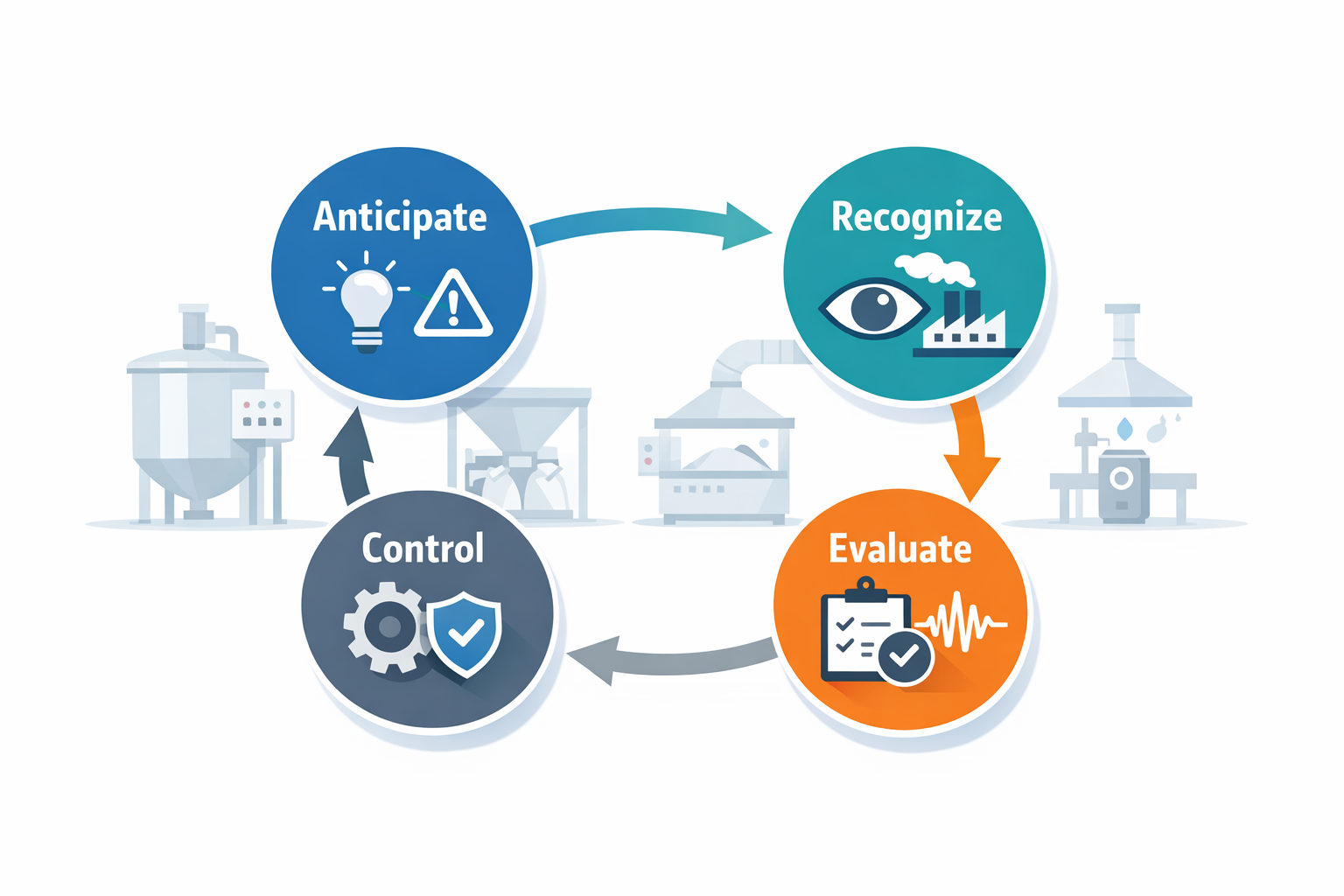
In our example plant, anticipation starts before a new resin line is commissioned. The hygienist reviews solvent flash-off during mixing, dust release during powder bag dumping, and aerosol generation around wastewater aeration tanks and cooling loops. None of these may cause an injury report on day one, but all can create chronic respiratory, dermal, or systemic health risks if the process scales faster than the controls.
Anticipating Exposure During Process and Layout Changes
Anticipation is strongest when industrial hygiene is tied into engineering and production decisions early. A line that increases batch size by 30% may also increase vapor load, manual handling time, and cleaning frequency, even if the recipe stays the same. Likewise, moving powder charging closer to a busy aisle can change airflow patterns and spread dust beyond the original containment zone.
This is why the industrial hygienist needs visibility into management of change, maintenance shutdown plans, and temporary process deviations. In the example plant, a switch from sealed solvent transfer to partial manual decanting during pump maintenance creates a short-term exposure scenario that standard SOPs may not reflect. Good industrial hygiene catches that gap before operators normalize the workaround.
Recognizing What Workers Are Actually Exposed To
Recognition happens at task level, not only at substance level. In the mixing room, the hazard is not just “solvent”; it may be vapor peaks during lid opening, drum connection, and vessel cleaning. In powder processing, the concern is not just nuisance dust but whether the material has respirable, sensitizing, or combustible properties that change the exposure profile.
The same applies in utility and wet-process areas. Around wastewater pits or cooling systems, recognition includes bioaerosols, Legionella risk, and skin contact during sampling or chemical dosing. The industrial hygienist therefore spends time observing real work, shift timing, upset conditions, and contractor tasks, because exposure profiles on paper rarely match exposure profiles in production.
The Main Workplace Health Hazards in General and Chemical Manufacturing
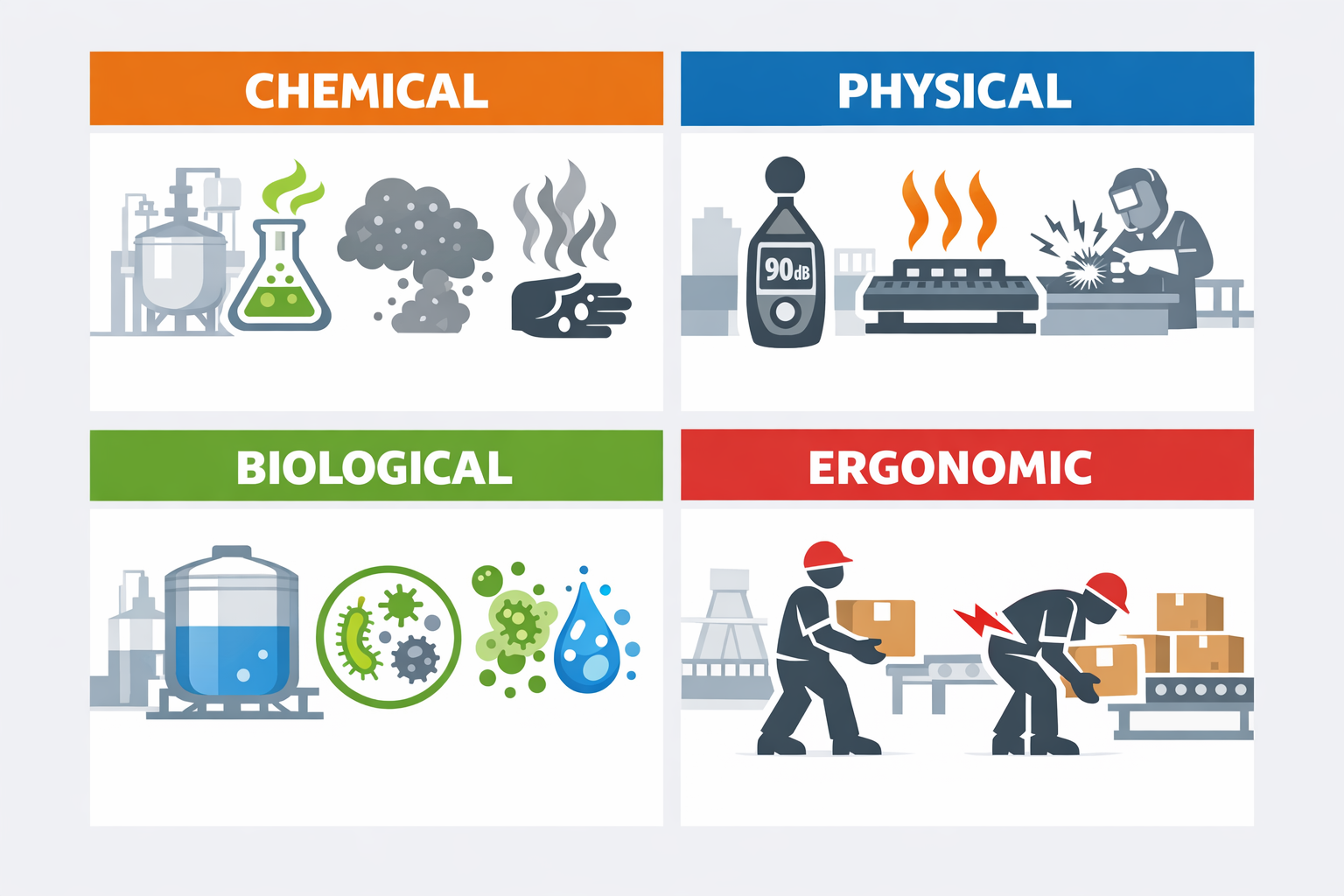
Once you know what industrial hygiene is, the next step is to sort hazards into categories that can be monitored and controlled consistently. In most manufacturing environments, workplace health hazards fall into three main groups: chemical, physical, and biological. That structure helps the role of an industrial hygienist stay practical, because different hazards require different sampling methods, exposure limits, and control strategies.
Chemical hazards often involve inhalation or skin contact with gases, vapors, fumes, mists, and dusts. Physical hazards usually include noise, heat, radiation, and vibration that can damage hearing, strain the body, or increase fatigue over time. Biological hazards are less common in dry-process factories but become important in wet systems, wastewater areas, cooling towers, and anywhere microbial growth can occur. Ergonomic stressors also matter, especially when repetitive work or poor postures increase breathing rates, fatigue, or contact time with other exposures.
Chemical Hazards: Vapors, Dusts, Fumes, and Skin Exposure
Chemical exposure is often the most obvious industrial hygiene concern in chemical and general manufacturing, but it is still frequently underestimated when symptoms are delayed or intermittent. In a resin mixing room, for example, operators may work around solvents that release volatile organic compounds during charging, blending, and drum transfer. Short-term peaks can occur when lids are opened, hoses are disconnected, or ventilation is bypassed for cleaning.
Exposure risk depends on more than the chemical itself. Task duration, temperature, room airflow, and work practices all affect how much reaches the worker’s breathing zone or skin. A process that appears stable on paper can produce very different exposures across shifts, especially in facilities with manual handling steps or inconsistent local exhaust performance.
Dust and fume hazards follow the same logic in different forms. Powder weighing may generate airborne particulates during bag dumping, while welding, soldering, or thermal cutting can create metal fumes with fine particles that penetrate deep into the lungs. In both cases, the industrial hygienist has to look beyond the SDS and assess how material is actually handled during production.
Physical Hazards: Noise, Heat, and Other Energy Exposures
Physical hazards are common in general manufacturing because they are built into the process rather than added through raw materials. In a metal fabrication shop, presses, grinders, compressors, and extraction fans can easily push worker noise exposure above 85 dBA over an 8-hour time-weighted average, the action level used in many hearing conservation programs. The risk rises further when workers move between high-noise zones without consistent protection or dosimetry data.
Heat is another major health hazard, especially in forging, foundry, or non-air-conditioned tropical facilities. When radiant heat from equipment combines with high humidity, workers face a greater likelihood of dehydration, heat exhaustion, and reduced concentration. That matters for industrial hygiene because heat stress changes both health risk and safe work capacity, even before a medical event occurs.
Biological Hazards: Microbes in Wet Process Areas
Biological hazards are more situational, but they can be serious when water and organic residue are part of the operating environment. In wastewater treatment rooms, wet scrubber systems, or cooling-water circuits, stagnant water and aerosol generation can expose workers to bacteria, fungi, or endotoxins. Maintenance tasks such as tank cleaning or filter changeout often create the highest risk because they disturb accumulated contamination.
These hazards are easy to miss if a site focuses only on chemical inventory and injury prevention. That is why the role of an industrial hygienist includes looking for process conditions that support microbial growth, not just reviewing labeled substances. The next step is understanding how to control workplace health hazards systematically through monitoring, interpretation, and the right control measures.
How to Control Workplace Health Hazards with the Industrial Hygiene Process
Start With a Structured Walkthrough and Exposure Plan
Once hazards have been identified, the next step in industrial hygiene is turning observations into a monitoring plan. Consider a resin-coating line where operators mix solvents, load parts, and work near curing ovens across two shifts. A walkthrough should document who is exposed, where exposure peaks are likely, how long tasks last, what controls already exist, and whether production changes could alter risk. This is where the role of an industrial hygienist becomes highly operational: not just spotting hazards, but deciding what must be measured first.
A practical exposure monitoring plan ranks similar exposure groups, tasks, and areas by risk rather than sampling everything at once. Higher-priority situations usually include new processes, visible control failures, worker complaints, process upsets, and jobs with known respiratory or dermal hazards. In many plants, baseline monitoring is followed by periodic reassessment based on exposure severity, process stability, and regulatory requirements. If a solvent mixing task has changed from weekly batching to daily production, monitoring frequency should increase accordingly.
Sample the Right Exposure, the Right Way
Sampling should match the real exposure pathway and decision needed. On the coating line, personal air sampling may be required for operators charging tanks, while area sampling may help evaluate background vapor migration near packing stations. Short-term sampling is useful when tasks create brief high peaks, while full-shift sampling helps determine time-weighted average exposure. Good industrial hygiene practice also includes calibration records, chain of custody, environmental conditions, and clear notes on task timing.
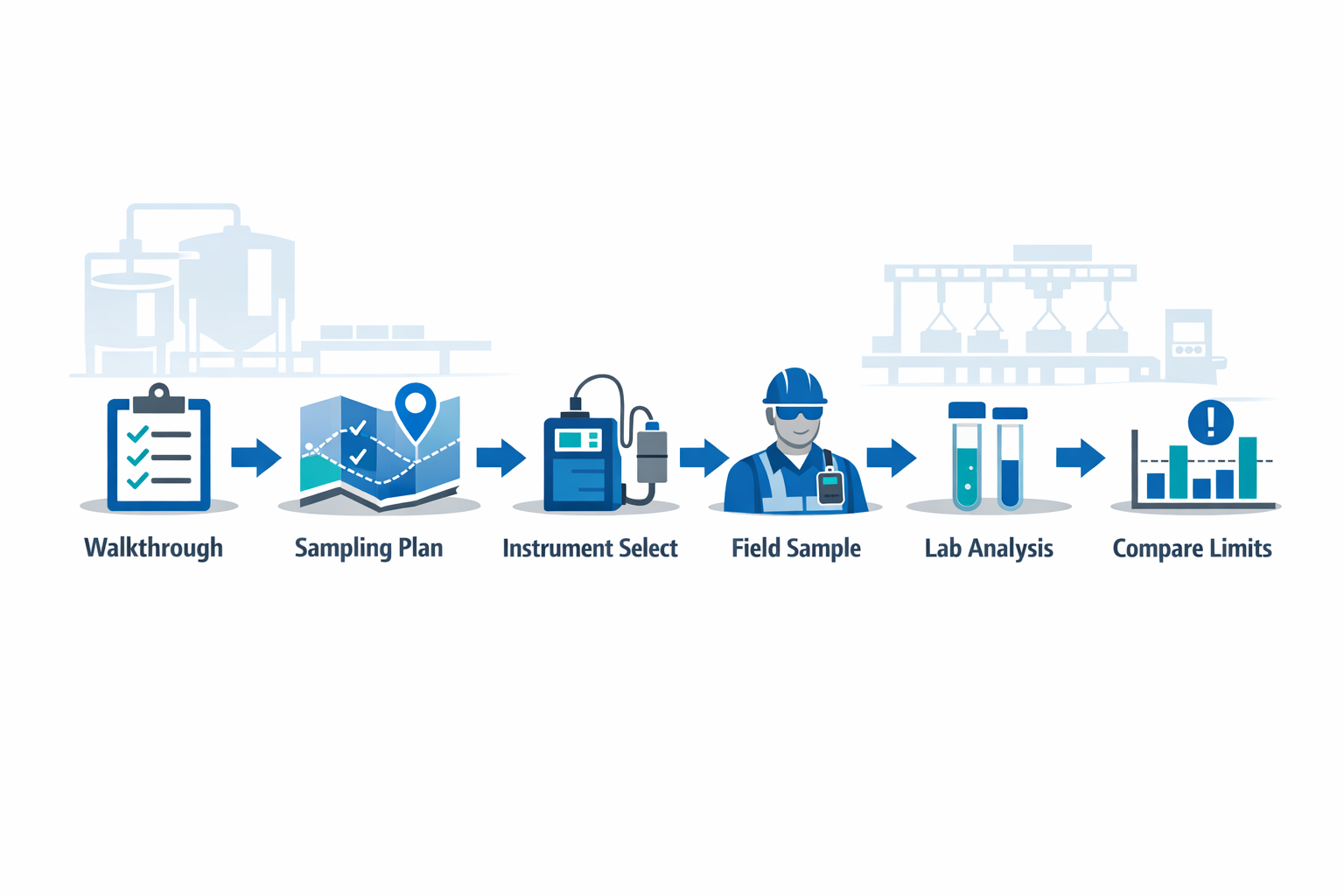
The exposure monitoring workflow should be repeatable enough that different hygienists or EHS teams would reach comparable conclusions. A typical sequence is walkthrough, sampling strategy, instrument selection, field sampling, laboratory analysis where needed, and comparison against occupational exposure limits or internal action levels. If a result is borderline, teams should check whether the sample reflects normal production, an upset condition, or an unusual maintenance activity before acting on it. That discipline matters because controlling workplace health hazards depends on reliable data, not isolated readings.
Interpret Results Using the Hierarchy of Controls
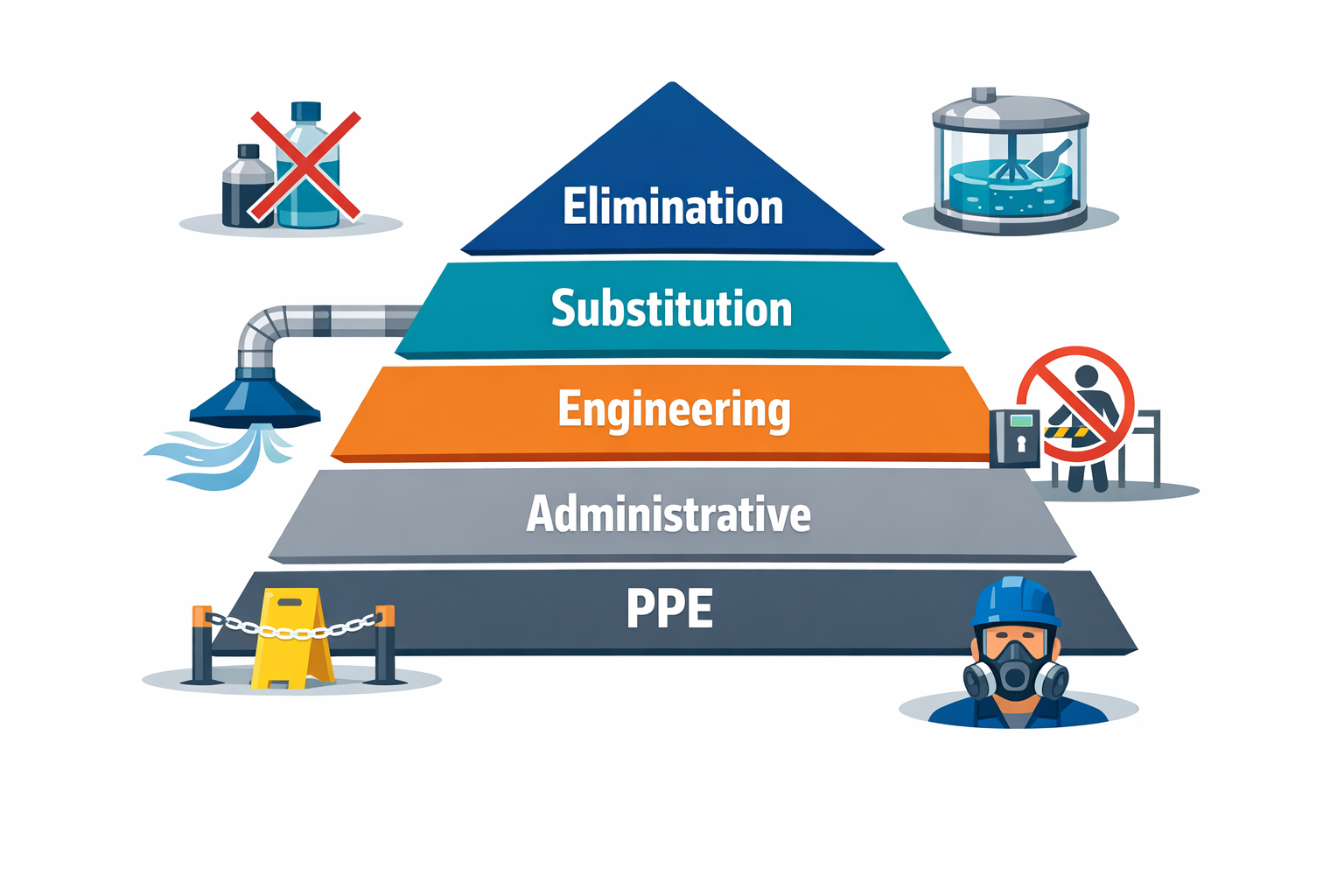
Sampling results only become useful when tied to decisions. If personal sampling on the resin mixer shows solvent exposure above an internal action level on both shifts, the team should first confirm the exposure pattern by task, duration, and control condition. From there, controls should be selected using the hierarchy of controls: elimination, substitution, engineering controls, administrative controls, and personal protective equipment in that order. In practice, that means asking whether the solvent can be replaced, the mixing lid enclosed, local exhaust improved, batch timing changed, or respirator use upgraded only after higher-level options are addressed.
This order matters because PPE depends heavily on consistent human behavior, while engineering changes usually reduce exposure at the source. In a manufacturing setting, enclosing the mixing vessel and improving capture velocity often delivers more reliable reduction than rotating staff between high-exposure tasks. Administrative controls still matter, especially for restricting access during charging or standardizing cleaning methods, but they should not be the first answer when exposure remains systemic. If you are asking what industrial hygiene looks like in action, this decision sequence is the clearest example.
Bagaimana Jodoo Helps Industrial Hygienists Standardize Monitoring, Sampling, and Corrective Actions
Build a Repeatable Monitoring Schedule Across Plants
Many plants still manage sampling calendars, exposure groups, lab reports, and corrective actions in separate spreadsheets, which makes overdue monitoring and inconsistent follow-up almost inevitable. Jodoo helps industrial hygienists turn those recurring tasks into structured workflows with due dates, approvals, reminders, and audit trails. That matters most in multi-line or multi-site manufacturing, where the role of an industrial hygienist often includes coordinating the same program across very different operating areas.
Take a regional coatings manufacturer with blending, filling, and solvent storage areas in two plants. The EHS team needs quarterly VOC personal sampling for mixers, annual baseline area monitoring in drum decanting, and extra follow-up sampling after ventilation changes. In Jodoo, those requirements can be configured as separate workflow rules by process, job type, trigger event, and site instead of forcing every area into one fixed template. That configurability is critical because industrial hygiene programs rarely follow a single uniform monitoring cycle.
Capture Sampling Data in the Field Without Rework
Field data quality usually breaks down at the point of collection, not in the final report. Jodoo’s mobile forms let sampling staff capture employee ID, similar exposure group, task observed, duration, pump ID, calibration checks, photos, and chain-of-custody details directly at the source. Required fields, logic rules, and timestamped entries reduce missing data and make records easier to defend during internal audits or regulator reviews. Instead of rekeying handwritten notes later, teams work from one live record.
In the coatings example, a hygienist collecting personal air samples in the blending room can log pre-sampling pump calibration, solvent type handled, local exhaust status, and unusual production conditions during the shift. If a batch change introduces a higher-volatility thinner, the form can require an additional note and trigger review. That creates cleaner context for interpreting results, especially when exposures vary by product mix and task duration. It also shortens the time between sampling and action.
Route Exceedances Into Corrective Action Fast
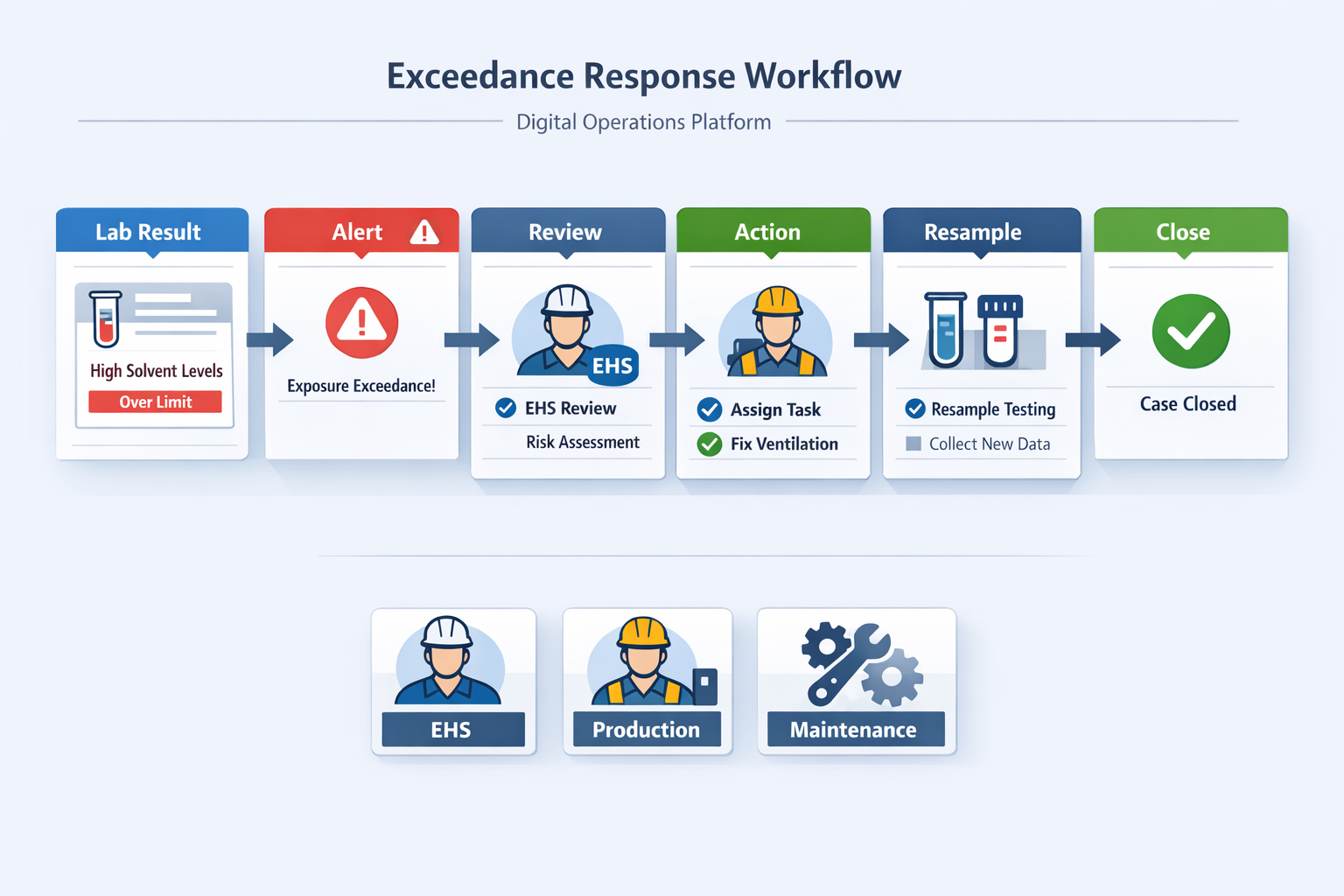
The biggest operational gap in many programs is not sampling but response. Jodoo can automatically compare results against internal action levels or occupational exposure limits, then trigger alerts, assign investigations, and route corrective actions to maintenance, production, or EHS leaders. A single workflow can move from lab result entry to risk review, temporary controls, engineering requests, resampling, and closure tracking without relying on email chains.
In the same plant, if a mixer operator’s 8-hour TWA exceeds the plant’s action level for xylene, the workflow can notify the industrial hygienist, production manager, and maintenance supervisor immediately. The case record can require root-cause review, document whether the issue relates to hood capture velocity or work practice, and assign deadlines for interim respirator use, ventilation repair, and confirmation sampling. Jodoo connects the full sequence from sampling through corrective action closure in one auditable process.
Turn Exposure Data Into Management Visibility
Industrial hygiene data often stays buried in PDFs until someone asks for trend evidence. With Jodoo dashboards, EHS managers can track sampling completion rates, overdue monitoring, exceedance counts, closure time for corrective actions, and recurring problem areas by plant, process, or similar exposure group. That gives leadership a practical view of where controls are holding and where exposure risk is drifting upward. For larger manufacturers, role-based access also helps site teams see local actions while corporate EHS compares performance across facilities.
This approach is especially useful when process changes happen faster than annual reviews. If one coatings line shows repeated action-level hits after throughput increases, the dashboard makes that pattern visible before it becomes a chronic exposure issue. For industrial hygiene in manufacturing, that combination of workflow control and data visibility is what turns a compliant program into a manageable one.
Conclusion: Build a Stronger Industrial Hygiene Program with Jodoo
Efektif industrial hygiene in manufacturing is not a one-time survey or a compliance checklist. It depends on a disciplined process: anticipate where health hazards may emerge, recognize the materials and tasks that create exposure, evaluate risk with the right monitoring methods, and control those risks before they affect workers, output, or regulatory performance. For EHS managers and industrial hygienists, that structure turns scattered observations into a repeatable program.
The strongest programs also make exposure management operational, not just technical. When sampling schedules live in spreadsheets, field notes sit on paper, and corrective actions move through email, follow-up becomes slow and inconsistent. That increases the risk of missed monitoring dates, incomplete records, and delayed response when exposure limits are exceeded.
Jodoo helps manufacturers digitize that process without heavy custom development. As a no-code lean manufacturing platform, it can be used to standardize monitoring schedules, centralize exposure records, automate exceedance alerts, and route corrective actions across teams with full visibility. If you want a more controlled and auditable industrial hygiene workflow, you can mulai uji coba gratis atau pesan demo untuk melihat apakah cocok dengan tanaman Anda.