Telusuri berdasarkan kategori

Introduction: What ISO 45001 Means for Manufacturing Facilities
The International Labour Organization estimates that nearly 3 million people die each year from work-related causes worldwide, which is why ISO 45001 matters far beyond certification paperwork. For manufacturers, it provides a structured way to control occupational health and safety risks before they become disruptions.
In plain language, ISO 45001 is the international standard for building and maintaining an occupational health and safety management system. For EHS managers, quality leaders, and compliance officers in manufacturing, automotive, and electronics plants, it turns safety from a reactive function into a managed operating discipline. That includes practical controls for hazards such as machine guarding gaps, chemical exposure, contractor risk, ergonomic strain, and weak incident follow-up.
This article will introduce what ISO 45001 requires and how to implement it in a real facility. We will move from the core requirements and certification expectations to a step-by-step implementation approach, then show how manufacturers can maintain audit readiness and day-to-day control more consistently.
The Core ISO 45001 Certification Requirements
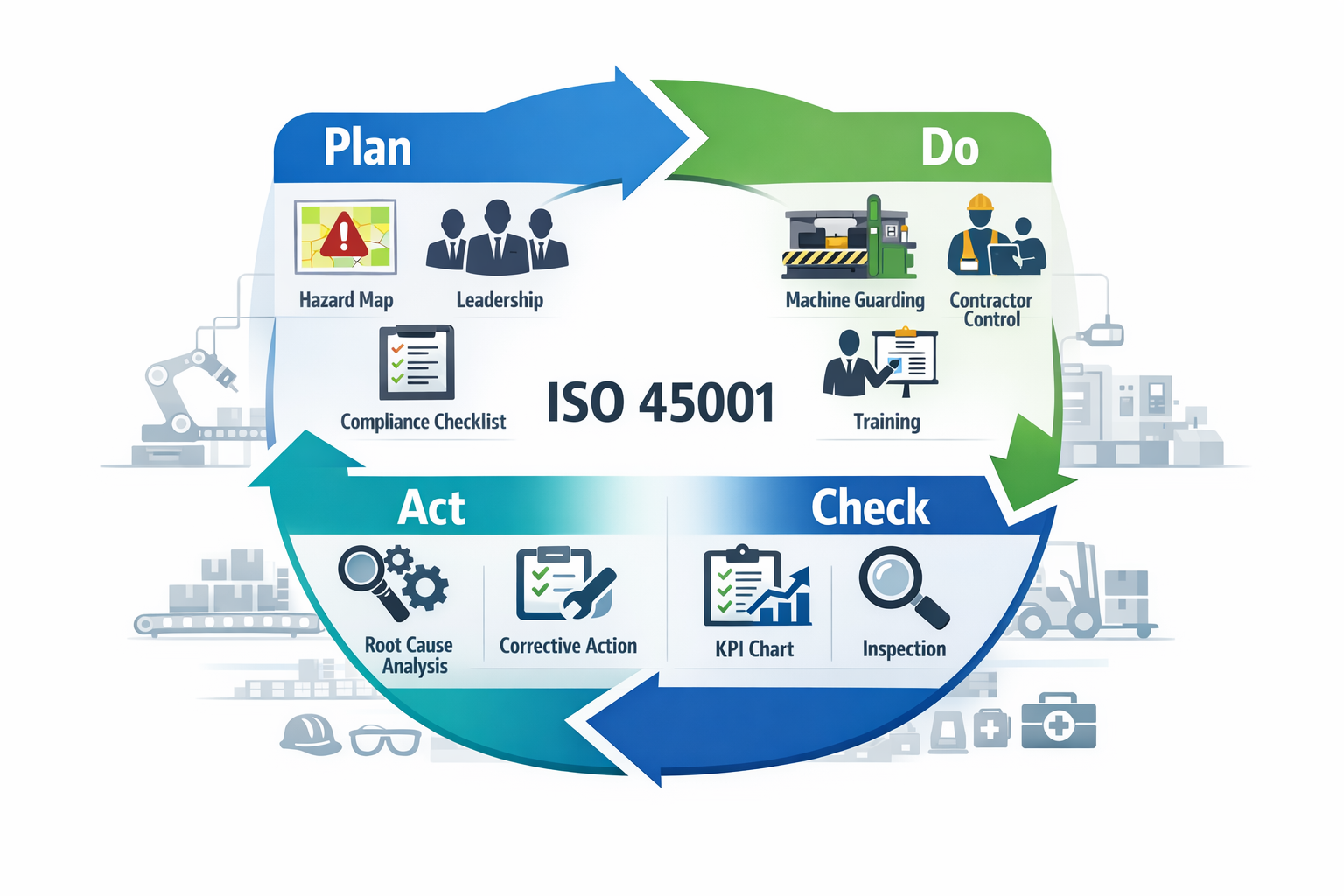
Bagi para produsen, ISO 45001 certification requirements are easiest to understand through the standard’s Plan-Do-Check-Act logic rather than by reading clauses in isolation. In practice, that means you set direction, control risks in daily work, verify whether controls are working, and improve when gaps appear. This matters because certification auditors do not just look for documents; they look for evidence that your safety management system operates on the shop floor.
Plan: Define Risk, Responsibility, and Compliance
The “Rencana” stage starts with context and leadership, which means understanding what can affect worker health and safety in your facility. A plant making stamped metal parts will have different exposure profiles from an electronics assembly site, including press hazards, noise, lockout risks, and contractor maintenance work. Management must identify these realities, define the system’s scope, and ensure safety responsibilities are clearly assigned across production, maintenance, EHS, and HR. If ownership is vague, certification often stalls later in the execution process.
Leadership under ISO 45001 goes beyond signing a policy. Plant leaders are expected to set objectives, provide resources, remove barriers, and show visible accountability for safety performance. That can mean approving machine guarding upgrades, funding exposure monitoring for solvent use, or requiring supervisors to close corrective actions on time. Auditors often test this by asking how leadership reviews incident trends, legal updates, or overdue actions. A policy on the wall is not enough without proof of involvement.
Worker participation is also a core planning requirement, and many manufacturers underestimate it. ISO 45001 expects employees to be consulted on hazards, incident investigations, and changes that affect their work. On a packaging line, operators may notice bypassed interlocks or unsafe jam-clearing practices long before management does. A compliant system gives them structured ways to raise concerns and see follow-up, not just a suggestion box with no feedback loop.
Legal and other compliance obligations must also be identified and kept current. In manufacturing, that usually includes occupational safety regulations, chemical storage rules, PPE requirements, contractor controls, and machine inspection obligations. The requirement is not only to list laws, but to connect them to actual processes, owners, and review frequencies.
Do: Control Hazards in Daily Operations
The “Do” stage is where planning becomes plant-floor control. Hazard identification and risk assessment must cover routine work, non-routine tasks, abnormal conditions, and emergencies. For example, a CNC machining area may appear controlled during normal production, yet chip removal, tool changeovers, and maintenance access can create higher-risk exposure points. ISO 45001 expects you to assess those realities systematically and apply controls using a clear hierarchy, with elimination and engineering controls preferred over PPE alone.
Operational control also includes managing change, procurement, and contractors. If a food manufacturer installs a faster conveyor, the safety review should happen before startup, not after an operator strain case appears. If contractors enter for confined-space cleaning or electrical work, permit controls, competency checks, and supervision must be defined in advance. These are common audit trails because contractors and process changes often sit outside routine production discipline.
Competence, awareness, and documented information also sit in this execution stage. Employees must be trained not only once, but in ways tied to the risks they actually face, such as chemical spill response, lockout-tagout, forklift segregation, or emergency evacuation. Records should show who was trained, when refreshers are due, and whether the training covered role-specific hazards. Documentation under ISO 45001 should support control, not become a paperwork archive disconnected from work.
Check and Act: Verify Performance and Improve It
The “Check” stage focuses on monitoring, audits, and management review. Manufacturers need leading and lagging indicators, such as near-miss reporting rates, overdue corrective actions, audit findings, exposure results, and incident frequency. Internal audits should test whether procedures are followed in practice, not simply whether forms are complete. For instance, a chemical handling audit should confirm labeling, segregation, spill kit readiness, and operator understanding on the line.
The “Act” stage is continual improvement, which means treating nonconformities and incidents as inputs for system change. If repeated hand injuries occur at one assembly station, the response should go beyond retraining to review tooling, work method, guarding, and supervision. Tindakan perbaikan must address root cause, verify effectiveness, and feed lessons back into objectives and operational controls. That is what turns ISO 45001 from a certification exercise into a functioning management system.
How to Implement ISO 45001 Step by Step in a Manufacturing Environment
Dapat diterapkan ISO 45001 implementation plan should move in a clear sequence, not as a document dump before an audit. Consider a mid-sized electronics assembly plant with 450 employees, two shifts, soldering lines, test stations, chemical cleaning, and regular maintenance contractors. The EHS manager has been asked to build a system that meets ISO 45001 certification requirements within 12 months without disrupting output. That is a realistic manufacturing scenario, and it shows how to implement ISO 45001 in a way that fits plant operations.
Start With Leadership Commitment and Scope
The first step is to secure visible leadership commitment from the plant manager, operations head, HR, maintenance, and quality. In the electronics plant, leadership agrees on three practical targets for year one: reduce recordable incidents by 20%, close corrective actions within 30 days, and achieve 100% completion of critical safety training. That matters because ISO 45001 works only when safety objectives are treated like production and quality objectives, with owners, timelines, and review routines.
Next, define the scope of the occupational health and safety management system. The plant decides to include production, warehouse, maintenance workshop, utilities, and contractor activities, while excluding a separate offsite sales office. This avoids a common implementation mistake: trying to certify only the easy areas while leaving higher-risk support processes outside the system.
Run a Gap Assessment and Build the Roadmap
Once scope is set, the EHS manager runs a structured gap assessment against current practices, records, and controls. At the electronics plant, the review finds that lockout-tagout exists but is inconsistently documented, chemical exposure assessments are outdated, contractor permits are managed on paper, and near-miss reporting varies by supervisor. That gap review turns ISO 45001 certification requirements into a practical action list rather than a clause-by-clause theory exercise.
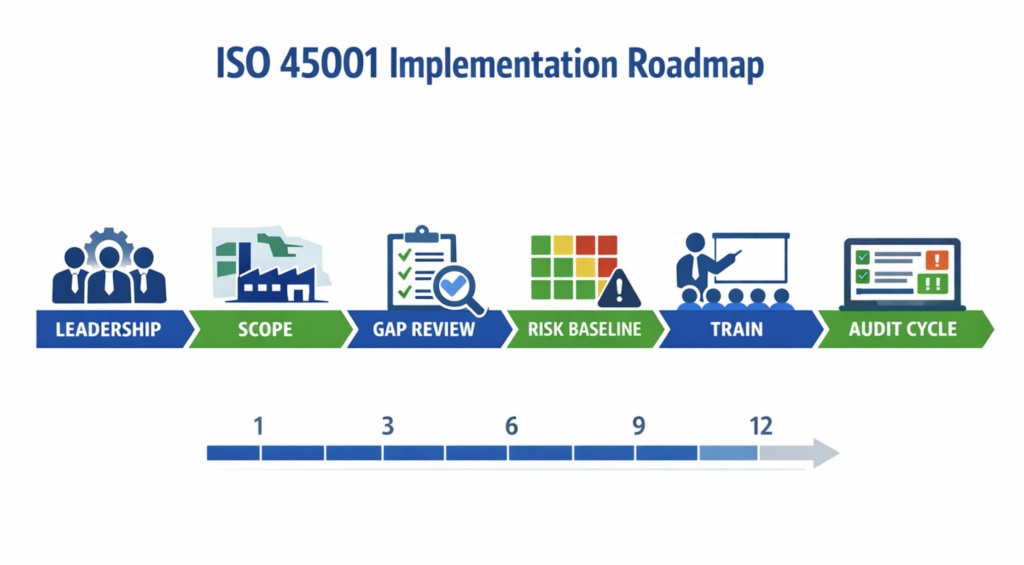
From there, build a phased roadmap with responsibilities and deadlines. Month 1 to 2 covers the gap assessment and legal register update, months 3 to 5 cover risk assessments and document drafting, months 6 to 8 cover training and operational rollout, and months 9 onward focus on internal audits, corrective actions, and management review. Plants that sequence work this way usually progress faster because teams know what must be stabilized first.
Establish the Hazard and Compliance Baseline
The next step is to build the baseline that the system will control every day. In the electronics plant, the team maps hazards by area: ergonomic strain at manual assembly benches, solder fume exposure, ESD-related work conditions, electrical testing hazards, forklift traffic in finished goods, and confined-space risks in utilities maintenance. They also create a legal and other requirements register covering machine guarding, hazardous chemical handling, PPE, emergency preparedness, contractor safety, and local reporting obligations.
This is where many projects either become useful or become paperwork. The plant assigns risk ratings, identifies existing controls, and records what is missing, such as local exhaust verification, contractor induction evidence, and formal emergency drill evaluations. By the end of this stage, the facility has a credible view of actual operational risk, not just a policy statement.
Assign Process Owners and Create Controlled Documentation
With the baseline defined, the plant assigns process owners for each part of the system. Maintenance owns energy isolation and contractor controls, production owns line-level safety checks and operator reporting, HR owns training matrices, quality supports document control, and EHS coordinates audits, legal updates, and management review inputs. Clear ownership is essential because ISO 45001 fails quickly when every action is routed back to one overstretched EHS manager.
Documentation should stay lean and operational. The electronics plant creates a safety policy, risk assessment method, legal register, training matrix, incident investigation procedure, contractor onboarding process, inspection checklists, emergency response plans, and corrective-action workflow. Each document is linked to a real activity, which is the best way to keep procedures used rather than filed.
Train Teams and Launch the First Control Cycle
Training begins after the core processes are defined, not before. Supervisors are trained first so they can lead shift briefings, verify controls, and respond consistently to incidents and near misses. Operators then receive role-specific instruction on reporting hazards, PPE, emergency actions, and the controls that apply to their stations, while contractors receive induction before site access.
The final step is to launch the check-and-improve cycle. The plant conducts internal audits by area, investigates findings, assigns corrective actions, and reviews trends monthly with leadership. This is also where the benefits of ISO 45001 for manufacturers start to appear: faster issue closure, better cross-shift consistency, and clearer evidence that controls are working before the certification audit arrives.
Benefits of ISO 45001 for Manufacturers Beyond Passing an Audit
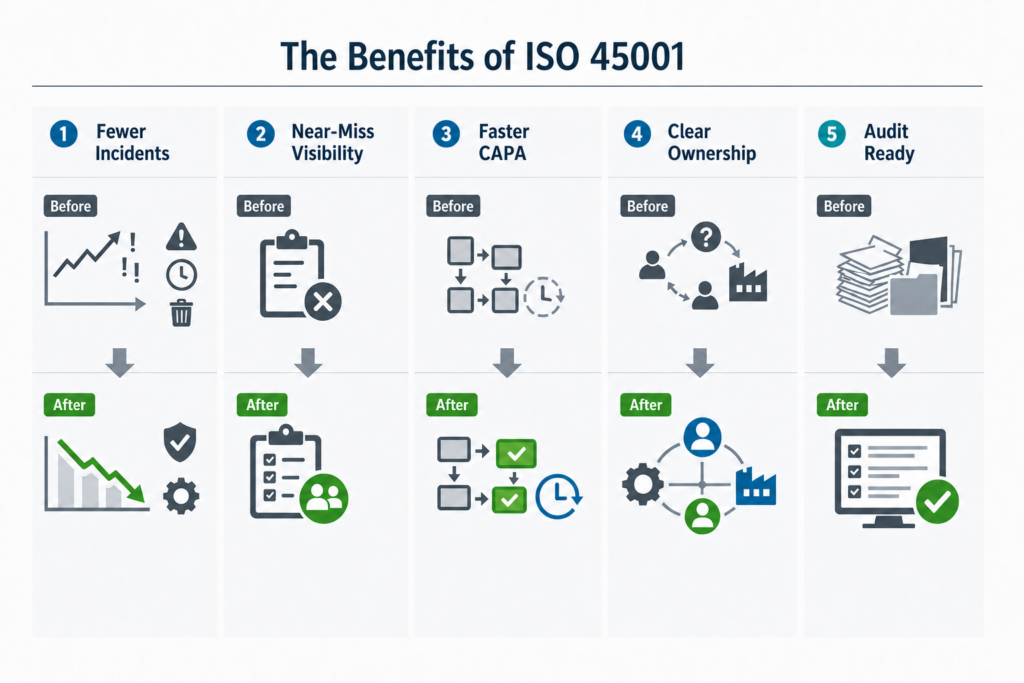
For many plants, the first business case for ISO 45001 is certification. The bigger value shows up after certification requirements are embedded into daily work. When the standard is used as an operating discipline rather than a binder on a shelf, manufacturers see measurable gains in incident prevention, response speed, and management control. That is where the real benefits of ISO 45001 for manufacturers become visible.
Fewer Recordable Incidents and More Stable Operations
A well-run ISO 45001 system reduces risk before it becomes injury, downtime, or scrap. In practice, that means hazards are identified earlier, controls are reviewed more consistently, and changes on the shop floor are less likely to create unmanaged exposure. In manufacturing, even a single serious incident can stop a line, trigger investigation delays, and disrupt customer commitments.
Better Near-Miss Visibility Before Losses Escalate
Plants with mature safety systems usually report more near misses, not fewer. That is often a sign of stronger reporting culture and better worker participation, both central to ISO 45001 certification requirements. When supervisors and operators trust that reporting leads to action instead of blame, management gets earlier warning on unsafe conditions, weak procedures, and recurring exposure points. Near-miss reporting is one of the clearest indicators that a plant is moving from reactive safety to preventive control.
The gap between audit-driven safety management and continuous performance management is significant. An audit-driven approach asks whether the form exists and whether training records are complete on review day. A performance-based approach asks whether recurring forklift near misses, chemical splash events, or bypassed guards are trending up by shift, line, or contractor group, and whether controls are actually working.
Faster CAPA Closure and Better Root-Cause Discipline
One of the most practical outcomes of ISO 45001 is faster corrective and preventive action closure. When investigation ownership, due dates, verification steps, and effectiveness checks are clearly defined, plants spend less time chasing open actions and more time removing repeat causes. This matters because delayed CAPA closure lets the same hazard reappear across shifts, departments, or sister sites. In safety management, slow follow-through is often as risky as weak hazard identification.
Clearer Accountability Across Departments and Shifts
Manufacturing incidents rarely belong to one function. A contractor permit issue may involve maintenance, production, EHS, and procurement; a chemical handling deviation may involve warehouse controls, labeling, and operator training. ISO 45001 helps assign responsibilities more clearly, so actions do not disappear between departments or shifts. That clarity is especially valuable in 24/7 operations where safety performance often varies more by handoff quality than by written procedure.
In general manufacturing, clearer accountability improves routine controls such as pre-start inspections, PPE compliance, and machine guarding checks. In multi-site groups, it also creates a common management language for escalation, review, and evidence. As a result, leaders can compare performance more reliably across plants instead of relying on inconsistent local spreadsheets or informal reporting habits.
Stronger Regulatory Readiness and More Consistent Execution
ISO 45001 does not replace legal compliance, but it makes compliance easier to sustain. Plants with structured reviews, documented controls, and current training records are better prepared for regulator visits, customer audits, and internal management review. They can show what controls exist, who was trained, what actions remain open, and whether changes were assessed before implementation. That reduces scramble, shortens response time, and lowers the chance of missing critical evidence.
The long-term gain is consistency. Once ISO 45001 requirements are translated into repeatable plant routines, safety execution becomes less dependent on individual managers and more resilient across turnover, expansion, and shift variation. For manufacturers, that is the difference between passing an audit once and building a safer operation that performs under pressure every day.
Bagaimana Jodoo Helps Digitize ISO 45001 Compliance and Audit Readiness
Once an ISO 45001 program is designed, the real challenge is execution at scale. In many plants, the gap is not understanding the ISO 45001 certification requirements but keeping evidence complete, current, and consistent across shifts, departments, and sites. That is where a no-code platform like Jodoo becomes useful: it turns safety procedures, approvals, and records into controlled digital workflows instead of disconnected paper files and spreadsheets. Using the same mid-sized metal components plant from the implementation roadmap, we can see how digitization supports day-to-day control without rebuilding the whole system in ERP.
Centralize Controlled Records and Workflow Logic
At the plant, EHS had SOPs in shared folders, training sheets in HR files, incident logs in Excel, and audit findings in email threads. Jodoo brings those elements into one structured system by linking digital forms, approval workflows, document records, and dashboards around the same process owners and asset data. That matters because ISO 45001 depends on traceable evidence: who reported a hazard, who approved a corrective action, when retraining was completed, and whether overdue actions escalated automatically.
Instead of storing a PDF procedure separately from the inspection it governs, the plant can connect them in one app. A lockout-tagout inspection form can pull the latest approved work instruction, require a supervisor sign-off for nonconformities, and create a corrective action record automatically when a high-risk finding is logged. For teams working out how to implement ISO 45001 practically, this reduces manual follow-up and lowers the risk of missing records during an external audit.
Digitize Incident Reporting and Shop-Floor Inspections
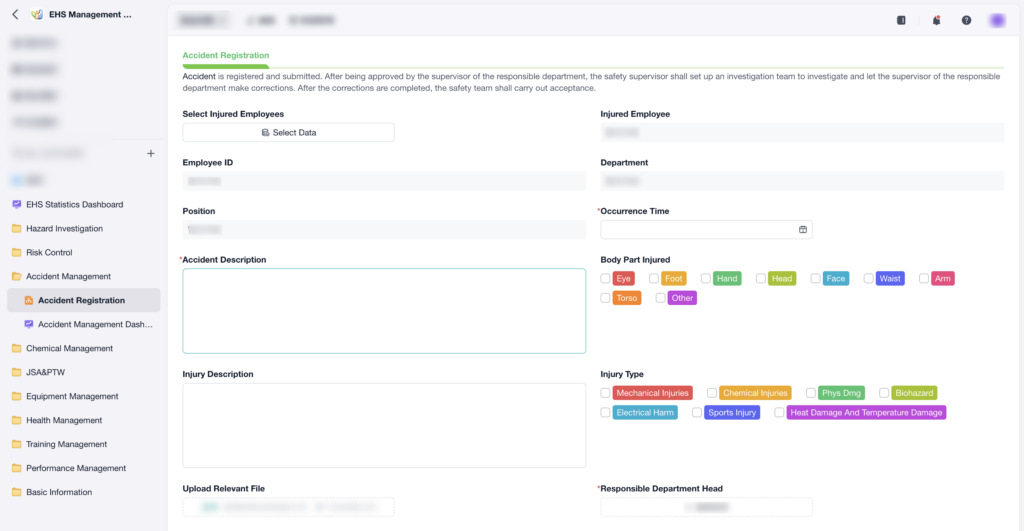
Speed matters in incident and near-miss reporting. With Jodoo forms on mobile devices, operators and supervisors can submit incidents immediately with photos, location, machine ID, injury classification, and initial containment actions. Required fields and routing rules improve data quality, while automatic notifications ensure that EHS, maintenance, and production leaders see serious events without waiting for paper forms to move between departments.
The same structure works for routine inspections. In the metal plant, weekly press-machine guarding checks, forklift inspections, and chemical storage reviews are scheduled through digital checklists with role-based assignments and deadlines. If a guard interlock fails or a spill kit is incomplete, Jodoo can trigger a follow-up task, notify the responsible owner, and log timestamps for closure, creating the kind of objective evidence auditors expect.
Track CAPA and Keep Actions From Stalling
Corrective and preventive action is where many systems lose momentum. Plants may identify issues during audits or incident investigations, but closure gets delayed when ownership is unclear, or actions are tracked in separate files. Jodoo Workflow helps standardize CAPA by assigning due dates, escalation paths, approval steps, and verification requirements based on risk level or issue type.
Manage Training, Contractor Control, and Audit Evidence
Training records are often a weak point in surveillance audits because plants struggle to prove competence by role, machine, or hazard exposure. Jodoo can maintain a live matrix showing who has completed induction, refresher training, emergency drills, or permit-to-work instruction, with alerts before certifications expire. For contractors, the plant can use pre-entry forms to collect insurance, safety orientation sign-off, permits, and restricted-area approvals before work starts.
Management review preparation also becomes easier when records are already structured. Instead of manually consolidating spreadsheets before audit season, the EHS manager can pull dashboards for incident trends, open CAPAs, overdue inspections, contractor compliance, and training completion rates. External auditors do not just want documents; they want a searchable audit trail, and a connected system makes that evidence faster to retrieve and easier to trust.
Conclusion: Build a Safer, More Audit-Ready ISO 45001 System With Jodoo
ISO 45001 is not just a certificate to display during customer audits. In a manufacturing facility, it works best as a repeatable management system for identifying hazards, assigning responsibility, verifying control effectiveness, and driving continual improvement. That is why successful implementation depends on more than written procedures. You need clear ownership, reliable records, regular review cycles, and consistent execution across shifts, lines, and sites.
If you want to standardize ISO 45001 workflows without heavy IT development, Jodoo can help. As a no-code lean manufacturing platform, Jodoo lets your team digitize forms, approvals, CAPA tracking, and audit records in one system. You can mulai uji coba gratis atau pesan demo to see how Jodoo supports a safer, more controlled manufacturing operation.