Telusuri berdasarkan kategori

Introduction: What Mean Time to Failure (MTTF) Tells Maintenance Teams
An unplanned stoppage can cost manufacturers thousands to hundreds of thousands of dollars per hour, depending on the process, labor intensity, and downstream disruption. In many cases, the trigger is not a major machine breakdown but a small component that reached the end of its usable life with no clear warning. That is where Mean Time to Failure (MTTF) becomes useful for maintenance and reliability teams.
In simple terms, MTTF is the average operating life of a non-repairable component before it fails and must be replaced. This makes it especially relevant for parts such as sensors, fuses, filters, batteries, and certain bearings used across automotive plants, electronics lines, and general industrial operations. Instead of treating every failure as an isolated event, MTTF helps you quantify how long these parts typically last under real operating conditions.
This article explains how to calculate MTTF correctly, when to use it instead of MTBF, and how MTTR fits into the broader reliability picture. It also shows how MTTF supports practical maintenance decisions, from replacement timing and spare parts planning to supplier review and shutdown preparation.
MTTF Definition, Formula, and How to Calculate It Correctly
What MTTF Means in Reliability Analysis
Mean Time to Failure, or MTTF, is the average operating time a non-repairable part is expected to run before it fails and must be replaced. In maintenance practice, this metric is best used for components such as bearings, fuses, filters, sensors, and batteries when the failed item is not restored to its original condition through repair. That distinction matters because MTTF is about service life to replacement, not uptime between repairs.
For example, if a proximity sensor on an electronics production line fails, the maintenance team usually swaps it out rather than rebuilding the sensor itself. In that case, tracking Mean Time to Failure gives you a practical baseline for expected life by part type, line, or supplier batch. This is also why the difference between MTTF and MTBF becomes important later: they answer different reliability questions.
The MTTF Formula
The standard MTTF formula is straightforward:
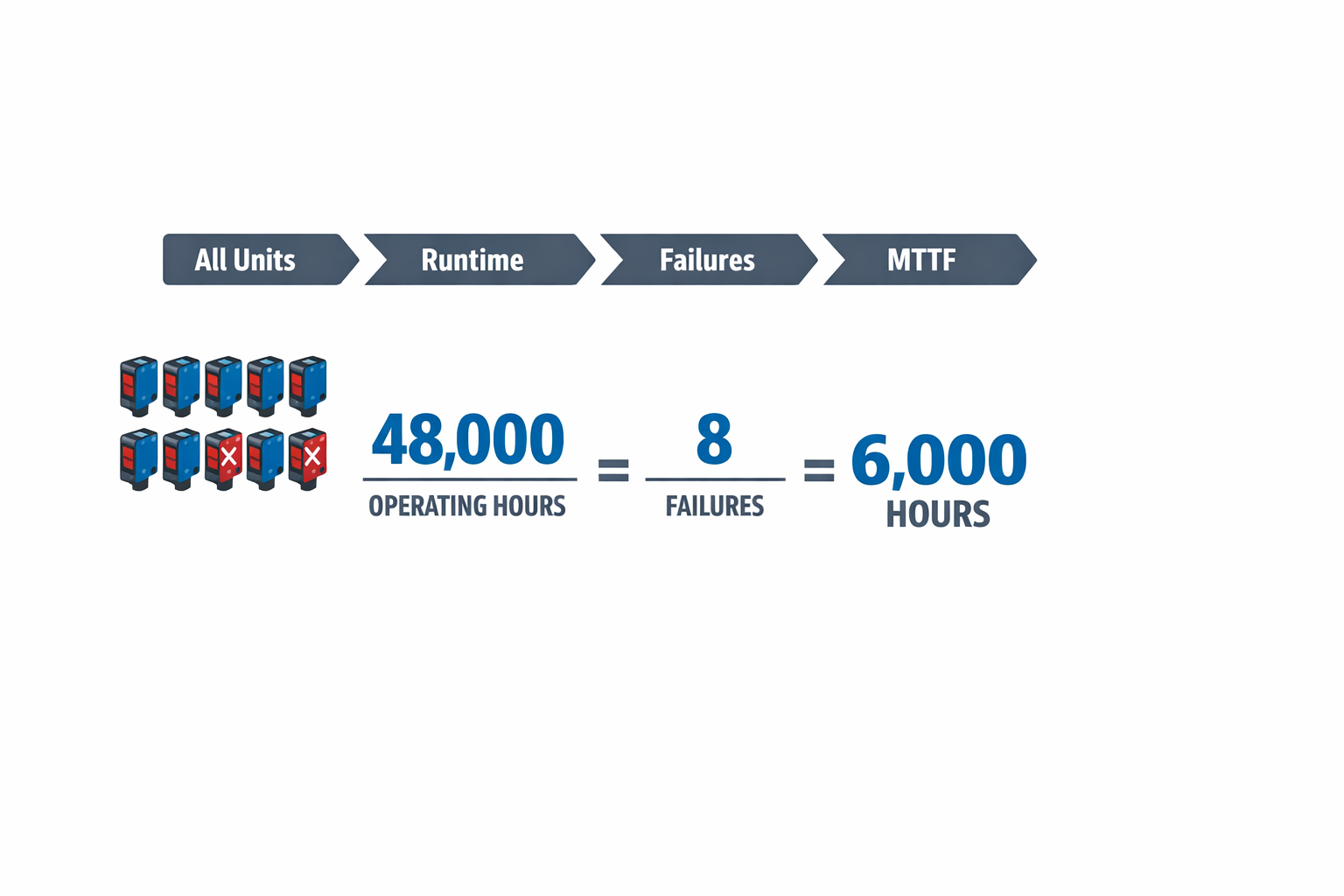
MTTF = Total Operating Hours of All Units ÷ Total Number of Failures
In this formula, total operating hours means the combined runtime accumulated by the population of identical non-repairable parts you are analyzing, while total number of failures means the number of those parts that failed during the observation period. The result is an average life in hours, cycles, days, or another consistent time unit. If your runtime data is recorded in hours, your MTTF will also be in hours.
The key to calculating MTTF correctly is consistency. You need the same part type, similar duty conditions, and a complete count of both runtime and failures across the group being studied. If those inputs are inconsistent, the average can look precise while actually hiding major reliability variation.
Step-by-Step Example from an Electronics Production Line
Take an SMT electronics line using the same photoelectric sensor model on multiple conveyor stations. Over six months, the maintenance team tracks 20 identical sensors installed under similar operating conditions. Together, those sensors accumulate 48,000 operating hours, and during that period, 8 sensors fail and are replaced.
Using the formula, the calculation is:
MTTF = 48,000 hours ÷ 8 failures = 6,000 hours
That means the average expected life of that sensor model, in that application, is 6,000 operating hours. This does not mean every sensor will fail exactly at 6,000 hours. Some may fail at 4,500 hours and others at 7,200 hours, but the average gives the reliability team a useful benchmark for comparing vendors, setting replacement review points, and spotting abnormal failure patterns.
You can also extend the same logic to narrower slices of data. If Line A shows an MTTF of 7,100 hours for the same sensor while Line B shows 4,900 hours, the problem may not be the part alone. It may point to contamination, misalignment, voltage instability, or a different operating load on one line.
Common Mistakes That Distort MTTF
One common error is mixing different asset populations in the same calculation. If you combine sensors from reflow conveyors, pick-and-place feeders, and final inspection stations, the operating environment may be too different for the result to mean much. MTTF works best when the parts are truly comparable in model, duty, and failure exposure.
Another frequent mistake is using incomplete runtime data. If failed parts are counted but operating hours are estimated loosely or pulled from only one shift, the final MTTF will be unreliable. A missing runtime history can make part life appear shorter or longer than it really is, which leads to weak maintenance decisions.
Teams also get into trouble when they count replacements for preventive reasons as failures. If a sensor was changed during a planned shutdown before it failed, that event should not automatically be logged as a failure in the MTTF calculation. Keep failure events separate from scheduled replacements, so the metric reflects actual reliability, not policy.
What a Good MTTF Calculation Should Tell You
A useful MTTF figure should help you answer a specific operational question, not just populate a KPI report. At minimum, it should tell you how long a non-repairable component lasts on average in a defined production context and whether that life is changing over time. That is the practical starting point for using MTTF to improve maintenance planning, even though the planning decisions themselves come in the next step.
If you are calculating MTTF regularly, make sure each number is tied to a clear scope: which part, which line, which supplier, which time period, and which runtime basis. That discipline makes the metric far more actionable and also prevents confusion later when teams compare it with repair-based metrics such as MTBF.
MTTF vs. MTBF vs. MTTR: Choosing the Right Reliability Metric
A Quick Framework for Selecting the Right Metric
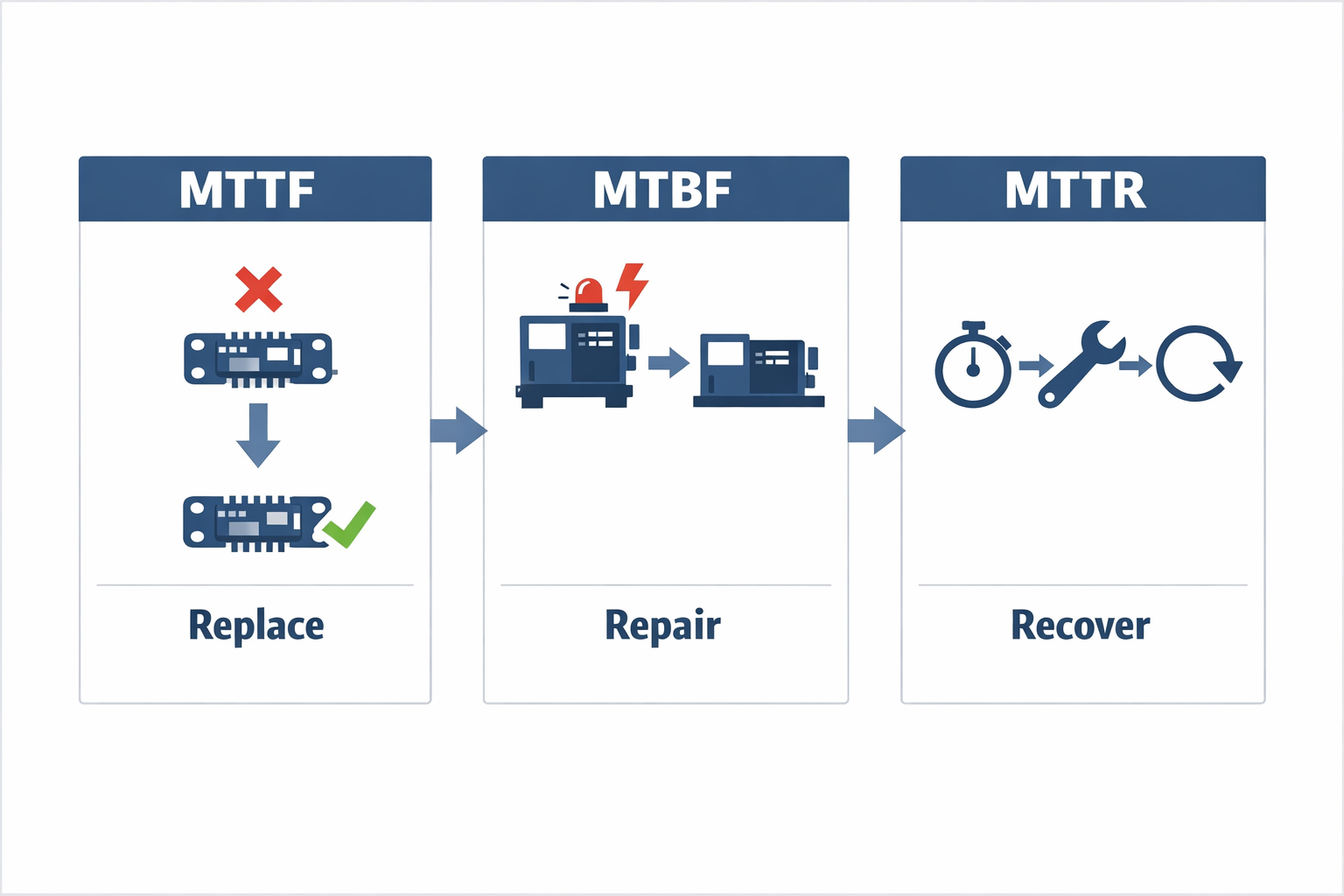
Once you know how to calculate MTTF, the next question is where it fits alongside other maintenance KPIs. The simplest way to separate them is by asking three practical questions: Is the item repaired or replaced? How often does it fail? How long does recovery take? In most plants, you need all three views because consumable parts, repairable assets, and downtime response do not behave the same way.
A side-by-side framework helps: MTTF is for non-repairable items, MTBF is for repairable assets that return to service, and MTTR measures how quickly the team restores function after a failure. Together, they show not just reliability, but also maintainability and operational readiness.
The Difference Between MTTF and MTBF
MTTF estimates the average life of a part that is discarded after failure, while MTBF estimates the average time between failures for equipment that is repaired and put back into operation. If a component is not intended to be restored, MTBF is the wrong metric even if it is installed inside a repairable machine.
In an automotive tooling cell, a proximity sensor on a fixture may be treated as a replaceable part, so MTTF is the better measure for that sensor population. The fixture itself, however, is a repairable asset that remains in use after maintenance, so MTBF is the better reliability metric for the fixture. This distinction matters because mixing the two can distort replacement plans and reliability reporting.
Which Metric Fits Which Manufacturing Scenario?
Menggunakan MTTF when you are tracking non-repairable items such as fuses, filters, batteries, or sealed sensors that are removed and replaced after failure. In SMT equipment, feeder sensors or small power modules are often analyzed this way because the maintenance action is replacement, not overhaul. This makes MTTF useful when you want to compare vendor quality or expected service life across batches.
Menggunakan MTBF for repairable systems such as conveyors, pick-and-place machines, pumps, compressors, and reflow ovens. These assets are expected to fail, be repaired, and continue operating over a long service life. MTBF is the better metric when you are evaluating asset reliability at the machine or subsystem level rather than the life of one disposable component.
Menggunakan MTTR when the main management question is how fast the team can recover production. This is especially important in mixed manufacturing systems where even a short stoppage can disrupt upstream and downstream processes. If you are using MTTF to improve maintenance planning, MTTR becomes the balancing metric that shows whether the replacement strategy is enough or whether the repair workflow also needs attention.
Using MTTF to Improve Maintenance Planning and Spare Parts Decisions
Turn MTTF Into Replacement Rules
Once you know how to calculate MTTF, the next step is deciding what action it should trigger. For non-repairable parts, MTTF helps you set replacement intervals based on actual service life rather than calendar guesses or operator habit.
A high MTTF usually indicates stable part performance under current operating conditions, but a falling MTTF needs investigation rather than automatic blame on the part itself. Shorter life may point to heat, contamination, voltage instability, misalignment, or an installation issue on one line. Maintenance teams should therefore review MTTF together with failure mode and operating context, especially when the same part number performs differently across assets. In practice, MTTF is most useful when it leads to a specific decision: replace earlier, inspect the environment, or review supplier quality.
Use MTTF to Set Spare Parts Stock Levels
MTTF also improves spare parts planning because it gives purchasing and maintenance a more realistic consumption forecast. If a plant uses 20 identical filters and the fleet-level MTTF is 3,000 hours, the team can estimate expected replacement demand over the next quarter based on actual runtime, not rough annual usage assumptions. That reduces the risk of tying up cash in excess inventory while still protecting uptime for critical consumables. For high-volume plants, even a small forecasting improvement can materially reduce carrying cost, which often runs at 20% to 30% of inventory value per year when storage, obsolescence, and handling are included.
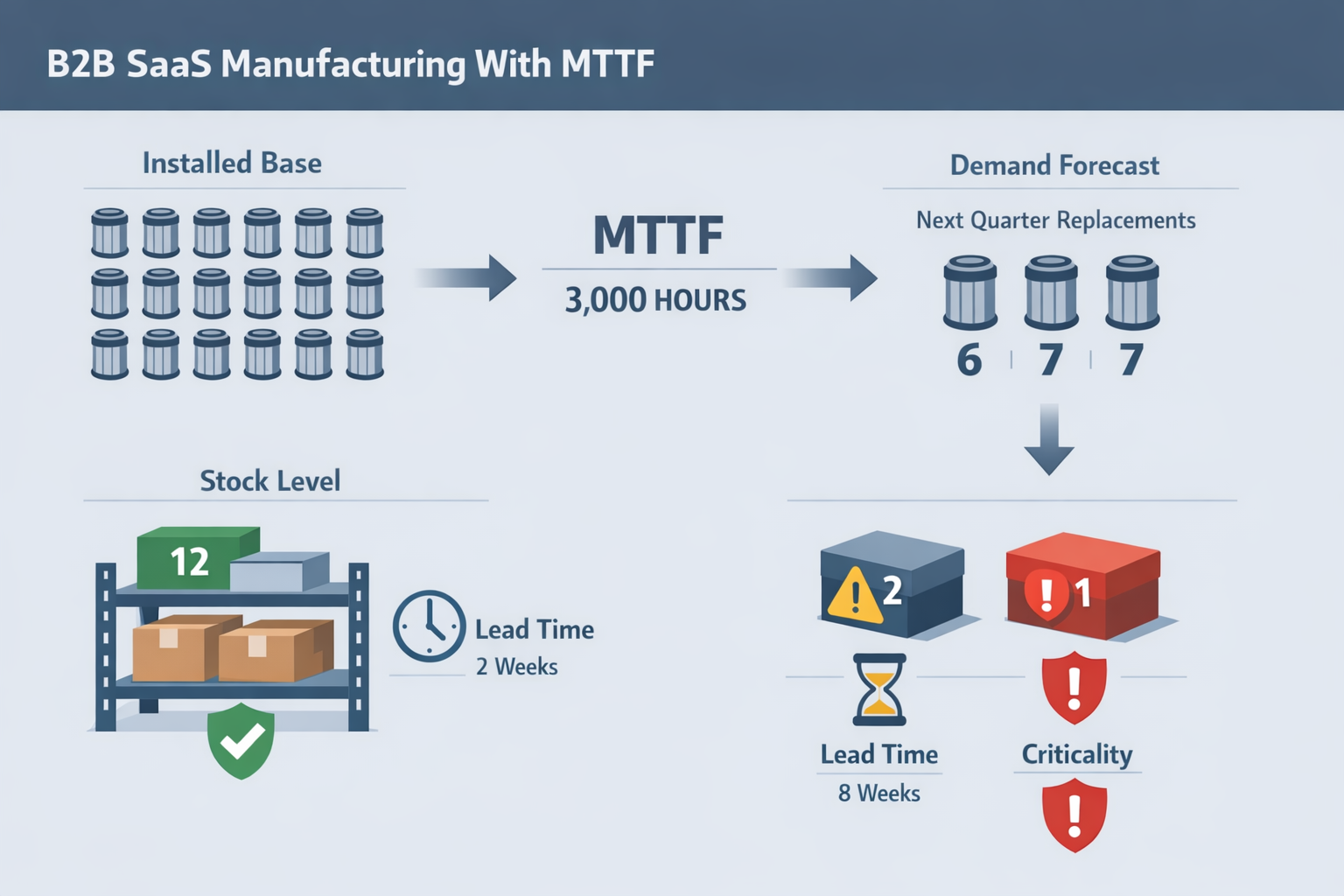
Replacement timing and stocking decisions should also reflect criticality, lead time, and consequence of failure. A low-cost fuse with a local one-day lead time does not need the same buffer logic as a specialized imported sensor with an 8- to 12-week lead time. MTTF helps you estimate likely demand, but the reorder point should also account for runtime variability and supplier risk. In other words, MTTF tells you how fast parts are consumed; operations planning decides how much uncertainty you can tolerate.
Segment MTTF by Line, Vendor, and Operating Condition
Plant-wide averages can hide the real issue, so segmenting MTTF is often where the value appears. If one vendor’s proximity switches last 6,200 hours on Line A but only 3,900 hours on Line C, the gap may reflect harsher washdown conditions, mounting differences, or inconsistent incoming quality. Looking only at a blended average would mask that pattern and lead to the wrong stocking and sourcing decisions. This is also why the difference between MTTF and MTBF matters operationally: for consumable or non-repairable parts, you need life-by-population insight, not repair-cycle averages.
Segmentation also supports supplier review with evidence. When MTTF falls for one vendor batch or one production area, procurement can escalate with data on service life, failure timing, and affected lines. That creates a stronger case for incoming inspection changes, warranty claims, or alternative sourcing. For reliability engineers, this turns MTTF from a reporting metric into a negotiation tool.
Prepare Better for Planned Shutdowns
Shutdown preparation improves when MTTF data is used to pre-build replacement lists. Before a monthly or quarterly stoppage, teams can identify components approaching expected end of life and replace them while access is available, instead of waiting for in-service failure. This approach is especially useful for filters, batteries, small sensors, and other parts that are inexpensive individually but disruptive when they fail unexpectedly. The result is fewer emergency jobs, better labor planning, and more predictable shutdown scope.
The key is to avoid treating MTTF as a fixed deadline. Actual life will always vary, so the metric should define a planning window rather than an absolute failure point. Many teams use a percentage of expected life, such as reviewing parts at 70% to 80% of historical MTTF, then adjusting by criticality and operating condition. That is a more practical maintenance rule than replacing every part too early or waiting until stockouts and breakdowns force the decision.
How to Track MTTF in Manufacturing with Digital Workflows and Dashboards
Use Reliable Source Data
Jika kamu mau Mean Time to Failure (MTTF) to support real maintenance decisions, the calculation has to start with reliable source data. At minimum, plants should capture asset ID, part number or part class, runtime hours, failure date, production line, vendor, and failure code for each failed component. Without that structure, even if you know how to calculate MTTF, the result will be too noisy to compare across lines, suppliers, or part families.
Runtime data is especially important because calendar time alone can distort component life. A sensor used on a three-shift welding line will accumulate wear much faster than the same model on a lightly loaded backup station. This is also where the difference between MTTF and MTBF matters operationally: for non-repairable parts, you need part-level failure and replacement records, not just equipment downtime logs.
Standardize Failure Reporting at the Source
Itu inconsistency of on-site reports is the most likely cause for the reduction in the accuracy of MTTF. If one technician logs a failed proximity sensor as “sensor bad,” another uses the OEM code, and a third records it under the machine name only, your data becomes difficult to aggregate. Standard mobile forms with dropdown fields, required inputs, and photo attachments help ensure every failure record is usable for analysis.
In practice, this means replacing paper notes and informal messaging with a structured digital workflow. A technician scans the asset or spare part barcode, selects the failure code, enters the runtime reading, confirms the vendor batch if available, and submits the record from the line. That structure makes it much easier to calculate MTTF consistently and to use MTTF to improve maintenance planning instead of treating it as a spreadsheet exercise.
Connect Failure Data, Work Orders, and Inventory
This is where workflow design matters more than the formula itself. With Jodoo, a plant can build connected forms for failure logging, spare parts issuance, and maintenance work orders so that one event updates multiple records automatically. When a failed part is reported, the workflow can reduce spare inventory, trigger supervisor review for abnormal failures, and feed a dashboard that tracks MTTF by line, vendor, and component type.
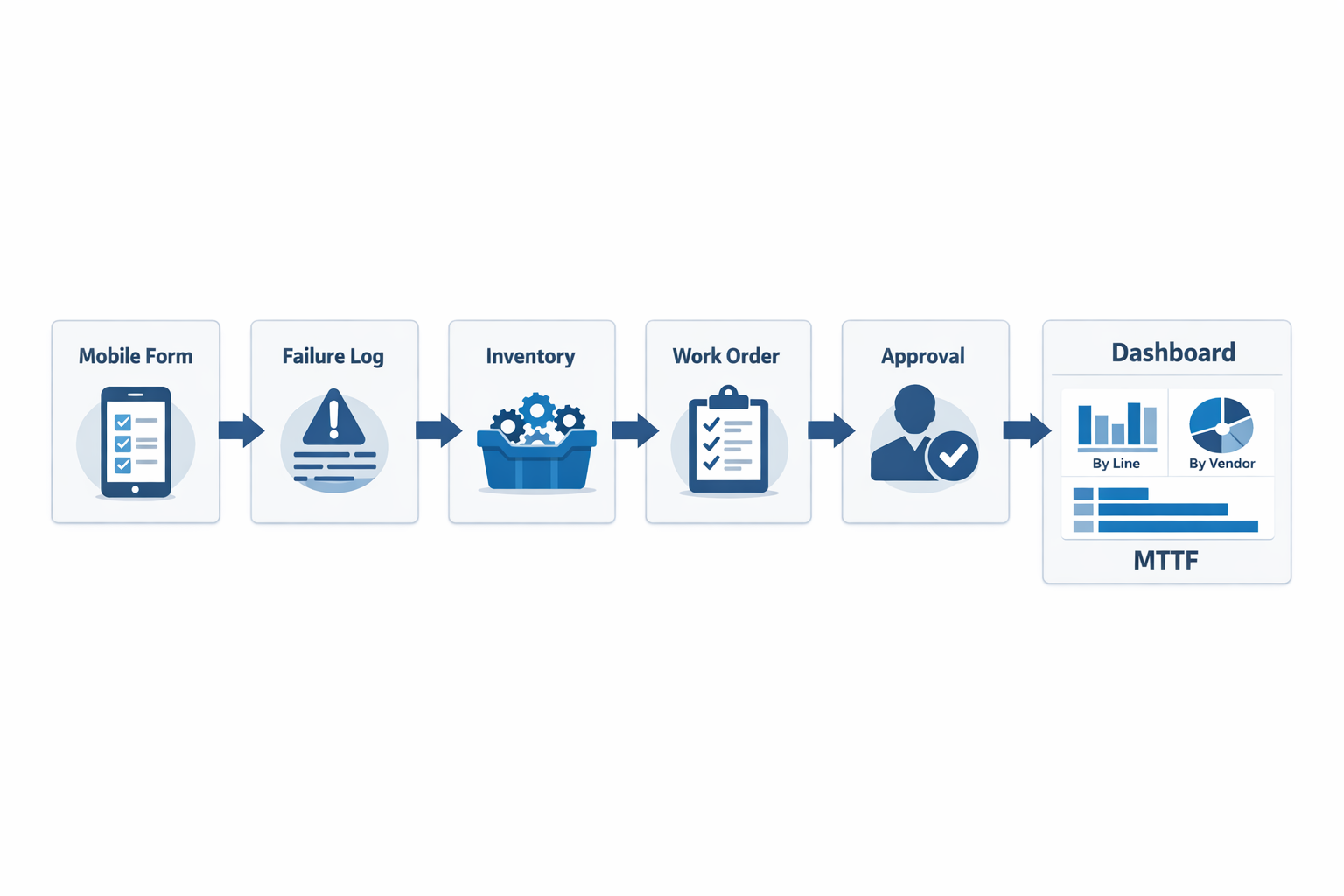
Because the data sits in one system, reliability metrics do not need to be rebuilt manually at month-end. Jodoo dashboards can calculate and display trends such as average life by sensor model, repeat failures within 30 days, or MTTF by supplier batch, with role-based visibility for maintenance, purchasing, and production leaders. That gives teams a practical bridge between metric tracking, the earlier step of calculating MTTF correctly, and the next step of acting on the results.
A Practical Example from an Automotive Supplier
One automotive supplier could use this setup to track photoelectric sensors across several assembly cells. Technicians submit failures through mobile forms, the maintenance lead approves replacement records, and the dashboard groups failures by vendor lot and line runtime. Within a few weeks, the team can see that one sensor batch is failing at a materially shorter average life than comparable stock, allowing purchasing to hold new orders and qualify an alternate supplier before the issue causes line stoppages.
This kind of visibility is what turns MTTF from a static KPI into a working control tool. Instead of debating whether a low value is random, the team can drill into the line, vendor, and failure pattern behind it. For plants managing hundreds or thousands of consumable components, that level of traceability is often the difference between reactive replacement and disciplined reliability control.
Conclusion: Turn MTTF from a Formula into a Better Maintenance System
Mean Time to Failure is most useful when it moves beyond reporting and starts shaping day-to-day maintenance decisions. For maintenance and reliability engineers, that means using MTTF to set smarter replacement intervals, identify weak part categories, review supplier performance, and plan spare parts inventory with more confidence. In practice, a falling MTTF is often an early warning that a line, vendor batch, or operating condition needs attention before failures start affecting output, quality, or maintenance cost.
The main point is simple: MTTF helps you plan, not just measure. When you track it consistently alongside metrics like MTBF and MTTR, you get a clearer view of which components should be replaced proactively, which ones can be stocked more leanly, and where failure patterns are starting to shift. That makes MTTF valuable not only for reliability analysis, but also for shutdown planning, purchasing decisions, and cross-functional coordination between maintenance, stores, and production.
If you want to make MTTF visible in everyday operations, Jodoo can help you build no-code maintenance workflows, digitize work orders and spare parts processes, and monitor reliability metrics in real-time dashboards without a heavy CMMS overhaul. You can mulai uji coba gratis atau pesan demo to see how it fits your maintenance system.