Browse by category

Introduction: Why Incident Management Software Matters More on Today’s Factory Floor
A delayed incident report does more than slow paperwork. OSHA estimates that employers pay nearly $1 billion per week for direct workers’ compensation costs, and in manufacturing, many of those costs start with slow reporting, incomplete investigations, or missed corrective actions. When incident management software is replaced by spreadsheets, email chains, or paper forms, even a routine near miss can turn into a compliance gap, a repeat hazard, or an avoidable production disruption.
That risk is broader than recordable injuries alone. A chemical spill, forklift collision, ergonomic strain, machine guarding issue, or contractor safety event can involve supervisors, EHS, maintenance, HR, and IT within hours. If each team works from different records, response time slips, accountability blurs, and audit readiness suffers.
This guide is for EHS managers and IT managers evaluating incident reporting and investigation systems for manufacturing. We will look at what modern manufacturing teams actually need, which features matter on the plant floor, and how to choose a system without locking yourself into a rigid EHS suite.
What Manufacturing Teams Need From Incident Management Software
In manufacturing, incident management software is not just a digital form for logging injuries or spills. It is the operating system for moving an event from first report to verified closure, with clear ownership at every step. For EHS managers and IT teams, the real requirement is continuity: one system that captures the event, routes it correctly, drives investigation, tracks corrective action, and preserves audit-ready records without manual re-entry.
Capture the Incident at the Point of Occurrence
Consider a metal fabrication plant where a press operator suffers a minor hand injury during a night shift. A supervisor needs to record the event immediately on a phone or tablet, attach photos of the machine guard, identify witnesses, and note whether first aid was given. If reporting waits until someone returns to a desktop or rewrites notes from paper, details go missing and response time slows.
That is why mobile capture is foundational, not optional. The best incident management software supports structured data entry on the shop floor, including timestamps, location, equipment, injury type, and attachments. In plants with unstable connectivity, offline capability also matters, because incidents do not wait for Wi-Fi.
Route the Right Case to the Right People
Once the report is submitted, the system should automatically classify severity and trigger role-based routing. In the same fabrication plant, a recordable injury may need immediate alerts to the EHS manager, production manager, HR, and maintenance lead, while a low-risk near miss might go first to the area supervisor for review. This routing logic is one of the key features of EHS incident systems because it prevents delays caused by email forwarding and unclear responsibility.
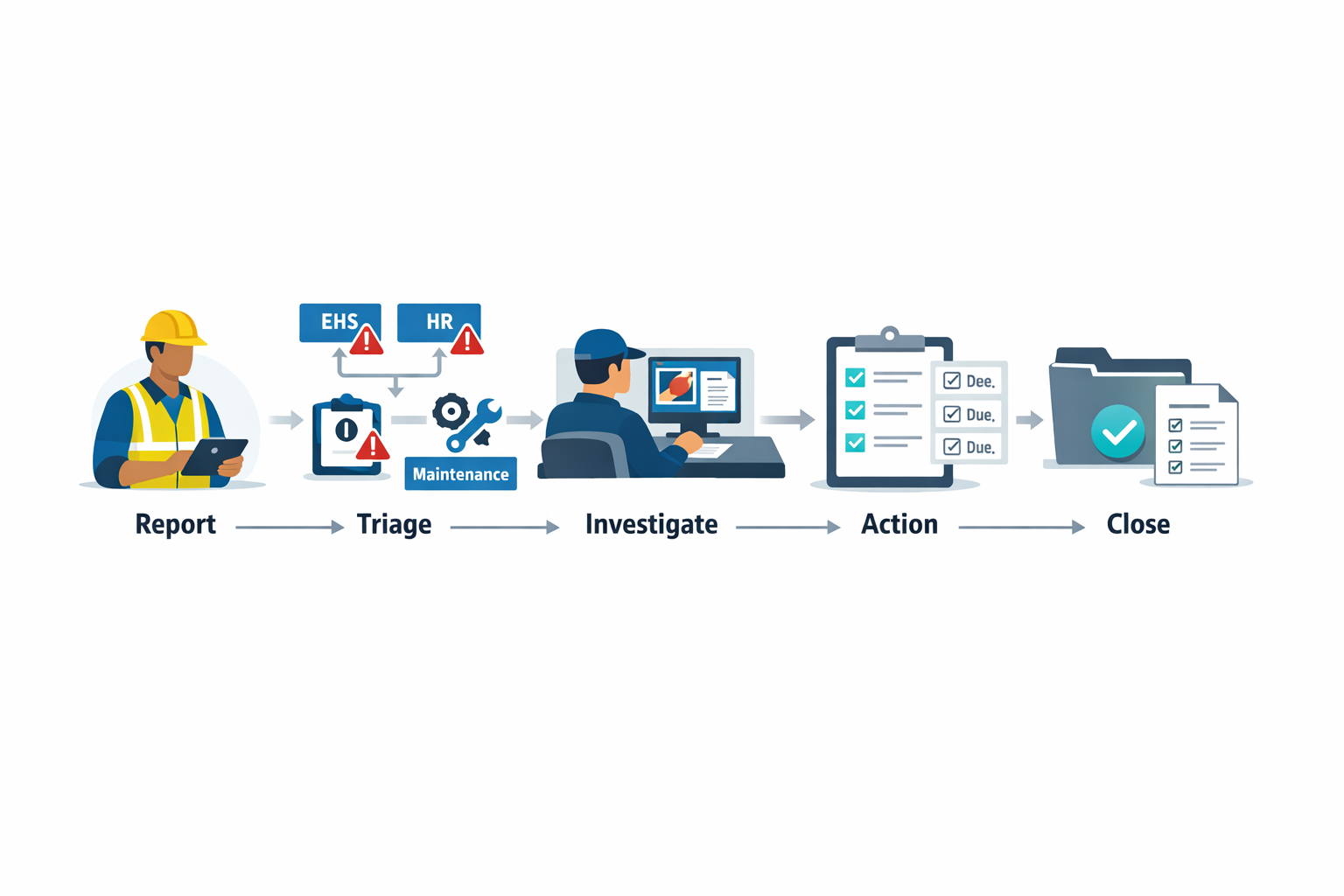
A practical incident workflow moves through five connected stages: report, triage, investigation, corrective action, and closure. After the press injury is logged, the EHS manager reviews facts, assigns an investigator, sets deadlines, and launches follow-up tasks for machine inspection and guard verification. Each handoff is recorded in the same case, so the plant can see status, overdue actions, and approvals without chasing updates across separate tools.
Support Investigation and Root Cause Analysis
An effective system must then support disciplined investigation rather than just store narratives. In our example, the investigator interviews the operator, checks maintenance history, reviews training records, and documents whether the guard issue resulted from wear, bypass behavior, or an incomplete lockout procedure. This is where incident software starts to deliver the benefits of digital incident tracking: faster evidence collection, better consistency, and less dependence on memory.
For manufacturing teams, investigation workflows should also connect to structured methods such as 5 Whys, fishbone analysis, or 8D when required. Not every event needs the same depth, but the system should enforce the level of analysis that matches the severity. That balance is important for anyone considering how to choose incident management software for a plant with both minor events and serious exposures.
Turn Findings Into Corrective Action and Closure
The case is not complete when the cause is identified. The software should assign corrective and preventive actions to named owners, track due dates, escalate overdue tasks, and require evidence before closure. In the press injury case, that may include replacing the guard, retraining operators, updating the inspection checklist, and verifying effectiveness after thirty days.
Preserve Trends and Audit-Ready Records
Closed cases should become usable operational data, not dead files. Manufacturing teams need searchable records, trend views by line or shift, and documentation that supports OSHA reporting and internal audits. OSHA-ready documentation is foundational because if the system cannot produce complete, time-stamped records with actions, approvals, and history, it will fail exactly when regulators, customers, or corporate reviewers ask for proof.
Benefits of Digital Incident Tracking for EHS and IT Leaders
Digital incident tracking changes the value of incident data from a recordkeeping task into an operational control system. For EHS managers, that means faster containment, cleaner investigations, and fewer overdue actions. For IT managers, it means standardized data, controlled access, and less dependence on disconnected spreadsheets. These are some of the most practical benefits of digital incident tracking, and they should shape how you think about choosing incident management software for a manufacturing environment.
Faster Response and Investigation for EHS Teams
Speed matters most in the first hours after an incident, especially when equipment, chemicals, or worker exposure may be involved. A digital system reduces delay by routing reports instantly to supervisors, EHS staff, and maintenance teams instead of waiting for paper forms or email chains. That helps teams start fact gathering while evidence, machine conditions, and witness accounts are still fresh. In manufacturing, even a 24-hour delay can weaken root cause analysis and slow corrective action.
Consider an automotive parts plant handling a forklift collision in the finished goods area. With digital reporting, the shift leader can submit photos, location details, and witness names from a phone before the next shift starts. EHS can begin the investigation the same day, assign actions immediately, and track whether barriers, retraining, or traffic flow changes are completed on time. That is where incident management software delivers measurable value: shorter investigation lag, fewer missed follow-ups, and more consistent closure discipline.
Higher Reporting Adoption From Frontline Teams
Many near misses never make it into formal records because reporting feels slow, unclear, or punitive. Digital forms make reporting easier by reducing the effort needed to document unsafe conditions, minor injuries, or process deviations. When workers can scan a QR code, select a hazard type, and attach a photo in under two minutes, reporting rates usually improve. This matters because organizations with stronger near-miss reporting often identify control gaps before they lead to recordable incidents.
An electronics assembly facility is a good example. After replacing paper cards with a mobile form, the plant saw near-miss submissions rise because operators could report solder fume exposure concerns and slip hazards without leaving the line for long. More reports did not mean the site became less safe; it meant visibility improved. For EHS leaders, that creates earlier intervention, while for plant leadership it creates a clearer picture of whether supervisors are closing risks promptly.
Better Visibility, Governance, and Data Quality for IT
From an IT perspective, the issue is not just collecting more reports but collecting usable data. Digital systems enforce required fields, standardized classifications, timestamps, and role-based permissions, which improves data quality across sites. That makes it easier to support governance, retention, and audit requirements without building manual checks around every spreadsheet. It also reduces the risk of conflicting versions of the same incident record circulating through email attachments.
For a multi-site manufacturer, digital dashboards can reveal recurring patterns that are hard to see in static reports. You can compare incidents by plant, line, shift, injury type, or root cause category and spot where the same breakdown keeps reappearing. A spike in hand injuries on night shift across two facilities, for example, may point to training drift or glove selection issues rather than isolated events.
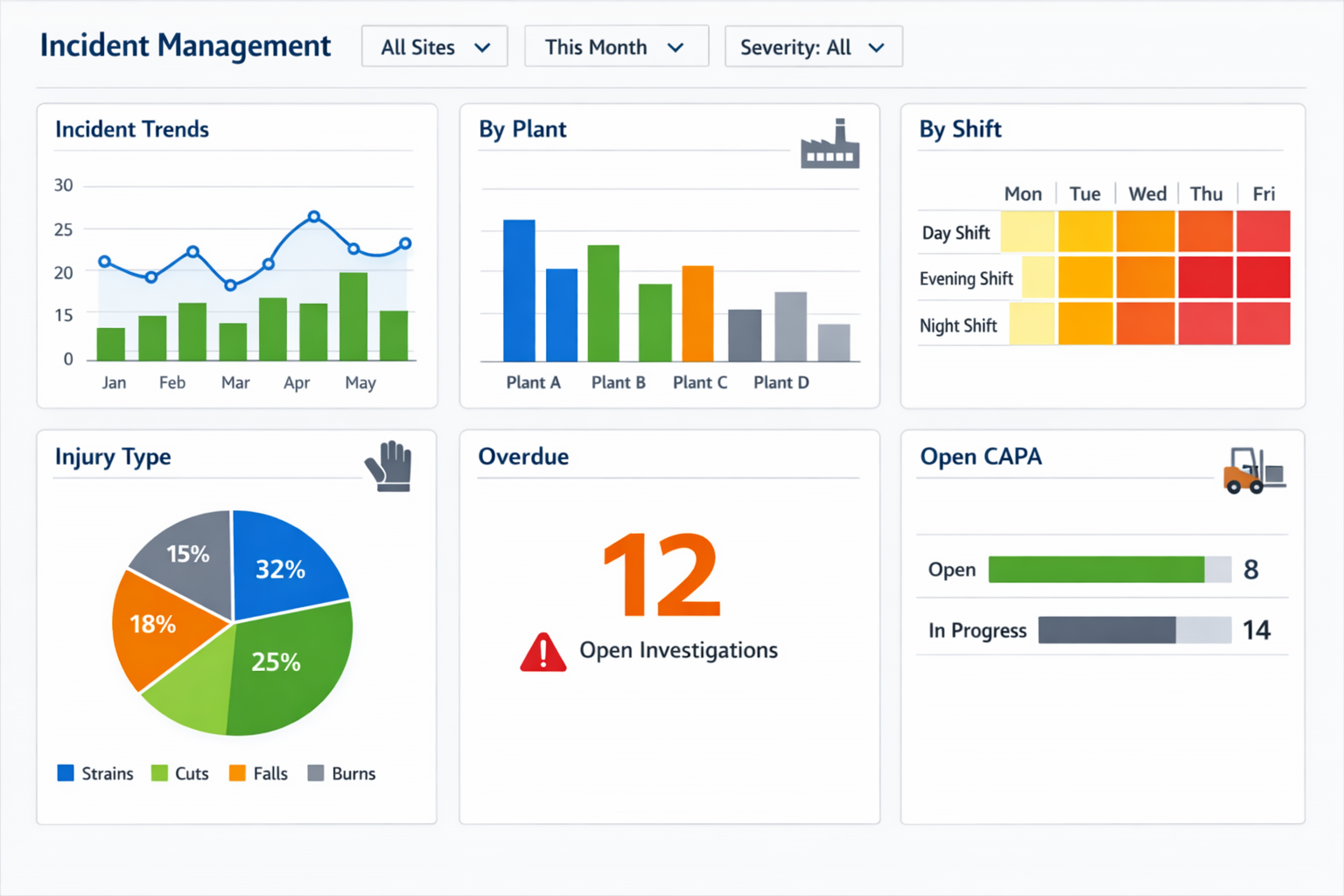
This visibility is also useful when evaluating the key features of EHS incident systems. Clean dashboards help leadership review overdue investigations, open CAPAs, and repeat hazards without waiting for month-end summaries. That gives EHS, IT, and operations a shared dataset for decisions, which is one reason digital reporting should be part of how you choose incident management software.
Key Features of EHS Incident Systems That Actually Work in Manufacturing
When EHS and IT teams compare incident management software, the question is not whether a tool can log an event. Most can. The real test is whether the system can support plant reality: fast reporting on the floor, structured investigation, accountable corrective action, clean data, and records that stand up during audits. That is the difference between a basic reporting app and one of the key features of EHS incident systems that actually works in manufacturing.
Mobile Reporting and Configurable Intake
On a factory floor, reporting speed depends on convenience. A strong system should let operators, supervisors, and contractors submit incidents, near misses, spills, or unsafe conditions from a phone or tablet, with photo uploads, timestamps, location fields, and offline support for weak-connectivity areas such as warehouses, utility rooms, or outdoor yards. If reporting takes more than a few minutes, near-miss capture usually drops.
Forms also need to be configurable by site, hazard type, and process area. A food plant may need contamination and sanitation fields, while a metal stamping plant may need machine guarding, lockout/tagout, and hand injury details. Good incident management software standardizes core records while still allowing each plant to collect the specific data needed for local compliance and investigation quality.
Workflow Automation
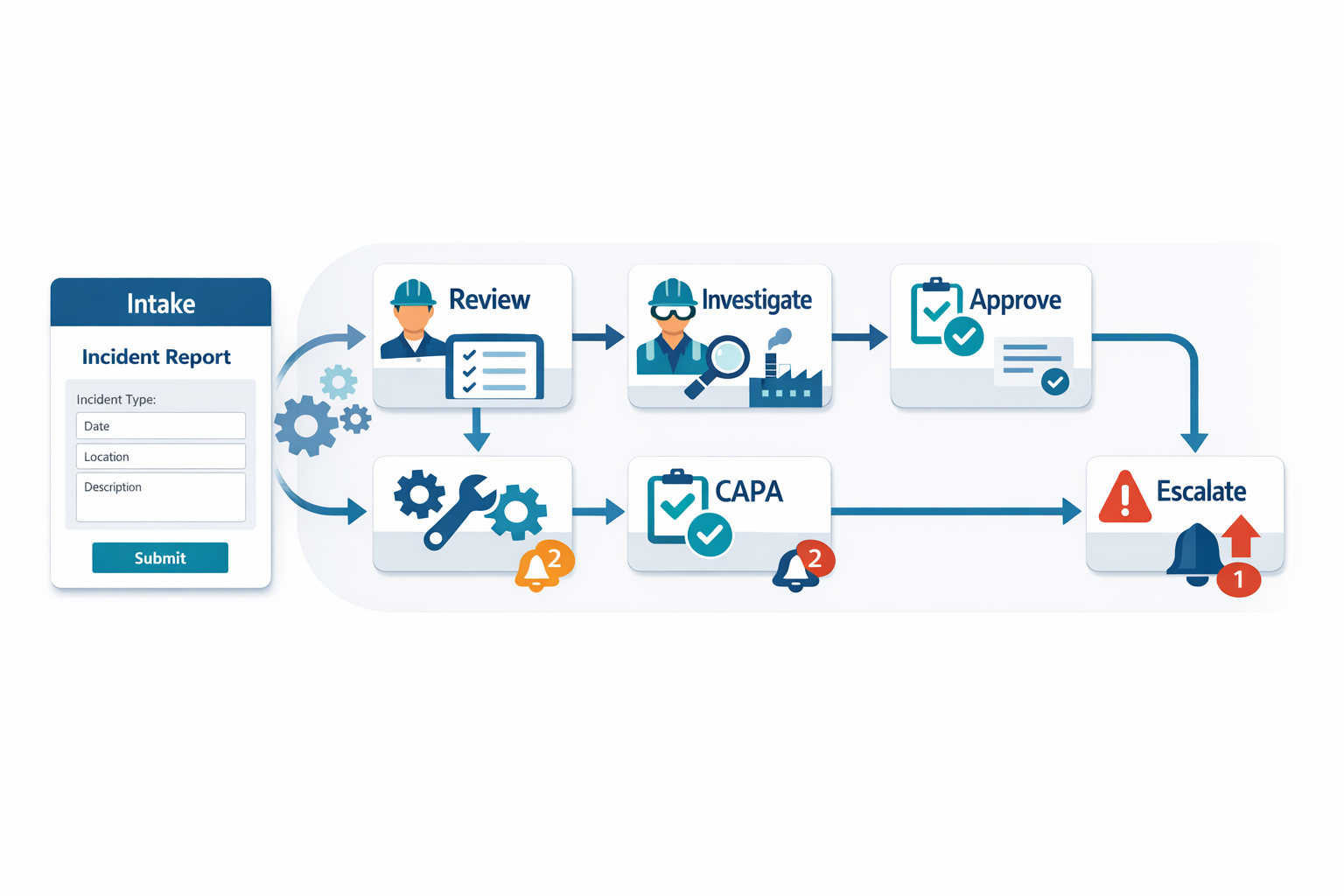
Many manufacturers buy tools that stop at intake. That creates a digital version of the same manual problem: someone reports an incident, then EHS still has to chase investigators by email, assign actions in spreadsheets, and remind department heads to close findings. A better system automates investigation steps, escalation paths, approvals, and corrective action ownership from the start.
Root Cause, 8D, and CAPA Tracking
For manufacturing, investigation workflow matters as much as the form itself. The system should support root cause methods your plants already use, whether that is 5 Whys, fishbone, or an 8D structure for more serious quality or safety events. It should also connect findings directly to corrective and preventive actions, owners, due dates, verification steps, and closure evidence.
A plastics manufacturer, for example, may need an injury case to trigger a supervisor review, EHS investigation, maintenance check, and retraining task in parallel. If CAPA items live outside the incident record, closure becomes hard to prove, and lessons are easy to lose. This is one reason the benefits of digital incident tracking depend heavily on workflow depth, not just reporting speed.
Escalation Rules and Flexible Logic
The best systems let you vary workflow by severity, department, or plant without custom code. A first-aid case in assembly may need only supervisor review, while a lost-time injury in casting may require plant leadership, HR, and corporate EHS notification within hours. That flexibility is central when deciding how to choose incident management software for multi-site operations.
Dashboards, Audit Trails, Integrations, and OSHA Support
Finally, evaluation should focus on control and visibility. Real-time dashboards should show incident rates, open investigations, overdue actions, repeat hazards, and trends by line, shift, and site. Full audit trails should record every edit, status change, approval, and attachment so both EHS and IT can trust the record.
Integration matters when incident data must connect to HR, maintenance, training, or production systems. And for U.S.-regulated operations, OSHA-ready fields and exportable records reduce manual rework during reporting. These are the practical features that separate a usable plant system from software that becomes another disconnected admin tool.
Conclusion: Why Jodoo Is a Strong Fit for Manufacturers Building Modern Incident Workflows
For manufacturers, the right incident management software is not just a reporting tool. It needs to support fast shop-floor reporting, structured investigation, corrective action follow-through, audit-ready records, and clear visibility across sites, shifts, and departments. Just as important, it must fit how your plant actually works instead of forcing EHS and IT teams into rigid workflows that are hard to maintain.
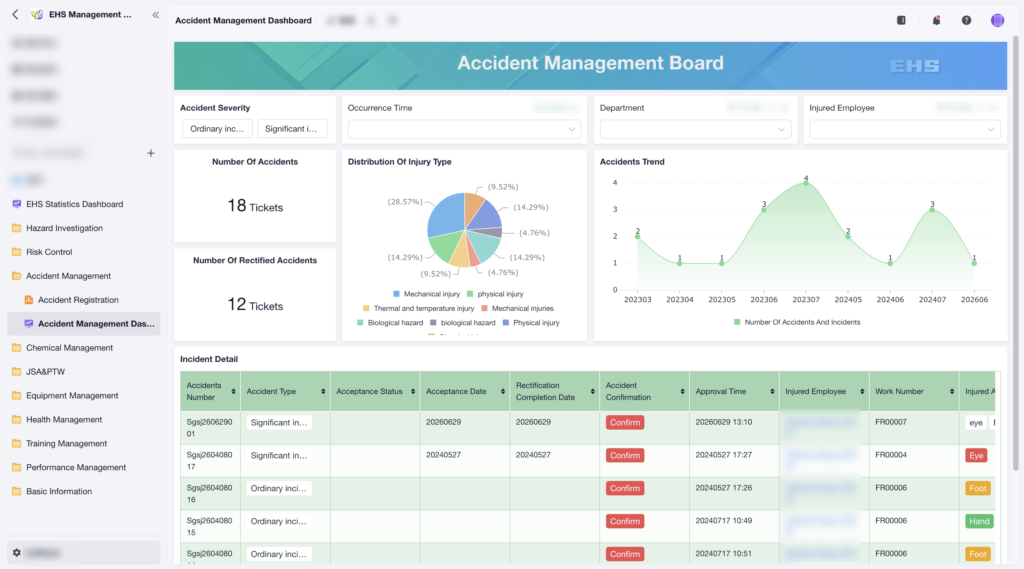
As a no-code lean manufacturing platform, Jodoo lets manufacturers build incident reporting apps and workflows that match their operating reality without waiting on long custom development cycles. An EHS team can set rules so that if an incident is not investigated within 24 hours, the system automatically escalates it to the plant manager or regional EHS lead, while dashboards update in real time for faster decisions.
Because Jodoo also supports forms, workflow automation, dashboards, and integrations in one platform, incident management can connect directly with audits, inspections, CAPA, maintenance, and training records. If you want a more flexible way to digitize incident workflows, you can book a demo or start a free trial with Jodoo.