Browse by category

Introduction: Why Inventory Control Matters for Manufacturers
For many manufacturers, profit does not appear on the income statement first. It gets trapped on the warehouse floor as slow-moving stock, emergency purchases, and production delays. Studies often estimate that carrying inventory can cost 20% to 30% of its value per year once storage, obsolescence, insurance, and financing are included, which is why strong inventory control is as much a cash-flow discipline as it is an operations task.
The challenge is straightforward but difficult to manage in practice: you need enough material to keep production running, but not so much that working capital sits idle in racks, bins, and excess safety buffers. If stock levels are too low, a single supplier delay can stop a line. If they are too high, cash gets tied up in raw materials, work-in-progress, and finished goods that may not move on schedule.
This article looks at practical ways to balance that tradeoff. You will see where ABC analysis, safety stock, and just-in-time principles fit, then how techniques like reorder points, cycle counting, and material workflows translate into daily execution for inventory managers and supply chain leaders.
The Manufacturing Inventory Control Challenge: Balancing Stock, Service Levels, and Cash Flow
When Day-to-Day Inventory Signals Start Breaking Down
Consider a mid-sized electronics assembly plant producing control panels for industrial customers. On paper, the plant carries six weeks of component inventory, yet supervisors still escalate shortages of terminals, relays, and wiring harnesses during peak orders. At the same time, finance sees too much cash tied up in slow-moving imported parts that were bought “just in case.” This is the practical inventory control problem in manufacturing: high stock does not always mean high availability.
The first symptom is usually instability on the shop floor rather than in the warehouse. Production planners release jobs assuming materials are available, but operators discover missing items only when kits reach the line. WIP then starts to pile up between assembly steps because one missing component can hold an otherwise complete batch. What looks like a planning issue is often an inventory execution issue.
Why Raw Materials Variability Creates Constant “Firefighting” Actions
In many factories, raw materials do not arrive with perfectly stable lead times, quantities, or quality. A supplier may promise a ten-day lead time but actually deliver in seven days one month and fifteen the next, while incoming lots may also contain short shipments or failed inspections. For the electronics plant, a delayed relay shipment does not just affect one SKU; it disrupts multiple panel variants scheduled for the same week. That is why learning how to manage raw materials inventory starts with variability, not just stock levels.
This variability pushes planners toward defensive buying. They raise order quantities, add buffer stock, and keep alternative materials wherever possible. Those actions protect output in the short term, but they also increase storage costs, aging risk, and the chance that records no longer reflect what is physically usable. The plant feels safer, yet control becomes weaker.
Where WIP Visibility Gaps Distort the Real Picture
Once materials move from stores to production, visibility usually drops. In many manufacturers, raw material receipts are recorded carefully, but line-side usage, returns, scrap, and partial batch consumption are updated late or not at all. In the running example, the warehouse system shows 2,000 terminals on hand, but 600 are already sitting in open kits, 150 were scrapped during rework, and 200 were returned without immediate posting. The book balance is technically positive, but the usable balance is wrong.
That gap matters because WIP hides both shortages and excess. Teams may reorder parts that are already somewhere on the floor, while truly critical shortages stay invisible until the next job starts. This is also why many discussions about the best inventory control techniques for manufacturing fail in practice: the method may be sound, but the transaction data underneath it is unreliable.
The Core Tradeoff: Protection vs. Carrying Cost
Every manufacturer is balancing three competing priorities: preventing stockouts, controlling carrying costs, and keeping production flowing. If the electronics plant cuts inventory too aggressively, line stoppages increase, and customer shipments slip. If it overcompensates, working capital rises, storage space tightens, and obsolete stock accumulates when the product mix changes.
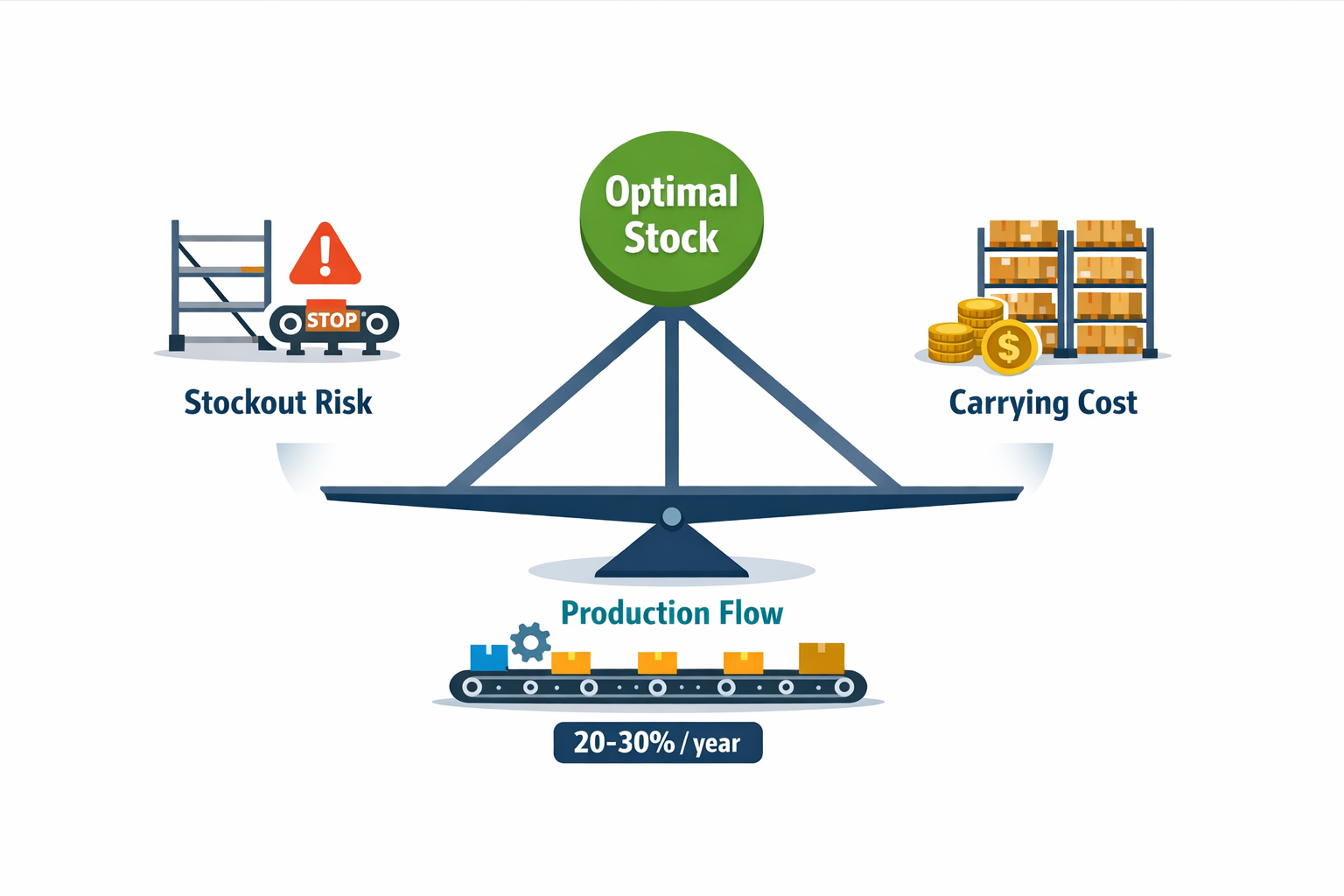
The financial effect is larger than many teams expect. Carrying inventory often costs 20% to 30% of inventory value per year when storage, handling, insurance, obsolescence, and cost of capital are included. At the same time, a single hour of downtime in discrete manufacturing can cost thousands of dollars in lost labor efficiency, schedule disruption, and expedited freight. Inventory control is therefore not about minimizing stock at all costs; it is about placing the right stock in the right place with the fewest distortions.
How Small Record Errors Become Business-Level Impact
Inaccurate counts are usually the link between operational noise and financial underperformance. A missed goods receipt, an unrecorded material return, or an incorrect unit conversion seems minor, but repeated across hundreds of transactions, those errors distort purchasing, planning, and production promises. In the plant example, buyers respond to false shortages with urgent orders, while planners delay other jobs because the system cannot distinguish available stock from committed stock.
The result is a double penalty: excess inventory in some categories and stockouts in others. Service levels fall because shipments become less predictable, while cash flow weakens because more money is locked into materials that do not improve output. For manufacturers focused on reducing inventory costs without stockouts, this is the real challenge to solve before any technique can deliver consistent results.
Best Inventory Control Techniques for Manufacturing and When to Use Them
ABC Analysis, Safety Stock, and JIT
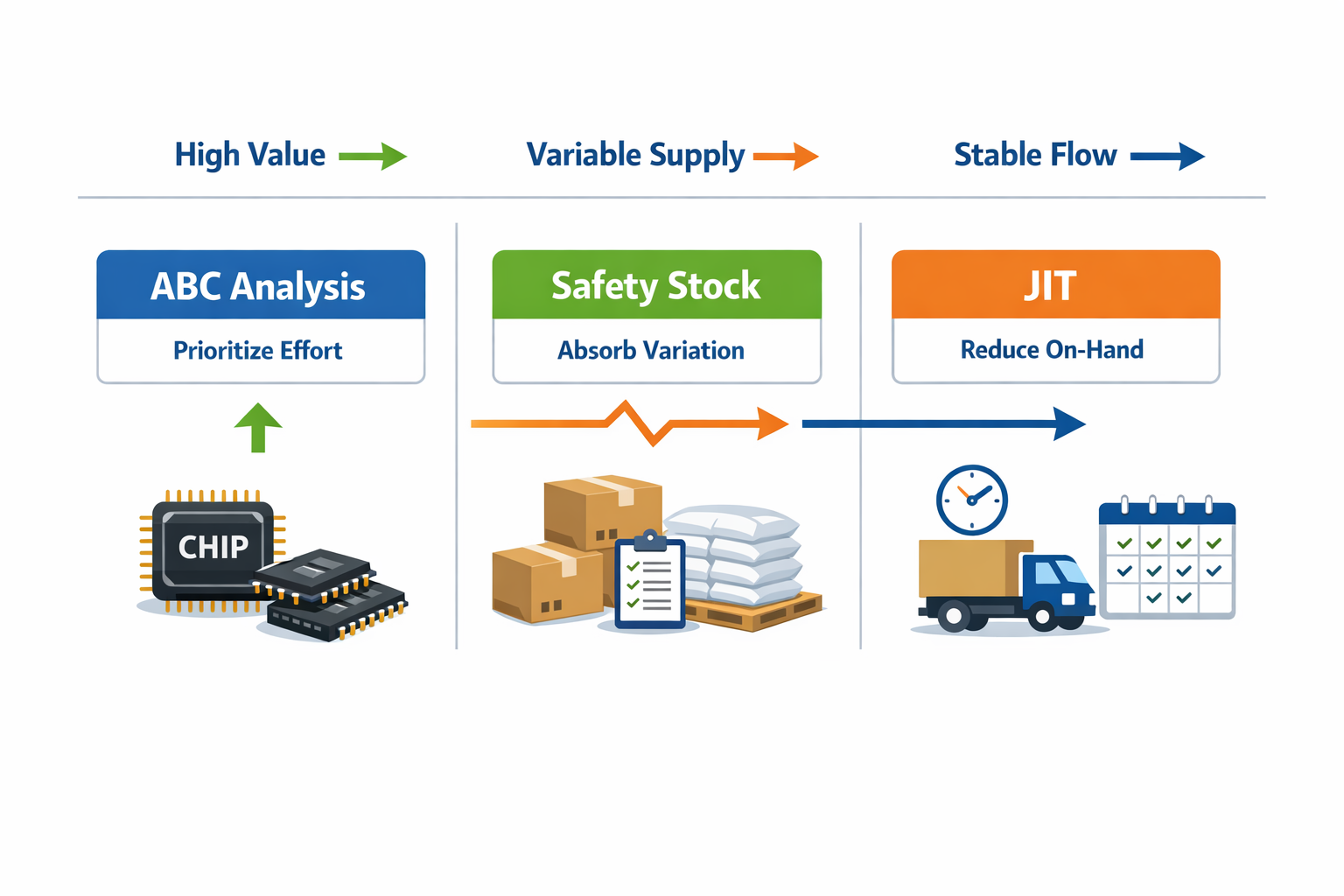
The best inventory control techniques for manufacturing are not interchangeable. ABC analysis helps you focus effort on the few items that drive most inventory value; safety stock protects production from demand or lead-time variation, and just-in-time (JIT) reduces on-hand stock where supply is stable and replenishment is frequent. In practice, many manufacturers use all three, but on different item groups rather than across the entire storeroom.
A printed circuit board plant, for example, may apply tight controls and daily review to imported microchips, hold calculated safety stock for packaging materials with variable supplier performance, and run near-JIT replenishment for locally sourced labels delivered every two days. That is the real decision logic: not which method is “best” overall, but which method fits the material’s value, volatility, and replenishment reliability. If you are trying to reduce inventory costs without stockouts, this combination approach is usually more effective than a single policy.
Use ABC Analysis to Prioritize Control Effort
ABC analysis is most useful when your team cannot manage every SKU with the same level of attention. In many factories, 10% to 20% of items account for 70% to 80% of inventory value, making equal control effort inefficient. Classifying items by annual consumption value lets you assign tighter review cycles, approval rules, and count frequency to A-items, while simplifying control for lower-value C-items.
This method fits multi-SKU environments such as electronics, automotive components, and industrial assembly, where purchasing teams juggle hundreds or thousands of part numbers. Its strength is focus, but its tradeoff is that value alone does not capture production criticality. A low-cost gasket can still stop a line, so many manufacturers combine ABC with criticality or lead-time risk.
Use Safety Stock and Reorder Points to Absorb Variability
Safety stock and reorder points work best when demand or supplier lead times are not fully predictable. A reorder point sets the stock level that triggers replenishment, while safety stock gives you a buffer against delays, forecast error, or scrap spikes. This is especially relevant in managing raw materials inventory for imported resin, chemicals, or metal stock with long and variable lead times.
A practical formula is: Reorder Point = Demand During Lead Time + Safety Stock. If a plant uses 500 kg of resin per week and the lead time is 3 weeks, the baseline demand during lead time is 1,500 kg; if variation analysis suggests a 300 kg buffer, the reorder point becomes 1,800 kg. The tradeoff is straightforward: buffers improve continuity, but they also increase carrying cost, storage space, and obsolescence risk.
Use Cycle Counting and FIFO to Improve Accuracy and Material Discipline
Cycle counting is a control technique for accuracy, not replenishment. Instead of shutting down for a full annual count, you count selected items throughout the month, often with A-items checked weekly and C-items monthly or quarterly. Manufacturers using cycle counts often improve record accuracy faster because discrepancies are found close to the transaction date, when root causes are still visible.
FIFO matters most for materials with shelf life, quality drift, or cost exposure across batches. Food ingredients, adhesives, coatings, and rubber compounds are common examples. The benefit is lower expiry and traceability risk, while the tradeoff is stricter location control and shop-floor discipline.
Use EOQ and Kanban When Demand Is Repeatable
EOQ is useful when demand is relatively stable and ordering or setup cost is high. It helps determine an economical order size by balancing purchase frequency against holding cost, making it practical for standard consumables or repetitive indirect materials. The limitation is that EOQ assumes relatively steady conditions, so it becomes less reliable when demand swings sharply.
Kanban or pull replenishment works well for high-runner items consumed at a predictable rate near the line. A two-bin system for fasteners or packaging inserts is a simple example. The advantage is visual control and faster replenishment decisions, but it depends on disciplined replenishment signals and stable usage patterns.
Reducing Inventory Costs Without Stockouts: From Spreadsheets to Digital Control Workflows
Where Manual Inventory Control Breaks Down
Once you have chosen the right control methods, the next challenge is execution. Many manufacturers already know the best inventory control techniques for manufacturing, but they still lose cash because stock movements are recorded late, adjusted informally, or checked only during month-end reconciliation. In practice, the issue is not always planning logic; it is weak transaction discipline on the shop floor and in the storeroom.
Designing A Simple Digital Workflow Before A Full ERP Change
You do not need a full ERP replacement to fix these execution gaps. In many factories, the fastest way to reduce inventory costs without stockouts is to digitize the high-risk transactions first: receipt, issue, return, adjustment, and count verification. That gives you cleaner stock data, faster exception handling, and a better basis for supplier and purchasing decisions.
With Jodoo, a manufacturer can build a no-code inventory workflow that fits existing store and production processes rather than forcing a new system rollout across every department. For the packaging plant, each material lot can carry a QR code linked to the item code, supplier batch, receipt date, location, and available quantity. Store staff scan the code during check-in, production staff scan again during line issue, and any unused material returned from the line is scanned back into stock with reason codes and quantity validation.
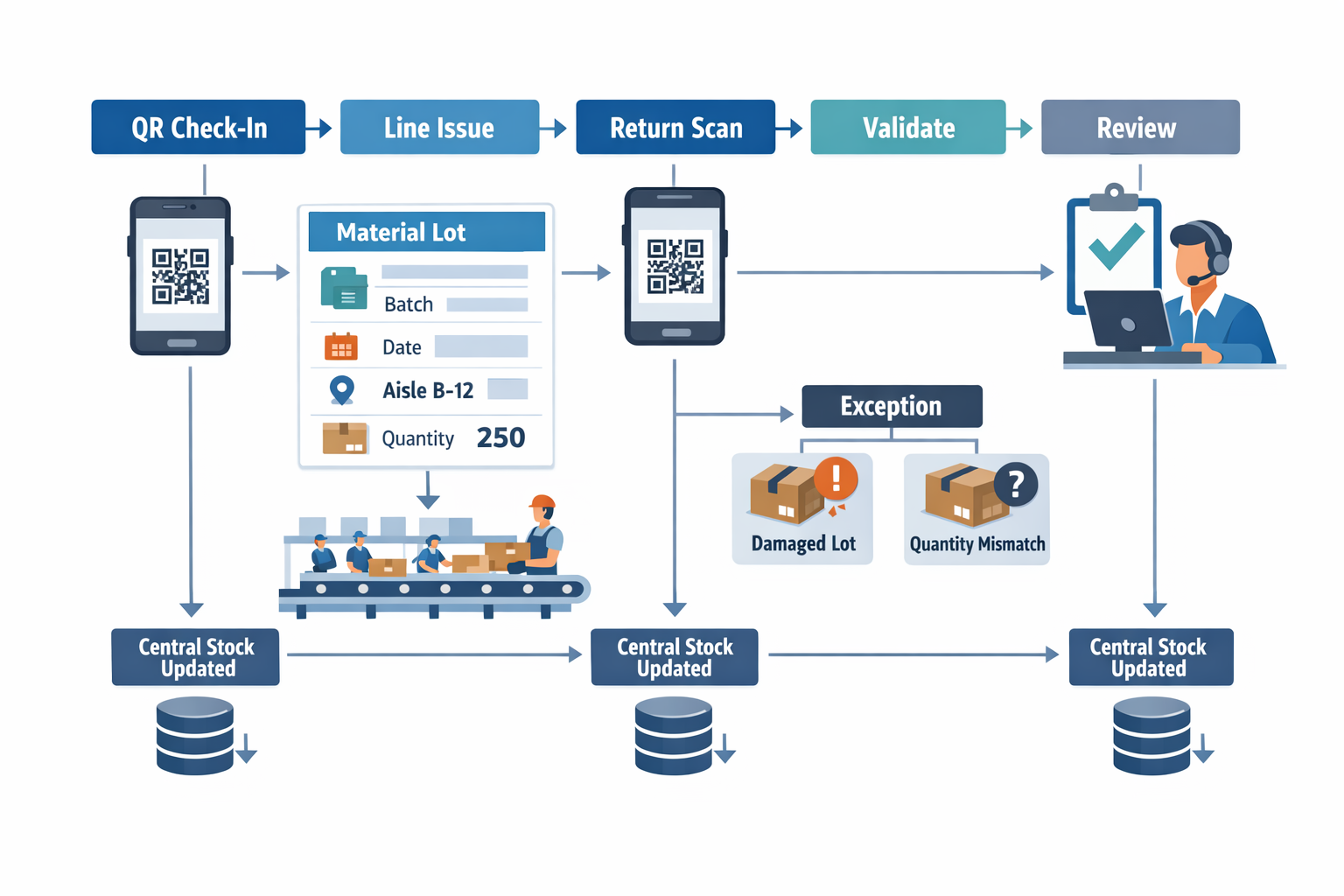
Because the transaction is captured at the point of movement, the central stock record updates automatically instead of waiting for spreadsheet consolidation. Jodoo’s form logic can require mandatory fields, block incomplete entries, and route abnormal transactions such as damaged lots or quantity mismatches for supervisor review. That is where no-code fits well alongside ERP or MRP: it closes operational data gaps at the execution layer while the core planning or financial system remains in place.
Building Audit Discipline Into Daily Inventory Work
Digital control works only if exception handling is built into the routine. For example, if the packaging plant’s night shift issues resin from the wrong bin, the workflow should not just log the transaction; it should flag the location mismatch, notify the store lead, and create a follow-up task before the next shift begins. This turns inventory control from passive recordkeeping into active process control.
Jodoo also helps standardize cycle count discipline without adding heavy administrative work. Teams can assign scheduled counts by zone, require photo evidence for damaged packaging, and compare counted versus system quantity in one workflow. Instead of waiting for a major stock discrepancy to appear in finance reports, inventory managers can catch repeat errors by operator, location, or material type within days.
Turning Stock Data Into Actionable Visibility
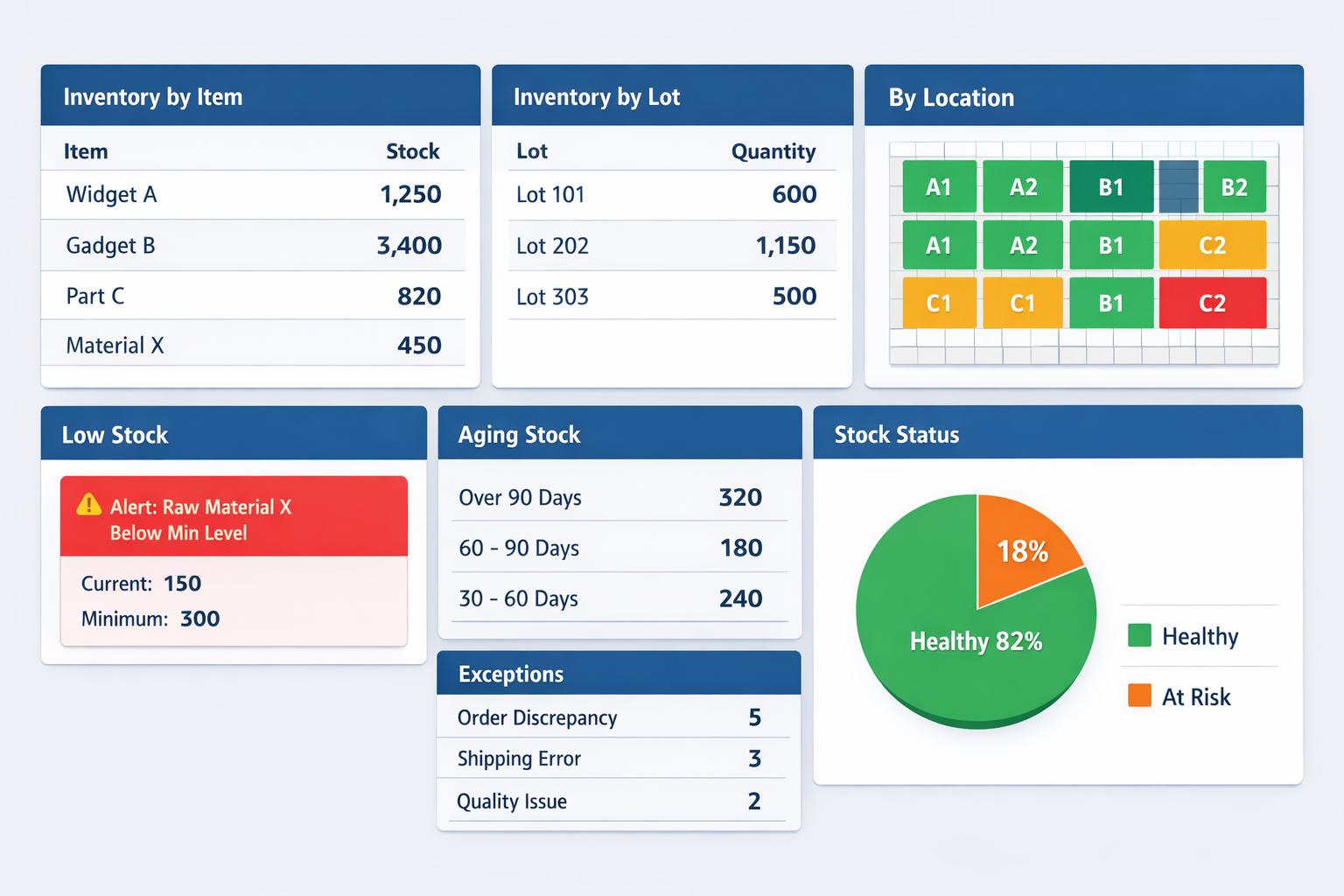
Better execution matters because visibility improves with it. When receipt, issue, return, and count data flow into one database, purchasing managers can see which materials are truly available, which lots are aging, and which items are approaching reorder thresholds. That is especially useful for teams still refining how to manage raw materials inventory across multiple suppliers and variable lead times.
Jodoo can trigger low-stock alerts automatically when on-hand quantity falls below the threshold set for a specific raw material or warehouse location. In the packaging example, if additive stock drops below the minimum needed for two production days, the purchasing manager receives a notification immediately rather than discovering the shortage during the next manual review. Dashboards then show live inventory by item, lot, location, and exception status, helping managers act on shortages, excess, and transaction errors before they become cost problems.
Conclusion: Build a Practical Inventory Control System With Jodoo
Effective inventory control is not about keeping the lowest possible stock or building the largest safety buffer. It comes from matching the right techniques to your production reality, then executing them consistently every day. For most manufacturers, that means combining methods such as ABC analysis, reorder points, safety stock, cycle counting, FIFO, and pull-based replenishment based on material criticality, lead-time risk, and demand variation.
Just as important, good inventory control depends on disciplined execution on the shop floor. If receipts are delayed, issues are not recorded, returns are missed, or stock counts are unreliable, even a well-designed policy will fail. That is why manufacturers need not only planning rules, but also clear workflows, accurate transactions, and fast visibility into exceptions that affect production and cash flow.
Jodoo helps manufacturers put that discipline into practice as a no-code lean manufacturing platform. You can digitize inventory check-in and check-out, standardize approvals, track stock movements in real time, and surface low-stock risks through dashboards and alerts without heavy custom development. If you want to improve stock accuracy and make faster inventory decisions, you can start a free trial or book a demo with Jodoo.