Browse by category

Introduction: What ISO 9001 Means for Manufacturers Today
For many manufacturers, the hardest part of ISO 9001 is not understanding the standard. It is proving, every day, that quality controls actually happen as defined across production, purchasing, inspection, maintenance, and corrective action. That matters because poor quality is expensive: according to ASQ, the cost of poor quality can reach 15% to 20% of sales revenue in some organizations, and much of that loss comes from weak process control, rework, delays, and customer complaints.
In practical terms, ISO 9001 is a framework for building a quality management system that is consistent, traceable, and repeatable. Quality managers care because it strengthens audit readiness and CAPA discipline. Compliance officers care because it creates documented control over records, approvals, and responsibilities. Plant managers care because a working QMS reduces variation, scrap, missed handoffs, and avoidable disruption on the shop floor.
This article explains the ISO 9001 requirements in plain manufacturing language, walks through the certification process step by step, and shows how to prepare without turning your QMS into a paperwork burden. The goal is simple: make ISO 9001 part of daily operations, not a once-a-year audit exercise.
ISO 9001 Requirements Explained for Manufacturing Operations
To make ISO 9001 requirements easier to apply, it helps to read the standard as an operating system for quality rather than a stack of clauses. ISO 9001:2015 is built around seven practical areas that shape how work is planned, executed, checked, and improved.
Context, Leadership, and Planning
Clause 1, context of the organization, asks you to define what affects your quality management system and where it applies. In a general manufacturing plant, that may include customer specifications, supplier stability, machine capability, labor turnover, and regulatory obligations. In an automotive supplier, scope decisions often include traceability, customer-specific requirements, and outsourced heat treatment or plating processes.
Clause 2, leadership, is where many systems either become real or remain symbolic. Top management is expected to set the quality policy, assign responsibilities, and ensure quality objectives are aligned with business priorities such as scrap reduction, on-time delivery, or warranty performance. On the plant floor, that shows up in visible ownership: production supervisors acting on nonconformance trends, engineering closing corrective actions, and managers reviewing quality results regularly.
Clause 3, planning, focuses on risks, opportunities, and measurable objectives. For an electronics assembler, a planning exercise might identify ESD handling, component obsolescence, and operator certification as key quality risks, then define controls and targets around first-pass yield and defect escapes.
Support and Operational Control
Clause 4, support, covers the resources that make the system function: people, competence, infrastructure, monitoring equipment, documented information, and communication. In practice, this includes calibration records, training matrices, work instructions, revision control, and clear communication of process changes across shifts. In electronics and precision manufacturing, weak control here often causes downstream defects because operators are working from outdated instructions or using instruments past calibration due dates.
Clause 5, operation, is the most visible part of the standard for production teams because it governs how products are made and controlled. It includes contract review, design and development where applicable, purchasing control, production planning, identification and traceability, preservation, release, and control of nonconforming outputs.
Performance Evaluation and Improvement
Clause 6, performance evaluation, requires manufacturers to monitor, measure, analyze, and review whether the system is working. Typical plant-level evidence includes internal audit results, customer complaints, supplier defects, scrap trends, rework hours, on-time delivery, and process capability data.
Clause 7, improvement, turns findings into action. This includes handling nonconformities, taking corrective action, and pursuing continual improvement based on data rather than assumption. In a consumer electronics factory, if final inspection shows repeated solder bridging on one line, the response should move beyond sorting the affected boards to identifying root cause, updating process parameters, retraining operators, and verifying effectiveness.
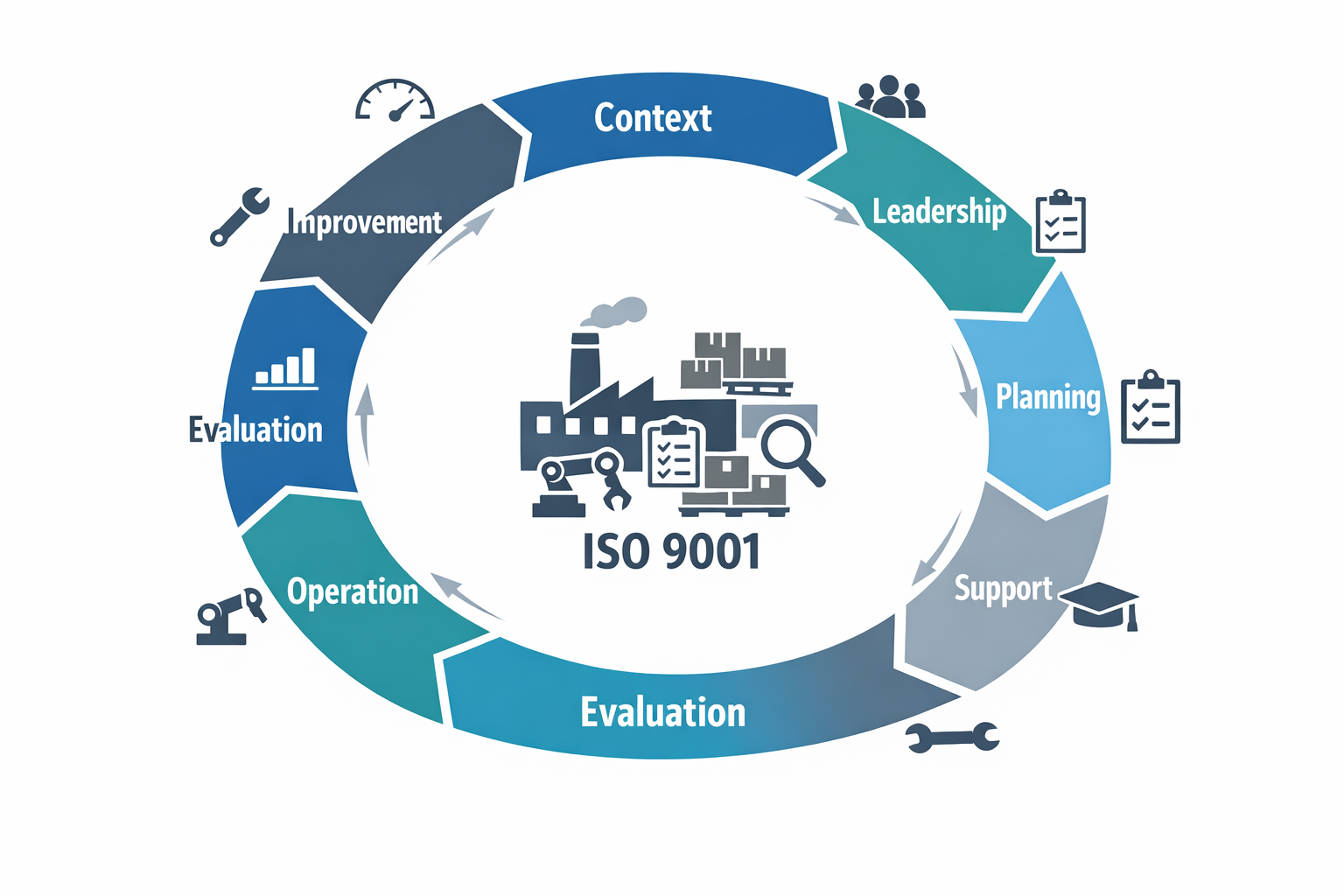
The reason ISO 9001 requirements are best understood together is that they form a closed-loop system. Context defines what matters, leadership sets direction, planning decides what to control, support provides the resources, operation runs the process, performance evaluation measures results, and improvement closes the loop when gaps appear.
How to Get ISO 9001 Certified: The Step-by-Step Process
1. Define Scope, Team, and Timeline
If you want to know how to get ISO 9001 certified, start by defining exactly what the certification will cover. For a manufacturer, that usually means specific products, processes, and sites rather than the whole business by default. A practical first step is to appoint a cross-functional team led by quality, with operations, engineering, purchasing, HR, and maintenance involved. In our running example, a precision metal parts plant in Penang scopes certification to its CNC machining, surface treatment, final inspection, and shipping operations.
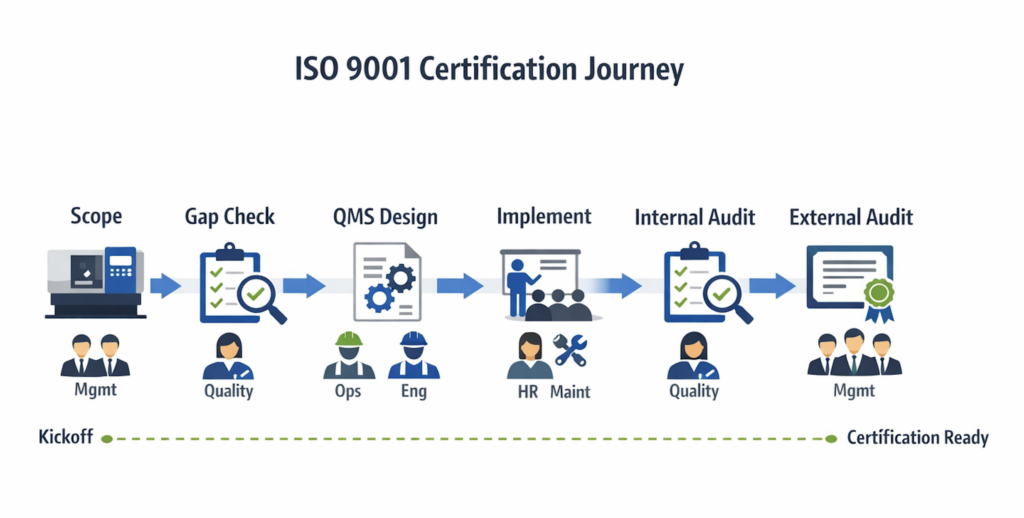
The certification path usually moves through six stages: scope setting, gap assessment, QMS design, implementation, internal audit, and the external certification audit. Ownership also shifts as the project progresses, with quality leading the framework, department heads owning execution, and top management validating direction and resources.
2. Run a Gap Assessment Against ISO 9001:2015
Once scope is clear, compare current practices against ISO 9001:2015 requirements explained in operational terms. This is not just a document review; it should include shop floor observation, interviews, and record sampling. You are looking for missing controls, inconsistent execution, and weak evidence. In the Penang plant, the team finds that inspection criteria exist, but operator training records, supplier evaluation evidence, and formal change-control approvals are incomplete.
A good gap assessment ranks findings by risk and audit impact. For example, missing calibration records for critical gauges is more urgent than inconsistent document formatting. Many manufacturers complete this step in 2 to 6 weeks, depending on site complexity and how much of the QMS already exists. The output should be a prioritized action plan, not a long checklist that nobody owns.
3. Build and Update the QMS Documentation
After the gap assessment, the next step is to build only the documentation needed to control the process and prove control. ISO 9001 does not require a bloated manual, but it does require clear, maintained documented information where the business needs it. That usually includes a quality policy, quality objectives, process maps, procedures, work instructions, forms, and records. In the running example, the plant standardizes document control for setup approval, first-piece inspection, nonconformance handling, and supplier corrective action.
The best documentation reflects how work actually happens. If a procedure says production supervisors review scrap daily, there should be a real review method, a named owner, and retained records. Keep language simple enough for supervisors and operators to use under production pressure. Certification auditors look for alignment between documented process, actual practice, and objective evidence.
4. Implement the System and Train the Plant
Documentation alone does not move a factory toward certification; implementation does. This is where department managers convert procedures into routine behavior through training, visual controls, approval rules, and recordkeeping. At the Penang site, quality trains inspectors on revised defect coding, production trains line leaders on escalation steps, and purchasing adopts a formal supplier re-evaluation schedule. Most manufacturers need 8 to 12 weeks here before the system produces enough consistent records for audit readiness.
5. Conduct Internal Audits and Management Review
Before inviting a certification body, test the system through internal audits. Internal auditors should verify whether processes conform both to ISO requirements and to the company’s own procedures. In the example plant, auditors sample training records, production orders, maintenance logs, and CAPA files across two shifts to check whether the QMS works consistently, not only during office hours.
Management review comes next and should assess the full system, not just audit results. Top management should review quality objectives, customer feedback, process performance, nonconformities, corrective actions, supplier issues, and resource needs. This review is often the final checkpoint before Stage 1 and Stage 2 certification audits. Any open issues should have owners, deadlines, and evidence of follow-up.
6. Prepare for Stage 1 and Stage 2 Certification Audits
The external audit typically happens in two parts. Stage 1 reviews your readiness, scope, documentation, and understanding of key processes, while Stage 2 evaluates implementation and effectiveness on the ground. In many mid-sized plants, the full certification cycle from kickoff to audit takes 3 to 6 months, though multi-site or highly regulated operations may take longer.
Common ISO 9001 Preparation Challenges in Manufacturing
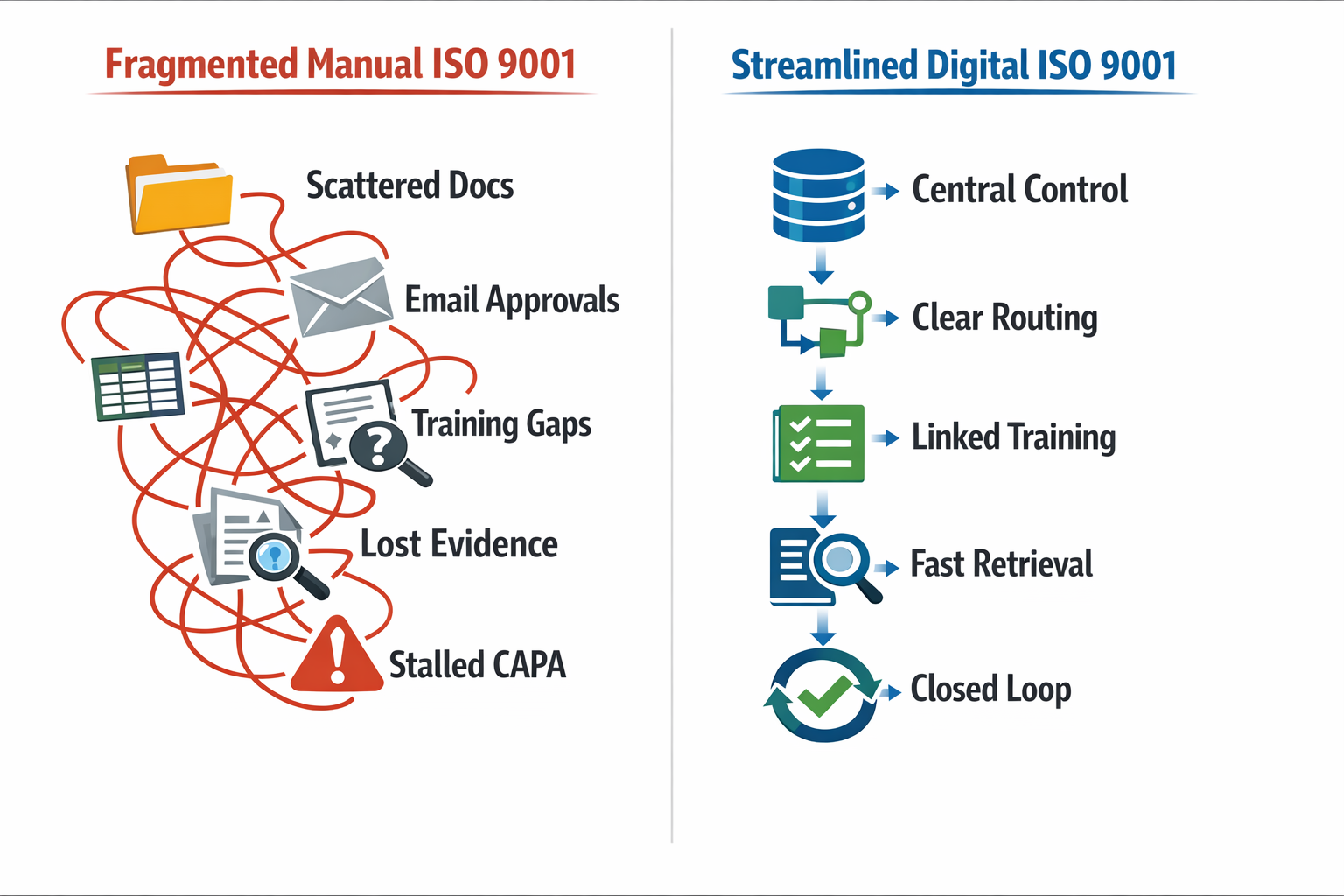
Many manufacturers do not struggle because the ISO 9001 requirements are unclear. They struggle because the quality system works differently in each department, shift, and plant. On paper, the procedures exist; in daily operations, approvals happen by email, training is tracked in separate files, and audit evidence sits across shared folders, binders, and personal spreadsheets. That gap between documented intent and repeatable execution is what usually slows down teams trying to figure out how to get ISO 9001 certified and keep the system sustainable after the audit.
Scattered Document Control
Document control is often the first weak point auditors notice because it affects almost every other process. A manufacturer may have approved work instructions, inspection standards, and calibration procedures, but operators still print old versions, supervisors save local copies, and engineering updates do not reliably reach production.
Inconsistent Approval Workflows
Approval workflows also break down when they depend on inboxes and verbal follow-up rather than defined routing. A deviation request may need sign-off from production, quality, and engineering, yet one approver responds in email, another marks up a PDF, and a third gives verbal approval during a shift meeting. When records are later reviewed, the factory cannot clearly show who approved what, when, and under which conditions.
Manual quality processes create delays and ambiguity because status is not visible in real time. Controlled digital workflows, by contrast, route the request to the right role, time-stamp each decision, and preserve the approval trail in one record. That difference matters not just for certification, but for day-to-day containment, release, and change control.
Weak Training Records and Competence Tracking
Training records are another frequent problem area, especially in plants with high turnover, multiple shifts, or frequent process changes. HR may store induction records, supervisors may track on-the-job training separately, and quality may maintain a skills matrix that is updated only before customer visits. As a result, the organization cannot quickly confirm whether a specific operator was trained on a revised instruction, inspection method, or machine setting.
In electronics assembly, this becomes critical when soldering standards, ESD controls, or rework criteria change. If competence records are incomplete, the company may be following the right procedure on paper while assigning work to people whose qualification status is unclear. Auditors do not only ask whether training occurred; they often ask for objective evidence tied to role, date, and current revision.
Disconnected Audit Evidence
Internal audits often expose another weakness: evidence exists, but it is difficult to retrieve. Maintenance logs may sit in one system, first-pass yield data in another, and supplier corrective actions in email threads. During audit preparation, quality teams then spend days chasing screenshots, signatures, and spreadsheets just to reconstruct a single process trail.
CAPA That Stalls After Initial Action
Corrective and preventive action is where many ISO 9001 programs lose momentum after the first audit cycle. Teams are usually good at logging a nonconformance and assigning immediate containment, but follow-up actions often live in spreadsheets or email reminders with no clear escalation. Root cause analysis gets delayed, effectiveness checks are missed, and repeated issues quietly return to the same lines or suppliers.
That matters because CAPA is one of the clearest indicators of whether the quality system actually drives improvement. Manufacturers seeking certification often focus on passing the audit, but long-term performance depends on closing the loop between issue detection, action, verification, and learning. If that loop is not visible and disciplined across departments, certification becomes much harder to sustain.
How Jodoo Helps Manufacturers Prepare for ISO 9001 Compliance
Build the QMS Around Real Factory Work
Once you move from understanding ISO 9001 requirements to implementing them, the challenge is rarely the standard itself. The harder part is turning procedures, approvals, audits, and corrective actions into repeatable daily work across production, quality, engineering, and HR. This is where Jodoo fits: not as a replacement for your ERP or MES, but as a no-code layer that standardizes quality workflows, captures evidence, and makes records easier to control.
Centralize Document Control and Approval Routing
Jodoo can be used to build a document control app with revision fields, effective dates, owners, approval steps, and access permissions by role or department. Instead of emailing SOP revisions or storing uncontrolled files in shared folders, the quality team can route work instructions, inspection standards, and quality procedures through structured approval workflows. That gives manufacturers a clear approval trail, version history, and evidence that only current documents are in use.
Digitize Internal Audits and Training Acknowledgments
Jodoo also helps translate audit preparation into structured execution. Quality teams can create mobile audit checklists by process, line, or department, with required fields for findings, photos, severity, and follow-up owners. Internal audit records become searchable and standardized, which reduces the time spent compiling evidence before a surveillance or certification audit.
The same approach works for competence and awareness records. When the revised soldering standard is approved, Jodoo can automatically send acknowledgment tasks to line leaders and inspectors, collect digital sign-off, and record completion dates by employee.
Make CAPA and Nonconformance Records Easy to Retrieve
Corrective action often breaks down when nonconformance data, root cause analysis, and closure evidence sit in separate emails, files, and spreadsheets. Jodoo can connect nonconformance reports, containment actions, root cause analysis, CAPA tasks, verification results, and approval status in one workflow-driven record. That structure helps teams move faster from issue detection to verified closure without losing auditability.
Use Dashboards for Management Review and Audit Readiness
Management review is easier when quality data is already structured. Jodoo dashboards can pull live information from audit findings, overdue CAPAs, training completion, supplier issues, and defect trends into one view for plant leadership. That gives quality managers a practical way to present progress, risks, and recurring issues without manually merging reports every month.
For the electronics manufacturer, the plant manager can review open major findings, average CAPA closure time, document revision status, and training completion by department before the formal review meeting. This supports faster decisions on staffing, process priorities, and escalation. It also helps maintain readiness between audits, which is often the difference between getting certified once and sustaining the system afterward.
Fit Jodoo Alongside ERP and MES
For most manufacturers, Jodoo works best as the workflow and compliance layer around existing systems. ERP and MES remain the systems of record for production, inventory, and machine or traceability data, while Jodoo manages the approval-heavy quality processes those systems usually do not handle well. That makes it a practical option for companies that have outgrown spreadsheets but do not want the cost, implementation time, or rigidity of heavyweight QMS software.
Conclusion: Turn ISO 9001 Requirements Into an Audit-Ready Operating System
For manufacturers, ISO 9001 works best when it is built into daily operations, not managed as a separate compliance project. The plants that sustain certification most effectively are usually the ones that turn document control, training, audits, nonconformance handling, and corrective actions into repeatable workflows with clear ownership. That approach reduces audit stress, shortens response time when issues occur, and makes continuous improvement easier to maintain across shifts, lines, and departments.
The core lesson is simple: certification is not just about having procedures on file. It is about proving that your quality management system is consistently followed, reviewed, and improved with objective evidence. When records are scattered across paper files, spreadsheets, and email threads, even strong teams struggle to stay audit-ready.
If you want a more practical way to prepare, Jodoo gives manufacturers a no-code lean manufacturing platform to digitize approvals, audit checklists, CAPA tracking, training records, and management-review dashboards without heavy custom development. You can start a free trial or book a demo to see how Jodoo can help you streamline ISO 9001 preparation and build a more visible, audit-ready operating system.