カテゴリー別に閲覧する

Introduction: Why Occupational Health Matters in Modern Manufacturing
Every year, work-related diseases cause far more deaths than workplace accidents globally, yet many manufacturers still give less attention to long-term exposure risks than to visible safety incidents. For EHS and HR leaders, occupational health is the discipline that closes that gap. In manufacturing, it focuses on preventing work-related illness, tracking exposure-related risk, and confirming that employees are fit for duty while the business meets regulatory and documentation requirements.
That matters because many of the most serious factory health risks develop slowly. Repetitive motion can lead to musculoskeletal disorders, excessive noise can cause irreversible hearing loss, and chemical or dust exposure may not show clear symptoms until months or years later. The ILO estimates that occupational diseases account for the vast majority of work-related fatalities worldwide, making health surveillance and exposure control a core operational responsibility, not just a compliance checkbox.
This article explains how occupational health differs from occupational safety, what a strong manufacturing program should include, and how to manage common risks such as ergonomics, chemical exposure, noise, and medical surveillance. It also shows how digital workflows can help standardize screening, follow-up, and recordkeeping across multiple plants.
Occupational Health Vs. Occupational Safety: What Manufacturers Need to Manage Differently
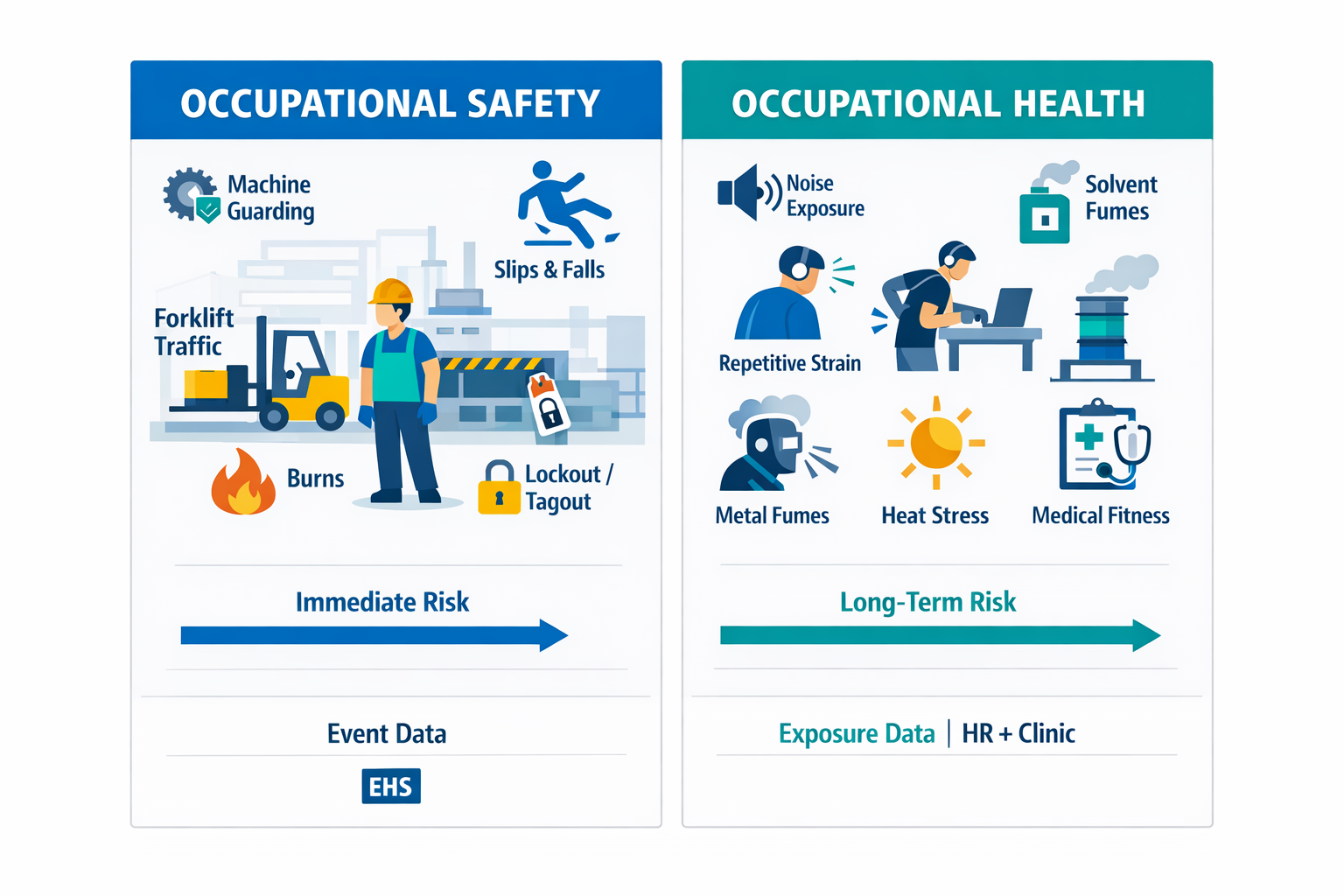
Manufacturers often group health and safety, but the difference between occupational health そして 安全性 matters in day-to-day program design. Safety management is usually built around immediate hazards: machine guarding, lockout/tagout, forklift traffic, slips, burns, and other conditions that can cause injury in seconds or minutes. Occupational health management deals more with slower-developing harm, such as solvent exposure, repetitive strain, hearing loss, metal fume inhalation, heat stress, and the employee’s medical fitness for specific work. Both belong under the same risk-management umbrella, but they require different controls, records, timelines, and follow-up methods.
A practical comparison framework is simple: ask what can go wrong, how fast the harm appears, and what evidence proves control. If the risk is immediate and event-based, it usually sits in safety. If the risk accumulates over weeks, months, or years and may require exposure tracking, screening, or clinical review, it sits in occupational health. That distinction helps manufacturers apply occupational health and safety best practices without treating every issue as the same type of program.
Scope: Acute Injury Prevention Vs. Long-Term Health Protection
Safety programs are designed to prevent incidents before they happen and to control consequences when they do. In a stamping plant, that means guarding presses, enforcing PPE use, managing confined space entry, and investigating near misses. Success is often measured through incident rates, unsafe condition closure, and compliance with operating procedures. The time horizon is short because the exposure-to-injury pathway is short.
Occupational health has a wider biological and exposure-related scope. In an electronics plant, workers may not be injured today by flux fumes or poor workstation design. However, repeated exposure can still lead to asthma symptoms, dermatitis, or musculoskeletal disorders over time. That means occupational health must cover exposure assessment, work-related illness prevention, health surveillance, and fitness-for-duty decisions. The time horizon is longer, and the controls often combine engineering, administrative, and medical oversight.
Ownership: Shared Goals, Different Roles
Safety is typically led by EHS with direct involvement from production supervisors, maintenance, and frontline teams. Supervisors can verify guarding, stop unsafe acts, and correct visible hazards during the shift. Corrective action is often immediate and operational. This makes safety ownership highly embedded in daily production management.
Occupational health usually requires a broader group. EHS may identify exposures and define controls, but HR often becomes involved in leave, accommodations, and return-to-work coordination, while occupational health providers or clinics manage exams and medical opinions. Line managers still play a role, but they should not own confidential medical decisions. In practice, how to manage occupational health programs depends on clear boundaries between operational oversight and protected health information.
Data Needs: Event Records Vs. Exposure and Medical Tracking
Safety data is usually event-centered. Manufacturers track incidents, first-aid cases, unsafe observations, 是正措置, and training completion. These records support investigations, root-cause analysis, and compliance reviews, and they are often tied to specific dates, shifts, and locations. The information is operational and broadly shareable inside the plant.
Occupational health data is more longitudinal and more sensitive. It may include exposure histories, audiometry results, respirator clearance status, symptom questionnaires, restriction notices, and follow-up dates across several years. A fabrication company, for example, may need to connect welding fume exposure groups with periodic medical surveillance and work restrictions without exposing private medical details to supervisors. That is why health and safety should be coordinated closely, but not run as a single undifferentiated system.
The Core Elements of an Occupational Health Program in Manufacturing
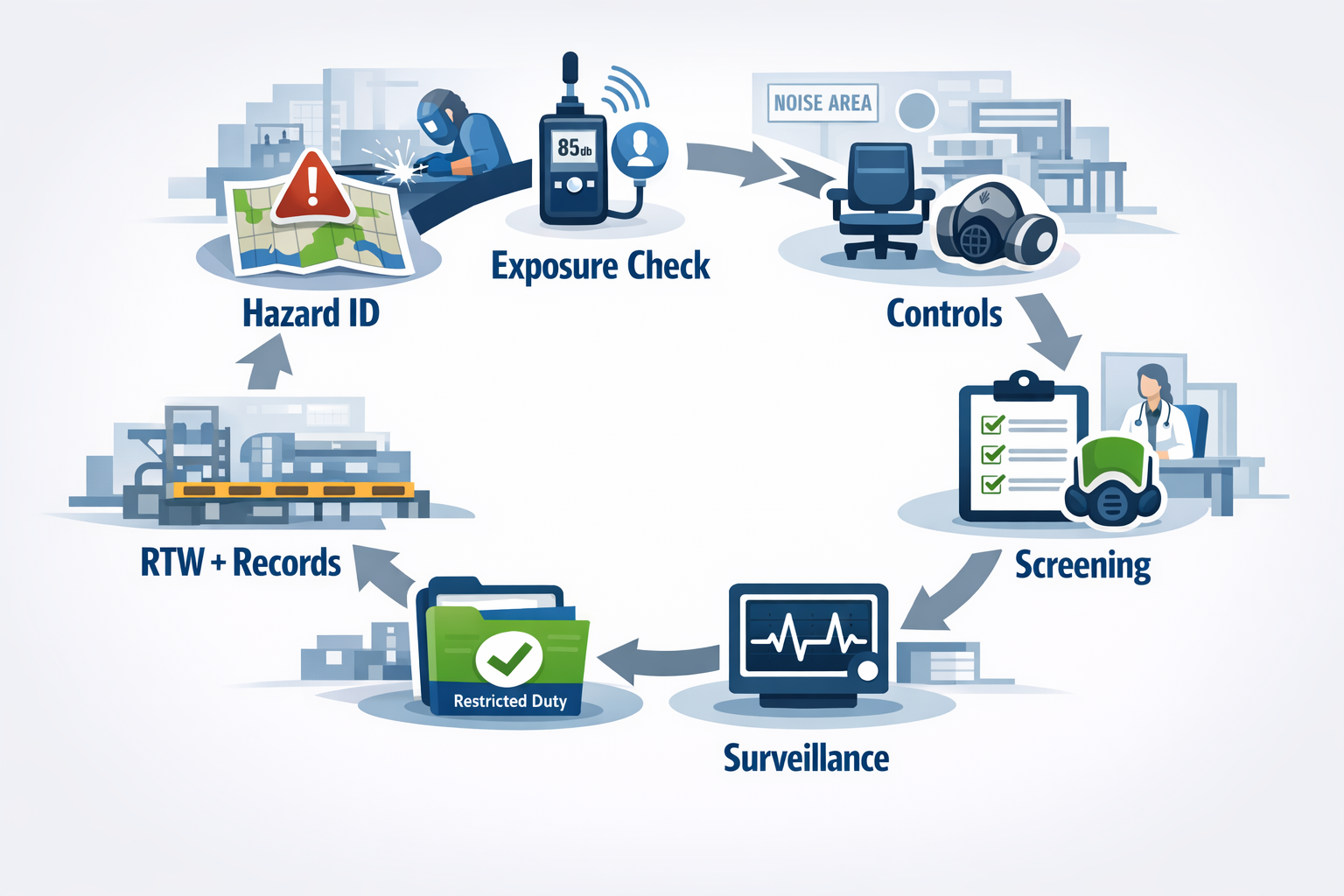
強い occupational health program starts with a clear framework: anticipate hazards, assess exposure, control health risks, monitor worker health, manage work restrictions, and maintain records that stand up to audits. In practice, that means linking shop-floor conditions to specific health controls such as ergonomics review, hearing conservation, respiratory protection support, health screening, medical surveillance, and return-to-work coordination. This is also where manufacturers move from broad occupational health and safety best practices to plant-specific health management.
Hazard Anticipation and Exposure Assessment
The first building block is systematic risk identification. EHS teams need to look beyond incidents and map routine exposure sources such as welding fumes, solvent vapors, metalworking fluids, repetitive motion, vibration, and high noise zones. Exposure assessment should combine walk-through observations, job-task analysis, and where needed, industrial hygiene sampling. Without that baseline, it is difficult to decide who needs surveillance, what controls are working, and how to manage occupational health programs consistently.
Different factory environments require different emphasis. In electronics production, the priority may center on solder fumes, cleanroom chemicals, and seated repetitive work at inspection stations. In general industrial fabrication, the bigger concerns are often airborne contaminants, hand-arm vibration, and sustained noise from cutting, grinding, and stamping. The program should reflect actual exposure patterns, not a generic checklist.
Ergonomics, Hearing, and Respiratory Protection Support
Once risks are identified, the next step is to build targeted prevention programs. Ergonomics should cover workstation design, lift assists, task rotation, and early reporting of discomfort before it becomes a musculoskeletal disorder. In automotive assembly, even highly automated lines still create cumulative strain from overhead reach, forceful fastening, and repetitive assembly cycles. Good occupational health practice uses both engineering changes and work-method review to reduce those demands.
Hearing conservation is essential wherever time-weighted noise exposure approaches or exceeds regulatory thresholds. A complete program includes noise monitoring, audiometric testing, hearing protection selection, training, and follow-up when threshold shifts appear. Fabrication plants often underestimate mixed exposure from several moderate-noise processes running at once. That makes area mapping and periodic remeasurement important.
Respiratory protection support is broader than issuing masks. Workers need proper hazard evaluation, respirator selection, medical clearance where required, fit testing, and training on use limitations. This is especially important in welding, coating, and dust-generating operations, where the wrong respirator program can create a false sense of protection.
Health Screening and Medical Surveillance
Health screening helps identify whether workers are fit for specific job demands, while medical surveillance tracks the health effects of defined exposures over time. Surveillance protocols should be tied to real risks, such as audiometry for noise, lung function review for respiratory exposures, or skin monitoring for certain chemical processes. In electronics plants, this may involve targeted surveillance for solvent handling roles rather than blanket exams for all employees. A focused approach is more defensible and more useful than over-testing.
Return-to-Work Coordination and Recordkeeping
The final program elements are administrative but critical. Return-to-work coordination should connect medical restrictions with actual job tasks so supervisors can place employees safely without creating informal exceptions on the floor. HR, EHS, and line management need a shared process for temporary restrictions, reassessment dates, and duty modifications. Strong recordkeeping then ties the whole program together, supporting trend review, regulator inquiries, and proof that required follow-up was completed on time.
How to Manage Occupational Health Programs for Compliance and Continuity
Start With Clear Ownership Across Functions
To manage occupational health programs well, you need explicit ownership, not a shared assumption that “someone” is tracking it. In a multi-site manufacturer, EHS should typically own exposure-risk rules and surveillance requirements, HR should manage employee status changes and leave coordination, line supervisors should trigger job-change notifications, and the occupational health provider should handle medical evaluations and fitness recommendations. Legal or compliance teams may also need visibility where local labor and privacy rules differ by plant. This structure matters because the difference between occupational health and safety also affects who acts, when they act, and what records they control.
Consider a regional metal components manufacturer with three plants in Thailand, Vietnam, and Malaysia. The company already manages incident reporting well, but its occupational health process is fragmented: one site tracks hearing tests in spreadsheets, another relies on clinic emails, and restricted-duty updates reach supervisors late. The first step is to map responsibilities by process, not by department chart. That means assigning one owner for exposure monitoring, one for exam scheduling, one for work restrictions, and one for record retention.
Define Triggers Before Cases Start Moving
Once ownership is clear, the next step is to define exactly what events trigger action. Common triggers include pre-placement exams for high-exposure jobs, periodic audiometry for noise-exposed workers, spirometry for respiratory-risk roles, follow-up after abnormal test results, return-to-work reviews after medical leave, and assessments after process changes that alter exposure. Without trigger rules, plants make inconsistent decisions and miss required follow-up. That is where occupational health and safety best practices often fail in execution, even when policy documents look complete.
For the metal components manufacturer, the team creates a trigger matrix tied to job code, exposure category, and employment status. A press operator automatically enters the annual hearing-test cycle, a welding reassignment triggers respiratory review, and any blood lead result above the internal action level prompts provider follow-up and exposure reassessment. Supervisors do not decide case by case; they initiate action based on defined rules. This reduces delays and makes program continuity less dependent on individual experience.
Standardize the Workflow and Documentation
After trigger design, convert the program into a repeatable workflow from identification to closure. A practical sequence is: job or exposure change identified, exam requirement confirmed, appointment arranged, employee evaluated, provider recommendation received, work status updated, restrictions communicated, and follow-up tracked to completion. Standard forms should support each step, including referral requests, medical status notices, restricted-duty confirmations, and exposure follow-up records.
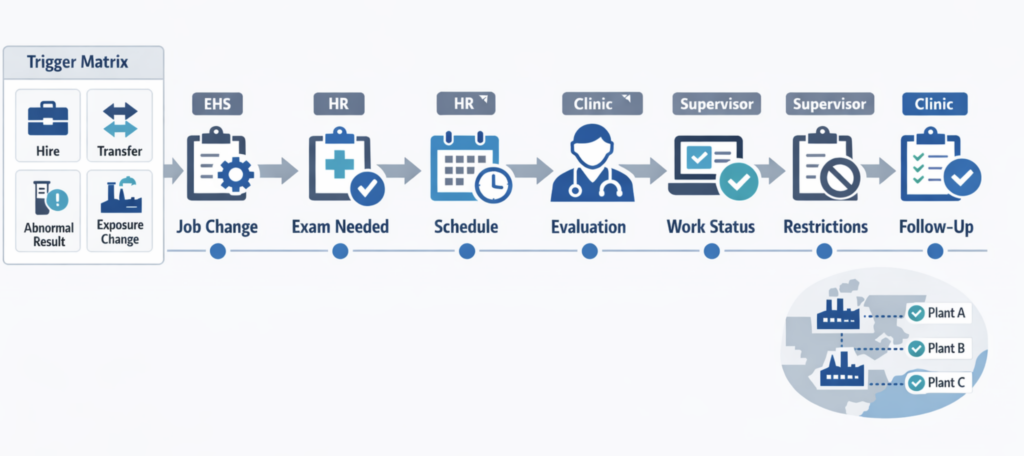
In the running example, the manufacturer uses one documentation standard across all three plants even though clinic partners differ. Supervisors submit the same referral information, providers return the same work-status categories, and HR records restricted duty using the same codes. This consistency makes audits easier and prevents one plant from classifying a temporary restriction differently from another. It also supports trend review when management wants to compare overdue exams, abnormal findings, or reassignment rates across sites.
Build Review Cycles for Overdue Actions and Regulatory Change
Execution is not enough; the program needs a review rhythm. At minimum, EHS and HR should review overdue exams, missed follow-ups, open restrictions, and high-risk exposure groups monthly, while leadership should review program performance quarterly. External requirements should also be checked on a defined cadence, especially for companies operating across multiple jurisdictions where medical surveillance, retention periods, and privacy obligations may vary.
For the manufacturer, monthly reviews reveal that one plant is closing audiometry follow-up within seven days, while another takes more than 20. That gap leads to a corrective action: supervisors must acknowledge restrictions within 24 hours, and HR must escalate unresolved cases weekly. This is how to manage occupational health programs in a way that protects compliance and keeps production planning stable when staffing, exposures, or regulations change.
How Digital Workflows Improve Occupational Health and Safety Best Practices
The multi-site manufacturer from the previous section has already defined exam triggers, exposure categories, and restricted-duty rules. The next problem is execution. When health questionnaires sit on paper, exam due dates live in spreadsheets, and clinic updates arrive by email, even a well-designed occupational health program becomes hard to run consistently across plants. デジタルワークフロー close that gap by turning policy into repeatable action, which is where occupational health and safety best practices become operational rather than theoretical.
Digital Screening Replaces Incomplete Front-End Data
In this manufacturer’s old process, pre-placement forms and periodic health questionnaires were completed by hand, then rekeyed by HR or EHS staff. That created missing fields, unreadable entries, and long delays before anyone spotted a potential issue such as respiratory symptoms in a solvent-exposed worker.
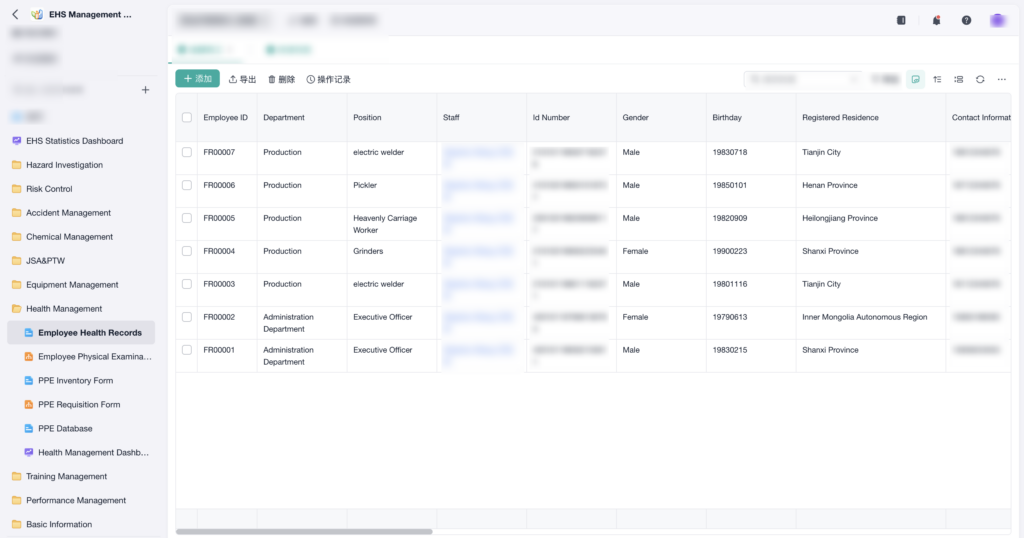
と Jodoo, the company can build mobile-friendly screening forms with required fields, conditional logic, e-signatures, and attachment support so employees, supervisors, and providers submit complete data the first time. That matters because the difference between occupational health and safety often shows up in data quality: health programs depend on longitudinal records, not just incident logs.
Automated Exam Scheduling Reduces Missed Surveillance
The manufacturer also struggled to manage occupational health programs across three plants because periodic audiometry, respirator clearance reviews, and follow-up exams were tracked in separate files. A missed exam does not always cause an immediate disruption, but it creates compliance exposure and can leave fit-for-duty decisions outdated.
Jodoo Workflow lets the team trigger scheduling tasks based on hire date, exposure classification, job transfer, or prior exam outcome, then send reminders to employees, supervisors, and HR before deadlines are missed. Instead of searching across folders and inboxes, coordinators see each case status in one workflow history.
Role-Based Access Protects Sensitive Health Information
Privacy is where many manual systems fail hardest. In the old setup, clinic notes, restrictions, and appointment confirmations were often forwarded too widely because no one had a clean way to separate medical detail from operational action. Jodoo supports granular permissions at the app, form, field, and record level, so occupational health staff can limit medical content to authorized users while supervisors only see work restrictions, clearance status, or next required action. That is a practical control for both compliance and trust, especially when HR, EHS, line management, and external providers all touch the same case.
Dashboards Surface Overdue Actions and Program Gaps
Once the workflow is digitized, the manufacturer no longer has to wait for a monthly spreadsheet review to find overdue exams or unresolved restrictions. Jodoo dashboards can show open surveillance actions by plant, exam type, exposure group, or due date, giving EHS and HR a live view of backlog and risk. If one site has 18 overdue hearing tests while another has none, leadership can investigate whether the issue is staffing, scheduling capacity, or a breakdown in local follow-up. This is how to manage occupational health programs with more consistency and less manual chasing.
Configurable Workflows Support Plant and Regulatory Differences
Not every site follows the same path. One plant may require additional contractor screening, while another must follow different local reporting timelines or partner with different clinics. Because Jodoo is no-code and configurable, the manufacturer can standardize its core occupational health workflow while adapting approval paths, notifications, forms, and document requirements by plant or jurisdiction. That balance between standardization and local fit is what makes digital execution sustainable at scale.
Conclusion: Build a Healthier, More Compliant Manufacturing Operation With Jodoo
Occupational health is not the same as occupational safety, even though both programs must work together on the factory floor. Safety controls immediate injury risks through machine guarding, lockout/tagout, and slip prevention, while occupational health manages longer-term risks such as noise exposure, respiratory hazards, ergonomic strain, and medical surveillance. For EHS and HR leaders, the priority is to run both disciplines in a coordinated way so workers stay fit for work and the business stays audit-ready.
That coordination becomes harder as plants grow, exposure profiles change, and requirements differ by role, site, or jurisdiction. If your team is still relying on paper forms, email chains, and disconnected spreadsheets, it is worth asking whether your current process can reliably support health screening, exam scheduling, follow-up actions, restricted-duty tracking, document control, and privacy protection at scale. In practice, those gaps often create delays, missed reviews, and unnecessary compliance risk.
Jodoo gives manufacturers a practical way to digitize these workflows without heavy IT development. As a no-code lean manufacturing platform, it can help you build structured screening forms, automate approvals and reminders, control access to sensitive records, and monitor overdue actions across plants. If you are reviewing your occupational health process, you can 無料トライアルを開始する または デモを予約する to see what a more controlled system could look like.