Browse by category

Introduction: What Just-in-Time Manufacturing Means for Modern Operations
Excess inventory ties up far more cash than many plants realize. In some manufacturing environments, inventory can account for 20% to 30% of total operating costs once storage, handling, obsolescence, and quality risk are included. That is why just-in-time(JIT) manufacturing continues to matter for operations managers under pressure to improve output, protect margins, and respond faster to demand changes.
The core of JIT manufacturing is producing only what is needed, when it is needed, and in the quantity needed. The goal is not simply to cut inventory. It is to improve flow, shorten lead times, expose hidden process problems, and make production more responsive.
This article explains how JIT manufacturing reduces inventory, improves material and information flow, and where companies often struggle during implementation. It also discusses why successful JIT depends on stable scheduling, supplier coordination, accurate shop-floor data, and digital tools such as Jodoo to standardize signals, workflows, and real-time visibility.
How JIT Manufacturing Works Across Production, Inventory, and Supply Chain
Customer Demand Starts the Signal
In JIT manufacturing, the process begins with actual demand, not a long forecast pushed into the factory. A confirmed customer order, a replenishment signal from a distributor, or real consumption at the next production stage triggers action upstream. That makes JIT manufacturing a pull-based system: production moves only when downstream demand creates a clear signal. In practice, that means planners, buyers, warehouse teams, and line supervisors all work from the same demand signal rather than separate spreadsheets and assumptions.
For example, an electronics assembly plant making industrial control boards could release smaller batches based on daily customer demand and actual line consumption. If one board model is consumed faster than expected, that usage becomes the signal to replenish components and schedule the next build. The result is tighter alignment between what customers want, what the line makes, and what inventory is actually needed.
Production Scheduling Converts Demand into Small, Controlled Runs
Once demand is visible, planners translate it into short-interval schedules. In JIT production, this usually means smaller lot sizes, more frequent changeovers, and tighter sequencing so each process makes only what the next process can absorb. The goal is not maximum machine utilization in isolation, but steady material flow across the plant.
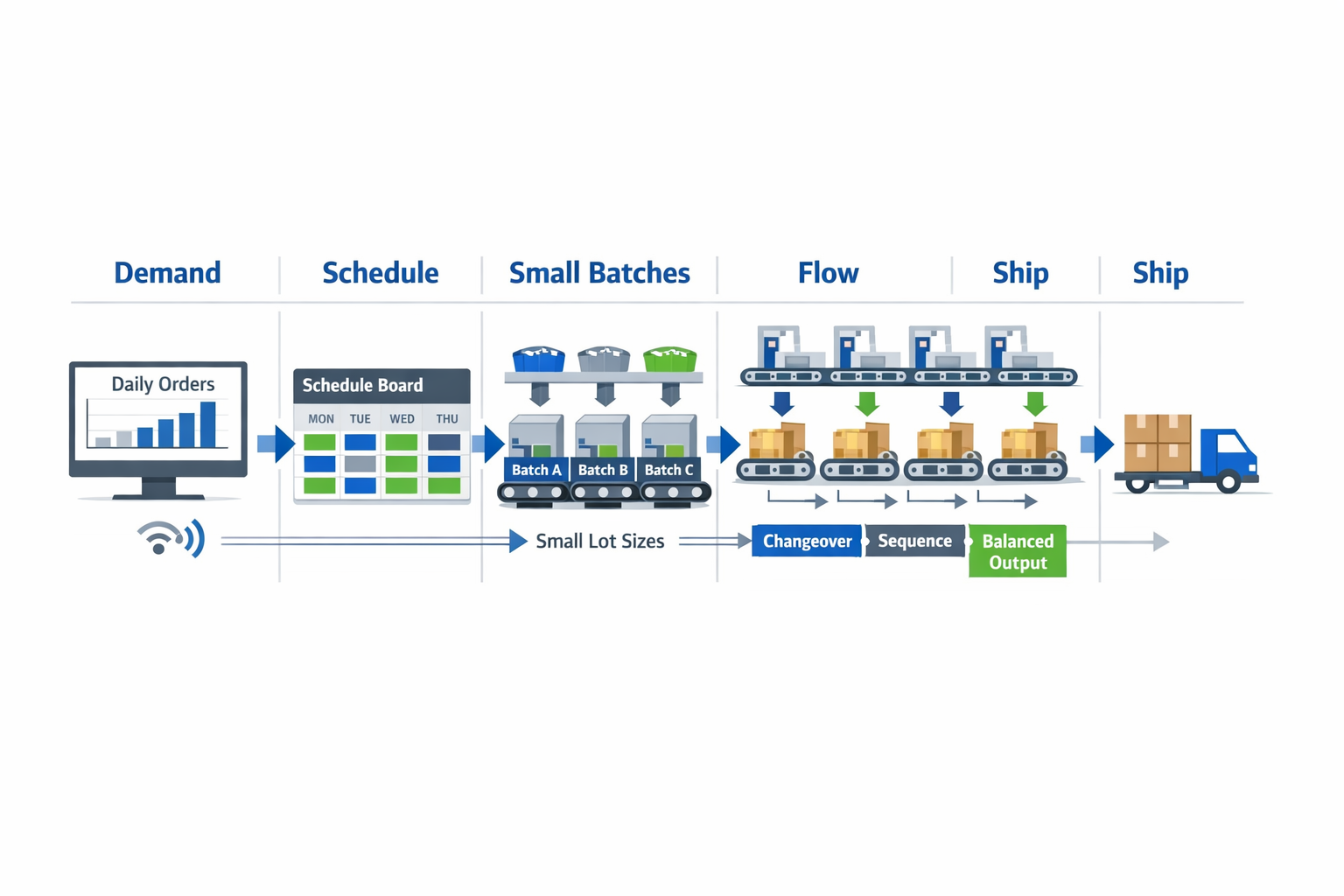
For instance, in a food manufacturing plant producing bottled sauces, the filling line may run according to retailer replenishment orders, rather than producing excess volume ahead of demand. This keeps shelf-life risk and avoids packaging waste.
JIT Inventory Management Relies on Consumption, Not Guesswork
JIT inventory management works by linking inventory replenishment directly to actual use. The material movement should reflect real production demand and current stock levels. Raw materials, components, and work-in-progress are replenished when they are consumed to a reorder point or visual trigger, not simply because a calendar date arrives. In well-run operations, this can happen through kanban cards, barcode scans, ERP transactions, supplier portals, or digital replenishment workflows.
A practical example is a garment factory sewing export orders in multiple styles and colors. When a cutting department consumes a defined quantity of fabric rolls for one style, that usage triggers replenishment from the warehouse for the next planned batch. Trims such as labels, zippers, and buttons are also issued in smaller quantities tied to actual line progress. This approach reduces excess stock on the floor and makes shortages easier to detect early because inventory signals are more accurate and immediate.
Warehouse and Internal Logistics Keep Material Moving at the Right Time
A JIT supply chain does not work if materials arrive at the plant but sit disconnected from production needs. Warehouse teams play a critical role by receiving, verifying, storing, and issuing materials in sync with the production sequence. Internal logistics often shift from bulk transfers to timed deliveries, line-side staging, and route-based replenishment. In many factories, this is where JIT succeeds or fails, because the line can only run smoothly if the right material reaches the right station at the right time.
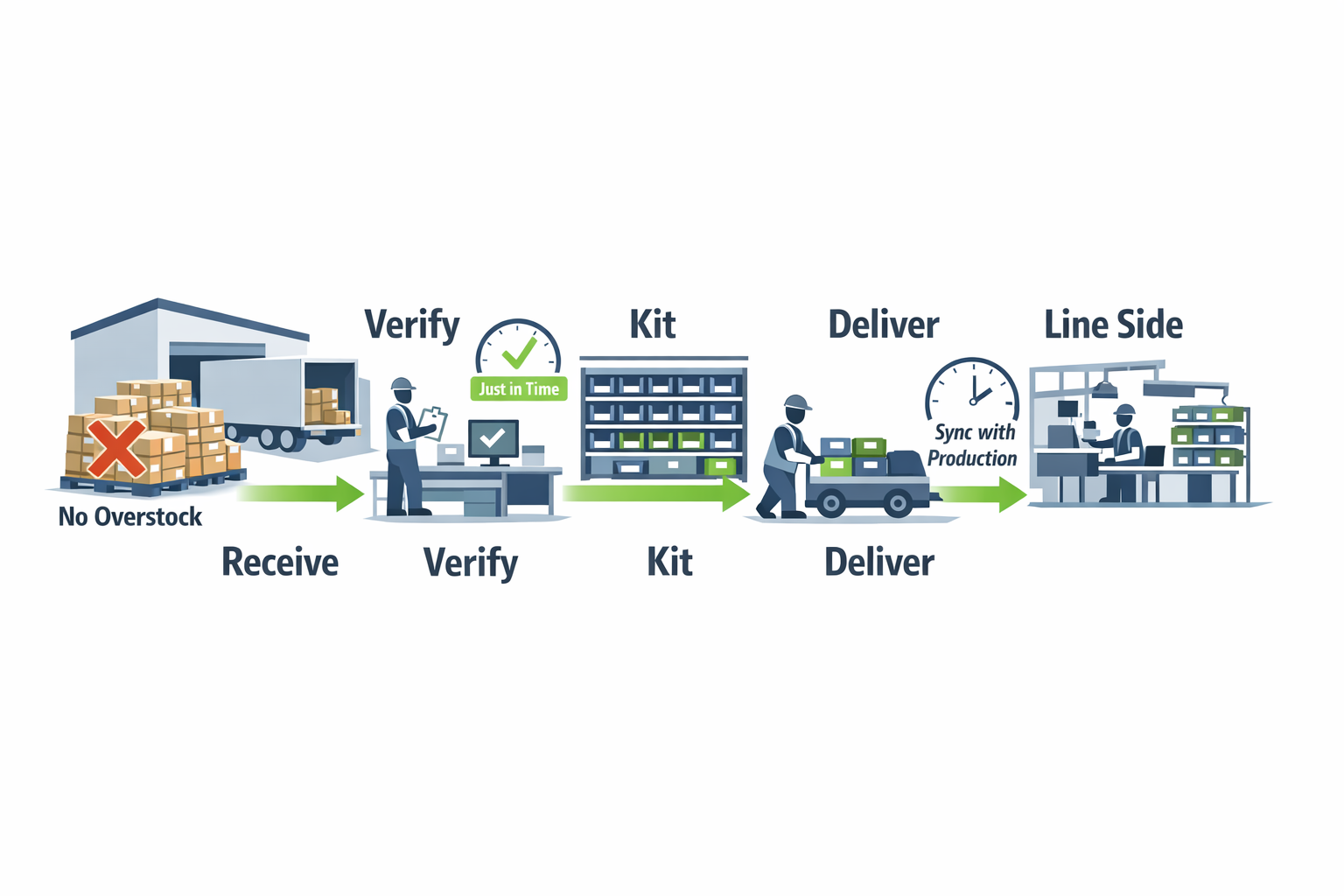
In an electronics environment, this might mean kitting resistors, connectors, and housings for each assembly order and delivering them to the SMT or final assembly area just before use. In a food plant, it may mean staging packaging film, caps, and labels by production slot rather than sending a full week’s supply to the line. These routines shorten search time, reduce handling errors, and improve visibility of what has been consumed versus what is still available.
Suppliers Must Respond to Short Lead Times and Clear Signals
The external side of JIT manufacturing depends on suppliers receiving timely, accurate demand information and being able to respond in smaller, more frequent shipments. Instead of shipping large monthly quantities, suppliers may deliver daily, multiple times per week, or according to agreed call-off schedules. This requires stable ordering rules, reliable transport, and mutual visibility into inventory and production requirements. Supplier performance becomes less about offering the lowest unit price and more about supporting flow with consistency.
Consider a beverage producer sourcing preforms, caps, and carton packaging from nearby suppliers. If daily production schedules are shared and call-offs are updated based on actual output, suppliers can replenish only what will be consumed in the next short cycle. That reduces inventory holding inside the plant while keeping service levels stable. Digital workflows can support this by keeping purchasing, warehouse teams, and suppliers aligned on the same demand signal and live data.
Stable Processes and Synchronized Information Make JIT Sustainable
For JIT manufacturing to hold, process stability matters as much as scheduling logic. Short lead times only help if machine uptime is predictable, quality is consistent, and changeovers are controlled. If scrap spikes or downtime become frequent, a low-inventory system loses its buffer quickly. That is why many manufacturers combine JIT practices with standard work, preventive maintenance, quality checks, and real-time production tracking.
Digital coordination becomes valuable when teams need to connect consumption signals with replenishment, supplier updates, and exception handling. A platform like Jodoo can help operations teams connect purchase requests, inventory transactions, production orders, supplier updates, and dashboard alerts in one workflow without heavy custom development. That kind of synchronized information flow is what turns JIT manufacturing from a planning concept into a repeatable operating system.
The Benefits and Pain Points of Just-in-Time Manufacturing
Why JIT Manufacturing Appeals to Operations Teams
The biggest advantage of JIT manufacturing is financial. When you buy raw materials and components closer to actual production demand, you reduce carrying costs tied to storage, insurance, handling, and obsolescence. And these costs could quietly drain the margin every month. For operations managers under pressure to improve working capital, JIT manufacturing turns inventory from a buffer into a controlled flow.
It also reduces overproduction, which is one of the most expensive forms of waste in any factory. In an electronics assembly plant, for example, building extra printed circuit board subassemblies “just in case” can create immediate problems when customer specifications change or a revision is released. What looked like safety stock quickly becomes obsolete inventory. In this sense, JIT could support lean manufacturing goals by reducing overproduction.
Better JIT inventory management often gives both finance and operations a clearer picture of what inventory is truly needed now versus what is simply convenient to store. Therefore, cash flow improves because money is not trapped in racks of slow-moving material. A food packaging plant that shifts from monthly bulk film purchases to staggered deliveries aligned with weekly schedules may free up warehouse space and respond faster to order-mix changes.
Space utilization is another major benefit, especially in plants where floor area is already constrained. When fewer pallets sit between receiving, kitting, and production, teams can reclaim space for higher-value activities such as pre-assembly, quality checks, or line-side replenishment zones. That physical change often improves flow more than managers expect because congestion on the shop floor is frequently mistaken for capacity loss.
A less discussed but highly valuable benefit is faster issue visibility. When buffers are smaller, process weaknesses show up earlier instead of being hidden behind days of inventory. If a filler machine in a food plant starts drifting out of tolerance, a JIT system exposes the disruption quickly because downstream stations no longer have a large stock cushion. That gives supervisors the chance to correct root causes sooner rather than discovering them after a full shift of excess work-in-process.
Where Just-in-Time Manufacturing Gets Difficult
The challenge is that JIT production depends on consistency across the entire operation, not just within a single production line. Supplier delays become more damaging because the plant has intentionally reduced protection stock. For automotive tier suppliers, a late shipment of brackets or connectors can disrupt sequenced assemblies within hours, especially when production is sequenced to customer releases. A JIT supply chain works well only when supplier performance, transport reliability, and internal scheduling discipline are all stable simultaneously.
Demand volatility is another hard reality. In consumer electronics and appliance manufacturing, order patterns can shift quickly due to promotions, model launches, or distributor changes. If your planning horizon shortens but suppliers still need long lead times, JIT inventory management becomes a balancing act between responsiveness and stockout risk. Plants often discover that the technical challenge is not only inventory reduction, but also building faster replanning cycles and clearer supplier signals.
Quality holds are especially disruptive in a JIT environment because there is less backup stock to absorb the delay. Consider a factory producing sensors for industrial equipment: if incoming micro-components fail inspection, the line may stop even when every other process is running on time. In a traditional system, excess material might hide the issue for a few days. Under JIT manufacturing, quality problems become immediate operational events, which is useful for control but demanding for planners and quality teams.
Stockouts are not always caused by poor planning; they are often the result of setup-time constraints and line changeover realities. A packaging manufacturer running many SKUs may want smaller batches to support JIT production, but frequent changeovers can reduce available runtime if setups are not standardized. That means the plant can end up with the right inventory strategy on paper, but not enough actual throughput on the floor. This is one reason JIT success is closely linked to SMED, disciplined scheduling, and realistic minimum run quantities.
Another pain point is exception-heavy communication across the shop floor. JIT systems generate more moments where people need to react quickly to shortages, substitutions, expedited deliveries, inspection releases, or sequencing changes. In many factories, those exceptions are still managed through calls, whiteboards, spreadsheets, and messaging groups, which creates delays and confusion. A platform like Jodoo can help here by digitizing material requests, supplier follow-ups, quality release workflows, and real-time dashboards so teams can respond to JIT exceptions with shared data instead of fragmented updates.
A Practical Way to Think About the Trade-Off
A useful way to evaluate JIT manufacturing is to ask where your plant can truly run with less inventory and where it still needs controlled buffers. For example, an electronics plant may run JIT on standard fasteners and packaging materials but keep strategic safety stock for long-lead semiconductors. That is not a failure of JIT; it is a realistic operating design. The goal is not zero inventory at all costs, but better flow, faster problem detection, and lower waste where the process can support it.
Is Your Factory Ready for JIT? How to Evaluate Lean, JIT, and Hybrid Strategies
Before you roll out JIT manufacturing, the real question is not whether JIT sounds efficient. It is whether your factory can support it consistently without creating instability on the shop floor. Many teams confuse JIT with lean manufacturing, but in fact, this is not the case. Lean manufacturing is the broader operating philosophy, while JIT is one method inside lean that focuses on producing and replenishing only what is needed, when it is needed, in the quantity needed.
In practice, that distinction matters because not every plant is ready for pure JIT production. A factory may be advanced in visual management, standard work, and continuous improvement, yet still need strategic buffers for raw materials or finished goods. That is why many manufacturers adopt a hybrid model: lean principles across operations, with selective JIT applied only where demand, supply, and process control are strong enough.
JIT vs. Lean Manufacturing: Know the Difference Before You Decide
The distinction is straightforward: lean manufacturing aims to eliminate waste across the whole value stream, while JIT focuses specifically on flow and timing. You can run lean projects in maintenance, quality, layout design, and labor utilization without using pure JIT replenishment. Likewise, a company may attempt JIT inventory management but fail if the broader lean discipline is weak.
For example, an electronics assembly plant may use JIT for stable, high-volume boards while keeping a buffered approach for custom variants with frequent engineering changes. That is often a better decision than forcing one inventory policy across every product family.
Evaluate Demand Stability and Mix Complexity
The primary screening factor is the demand pattern. JIT works best when customer demand is predictable enough to support repeatable replenishment signals, smaller batch sizes, and level-loaded scheduling. If weekly order volumes swing sharply, or if the product mix changes daily with little notice, pure JIT can create scheduling churn rather than smoother flow.
Look at at least three to six months of order history by SKU family, not just total monthly volume. A product line with a forecast accuracy above 75% to 85% and repeat demand patterns is far more suitable for JIT than a line with highly erratic ordering. In food manufacturing, for example, a beverage plant supplying supermarket private-label bottled water may be a good JIT candidate for packaging materials, while seasonal promotional SKUs may still require planned buffer stock.
Measure Supplier Reliability, Not Just Lead Time
A short lead time alone does not make your JIT supply chain reliable. What matters is on-time delivery performance, quantity accuracy, shipment frequency, and the supplier’s ability to respond to schedule changes without quality drift. If suppliers deliver in two days but only hit requested dates 82% of the time, your internal flow will still be disrupted.
This is where many factories benefit from segmenting suppliers instead of applying JIT to all purchased items at once. For example, a snack food plant may receive cartons and labels from local suppliers with daily deliveries and 98%+ delivery adherence, making them suitable for JIT replenishment. Imported seasoning blends with longer transit variability may need a controlled safety stock policy, even in an otherwise lean operation.
Check Process Capability and Schedule Discipline
JIT requires stable internal execution. If cycle times vary widely by shift, if production orders are frequently resequenced, or if unplanned downtime is common, inventory will end up absorbing those fluctuations whether you intend it to or not. In other words, low inventory does not create flow by itself; it exposes whether your process can stick to plan.
Review OEE trends, schedule attainment, and order completion reliability by line. If one line regularly hits 95%+ schedule adherence and maintains predictable takt-based output, it may be ready for JIT. If another line loses hours each week to recurring minor stoppages, a hybrid strategy is safer until process stability improves.
Assess Quality, Maturity, and First-Pass Yield
Strong quality systems are essential for JIT manufacturing because there is less inventory to hide defects or quarantine late-stage rework. If your plant depends on sorting, end-of-line inspection, or emergency replacement batches, reducing buffers too early will magnify the effect of every defect. JIT works best when quality is built into the process, not inspected afterward.
A good checkpoint is first-pass yield by product family and by shift. In electronics or medical packaging environments, even a small drop in first-pass yield can quickly affect downstream delivery when inventories are lean. Plants that sustain high process capability and fast containment response are much better positioned to run JIT inventory management without frequent firefighting.
Look Closely at Changeover Performance
Changeover speed is one of the clearest readiness indicators for JIT production. Smaller lot sizes only make sense when switchovers can happen quickly and repeatably without excessive scrap, labor loss, or schedule overruns. If every product change still takes 90 minutes and requires trial-and-error adjustment, JIT will simply increase instability.
Consider a garments factory producing export orders across multiple colors and sizes. If the sewing and finishing teams have standardized setup procedures and can reduce style changeovers from 45 minutes to 15 minutes, they gain the flexibility needed for shorter runs and more frequent replenishment. If changeovers remain inconsistent across shifts, a hybrid approach with controlled batch sizes is usually more practical.
Validate Inventory Accuracy and Data Visibility
You cannot run effective JIT inventory management if your stock records are unreliable. Bin-level inventory accuracy, real-time material issue recording, and clear replenishment triggers are basic requirements. If the ERP says a reel of components or a pallet of packaging is available, but the floor cannot find it, the planning logic breaks down immediately.
Most plants should target inventory accuracy above 97% to 99% for items managed under JIT rules. This is one area where digital tools matter because the process must connect receiving, storage, line-side replenishment, and consumption data. With a no-code platform like Jodoo, manufacturers can build barcode-based inventory transactions, supplier delivery forms, replenishment workflows, and live dashboards without waiting for a long custom software project.
Why Hybrid Strategies Often Work Better than Pure JIT
For many factories, the right answer is not pure JIT or no JIT at all. It is a hybrid operating model that applies JIT when conditions are stable and keeps planned buffers where variability is structurally higher. This is especially useful in multi-site or mixed-mode manufacturing environments where product families behave very differently.
For example, an industrial electronics manufacturer may run JIT supply chain practices for common enclosures, fasteners, and standard PCB components sourced locally, while holding strategic stock for imported semiconductors with volatile lead times. That is still a lean decision because it matches inventory policy to actual risk. The goal is not zero inventory everywhere; the goal is better flow with less waste and fewer surprises.
A Practical Readiness Checklist
If you are evaluating JIT manufacturing, a practical readiness check should cover six areas: Is demand stable enough by SKU family? Are key suppliers consistently reliable? Are your lines capable of holding a schedule with low variation? Is quality mature enough to avoid defect-driven disruptions? Are changeovers fast enough for smaller batches? Is inventory data accurate enough to support real-time replenishment?
If your answer is “yes” to most of those questions in one value stream, start there rather than launching plant-wide. A focused pilot is usually more effective than a full conversion. With Jodoo, you can digitize the pilot quickly by creating custom apps for kanban signals, supplier delivery tracking, material requests, workflow alerts, and dashboard monitoring, then expand only after the process proves stable.
Why Jodoo Is the Digital Infrastructure for JIT Inventory Management
Jodoo fits JIT manufacturing as the execution layer between planning and the shop floor. It does not require you to replace your ERP, MES, or supplier systems. Instead, it gives operations teams a practical way to run JIT inventory management with live data capture, workflow automation, and role-based visibility, without falling back to paper cards, email chains, or disconnected spreadsheets. That matters because in JIT manufacturing, timing is not just a planning issue; it is an execution issue that depends on fast signals, clean handoffs, and immediate response to exceptions.
Build Digital Kanban Around Actual Factory Flow
In many plants, kanban still breaks down at the last mile. A planner may know target stock levels, but the signal from line-side consumption to replenishment is often manual, delayed, or inconsistent across shifts. With Jodoo, you can build digital kanban processes that match how your factory actually moves material, whether that means bin scans at assembly cells, mobile forms for tugger routes, or workstation-level replenishment requests linked to part numbers, suppliers, and standard container quantities. This makes JIT production more reliable because replenishment is triggered by actual use, not by end-of-shift updates.
For instance, in an electronics assembly plant with multiple SMT and final assembly lines, operators can scan a QR code when connector bins fall below a defined threshold, and Jodoo could automatically create a replenishment record, notify purchasing and warehouse teams, and update a live kanban board. If the expected inbound shipment is already late, the system escalates the issue immediately so the team can reallocate stock before the line stops. In one workflow, the plant turns a fragile manual signal into a controlled JIT inventory management process.
Turn Inventory Status into Real-Time Action
For JIT manufacturing to work, inventory visibility must be timely enough for teams to make decisions during the shift, not after it ends. Jodoo helps teams track line-side stock, supermarket inventory, in-transit replenishment, and shortage risk in real time through mobile data capture, barcode scans, and dashboards that update as transactions happen. A supervisor can see which parts are within target range, which bins are approaching minimum levels, and which replenishment tasks are overdue, all without waiting for batch updates from a core system. That level of visibility supports a more responsive JIT supply chain inside the factory walls.
This is especially useful in mixed-model environments where consumption changes by product variant. A food packaging plant, for example, may switch between SKU formats that use different caps, labels, and cartons by the hour. Jodoo can track those material calls dynamically and trigger replenishment based on actual production orders and consumption patterns, so warehouse teams deliver the right packaging materials at the right time instead of buffering every line with excess stock. This turns JIT from a planning rule into a daily control process.
Automate Replenishment Triggers and Shortage Alerts
A strong JIT system depends on predefined rules, not heroic follow-up. Jodoo lets you configure replenishment triggers based on min-max levels, kanban quantities, scan events, production order progress, or forecasted hours of coverage. Once conditions are met, workflows can assign tasks, send mobile alerts, escalate overdue requests, and flag materials with no confirmed inbound supply. This reduces reaction time and helps planners focus on true exceptions rather than monitoring every part manually.
Shortage alerts are particularly important in factories with tight component synchronization. According to APICS and broader lean operations benchmarks, material shortages remain one of the most common causes of avoidable downtime in high-mix production environments. With Jodoo, shortage risk can be surfaced early through dashboards that combine current stock, open purchase orders, incoming inspection status, and production demand. Instead of debating whether a late delivery is critical, the team sees immediately which order, line, and shift will be affected.
Coordinate Suppliers and Incoming Inspection in One Workflow
JIT is not only an inventory technique; it also depends on supplier coordination, receiving discipline, and fast quality feedback.
In a beverage plant, for instance, incoming caps or printed labels may arrive on time but still require lot verification before production release. With Jodoo, a receiving clerk can log the delivery, attach photos, and trigger an inspection task automatically. If the inspection passes, stock status changes and the replenishment board updates; if it fails, the system blocks release, alerts procurement, and starts supplier follow-up immediately. This is a practical example of how JIT supply chain execution depends on both speed and control.
Manage Exceptions Without Breaking Flow
No factory runs perfectly every day, and rigid systems often struggle with the small operational exceptions that disrupt JIT production. Jodoo is useful because you can configure exception handling around your real SOPs, such as substitute material approvals, urgent inter-line transfers, partial receipts, quarantine routing, or temporary supplier changes. Instead of creating workarounds outside the system, teams can follow guided workflows that document decisions and keep inventory status visible to everyone involved. That flexibility is important for manufacturers trying to strengthen JIT inventory management without adding more software complexity.
This is also where Jodoo supports the broader relationship between JIT and lean manufacturing. Jodoo helps execute both by digitizing the day-to-day rules that keep material moving correctly, from kanban replenishment and shortage escalation to inspection release and supplier response tracking. For operations leaders, that means a more practical path to JIT manufacturing: keep your ERP as the system of record, and use Jodoo to run the workflows that make flow possible on the ground.
Conclusion: How to Start Just-in-Time Manufacturing with Jodoo
JIT manufacturing delivers results when three things work together: stable processes, reliable supplier coordination, and real-time visibility on the shop floor. Reducing inventory alone is not the goal. The real objective is better flow, faster problem detection, and tighter alignment between demand, production, and replenishment. Therefore, digital coordination becomes critical, especially for teams trying to improve JIt supply chain visibility without waiting months for a custom software rollout.
Jodoo helps manufacturers turn JIT plans into practical daily workflows. As a no-code lean manufacturing platform, it lets you build custom apps for kanban replenishment, production tracking, supplier follow-up, inventory alerts, quality checks, and real-time dashboards without heavy development. That means your team can standardize processes faster, respond to disruptions earlier, and improve execution across production, warehouse, and procurement.
If you want to make JIT manufacturing more workable in your factory, explore how Jodoo can help. You can start a free trial or book a demo to see how quickly your team can launch a JIT workflow that fits your operation.