Browse by category

Introduction: Why Lead Time Hides the Biggest Delays in Manufacturing
Many factories miss customer due dates not because machines are too slow, but because work spends too much time waiting. In many manufacturing environments, lead time is the total elapsed time from receiving an order to delivering the finished product, and a large share of that time is often non-value-added. Studies of manufacturing flow consistently show that waiting, queues, and handoffs can consume far more time than actual processing.
This article explains how to reduce manufacturing lead time in a practical way. It will cover what lead time means, how it differs from cycle time, where hidden delays accumulate, and seven proven strategies to improve production flow. Just as importantly, it will show how approvals, material requests, and cross-department handoffs often create the biggest delays—especially when they are managed through email, paper, or spreadsheets.
What Lead Time Means in Manufacturing
Lead Time Covers the Entire Order Journey
In manufacturing, lead time is the total elapsed time from when a customer order is confirmed to when the finished product is ready for delivery or actually shipped, depending on how your business measures it. For supply chain and operations managers, that means lead time includes much more than processing time on the shop floor. It captures every delay that the order experiences across purchasing, planning, production, inspection, and dispatch. If you want to understand how to reduce manufacturing lead time, you have to measure the full path, not just machine performance.
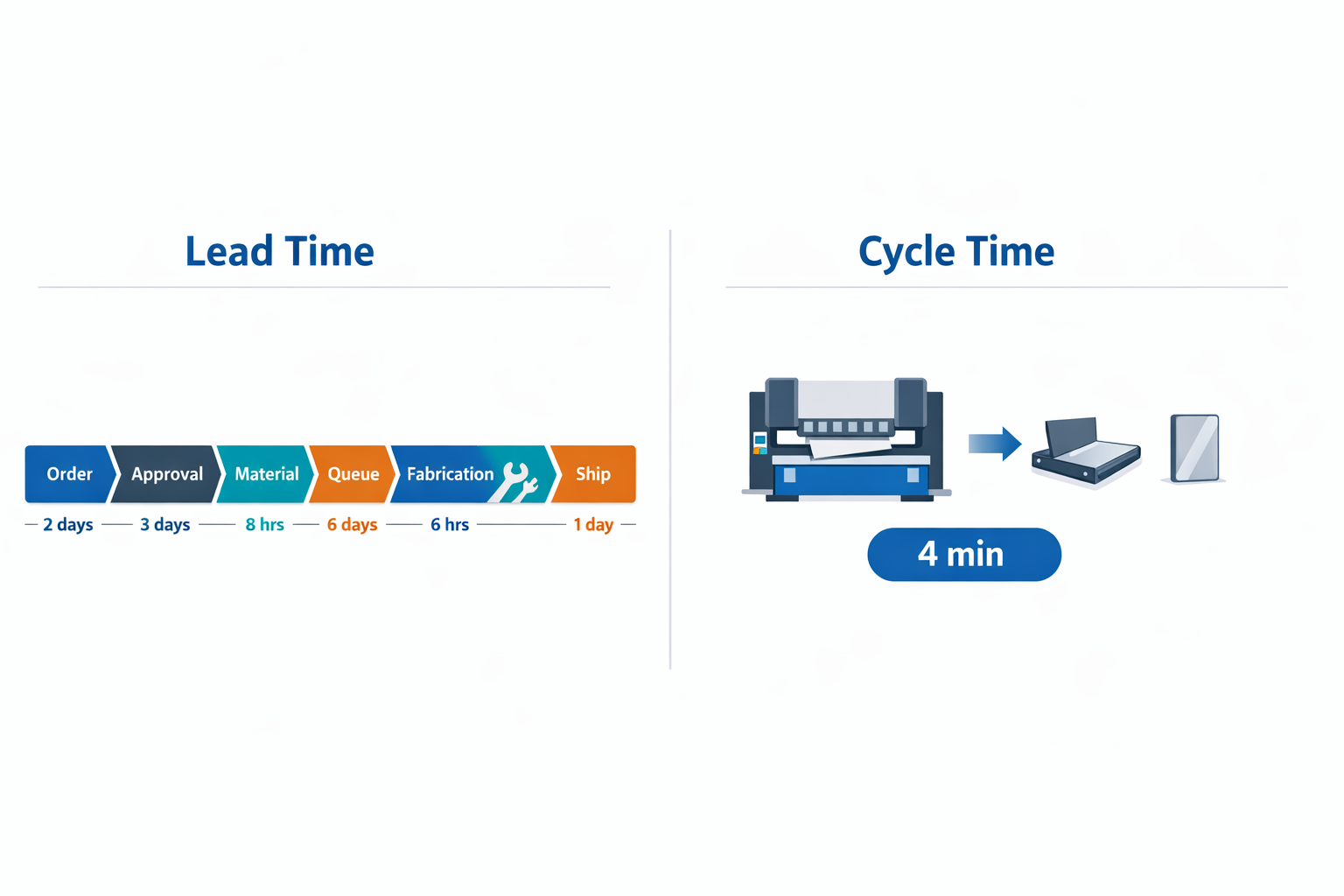
A practical formula is: Lead time = procurement time + production time + waiting time + delivery time. Procurement time covers sourcing and receiving materials, production time covers actual fabrication and assembly, waiting time includes queues, approvals, and changeovers, and delivery time covers packing and outbound movement. In many factories, waiting is the largest and least visible component.
Lead Time vs. Cycle Time
Cycle time measures how long it takes to complete a specific process step or unit once work starts, while lead time measures how long the customer waits from order to fulfillment. A laser cutting cell may have an excellent cycle time, but if the job sits unapproved or unpicked for days, the total lead time is still poor. Teams that confuse these metrics can improve local efficiency without improving on-time delivery.
Where Long Manufacturing Lead Times Really Come From
Imagine a factory that produces electrical panels based on orders. The quoted lead time is 18 days, while actual completion averages 24. The machine cycle time for cutting and assembly is still within standard, so the gap is not mainly on the shop floor. This is where many teams miss the real issue: once you understand the difference between lead time and cycle time, you can see that long lead time is usually built from waiting, rechecking, and handoff delays outside value-added work. If you want to reduce manufacturing lead time, you need to trace the order from request to shipment, not just inspect machine performance.
Delay Starts Before Production Release
The first delay often appears when sales confirms the order and engineering must review specifications before production can start. In our factory example, a non-standard enclosure size needs drawing approval, but the request sits in an inbox for a day because one approver is traveling. That single day does not look serious in isolation, yet it pushes purchasing, planning, and production release back in sequence.
Manual Approvals Stretch Small Decisions Into Multi-Day Waits
After engineering signs off, purchasing raises a material request for breakers, copper bars, and cable glands. If that request moves through email, spreadsheets, and printed signatures, each step adds idle time between actions rather than actual work time.
Shortages and Supplier Response Lag Compound the Delay
Once purchasing identifies a missing breaker model, the next problem is the supplier’s response speed. One supplier confirms stock in two hours, while another replies the next morning and then revises the promised date after checking its warehouse. In many factories, supplier-related waiting accounts for a large share of total lead time, especially when planners do not get early visibility into at-risk materials.
Poor Schedule Visibility Creates Queue Time on the Floor
Even after materials arrive, the order may not move immediately. In the panel factory, production control releases three urgent jobs at once, so assembly waits behind older work, and testing capacity becomes the real bottleneck. This is why strategies to improve production lead time must address queue management and schedule visibility, not only labor efficiency.
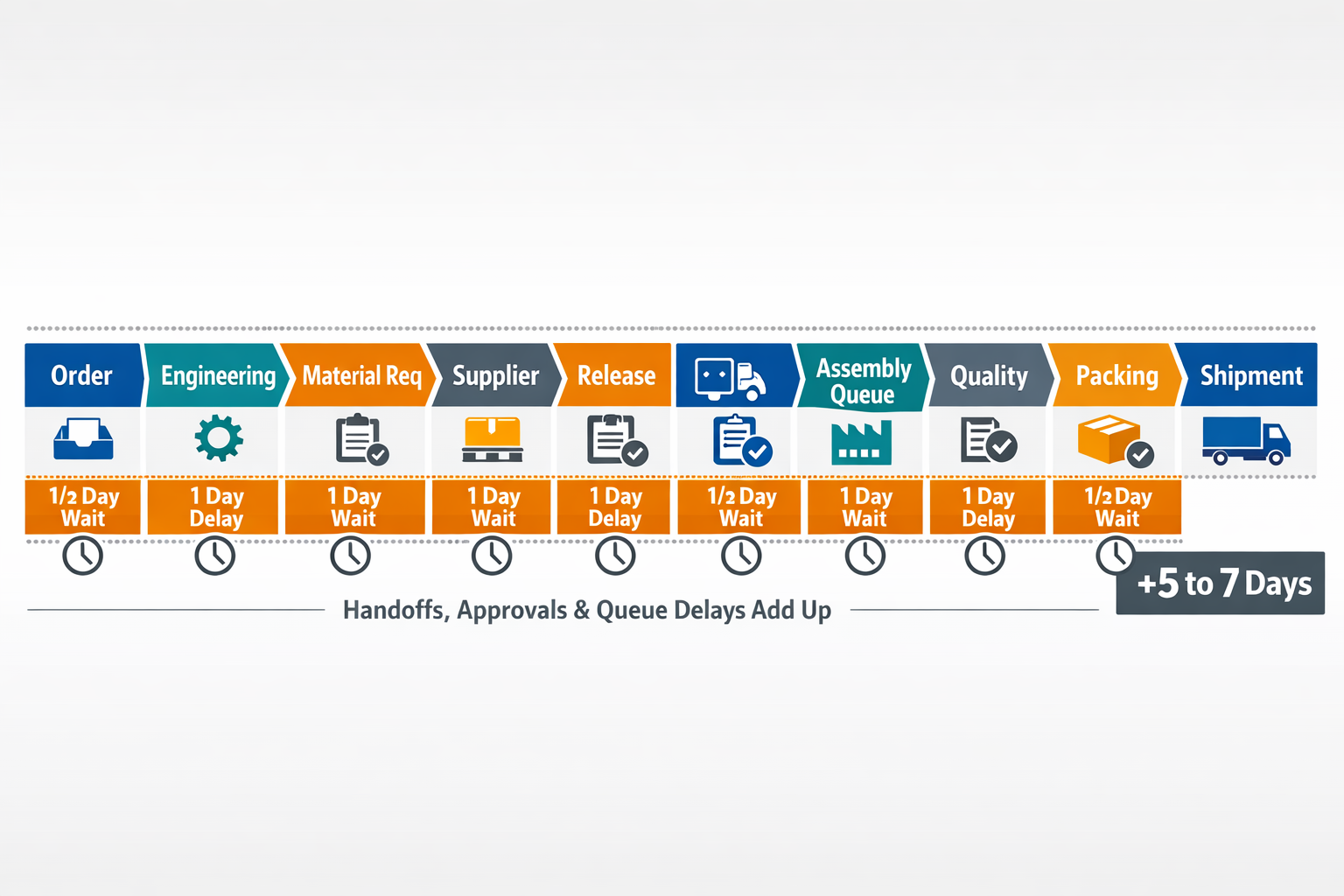
The end-to-end delay map is usually straightforward: order confirmation, engineering review, material request, supplier confirmation, production release, queue before assembly, quality check, packing, and shipment. None of these stages may look severely broken on its own, but half-day and one-day pauses across eight stages can easily add 5 to 7 extra days. That is the practical root cause behind long manufacturing lead times.
Quality Holds and Shipment Readiness Add the Final Days
The last hidden delays often happen after production appears complete. In our example, final testing finds a labeling mismatch, so the unit waits for rework approval and a repeat inspection before packing. The lesson is simple: long lead time usually comes from unmanaged waits between functions, which is exactly why the next section focuses on practical ways to reduce those delays.
7 Proven Strategies to Improve Production Lead Time
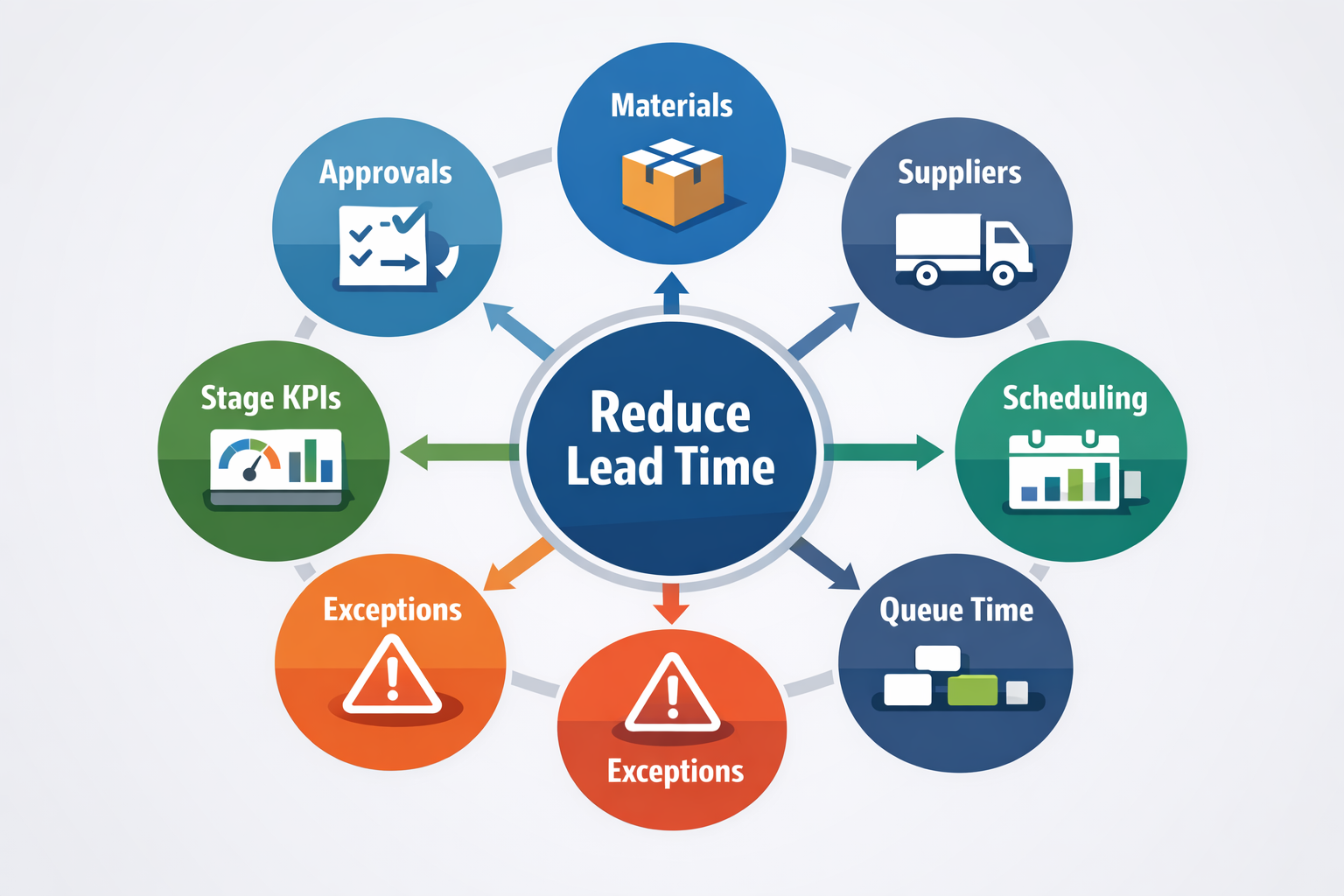
Once you have mapped where orders stall, the next step is to act on the delays that add no customer value. The seven tactics below focus on the points where manufacturers usually lose the most time: approvals, materials, supplier response, schedule flow, queue buildup, exception handling, and KPI visibility. Together, they form a practical framework for anyone asking how to reduce manufacturing lead time without disrupting core production systems.
1. Standardize Approval Paths
Many factories still rely on email, chat, or paper sign-off for engineering changes, material substitutions, and urgent purchases. That creates variable response times, especially when supervisors are absent or approval authority is unclear. Define approval rules by order value, product family, or risk level so routine decisions move in hours instead of days.
2. Tighten Material Replenishment Triggers
Material shortages often come from late signals, not long supplier lead times alone. Review min-max levels, reorder points, and actual consumption frequency at the component level, especially for fast-moving or single-source items. In electronics assembly, one missing connector can hold a full production batch even when machine capacity is available.
3. Improve Supplier Follow-Up Discipline
Supplier performance should be managed as a live process, not a monthly scorecard. Set clear follow-up points for order confirmation, committed ship date, in-transit updates, and receipt variance so buyers can intervene before shortages hit the line. Companies with structured supplier collaboration can reduce supply chain delays by 15% to 35%, especially on imported materials with variable transit times.
4. Balance Schedules to Reduce Peaks and Gaps
An overloaded schedule increases waiting time between work centers, even when average utilization looks acceptable. Use finite-capacity planning or at least a constraint-based weekly review to level demand across bottleneck resources such as CNC machining, painting, or final testing. This is where the difference between lead time and cycle time matters in practice: fast processing at one machine does not help if jobs wait two days for the next step.
5. Cut Queue Time Between Steps
Queue time is often the largest hidden portion of total lead time, so treat it as a production problem, not just a planning issue. Reduce batch sizes where feasible, release work in smaller controlled waves, and define maximum wait thresholds between stages.
6. Escalate Exceptions Faster
Production delays become expensive when abnormal events sit unresolved. Create a simple escalation rule for shortages, quality holds, machine downtime, and documentation mismatches so issues are routed to the right owner within a defined response window. A two-hour escalation standard is often more effective than adding buffer inventory because it protects flow at the moment of risk.
7. Track Stage-Level KPIs, Not Just Overall Lead Time
If you only measure total lead time, you know the result but not the cause. Track request-to-approval time, purchase order confirmation time, goods receipt delay, queue time by work center, and hold time in quality or warehouse staging. These stage-level metrics are the most reliable strategies to improve production lead time because they show exactly where intervention will deliver the fastest gain.
How No-Code Workflows Help Reduce Lead Time Without Replacing Your ERP
Use a Workflow Layer to Close the Execution Gap
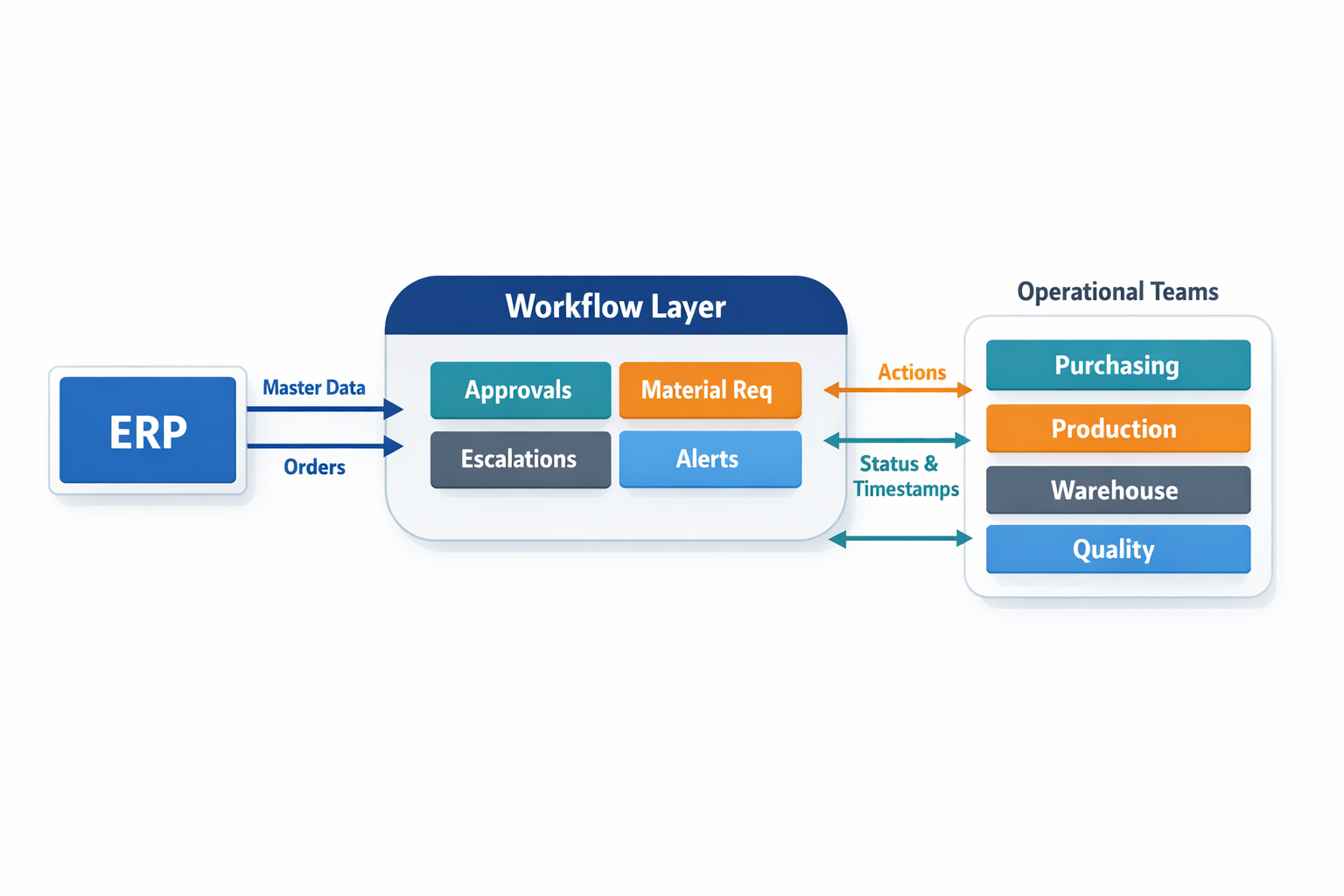
Many manufacturers already have an ERP, but ERP records do not always keep work moving in real time. Orders may be planned correctly in the system, yet approvals, shortage responses, and handoffs still happen through calls, chat messages, spreadsheets, or paper forms. That is where a no-code workflow layer helps: it turns those informal steps into structured actions with owners, rules, and timestamps.
Jodoo fits between ERP master data and day-to-day execution rather than replacing the ERP itself. The ERP remains the system of record for items, orders, inventory, and transactions, while Jodoo handles the operational workflows that decide what happens next, who must act, and when escalation should begin. That makes it practical for teams that want faster execution without a multi-year systems project or major IT backlog.
Automate Approvals Before They Stall Orders
One common source of hidden delay is the approval chain around schedule changes, urgent purchases, overtime, rework, or substitute materials. In many plants, a request sits in someone’s inbox for hours or even days because there is no routing logic, no reminder, and no escalation rule. Jodoo Workflow lets operations teams build approval paths with conditions, parallel reviewers, return steps, and automatic notifications, so requests move immediately to the right decision-maker. This supports several strategies to improve production lead time because orders do not wait for administrative follow-up before they can proceed.
For example, a packaging plant facing a carton shortage can trigger a substitute-material approval from a supervisor’s phone, route it to quality and planning at the same time, and log the full decision trail. Instead of waiting until the next shift meeting, the team can release the order within the hour.
Speed Up Material Response on the Shop Floor
Material shortages often become longer stoppages because the request process is unclear or delayed. With Jodoo Form Builder, operators can submit mobile material requests, attach photos, scan item codes, and send the request directly to the warehouse or purchasing teams. Structured forms reduce back-and-forth and improve response accuracy, especially in plants where supervisors manage multiple lines.
Keep Orders Moving With Real-Time Visibility
Real-time tracking is what connects workflow action to measurable lead-time reduction. Jodoo dashboards can show open approvals, shortage age, queue status by production stage, and late handoffs across purchasing, production, warehouse, and quality in one view. That gives managers a live control tower for exception management instead of relying on end-of-day reports.
Conclusion: Build a Faster, More Connected Lead-Time Reduction System
Reducing manufacturing lead time is rarely about running machines faster alone. In most factories, the bigger losses sit in hidden waiting time: delayed approvals, late material responses, unclear priorities, quality holds, and handoffs between purchasing, production, warehouse, and QA. If you want a shorter lead time, you need to remove those non-productive gaps as systematically as you reduce setup time or scrap.
The practical path forward is straightforward. First, measure lead time by stage so you can see where orders actually stall, not where teams assume they stall. Then standardize the workflows around those weak points, especially approvals, shortage handling, production release, and exception escalation. Finally, digitize the handoffs so each team works from the same real-time status instead of chasing updates across paper forms, spreadsheets, and chat messages.
That is where Jodoo can help. As a no-code lean manufacturing platform, Jodoo lets operations teams build approval workflows, material request forms, production tracking apps, and real-time dashboards without a heavy ERP replacement project. If you are looking for a practical way to reduce lead time with more connected factory workflows, you can start a free trial or book a demo to see how Jodoo fits your process.