Browse by category

Introduction: What Predictive Maintenance Software Means for Manufacturers in 2026
Unplanned downtime still hits harder than many factories expect. Industry studies regularly estimate that downtime costs manufacturers thousands to hundreds of thousands of dollars per hour. That is why predictive maintenance software has moved from a pilot-project topic to a 2026 investment priority for Maintenance Directors and IT Managers.
In simple terms, predictive maintenance software uses real-time equipment data to detect early signs of failure before a breakdown happens. That makes it different from reactive maintenance, which starts after an asset fails, and preventive maintenance, which follows fixed schedules whether the machine needs service or not. For manufacturers running motors, pumps, compressors, conveyors, and CNC assets, that difference directly affects uptime, spare parts usage, and maintenance labor efficiency.
This article is designed as both a buyer’s guide and a practical solution guide. First, it explains how condition monitoring works in day-to-day manufacturing operations. Then it shows what to look for when comparing software options, and finally it covers the execution layer that turns alerts into inspections, approvals, and completed maintenance actions.
How Predictive Maintenance Uses Condition Monitoring to Prevent Failures
From Asset Signals to Usable Maintenance Data
In practice, predictive maintenance software starts with continuous condition monitoring on critical assets such as motors, pumps, compressors, and conveyors. Sensors collect operating signals like vibration, surface temperature, current draw, pressure, runtime hours, and cycle counts, then send that data to a gateway, cloud platform, or plant network. This is the practical way IoT enables predictive maintenance: it turns machine behavior into a live data stream instead of relying only on calendar-based inspections. For Maintenance Directors and IT Managers, the key shift is that maintenance decisions are based on asset condition, not fixed intervals alone.
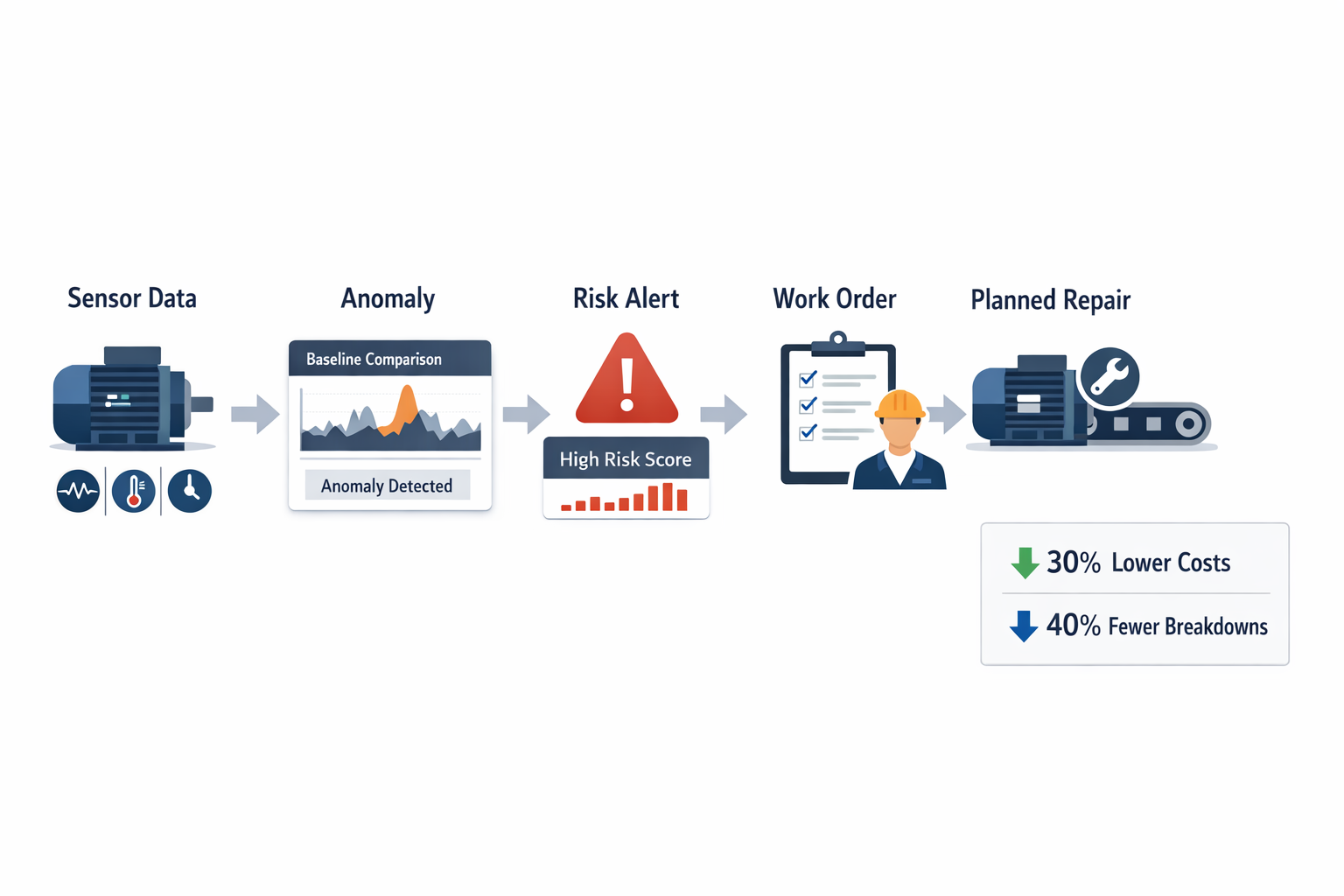
Take a conveyor drive motor in a food packaging line as a running example. Under normal conditions, its vibration stays within a stable band, bearing temperature rises gradually during production, and runtime data aligns with shift schedules. Over several weeks, the software establishes a baseline for what “normal” looks like for that motor under actual load. That baseline matters because the same vibration level can be acceptable on one asset and abnormal on another.
How Anomaly Detection Works on the Shop Floor
Once the baseline is in place, the software watches for deviation patterns rather than just absolute threshold breaches. In our conveyor motor example, the first sign may be a 12–18% increase in vibration amplitude on the drive-end bearing, followed by a modest but persistent temperature rise during the second shift. On its own, each signal may not justify stopping production, but together they suggest early bearing wear or misalignment. This is where predictive maintenance becomes more useful than simple alarm monitoring.
More advanced systems apply trend analysis, rules, or machine learning models to separate noise from meaningful change. For example, a one-time temperature spike after sanitation washdown may be ignored, while a repeating rise across five production days gets flagged. Runtime context also improves accuracy, because a pump that overheats after 300 operating hours tells a different story from one that spikes during startup only. The goal is not to predict every failure perfectly, but to identify deterioration early enough to intervene during a planned window.
From Signal to Alert to Work Order Flow
When the pattern crosses a defined risk level, the system generates an alert with enough context for action. In the conveyor motor scenario, the software can combine higher vibration, above-baseline temperature, and accumulated runtime into a severity score, then recommend a bearing inspection within the next 24 hours. The best platforms do not stop at detection; they convert the alert into a maintenance task, inspection checklist, or work order that includes asset ID, fault type, trend history, and priority. That flow from signal to alert to work order is what turns condition data into execution.
Why Context Matters More Than Raw Alerts
Condition monitoring only works well when software understands production context. A compressor running at peak demand in a hot utility room will naturally behave differently from the same model in a climate-controlled area. In the conveyor example, the software should account for product changeovers, cleaning cycles, and shift loading, so maintenance teams do not chase false positives. That is why good predictive maintenance software needs asset hierarchy, operating history, and event logs alongside sensor feeds.
This is also why the question of how to choose predictive maintenance software cannot be answered by sensor capability alone. If the system cannot connect machine signals to maintenance workflows, technicians still end up managing alerts manually. At this stage, what matters is clean data collection, reliable anomaly logic, and a clear path from diagnosis to intervention.
What to Look for When Choosing Predictive Maintenance Software
If you are deciding how to choose predictive maintenance software, treat it as an operations systems decision, not just a maintenance app purchase. The right platform should connect condition data, detect meaningful risk, and move your team from alert to action with minimal delay. For most manufacturers, the evaluation comes down to eight criteria: connectivity, alert logic, workflow automation, mobile execution, analytics, security, scalability, and system fit.
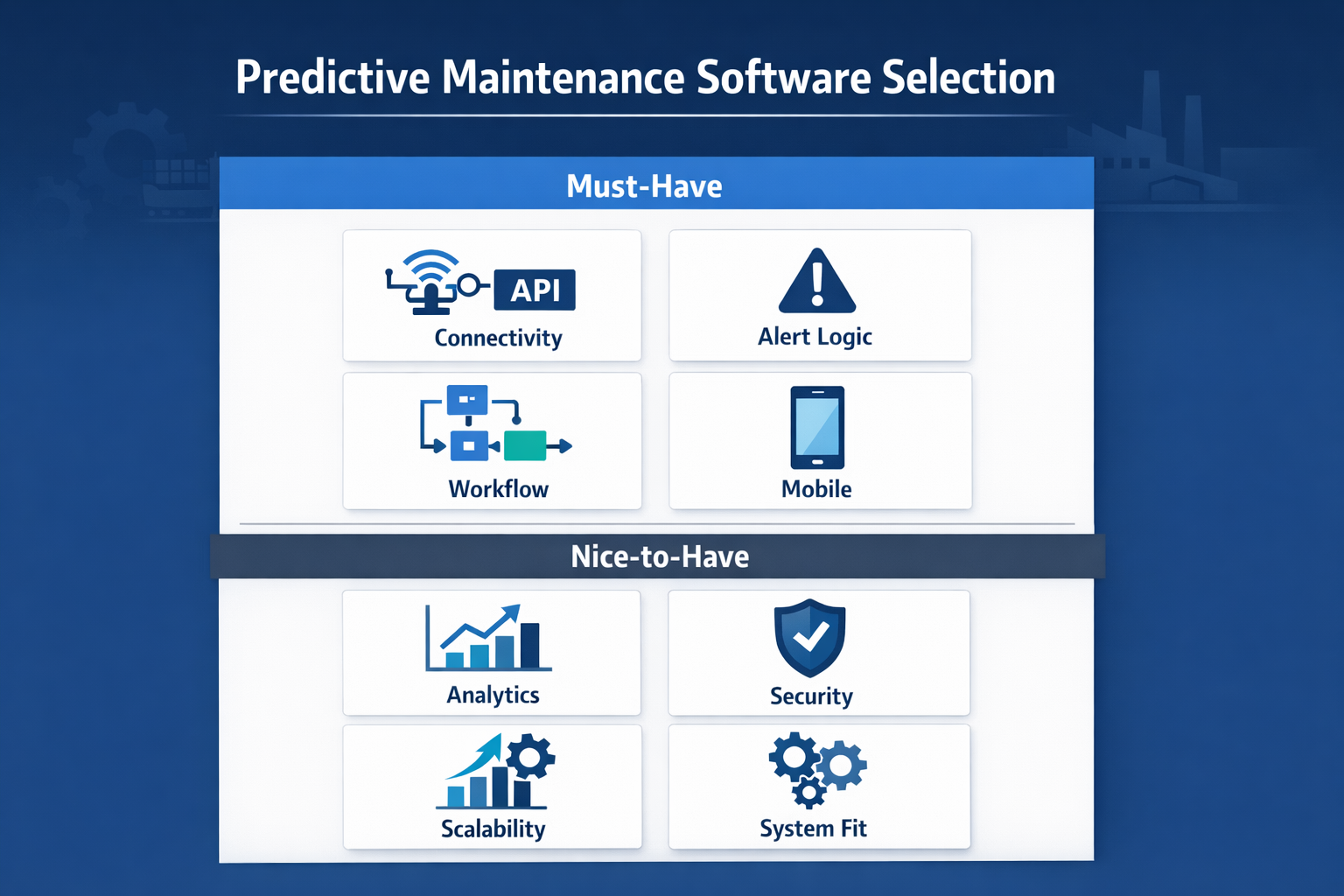
A practical scorecard helps separate must-have capabilities from nice-to-have features. Must-haves are the functions required to make predictive maintenance usable on the plant floor, while nice-to-haves improve speed, visibility, or long-term optimization. This distinction matters because many tools look strong in demos but fail when they have to work across shifts, sites, and legacy systems.
Start With Data Connectivity and Integration Fit
The first question is whether the software can ingest the signals you already have or plan to deploy. In manufacturing, that usually means vibration, temperature, current draw, runtime, pressure, and oil or lubrication data from sensors, PLCs, gateways, or SCADA environments. Because IoT enables predictive maintenance by making asset condition visible in near real time, poor connectivity is usually a deal-breaker.
API flexibility matters just as much as sensor support. If your maintenance team uses a CMMS while production and planning data sit in MES or ERP, the software should exchange data cleanly across those systems. A tool that only visualizes sensor data but cannot push events, equipment IDs, or work order context into core systems will create another silo.
Evaluate Alert Logic, Not Just Dashboards
Good dashboards are useful, but alert quality is what determines whether the software reduces failures or simply creates noise. Look for threshold rules, rate-of-change detection, trend analysis, persistence logic, and the ability to combine multiple signals before triggering action. The goal is not to detect every anomaly, but to identify the anomalies that actually justify maintenance intervention.
A must-have here is configurable alert logic by asset class, criticality, and operating context. A nice-to-have is machine learning that improves anomaly detection over time, but only if your plant has enough clean historical data to support it. In many factories, solid rule-based logic delivers faster value than advanced AI features that require months of tuning.
Check How Alerts Become Work Orders and Whether It Works on the Shop Floor
The software should not stop at notification. You need to see exactly how an alert becomes an inspection, a maintenance task, an approval, and a closed record with root-cause notes. If your team still has to copy alerts from one screen into email, WhatsApp, or a separate work order system, the process will slow down at the point where speed matters most.
At minimum, the platform should support automatic work order creation, priority assignment, due dates, asset tagging, technician assignment, and status tracking. Better systems also support escalation rules, attachment of trend data or photos, and links to SOPs or past maintenance history. For plants running 24/7 operations, that execution layer often matters more than having another analytics widget.
Mobile usability is often underestimated during software selection. Maintenance technicians need to acknowledge alerts, review asset history, record findings, attach photos, and close tasks from the line, not from a desktop in the maintenance office. If the mobile interface is slow, confusing, or dependent on constant high-quality connectivity, compliance will fall.
Look for role-based mobile views, offline or low-bandwidth tolerance, barcode or QR support for equipment lookup, and simple task forms that can be completed during inspection rounds. These are must-haves in large plants and especially important in Southeast Asia, where facilities may vary widely in wireless coverage, contractor access, and device standardization. Nice-to-have features include voice notes and richer in-app collaboration, but only after the basics are reliable.
Prioritize Analytics That Support Decisions
Analytics should help your team answer operational questions, not just display trends. You want visibility into alert frequency, mean time to acknowledge, mean time to repair, repeat failure patterns, downtime avoided, and which assets generate the most predictive interventions. These measures are what help Maintenance Directors justify budget and help IT Managers assess system value.
Review Security, Governance, and Scalability Early
Security should be part of the first evaluation round, not a final procurement checkbox. Predictive maintenance software often touches production assets, operating schedules, maintenance history, and sometimes vendor access, so role-based permissions, audit logs, and secure APIs are basic requirements. For IT teams, SSO support, data residency clarity, and integration governance are also important.
Scalability is just as practical as security. A pilot on 20 assets can succeed with manual setup, but a rollout across 10 plants and 2,000 assets requires template-based deployment, consistent naming structures, and manageable administration. If the software cannot scale asset libraries, workflows, users, and site-level reporting without heavy reconfiguration, your total cost of ownership will rise quickly.
For most manufacturers, the must-have list includes sensor and API connectivity, configurable alert rules, automatic work order creation, mobile task execution, integration with CMMS or ERP, role-based security, and reporting tied to maintenance outcomes. Without these, the software may monitor equipment but still fail as an operational tool. These are the capabilities that support day-to-day execution.
The nice-to-have list usually includes advanced AI recommendations, digital twin visualization, broad benchmarking, and highly customized executive dashboards. These can add value, especially for mature multi-site programs, but they should not outweigh execution fundamentals during selection. A simpler platform that gets the response workflow right will usually outperform a more sophisticated platform that leaves action disconnected from insight.
Best Predictive Maintenance Software Options for Manufacturing
If you are comparing predictive maintenance software in 2026, it helps to ignore generic “top 10” lists and sort the market by operating model instead. Most manufacturing buyers end up choosing from three categories: enterprise EAM/CMMS suites with predictive modules, sensor-first predictive maintenance platforms, and flexible workflow platforms that connect alerts to execution. The right fit depends less on headline features and more on your asset complexity, existing systems, and how quickly you need results.
Enterprise EAM and CMMS Platforms
Traditional EAM and CMMS vendors are usually the best fit for large manufacturers that already run mature maintenance programs across many plants. Their strength is system depth: asset hierarchy, spare parts control, preventive maintenance scheduling, technician labor tracking, compliance history, and enterprise reporting. When these platforms add predictive capabilities, they can centralize condition insights inside the same environment used for planning and execution.
This category fits best when you already have strong master data, a dedicated maintenance systems team, and formal IT governance. A regional automotive supplier with multiple plants, for example, may prefer this route because it needs one maintenance record structure across hundreds of CNC machines, utilities, and facility assets. The trade-off is implementation speed, since configuration, integrations, and change management can take months rather than weeks.
Sensor-First Predictive Maintenance Vendors
Sensor-first platforms are designed around condition monitoring before anything else. They typically excel at ingesting vibration, temperature, ultrasound, current, pressure, and runtime data, then applying anomaly detection, thresholds, and machine-learning models to spot failure patterns early. This is where the benefits of condition-based maintenance are most visible, especially on rotating assets such as motors, pumps, compressors, and fans.
These tools are often the fastest path if your priority is improving visibility into machine health rather than replacing your maintenance backbone. A food and beverage plant with frequent motor and conveyor issues may adopt a sensor-led platform because it wants fast deployment on critical lines and clear evidence of how IoT makes predictive maintenance practical on the shop floor. The limitation is that many sensor-first tools are stronger at detection than at handling approvals, work routing, contractor coordination, and cross-department execution.
Flexible Workflow Platforms
A third category is the workflow platform that sits between condition data and operational response. This model is useful when a manufacturer already has sensors, a basic CMMS, or mixed systems across sites, but still struggles to turn alerts into consistent action. Instead of focusing only on analytics, these platforms focus on alert handling, inspection workflows, escalation rules, mobile task execution, and management visibility.
For fast-scaling manufacturers, this can be a more practical choice than a full EAM replacement. A multi-site electronics manufacturer, for instance, may already collect machine data from different OEM systems but lack a standard process for triaging alerts, assigning inspections, and tracking closure. In that situation, the software decision is not just about how to choose predictive maintenance software for analysis, but also how to operationalize decisions across plants without a heavy IT project.
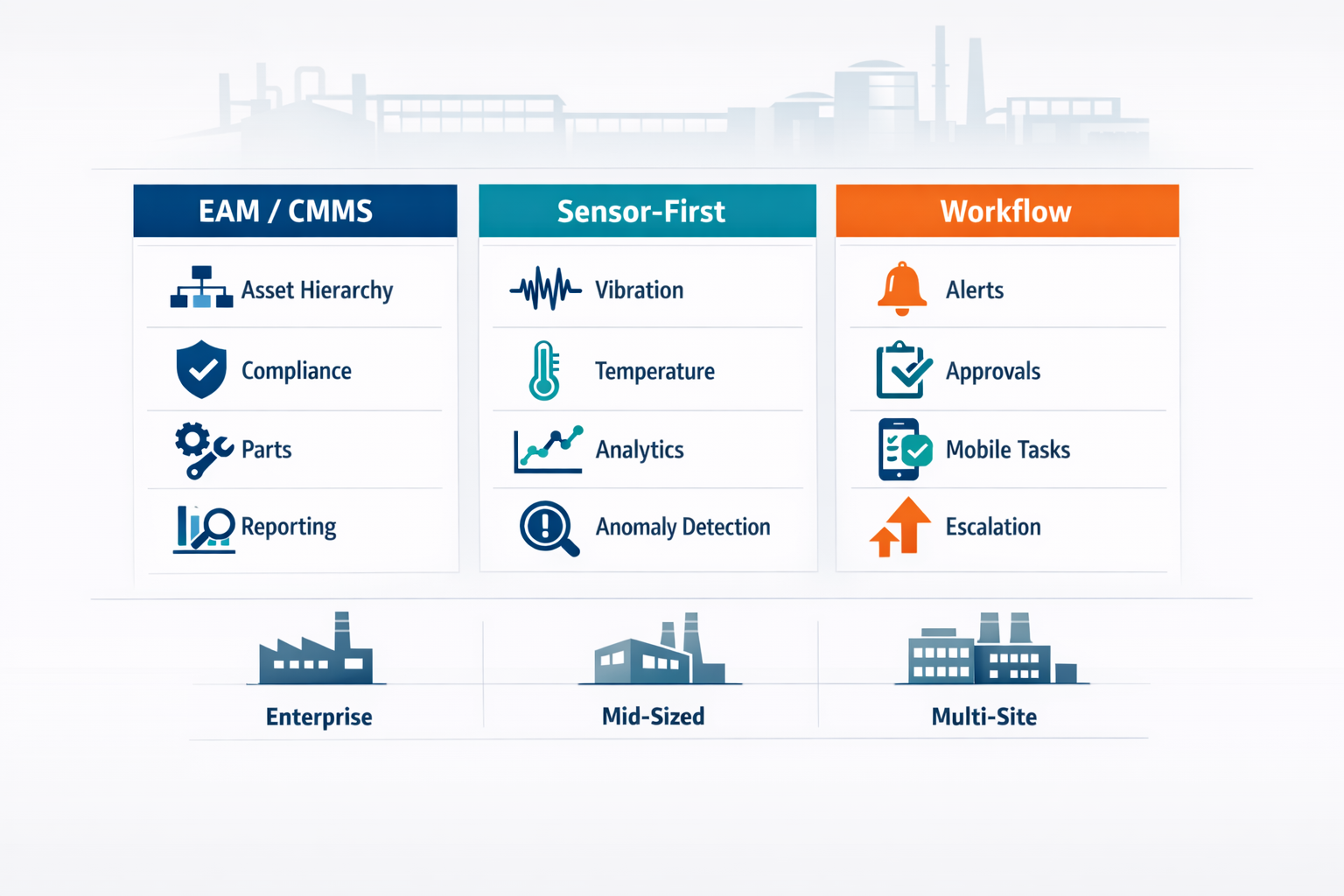
For a large enterprise plant, choose an EAM- or CMMS-led approach if maintenance is already tightly governed and predictive maintenance needs to fit existing ERP, spare parts, and reliability processes. For a lean mid-sized factory, sensor-first software usually delivers faster ROI when you need to prove value on a limited set of critical assets before expanding. For a fast-scaling multi-site manufacturer, a workflow-centric approach can create standard operating response across sites even when local systems and equipment differ.
This category view is more useful than a shallow ranking because the “best” predictive maintenance software is highly situational. Buyers who focus only on feature lists often miss the larger question of organizational fit: who owns the data, who responds to alerts, and how quickly the plant can implement change. That is the lens that should guide the shortlist before you compare vendors in detail.
When a No-Code Workflow Layer Is the Better Fit for Predictive Maintenance
When a Workflow Layer Fills the Gap Between Detection and Action
Many predictive maintenance software tools are strong at detecting anomalies but weaker at driving the next operational step. In practice, the value is not created when a sensor flags abnormal vibration or heat; it is created when the right person gets the right task, with the right priority, before production is affected. That execution gap is where a no-code workflow layer becomes useful, especially for plants that already have sensors, a CMMS, or basic alerting in place.
For Maintenance Directors and IT Managers, this matters because the buying decision is not always about replacing existing systems. Sometimes the better answer is to add a workflow layer that standardizes what happens after an alert, without forcing a full CMMS or ERP replacement. This is often the more practical path when you already know how to choose predictive maintenance software at the detection level, but still struggle to turn alerts into fast, repeatable action across teams.
A no-code workflow layer is usually the better fit in three situations. First, your plant already collects asset condition data, but technicians still rely on calls, WhatsApp messages, or spreadsheets to respond. Second, your existing maintenance system can log work orders, but it cannot easily handle plant-specific approval rules, escalation paths, or cross-functional coordination with production and engineering. Third, IT wants to avoid a long implementation cycle just to close a workflow problem rather than a data-collection problem.
This approach also aligns well with the benefits of condition-based maintenance. The point is not just to maintain assets based on actual condition, but to make that response consistent every time an abnormal signal appears. If the workflow from alert to inspection to closure is still manual, you lose much of the operational value that predictive programs are supposed to deliver.
How Jodoo Connects Predictive Alerts to Action
Jodoo fits this layer by connecting sensor outputs, monitoring platforms, or existing maintenance systems through APIs, webhooks, and no-code automation rules. That means when IoT systems detect an abnormal pattern, Jodoo can automatically create a high-priority inspection request, assign it by asset or area, notify the supervisor, trigger approvals if shutdown is needed, and track completion in one workflow. Instead of asking teams to monitor multiple dashboards, it turns machine signals into governed action.
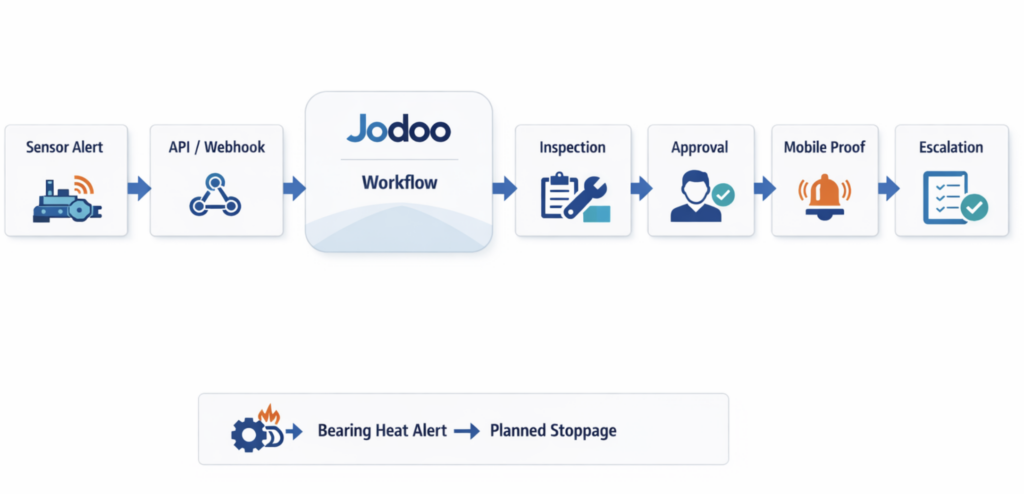
This is where how IoT enables predictive maintenance becomes operational rather than technical. IoT devices and monitoring tools provide the signal, but Jodoo handles the execution logic around that signal. For manufacturers, that includes routing by shift, attaching SOPs, collecting inspection evidence from mobile devices, escalating overdue tasks, and maintaining an audit trail for every decision.
Why This Model Works for Mid-Sized and Multi-Site Manufacturers
This model is especially useful for manufacturers that need speed and flexibility more than another heavy software deployment. A mid-sized plant can use Jodoo to digitize alert handling, inspections, approvals, and closure tracking without rebuilding its entire maintenance stack. A multi-site manufacturer can standardize escalation logic across plants while still allowing each site to adapt thresholds, roles, and response steps to local operating conditions.
From an IT perspective, the advantage is control without excessive custom coding. From a maintenance perspective, the advantage is that predictive maintenance software stops being just an analytics layer and becomes part of daily execution. That is often the missing link between detecting risk early and actually reducing downtime, maintenance cost, and production disruption.
Conclusion: Choose Predictive Maintenance Software That Turns Data Into Action
The right predictive maintenance software does more than detect abnormal vibration, temperature, or runtime patterns. It creates value when three layers work together: reliable condition data, alert logic that identifies real risk, and execution workflows that help teams respond before a failure stops production. For Maintenance Directors, that means fewer emergency repairs and better labor planning. For IT Managers, it means choosing a system that fits existing CMMS, ERP, MES, and sensor environments without creating another silo.
In practice, the best choice depends on your plant’s maturity and constraints. Some manufacturers need deep enterprise asset management, while others need faster deployment, easier integration, and stronger coordination between maintenance, production, and supervisors. That is often where implementation succeeds or fails, because an alert only matters if it becomes a tracked inspection, approved action, and closed work order.
If you need a flexible operational layer to connect IoT signals with plant-specific maintenance workflows, Jodoo is worth evaluating. As a no-code lean manufacturing platform, Jodoo helps manufacturers turn sensor alerts into inspections, escalations, notifications, dashboards, and auditable follow-up without a long development cycle. You can start a free trial or book a demo to see whether it fits your maintenance process.