Browse by category

Introduction: Why Preventive Maintenance Matters in Manufacturing
A single hour of unplanned downtime can cost manufacturers thousands to hundreds of thousands of dollars. Yet many plants still rely on a break-fix approach, where maintenance starts only after a machine stops, rejects rise, or delivery dates are already at risk. That is exactly why preventive maintenance matters: it replaces last-minute firefighting with planned inspections, servicing, and part replacement before failures disrupt production.
In plain terms, preventive maintenance means doing the right maintenance work at the right interval to keep equipment reliable, safe, and available for production. Instead of waiting for a compressor trip, a conveyor bearing seizure, or a CNC spindle issue, your team follows a schedule based on time, run hours, cycles, or known wear patterns. This shift helps plants stabilize output, reduce emergency work, and make maintenance labor more predictable.
This guide is built to help you answer three practical questions. First, what are the real benefits of preventive over reactive maintenance on the shop floor and in the budget? Second, what do useful preventive maintenance schedules and PM task examples actually look like? Third, how can you start a preventive maintenance program without turning it into a complex system rollout?
The Real Benefits of Preventive Over Reactive Maintenance
Planned Maintenance Changes Daily Operations
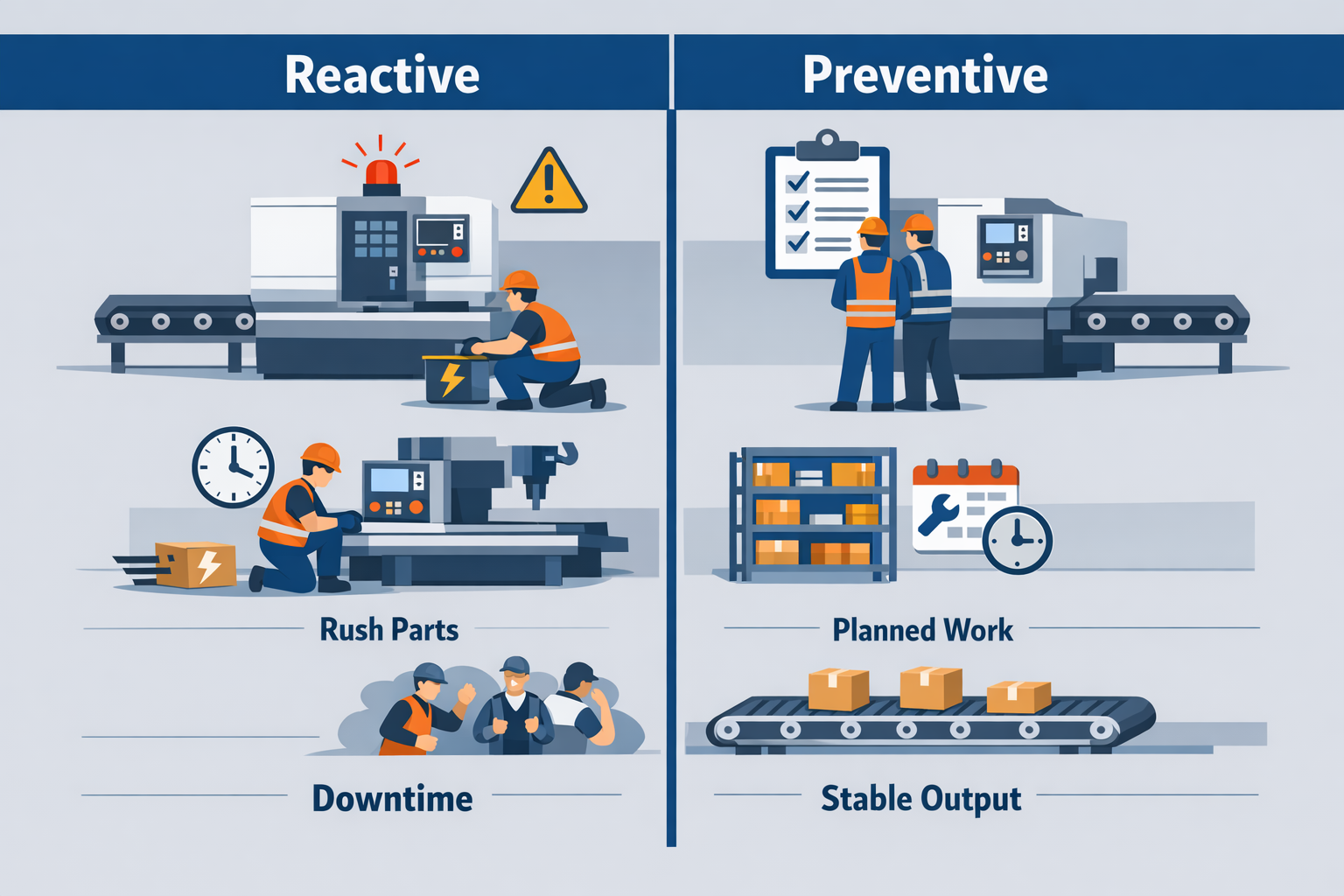
The benefits of preventive over reactive maintenance become clear when you look at how work actually happens on the shop floor. In a reactive environment, maintenance teams are pulled into breakdowns with little warning, production schedules change by the hour, and spare parts are often sourced in a rush at a higher cost. In a preventive maintenance program, the same team works from planned tasks, scheduled shutdown windows, and known parts requirements. That shift reduces operational volatility, which is often more valuable than the maintenance savings alone.
Less Unplanned Downtime, More Stable Throughput
Unplanned downtime is one of the most expensive forms of waste in manufacturing because it affects labor, output, delivery, and quality at the same time. Preventive maintenance lowers that risk by catching wear, looseness, contamination, and drift before they turn into a hard stop. A food processing line, for example, can avoid a full-shift loss if a weekly inspection finds a belt tracking issue before it damages the drive assembly.
More stable equipment also supports more stable production output. When machines are maintained at planned intervals, cycle times, pressure levels, temperature control, and repeatability tend to stay closer to standard. That matters in plants where small mechanical deviations lead to scrap, rework, or frequent micro-stoppages that never appear as major failures but still reduce OEE. Preventive work improves reliability not only by preventing breakdowns, but also by protecting process consistency.
Longer Asset Life and Lower Total Maintenance Cost
Well-timed preventive maintenance helps assets last longer because it reduces cumulative damage. Bearings run cooler when lubrication is done on time, compressors avoid major wear when filters are changed before restriction becomes severe, and electrical panels stay more reliable when dust and loose terminals are addressed early. These are small interventions compared with the cost of replacing a failed motor, damaged gearbox, or burned drive. Over time, planned care delays capital replacement and improves return on existing equipment.
It also lowers emergency labor and purchasing costs. Reactive maintenance often requires overtime, contractor support, and premium freight for urgent spare parts, all of which raise maintenance spend without improving system reliability. By contrast, planned maintenance allows parts to be stocked more rationally and labor to be assigned during normal hours. That cost control is one reason many plants treat preventive maintenance as an operations strategy, not just a maintenance activity.
Safer Work and Better Execution Discipline
Breakdown conditions are inherently harder to manage safely. Technicians may troubleshoot live systems under production pressure, isolation steps may be rushed, and the work area may be crowded by operators waiting for restart. Preventive maintenance creates better conditions because tasks can be prepared in advance with lockout steps, tools, permits, and replacement parts ready. That reduces both safety exposure and the chance of incomplete repairs.
How to Start a Preventive Maintenance Program in a Manufacturing Plant
Build a Complete Asset Register First
If you want to know how to start a preventive maintenance program without creating extra admin work, begin with an asset register. In a metal fabrication plant, for example, the maintenance team might start with one production cell that includes two CNC machines, an air compressor, a coolant pump, and a chip conveyor. For each asset, record a clear asset ID, location, manufacturer, model, serial number, install date, and any known service intervals. This gives you a usable baseline instead of a vague equipment list that cannot support planning.
The register should also capture practical operating details, not just nameplate data. Add fields for shift pattern, average running hours, spare part dependency, common failure modes, and whether the asset has backup capacity. Plants that skip this step often end up with PM plans that look complete on paper but miss the machines that actually constrain output.
Rank Assets by Criticality and Failure Risk
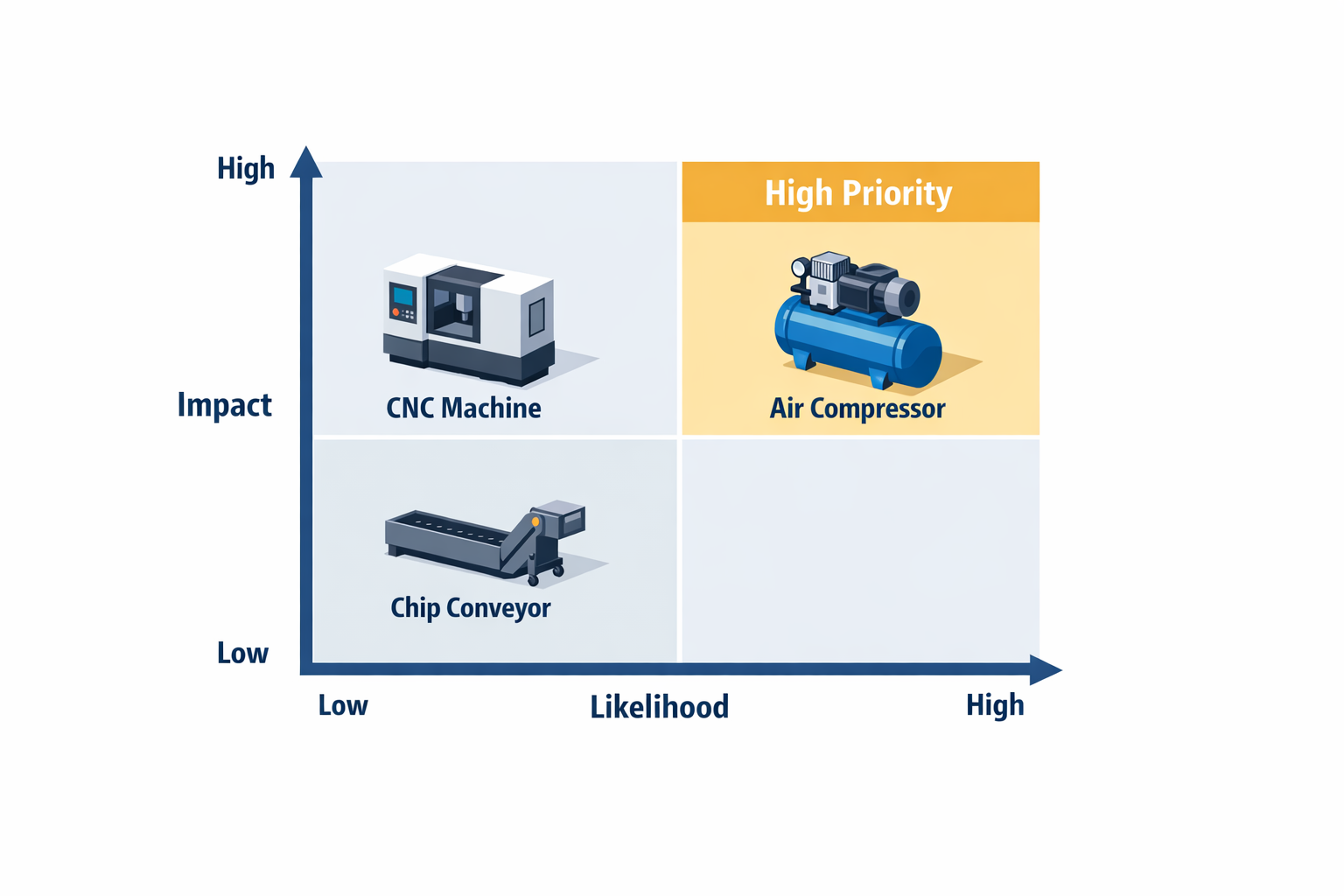
Once the register is in place, rank assets based on two factors: how badly a failure would affect production, and how likely that failure is to happen. In the same fabrication plant, one CNC machine may be the only unit capable of a tight-tolerance operation, while the compressor supports the whole cell and can stop every connected machine if it fails. That means both assets may rank above the chip conveyor, even if the conveyor fails more often. A simple scoring model from 1 to 5 for production impact, safety risk, repair time, and failure frequency is usually enough to set priorities.
Define PM Tasks Using OEM Guidance and Plant History
After ranking the equipment, define PM tasks for the top-priority assets using two sources: the OEM manual and your own maintenance history. For the critical CNC machine, the OEM may specify weekly lubrication, monthly way cover inspection, quarterly spindle cooling checks, and periodic backlash verification. Your plant history may add tasks the manual does not emphasize, such as checking coolant concentration every three days because poor coolant control has caused repeat tool wear and unplanned stoppages.
Keep each task specific enough that two different technicians would perform it the same way. “Inspect machine” is too broad to be useful, but “check spindle vibration trend, inspect lubrication lines for blockage, clean cabinet filters, and record abnormal noise” is actionable. This is also where many plants begin building their first preventive maintenance schedule examples, even if they are still working in a spreadsheet.
Assign Clear Ownership and Timing
A preventive maintenance program fails quickly when tasks exist, but ownership does not. In the fabrication plant, the maintenance supervisor may own monthly and quarterly PM compliance, production operators may handle basic autonomous checks at shift start, and the planner may reserve a two-hour Sunday window for the CNC machine. Each task should have a named role, a due frequency, an estimated duration, and a rule for what happens if the task is missed or a defect is found.
This handoff between maintenance and production is where planning becomes real. If operators are expected to clean sensors or check oil levels, those steps need to be written into standard work and verified. If technicians need machine downtime, the production schedule must reflect it, or PM tasks will keep slipping behind urgent jobs.
Start With a Pilot Before You Scale
The safest way to launch is to pilot the program on a limited scope, then expand once the routines are stable. In this example, the plant starts with the CNC cell and compressor because those assets combine high production criticality with clear recurring tasks. Over the first 30 to 60 days, the team tracks schedule compliance, repeat findings, emergency callouts, and whether planned maintenance windows are realistic.
A pilot helps you correct the program before scaling it plant-wide. You may find that a weekly lubrication task should move to every five operating days, or that a monthly inspection needs a spare filter kit prepared in advance. Once the pilot produces consistent execution, you can roll the same logic across other lines instead of guessing your way into a full-site preventive maintenance program.
Preventive Maintenance Schedule Examples and What to Put in Each PM Task
Calendar-Based vs. Usage-Based Scheduling
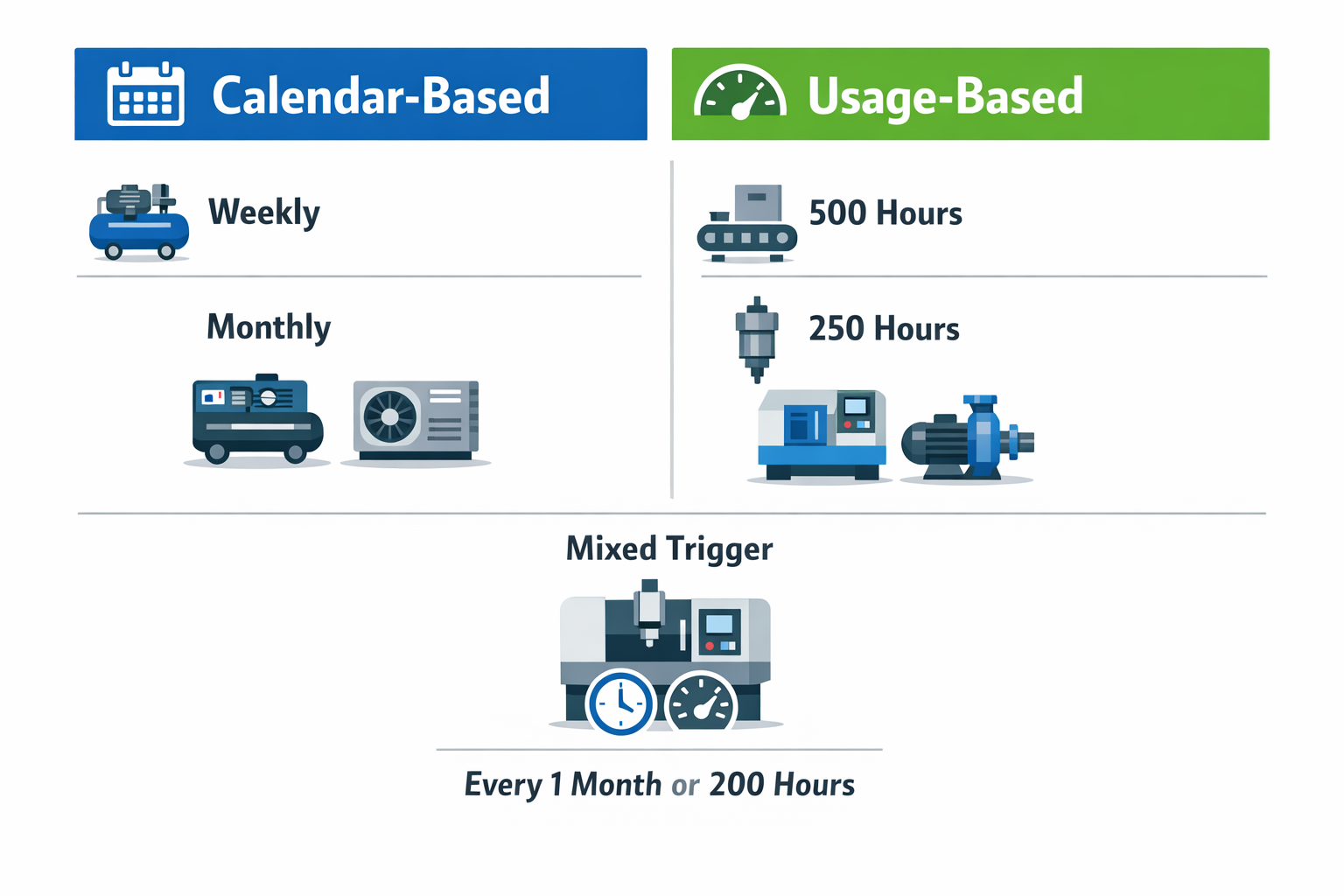
Useful preventive maintenance schedule examples start with the right trigger. In most plants, calendar-based PM works best for assets that degrade over time regardless of output, such as air compressors, emergency generators, HVAC units, and safety systems. Usage-based PM fits equipment whose wear depends more on running hours, cycles, or production volume, such as CNC spindles, conveyors, pumps, and stamping presses. Choosing the right trigger matters because it turns preventive maintenance from a generic routine into a schedule that reflects actual equipment behavior.
A simple rule is this: use calendar intervals when deterioration is tied to time, inspection frequency, or compliance requirements, and use meter-based intervals when wear tracks operating load. For example, a compressor oil check may be scheduled every week, while a conveyor chain inspection may be triggered every 500 operating hours. A CNC machine may need lubrication every 250 spindle hours, and alignment checks every quarter. Plants that are learning how to start a preventive maintenance program often get better results by mixing both methods instead of forcing one schedule type across all assets.
Preventive Maintenance Schedule Examples by Equipment Type
For a conveyor system, a practical schedule may include daily visual checks, weekly lubrication, and monthly belt tracking inspection. Daily tasks can focus on abnormal noise, loose guards, and material buildup, while weekly work covers chain tension and bearing lubrication. Monthly work should go deeper into pulley wear, belt alignment, and motor mounting condition. This is one of the clearest preventive maintenance schedule examples because conveyors often fail through gradual, visible deterioration.
For an air compressor, a calendar-based plan is usually more effective because air quality, heat, and oil condition degrade over time even when production volume changes. A weekly PM can include condensate drain checks, pressure verification, and leak inspection, while monthly work may cover filter condition, belt tension, and cooler cleaning. Quarterly tasks may include oil replacement sampling, safety valve inspection, and motor current review. In many factories, compressors are critical utilities, so their PM tasks should be written with tighter inspection standards than general support equipment.
For a CNC machine, the PM schedule usually combines time-based and usage-based triggers. Operators may complete daily checks on coolant level, air pressure, and chip buildup, while maintenance technicians perform lubrication, spindle checks, and backlash inspection after a defined number of operating hours. A monthly checklist may include way cover inspection, tool changer function test, and verification of axis repeatability. This structure helps convert the broader benefits of preventive over reactive maintenance into measurable control over precision, scrap, and uptime.
What Every PM Work Order Should Include
A preventive maintenance task should not stop at “inspect machine” or “service conveyor.” Each work order needs enough detail for a technician to execute the task consistently across shifts, lines, and plants. At minimum, include the asset ID, equipment location, PM trigger, due date, task procedure, required tools or spare parts, lockout/tagout steps, inspection points, expected limits, findings, and sign-off fields. Without that level of detail, the schedule exists, but execution varies too much to trust the record.
The procedure itself should be written as a short sequence, not a vague instruction. Instead of saying “check bearings,” specify what to inspect: temperature, noise, grease condition, housing looseness, and signs of contamination. If a torque value, clearance, or pressure range applies, put that value directly in the task. That makes the PM document an execution standard, not just a reminder.
Safety steps should also be built into the work order rather than treated as separate tribal knowledge. If the task requires lockout, guarding removal, confined access, hot-surface awareness, or compressed air isolation, list those steps in order before the inspection or service actions begin. This is especially important for rotating equipment and stored-energy systems. A good PM checklist protects both uptime and safe work discipline.
Turning a Checklist Into an Executable Standard
The best PM checklists make it easy to record findings, not just completion. Technicians should be able to note readings, attach photos if needed, identify abnormal conditions, and state whether follow-up corrective work is required. A “pass/fail” box alone is rarely enough for critical assets because it does not show trend deterioration. If you want preventive maintenance to support planning decisions later, the task must capture usable condition data.
Sign-off should confirm more than attendance. The technician sign-off shows the work was completed, while a supervisor or planner sign-off may confirm review of findings, exceptions, and required next actions. This creates a cleaner handoff between routine PM and repair planning. For plants refining their approach after learning how to start a preventive maintenance program, this is often the step that separates compliance activity from real reliability improvement.
How to Digitize Preventive Maintenance Workflows with Jodoo
Turn Your PM Plan Into a Live Workflow
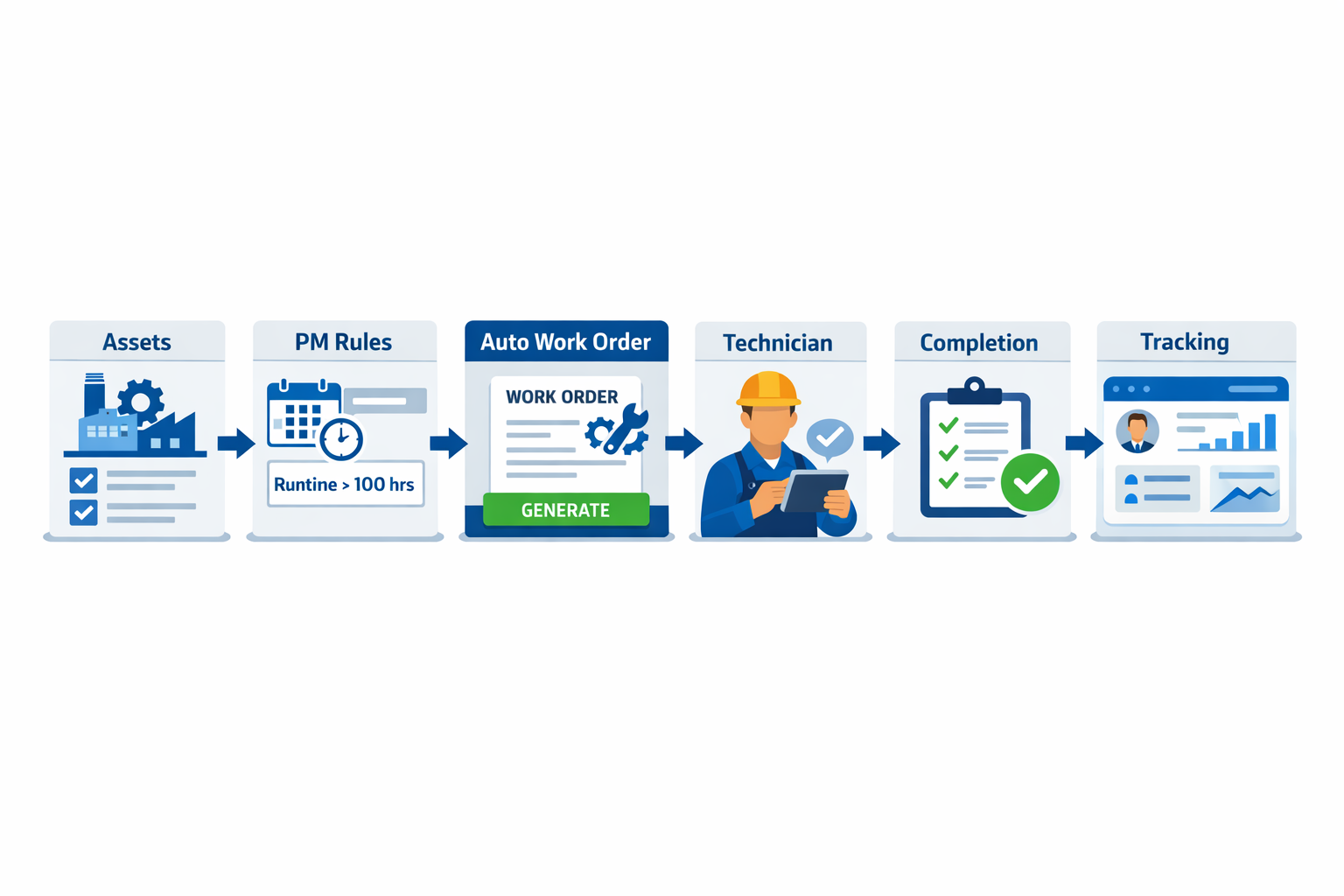
Once your plant has defined assets, schedules, and task standards, the next step is execution control. This is where many teams stall, because the preventive maintenance plan still lives in Excel, on a whiteboard, or inside one supervisor’s memory. With Jodoo, you can convert that plan into a no-code workflow that automatically creates, routes, tracks, and verifies maintenance work across shifts and lines.
Instead of manually issuing weekly or monthly tasks, you can set rules that trigger recurring work orders by date, runtime, or production count. For a packaging plant starting with one filling line, that could mean auto-generating a weekly lubrication task every Friday and a monthly inspection task on the first working day of each month. If you already capture meter readings or machine counters, Jodoo can also use that data to trigger work based on actual usage rather than only the calendar, which is often the next step after plants learn how to start a preventive maintenance program in a more disciplined way.
Push Tasks to Technicians Without Manual Follow-Up
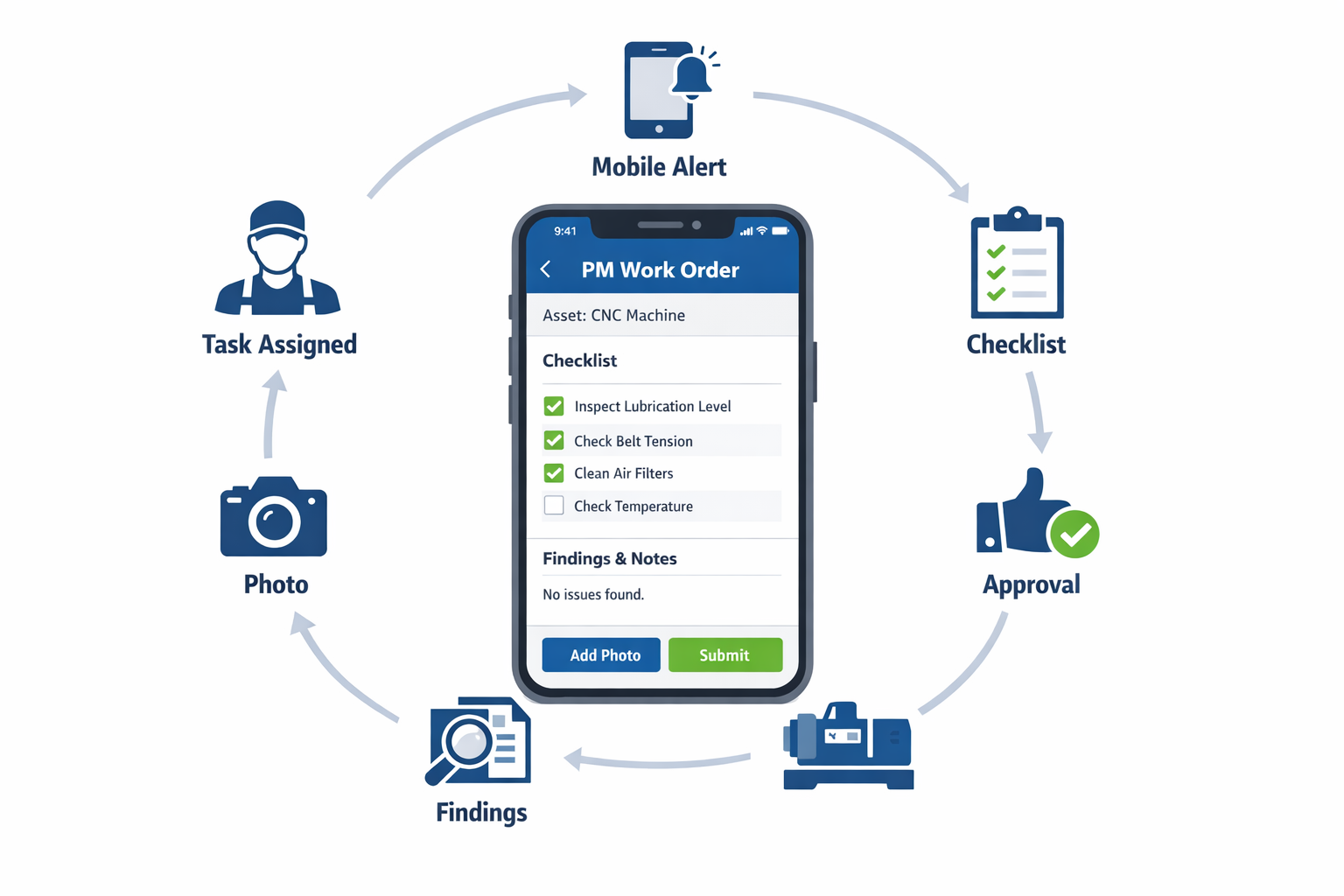
A preventive maintenance workflow only works if the right technician sees the right job at the right time. In Jodoo, work orders can be assigned automatically based on asset, line, shift, or technician role, and mobile notifications can alert the assigned person as soon as the task is released. That removes the daily coordination effort of printing job sheets, chasing updates over WhatsApp, or checking whether someone remembered to act.
In the same packaging line example, the lubrication task is pushed to the maintenance technician’s phone with the asset ID, checklist steps, required grease type, lockout instructions, and due time. The technician opens the mobile job, completes each checklist item, records findings, adds a photo if needed, and submits the form before line restart. Supervisor verification can be set as a required approval step, so the machine cannot be marked ready until sign-off is complete and the record is stored for auditability.
Standardize Completion, Escalation, and Visibility
Jodoo also helps enforce consistency after the task is assigned. You can make certain fields mandatory, such as abnormal findings, replaced parts, downtime minutes, or follow-up actions, so every PM record contains the same operational detail. That matters when you want preventive maintenance schedule examples to become repeatable plant standards rather than loosely followed reminders.
If a work order is overdue, Jodoo Workflow can escalate it automatically to a supervisor or maintenance manager. You can set reminder intervals, exception rules for missed PMs, and status tracking so overdue jobs are visible before they turn into production risk. This supports the practical benefits of preventive over reactive maintenance by making incomplete tasks visible early, instead of discovering the gap only after a breakdown.
Give Managers a Real-Time PM Dashboard
Once work orders and completion records are digitized, Jodoo Dashboard can give plant leaders a live view of PM execution. Managers can track schedule compliance, overdue rate, repeat findings by asset, mean time between failures, and technician workload by line or department. That makes it easier to see whether the program is actually improving reliability or just creating more paperwork.
For the packaging plant, the maintenance manager can start with one dashboard for that pilot line, then expand it to other lines once the process is stable. This phased rollout is usually more effective than trying to digitize the whole factory at once, especially if your team is still refining frequencies, ownership, and checklist detail. In practice, Jodoo works best when you use it to operationalize an existing PM structure, then improve the workflow as real maintenance data starts coming in.
Conclusion: Build a Preventive Maintenance Program That Scales
Preventive maintenance delivers results when it is built as an operating system, not just a maintenance calendar. The plants that gain the most value usually start with critical equipment, define clear PM triggers, and standardize each task so technicians know exactly what to inspect, replace, lubricate, record, and verify. That approach reduces missed work, makes audits easier, and gives maintenance managers a more reliable view of asset condition and labor demand.
The next step is execution discipline. Once schedules, checklists, and ownership are in place, digitizing the workflow makes preventive maintenance visible, traceable, and easier to scale across lines, shifts, and sites. Instead of relying on paper forms or spreadsheet reminders, teams can manage recurring work orders, approvals, completion records, and KPI dashboards in one system.
If you want to launch or upgrade your preventive maintenance process without waiting for a long IT project, Jodoo gives manufacturing teams a practical no-code way to build maintenance workflows around their real SOPs. You can use it to create PM forms, automate task routing, track overdue work, and monitor completion in real time. Start a free trial or book a demo to see how Jodoo can fit your plant’s maintenance workflow.