Browse by category

Introduction: What PPAP Means in Modern Manufacturing
A single missing capability study or outdated control plan can delay a launch, trigger multiple customer follow-ups, and put supplier credibility at risk. In automotive and other discrete manufacturing sectors, that is why the Production Part Approval Process (PPAP) matters: it is the formal framework OEMs and manufacturers use to confirm that a supplier can consistently produce conforming parts under actual production conditions, not just in a trial run.
For Quality Managers and Supplier Quality Engineers, PPAP is more than a document package. It connects design intent, process control, measurement reliability, and production evidence into one approval process that shows whether a part is truly ready for release. This matters because poor launch quality is expensive; industry studies routinely show that the cost of correcting defects after start of production is far higher than preventing them during pre-launch validation.
In this article, you will get a practical view of why customers require PPAP, the 18 PPAP elements and what each one proves, the different PPAP submission levels and when they are typically requested, and how to prepare a cleaner submission with fewer document gaps, version issues, and manual approval delays.
Why OEMs Require PPAP and When a Submission Is Triggered
Why OEMs Ask for PPAP Before Full Production
OEMs require the PPAP because launch risk is expensive and often hard to reverse once parts enter serial production. A weak submission can lead to line stoppages, warranty claims, containment costs, or late engineering firefighting across multiple tiers of supply. In automotive alone, poor quality is estimated to consume 15% to 20% of sales revenue in many organizations when scrap, rework, returns, and hidden failure costs are included. PPAP creates a formal checkpoint before that risk scales.
At a practical level, PPAP tells the customer one thing: the supplier has translated requirements into a stable manufacturing process, not just a good sample part. OEMs want evidence that drawings, specifications, tooling, measurement methods, and operators all work together under normal production conditions. That is why a PPAP package is tied to actual production runs rather than lab-only results or prototype builds. When a supplier can show repeatability at rate, customer confidence rises sharply.
PPAP also protects traceability and accountability across the supply chain. If a defect appears months later, the customer needs a documented baseline for what was approved, how it was made, and what controls were in place at launch. This matters even more in regulated or safety-critical sectors, where lot genealogy, material certifications, and process records may be needed during audits or recalls. In that sense, PPAP is not just a submission exercise; it is a control point for future problem solving.
What OEMs Are Verifying
From the OEM perspective, PPAP is a way to verify four things at once. First, the part meets design intent. Second, the process can hold tolerance consistently. Third, the supplier can detect and control failure modes before the customer sees them. Fourth, the approved package creates a reference point for future changes.
That is why customers often focus less on isolated documents and more on consistency between them. If the drawing revision, process flow, PFMEA, control plan, dimensional results, and capability studies do not align, the OEM sees execution risk. A submission may look complete on paper but still fail review because the evidence does not tell one coherent manufacturing story.
Common Events That Trigger a PPAP Submission
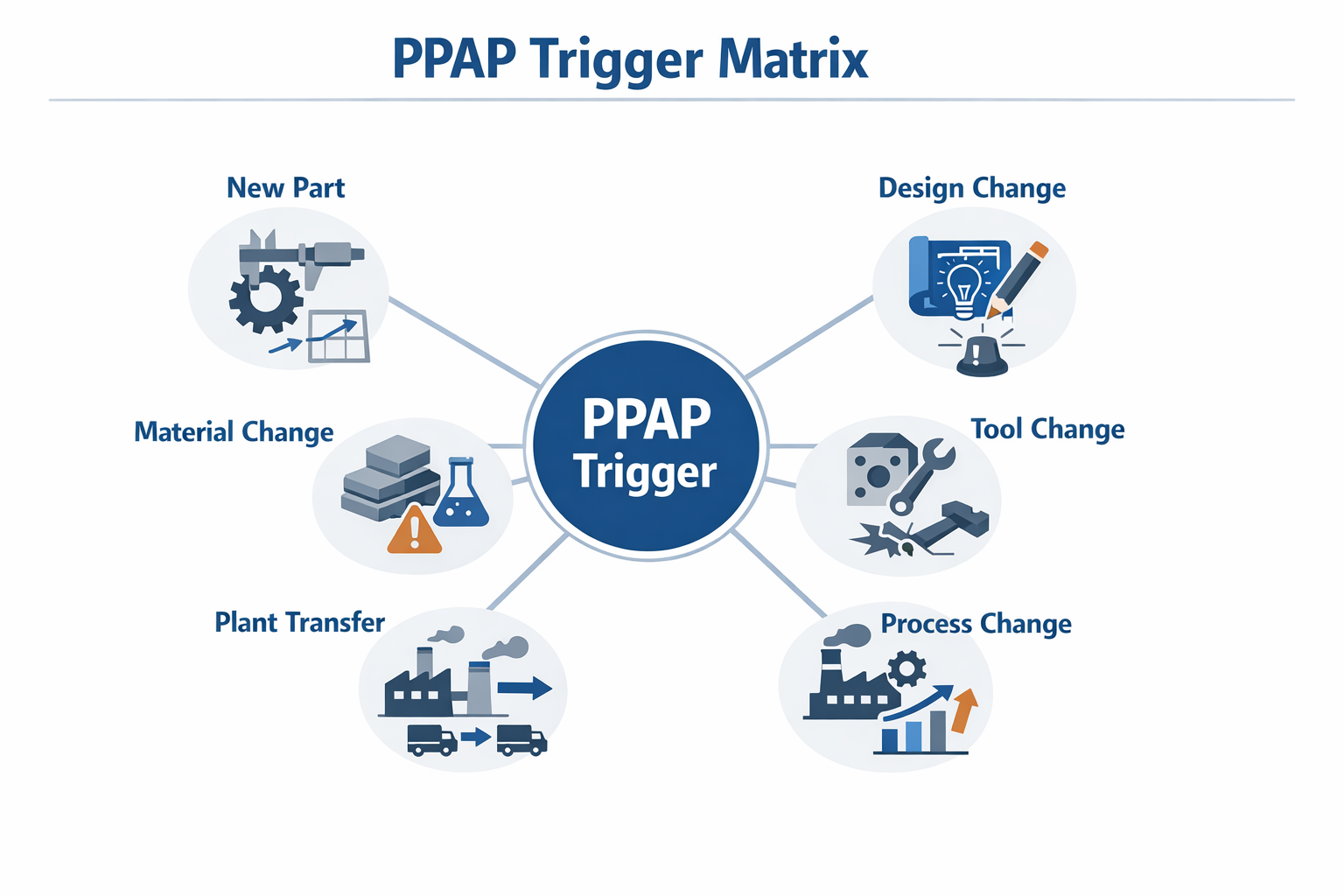
In practice, PPAP is most commonly triggered by a new part introduction. If a supplier is being approved for a first-time part number, the customer typically requires formal submission before production release. This is standard in automotive and common in other discrete manufacturing sectors where fit, function, and downstream assembly performance matter.
Engineering changes are another frequent trigger. A drawing revision that changes dimensions, tolerances, coating, software logic, or special characteristics can require a new or updated PPAP, even when the change appears minor internally. Customers are not only assessing the revised feature itself; they are assessing whether the broader process control strategy still holds after the change.
Tooling and process changes also trigger PPAP because they can alter variation patterns in ways that are not obvious at first glance. Examples include moving a mold to another press, replacing a die, changing a fixture, shifting from manual to semi-automatic assembly, or relocating inspection to a different measurement system. Supplier or plant transfers carry the same concern, since a new site means new people, machines, environment, and sometimes new sub-suppliers. Material changes, such as switching resin grade, steel source, or plating chemistry, are also common triggers because they can affect performance, appearance, or long-term durability.
Why Trigger Rules Matter in Daily Quality Management
Many PPAP delays happen because suppliers treat trigger events as technical changes rather than customer approval events. A process engineer may see a tooling move as routine maintenance, while the OEM sees it as a potential source of dimensional shift that must be revalidated. This gap is why supplier quality teams need a clear trigger matrix tied to customer-specific requirements.
For example, an electronics housing supplier may run acceptable samples after changing a mold insert and assume shipment can continue. If the customer required notification and resubmission, that assumption creates exposure immediately. A strong PPAP process prevents those judgment calls from being made informally, especially during fast launches or capacity transfers.
The 18 PPAP Elements Explained
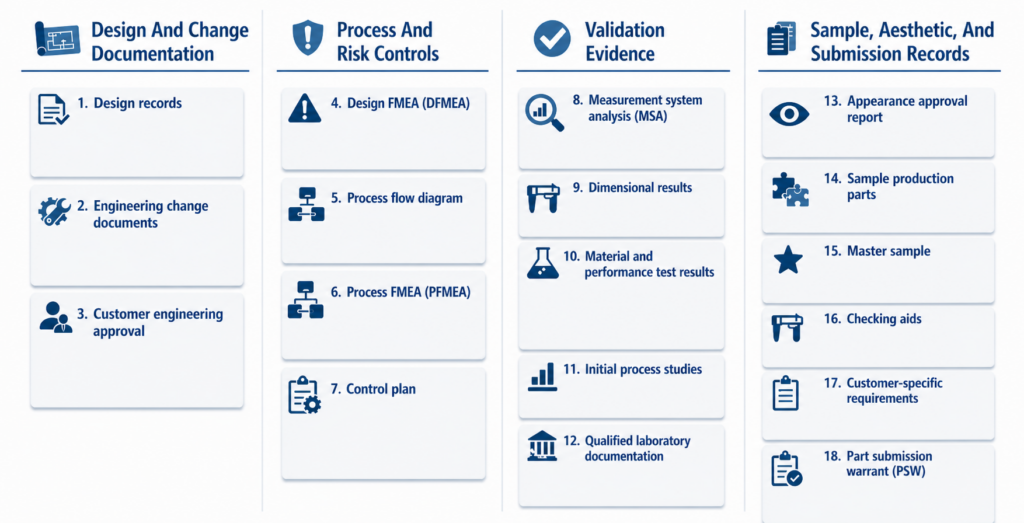
The 18 PPAP elements are easier to manage when you group them by purpose rather than memorize them as a flat list. In practice, quality teams work across four clusters: design and change documentation, process and risk controls, validation evidence, and final submission records. That structure also helps when you prepare a PPAP submission, because missing items usually come from one broken link in the chain, not from the whole package at once.
Design And Change Documentation
1. Design records are the current drawing, CAD data, specifications, and notes that define what must be made. They matter because every other PPAP document must trace back to the latest approved requirement set. If tolerances, finish calls, or special characteristics are unclear here, the rest of the file will drift.
2. Engineering change documents capture approved changes not yet fully reflected in the drawing package. This element proves the supplier is building to the latest authorized condition, not an outdated revision. It becomes critical when a launch part is approved under temporary deviation or late design release.
3. Customer engineering approval, when required, shows that the customer has reviewed engineering trials or prototype results before production approval. Not every part needs it, which is why suppliers sometimes miss it.
Process And Risk Controls
4. Design FMEA (DFMEA) evaluates how product design could fail and what the effects would be. For build-to-print suppliers, this may be customer-owned, while for design-responsible suppliers it is mandatory.
5. Process flow diagram maps each manufacturing step from receiving through packing. It exists to show the real sequence of production and inspection so auditors can match risks, controls, and records to actual operations. A weak process flow usually leads to weak PFMEA and control plan alignment.
6. Process FMEA (PFMEA) analyzes how the process could create defects, escapes, or variation. This is one of the most scrutinized elements because it should reflect actual shop-floor risk.
7. Control plan translates process risk into operational control points, reaction plans, sample sizes, and measurement methods. It is where PFMEA becomes executable on the line.
Validation Evidence
8. Measurement system analysis (MSA) demonstrates that gauges and inspection methods are capable of detecting true variation. Gauge R&R studies are the most common evidence, especially for variable measurements.
9. Dimensional results verify that parts meet every drawing requirement based on measured samples.
10. Material and performance test results confirm compliance with material chemistry, mechanical properties, functional requirements, or endurance standards.
11. Initial process studies assess short-term capability for selected characteristics, commonly using Cp and Cpk.
12. Qualified laboratory documentation shows that testing was performed by an approved internal or external lab. It supports confidence in the validity of material and performance data.
Sample, Aesthetic, And Submission Records
13. Appearance approval report applies to parts where color, grain, gloss, or cosmetic finish matters.
14. Sample production parts are the physical pieces tied to the PPAP evidence set.
15. Master sample is the retained reference approved for comparison.
16. Checking aids cover fixtures, templates, or gauges used to inspect the part.
17. Customer-specific requirements capture any OEM additions beyond the standard PPAP checklist.
18. Part submission warrant (PSW) is the formal summary record stating the supplier has met all PPAP requirements.
PPAP Levels and What Each Submission Level Includes
After you understand the 18 elements of PPAP explained in the previous section, the next question is practical: how much of that evidence must you actually submit to the customer?
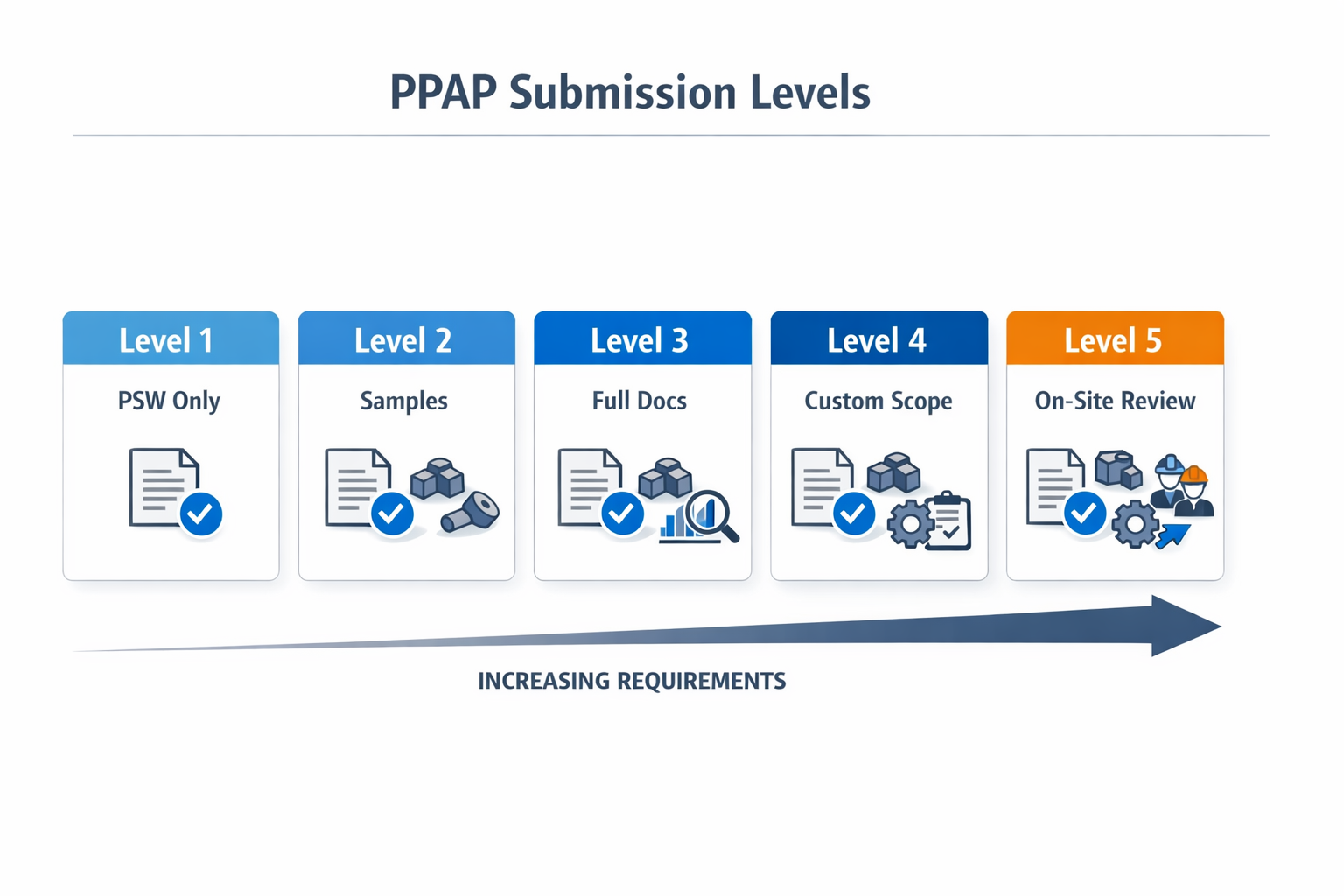
In AIAG practice, Level 1 through Level 5 define increasing depth of submission and review, but customers often tailor the requirement. Some OEMs issue their own forms, some ask for selected documents beyond the standard level, and some require electronic portal uploads with program-specific naming rules. For quality teams, the safest approach is to treat the level as a baseline, then confirm the customer-specific checklist before you build the file.
Level 1 Through Level 5 at a Glance
At a high level, Level 1 usually requires only the Part Submission Warrant, Level 2 adds sample products and limited supporting data, Level 3 is the default full submission with complete supporting documentation, Level 4 follows other customer-defined requirements, and Level 5 requires the full documentation set plus an on-site review of records and manufacturing readiness. In practice, Level 3 is the most common for new launches, while Levels 1 and 2 are more often used for lower-risk changes or repeat approvals. Level 5 is typically reserved for high-risk parts, safety-critical applications, or suppliers needing closer customer oversight.
What Each Level Generally Includes
Level 1 is the lightest formal submission. You typically submit only the PSW, while the rest of the PPAP records are retained at your site. This level is often used for minor changes, straightforward carryover parts, or situations where the customer already has strong confidence in the supplier and process.
Level 2 usually includes the PSW, product samples, and limited supporting data requested by the customer. The phrase “limited supporting data” is important because it is not always the same from one customer to another. One OEM may ask for dimensional results and material certifications, while another may want capability data for key characteristics as well.
Level 3 is generally the full PPAP submission and is the standard level most suppliers prepare for. Here, you submit the PSW along with the complete documentation package, which may include design records, approved engineering changes, PFMEA, control plan, process flow, dimensional results, MSA, capability studies, and validation records. If your team is learning how to prepare a PPAP submission, Level 3 is usually the model that drives the most cross-functional coordination.
Level 4 is not a lighter or heavier level by definition; it is a customer-defined submission. That means the customer decides exactly what must be submitted and what remains on file. This level is common when an OEM wants a targeted set of evidence for a specific change without asking for a full resubmission of every PPAP element.
Level 5 requires the complete PPAP documentation set and makes it available for review at the supplier’s manufacturing location. In many cases, the customer reviews the records on site while also assessing production controls, gaging readiness, operator methods, and traceability practices. It is less about paperwork volume alone and more about proving that documented controls match actual production conditions.
How to Match the Level to the Real Requirement
The most common mistake is assuming that the same level means the same package across every customer, plant, or program. In reality, two customers may both specify Level 3, yet one may require full raw-data attachments and the other may accept summarized evidence unless exceptions are found. That is why experienced Supplier Quality Engineers verify the level, the customer checklist, the submission method, and any special characteristic requirements before collecting documents.
A simple rule helps: as part risk, complexity, or change impact increases, submission depth usually increases too. For example, a bracket with no special characteristics may move under Level 2 after a minor fixture update, while a brake component with revised material and a new production line may trigger Level 3 or Level 5 review. Use the level as a decision framework, not as a shortcut.
What Quality Teams Should Confirm Before Submission
Before starting the package, confirm four points: the required PPAP level, the exact document list, the approval route, and the acceptance criteria for studies or validation results. This prevents rework later when a customer rejects a file that was technically complete but submitted in the wrong format. The next section will turn that requirement into an operational workflow for building and controlling the submission package.
How to Prepare a PPAP Submission
Start With Requirement Intake and Submission Scope
A controlled PPAP submission starts before anyone uploads a file. Suppose you are a Supplier Quality Engineer at an automotive stamping supplier preparing approval for a new seat bracket program. The customer sends a request referencing Level 3, a print revision change, annual volume, and a required submission date, but the real work is confirming exactly which evidence is expected, for which part number, plant, tool, and revision.
At this stage, build a single intake record that captures customer, part number, drawing revision, reason for submission, PPAP level, due date, and owner. This is where many teams lose control by starting in email and then splitting actions across personal folders, shared drives, and spreadsheets. If earlier sections covered the 18 elements of PPAP explained and PPAP levels and when each is required, your task here is operational: convert those requirements into a live checklist tied to one submission package.
Map the Submission Workflow Before Collecting Files
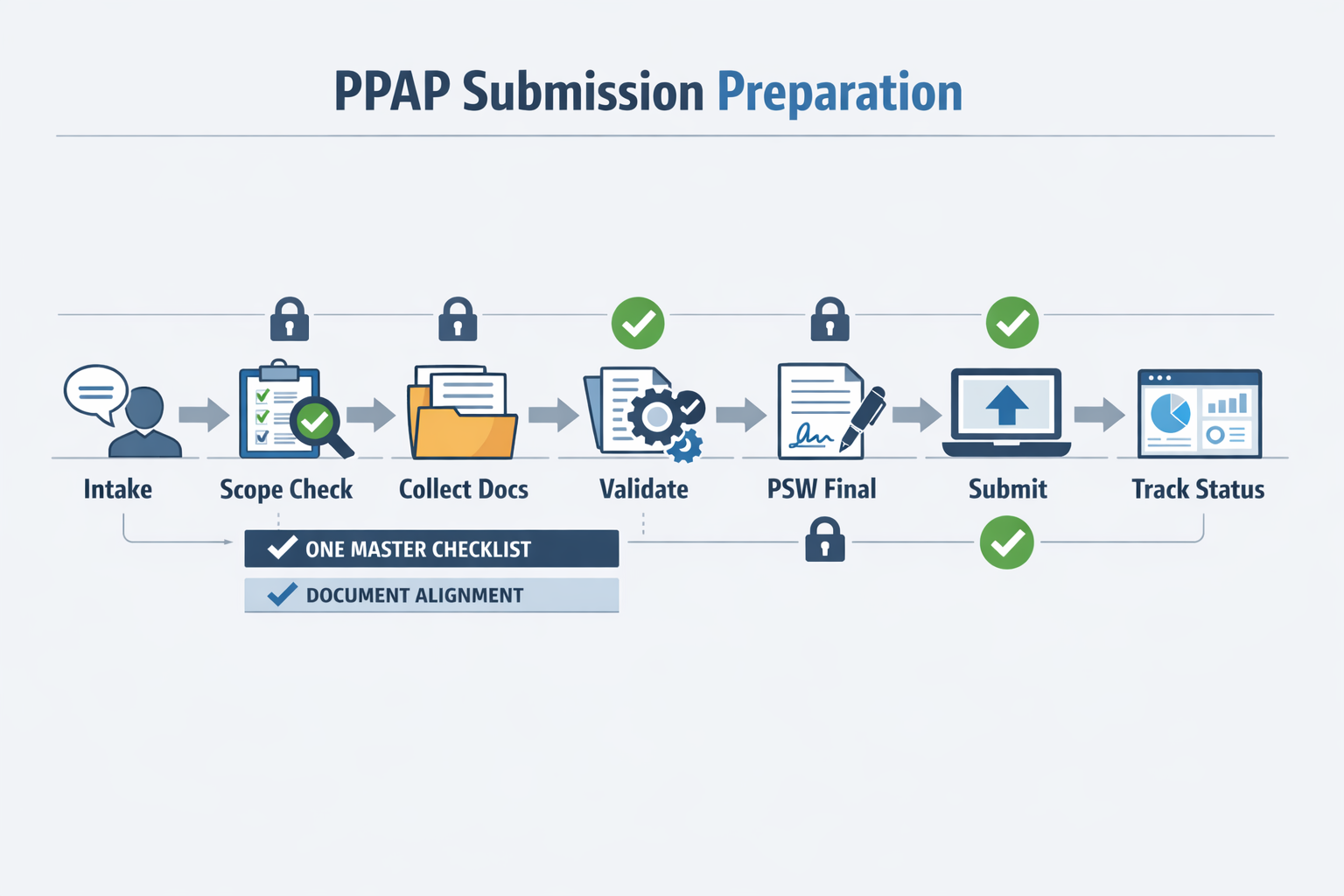
Before requesting documents, define the path from intake to approval so every stakeholder knows the next gate. For the seat bracket example, that means intake review, element checklist confirmation, supplier and internal document collection, technical validation, PSW completion, management approval, customer submission, and final disposition tracking. A simple staged workflow reduces rework because people stop asking whether the package is “almost done” when they can see which gate is still open.
Build One Master Checklist for All Required Evidence
The safest way to prepare a PPAP submission is to work from one controlled checklist rather than a folder of disconnected files. For the seat bracket, the checklist should list each required element, required format, source owner, latest revision, submission status, and approval status. That makes it obvious, for example, whether dimensional results are still pending from metrology or whether the control plan has been updated to match the latest PFMEA revision.
This checklist should also reflect customer-specific exceptions. A customer may waive design records because the part is build-to-print, or request material certifications at launch but not full appearance approval. Without those notes, teams often over-collect low-value documents while still missing the one item that actually blocks approval.
Validate Technical Alignment Before Final Assembly
Document collection is not the same as document readiness. In the running example, the most common failure is mismatch: ballooned dimensions based on one drawing revision, a control plan based on another, and capability studies run on a process setting that no longer matches the approved line conditions. A short cross-check meeting between quality, manufacturing engineering, and production can catch these breaks before the package reaches the customer.
Focus the review on links between core documents rather than reviewing each file in isolation. The PFMEA should support the control plan, the process flow should match actual routing, measurement methods should align with MSA records, and capability results should reflect the declared production process. This step is where a submission becomes coherent instead of merely complete.
Coordinate Suppliers and Internal Owners With Deadlines
If part of the package depends on outside plating, heat treatment, or raw material suppliers, assign dates that are earlier than the customer deadline. In the seat bracket case, waiting for the steel mill cert or coating lab report until the final week creates unnecessary escalation, even if every internal document is ready. Good PPAP coordination means managing response timing, not just technical content.
This is also where workflow digitization helps. With Jodoo, teams can route document requests to internal owners and external suppliers through structured forms, lock required fields by role, and trigger reminders when due dates slip. Instead of maintaining separate trackers for missing certs, open approvals, and PSW status, you keep one auditable record tied to the submission.
Complete the PSW Last, Not First
The Part Submission Warrant should be completed only after the evidence set has been validated. In practice, many teams fill it out early because the PSW looks like the headline document, then end up revising part weights, cavity counts, or submission reasons multiple times. For the seat bracket, complete the PSW from approved source data so the warrant reflects the exact package being sent.
Before release, run a final check for naming consistency, revision status, signatures, and customer-required file order. A package can be technically sound and still be delayed by preventable administrative errors. That is why learning how to prepare a PPAP submission is as much about submission control as quality evidence.
Track Approval Status After Submission
Submission is not the end of the process. Record whether the customer disposition is full approval, interim approval, or rejection, along with open action items, resubmission dates, and containment requirements. When that information sits in inboxes, the next engineering change often starts without a clear history of what was previously accepted or questioned.
A digital tracker built in Jodoo can show approval status by part, supplier, program, or plant, while preserving document history and decision trails. That gives Quality Managers and Supplier Quality Engineers a cleaner handoff from preparation to ongoing control, especially when several PPAPs are moving at once.
Conclusion: Standardize PPAP Management With Jodoo
The Production Part Approval Process is not just a documentation package. In practice, it is a cross-functional quality control process that proves a supplier can manufacture conforming parts consistently under real production conditions. That is why strong PPAP performance depends on more than knowing the 18 elements. You also need clear submission requirements, controlled records, supplier follow-up, and real-time visibility into approval status.
For many quality teams, the real challenge is coordination. PSWs sit in email threads, measurement reports live in shared folders, and approvals stall because one missing study or outdated control plan goes unnoticed too late. A more reliable approach is to standardize the workflow so every submission follows the same structure, checkpoints, and escalation rules.
Jodoo helps manufacturers digitize PPAP management without heavy custom development. You can build standardized PSW templates, collect supplier documents through secure external links, automate reminders and approval routing, and track submission progress by part, supplier, plant, or program in a live dashboard. If you want tighter document control and faster PPAP turnaround, Jodoo gives your team a practical no-code way to manage it. Start a free trial or book a demo to see how it can fit your quality process.