Просмотр по категориям

Introduction: Why Safety Certifications Matter in Manufacturing
A single safety gap can shut down production far faster than most equipment failures. According to the International Labour Organization, work-related accidents and diseases cause nearly 3 million deaths globally each year, and manufacturing remains one of the higher-risk sectors for serious incidents. That is why safety certifications matter beyond individual career development: they help manufacturers prove competence, reduce preventable risk, and build a more consistent safety culture across shifts, lines, and sites.
Для ЭХС managers, safety officers, and HR leaders, the challenge is not just sending people to training. You also need to know which credentials actually strengthen manufacturing operations, which ones support regulatory readiness, and which ones are most relevant for different roles. A plant safety coordinator, for example, may need a different path than an experienced EHS manager leading audits, incident investigations, and compliance programs.
This article will break down the top safety credentials manufacturing teams compare most often, explain how professional certifications differ from OSHA training, and help you decide which option fits your team’s responsibilities and career stage. It will also cover the practical side of managing certification records, renewals, and workforce readiness after training is complete.
Safety Certifications vs. OSHA Training
A common point of confusion in manufacturing is treating OSHA training cards and professional safety certifications as the same thing. They are related, but they serve different purposes. OSHA training helps employers meet training obligations for specific hazards and job roles, while professional safety certifications validate a person’s broader competence in safety management, risk control, and regulatory knowledge.
Certification, Certificate, and Regulatory Training Are Not the Same
A professional certification is a credential awarded by a recognized body after you meet eligibility requirements and pass an exam. A certificate usually means you completed a course, such as OSHA 10 or OSHA 30, but it does not automatically prove professional-level EHS capability. Regulatory training is what employers must provide under applicable safety rules so workers can perform tasks safely, whether or not a third-party credential is involved.
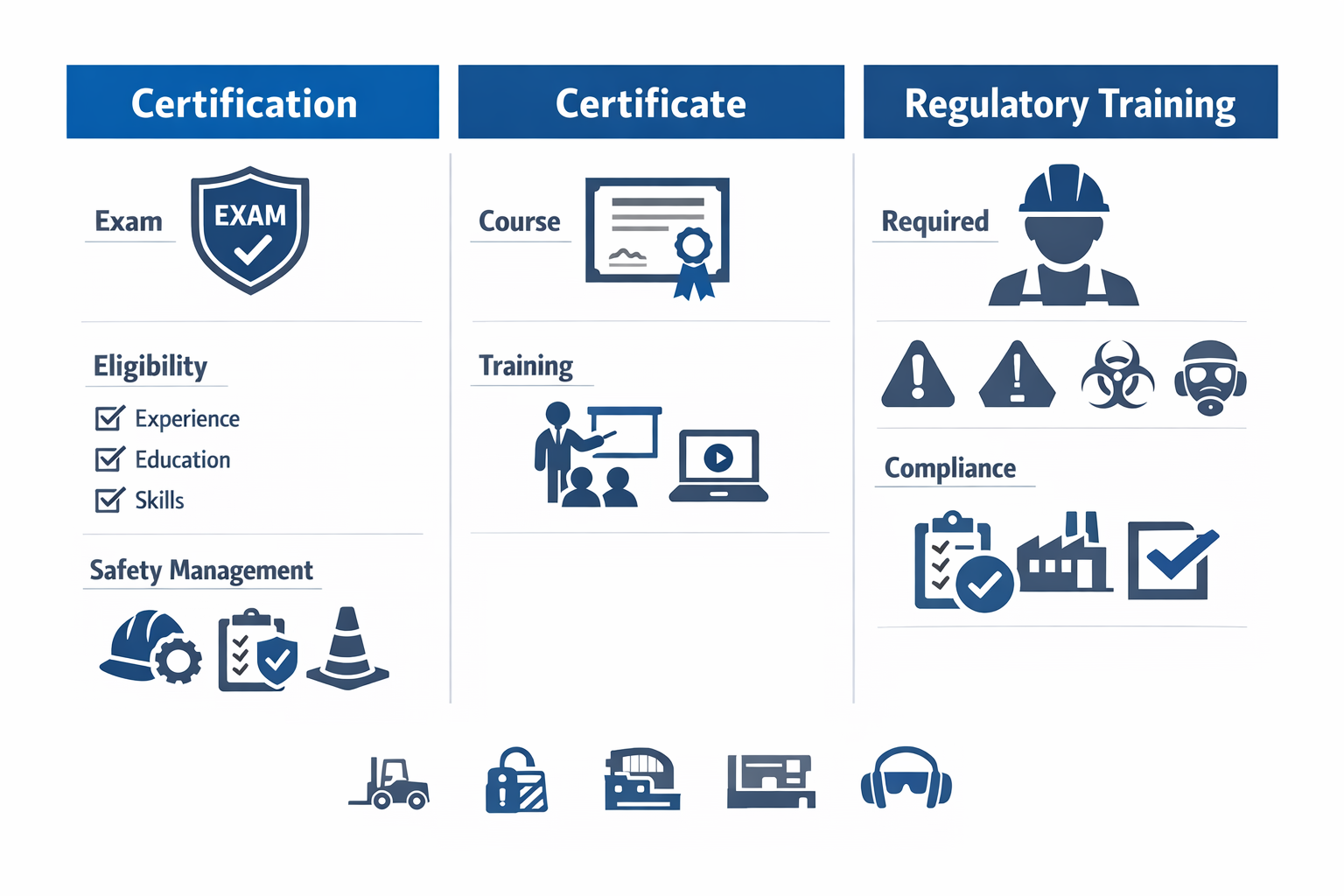
For example, a maintenance supervisor may complete lockout/tagout training, forklift refresher training, and OSHA 30. That record helps the employer show training compliance, but it is not equivalent to credentials like ASP, CSP, или NEBOSH, which are often considered among the best safety certifications for EHS professionals. This distinction matters when you are hiring for plant-level safety leadership versus documenting mandatory operator training.
How OSHA 10 and OSHA 30 Fit In
If you are asking how to get OSHA safety certified, the practical answer usually refers to completing OSHA Outreach Training. OSHA 10 is an entry-level course that gives workers a basic understanding of common workplace hazards, while OSHA 30 goes deeper and is more often taken by supervisors, coordinators, and safety leads. In manufacturing, OSHA 30 is often preferred for frontline leaders because it covers hazard recognition, worker rights, employer responsibilities, and incident prevention in more depth.
It is also important to note that OSHA itself does not certify someone as a safety professional through OSHA 10 or 30. After completing an authorized course, the participant typically receives a completion card, not a professional designation. That makes OSHA training valuable for awareness and compliance, but limited as a signal of advanced EHS capability.
How Professional Safety Certifications Differ
Credentials such as ASP, CSP, и NEBOSH assess broader knowledge across incident investigation, safety systems, exposure control, risk assessment, and regulatory frameworks. They also usually require formal eligibility criteria, such as education, experience, or both. In practice, these are the credentials hiring managers compare when deciding which safety certification is right for them or for a future EHS leader.
In short, OSHA training shows someone has completed an approved course, while a professional safety certification shows verified competence at a higher level. Manufacturing teams need both, but they should not use one as a substitute for the other.
Top Safety Certifications for Manufacturing Professionals
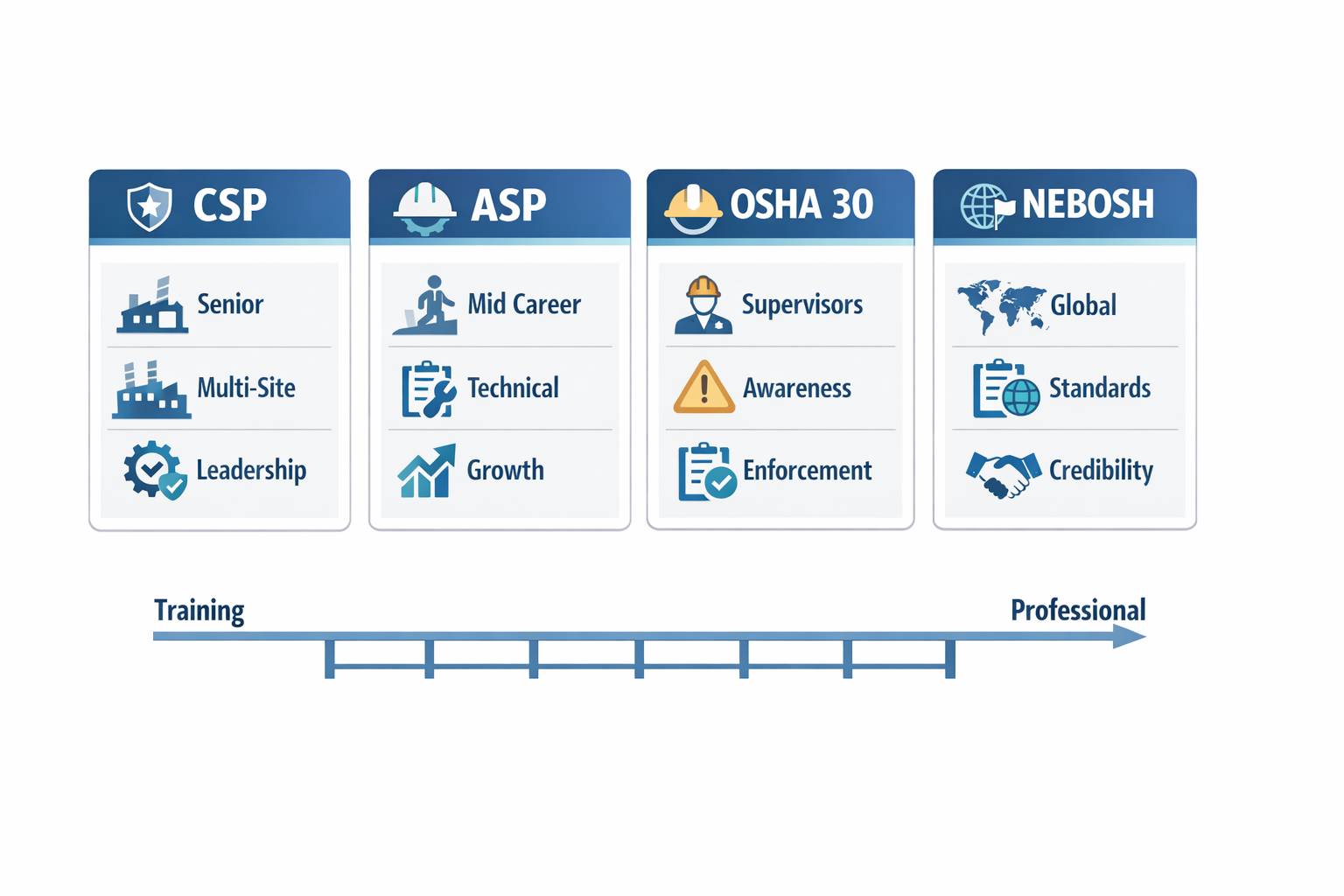
When manufacturing leaders compare safety certifications, they are usually weighing scope, credibility, and fit. CSP, ASP, OSHA 30, and NEBOSH do not serve the same purpose, so the right choice depends on whether you need supervisory training, entry-to-mid-career validation, or broader professional standing across sites and regions. For EHS managers, safety officers, and HR teams, this four-part comparison is the most practical way to narrow the field among the best safety certifications for EHS professionals.
CSP: Certified Safety Professional
Он Certified Safety Professional (CSP) is widely regarded as one of the strongest credentials for experienced EHS leaders. Issued by the Board of Certified Safety Professionals, it signals advanced competence in hazard control, risk management, incident investigation, system design, and regulatory application. In manufacturing, a CSP is especially valuable for plant-level EHS managers, regional safety leaders, and professionals responsible for multi-site programs or strategic compliance improvement.
A CSP carries weight because it requires both education and professional safety experience, making it different from short-course training. For example, a group EHS manager overseeing chemicals, machine guarding, and contractor safety across several plants can use CSP status to demonstrate decision-level capability. If you are asking which safety certification is right for me at a senior level, CSP is often the clearest long-term target.
ASP: Associate Safety Professional
Он Associate Safety Professional (ASP) is often the stepping stone to CSP and a strong standalone credential for early- to mid-career practitioners. It shows working knowledge of safety fundamentals, math, risk assessment, and program management, but usually fits professionals who are still building field experience. In a factory setting, this makes it well suited for safety officers, coordinators, and engineers moving into EHS responsibility.
For many employers, ASP shows that a candidate understands more than basic compliance tasks. A production engineer transitioning into safety at an electronics plant, for instance, can use ASP to prove broader technical grounding. Among manufacturing-focused safety certifications, ASP is one of the most practical choices for upward career mobility.
OSHA 30
OSHA 30 is not a professional certification in the same sense as CSP or ASP, but it remains highly relevant in manufacturing. It shows completion of 30 hours of structured safety training and is often expected for supervisors, team leads, and personnel with frontline responsibility. If someone asks how to get OSHA safety certified, this is usually what they mean: completing an authorized OSHA 30 course.
Its value is operational rather than professional-grade credentialing. In a metal fabrication plant, a newly promoted supervisor with OSHA 30 is better prepared to recognize common hazards and enforce safe work practices. It is useful, but it should not be mistaken for a higher-level EHS certification.
NEBOSH
NEBOSH qualifications are especially recognized in international and multinational environments. They signal structured competence in occupational health and safety management and are often preferred where companies operate under UK-influenced or global EHS frameworks. For manufacturers in Southeast Asia working with multinational customers, NEBOSH can be a strong differentiator.
In practice, NEBOSH often fits EHS professionals who need credibility across borders, not just within one national system. A safety manager at a contract manufacturing site supplying European clients may find NEBOSH particularly relevant. If your role involves global reporting standards or cross-country mobility, NEBOSH deserves serious consideration.
Which Safety Certification Is Right for You? A Role-Based Guide for Manufacturing Teams
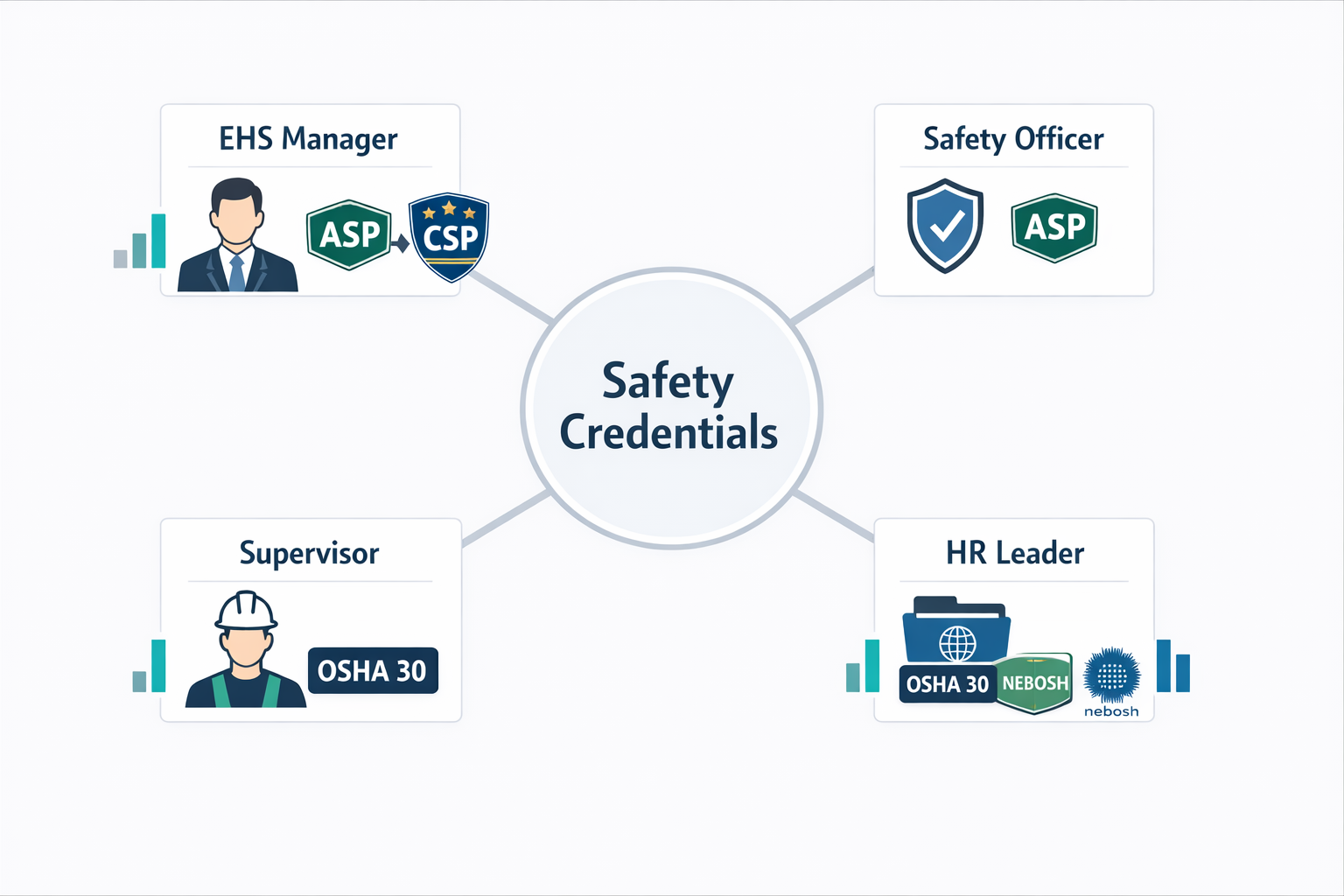
If you are asking which safety certification is right for you, the best answer depends less on the credential name and more on your role, authority, and career stage. A plant EHS manager, a line supervisor, and an HR training lead do not need the same depth of safety knowledge or the same type of credential. In manufacturing, the right choice should match three factors: decision-making scope, required technical competence, and whether you are building a long-term EHS career or meeting a role-specific operational need.
Use a simple filter before choosing: Are you responsible for plant-wide safety systems, day-to-day hazard control, frontline enforcement, or training administration? Then look at your experience level, employer expectations, and whether the credential is meant to prove professional capability or provide practical awareness. That framework is more useful than searching generically for the best safety certifications for EHS professionals, because the “best” option changes by job function.
EHS Manager
For an EHS manager, the strongest long-term path is usually ASP first, then CSP if you meet the experience and eligibility requirements. These credentials signal broader competence in risk assessment, incident prevention, compliance management, and program leadership across a manufacturing site. In a multi-line factory, a CSP carries more weight than a short course because it shows you can design, improve, and govern systems, not just attend training.
Safety Officer or Safety Coordinator
If you are a safety officer or coordinator, ASP is often the most practical target if you want to advance into management. It is widely viewed as one of the best safety certifications for EHS professionals moving from execution into higher-level responsibility. For example, a coordinator handling inspections, toolbox talks, and incident follow-up in a food processing plant may use ASP to demonstrate readiness for broader ownership of audits and corrective actions.
Frontline Supervisor
For frontline supervisors, OSHA 30 is often the best fit, especially if your role centers on daily enforcement, contractor oversight, and shift discipline. If you are wondering how to get OSHA safety certified in a practical sense, this usually means completing OSHA 30 through an authorized provider rather than pursuing a professional board certification. In manufacturing, that makes sense for production leaders who must recognize hazards quickly, lead safe work practices, and reinforce compliance on the shop floor.
HR or Training Leader
For HR managers and training leaders, the best choice depends on whether you own compliance strategy or training coordination. OSHA 30 helps when you need working knowledge of shop-floor risk and training expectations, while NEBOSH can be more valuable in multinational environments where internationally recognized EHS knowledge matters. A regional HR leader supporting plants across Southeast Asia may prefer NEBOSH because it travels better across countries and supports standardized capability building.
Beyond Certification: How Manufacturers Track Expiration Dates, Training Matrices, and Renewal Readiness
Choosing among the best safety certifications for EHS professionals is only the starting point. Once employees complete OSHA 30, earn an ASP, or add a NEBOSH credential, the plant still has to manage proof, renewal timing, and role coverage across departments. In practice, the bigger risk is rarely “which safety certification is right for me,” but whether the site can show, at any moment, who is qualified for which task. That becomes especially difficult in plants running multiple shifts, contract labor, and frequent line changes.
From Onboarding to Active Duty
Consider a mid-sized electronics plant with 450 employees across two buildings and three shifts. During onboarding, HR collects training records, the EHS team assigns mandatory courses by role, and production supervisors confirm who can work around energized equipment, chemicals, or confined spaces. That sounds manageable until certifications have different validity periods, external providers issue records in different formats, and job transfers trigger new requirements. A worker who knew how to get OSHA safety certified in a previous employer may still need site-specific verification before starting on the line.
Why the Training Matrix Matters
A training matrix connects four things that are usually scattered across folders and spreadsheets: the employee, the role, the required certification, and the expiration or renewal date. In our electronics plant, a maintenance technician may need OSHA 30, lockout/tagout authorization, contractor induction, and an annual electrical safety refresher, while an assembly operator needs a different set. When that matrix is current, supervisors can assign work based on verified readiness instead of assumptions. When it is outdated, compliance gaps stay hidden until an incident, customer audit, or regulator asks for evidence.
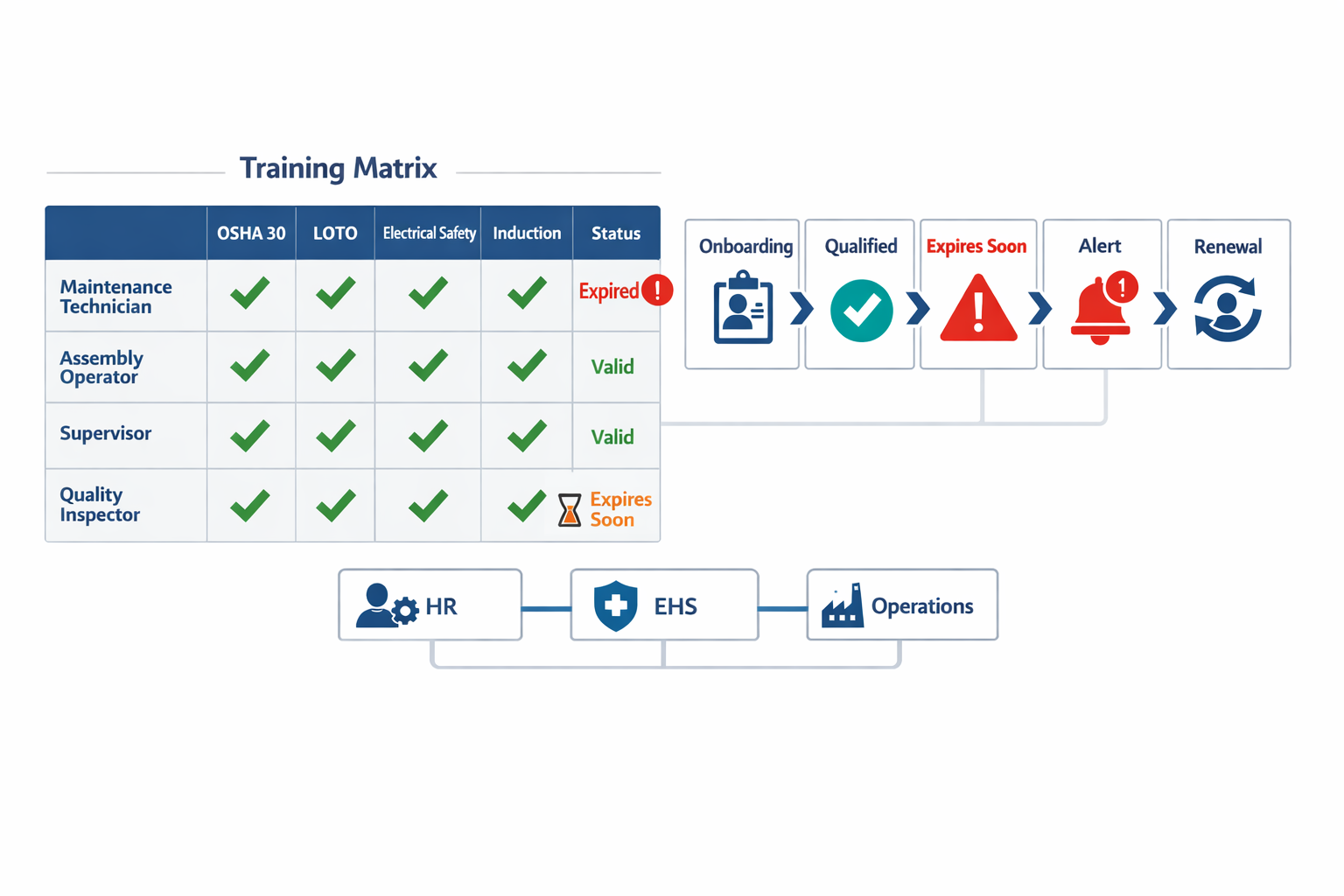
The matrix also creates cross-functional visibility. HR can see onboarding completion, EHS can monitor renewal cycles, and operations can spot whether weekend shift coverage depends on one or two people whose credentials expire next month. This matters because renewal risk is usually operational before it becomes regulatory. A single expired qualification can delay maintenance work, shift overtime to a smaller pool, or force last-minute reassignments.
Where Spreadsheets Start to Break
Spreadsheets often hold up at one site with stable staffing, but they weaken as complexity grows. Version control becomes a problem when HR updates one file, EHS keeps another, and supervisors rely on printed copies at the line. Manual reminder systems also fail quietly; if one cell is missed, the plant may not notice an expired certification until a monthly review. Across multi-site operations, that lag creates inconsistent standards and weak audit evidence.
The Missed-Alert Risk
In our example plant, a senior technician’s electrical safety authorization expires during peak season. The spreadsheet owner is on leave, the email reminder was tied to a local file, and the technician is still assigned to high-risk tasks for two weeks. No incident occurs, but the internal audit flags the gap immediately. That is why manufacturers need a controlled, visible system for renewal readiness, not just a list of completed courses.
Conclusion: Turn Safety Certifications Into an Audit-Ready System With Jodoo
For manufacturing teams, the right approach to safety certifications starts with clarity. OSHA 10 or OSHA 30 helps meet training needs, while credentials such as ASP, CSP, and NEBOSH demonstrate broader professional competence and often support career progression for EHS managers, safety officers, and training leaders. The best choice depends on role, plant risk profile, and whether your priority is frontline awareness, supervisory accountability, or deeper EHS leadership capability.
But choosing the right credential is only part of the job. In practice, compliance breaks down when certification records are scattered across spreadsheets, paper files, and email reminders, especially in multi-shift or multi-site manufacturing environments. To stay audit-ready, you need a reliable system for training matrices, expiration tracking, renewal workflows, and evidence retrieval.
Вот где Jodoo fits. As a no-code lean manufacturing platform, Jodoo helps HR and EHS teams build custom certification management workflows without heavy IT projects. You can centralize employee records, track renewal dates, trigger automated alerts, and maintain role-based visibility across plants and departments.
If you want a more controlled, audit-ready way to manage safety credentials, you can начать бесплатную пробную версию или заказать демонстрацию с Джоду.
“