Duyệt theo danh mục

Introduction: What Fault Tree Analysis Means in Manufacturing
A single critical failure can trigger hours of downtime, missed shipments, scrap, and safety exposure in the same shift. In process and discrete manufacturing alike, unplanned downtime typically costs thousands to hundreds of thousands of dollars per hour. That is why Fault Tree Analysis (FTA) remains a valuable method for teams that cannot afford to stop at the first obvious cause.
Fault Tree Analysis is a top-down, deductive approach that starts with one unwanted event, such as a machine fire, batch contamination, or line stoppage, and works backward to identify the combinations of failures that made it possible. For reliability engineers, quality managers, and EHS leaders, it is especially useful when the problem is not linear and several technical, human, or process-related causes may be interacting. Instead of asking only what happened, FTA helps you map how the event could happen.
In this guide, you will learn how fault tree analysis works, how to build a fault tree diagram, and when to use FTA. The article also looks at how digital workflows help manufacturing teams turn root cause and safety risk analysis into assigned, traceable corrective action rather than another static report.
How Fault Tree Analysis Works: Top-Down Logic, Symbols, and Diagram Structure
Start With One Clear Top Event
Fault Tree Analysis works best when you begin with a single, specific failure event that matters operationally. In practice, that top event should be defined in measurable terms, not vague language such as “line problem” or “quality issue.” A better statement is: “Filler Line 3 stopped unexpectedly for 42 minutes due to low pneumatic pressure at the capping station.” That level of precision keeps the tree focused and prevents the team from mixing safety, maintenance, and quality issues into one diagram.
For this walkthrough, use that packaging-line incident as the running example. The team already knows the shutdown occurred, so the purpose of the tree is not to describe the event but to trace how multiple causes may have combined to produce it. This is why FTA is a top-down method: you start from the unwanted outcome and work backward through the logic.
Map Events From Top to Basic Causes
Once the top event is defined, the next step is to break it into the immediate conditions that could have caused it. In a fault tree, the top event is the final failure being investigated, intermediate events are contributing failures that need further breakdown, and basic events are causes you stop analyzing because they are sufficiently specific and actionable. In the packaging example, “low pneumatic pressure at capping station” may be an intermediate event, while “regulator set below specification” or “air hose cracked” may become basic events.
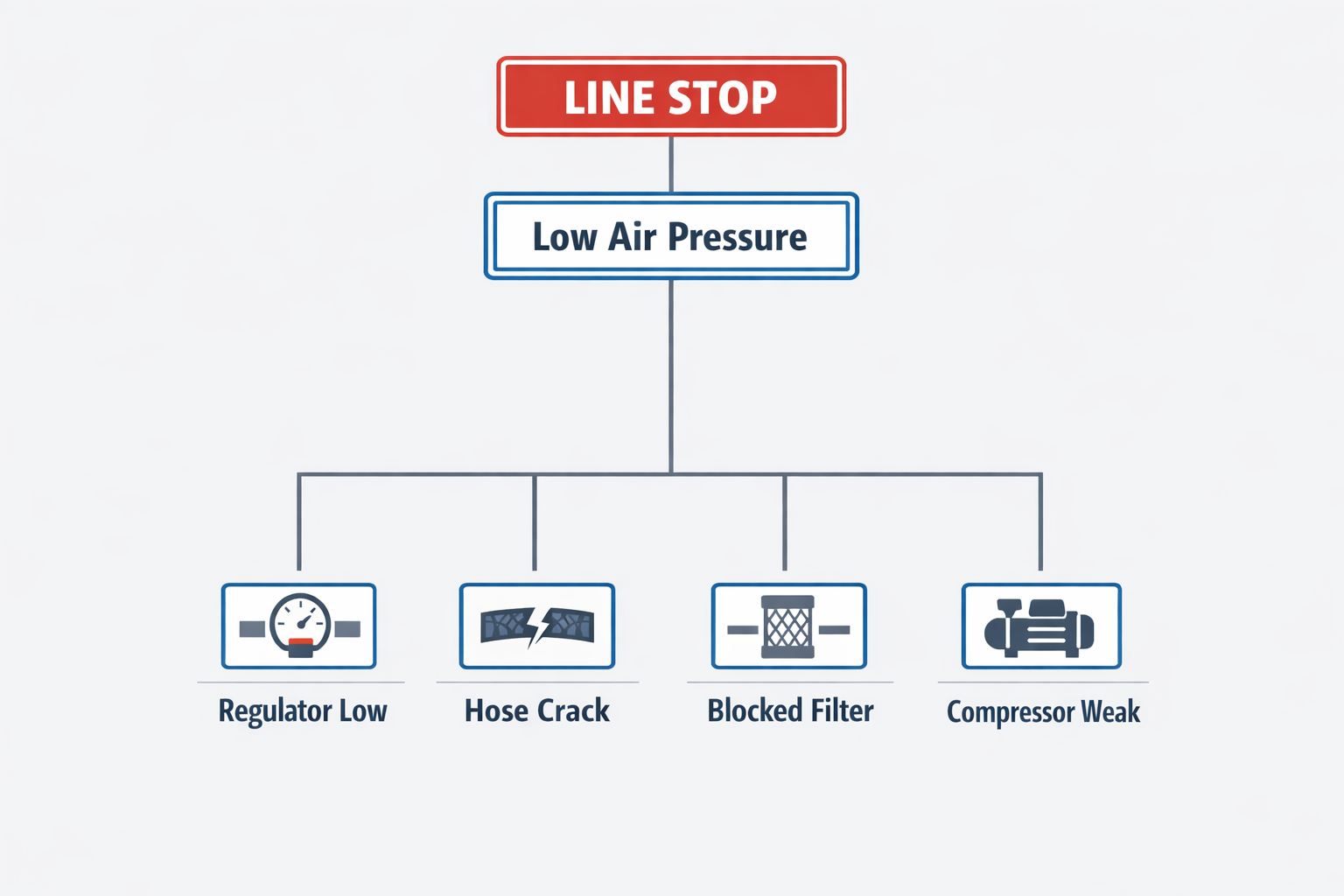
This distinction matters because Fault Tree Analysis is only useful when the tree reaches causes the team can test, verify, or act on. If every branch remains at the intermediate level, the output becomes a conceptual sketch rather than a root-cause tool. If every branch goes too deep, the tree becomes slow to maintain and difficult to use in live investigations.
Use Logic Gates to Show How Failures Combine
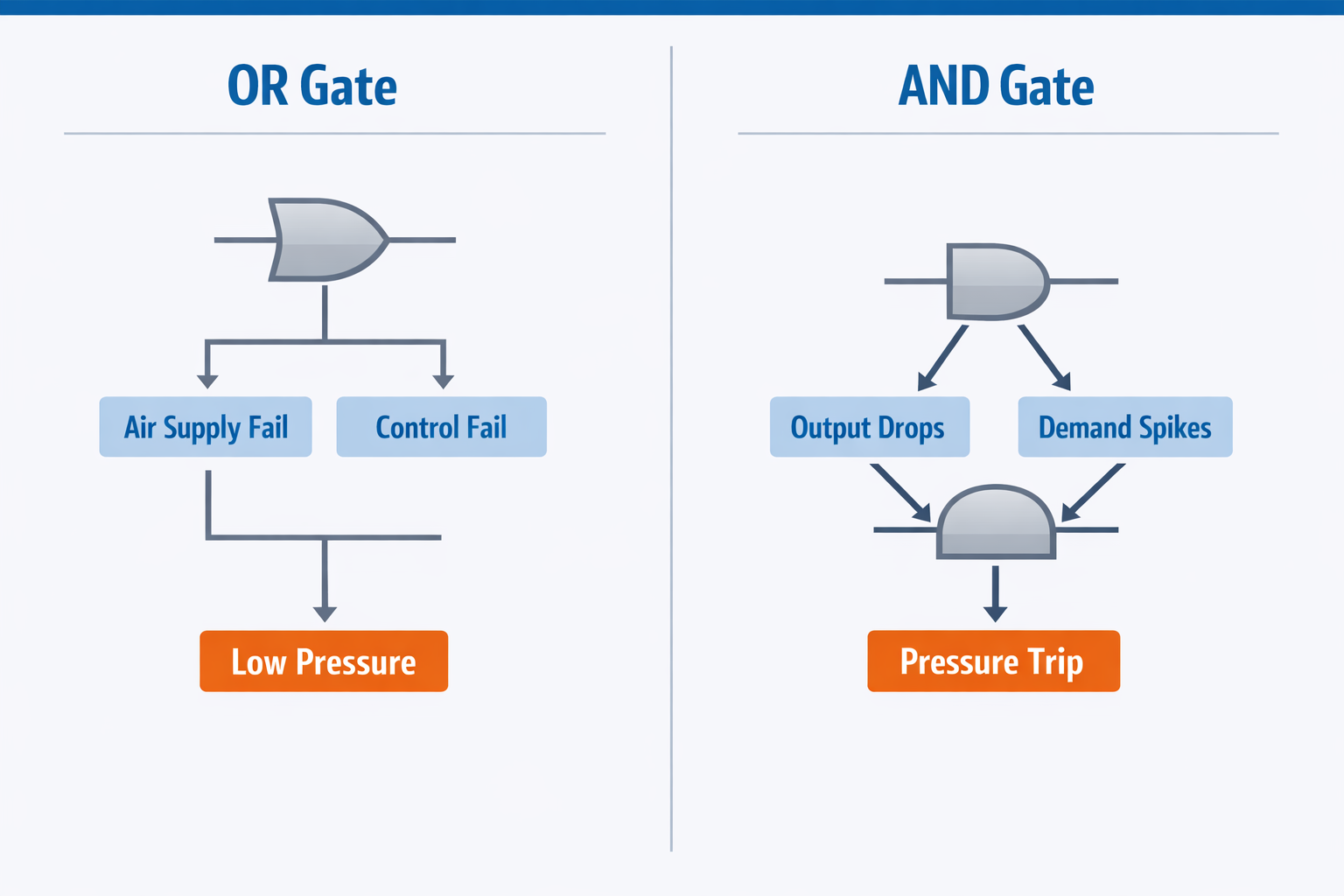
The power of a phân tích cây lỗi diagram comes from its logic gates. An OR gate means any one of the input events can produce the higher-level event, while an AND gate means multiple conditions must occur together. In the packaging-line case, “low pneumatic pressure at capping station” could result from air supply failure OR local pressure control failure, because either path alone could stop the machine.
AND and OR gates change the meaning of the failure path in a very practical way. If a branch uses an OR gate, each cause is an independent candidate and should be checked separately. If a branch uses an AND gate, the investigation must confirm the combination; for example, a machine may only trip when compressor output drops AND demand on parallel lines spikes at the same time.
Build the Tree Step by Step
If you are deciding how to build a fault tree analysis diagram, use a disciplined sequence rather than brainstorming branches all at once. First, define the top event, time boundary, and affected system. Second, identify the immediate causes closest to the top event. Third, expand each branch by asking, “What had to fail, or what condition had to exist, for this event to occur?”
In the packaging example, the team might split the top event into two first-level branches: insufficient air delivered to the capping station and false low-pressure trip signal. The first branch could then break down into compressor underperformance, leakage in the line, blocked filter, or regulator malfunction. The second branch could branch into sensor drift, loose wiring, or incorrect trip threshold in the control logic.
Complete the Tree: Know When to Stop and Validate Against Evidence
A common mistake is treating every possible contributor as a branch that must be expanded further. In practice, you stop when a cause is specific enough to verify and assign action against, or when deeper analysis adds little decision value. In the packaging-line case, “air hose cracked near manifold connection” is usually a workable basic event, while “poor maintenance” is too broad and should not be treated as a stopping point.
Good stopping rules usually follow three tests. The cause should be observable or provable, within the team’s ability to control, Và specific enough to support corrective action. If a branch does not meet those tests, keep decomposing it until it does.
Before closing the analysis, check the full tree against real evidence from the incident. For the packaging example, that may include compressor trend data, maintenance work orders, spare-parts history, operator call logs, and downtime codes. If one branch has no evidence path, label it as a hypothesis rather than a confirmed cause.
A strong fault tree analysis diagram should let your team answer three questions quickly: what failed, how the failure path worked, and which basic causes are confirmed. When that logic is visible, the diagram becomes more than an RCA artifact. It becomes a decision tool that supports corrective action, verification, and cross-functional review.
When to Use FTA in Manufacturing Root Cause and Safety Analysis
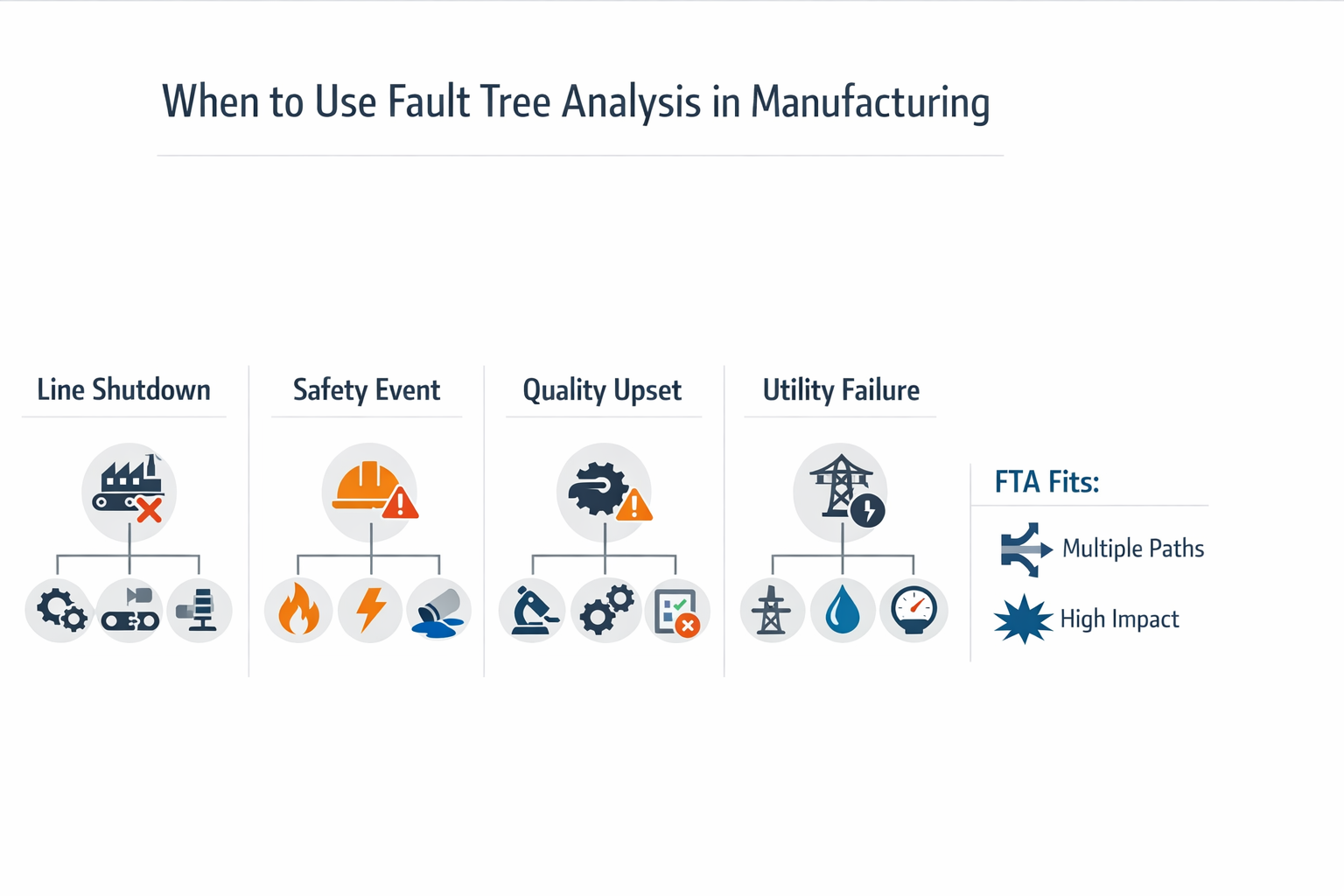
Fault Tree Analysis is most useful when the failure you are investigating is not driven by one obvious cause, but by several conditions that may have to occur together. In practice, that makes it a strong fit for high-consequence events such as line stoppages, personnel safety incidents, utility failures, contamination risks, and process deviations that can spread into scrap, rework, or customer complaints. If you are already thinking about how to build a fault tree analysis diagram, that is usually a sign the problem has enough interacting causes to justify a structured logic model. For simpler issues with a single likely cause, FTA is often more analysis than you need.
The best-fit use cases for FTA in manufacturing are events with multiple causal paths, shared causes across departments, Và significant operational or safety impact. Typical examples include a packaging line shutdown caused by both control-system and mechanical conditions, an automotive defect escape linked to process variation plus inspection failure, or a chemical overpressure event that depends on instrument, procedure, and human-response breakdowns. In those cases, FTA helps teams test combinations of causes instead of chasing one symptom at a time.
Use FTA for Complex Equipment Shutdowns
FTA works well when an unplanned shutdown could result from several subsystems rather than one failed part. Consider a CNC machining cell that stops unexpectedly during peak production: the top event may be “cell unavailable,” but the actual contributors may include spindle overload, coolant flow loss, sensor failure, PLC communication dropout, and delayed operator response. A fault tree helps reliability and maintenance teams show which paths are independent and which require a combination of failures.
Use FTA for Serious Safety or EHS Incidents
FTA is also a strong choice when the event has clear safety significance and cannot be explained by a single unsafe act. In a metal fabrication plant, for example, a worker injury during robotic cell entry may involve an interlock bypass, incomplete lockout, poor shift handover, and a failed presence sensor. A linear method may identify one immediate cause, but FTA is better when you need to understand how safeguards failed together.
Vì EHS managers, this top-down structure is especially useful in investigations tied to regulatory exposure or recurring near misses. It supports a more defensible record of causal logic, which matters when corrective actions must be reviewed across production, maintenance, and safety functions. That is why FTA is widely used in high-risk sectors beyond manufacturing, including aerospace, oil and gas, and process industries.
Use FTA When Process Upsets Can Trigger Quality Risk
In process manufacturing, FTA helps when one disturbance can cascade into both operational and product-quality consequences. A chemical blending batch that goes out of specification, for instance, may trace back to raw material variation, dosing valve sticking, operator override, recipe parameter error, or delayed lab confirmation. Because those causes may combine in different ways, the method is well suited to mapping the full failure chain rather than isolating one bad step.
This is one of the most practical fault tree analysis in manufacturing examples because it connects production, quality, and process engineering in one model. The same logic applies in food, electronics, and pharma environments where a process upset can create hidden downstream risk. If the question is not only “why did the deviation happen?” but also “what combinations made escape possible?”, FTA is usually the better choice.
In general manufacturing, FTA is often used for utilities, bottleneck assets, and recurring system-level failures that affect throughput. In automotive, it is valuable for defect escape analysis, especially where part variation, process capability, fixture condition, and inspection effectiveness all influence the result. In chemical and other continuous-process settings, it is frequently used for safety-critical events such as loss of containment, overpressure, or control-loop failure.
What these environments share is interdependence. The method becomes more valuable as automation increases, safeguards layer up, and the cost of a wrong conclusion rises. That is also the practical line between FTA and simpler root cause tools: the more the event depends on logic between multiple causes, the more FTA earns its effort.
When a Simpler Method May Be Enough
Not every manufacturing problem needs a fault tree. If a conveyor stops because a drive belt snapped and inspection confirms obvious wear with no wider system interaction, a direct corrective action review may be enough. If a small recurring defect appears to come from one workstation and one controllable variable, a 5 Whys or fishbone session may get you to action faster.
FTA vs FMEA, 5 Whys, and Fishbone: Choosing the Right Method
FTA vs FMEA: Start With the Question You Need to Answer
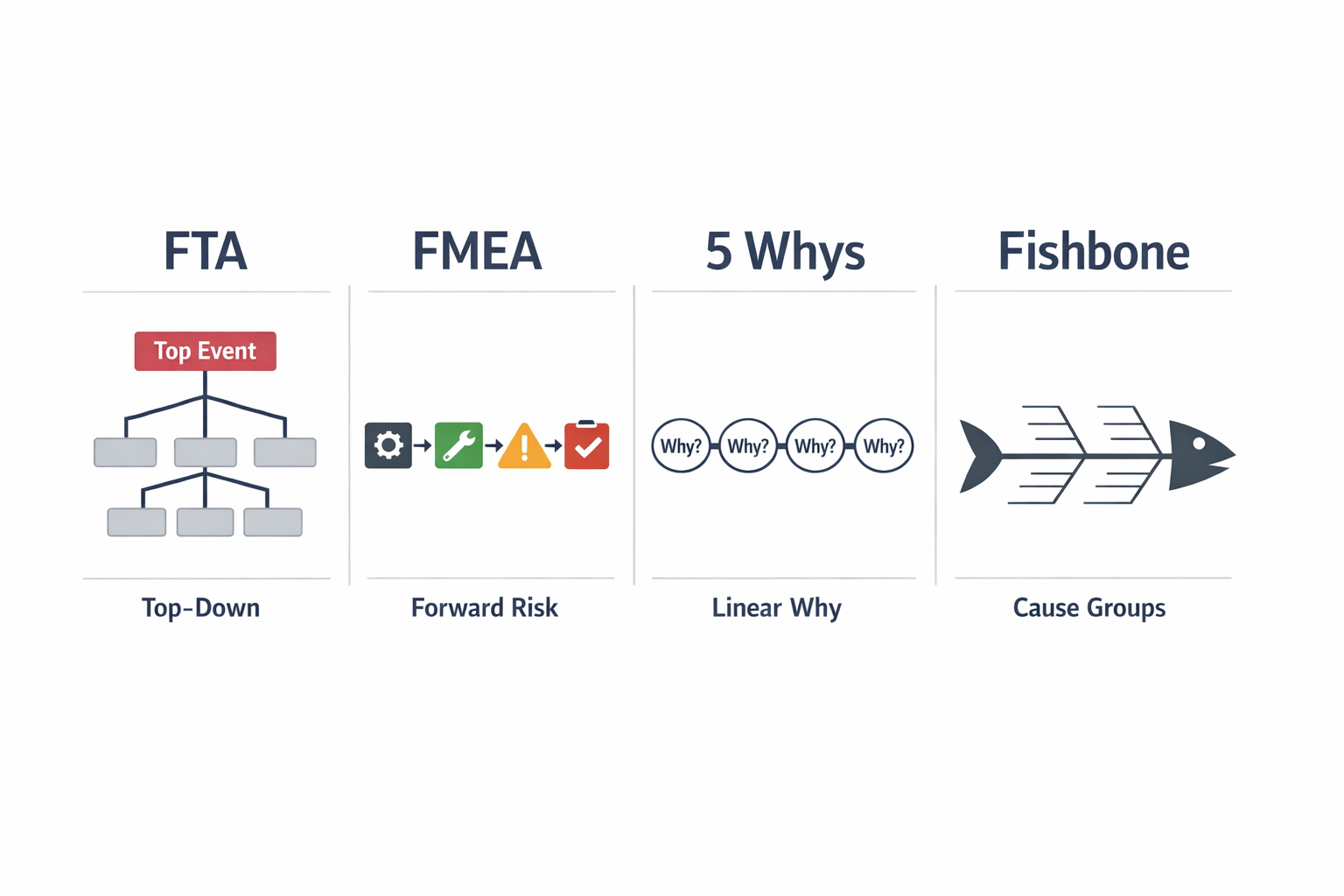
The most useful way to choose between Fault Tree Analysis Và FMEA is to look at the direction of analysis. FTA starts with one defined unwanted outcome and works backward to map how multiple causes could combine to produce it. FMEA moves in the opposite direction: it starts with potential failure modes at the component, process step, or task level and works forward to estimate their effects, severity, occurrence, and detectability.
That difference makes their timing different as well. FMEA is usually stronger earlier in design, process planning, APQP, or control-plan development, when you want to prevent failures before they happen. FTA is more useful once you need to understand why a critical event could occur or did occur, especially when the failure chain is conditional, interdependent, or safety-related. If you are deciding when to use FTA vs FMEA, the rule is simple: use FMEA to anticipate broad risk across a system, and use FTA to investigate a specific high-consequence event in depth.
When to Use Each Method
FTA is the better method when the event is already clear, but the cause chain is not. A plant might know that an emergency shutdown occurred, a batch reactor overpressurized, or a final inspection miss reached a customer, yet still needs to understand how equipment condition, operator action, process controls, and management safeguards interacted. In those cases, fault tree analysis in manufacturing works well because it captures combinations of causes rather than forcing the team into a single linear explanation.
It is also the better choice when logic matters as much as the causes themselves. For example, a packaging line contamination event may only happen if a seal integrity loss and a missed inspection occur together, while a line stop might result from any one of several sensor or drive failures. That distinction is exactly where FTA adds value, because the tree structure makes the difference between combined conditions and alternative paths visible in a way other RCA tools usually do not.
FMEA is usually the better choice when you need broad coverage instead of deep reconstruction. In a new assembly process, for example, the quality team may need to review every station, identify likely failure modes, estimate risk, and define controls before launch. That is not a “how to build a fault tree analysis diagram” problem; it is a structured risk-prevention exercise across many possible failure points.
FMEA is also more practical when the system is stable enough to analyze step by step and the team has standard scoring criteria. Automotive and electronics manufacturers rely on it because it supports repeatable cross-functional reviews and links well to control plans, process validation, and supplier quality requirements. If your main goal is prioritization across a wide process scope, FMEA usually gives a more actionable first pass than FTA.
5 câu hỏi "Tại sao?" Và sơ đồ xương cá are faster tools for narrower problems with fewer interacting variables. If a CNC cell has recurring burr defects because tool replacement is being delayed, a short 5 Whys session may be enough to trace the issue to unclear PM ownership or weak setup discipline. In that case, building a full fault tree would add effort without adding much decision value.
Fishbone diagrams are useful when the team needs to organize possible causes quickly across categories such as Man, Machine, Method, Material, Measurement, and Environment. They work well in early brainstorming for issues like paint adhesion defects, where the team wants to surface candidate causes before testing them. The trade-off is that fishbone shows categories, not logic, and 5 Whys shows a chain, not branching interactions.
A Practical Selection Guide for Manufacturing Teams
If the problem is broad, preventive, and still at the planning stage, start with FMEA. If the problem is specific, severe, and involves multiple possible cause combinations, use FTA. If the issue is localized and likely driven by one dominant cause path, 5 Whys is often sufficient, while fishbone is best when you need a fast cross-functional cause inventory before narrowing the field.
In practice, these methods often complement each other rather than compete. A team may use fishbone to gather hypotheses, 5 Whys to test a likely chain, FTA to analyze a critical event in depth, and FMEA later to strengthen controls across similar processes. The right question is not which method is best overall, but which one best matches the scope, timing, evidence, and decision you need to make.
How to Operationalize Fault Tree Analysis With Digital Workflows
Why FTA Often Breaks Down After the Analysis
Many teams are comfortable with how to build a phân tích cây lỗi diagram, but the process often loses control once the workshop ends. Causes sit in PowerPoint files, actions get copied into spreadsheets, and ownership becomes unclear across quality, maintenance, production, and EHS. In practice, that means the logic behind the analysis is separated from the people who must execute containment, verification, and long-term corrective action.
This gap matters because the value of Fault Tree Analysis (FTA) is not the diagram alone. It is the ability to convert a multi-cause failure path into auditable decisions, assigned tasks, and verified closure. For reliability engineers and quality managers, that requires a system that can preserve evidence, route approvals, and track whether the identified causes were actually eliminated.
What a Digital FTA Workflow Should Include
A workable digital process should start with a structured investigation record, not a blank document. That record typically includes the incident description, affected product or asset, top event, suspected causal branches, immediate containment, and linked evidence such as photos, inspection data, supplier documents, or maintenance logs. If your team uses 8D or 5 Whys alongside FTA, the workflow should let you configure those methods without forcing a separate tool for each one.
The next requirement is ownership control. Each causal branch or corrective action should have a named owner, due date, approval step, and status history, so teams can see whether the action is pending, implemented, or verified. This is especially useful in fault tree analysis in manufacturing examples where several departments contribute to one event, and delays often happen at handoff points rather than in the analysis itself.
Với Jodoo, manufacturers can build this as a connected no-code workflow rather than a collection of disconnected files. A QA team can configure RCA intake forms, 8D hoặc 5-Why templates, evidence fields for attachments and photos, approval steps for engineering review, and automatic reminders for overdue corrective actions. Because the forms, workflow logic, and data structure sit in one platform, the investigation record stays linked to action execution instead of being manually transferred between systems.
Connecting Investigation, CAPA, and Verification
The biggest operational advantage comes from linking analysis to closure. In Jodoo, one investigation record can automatically generate corrective-action tasks, route them to different functions, and update a shared status dashboard for managers. That creates a visible chain from root cause hypothesis to implemented action to effectiveness check, which is often missing in manual RCA programs.
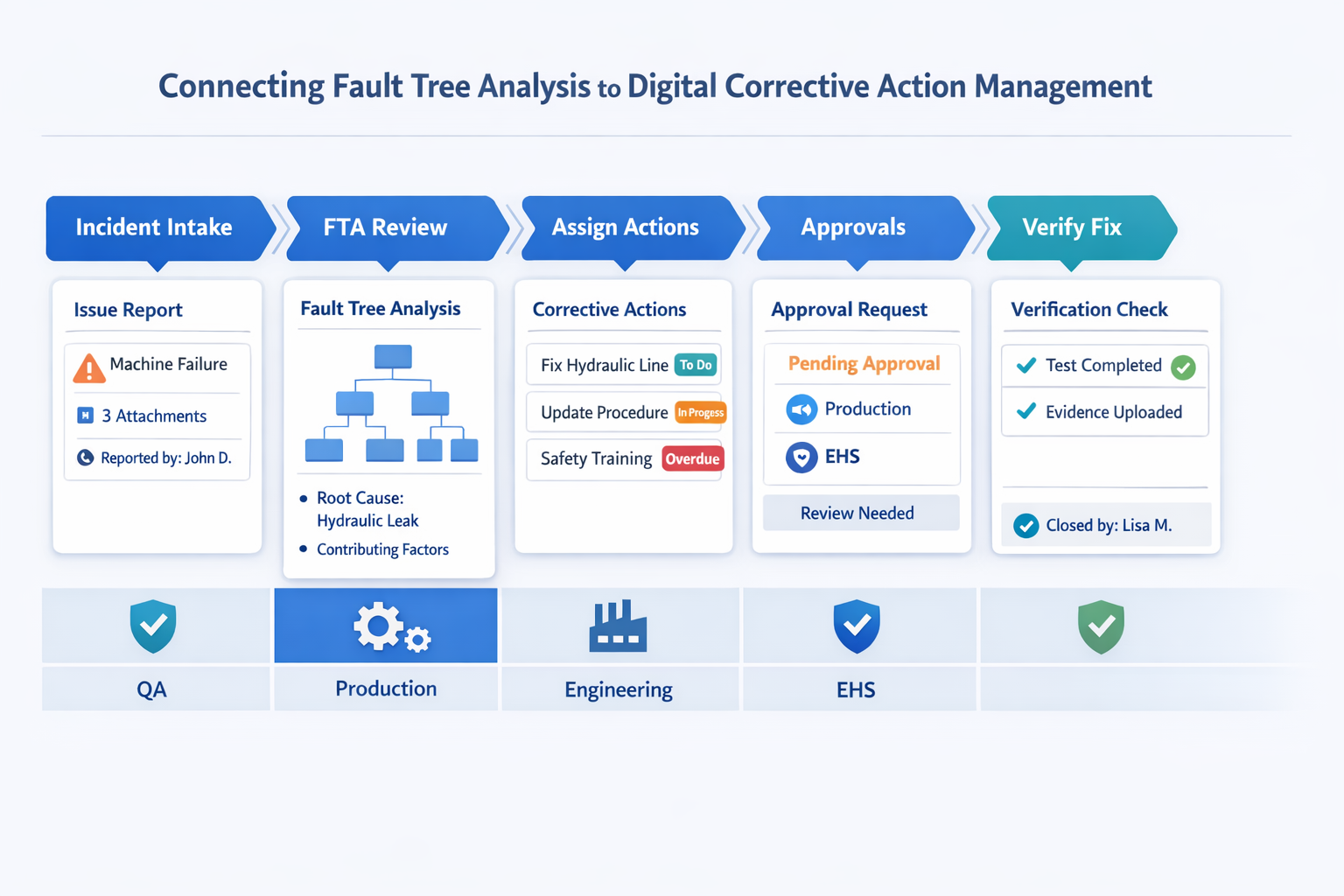
This kind of structure also helps teams avoid using the wrong method at the wrong time. If an issue starts as a simple deviation, you may not need a full FTA; if it expands into a cross-functional failure chain, the workflow can escalate it into a deeper investigation with added approvals and verification steps. That makes execution more disciplined without turning every issue into a heavy process, which is an important practical consideration when deciding when to use FTA vs FMEA or simpler tools.
Conclusion: Turn Fault Tree Analysis Into Repeatable Corrective Action
Fault Tree Analysis works best when you use it for what it is designed to do: break down a serious failure, safety event, or quality issue into a clear chain of contributing causes. Its value is strongest when multiple conditions interact, where simpler tools like 5 Whys may miss the full logic of the problem. In practice, that means starting with a well-defined top event, mapping causal paths with the right logic gates, and choosing FTA when the risk is high enough to justify a more structured analysis.
Just as important, the analysis should not stop at the diagram. The real operational benefit comes when findings are assigned, approved, tracked, and verified through corrective action, especially across maintenance, quality, engineering, and EHS teams. That is where many manufacturers struggle if FTA remains trapped in static documents, disconnected spreadsheets, or one-off workshop outputs.
If you want to standardize RCA, 8D, and corrective-action workflows after Fault Tree Analysis, Jodoo gives you a practical way to do it. As a no-code lean manufacturing platform, Jodoo helps teams digitize investigation forms, action ownership, approvals, and closure tracking in one system. You can bắt đầu dùng thử miễn phí hoặc Đặt lịch dùng thử to see how it fits your plant’s process.