Duyệt theo danh mục

Introduction: Why Scope 1, 2, and 3 Emissions Become a Data Problem in Manufacturing
Đối với nhiều nhà sản xuất, scope 1, 2, and 3 emissions are not difficult because the definitions are unclear. They are difficult because the data sits in too many places, with too many owners, across too many sites. In one reporting cycle, a company may need boiler fuel logs from one plant, electricity invoices from another, refrigerant top-up records from maintenance, and supplier data from procurement. That is why emissions reporting often breaks down as an operations problem before it becomes a sustainability problem.
At a high level, Phạm vi 1 covers direct emissions from sources a company owns or controls, such as onsite fuel combustion, company vehicles, and process gases. Scope 2 covers indirect emissions from purchased or acquired electricity, steam, heat, or cooling. Scope 3 includes other upstream and downstream value-chain emissions outside those boundaries, from purchased goods and transport to waste, business travel, and product distribution.
This article focuses on execution: how to classify records correctly, assign handoffs between teams, and collect evidence-based data from plants, utilities, asset owners, procurement, and suppliers in a controlled way.
Set the Ground Rules First
Start With Boundaries Before You Request Data
Before a manufacturer asks plants, finance, or procurement for records, it needs clear GHG inventory boundaries. Without them, the same gas boiler can be reported twice, a leased warehouse can be missed entirely, and purchased energy records can end up with conflicting scope assignments. In practice, boundary setting is the control step that determines which emissions sources belong inside the inventory and which fall into Scope 3 value chain emissions.
Organizational boundaries answer a simple question: which legal entities, joint ventures, and operating sites are included in the inventory. Operational boundaries go one level deeper by defining which emission sources are owned, controlled, or influenced across those entities.
Consider a regional industrial components manufacturer with three plants in Thailand, Vietnam, and Malaysia, plus a sales office and two leased warehouses. The corporate sustainability lead is responsible for group reporting, but each plant manager controls local utilities, maintenance, and production records. An asset owner at headquarters manages fleet contracts, central equipment leases, and major capital assets used across sites.
Before sending any data request, these three roles meet to resolve what sits inside the inventory. The corporate lead proposes the list of entities to include for the reporting year, the plant managers confirm which operations are active, and the asset owner identifies equipment and vehicles that may not sit neatly under one plant cost center.
Clarify Source Ownership Site by Site
The next step is to map each major source to a named owner. That does not mean assigning who created the emissions; it means assigning who must provide the first valid record and who approves the final classification. For a boiler at the Vietnam plant, the plant manager may own the operating record, while the maintenance team supplies servicing evidence and the sustainability lead reviews boundary treatment.
This matters most where legal ownership and operational control diverge. The Malaysia warehouse is leased, but the company pays the electricity bill directly, so its purchased energy records still belong in the reporting intake. By contrast, a third-party logistics hub that stores finished goods may sit outside organizational boundaries and be treated later under Scope 3 value chain emissions rather than plant operations.
Separate Boundary Decisions From Data Availability
Manufacturers often let available records drive the inventory, which is the wrong order. A source belongs in or out based on the established boundary rule, not on whether the invoice is easy to find. If supplier emissions data is missing for an outsourced process, that is a later data-quality issue, not a reason to redefine the boundary.
In the example company, the corporate lead initially wants to exclude a small generator fleet because fuel receipts are fragmented across sites. The asset owner pushes back because the fleet is centrally contracted and clearly under company control. They keep it inside the inventory, then assign a cleanup task for record collection rather than weakening the boundary.
Set a Base Year Before Trend Tracking
A base year gives the company a fixed reference point for future comparison. Without it, year-on-year changes mix real operational improvement with shifting site coverage, acquisitions, or revised source lists. The GHG Protocol expects a consistent basis for recalculations when structural changes occur, and that discipline is especially important in multi-site manufacturing groups.
For the components manufacturer, the team selects the prior full fiscal year as the base year because all three plants were operating for all twelve months. The document included entities, boundary assumptions, named data owners, and known exclusions before requesting records. That way, when expansion, divestment, or process changes happen later, the company can explain whether emissions changed because operations changed or because the inventory boundary did.
How to Classify Scope 1, Scope 2, and Scope 3 Emissions Without Workflow Confusion
Once your GHG inventory boundaries are set, classification should work like an intake decision, not a debate at quarter-end. For the multi-site manufacturer in our running example, the rule is simple: the team that sees the source record first submits it, and sustainability reviews the final scope assignment. That keeps plant data moving while preventing procurement, facilities, and EHS from making inconsistent judgments site by site.
Start With the Record
A practical classification workflow begins with one question: What document triggered this entry? If the record comes from an owned boiler fuel delivery, a diesel receipt for company trucks, or a refrigerant top-up logged by maintenance, the first review path is direct operations. If it comes from a power bill, district steam invoice, or another purchased energy record, it goes to the energy review path. If it comes from a supplier, logistics provider, waste contractor, or contract manufacturer, it enters the Scope 3 value chain emissions path.
The decision tree should follow source control before accounting details. If the company owns or controls the emitting asset or activity, test Scope 1 first. If the company is buying electricity, steam, heat, or cooling for its own use, test Scope 2 next. If neither applies and the activity sits upstream or downstream in the value chain, route it to Scope 3 review instead.
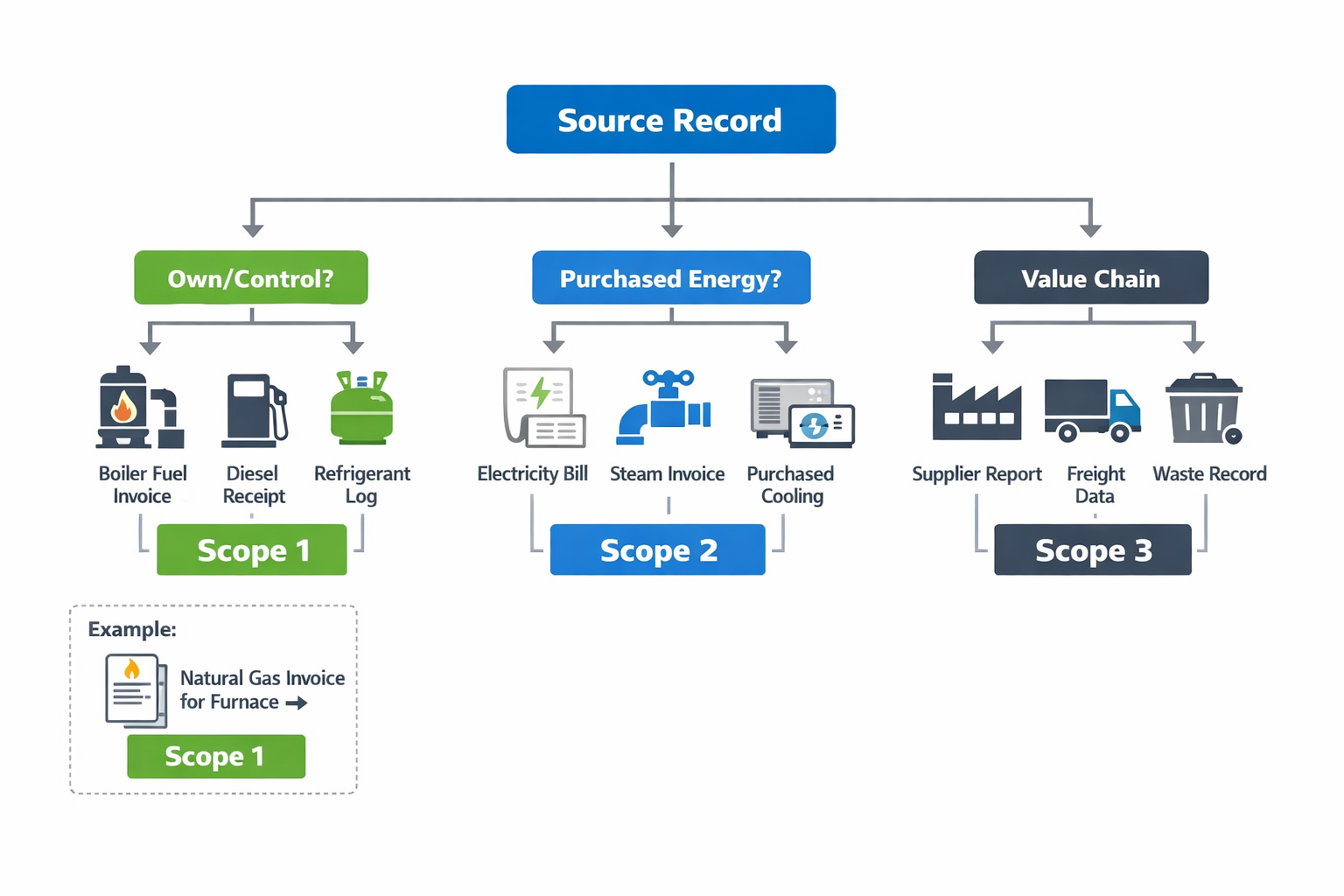
In our example, Plant A submits a monthly natural gas invoice for a heat-treatment furnace. The plant utilities coordinator uploads the invoice, tags the furnace as an owned stationary source, and sustainability reviews it as Scope 1. No one waits for emissions calculations before classifying the record; the classification happens at intake, so the evidence trail is clean from the start.
Classify Common Manufacturing Source Types
Stationary combustion is usually the easiest category to stabilize. Boilers, ovens, furnaces, generators, and kilns burning fuel on site are generally submitted by plant engineering, utilities, or maintenance because they hold the meter logs, tank refill records, or fuel invoices. Corporate sustainability then checks whether the asset is inside the agreed boundary and confirms the final scope.
Fleet fuel works similarly, but the handoff often starts outside the plant. If the manufacturer owns delivery trucks, forklifts, or service vehicles and pays for their fuel directly, fleet or transport operations should submit the fuel card report or receipt file for Scope 1 review. If transport is outsourced to a third-party carrier, the record does not stay in fleet operations; it moves to Scope 3 because the emissions come from an external value-chain partner.
Refrigerants create more confusion because the evidence usually comes from maintenance events rather than utility bills. In our example, Plant B replaces refrigerant during a chiller service visit, and the technician log shows gas type, quantity added, date, and asset ID. Maintenance submits the service record first, and sustainability checks whether the chiller is company-controlled before assigning Scope 1.
Separate Purchased Energy From Landlord and Supplier Cases
Purchased electricity, steam, heat, and cooling should have their own lane because the source document is different from fuel use. At Plant C, the finance team receives the electricity invoice, but the plant facilities lead validates meter IDs and service periods before submission. Sustainability then assigns Scope 2 after confirming the bill reflects energy consumed by a site inside the reporting boundary.
Landlord-provided energy needs one extra control. If a leased warehouse receives bundled electricity through rent rather than a direct utility invoice, facilities must attach the lease and landlord recharge statement before review. The record still follows the purchased-energy logic, but only after someone verifies that the manufacturer is the energy user rather than the asset owner.
Route External Activities Into Scope 3 Review
Contract manufacturing, third-party logistics, supplier-managed inputs, and waste treatment should not be forced into plant-owned categories. In our example, procurement receives a tolling report from an external processor and submits it for Scope 3 review because the production activity happened outside company-controlled operations. The same applies when a freight provider sends lane data or a waste vendor reports hauled tonnage: the first record may come from procurement or EHS, but final classification stays with the central reviewer.
Where the Data Actually Comes From
Internal Sources: What Plants and Asset Owners Should Submit
Once scope assignment rules are set, the next question is simpler but harder in practice: what document proves each record. For internal sources, corporate teams should request both activity data and the document that created it. Typical inputs include meter logs, fuel delivery notes, tank dip sheets, boiler run hours, maintenance logs for refrigerant top-ups, utility invoices, and lease documents that show who controls purchased energy records under the company’s GHG inventory boundaries.
A source-to-owner map prevents gaps and duplicate requests across sites. In a machining plant, diesel for backup generators may sit with maintenance, natural gas invoices with finance, and forklift LPG records with warehouse operations, even though all three affect one emissions file. A practical intake sheet should name the source, system of record, owning role, reporting frequency, required fields, and reviewer before submission starts.
For each internal record, keep the requested fields tight and auditable. At minimum, ask for site name, legal entity, asset or meter ID, reporting period, quantity, unit of measure, supplier name if relevant, invoice or document number, and document attachment. Reviewers should also check whether unit conversions are needed, whether dates match the reporting period, and whether the record reflects owned operations or landlord-controlled energy outside the current boundary decision.
Evidence Standards by Record Type
Different manufacturing environments generate different evidence, so one template should allow controlled variation. At a food processing site, steam may be purchased from a utility or produced onsite from natural gas, and the acceptable evidence changes accordingly. For purchased steam, use supplier invoice data and contract terms; for onsite generation, use fuel receipts, boiler logs, and maintenance records that support fuel use and operating status.
Chemical sites often expose a second issue: refrigerants and process gases are rarely captured in one finance system. Maintenance teams may hold work orders, service contractor reports, cylinder replacement logs, and leak inspection records, while EHS may retain incident notes. In that case, the monthly or quarterly packet should require gas type, quantity added or recovered, equipment ID, service date, and technician evidence, not just a summary number in an email.
Procurement and ERP Data for Upstream Categories
When the record comes from purchasing rather than plant operations, the ERP becomes the first source, but not the final evidence. Procurement exports can identify supplier, material code, description, plant, business unit, quantity, spend, currency, and purchase date for categories later used in Scope 3 value chain emissions work. Corporate reviewers should confirm that the spend or quantity file ties back to approved purchasing records and that category mappings are version-controlled rather than edited informally.
Freight records usually need a second handoff beyond procurement. A shipment may start in ERP, but mode, route, weight, distance, and carrier details often sit in transport management systems, forwarder reports, or customs files. For inbound logistics, a shipment reference plus carrier documentation so teams can reconcile what was bought, what was moved, and which party arranged transport.
Supplier Data Requests Need Structure
Supplier emissions data should be requested through a standard package, not ad hoc questionnaires. For a supplier-managed packaging category, ask for supplier name, site or product covered, reporting period, data type provided, supporting document list, contact owner, and any exclusions or assumptions. That keeps supplier emissions data usable even when suppliers vary widely in maturity.
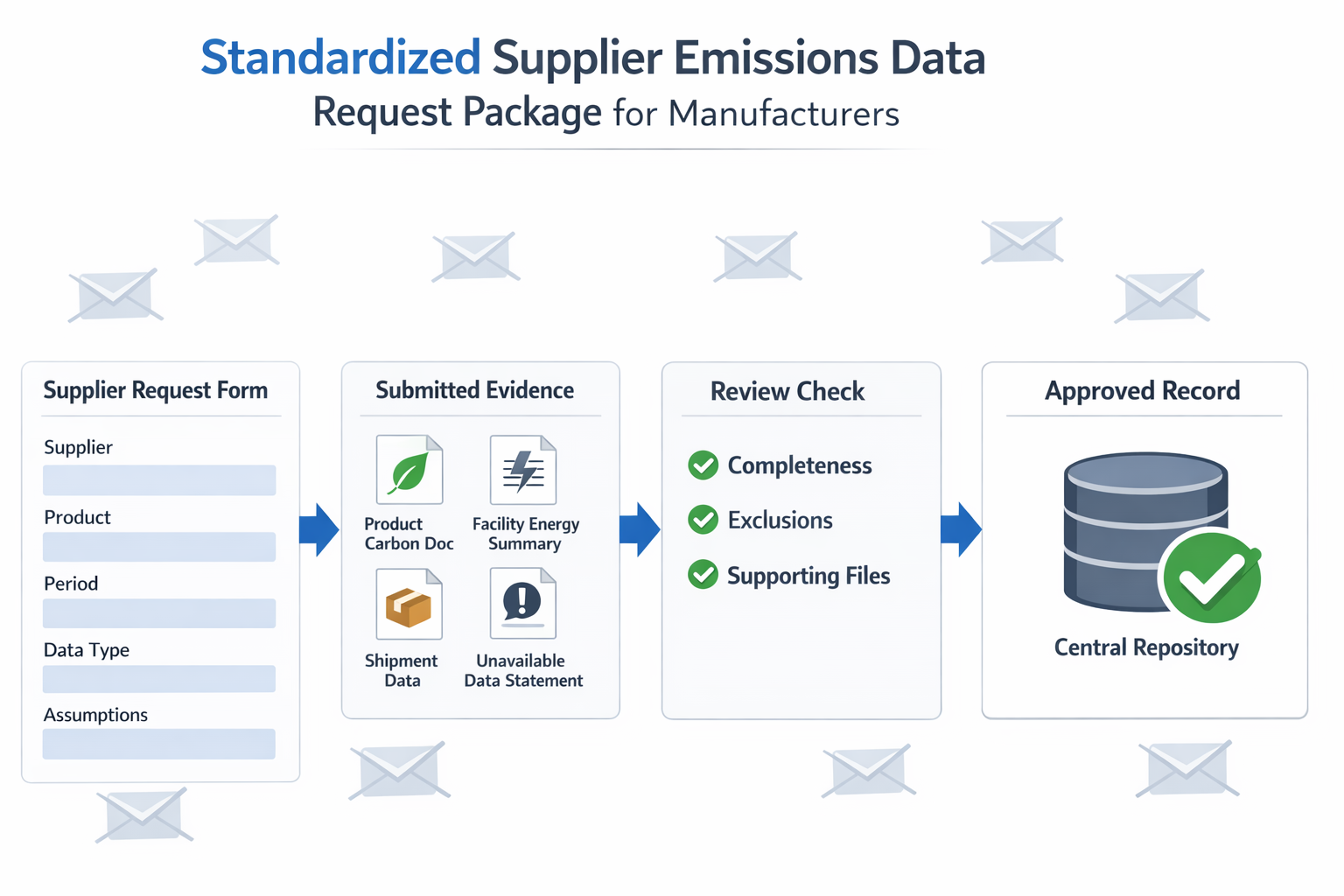
The package should also define acceptable evidence and review steps. Examples include product-level carbon documents, facility energy summaries tied to production volumes, shipment data, or a formal statement of unavailable data with reason codes. Standardizing monthly or quarterly intake this way lets corporate teams compare submissions across plants and suppliers without forcing every operation into the same source document.
Conclusion: Turn Emissions Data Collection Into a Managed Workflow With Jodoo
Accurate reporting for Scope 1, 2, and 3 emissions is not mainly a calculation problem. For manufacturers, it is first a data-governance and execution problem that depends on clear inventory boundaries, named process owners, standard intake forms, evidence requirements, review controls, and reliable handoffs across plants, procurement teams, logistics partners, and suppliers. When those basics are weak, reporting delays, duplicate requests, and classification disputes become routine.
Đây là nơi Jodoo fits. As a nền tảng sản xuất tinh gọn không cần lập trình, Jodoo can help you build the workflow layer around emissions data collection: digital forms for plant and supplier submissions, role-based permissions for sensitive records, reminders for monthly utility and fuel data, approval flows for scope assignment reviews, attachment handling for invoices and logs, dashboards for submission status, and APIs to connect to ERP or procurement systems. In practical terms, it helps teams replace scattered spreadsheets and email chains with a controlled, auditable process.
If you want to operationalize ESG data collection faster, bắt đầu dùng thử miễn phí hoặc Đặt lịch dùng thử to evaluate Jodoo for your workflow.