Introduction: Why ALCOA Principles Matter for Manufacturing Quality Data
A quality issue is much harder to close when the record behind it is incomplete, late, or unclear. In FDA warning letters and GMP inspections, data integrity failures still appear regularly, and the root cause is often not the test result itself but how the record was created, changed, or stored. That is why ALCOA principles matter: they define what makes manufacturing data trustworthy enough to support quality decisions, audits, and investigations.
In plain terms, ALCOA means that all data must be Attributable, Legible, Contemporaneous, Original, and Accurate. While the framework is strongly associated with pharmaceuticals, the same ALCOA data integrity requirements apply across regulated manufacturing environments, including medical devices, food, chemicals, electronics, and supplier-controlled production networks. If your inspection logs, production checks, or supplier documents cannot stand up to review, compliance risk rises quickly.
This article explains what ALCOA means in day-to-day manufacturing work, how the expanded ALCOA Plus model raises the standard, where paper-based systems create risk, and how digital quality records improve traceability. For quality managers and plant leaders, the goal is practical: build manufacturing quality records that support faster investigations, cleaner audits, and more reliable operations.
What ALCOA Means in Practice
To make the ALCOA principles useful on the factory floor, it helps to anchor them to one record instead of treating them as abstract compliance terms. Take an in-process inspection on a machining line: an operator checks a critical bore diameter every hour, records the result, attaches a photo of the caliper reading when the value is near the limit, and submits the record for QA review. In that one transaction, the full standard of ALCOA data integrity is already being tested.
If that inspection record is sound, an auditor or supervisor should be able to answer five basic questions immediately: Who entered the result? Can the entry be read clearly? Was it recorded when the check happened? What is the source record, and is the value correct? That is the practical meaning of attributable, legible, contemporaneous, original, and accurate in manufacturing quality records. It is not separate from operations; it is the difference between a usable record and one that creates doubt during a deviation review.
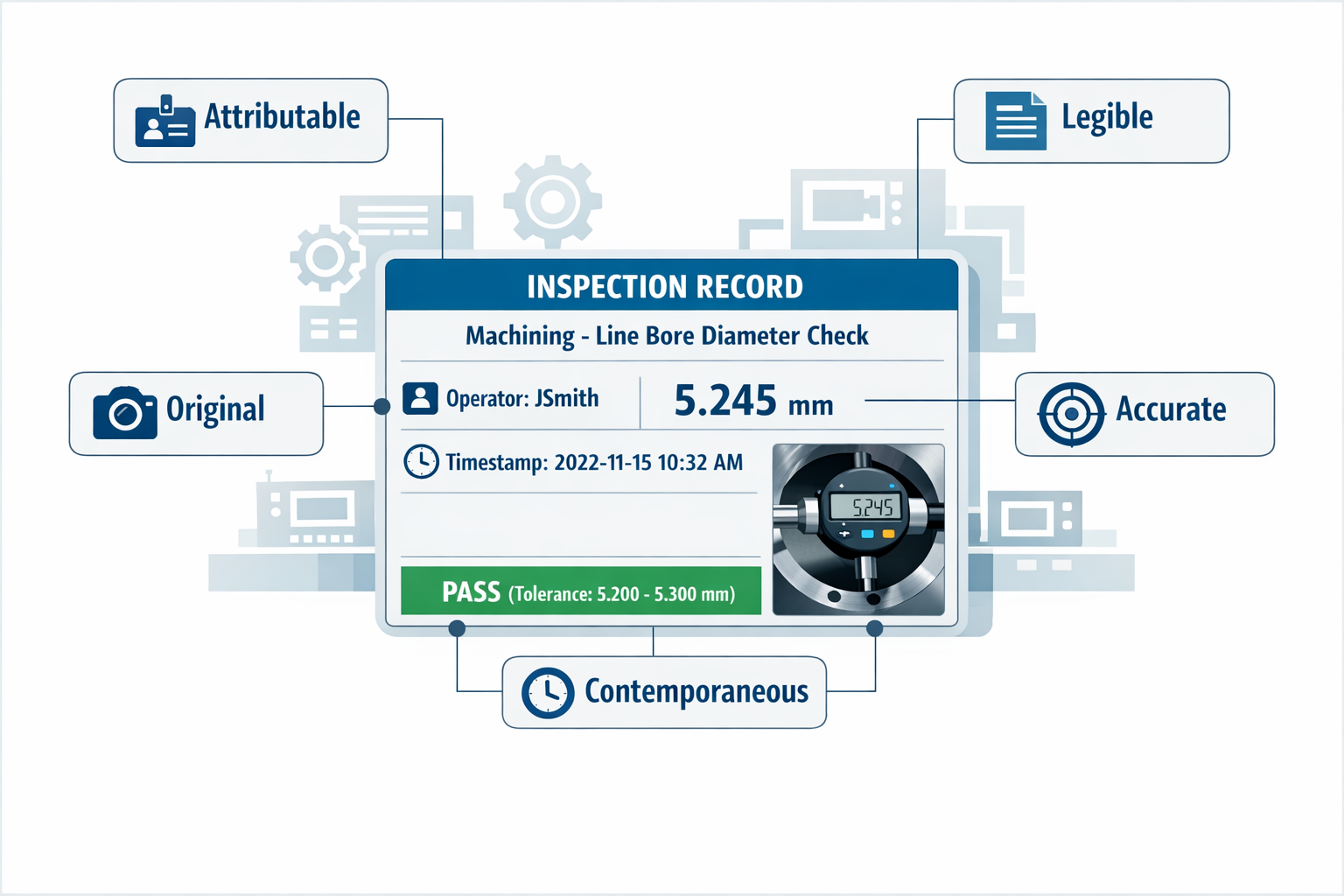
Attributable: You Can Identify Who Did the Work
一个 attributable record clearly shows who performed the inspection, who reviewed it, and who changed anything later. In our machining example, the record should identify the operator who measured the bore diameter, the QA technician who verified the result if needed, and the supervisor who approved any disposition. Initials without a clear link to a person, shared logins, or handwritten notes passed between shifts weaken accountability.
In practice, attributable data supports both traceability and investigation speed. If a dimension drifts out of tolerance three hours later, the team must know exactly which operator took the earlier readings and which lot or machine setting was in use at that time. For audit-ready quality data, attribution is not just a signature box; it is a reliable identity trail tied to each action in the record lifecycle.
Legible: Anyone Reviewing the Record Can Understand It
A legible record can be read correctly months later by someone who was not on the line when it was created. In the inspection example, the bore diameter, unit of measure, part number, time, and status should all be unambiguous. If “9.86” can be mistaken for “9.36,” or if the handwriting around a recheck note is unclear, the record stops being dependable.
Legibility also applies to how corrections are made. If the operator first writes “OK,” then overwrites it with a number and no explanation, the inspection result becomes harder to defend. Strong manufacturing quality records use clear values, consistent formats, and readable annotations so the record still makes sense during internal review, customer complaint analysis, or external audit.
Contemporaneous: The Record Is Created When the Activity Happens
Contemporaneous means the data is recorded at the time of the inspection, not reconstructed later from memory. In our scenario, if the hourly check was performed at 10:00 a.m., the measurement should be entered then, not copied into a batch spreadsheet at the end of the shift. Even small delays matter when you are trying to trace process drift, tool wear, or the first occurrence of a defect.
This principle is especially important when inspection frequency is part of the control plan. If four hourly checks are entered together at 2:00 p.m., the record no longer proves that the checks actually happened on time. For ALCOA data integrity, contemporaneous entry protects the sequence of events that investigators rely on later.
Original: The Record Preserves the First Capture of the Data
Original does not always mean paper; it means the first captured record or a verified true copy of it. In the machining example, the original record could be the operator’s direct entry into a controlled form, along with the attached photo of the measuring instrument display. If the operator writes results on scrap paper first and someone else later transfers them into a report, the scrap note was the source, and the typed version becomes a transcription.
That distinction matters during review. When a measurement is close to the tolerance limit, QA may need to see the source evidence, not just the summarized number in the final log. This is one reason many manufacturers are moving toward electronic quality records 和 digital quality records that capture data at the source, preserve attachments, and reduce questions about which version came first.
Accurate: The Record Reflects What Actually Happened
Accurate means the data is correct, complete enough for its purpose, and free from avoidable error. In the inspection scenario, the entered bore diameter must match the instrument reading, the part number must match the work order, and the pass/fail decision must follow the approved specification. A record that is signed on time but contains the wrong unit or the wrong sample ID is still a data-integrity failure.
Accuracy also depends on context. If the tolerance is 10.00 ± 0.10 mm, a result of 9.89 mm should not be marked as conforming by mistake, and a photo showing 9.98 mm should not be attached to a record that says 9.89 mm. This is where the five principles work together: attribution shows who entered it, legibility makes it reviewable, contemporaneous entry preserves timing, originality preserves source evidence, and accuracy confirms the content itself can stand up in an audit.
From ALCOA to ALCOA Plus: What Stronger Data Integrity Looks Like Today
The original ALCOA framework remains the base of data integrity: data should be attributable, legible, contemporaneous, original, and accurate. In practice, however, manufacturers now manage larger volumes of records across suppliers, production lines, laboratories, and distributed teams. That is why many compliance programs use ALCOA plus 原则 to extend the classic model and define what stronger, audit-ready quality data looks like over the full record lifecycle.
Why ALCOA Plus Was Added
The five original principles answer a basic question: can you trust this record? ALCOA Plus goes further and asks whether the record is also complete, consistent, enduring, , 和 available when the business or an auditor needs it. That matters in modern manufacturing because a correct entry on the day it was created is not enough if supporting evidence is missing, the sequence is unclear, or the record cannot be retrieved months later during an investigation.
A useful way to think about it is this: attributable, legible, contemporaneous, original, and accurate focus on the integrity of each entry, while ALCOA Plus expands the focus to the integrity of the entire record set. A nonconformance file, for example, must not only show who logged the defect and when, but also include the investigation notes, disposition decision, approvals, and linked evidence in a consistent, reviewable trail.
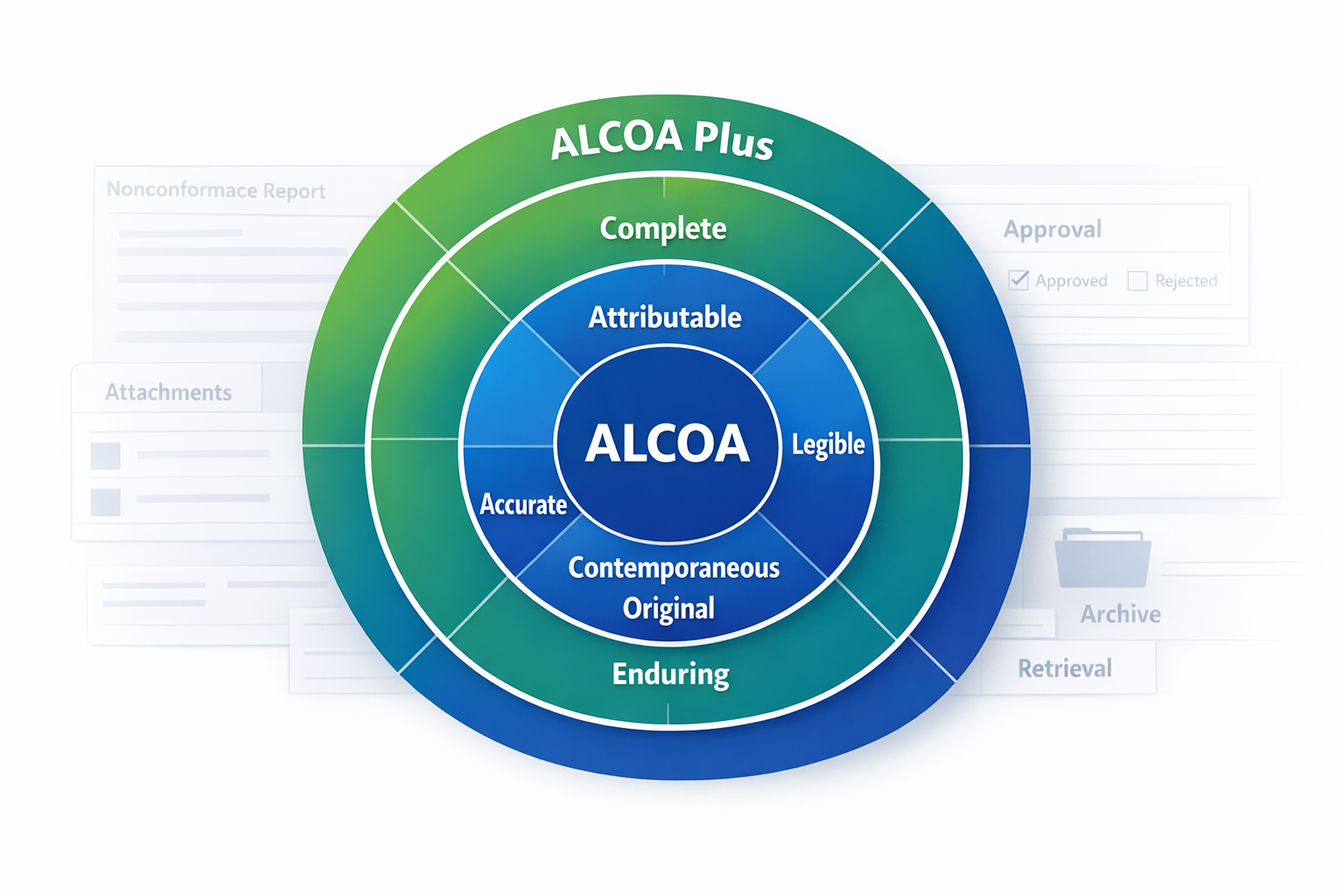
What the “Plus” Principles Mean in Manufacturing
完全的 means the record contains all required data, not just the final result. A supplier quality file includes the approved specification, incoming inspection results, deviation history, supplier corrective action, and final release decision. If one of those pieces sits in a separate inbox or local folder, the file may be accurate in parts but still weak as audit-ready quality data.
Consistent means the record follows a logical sequence across time, format, and process steps. For retained production checks, time stamps should align with the production schedule, shift handover, and batch progression rather than appearing out of order. Inconsistent sequencing is often what raises questions during audits, even when the values themselves look correct.
Enduring means the record remains preserved and readable for the full retention period. A printed thermal label that fades after six months or an image stored on a technician’s phone does not meet that standard well, especially in industries with multi-year retention requirements. Manufacturing quality records need to survive beyond the moment of capture and remain usable during complaints, recalls, or regulatory review.
Available means authorized users can retrieve the record quickly in a usable format. During an internal audit or customer complaint review, quality teams should not spend hours searching shared drives for the latest nonconformance attachment or a signed production check sheet. If data exists but cannot be located promptly, its practical compliance value is limited.
Why This Matters for Audit-Ready Quality Data
ALCOA Plus reflects how regulators and customers now assess records in real operations. They are not only looking at whether a single data point was entered properly, but also whether the full body of evidence can support traceability, decision-making, and historical reconstruction. This is especially relevant as electronic quality records and digital quality records become more common and expectations for retrieval speed increase.
For quality managers, the shift from ALCOA to ALCOA Plus changes the standard from “valid entry” to “defensible system of record.” That is the level needed for supplier audits, deviation reviews, CAPA follow-up, and long-term record retention. In other words, strong data integrity today means not only creating trustworthy records but also keeping them complete, connected, and accessible over time.
Where Paper Records Create Data-Integrity Risk in Manufacturing
Paper forms and spreadsheet-based logs often fail not because teams ignore procedures, but because the control points are too weak to protect the record itself. In many plants, the SOP is sound, yet the actual path from observation to final storage still depends on handwriting, manual re-entry, file naming discipline, and shared folders. That gap is where ALCOA data integrity starts to break down. Once a record is hard to read, delayed, overwritten, or detached from its source evidence, your manufacturing quality records become harder to trust during audits and investigations.
Illegible Notes Undermine Legibility and Accuracy
In food and beverage plants, handwritten hygiene checks, CCP verifications, and line clearance records are often completed in fast-moving environments with wet surfaces, gloves, and frequent operator changes. Under those conditions, a number like 7.1 can look like 7.7, a signature may be unreadable, and a corrective action note may be too vague to interpret later. That creates a direct risk to the “legible” and “accurate” parts of attributable, legible, contemporaneous, original, and accurate recordkeeping. If QA cannot clearly read what was recorded, the record may exist, but it is no longer strong evidence.
The problem usually grows when supervisors must reconstruct what happened after a deviation or customer complaint. A paper form with unclear handwriting forces the team to rely on memory, shift rosters, or verbal confirmation to identify who recorded the result and what action was actually taken. That slows root cause analysis and weakens confidence in the original entry. In an audit, this can turn a minor documentation issue into a broader question about whether the plant’s quality controls are truly reliable.
Delayed Transcription Breaks the Link Between Event and Record
In electronics assembly, it is still common for operators to record production checks on paper during the shift and then transfer the data into a spreadsheet at the end of the day. The delay may seem harmless, but it breaks the contemporaneous element of ALCOA data integrity. A result entered hours later is more vulnerable to memory errors, skipped values, and “best guess” reconstruction, especially when one operator is handling multiple stations or product variants. Even if the final spreadsheet looks clean, it may no longer reflect the real timing of the shop-floor event.
A second problem appears when paper and spreadsheet values do not match. QA then has to decide which version is the source, whether the transcription error affected product disposition, and whether any out-of-spec condition was acted on in time. This is a common reason why investigations take longer than they should. Teams spend time comparing handwritten sheets, Excel tabs, and email attachments instead of analyzing the process failure itself.
The Paper-to-Spreadsheet-to-Shared-Drive Failure Chain
Many quality processes follow the same weak chain: data is captured on paper, retyped into a spreadsheet, saved to a shared drive, and then circulated by email for review. Each handoff creates a new opportunity for missing fields, version confusion, unauthorized edits, and detached attachments such as photos, supplier certificates, or calibration evidence. What began as one shop-floor observation can quickly turn into several partially conflicting records. At that point, the plant may still have documentation, but not truly audit-ready quality data.
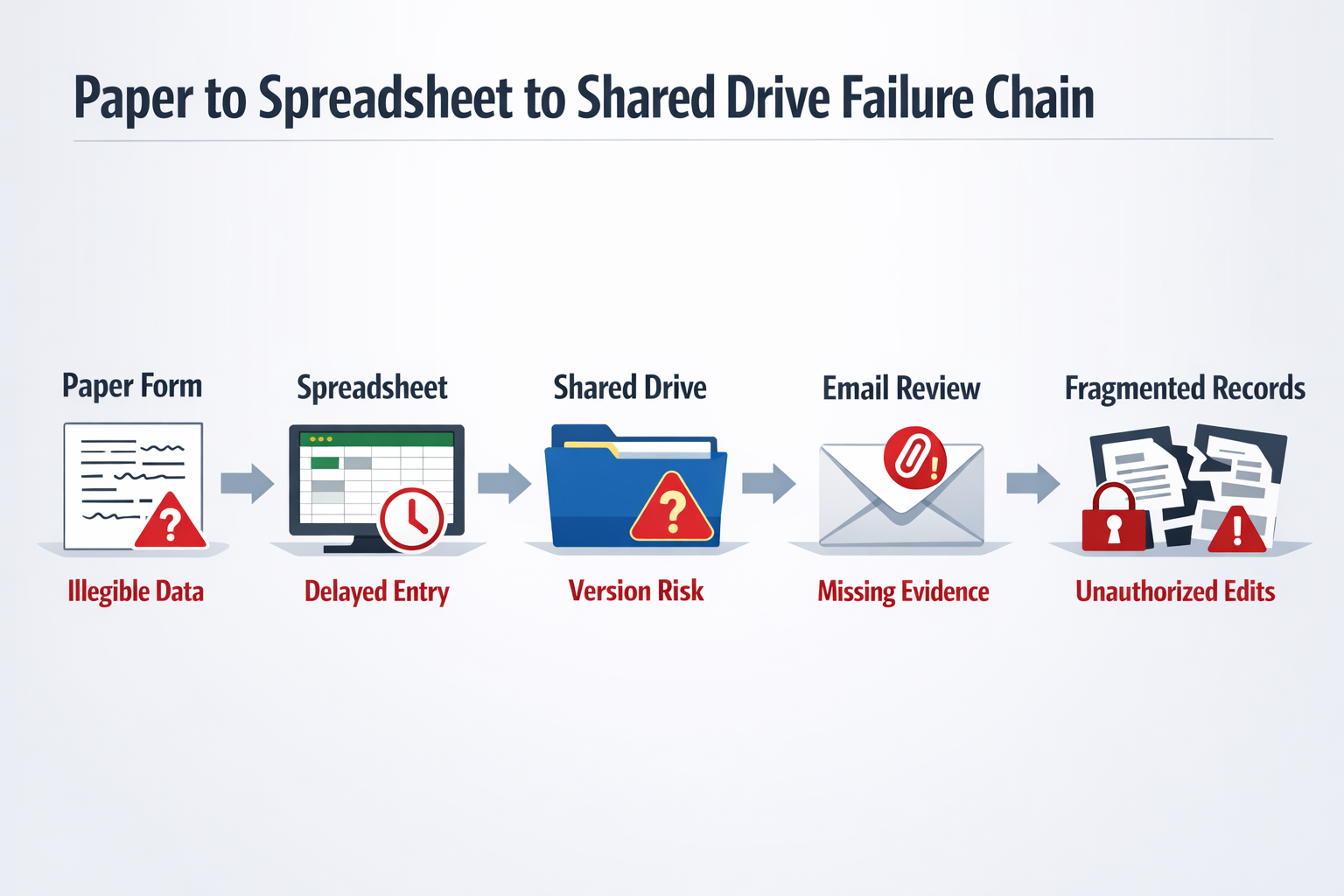
This failure chain also makes ALCOA plus principles harder to sustain. Completeness suffers when attachments remain on a phone or in an email inbox, consistency suffers when different spreadsheet templates are used across shifts or plants, and availability suffers when records are buried in folders that only one coordinator understands. During an internal audit, the delay is frustrating; during an external inspection, it can become a formal observation. The issue is not only storage format, but the lack of control across the full record lifecycle.
Missing Revision Control Weakens Supplier Quality Documentation
Supplier quality documentation is another high-risk area, especially when specifications, COAs, incoming inspection sheets, and supplier corrective action records are managed through spreadsheets and shared folders. In that setup, teams often work from duplicate files with names like “Final,” “Final v2,” or “Latest Approved,” with no dependable way to confirm which file governed the actual decision. That weakens the “original” and “accurate” aspects of the record because the approved version is not always clear. For regulated or customer-audited manufacturers, that is a serious documentation control gap.
The operational impact is wider than compliance alone. If the wrong supplier specification is used during incoming inspection, a material lot may be accepted against obsolete criteria or rejected unnecessarily. When the discrepancy surfaces later, the investigation has to trace not just the material history but also the document history. Without controlled revision tracking, manufacturing quality records become harder to defend, even when the team acted in good faith.
Why These Weak Controls Lead to Bigger Quality Problems
Weak paper and spreadsheet controls rarely stay isolated as documentation issues. They lead to slower deviation investigations, longer batch or lot review times, and more effort spent reconciling records before customer or auditor visits. In sectors with tighter compliance expectations, data-integrity observations remain a recurring inspection theme; regulators and certification bodies consistently look for evidence that records are complete, traceable, and protected from uncontrolled change. If that evidence depends on manual reconstruction, the plant is already on the back foot.
This is why many manufacturers move beyond paper, not just for efficiency, but to make quality data usable as evidence. When a record can be questioned at multiple points—who wrote it, when it was written, whether it was altered, and which version is current—it no longer supports fast, confident decisions. The next step is to design record capture and review in a way that enforces those controls by default, which is where electronic quality records and digital quality records become operationally important.
How Digital Quality Records Support Audit-Ready Compliance Workflows
Standardize Data Capture at the Source
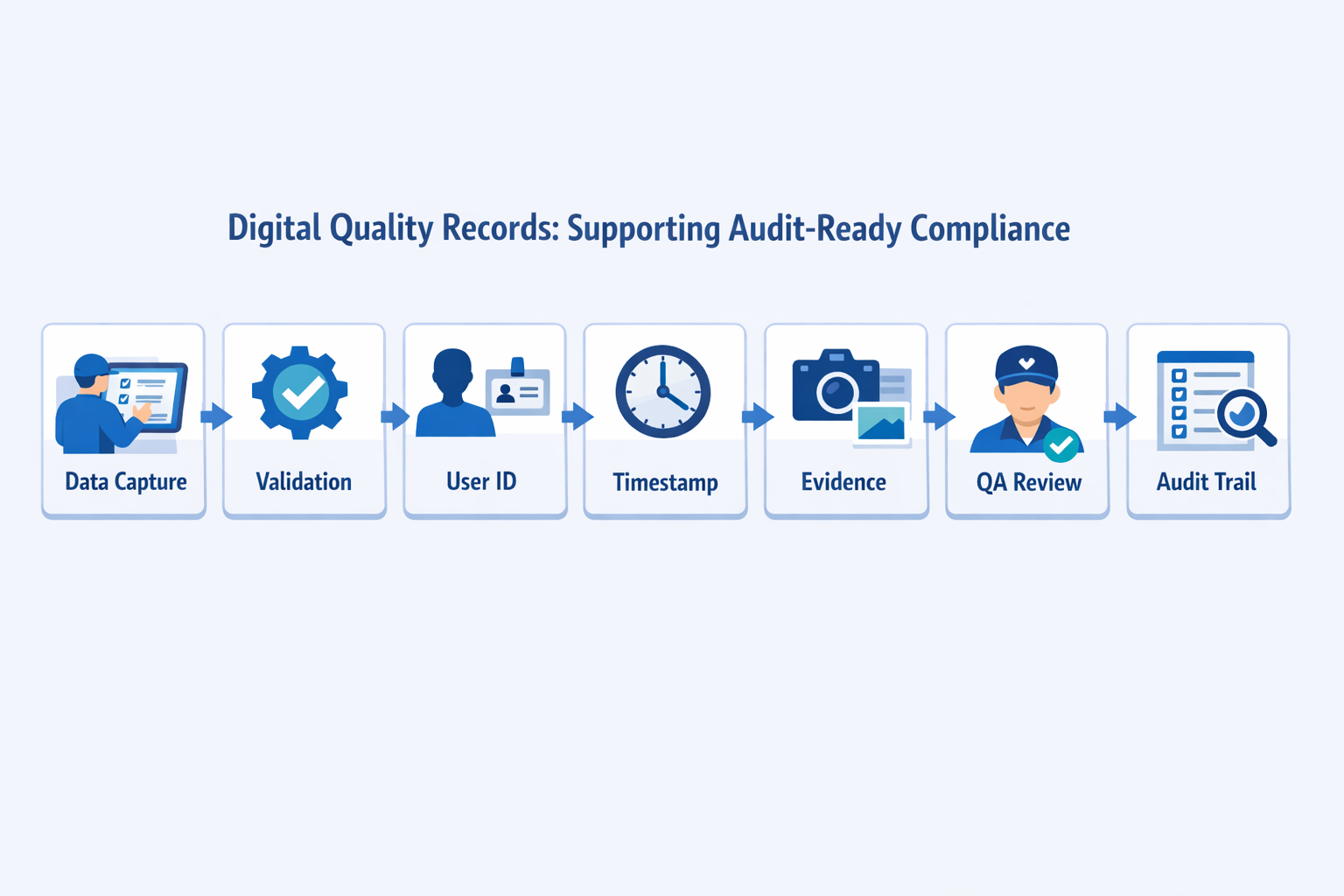
Electronic quality records make ALCOA data integrity practical because they build control into the moment data is captured, not after the fact. A digital quality record can require the exact fields a process needs, such as batch number, machine ID, inspection point, defect code, quantity affected, and disposition status. That structure supports records that are attributable, legible, contemporaneous, original, and accurate by default, instead of relying on operators to remember every rule. In regulated manufacturing, this is a major shift from “documenting work later” to recording quality events as they happen.
Required fields and validation rules reduce incomplete or inconsistent entries before they reach QA review. For example, a nonconformance form can block submission if the operator skips lot traceability, enters text in a numeric tolerance field, or forgets to attach a photo of the defect. This supports not only the core ALCOA principles but also ALCOA Plus expectations such as completeness and consistency. In practice, better first-time data capture shortens review cycles and reduces clarification back-and-forth between production and quality teams.
Use Identity, Time, and Evidence to Strengthen the Record
User-level login and automatic timestamps create clear accountability without adding manual work for the operator. Instead of relying on initials on paper, electronic quality records can tie each entry to a named user, role, device, and submission time. That makes it easier to prove who recorded the event, when it was entered, and whether it was captured at the point of activity. For audits and internal investigations, traceability matters as much as the data value itself.
Attachments also strengthen the original record by linking evidence directly to the event. A quality record can include photos, scanned labels, calibration references, supplier certificates, or test documents in the same record rather than across email threads and shared folders. When evidence stays attached to the transaction, reviewers do not have to reconstruct the story from multiple systems. The result is more reliable manufacturing quality records and faster root-cause review.
Turn a Form Into a Controlled Workflow
The real compliance gain comes when a digital form becomes a controlled workflow rather than a static record. Once submitted, the record can route automatically to the right supervisor, QA reviewer, or compliance approver based on defect severity, product family, or site. Each review step can be time-stamped, permission-controlled, and documented with comments, decisions, and required follow-up actions. That creates a full chain of custody for the record, from initial entry through closure.
Searchable version history adds another control layer that paper systems struggle to match. If a value is corrected, the system can preserve what changed, who changed it, and why the change was made instead of overwriting the prior entry. That helps quality teams distinguish a justified correction from an undocumented alteration, which is central to audit-ready quality data. In effect, the record becomes both the evidence and the audit trail.
Build Audit-Ready Controls Without a Heavy System Rollout
For many manufacturers, the challenge is not understanding the attributable, legible, contemporaneous, original, and accurate standard. The challenge is implementing it without waiting for a long MES or enterprise QMS project. This is where a no-code platform such as Jodoo can be useful, especially for plants that need to digitize specific quality workflows quickly while keeping approval logic, attachments, timestamps, and searchable history in one place. Instead of forcing teams into generic forms, Jodoo lets them configure records around actual shop-floor and QA processes.
A medical device supplier, for example, can replace paper nonconformance forms with a Jodoo workflow that captures operator identity at login, requires defect photos before submission, records timestamps automatically, and routes the case to a supervisor and QA for approval. The same record can hold containment actions, disposition decisions, and closure evidence without splitting information across paper files and spreadsheets. That gives the team a cleaner audit trail and a faster review cycle, while still allowing process changes as customer or regulatory requirements evolve. For plants trying to strengthen electronic quality records step by step, that flexibility is often more practical than a full platform replacement.
Conclusion: A Practical Path to ALCOA-Ready Quality Records with Jodoo
The core lesson is simple: the ALCOA principles are much easier to maintain when quality data is captured at the source, entered in a standard format, and reviewed through a controlled record lifecycle. When operators write checks later from memory, store files across spreadsheets and shared folders, or rely on unclear paper records, data integrity weakens quickly. That creates avoidable risk in audits, investigations, traceability, and day-to-day quality decisions.
For manufacturing teams, the goal is not just to “go digital.” It is to build quality records that are attributable, legible, contemporaneous, original, accurate, and still complete and retrievable months or years later. In practice, that means using structured forms, timestamps, user-level accountability, required evidence, approval workflows, and searchable history so every record can stand up to review.
If you want to replace paper with controlled digital workflows without launching a heavy enterprise software project, Jodoo is a practical choice. As a no-code platform for lean manufacturing and quality operations, Jodoo lets teams build inspection forms, nonconformance workflows, approval routing, and audit-ready records that match their actual process. 开始免费试用 或者 预约演示 to see how your plant can strengthen compliance with less manual effort.