按类别浏览

Introduction: Why Safety Culture Matters on the Manufacturing Floor
强大的 safety culture can be the difference between a near miss that becomes a lesson and one that becomes a lost-time injury. According to the ILO, work-related accidents and diseases cause 全球每年近300万人死亡, and manufacturing remains one of the higher-risk sectors because daily work combines machinery, materials movement, maintenance, and human judgment under production pressure. For plant leaders, that makes safety culture in the workplace more than a compliance topic.
In practical terms, safety culture is how people actually think and act when no one is watching. It shows up in whether operators report small hazards, whether supervisors respond quickly, and whether managers treat safety issues as production problems to solve rather than interruptions to ignore. In general manufacturing, automotive, and electronics plants, injury prevention alone is too narrow because many serious events start with repeated weak signals such as unsafe shortcuts, poor handoffs, or unresolved near misses.
This article explains what strong safety culture looks like, why it breaks down even when policies exist, and how to improve it through daily routines, reporting habits, and follow-through on the shop floor.
What a Strong Safety Culture Looks Like in Manufacturing
强大的 safety culture is visible in daily decisions, not just in audit results or posters on the wall. If you ask what safety culture in the workplace really looks like on a factory floor, the answer is simple: people speak up early, leaders respond consistently, and problems get fixed before someone gets hurt. In manufacturing, that standard has to hold across production, warehousing, maintenance, and support functions. The strongest plants treat safety as part of operational discipline, not as a separate campaign.
Visible Leadership on the Floor
Leadership commitment is easiest to judge at the gemba. Plant managers, production leaders, and supervisors in strong cultures regularly join walk-throughs, ask specific questions about risks, and remove barriers that operators cannot solve alone. They do not appear only after an incident or before an external audit. When leaders consistently act on what they see, employees learn that reporting hazards leads to action, not delay.
Visible leadership also means making trade-offs in the open. If a line restart is delayed because a guarding issue is unresolved, workers notice that safety rules apply even under schedule pressure. That matters because employees are quick to spot the gap between stated priorities and actual decisions. Over time, those repeated choices define credibility more than any training session.
Reactive vs. Proactive Safety Culture
The clearest difference between weak and strong culture is whether the plant waits for harm before responding. In a reactive warehouse operation, repeated forklift near misses may trigger reminders, warning signs, or one-off retraining only after an incident record starts to rise. In a proactive electronics assembly plant, supervisors investigate traffic patterns, separate pedestrian routes, adjust material staging, and review near-miss trends before an injury occurs. One approach manages events; the other manages exposure.
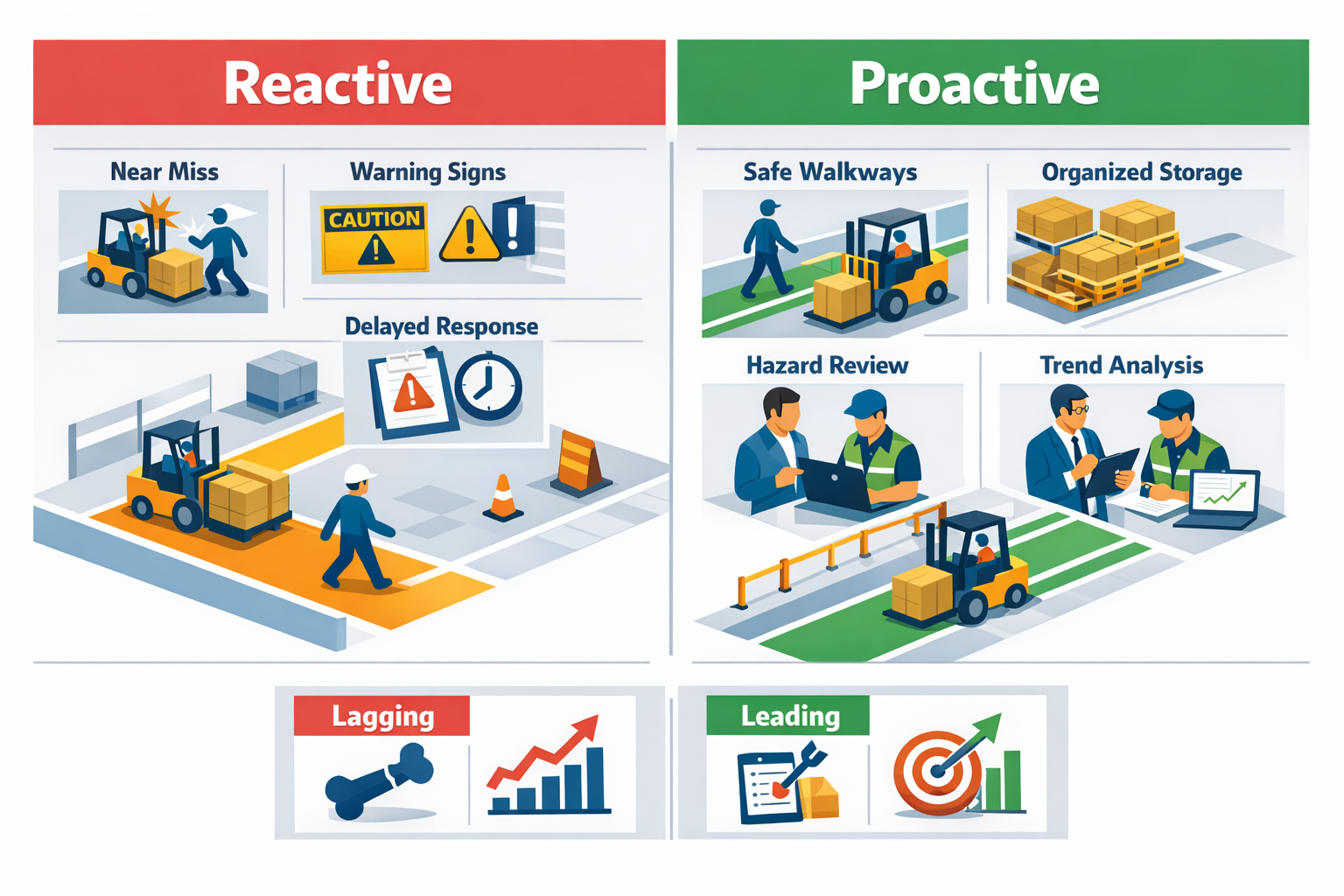
This contrast matters for 环境、健康与安全 and operations leaders because it changes what gets measured and rewarded. Reactive cultures focus on lagging outcomes such as recordables, lost-time injuries, or damage costs. Proactive cultures still track those results, but they pay closer attention to signals like near-miss reports, hazard closure time, repeat findings, and participation in corrective actions. That shift creates the foundation for later work on how to improve safety culture.
Frontline Trust and Reporting Without Fear
Strong cultures make it safe to report problems, including minor hazards and process deviations. Operators, technicians, and material handlers believe they can raise an issue without being blamed for slowing output or “creating paperwork.” That trust is essential because frontline employees usually see unstable conditions first. If they stay silent, leadership loses the earliest warning system in the plant.
Reporting without fear does not mean lower standards or less accountability. It means separating the act of speaking up from automatic punishment when the goal is prevention and learning. For example, if an assembler reports a recurring ESD mat trip hazard near a workstation, the response should start with investigation and correction, not criticism for not working around it. Plants that encourage early reporting usually surface more issues at first, which is often a sign of healthier culture, not worse performance.
Consistent Follow-Through Across Shifts and Functions
Trust rises when reports lead to visible follow-through. A strong safety culture closes the loop by assigning ownership, communicating status, and confirming that corrective actions actually worked. In practical terms, that means a maintenance fix, an operations adjustment, and an EHS verification happen as one process rather than as disconnected tasks. Workers remember whether yesterday’s report disappeared or was resolved.
Shared accountability is what keeps that follow-through from depending on one committed supervisor. The best plants make safety expectations consistent across day and night shifts, line leaders, warehouse teams, and support departments. That consistency is one of the most reliable examples of positive safety culture because it shows that safety is built into how work is managed, not into who happens to be on duty.
Why Safety Culture Breaks Down Even When Policies Exist
Policies Do Not Remove Friction From Daily Work
Many plants have the visible elements of a safety program: induction training, posted SOPs, scheduled audits, and monthly toolbox talks. Yet those controls do not automatically answer what safety culture in the workplace looks like during a rushed shift, a staffing gap, or a recurring equipment issue. Culture breaks down when the formal rules say “report it,” but the daily operating system makes reporting slow, inconvenient, or risky. In practice, workers judge safety by what happens after they raise a concern, not by what is written in the manual.
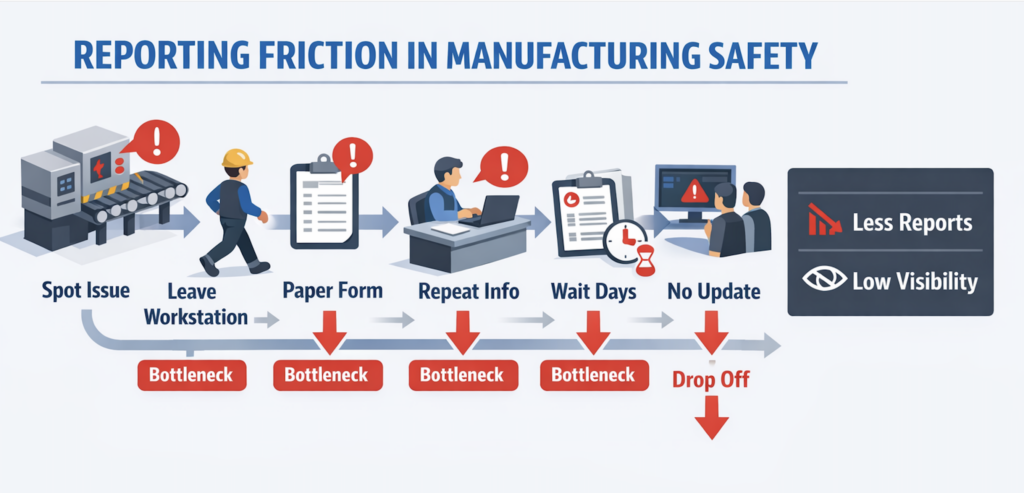
A common failure point is reporting friction. If an operator has to leave the line, find a paper form, explain the same issue twice, and wait days for an update, minor hazards often go unreported. Over time, that friction teaches the workforce that speaking up creates work for them but not action from management. The result is predictable: fewer reports, less visibility, and a weaker safety culture even though the plant appears compliant on paper.
Production Pressure Changes Behavior Faster Than Policy
Production pressure is one of the fastest ways to erode safe behavior, especially in high-output environments. On an automotive stamping line during peak demand, operators may notice oil buildup near a press walkway or a loose guard fastener but decide it can wait until changeover. They are not always ignoring risk; they are making a trade-off based on what the system rewards in that moment. If line uptime is praised every hour and minor hazard reporting slows the run, the message is clear.
This is why many sites struggle even after adding more training. Training tells people the right action, but performance pressure tells them the practical priority. Research from the International Labour Organization continues to show that hundreds of millions of workers worldwide suffer non-fatal occupational injuries each year, and many incidents are linked to organizational conditions rather than individual negligence alone. When production metrics consistently outrank response to reported hazards, policy loses credibility.
Inconsistent Supervisor Follow-Through Undermines Trust
Supervisor behavior is where many safety programs either gain traction or stall. A worker may report a damaged cable cover, blocked extinguisher access, or repeated near miss, but if one supervisor acts immediately and another does nothing, employees stop seeing the process as reliable. Inconsistent follow-through makes safety feel personal and situational instead of standardized. That weakens trust across crews, departments, and shifts.
The damage is cumulative. Workers remember when an issue stayed open, when no one communicated next steps, or when reporting led to blame instead of problem-solving. That memory affects the next reporting decision more than any poster campaign about how to improve safety culture. Before leaders ask for more participation, they need to understand that delayed or uneven response trains silence.
Weak Shift Handoffs Break the Feedback Loop
In mixed-shift facilities, unresolved safety issues often disappear between crews. A night-shift technician may isolate a leaking hose, leave a handwritten note, and expect maintenance follow-up in the morning, but if the handoff is informal, the issue can be missed entirely. By the next shift, temporary fixes become normal conditions. This is how known hazards stay in circulation without clear ownership.
Weak handoffs also distort the plant’s view of risk. EHS may see low reporting volume and assume conditions are stable, while operators know that open concerns are simply not surviving shift changes. Few examples of positive safety culture are more telling than a plant where every open hazard has an owner, a deadline, and visible status across shifts. Without that operational discipline, even good intentions fragment.
How to Improve Safety Culture With Frontline-Centered Practices
A stronger safety culture is built through daily operating habits, not a campaign poster or an annual training push. If you want a practical answer to how to improve safety culture, start by redesigning the moments where workers notice risk, report it, and see what happens next. In one electronics plant, recurring near misses around reel changes and material handling were not caused by a lack of rules. They persisted because reporting was inconsistent, supervisor response varied by shift, and corrective actions were hard to track across production lines.
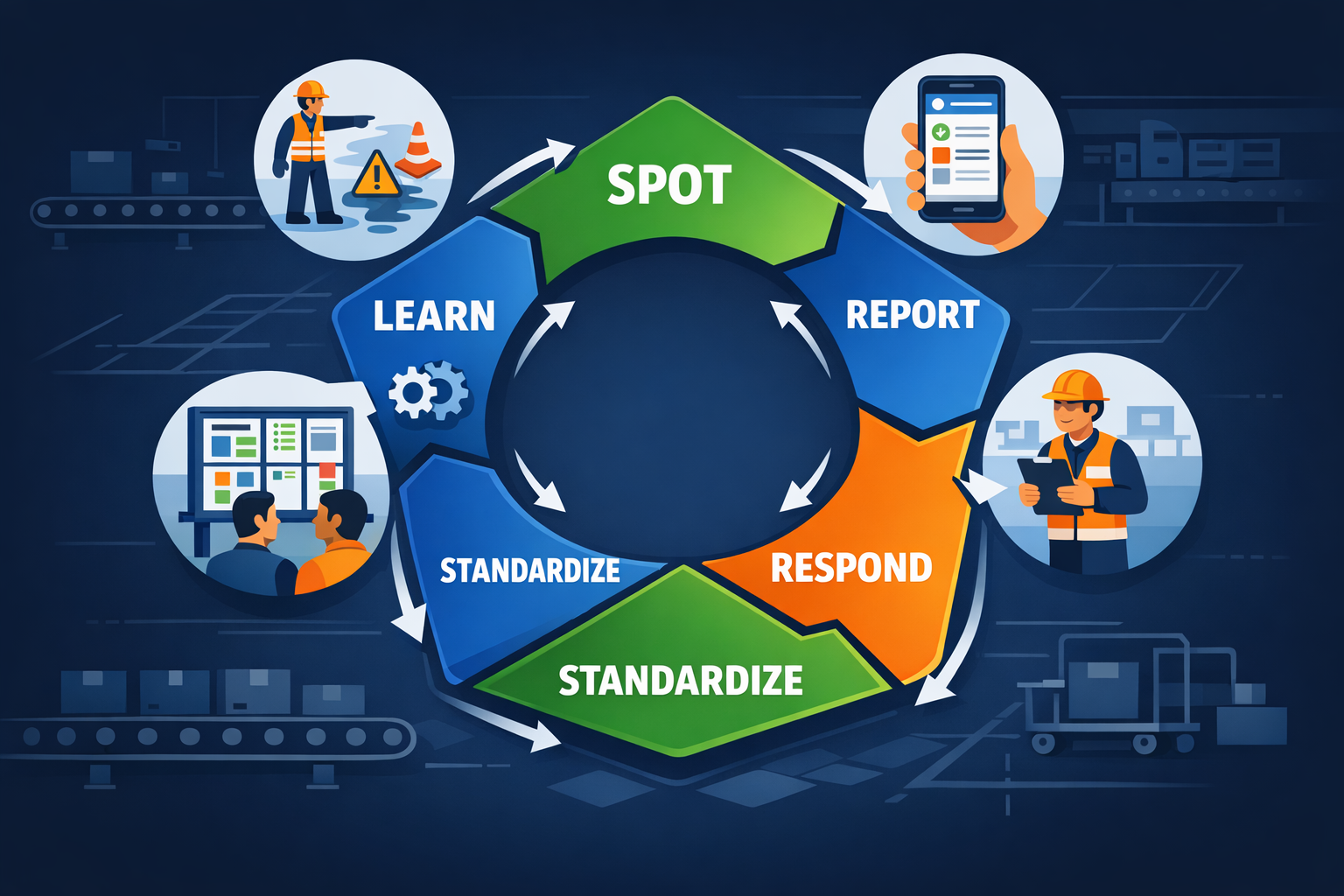
A useful framework is to treat safety culture as a closed loop with five steps: spot, report, respond, standardize, and learn. That sequence gives plant leaders a workable model for what safety culture in the workplace looks like when it functions well at floor level. It also helps teams move from lagging discussions about incidents to leading actions that reduce exposure before someone gets hurt.
Make Reporting Fast Enough for Real Production Conditions
In the electronics plant, operators often noticed blocked walk paths, unstable material carts, or awkward reaches during changeovers, but many issues went unreported because the process took too long. If reporting requires leaving the line, finding paper, or explaining the same issue to multiple people, participation drops fast during high-output periods. A practical target is simple: a frontline worker should be able to log a near miss or hazard in under two minutes, with enough structure to support action later.
That usually means standardizing a short reporting format with location, issue type, photo, immediate risk level, and whether production was affected. The goal is not a perfect narrative; it is a usable signal. Plants that increase reporting volume often see a short-term spike in recorded hazards, which is usually a sign of growing trust, not worsening conditions.
Reinforce Supervisor Response Habits
Once reports start coming in, supervisor behavior becomes the real test of credibility. To strengthen safety culture, define response habits as clearly as production routines. Supervisors should acknowledge every report, classify urgency, assign containment if needed, and communicate the next step within the same shift whenever possible. Even when the fix takes longer, early acknowledgement shows that speaking up leads somewhere.
Standardize Across Lines and Shifts
Standardization should focus on the handoff points where issues are most likely to disappear. Daily tier meetings, shift-start reviews, and visual action lists should use the same status language across all lines: new, contained, assigned, verified, closed. This is where digital workflow tools such as Jodoo can help by routing reports automatically, time-stamping actions, and giving supervisors and EHS one shared record instead of separate notebooks or spreadsheets.
Use Leading Indicators That Show Engagement
If your dashboard only tracks recordable injuries, you are measuring outcomes too late. The electronics plant made better progress when it added leading indicators such as hazard reports per 100 employees, same-shift acknowledgement rate, corrective action closure time, repeat near misses by area, and percentage of actions verified on the floor. These measures show whether the system is active before injury numbers change.
The point is not to reward raw report counts in isolation. It is to see whether people are identifying risk early and whether management is removing barriers fast enough. That creates measurable examples of positive safety culture without waiting for an audit.
Recognize Participation Without Hiding Problems
Many plants unintentionally weaken reporting by celebrating “zero incidents” in ways that make people cautious about speaking up. In the electronics plant, recognition shifted from injury-free days alone to proactive behaviors such as flagging a recurring obstruction, suggesting a safer cart layout, or helping verify a fix after implementation. That change improved both participation and the quality of reports.
Recognition works best when it reinforces learning, not silence. Thank workers for raising issues, show which suggestions were adopted, and make team-level improvements visible. When people can see that reporting leads to changes in layout, handling, or SOPs, safety culture becomes part of normal operations rather than a separate program.
Examples of Positive Safety Culture in Daily Manufacturing Operations
Seeing a strong safety culture on the floor is more useful than hearing another slogan in a town hall. In practice, the best examples of positive safety culture show up as fast responses, visible follow-through, and small operational changes that reduce risk before someone gets hurt.
A Hazard Report That Gets Acknowledged and Closed
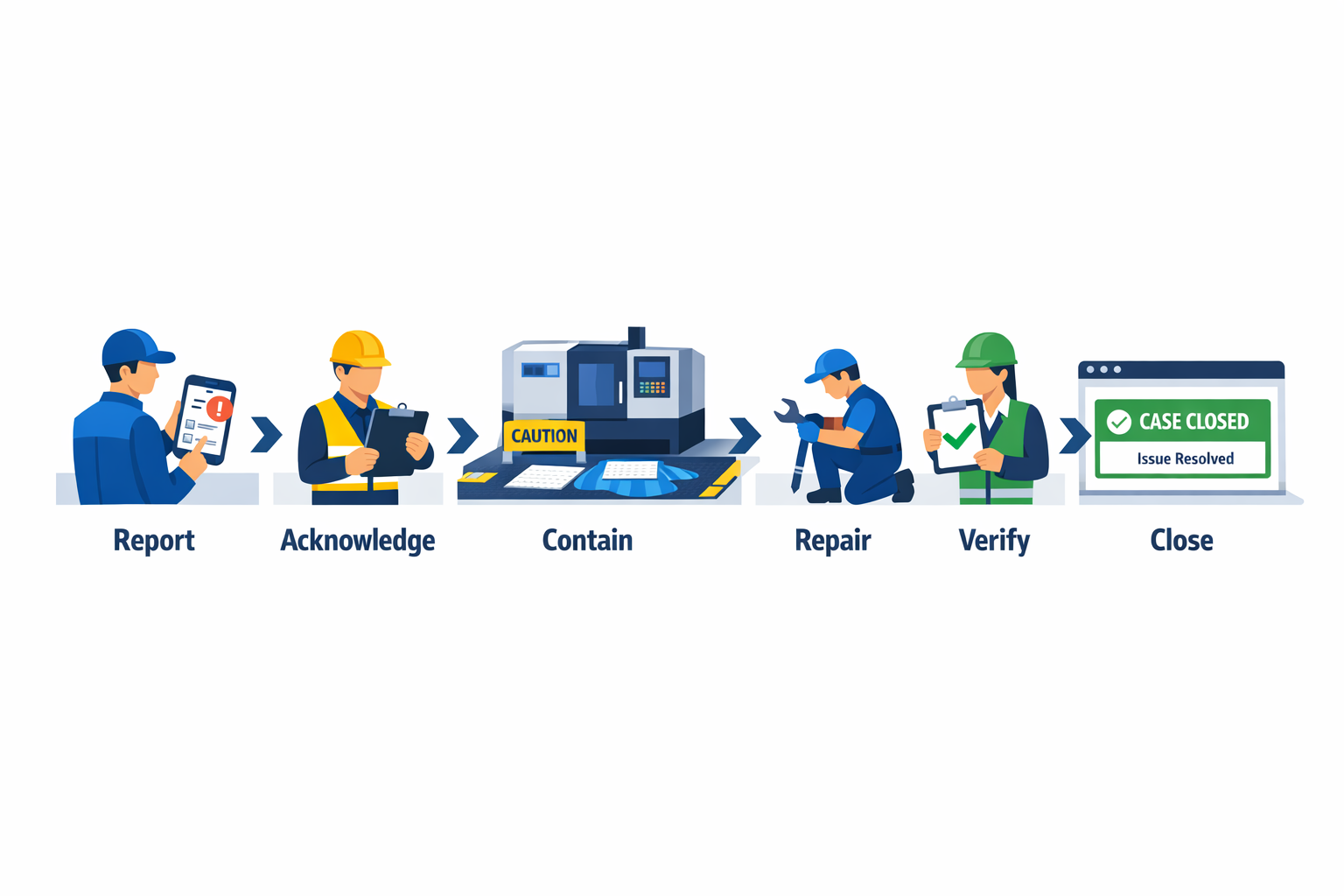
In a general manufacturing plant, an operator notices coolant leaking near a walkway beside a CNC cell. Instead of waiting for the next shift meeting, she submits a hazard report during the shift, and the area supervisor acknowledges it within 15 minutes. Maintenance is assigned immediately, temporary containment is put in place, and EHS verifies the housekeeping and slip-risk controls before the shift ends. By the next morning, the operator can see the case status, action owner, and final closure note.
This is a practical example of how to improve safety culture because the worker receives proof that speaking up leads to action. The process is closed loop: report, acknowledge, contain, correct, verify, and communicate back. Plants with this habit usually see reporting volume rise first, which is a healthy sign rather than a failure. More reports often mean more trust, and trust is one of the clearest markers of a mature safety culture.
A Near Miss That Leads to a Process Change
In an automotive subassembly area, a tugger nearly clips a pedestrian at an aisle crossing during a shift change. No one is injured, but the near miss is logged, reviewed that day, and discussed in the next production meeting with operations, logistics, and EHS. Instead of treating it as driver error alone, the team maps the traffic pattern, checks line-of-sight obstruction, and adjusts both floor markings and dispatch timing. Within two weeks, the crossing is redesigned, and supervisors confirm compliance during layered audits.
What makes this a positive example is that the plant learns from weak signals. A reactive culture waits for recordable injuries; a stronger one treats near misses as process data. This kind of follow-through also answers a common management question about how to improve safety culture without slowing output. The answer is not more slogans but faster learning from small events before they become serious incidents.
A Toolbox Talk That Produces a Trackable Improvement
In an electronics assembly plant, technicians raise the same concern during a toolbox talk: reel carts are being parked too close to emergency access routes during peak demand. Rather than recording the comment as meeting attendance only, the line leader logs it as an improvement item with an owner and due date. Industrial engineering reviews the material staging layout, updates the visual limits, and tests a revised cart parking zone on one line before rolling it out plant-wide. At the next toolbox talk, the team reviews the before-and-after result and confirms the exit path remains clear during rush periods.
That is what good daily management looks like when safety participation is treated as operational input. The meeting creates a measurable change, not just a compliance record. For EHS managers and plant leaders, these small signals matter because they show whether employees believe their observations count.
Conclusion: Build a Proactive Safety Culture With Jodoo
强大的 safety culture in manufacturing is not created by posters, annual training, or injury targets alone. It is built through daily routines that make it easy for people to report hazards, trust that someone will respond, and see that corrective actions are actually completed. When leadership visibility, supervisor follow-through, and frontline participation are supported by clear systems, plants move from reactive firefighting to proactive risk reduction.
That is where digital workflow design matters. As a no-code lean manufacturing platform, Jodoo helps manufacturers turn safety expectations into repeatable action. Teams can use mobile forms and QR code scanning to let operators submit hazard reports or near-miss observations directly from the shop floor, then route each issue through automated workflows for review, assignment, escalation, and closure. Just as important, workers can receive timely updates when their reports are reviewed or implemented, which strengthens trust and encourages continued participation.
If you want to improve safety culture without launching a large IT project, start with one workflow, such as hazard reporting or corrective action tracking, and expand from there. 开始免费试用 或者 预约演示 to see how Jodoo can support safer, more accountable manufacturing operations.