製造商遵守 OSHA 標準:關鍵標準、檢查清單和最佳實踐

Introduction: Why OSHA Compliance Still Demands a System, Not Just a Checklist

A manufacturer can go months without a recordable incident and still fail an inspection because a lockout procedure is outdated, forklift training is incomplete, or hazard communication records do not match what is happening on the floor. That is the reality of OSHA compliance in manufacturing: it is not judged by good intentions or annual binders, but by whether controls are consistently working in daily operations. For 環境、健康與安全 managers, compliance officers, and plant managers, that gap between policy and practice is where risk builds quietly.

OSHA penalties have increased steadily over time, and serious violations can now cost tens of thousands of dollars per item, before you factor in downtime, rework, insurance impact, or injury-related disruption. In general manufacturing, automotive, and electronics plants, compliance failures often show up in routine areas such as machine guarding, energy isolation, PPE use, chemical labeling, and operator training.

This article breaks down the manufacturing standards you need to control first, why common violations keep reappearing, how to build a practical plant-level compliance program, and how to prepare for an OSHA inspection without last-minute scrambling.

The Manufacturing OSHA Standards You Need to Control First

For most manufacturers, OSHA exposure is concentrated in a small group of standards that touch routine production, maintenance, material handling, and operator behavior every shift. If you control these first, you reduce both serious injury risk and the citation patterns that repeatedly appear in manufacturing. The practical question is not just what the standard says, but where the requirement shows up in daily work and what evidence proves control.

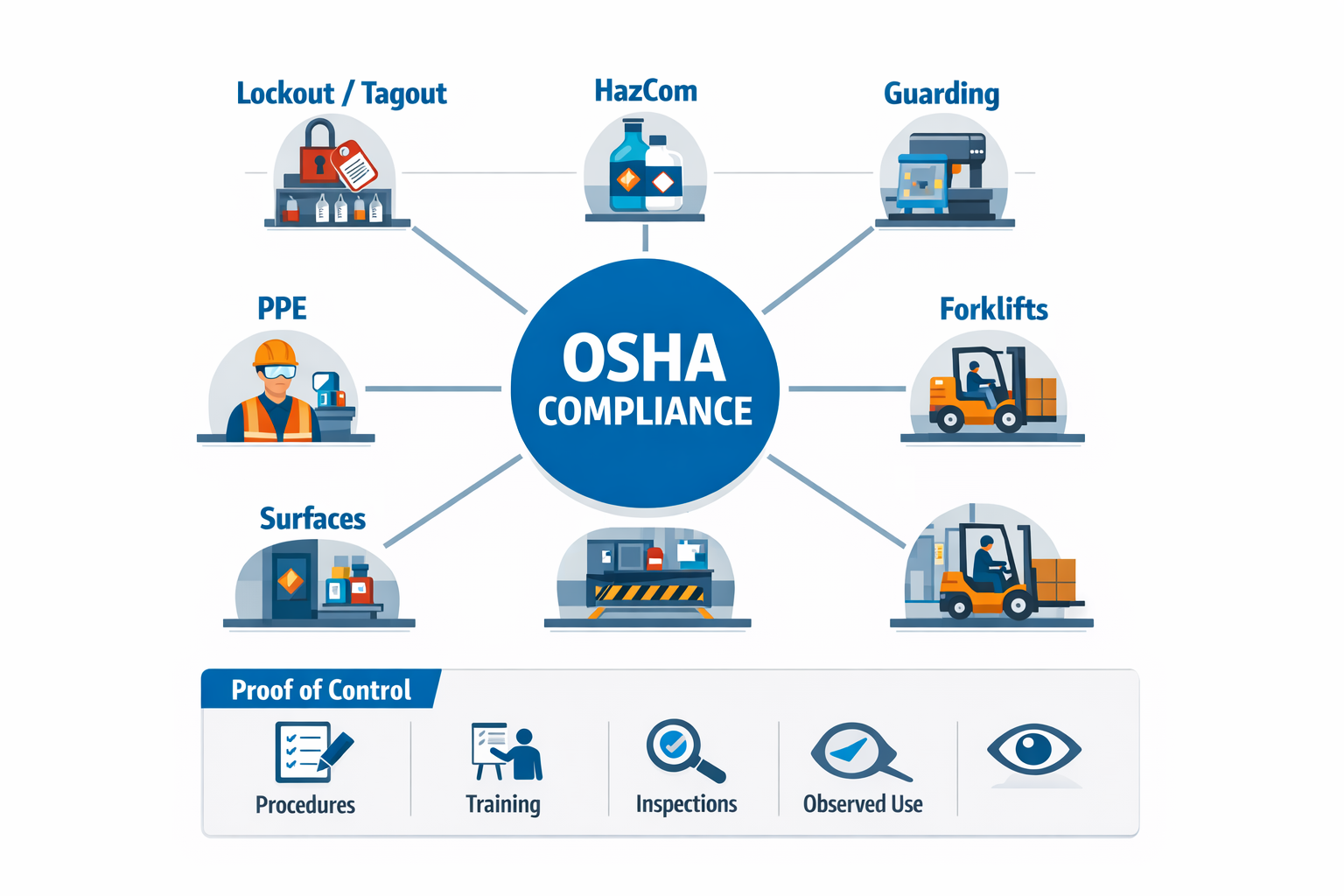
In a typical plant, lockout procedures affect maintenance and changeovers, hazard communication affects chemical use and storage, machine guarding affects production equipment, PPE affects nearly every task, walking-working surfaces affect traffic routes and housekeeping, and powered industrial truck rules affect warehouses and line-side movement. This is why OSHA compliance must be visible in the work itself, not only in a binder.

Infographic of key OSHA compliance standards for manufacturers including lockout tagout hazard communication machine guarding PPE walking surfaces and forklifts

Lockout/Tagout

OSHA expects manufacturers to identify energy sources, document machine-specific isolation steps, provide locks and tags, train authorized and affected employees, and verify zero energy before servicing begins. Plants usually fail when generic procedures are copied across different machines, contractors are not aligned to site rules, or supervisors allow “quick fixes” without full isolation. In metal fabrication, for example, a press brake may have electrical, hydraulic, and stored mechanical energy, but the posted procedure covers only the main disconnect.

Proof of control is practical and specific: machine-level lockout procedures, employee training records by role, periodic inspections of each procedure, and observed behavior during maintenance. If an OSHA inspector sees technicians relying on verbal coordination instead of personal locks, the paperwork will not save the plant. Many common OSHA violations in manufacturing start here because production pressure overrides isolation discipline.

Hazard Communication

Hazard communication requires an accurate chemical inventory, accessible Safety Data Sheets, proper container labeling, and training workers can apply during normal tasks and spills. Plants often miss the operational details: secondary spray bottles without labels, outdated SDS files, or temporary workers who never receive chemical-specific instruction. An electronics assembly site using solvents and adhesives may appear organized, yet still fail if operators cannot explain basic handling precautions.

Good evidence includes a current chemical register, revision-controlled SDS access, labeled transfer containers, and training logs tied to actual chemicals in use. Supervisors should also be able to show how new chemicals are reviewed before production release. This standard matters for both injury prevention and any OSHA inspection preparation checklist because inspectors regularly sample labels, records, and worker responses together.

Machine Guarding

OSHA expects guards to prevent contact with moving parts, nip points, rotating components, and flying chips or sparks. Manufacturers commonly fail when guards are removed for cleaning, bypassed to speed setup, or left poorly adjusted after maintenance. In a packaging plant, an interlocked guard may exist on paper, but if operators routinely prop the door open to clear jams, the real control has failed.

To prove control, plants need equipment risk assessments, guard inspection records, documented repair response, and visible enforcement of bypass rules. The strongest signal is stable operator behavior during observation. If you are looking at how to ensure OSHA compliance, machine guarding is one of the clearest standards where documented checks must match floor reality.

The Supporting Standards That Trigger Frequent Citations

PPE, walking-working surfaces, and powered industrial trucks often become citations because they depend on daily consistency. OSHA expects hazard-based PPE selection, clean and dry aisles, guarded floor openings, forklift operator evaluation every three years, and disciplined charging, parking, and pedestrian separation. The records are straightforward, but what matters is whether the plant can show repeatable execution across shifts, departments, and peak-demand periods.

Common OSHA Violations in Manufacturing and Why They Keep Reappearing

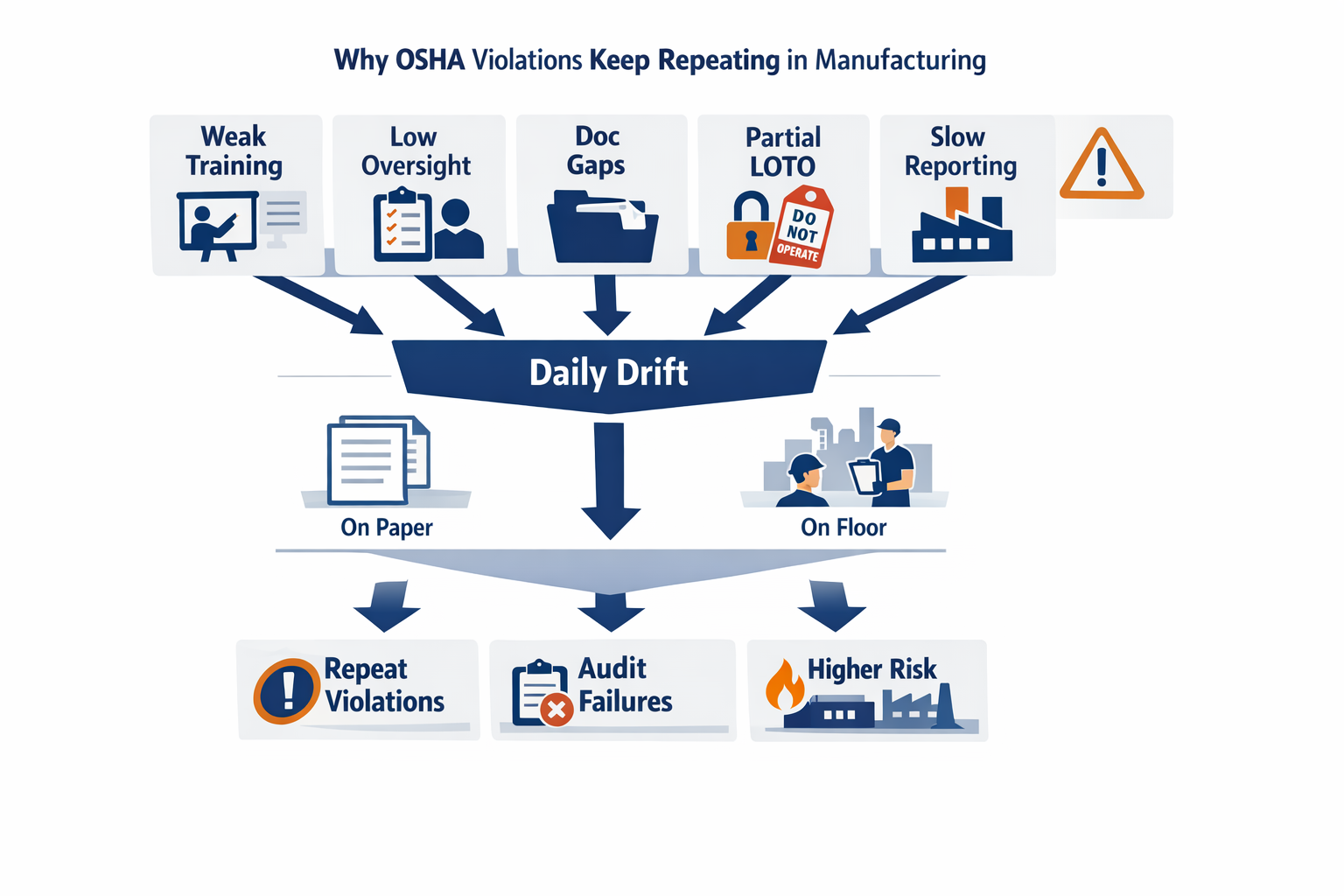
Manufacturers rarely repeat the same OSHA violations because they do not know the rule. More often, the problem is that controls exist on paper but break down in daily execution. That is why the most common OSHA violations in manufacturing tend to cluster around the same operational weak points: inconsistent training, weak front-line supervision, poor documentation discipline, incomplete equipment isolation, and delayed hazard reporting. If you want to understand how to ensure OSHA compliance, you have to examine where routine work drifts away from the written standard.

Training That Does Not Hold Up on the Floor

A frequent failure pattern is training that is technically completed but not operationally retained. Plants may have sign-in sheets, slide decks, and annual refresher dates, yet employees still cannot explain the correct response to a jam, spill, unlabeled drum, or missing guard. OSHA looks beyond attendance records and evaluates whether workers understand the hazard in the context of their actual task. In a metal fabrication shop, for example, temporary operators may be trained during onboarding but not retrained when moved from assembly to press operations, creating immediate exposure.

This gap usually starts when training is treated as a compliance event instead of a skill verification process. Supervisors assume HR or EHS has covered the requirement, while operators learn shortcuts from peers on the line. Over time, the shop develops an unofficial way of working that no longer matches the documented procedure. That is often why facilities are surprised by citations even when they believe training is current.

Supervision and Routine Controls That Fade Between Audits

Many repeat violations come from weak daily reinforcement rather than a missing policy. A plant may have lockout rules, forklift speed limits, PPE requirements, and housekeeping standards, but no one checks them consistently during the shift. When production pressure rises, supervisors may prioritize output over correction of small deviations, especially if the deviation has not yet caused an incident. Those “small” misses accumulate into the exact conditions OSHA cites during a walkthrough.

Process infographic showing common causes of repeat OSHA violations in manufacturing such as weak training poor supervision documentation gaps and incomplete lockout

Documentation Gaps That Undermine Otherwise Good Practice

Documentation failures are another major source of enforcement exposure because they weaken the plant’s ability to prove control. Operators may wear PPE, forklifts may be inspected, and machine guards may be in place, but if records are incomplete, outdated, or inconsistent across departments, the plant looks unmanaged. OSHA compliance depends on both field conditionsverifiable evidence. During a review, missing training matrices, unsigned inspection logs, or outdated hazard assessments can turn a manageable issue into a citation.

This is also where many facilities struggle with handoffs. Maintenance, production, 環境、健康與安全, and HR may each hold part of the record, with no single owner responsible for accuracy. As a result, expired certifications, overdue inspections, and unclosed corrective actions remain hidden until someone prepares for an OSHA inspection checklist or responds to an incident. By then, the documentation gap has already become operational risk.

Equipment Isolation and Hazard Reporting Fail at the Point of Use

Some of the most serious violations persist because the breakdown happens at the exact moment a worker must choose between stopping and continuing. During maintenance, cleaning, or troubleshooting, employees may rely on partial isolation, verbal communication, or past habit instead of full energy-control steps. In a packaging plant, a mechanic who shuts off the HMI but does not isolate pneumatic energy may believe the machine is safe because the line appears stopped. OSHA repeatedly cites these cases because the written procedure was never translated into a reliable point-of-use behavior.

Hazard reporting fails similarly. Employees notice leaking hoses, damaged cords, slippery surfaces, or bypassed interlocks, but do not report them because response is slow, unclear, or inconsistent. That silence allows minor deficiencies to stay in circulation until they become one of the common manufacturing violations leaders thought they had already addressed.

How to Ensure OSHA Compliance With a Practical Plant-Level Program

Assign Clear Ownership and Scope

If you want to ensure OSHA compliance at the plant level, start by assigning named ownership instead of leaving safety tasks spread across departments. In a mid-sized metal fabrication plant, the EHS manager owns the program, maintenance owns equipment isolation execution, production supervisors own shift-level enforcement, and HR supports training records. That structure matters because OSHA gaps often appear in handoffs, not in policy language. A RACI-style matrix for each major standard, inspection task, and corrective action prevents “someone else is handling it” failures.

Ownership also needs a plant map, not just a job title list. The fabrication plant divided responsibilities by process area: laser cutting, press brake cells, welding bays, paint line, and warehouse. Each area had a responsible supervisor, defined audit frequency, and required records. This made compliance visible in daily operations instead of keeping it inside an annual EHS binder.

Build Written Programs Into Actual Work

Written programs should reflect the way work is performed on the floor, not copied language from a template. In the same plant, the lockout/tagout procedure was rewritten by machine family, with shutdown points, stored energy risks, photos of disconnects, and verification steps for each asset type. Hazard communication, PPE, forklift operation, and emergency response programs were updated the same way. When procedures match the plant’s actual layout and equipment, supervisors can enforce them, and operators can follow them under time pressure.

Document control is part of this step, not an administrative afterthought. The plant moved from scattered Word files and paper revisions to a controlled master list with issue dates, approvers, review cycles, and archived superseded versions. That reduced one of the root causes behind common OSHA violations in manufacturing: outdated instructions still circulating at the line. If a program changes after an incident, retraining and version updates should happen together.

Schedule Routine Inspections and Close the Loop

A practical compliance program runs on scheduled verification. The fabrication plant set daily supervisor checks for guarding and housekeeping, weekly area inspections for PPE and access routes, and monthly cross-functional audits covering training, machine isolation, and incident follow-up. These reviews were short, repeatable, and tied to standard forms, which made trend analysis possible. The point was not to create more paperwork, but to detect drift before it became a citation or injury.

The plant also built a closed-loop corrective action process. Hazards found during inspections were logged with risk level, interim control, owner, due date, and verification evidence after completion. Supervisors could not mark an issue closed until someone confirmed the fix on the floor, such as a replaced guard, relabeled chemical container, or tested lockout point.

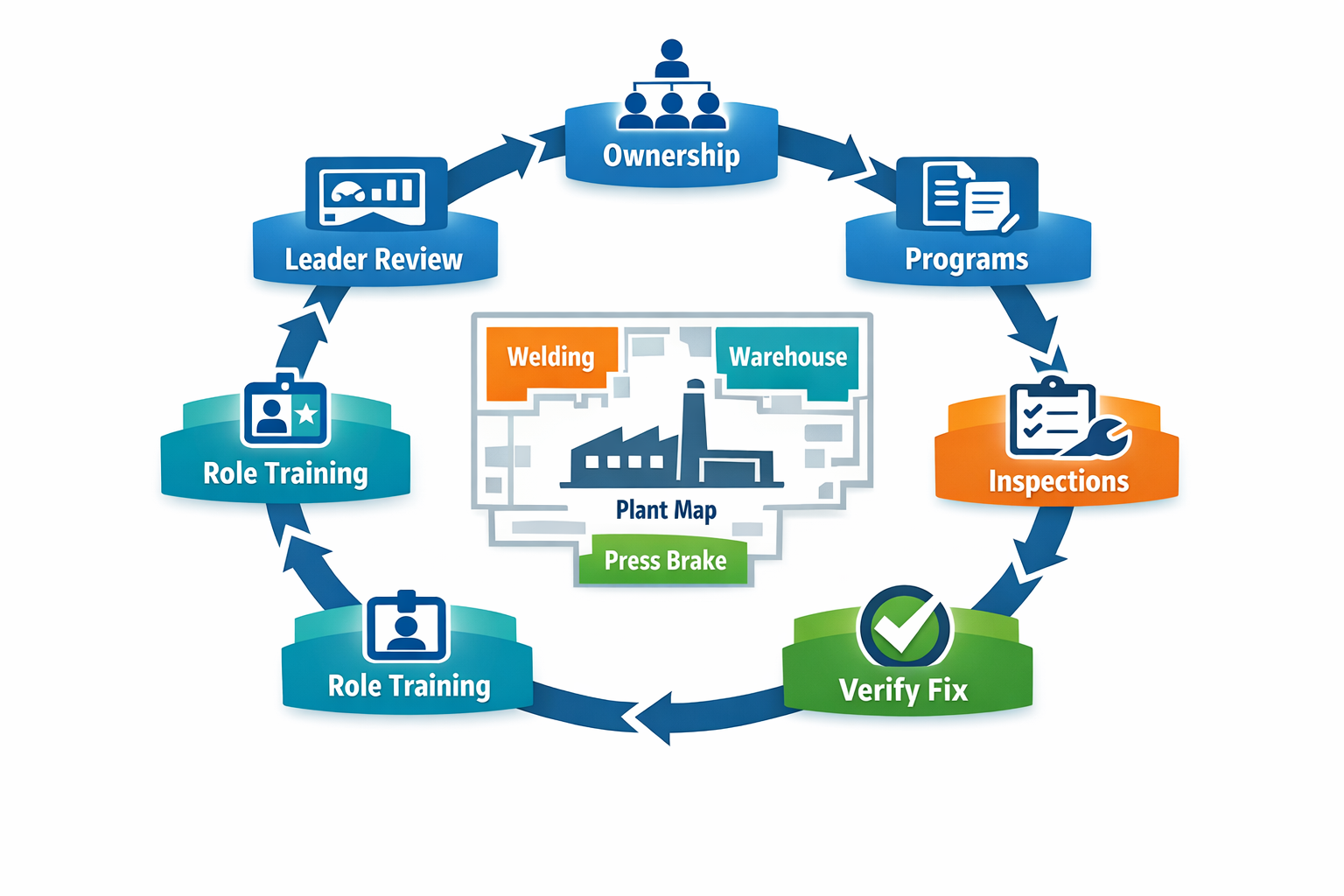
Closed loop OSHA compliance workflow for manufacturers showing ownership inspections corrective actions verification training and leadership review

That closed loop is where many programs fail. A missing guard reported on Monday becomes a repeat finding on Friday when no one verifies the repair, and then a serious exposure during an audit. Treating hazard identification, assignment, correction, and verification as one workflow is one of the most reliable answers to how to ensure OSHA compliance 隨著時間的推移。.

Train by Role, Then Review Performance

Training should follow risk exposure and job responsibility, not a generic annual calendar. In the fabrication plant, operators received task-specific machine safety refreshers, forklift drivers completed observations plus retraining after near misses, and supervisors were trained on what evidence auditors expect during routine reviews. Competency checks mattered more than attendance sheets alone. Short quizzes, floor demonstrations, and documented observations gave the plant stronger proof of control.

Leadership review is the stabilizing step. Each month, plant leadership reviewed open corrective actions, overdue training, repeat findings, and incident trends by department. That routine turns compliance data into management action and supports later inspection readiness without becoming a separate OSHA inspection preparation checklist exercise. When leaders review lagging and leading indicators consistently, the program shifts from reactive response to controlled performance.

OSHA Inspection Preparation Checklist for Manufacturers

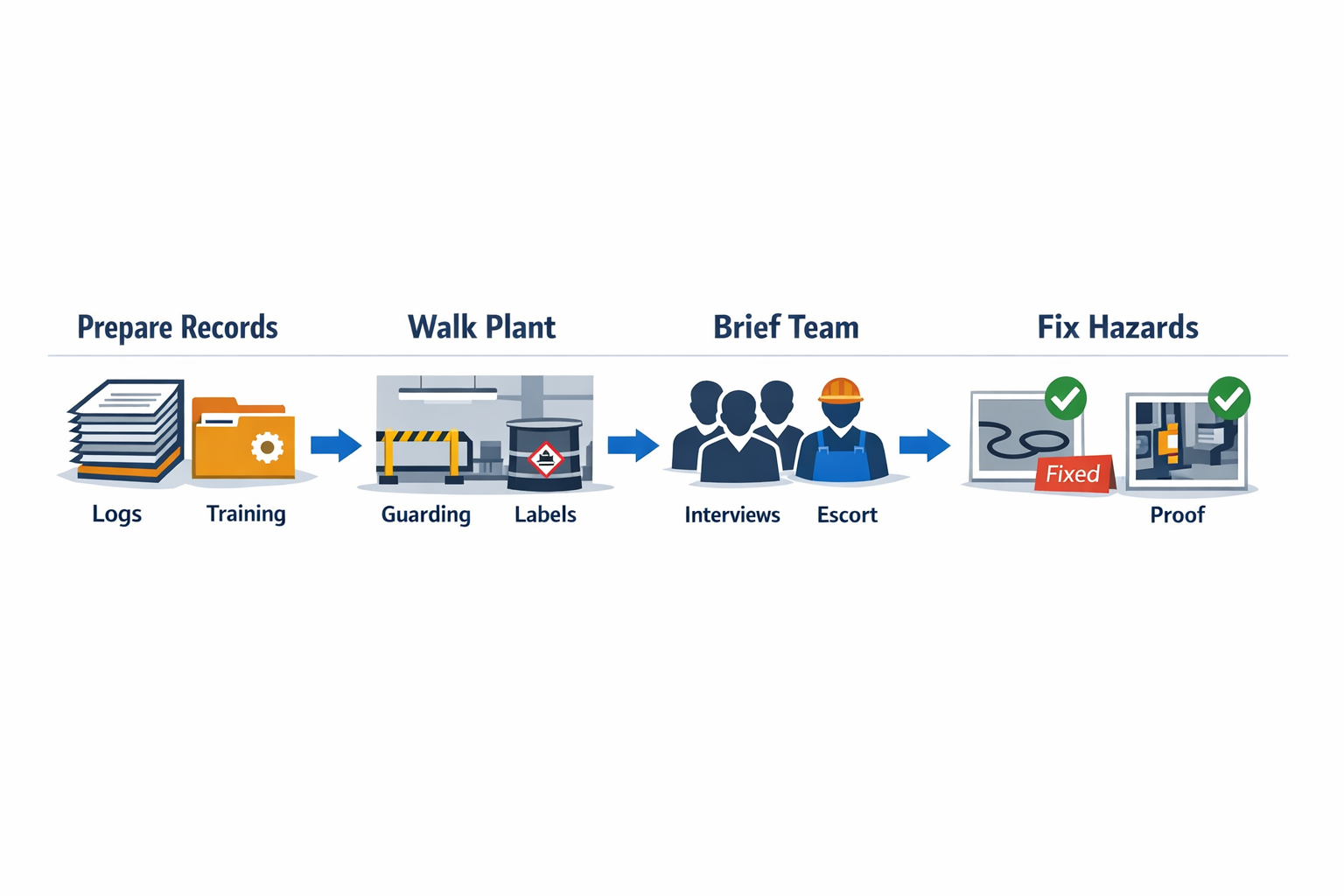
An OSHA inspection preparation checklist is most useful when it follows the way an actual visit unfolds. For a plant manager or EHS lead, that means preparing records first, then verifying floor conditions, then aligning supervisors and operators on what they need to show. In our running example, a mid-sized metal stamping plant is preparing for a programmed inspection three weeks after closing several machine-safeguarding and forklift-related findings. The goal is not to stage the plant for one day, but to show that controls are active, recent, and consistently enforced.

Prepare the Records OSHA Will Request First

Start with the documents an inspector is most likely to ask for during the opening conference. At minimum, the stamping plant assembles OSHA 300, 300A, and 301 logs if required, written programs for lockout/tagout, hazard communication, powered industrial trucks, PPE, and emergency response, plus training records, inspection logs, and recent corrective-action reports. OSHA also often checks whether training is current, whether incident investigations were completed, and whether recurring hazards were escalated beyond the frontline level. If records are incomplete, inconsistent, or stored across email, binders, and spreadsheets, the plant looks unprepared even before the walkaround begins.

Next, run a pre-inspection sequence that mirrors the auditor’s logic. The EHS manager reviews documents for missing signatures, expired forklift certifications, outdated SDS access instructions, and open corrective actions, then walks the floor with maintenance and production to confirm the paperwork matches actual conditions. That order matters because many common OSHA violations in manufacturing appear when written controls say one thing and operators do another. A strong preparation routine closes that gap before the inspector finds it.

OSHA inspection preparation checklist infographic for manufacturers showing records review plant walkthrough team briefing and hazard correction proof

Walk the Plant Like an Inspector Would

During the floor audit, focus on exposure points rather than general housekeeping alone. In the stamping plant, the team checks point-of-operation guarding, energy-isolation hardware, electrical panel clearance, marked pedestrian lanes, eyewash accessibility, chemical labeling, and forklift charging areas. They also verify whether required PPE is being worn correctly and whether temporary changes, such as moved racks or new worktables, have created fresh hazards. OSHA will notice these details because they show whether the plant manages routine change, not just fixed conditions.

Use supervisors to confirm what “normal work” looks like on each shift. A machine may appear compliant during a daytime audit but run differently on overtime or night shift when staffing is thin. To ensure OSHA compliance in practice, the plant includes second-shift leads in the walkthrough and checks whether inspection sheets, startup checks, and lockout devices are actually used when line interruptions occur. That gives the team evidence of control under real operating conditions.

Brief the People OSHA May Interview

Inspection readiness also depends on who can explain the process clearly. The plant briefs reception, the inspection escort team, maintenance supervisors, forklift trainers, and line leaders on who contacts legal counsel, who retrieves records, and who answers technical questions. Operators are not coached on what to say, but they are reminded where SDSs are located, how to report hazards, and what procedure they follow before clearing a jam. Confident, consistent answers matter because they support the written program with observable behavior.

Correct Obvious Hazards and Keep Proof Accessible

Finally, remove anything that would trigger an avoidable citation before the visit: missing guard bolts, blocked extinguishers, unlabeled secondary containers, damaged extension cords, or unsigned inspections. The stamping plant logs each correction with date, owner, photo, and verification so the team can show not only that an issue was found, but that it was closed promptly. This is where a practical OSHA inspection preparation checklist becomes part of how to ensure OSHA compliance over time. If OSHA asks what the plant did after identifying a risk, accessible proof is often as important as the correction itself.

Conclusion: Turning OSHA Compliance Into a Continuous Digital Workflow With Jodoo

For manufacturers, OSHA compliance is strongest when it runs as a daily operating system rather than a binder on a shelf. The plants that stay inspection-ready usually do a few things consistently: they control high-risk standards, close routine gaps before they become repeat violations, and keep training, inspections, and corrective actions moving on schedule. That matters because many OSHA findings do not come from unknown hazards. They come from known issues that were not reported, tracked, or verified to closure.

This is where digital workflow matters. As a no-code lean manufacturing platform, Jodoo helps EHS and operations teams turn compliance activities into structured, auditable processes without waiting on custom software. You can build scheduled safety audit forms, trigger automated training reminders by role or expiry date, enable mobile hazard reporting from the shop floor, and route corrective actions to maintenance, supervisors, or EHS with due dates and status tracking. Instead of chasing spreadsheets and email threads, your team gets one system for visibility, follow-up, and proof of control.

If you want to make OSHA compliance easier to sustain across shifts and departments, you can 開始免費試用 或者 預約演示 與 Jodoo 合作。.