2026年製造業向け最適EHSソフトウェア:機能、メリット、そして選び方

Introduction: Why EHS Software Matters More for Manufacturers in 2026

A typical manufacturing injury can cost employers tens of thousands of dollars in direct costs alone, and the indirect cost from downtime, investigation, retraining, and lost output is often much higher. That is one reason EHS (Environment, Health and Safety) software has moved from a back-office compliance tool to an operational priority for plant leaders in 2026. In simple terms, EHS software helps manufacturers manage environment, health, and safety processes in one system, from incident reporting and inspections to corrective actions, training records, and audit evidence.

The urgency is growing because plant environments have become more complex. Many manufacturers now operate across multiple sites, run mixed shifts, and depend on faster escalation when a near miss, chemical spill, or machine safety issue occurs. In automotive, electronics, and general manufacturing, paper forms and spreadsheet trackers often create reporting delays, missed follow-ups, and weak version control during audits.

This article explains what modern EHS systems should do, what benefits they bring to EHS, IT, and operations teams, and how to choose a platform that fits your factory without overbuying. It also looks at why flexible, no-code workflows are becoming a practical option for manufacturers that need faster change.

Core Workflows an EHS System Should Handle

Modern EHS software should cover the daily control points that create risk, not just store audit documents. In manufacturing, that means incident and near-miss reporting, routine inspections, corrective and preventive actions, training records, compliance tracking, and environmental logs such as waste, emissions, wastewater, or chemical storage. If a system handles only one or two of these well, teams usually end up back in email, spreadsheets, or paper binders. A usable platform should connect these records so one event can trigger the next required action.

Incident reporting is the first test. A line operator or supervisor should be able to log an injury, spill, unsafe condition, or near miss from a phone in less than two minutes, with photos, location, time, and involved equipment attached. In a metal fabrication plant, for example, a forklift near-miss report should not wait until the end of shift because delayed reporting reduces accuracy and slows containment. Good EHS software makes reporting immediate, simple, and consistent across shifts.

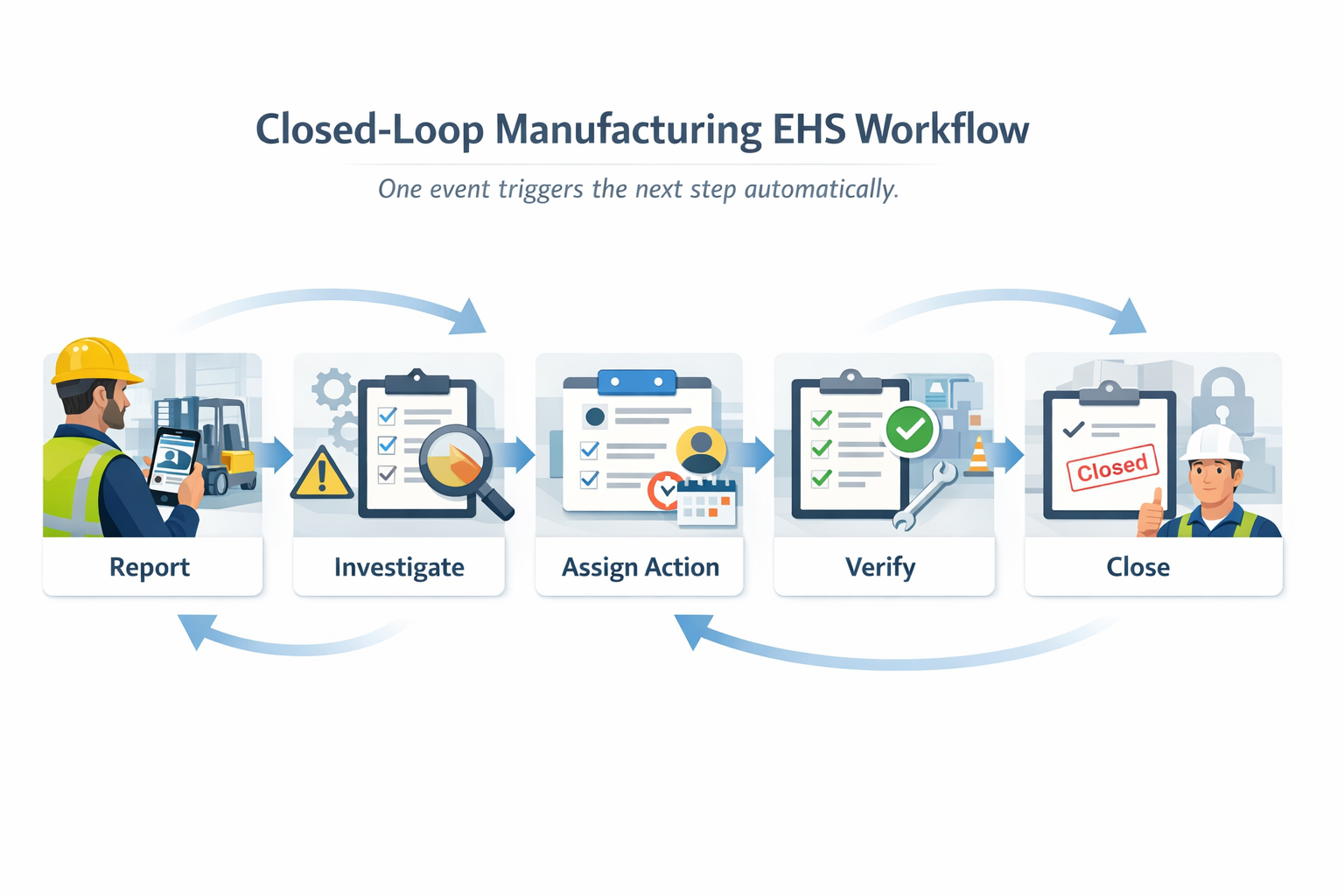
From there, the system should carry the case through investigation, action assignment, verification, and closure. If an incident reveals poor pedestrian segregation, the software should assign corrective actions to maintenance, set due dates, notify owners, escalate overdue items, and keep evidence of completion. This end-to-end flow is one of the most important features of EHS management systems because unresolved actions are where many plants lose control. A closed-loop process matters more than a long feature list.

Closed-loop EHS software incident reporting and corrective action workflow for manufacturing plants

Inspections and audits are the next core job. Manufacturing sites run layered safety walks, PPE checks, machine guarding reviews, fire equipment checks, contractor inspections, and permit-related verifications on different frequencies. A strong system should support recurring schedules, standardized checklists, pass-fail scoring, photo evidence, and automatic action creation when a nonconformance is found. In practice, this prevents teams from treating inspections as stand-alone tasks with no follow-through.

Training and competency tracking should also be built in, especially in plants with high turnover, multiple shifts, or temporary labor. You need to see who completed lockout/tagout training, forklift certification, chemical handling refreshers, or emergency response drills, and which records are expiring soon. According to OSHA, inadequate training remains a factor in many workplace incidents, which is why expiring certifications should trigger alerts before they become audit findings. For EHS managers, this is less about record storage and more about workforce readiness by role and area.

The Benefits of Digital EHS Platforms for Plant Operations

Better Visibility for EHS Managers

のために EHS managers, the biggest gain from digital EHS platforms is speed to 可視性. When incident reports, inspection findings, and unsafe condition logs move from paper or Excel into one system, you can see what happened, where it happened, and whether action is underway without waiting for end-of-shift updates. In practice, manufacturers often cut reporting delays from days to hours because operators can submit photos, locations, and event details directly from the shop floor. That faster capture improves data quality as well, since reports are entered closer to the event rather than reconstructed later.

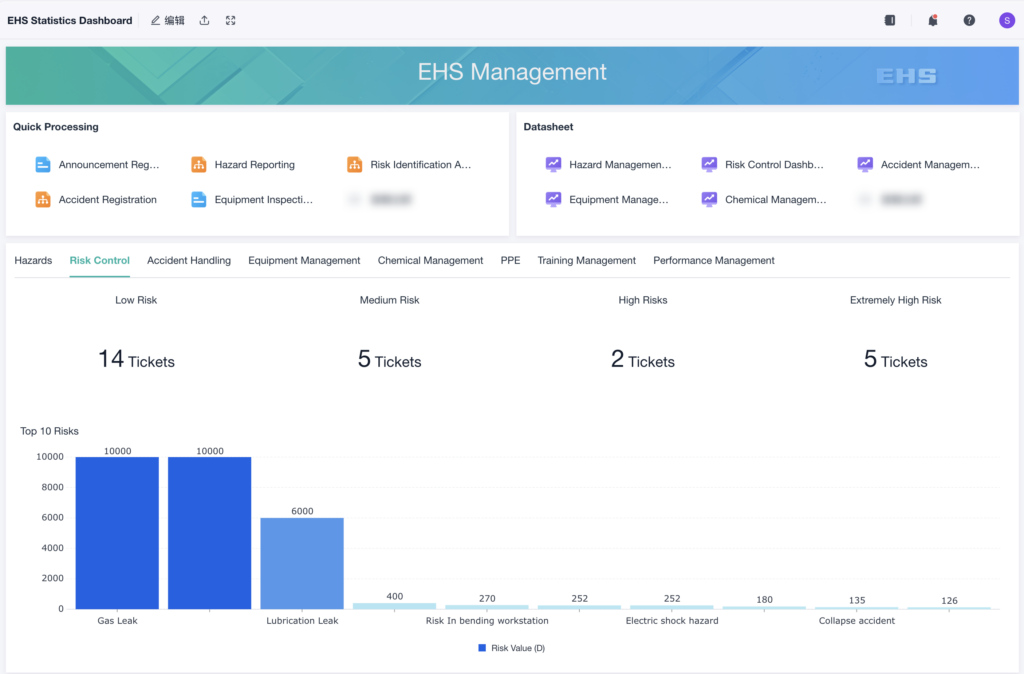
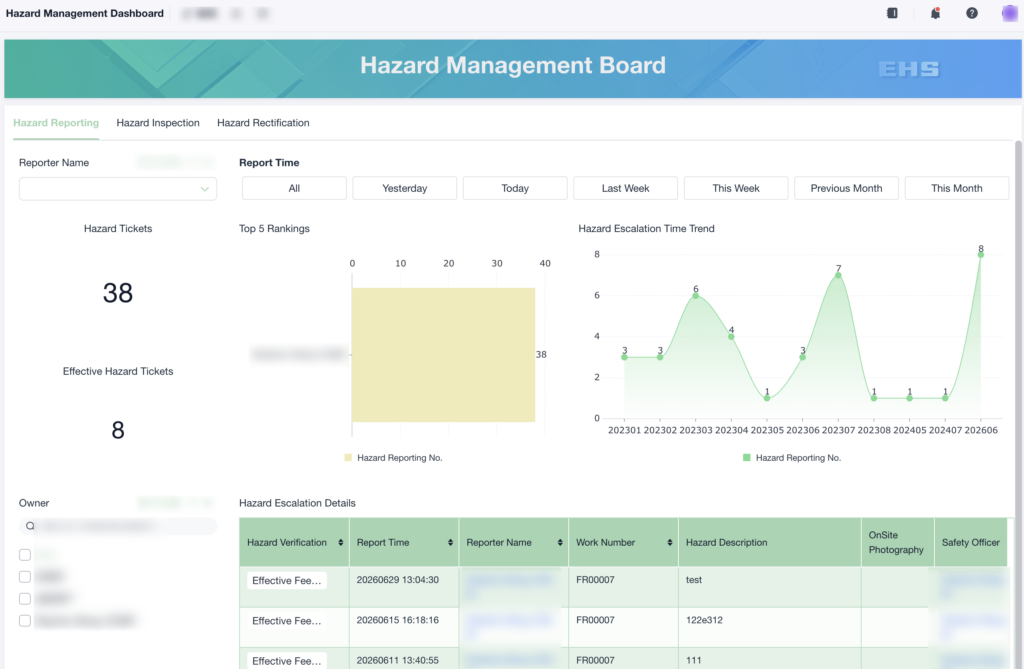
リアルタイムダッシュボード also change how site-level data is managed. Instead of pulling separate files from each plant, an EHS lead can track open corrective actions, overdue inspections, repeat hazards, and TRIR-related trends across lines or facilities from one view. A regional electronics manufacturer, for example, can quickly spot that one site has a rising pattern of chemical handling near-misses while another is missing monthly ventilation checks. That kind of management visibility is one of the most practical benefits of digital EHS platforms because it supports earlier intervention, not just cleaner reporting.

Real-time EHS software dashboard for manufacturing sites showing incidents actions inspections and trends

Digital visibility also helps with audit readiness. If training records, カパ status, inspection history, and document revisions are time-stamped in the same environment, your team spends less time chasing evidence during ISO 14001, ISO 45001, or customer audits. Deloitte has estimated that poor data quality costs organizations millions annually, and in manufacturing EHS, the operational impact often shows up as rework, delayed investigations, and weak closure discipline rather than only financial loss. Stronger records make trends easier to trust and corrective actions easier to defend.

Stronger Accountability Across Teams

Manual systems often fail after the incident report is filed, not before. A supervisor writes a containment action, maintenance gets a verbal request, and no one has a reliable way to confirm whether guarding was repaired, retraining was completed, or the hazard returned two weeks later. Digital systems assign owners, due dates, escalation rules, and status tracking, which makes follow-through much harder to ignore. That matters because many plants do not lack reporting volume; they lack closure discipline.

This is where the key features of EHS management systems translate into operational value. Automated reminders, approval trails, and linked corrective actions create a visible chain from finding to closure, which improves accountability across production, maintenance, quality, and HR. In an automotive parts plant, a forklift near-miss can trigger an investigation task for EHS, a traffic-lane review for operations, and refresher training for warehouse staff, all with deadlines attached. Plants that digitize this process typically see fewer overdue actions and less dependence on individual memory or spreadsheet ownership.

Cleaner Governance for IT Managers

For IT managers, the benefit is not only process automation but system control. Replacing scattered spreadsheets, WhatsApp messages, and paper files with a governed platform reduces version confusion, duplicate records, and uncontrolled local workarounds. It also improves permission management, which is important when incident details, medical restrictions, contractor records, and environmental logs should not be visible to every user. A centralized platform gives IT a cleaner security model while still supporting plant-level execution.

統合 is another practical advantage. EHS data becomes more useful when it can connect with HR training records, maintenance systems, badge access logs, or production master data instead of being re-entered manually. IT teams evaluating how to choose EHS software usually look closely at this point, because isolated tools often create long-term support overhead. A platform that supports APIs, role-based access, and structured workflow changes will usually scale better across multiple sites than a standalone incident app.

Faster Decisions for Operations Directors

Operations directors care less about software categories than about whether plant issues are surfaced early enough to protect output, labor stability, and customer commitments. Digital EHS reporting shortens the time between event detection and management response, which can reduce recurring stoppages tied to the same unresolved hazards. In a food packaging plant, for instance, repeated slip hazards near washdown zones may look minor individually but can drive absenteeism, restricted duty, and line disruption if not closed systematically. A digital platform makes those patterns visible before they become chronic operational losses.

Standardization is another major advantage, especially for groups running several plants. When inspection forms, action priorities, and reporting fields are consistent, leadership can compare sites on the same basis and replicate better practices faster. That does not answer how to choose EHS software by itself, but it does clarify the outcome you should expect: fewer reporting gaps, stronger frontline adoption, and more reliable execution across the network. Those are the benefits that matter most when EHS performance is tied directly to plant stability.

How to Choose Suitable EHS Software for Manufacturing

Start With Operating Reality, Not Vendor Demos

If you want to know how to choose EHS software well, start with your plant model rather than a feature checklist. A single-site food packaging plant with simple inspections does not need the same system as a five-site automotive supplier managing contractor permits, incident investigations, and customer audit traceability. The right scope depends on process complexity, site count, regulatory exposure, and how often your workflows change. Buying above that level usually creates slower rollout, lower adoption, and more admin work than the plant can support.

Consider a mid-sized metal components manufacturer with 3 plants, 1,200 employees, and one regional EHS team. Its current process relies on emailed incident forms, spreadsheet action logs, and separate training records at each site. The company’s shortlist starts with five questions: How many workflows must be standardized now, how many users need mobile access, what regulations drive record retention, how much IT support is available, and how fast must the first site go live? Those questions narrow the field faster than any generic “top features” list.

Separate Must-Have Workflows From Nice-To-Have Modules

Before comparing vendors, map the workflows you need in the first 12 months. For most manufacturers, that includes incident and near-miss reporting, inspections, corrective and preventive actions, training records, permit approvals, and audit follow-up. Some platforms bundle every possible EHS module, but if you only need six core workflows, paying for chemical stewardship, ESG reporting, or advanced industrial hygiene on day one may not improve outcomes. This is where many teams confuse the broad key features of EHS management systems with the features they will actually use.

A practical method is to score each workflow by risk, frequency, and standardization need. In our metal components example, incident reporting and corrective actions score highest because they affect response speed across all three plants. Waste tracking matters, but only one site handles regulated disposal at a scale that justifies early digitization. That pushes the buyer toward a phased rollout instead of a full-suite purchase.

Build a Simple Evaluation Scorecard

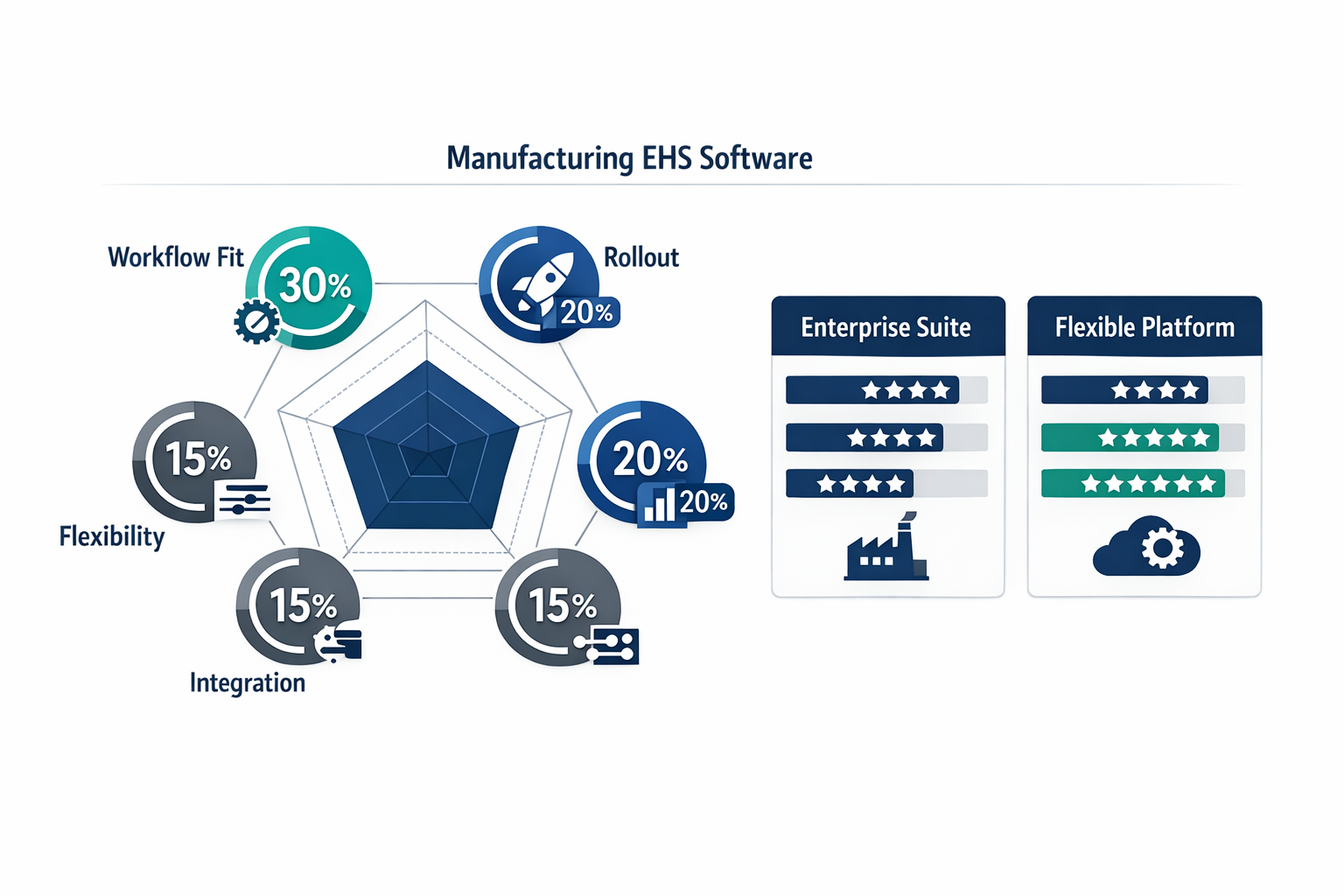
Your scorecard should compare systems on five dimensions: functional fit, rollout effort, adaptability, integration needs, and total cost of ownership. Functional fit covers the workflows you mapped; rollout effort covers configuration time, training load, and data migration. Adaptability matters because EHS processes change after audits, customer requirements, or organizational restructuring. Total cost should include implementation services, admin effort, user licensing, support, and the cost of changing workflows later.

EHS software evaluation scorecard for manufacturing with weighted buying criteria

For the metal components manufacturer, the team weights the scorecard as follows: 30% workflow fit, 20% ease of rollout, 20% reporting and audit visibility, 15% integration, and 15% long-term flexibility. One enterprise suite ranks high on breadth but requires a six-month implementation and paid consulting for form changes. A lighter platform covers fewer edge cases but can launch incident reporting in six weeks and adapt locally without restarting the project. That difference matters more than raw feature volume.

Match the System to Your IT Capacity and Timeline

A good selection process must reflect who will maintain the system after go-live. If your IT team is already tied up with ERP, MES, or cybersecurity priorities, a platform that needs constant vendor services for every field change will become a bottleneck. If you have strong internal developers and highly specialized compliance requirements, a more structured enterprise suite may still make sense. The issue is not complexity alone, but whether your organization can sustain it.

Timeline is another filter buyers often underestimate. If leadership expects one site live before the next customer audit cycle, long implementation projects create risk. In our example, the manufacturer eliminates two vendors because both require a global template design phase before any plant can start. The final shortlist favors systems that support staged deployment, local training, and fast configuration of forms and approvals.

Choose for Future, Not Just for Launch

The best buying decision accounts for what your processes will look like in two years, not just at kickoff. Manufacturing groups often add sites, tighten supplier requirements, or merge EHS with quality workflows after a serious incident or customer escalation. That is why the long-term benefits of digital EHS platforms depend partly on how easily the software evolves. A rigid system may look strong in procurement but become expensive every time the business changes.

In the final selection, the metal components manufacturer chooses the platform that fits 80 to 90% of current needs without custom development and can extend later as sites mature. The deciding factors are configurable workflows, mobile usability for supervisors, audit-ready reporting, and manageable ownership costs. That is the core rule: choose EHS software that matches your operating model, your pace of change, and your team’s capacity to run it well.

Why Flexible No-Code EHS Workflows Are Gaining Ground in Manufacturing

The Gap Between Traditional EHS Suites and Daily Plant Change

Many manufacturers now understand the key features of EHS management systems, but they still struggle when those features are locked inside rigid software. A plant may need to add a contractor induction step, change incident severity rules, or route chemical spill reports to a new regional owner. In a traditional suite, even small workflow changes often depend on vendor consultants or internal IT backlogs, which slows response to operational reality.

That gap becomes more obvious in multi-site manufacturing groups where each plant follows the same policy but not the same process details. A stamping plant may need machine guarding checks tied to maintenance, while an electronics plant may need ESD and chemical handling steps in the same incident workflow. If the system cannot adapt quickly, teams fall back to spreadsheets, WhatsApp messages, and offline forms, which weakens standardization and auditability.

Where No-Code EHS Workflow Fits Best

ここで、ノーコードプラットフォームのような Jodoo fits a specific need: not replacing every enterprise EHS suite in every scenario, but helping manufacturers digitize and evolve operational workflows faster. With drag-and-drop forms, visual workflow design, role-based permissions, mobile data capture, and dashboard reporting in one environment, business teams can configure how incidents, inspections, and follow-up actions actually move through the plant. That matters when your buying decision is less about feature lists and more about how to choose EHS software that your sites can keep improving after go-live.

A good fit is a mid-sized manufacturer with several plants, moderate regulatory complexity, and a strong need to connect EHS with quality, maintenance, or operations. In those environments, the benefits of digital EHS platforms come less from owning the most specialized module and more from reducing the time between process change and system change. If one site identifies a better lockout-tagout verification step, the company can roll it out quickly instead of waiting for a quarterly development cycle.

Running Example: From Incident Form to Escalation Logic

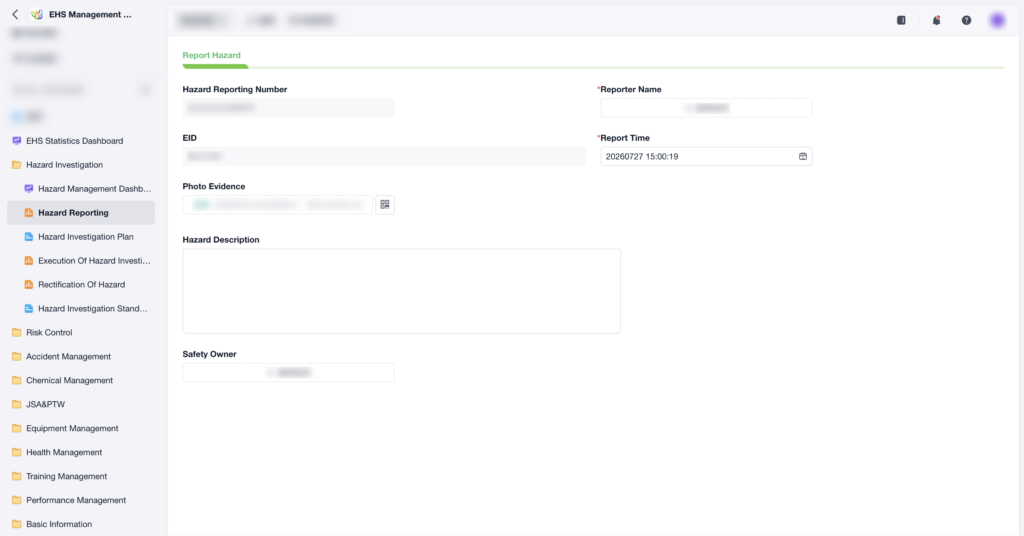
Consider the mid-sized manufacturer from the previous section: a three-site industrial components group shortlisting tools for incident reporting, action tracking, and audit readiness. After selection, the EHS manager uses Jodoo to build a mobile incident form with photo upload, location, line, injury type, immediate containment, and supervisor sign-off fields. The form also includes conditional logic, so a forklift near-miss triggers different required questions than a chemical splash event.

The next step is workflow configuration. Using a visual builder, the EHS team sets rules so high-severity incidents notify the plant manager immediately, while medium-risk cases route first to the area supervisor and site EHS lead. Corrective actions are then assigned with deadlines, reminders, and status tracking, creating a closed-loop process without waiting for IT to code a new module.

No-code EHS software workflow for incident routing escalation and corrective actions in manufacturing

That capability matters because business teams can own the workflow directly. If the Johor plant wants a mandatory root-cause attachment for lost-time incidents, while the Batam site needs an extra review step for contractor events, the EHS or operations team can adjust the workflow through configuration rather than reimplementation. For manufacturers deciding how to choose EHS software, this flexibility often determines whether adoption holds after the first six months.

Dashboards and Integrations That Support Real Operations

Once records start flowing, Jodoo’s dashboards can show overdue corrective actions by plant, incident trends by department, and recurring hazards by equipment group. For an operations director, that turns raw reporting into management visibility tied to shift leaders and site ownership. For IT, it avoids standing up a separate reporting stack just to answer routine EHS review questions.

Integration is another practical advantage. If the manufacturer already uses ERP, maintenance, HR, or messaging tools, Jodoo can connect workflows through APIs, webhooks, and no-code integrations instead of forcing a full rip-and-replace. That is especially useful when safety events overlap with training records, maintenance work orders, or supplier-related quality issues.

Conclusion: The Best EHS Software Is the One Your Team Can Actually Adapt and Use

For manufacturers, the right EHS software is not simply the platform with the longest feature list. It is the system your teams can use consistently on the shop floor, your managers can trust for follow-through, and your business can adapt as processes, sites, and compliance requirements change. In practice, that means choosing software that supports fast incident reporting, clear corrective action ownership, real-time visibility, and rollout across multiple plants without creating heavy IT dependence.

That is why the best-fit solution often comes down to operational fit rather than brand size. If your plant relies on paper forms, spreadsheets, email approvals, or disconnected tools, a rigid system can slow adoption as much as it improves control. By contrast, a flexible platform helps EHS, operations, and IT teams standardize what must be standardized while still adjusting workflows for real factory conditions.

If you need a practical way to digitize EHS workflows faster, Jodoo is worth evaluating. As a no-code platform built for リーン生産方式 operations, it helps teams create forms, automate approvals and escalations, and build dashboards without long development cycles. You can 無料トライアルを開始する または デモを予約する to see how it fits your plants.