カテゴリー別に閲覧する

Introduction: ESG in Manufacturing Is an Operating Model
Many manufacturers still approach ESG only when a customer questionnaire arrives, an investor asks for data, or a regulator changes the rules. That is a weak starting point. KPMG’s 2024 survey found 世界最大手250社のうち96% now report on ESG or sustainability in some form, which means manufacturers are under growing pressure to produce evidence, not broad statements.
In manufacturing terms, Environment, Social, and Governance (ESG) is not just a disclosure topic. It is the operating discipline behind how a plant tracks energy, waste, safety incidents, labor practices, supplier checks, approvals, and management follow-up. ESG is also not a reporting standard, rating, certification, or sustainability report by itself. It is the way environmental, social, and governance responsibilities are built into repeatable routines across operations.
A multi-site discrete manufacturer may need consistent data from machining, assembly, and supplier quality teams across several plants. A process plant may focus more heavily on emissions, water use, permit conditions, and incident escalation. In both cases, ESG starts with clear ownership, reliable evidence, and accountability at the process level.
This article explains how to design that operating model: how to structure ownership, prioritize issues, standardize workflows, and manage execution across sites.
What an ESG Operating Model Looks Like
For a multi-site manufacturer, an ESG operating model is the management structure that turns ESG priorities into assigned work. It defines which operational domains are in scope, who owns each process, what data and evidence are required, when submissions are due, who reviews them, and how exceptions are handled. In practice, that means ESG governance is embedded in plant routines, supplier controls, workforce processes, and management review cycles. The objective is not to make every site look identical, but to make responsibilities, evidence, and escalation paths consistent enough to manage.
The Core Domains and Owners
Most manufacturers organize ESG implementation across four working domains: plant environment, workforce and labor practices, supplier controls, and executive oversight. Plant environment usually sits with site leaders and EHS managers, covering items such as energy, water, waste, emissions-related logs, and incident response. Workforce topics often involve HR, operations, and compliance teams, while supplier topics typically sit with procurement and supplier quality. Executive oversight then consolidates performance, exceptions, and follow-up actions into a regular governance cadence.
Consider a regional electronics manufacturer with five plants in Malaysia, Thailand, and Vietnam. Each site records monthly utility use, waste manifests, safety incidents, overtime summaries, and supplier screening updates using the same corporate definitions. The plant manager owns site submission completeness, the EHS leader owns environmental records, HR owns workforce data, and procurement owns supplier declarations. At headquarters, a sustainability manager checks cross-site consistency before the compliance lead and executive committee review exceptions and trends.
The End-to-End Operating Architecture
実用的な ESG operating model follows a clear chain from input to oversight. Frontline teams capture operational records, site owners validate them, functional reviewers check completeness and anomalies, and central teams consolidate results for management review. Where thresholds are missed or evidence is incomplete, the process must trigger an exception path rather than waiting for quarter-end cleanup. That architecture matters because ESG breaks down when data moves without ownership or when issues surface only during reporting season.
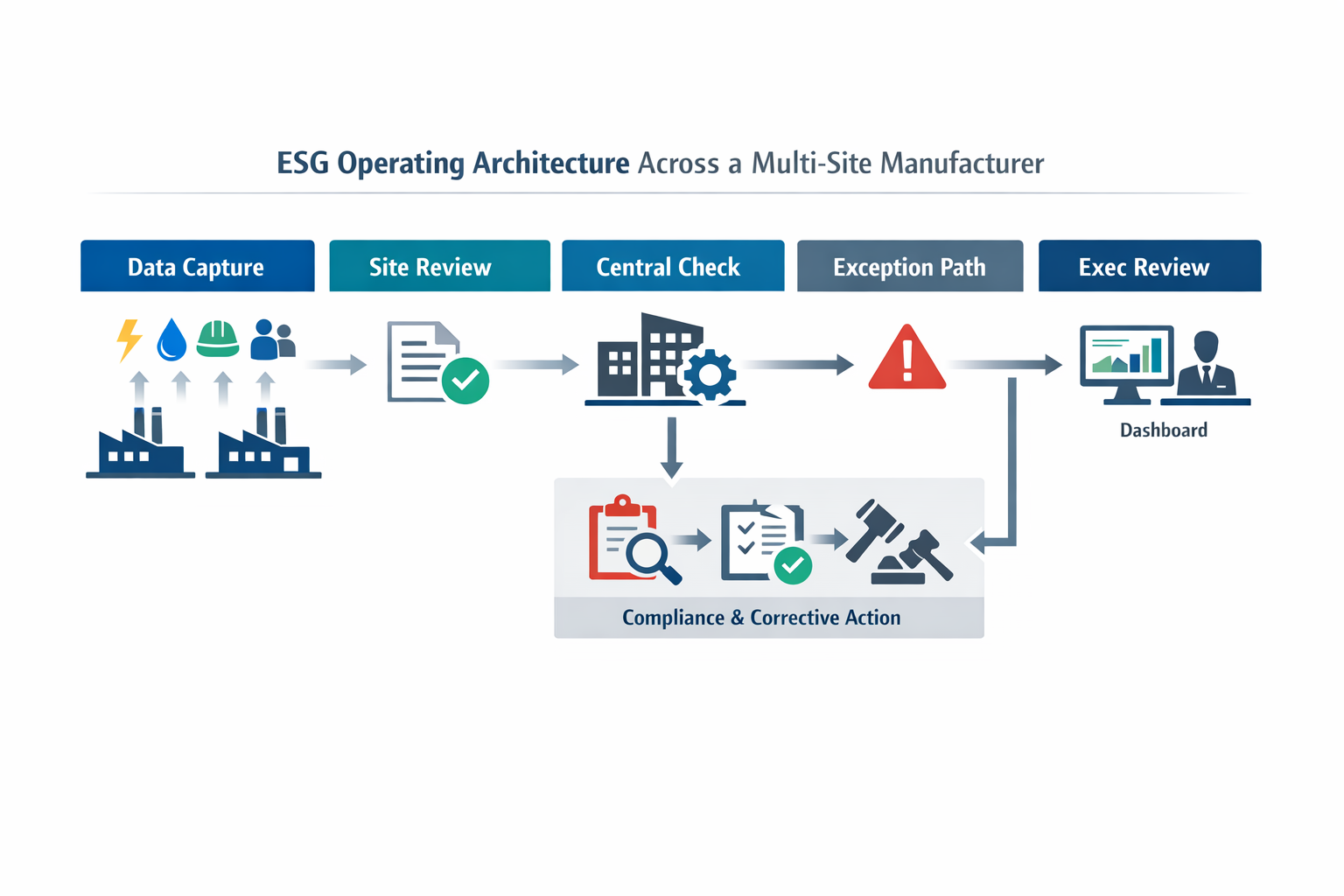
In the electronics manufacturer example, a Thailand site submits monthly wastewater test records and supporting lab certificates by the fifth working day. The site EHS leader reviews the numbers first, the plant manager approves the submission, and the regional sustainability manager receives an alert if a result is missing or outside the approved range. If the exception is material, the compliance team is looped in, and a 是正措置 is assigned with a due date. By the time executives see the monthly dashboard, they are reviewing validated records and open issues, not raw spreadsheets.
Coordination Across Functions
ESG work crosses functions because the underlying controls live in different processes. A plant manager can confirm whether site actions happened, but cannot validate supplier due diligence without procurement or workforce grievance handling without HR. Likewise, procurement may collect supplier declarations, but compliance must decide which gaps require escalation. An ESG operating model, therefore, depends on coordinated accountability, where each function owns its part but works from shared timing, definitions, and review rules.
This cross-functional design also prevents a common governance mistake: treating ESG as a sustainability team project with limited authority over operations. In stronger models, executives do not chase every data point, but they do set review cadence, tolerance thresholds, and accountability for unresolved issues. That gives site leaders clarity on what must be submitted, what requires approval, and what will be escalated. The result is a management system that connects shop-floor evidence to executive oversight without collapsing into fragmented, department-by-department tracking.
How Should Manufacturers Treat ESG Governance Issues
Start With Business Context
For manufacturers, prioritizing ESG issues should begin with how the business actually runs, not with a generic disclosure template. A high-volume food processor, an electronics assembler, and an automotive component supplier will face very different operational exposures, labor structures, and supply chain dependencies. That is why a practical ESG operating model starts by mapping where value is created, where disruption can occur, and which processes management can realistically control.
The first screen is business context: production model, utility intensity, workforce profile, customer mix, export exposure, and supplier footprint. This helps leadership separate topics that are strategically important from topics that are simply visible in market discussions. In practice, the question is not “Which ESG topics exist?” but “Which issues could materially affect plant continuity, cost, quality, labor stability, customer access, or license to operate?”
Move From Exposure to Priority
Once the operating context is clear, manufacturers can assess risk exposure across environmental, social, and governance dimensions. Environmental issues may include water dependency, wastewater discharge, energy volatility, emissions-intensive processes, or waste handling. Social issues often center on overtime controls, contractor safety, grievance handling, dormitory conditions, or training effectiveness, while governance issues may involve supplier due diligence, approval controls, policy enforcement, and investigation response.
A workable prioritization flow usually follows five steps: identify issues, test exposure by site or value chain segment, assess stakeholder pressure, evaluate control feasibility, and assign ownership. That last step matters because an issue without an accountable function is not yet part of ESG governance. A topic becomes operational only when someone is responsible for defining the metric, monitoring exceptions, and acting on gaps.
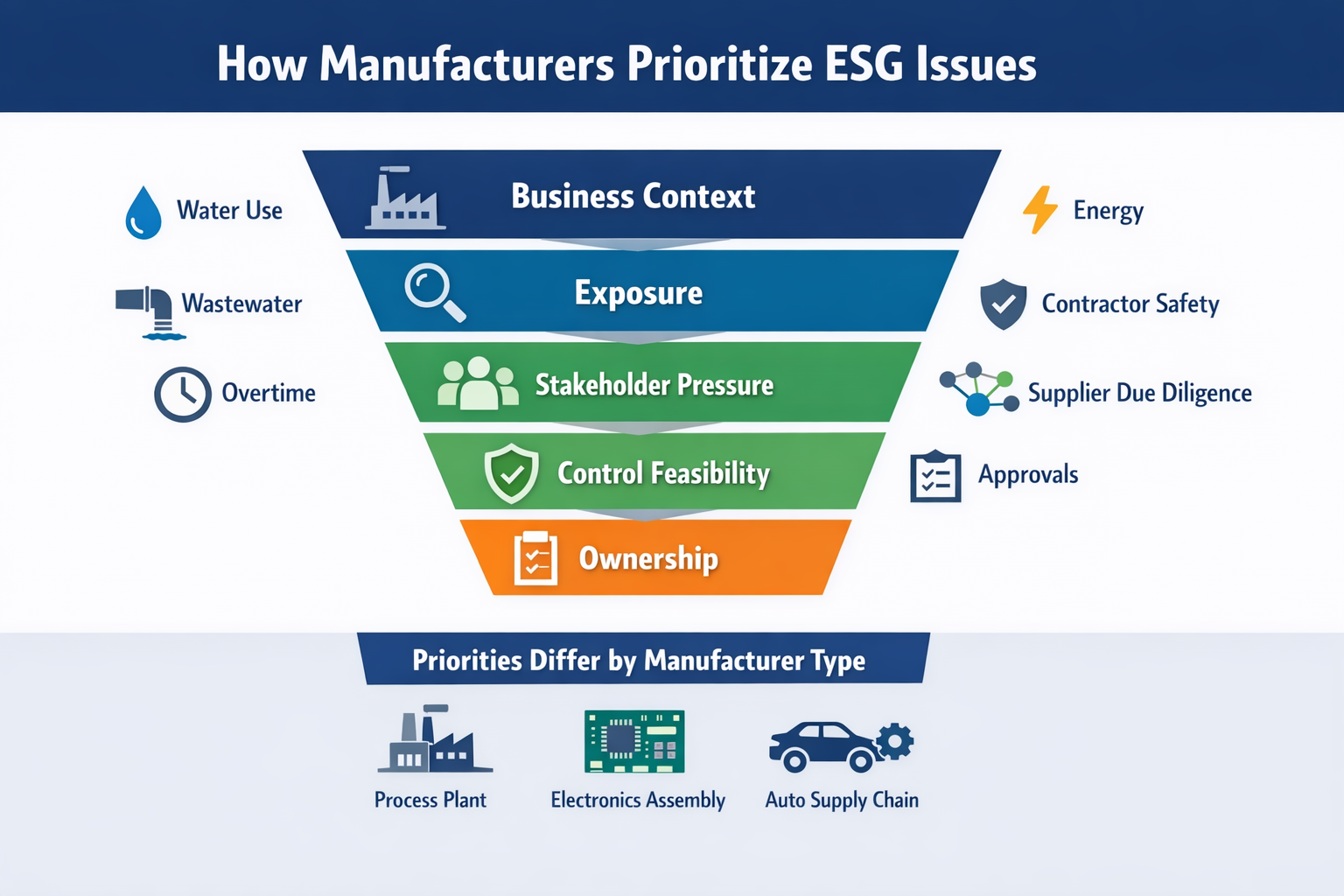
Stakeholder pressure should then be assessed with discipline rather than treated as a popularity contest. Customer audits, investor questionnaires, lender covenants, workforce expectations, community concerns, and regulatory trends do not carry equal weight in every business.
Consider the following three concise examples. In process manufacturing, water use may rise to the top because production depends on stable intake quality, wastewater compliance, and cost-sensitive treatment systems. In 電子機器組立, labor practices may rank higher because turnover, excessive overtime, and weak supervisor controls can disrupt throughput and damage customer relationships faster than most environmental metrics.
では automotive supply chain, supplier screening may become the lead governance issue because ESG performance is only as strong as the upstream material and component base. Here, the priority is not to track every possible supplier attribute, but to identify the risk points that can be screened, reviewed, and escalated consistently. Good ESG prioritization is therefore selective, evidence-based, and tied to management action rather than to a future report outline.
The Operational Building Blocks of ESG Implementation
Standardize Definitions Before You Collect Anything
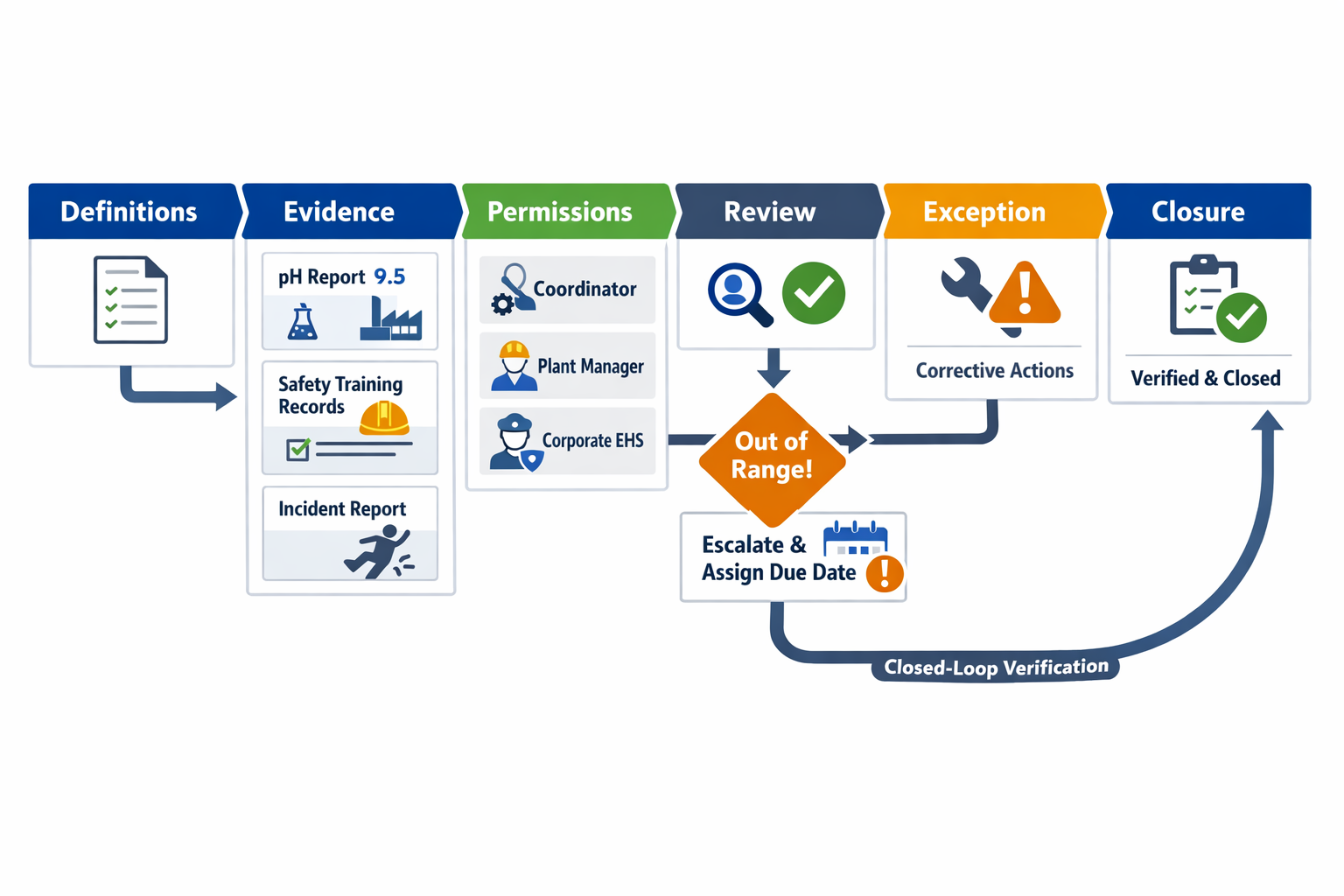
で ESG implementation, weak definitions create weak control. A plant cannot manage what each site defines differently, so terms such as recordable injury, training completion, water intensity, hazardous waste classification, or supplier audit closure need one approved meaning, one unit of measure, and one submission rule. In a multi-site electronics manufacturer, for example, the Penang plant and the Batam plant may both report overtime and chemical storage inspections, but unless the calculation logic and reporting boundaries match, executive review becomes misleading.
Clarify Local Ownership and Central Control
Once definitions are fixed, manufacturers need to split responsibility correctly between sites and corporate teams. Local ownership should cover primary data capture and first-line validation because supervisors, EHS coordinators, and HR administrators are closest to the event, meter, training log, or inspection record. Central ownership should control policy, thresholds, review logic, and exception criteria so ESGデータ is comparable across plants. In our running example, the Penang plant submits monthly wastewater pH readings, operator safety training completion, and contractor incident records, while corporate sustainability reviews consistency and flags out-of-range performance.
Require Evidence, Not Summary Numbers
Many ESG governance programs break down when plants submit only rolled-up figures in spreadsheets. A number without attachments, timestamps, source references, or sign-off history cannot withstand internal challenge, much less external review. For the Penang site, a wastewater submission should include lab certificates or meter logs; safety training should include attendance records, and a contractor incident entry should include the incident form, investigation notes, and immediate containment actions. This is where the operating mechanics matter: evidence must be required at the point of submission, not requested later by email.
Use Permissions and Reviews to Control the Workflow
役割に基づく権限 prevent two common failures in ESG implementation: unrestricted editing そして unclear accountability. Operators or coordinators should be able to submit records, plant managers should review site-level completeness and plausibility, and central owners should approve, reject, or escalate based on defined rules. In the Penang example, the EHS coordinator uploads the wastewater package, the plant manager confirms the production context after an abnormal discharge reading, and corporate EHS reviews whether the excursion exceeds the group threshold and needs formal escalation. Evidence, reviews, and corrective actions work best as one controlled workflow because each decision should remain linked to the original record, supporting documents, reviewer comments, and due dates for follow-up.
Build Exception Handling Into the Process
Not every variance is a crisis, but every exception needs a rule. If Penang reports wastewater pH outside the approved range, the system should trigger an exception path that requires cause classification, temporary containment, responsible owner assignment, and a target closure date. If training completion falls below the threshold, the route may go to HR and plant leadership instead of EHS.
Close the Loop With 是正措置 管理
The final building block is action closure with verification. In our example, the wastewater exception leads to a maintenance work order, operator retraining, and a repeat sample after line adjustment, with each step assigned to a role and tracked against a deadline. If the retest meets the limit, central EHS can close the case; if not, the issue stays open and escalates for management review. That closed-loop discipline turns an ESG operating model from periodic reporting into actual operational control.
How to Standardize ESG Governance and Execution Across Multiple Manufacturing Sites
Standardizing ESG governance across sites is not about making every plant operate the same way. It is about making ESG implementation comparable, auditable, and manageable at the group level while allowing each site to reflect its actual process risks, workforce structure, and supplier footprint. For most manufacturers, the practical goal is one ESG operating model with shared rules for classification, timing, review, and escalation. The local goal is different: capture the right evidence in a form that plant teams can actually maintain.
Build Standard Templates Around Shared Taxonomies
The first layer of standardization is a common taxonomy. Corporate teams should define a controlled list for items such as energy source, waste category, incident type, training topic, supplier risk level, corrective action status, and reporting period. When plants use different labels for the same issue, group reporting becomes a manual mapping exercise, and management loses confidence in trend analysis. A shared taxonomy gives environmental social governance data the same structure across sites even when the underlying operations differ.
Templates should then be built from that taxonomy, not from a single plant’s spreadsheet. A machining network may use a standard monthly environmental review template with group fields for coolant disposal, compressed air loss events, and scrap disposition, while still allowing one site to add a local field for heat-treatment emissions. A food or chemical process network may need mandatory fields for water intake source, wastewater deviation type, and permit threshold status, but one plant may also track brine discharge or CIP chemical concentration. Standardization works when 70 to 80 percent of the template is fixed and the rest is controlled local variation.
Preserve Local Flexibility Without Losing Control
Local variation should be designed, not improvised. Headquarters can lock core fields, definitions, due dates, and approval paths while allowing approved site-specific fields, attachments, and notes for local regulatory or process conditions. That balance matters because over-standardization creates low-quality submissions, while under-standardization destroys comparability across plants. A good ESG operating model treats local flexibility as a governed exception, not a separate system.
This is especially important in supplier-heavy contract manufacturing. A group procurement team may require all sites to use the same supplier screening categories, document expiry rules, and escalation thresholds, yet plants in different countries may need different evidence types, languages, or labor-agency checks. The standard is the decision logic, ownership, and status model; the local layer is the operational detail needed to execute it correctly. That distinction keeps ESG governance consistent without forcing false uniformity.
Standardize Cadence, Escalation, and Scorecards
Cross-site consistency also depends on schedule discipline. Recurring monthly, quarterly, and annual tasks should be assigned by role, with the same cut-off logic, review sequence, and exception windows across the network. If one plant reports safety training completion by calendar month and another by payroll cycle, group rollups will always require manual correction. Standard cadence turns ESG implementation into a routine management system rather than a year-end consolidation project.
Site scorecards should roll up a small set of common indicators while preserving drill-down to plant ownership. For example, a group dashboard can compare overdue corrective actions, environmental deviations, mandatory training completion, and high-risk supplier reviews across sites, then flag escalation when thresholds are breached for two consecutive periods. This is where platforms such as Jodoo can help: you can configure shared forms, controlled local fields, recurring workflows, role-based approvals, and dashboards that give executives a network view while keeping plant managers accountable for their own actions and evidence.
Conclusion: Turning ESG Into a Practical Operating Layer With Jodoo
製造業者にとって、, Environment, Social, and Governance (ESG) becomes manageable when it stops being treated as a year-end reporting exercise and starts operating as part of daily management. That means clear ownership by function, controlled data inputs from each site, evidence attached at the point of submission, review cadence built into routine operations, and visible follow-up when issues or exceptions appear. In practice, the strength of ESG execution depends less on policy language and more on whether plants, teams, and leaders can run the process consistently.
This is where workflow design matters. A configurable platform such as Jodoo can help manufacturers digitize ESG execution through structured forms, role-based data collection, approvals, reminders, attachments, audit trails, and dashboards that connect plant activity with management oversight. For operations teams already driving lean improvement, Jodoo works as a ノーコードリーン生産方式プラットフォーム that can be adapted to ESG workflows across plants, workforce processes, supplier checks, and executive reviews.
If you want to turn ESG into a practical factory workflow, try to 無料トライアルを開始する または デモを予約する with Jodoo now.