Why Safety Quotes Matter on the Manufacturing Floor
A single missed glove check, rushed forklift turn, or skipped lockout step can change an entire shift. According to the International Labour Organization, millions of workers die each year from occupational accidents and work-related diseases globally, and manufacturing remains one of the higher-risk environments because so many tasks depend on routine, timing, and human judgment. That is why safety quotes are more than posters with good intentions. Used well, they act as short, repeatable prompts that keep safe behavior visible in the middle of production pressure.
On the manufacturing floor, the best workplace safety quotes and daily safety reminders work because they fit how people actually operate. Operators move between machines, supervisors manage handoffs, warehouse teams handle traffic and lifting risks, and maintenance crews make fast decisions under time pressure. In those moments, a clear safety message can reinforce the right habit: stop and check, report the hazard, follow the procedure, protect the next person.
This article starts with 50 practical safety messages for manufacturing teams, then shows you how to choose the right message, where to place it, and how to make it part of daily operations instead of visual wallpaper. Because in factories, safety culture is built less by slogans alone than by consistent reminders tied to real action.
50 Safety Quotes for Manufacturing Teams, Organized by Use Case
Below are 50 safety quotes grouped by where they work best on the manufacturing floor. These include workplace safety quotes, manufacturing safety quotes, safety meeting quotes, toolbox talk messages, and short factory safety reminders you can use in daily communication.
Workplace Safety Quotes
These general workplace safety quotes work well across plants, warehouses, maintenance teams, and support areas.
- Safety is not extra work. It is how the work gets done.
- The job is not finished until everyone goes home safely.
- A safe choice made early prevents a hard lesson later.
- Shortcuts cut safety first.
- Protecting people is part of protecting production.
- Attention to risk is a sign of professionalism.
- If something feels unsafe, stop and check.
- Good habits prevent bad outcomes.
- Safety starts before the first task begins.
- One careful decision can prevent one serious injury.
使用 “The job is not finished until everyone goes home safe” at shift start when you want to set a clear tone without sounding repetitive.
Manufacturing Safety Quotes
These manufacturing safety quotes fit production lines, machine cells, assembly stations, and process environments.
- Machines move fast. Safe thinking must move first.
- Production targets never outrank personal safety.
- Guard the machine, guard the process, guard the worker.
- A clean line is easier to run and safer to manage.
- Lockout first. Restart later.
- Unsafe conditions create quality problems before they create injuries.
- The best operator is a safe operator.
- Standard work includes safe work.
- PPE only works when it is worn correctly every time.
- In manufacturing, small misses become big incidents quickly.
使用 “Standard work includes safe work” in supervisor communication when reinforcing that output and compliance are not separate goals.
Safety Meeting Quotes
These safety meeting quotes are better for formal briefings, weekly reviews, or post-incident discussions where you need a more direct message.
- Every incident has a warning sign. Our job is to catch it early.
- A near miss is a free lesson only if we act on it.
- Safety discussions should lead to safer decisions.
- The purpose of a safety meeting is not attendance. It is an action.
- When people speak up about risk, leaders should listen fast.
- Data tells us where the risk is growing.
- A repeated hazard is a management problem, not a worker problem.
- If the same issue keeps returning, the control is not strong enough.
- Clear communication prevents predictable mistakes.
- Safety improves when follow-up is visible.
使用 “A near miss is a free lesson only if we act on it” in a line-side huddle after a minor incident or audit finding.
Toolbox Talk Safety Quotes
These toolbox talk safety quotes are short, direct, and useful before a task starts.
- Take one minute now or lose one hour later. Check the risk first.
- Before you begin, know the hazard, the control, and the backup plan.
- The safest tool on site is a worker who pays attention.
- If the setup changes, the risk changes too.
- Pause, point, and confirm before the task starts.
- Do not trust routine more than the actual condition.
- Today’s familiar job can still cause tomorrow’s injury.
- See it, say it, solve it.
- When in doubt, ask before acting.
- A two-minute safety check can prevent a two-month recovery.
使用 “If the setup changes, the risk changes too” before maintenance, changeovers, or temporary process adjustments.
Short Factory Safety Messages
These short factory safety messages and daily safety reminders are easy to place on visual boards, screens, printouts, and team chat updates.
- Work safe. Start smart.
- Think first. Move second.
- No rush is worth an injury.
- Spot hazards early.
- PPE on. Risk down.
- Safe hands. Safe shift.
- Check twice. Operate once.
- Alert today. Safe tonight.
- Report the risk, not just the result.
- Safety first, every task, every time.
使用 “Report the risk, not just the result” in a supervisor reminder when you want more proactive hazard reporting instead of waiting for incidents.
How to Use This Quote List
You do not need a different message every day. In most factories, rotating 5 to 10 strong daily safety reminders is more effective than posting dozens of lines no one remembers. Choose quotes based on the situation: broad workplace safety quotes for common areas, manufacturing-specific messages for line teams, and more direct safety culture quotes for meetings and follow-up discussions.
How to Choose the Right Safety Quote for the Right Moment
A good safety message is not just about wording. It has to fit the situation, the audience, and the action you want people to take next. In practice, the best workplace safety quotes are matched to the communication moment, not chosen at random from a list.
Match the Quote to the Communication Channel
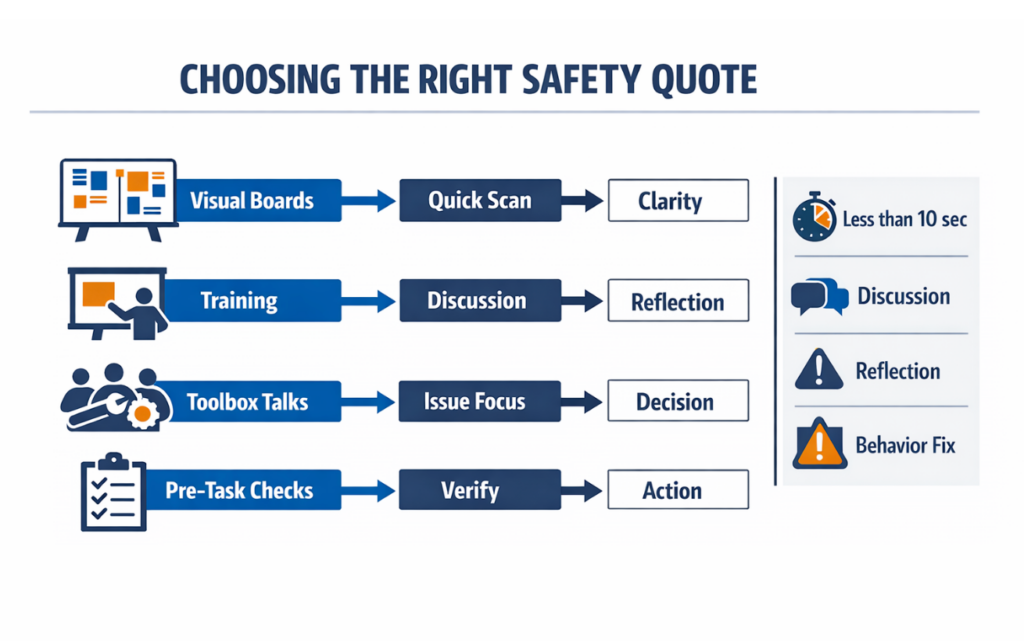
For visual boards, keep daily safety reminders short, concrete, and easy to scan in a few seconds. Operators walking past a line-side board or warehouse entrance will not stop for a long reflection, so factory safety messages work best when they are direct, such as “Think before you act” or “Safety starts with me.” These messages support repetition, which is useful in high-routine environments.
For training sessions, longer and more reflective safety culture quotes are more useful because the setting allows discussion. In induction training or monthly refresher sessions, a quote can open a conversation about habits, accountability, or why experienced workers still need to follow basic controls. This is where a message about mindset often works better than a reminder about a single rule.
For toolbox talks and incident reviews, use direct safety meeting quotes that connect clearly to the issue at hand. After a near miss involving improper lockout, for example, a vague motivational line will feel disconnected, while a quote such as “Shortcuts cut life short” creates a clearer bridge to the discussion. In these moments, relevance matters more than inspiration.
For incident-prevention routines such as pre-task checks or permit reviews, use a message that supports one specific pause point. Toolbox talk safety quotes in these settings should prompt attention, verification, or peer checking rather than general morale. A strong example is a short reminder that reinforces stopping, checking, and confirming before work begins.
The simplest selection framework is this: use short quotes for boards, direct quotes for meetings, reflective quotes for training, and action-oriented reminders for routine risk-control steps. If the audience has less than 10 seconds, prioritize clarity. If the goal is discussion, choose a message that invites reflection; if the goal is behavior correction, choose one that points to a decision.
Adjust the Tone to the Level of Urgency
Not every manufacturing safety quote should sound equally serious. If you use high-alert language every day, teams stop noticing it; if you use soft language after a serious event, the message feels weak. The tone should reflect the operational reality.
For normal daily operations, calm and steady daily safety reminders are usually enough. These help reinforce expected behavior without creating unnecessary alarm, especially in stable production environments with repetitive manual handling, machine loading, or forklift movement. The purpose is consistency, not shock value.
After an audit finding, unsafe observation trend, or near miss, shift to more direct language. Safety meeting quotes at this stage should make the consequence of inattention feel immediate without turning into blame. Supervisors often get better engagement when the message is firm, specific, and connected to what the team just experienced.
Consider Who Will Read or Hear It
The same quote will land differently with a new hire, a maintenance technician, and a production supervisor. New employees usually respond better to simple manufacturing safety quotes tied to visible behaviors because they are still learning the plant’s routines and risk points. Experienced teams often respond better to messages that emphasize responsibility, standards, and leadership by example.
Audience size also matters. A short quote on a digital board must work for mixed roles across a department, while a toolbox talk can be tailored to a smaller group facing the same task or hazard. If the audience is cross-functional, choose broad workplace safety quotes; if it is task-specific, choose language linked to the actual work.
Use the Quote to Support One Clear Outcome
Before choosing a quote, ask what you want people to do differently after seeing it. If the answer is “nothing specific,” the message is probably too general. The strongest safety quotes support one clear outcome: pause before starting, wear PPE correctly, report a hazard, follow the procedure, or speak up when something looks wrong.
That is why selection should start with the intended behavior, not the wording itself. A short line on a board may support awareness, while a more pointed message in a shift huddle may support immediate compliance. When the quote and the expected action align, safety communication feels useful instead of decorative.
Where to Put Safety Quotes in Daily Operations
Put the Message Where the Decision Happens
A safety quote only works when it appears close to the task, handoff, or decision it is meant to influence. In a metal fabrication plant, for example, the same message should not be copied everywhere without context. A line like “Take two minutes for safety before you take two weeks off” fits a pre-task check station better than a conference room wall because it reaches operators before setup, tool change, or material handling begins. Good safety quotes deployment should match the workplace accurately.
Toolbox talks are one of the best places for short, direct messages because supervisors can connect the quote to that shift’s risk. If the fabrication plant is starting a heavy die change, toolbox talk safety quotes should reinforce lockout, pinch-point awareness, and communication between maintenance and production. In shift meetings, a quote should support a specific operating condition, such as overtime fatigue, forklift traffic, or a housekeeping gap found on the previous shift. That is why the best safety meeting quotes are short enough to repeat, but specific enough to support discussion.
Use Different Placements for Different Types of Safety Messages
5S boards and visual management boards are better for stable, rotating factory safety messages than for long motivational statements. These boards work well with short manufacturing safety quotes tied to standards like PPE compliance, aisle clearance, spill control, or near-miss reporting. In the fabrication plant, a weekly board message near the welding area might focus on eye protection and screens, while the assembly board might focus on lifting posture or trip hazards from packaging waste. The point is not decoration; it is reinforcement of current floor-level priorities.
Digital displays are useful when you need broad reach across multiple shifts, entrances, canteens, or shared walkways. They are most effective for short daily safety reminders, incident-free milestones, and one clear message that can be read in a few seconds. In the same plant, the main screen near time clock stations could carry a rotating sequence: Monday for forklift separation, Wednesday for glove checks, Friday for end-of-shift cleanup. If messages stay unchanged for too long, people stop seeing them.
Training materials need a different tone from boards and displays. Here, reflective safety culture quotes can support onboarding, annual refresher sessions, and supervisor development, especially when paired with a real plant example or recent audit finding. In the fabrication plant, a trainer might open a new-hire session with a quote about responsibility, then connect it to actual permit-to-work steps or emergency response expectations. The quote should frame the lesson, not replace the procedure.
Build a Weekly Safety Communication Flow
The most effective plants do not treat safety quotes as isolated posters. They run a simple weekly rhythm across boards, meetings, and frontline routines so the same theme appears in the right format at the right time. In our fabrication plant example, Monday’s shift meeting introduces the week’s message, Tuesday’s 5S board repeats it visually, midweek toolbox talks connect it to a live risk, and pre-task checks reinforce it before higher-risk work begins.
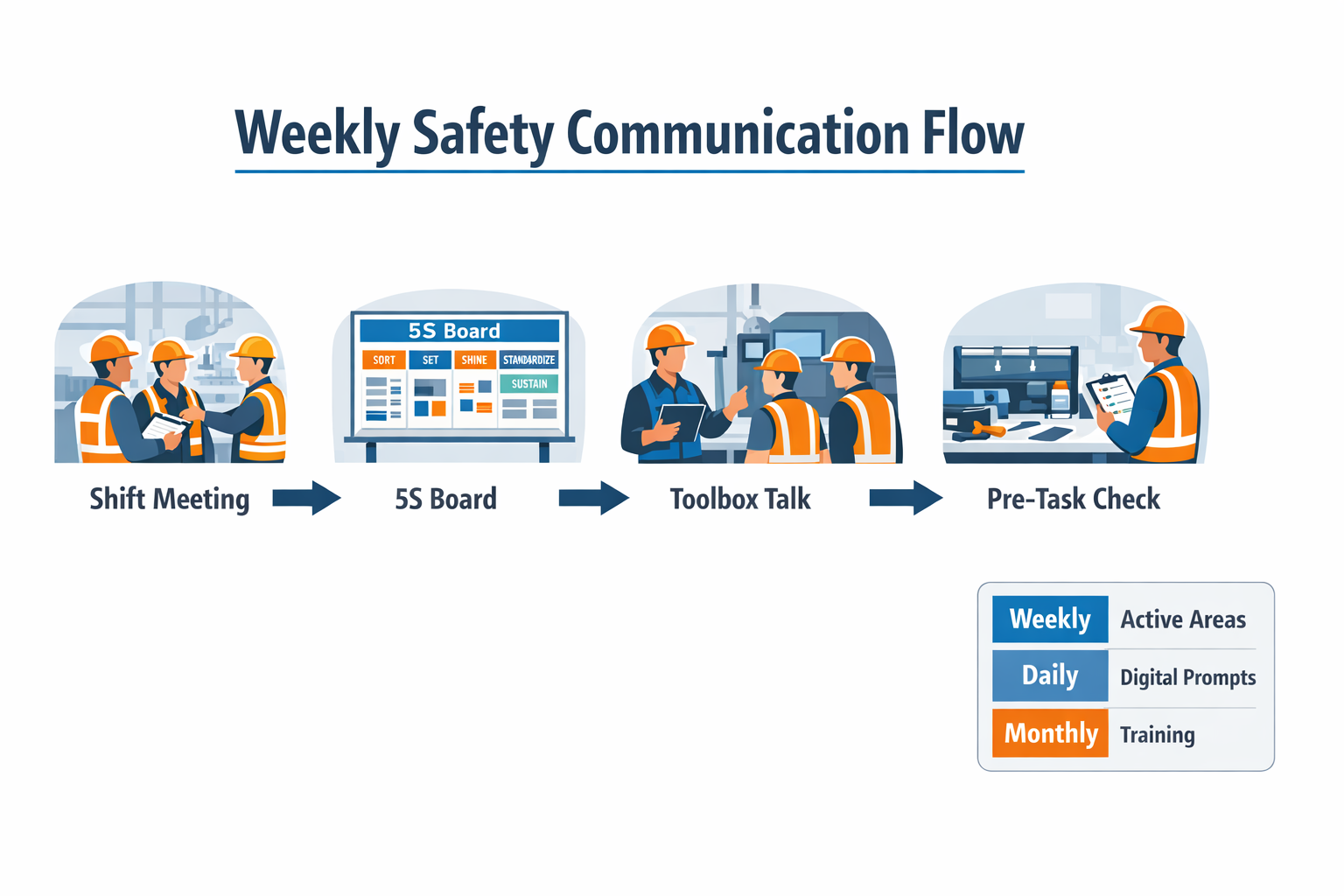
This flow prevents fragmentation and reduces the chance that safety quotes become background noise. A practical rotation cycle is weekly for active production areas, daily for digital prompts tied to current conditions, and monthly for training-room materials unless a new incident, audit issue, or seasonal risk requires faster change. If heat stress rises, contractors enter the site, or a near miss occurs, the plant should update the message immediately rather than wait for the next scheduled time. Relevance matters more than graphic design.
Assign Clear Ownership
Someone must own the message calendar, or even the best manufacturing safety quotes will turn into visual wallpaper. In most plants, EHS should set the monthly themes, while production supervisors or shift leaders adapt the wording for each area based on actual tasks and exposure. In the fabrication plant, EHS might set a “stored energy” theme for the month, but the press shop, welding cell, and warehouse each post different versions that reflect their risk profile. That balance keeps safety communication standardized without making it generic.
A good rule is to review message effectiveness during weekly supervisor or EHS meetings. If operators cannot recall the message, if it does not relate to observed hazards, or if the same board has gone unchanged for three weeks, it is no longer doing useful work. Short factory safety messages should be easy to update, tied to current floor conditions, and visible to the people who need them most. That is how safety quotes stay operational instead of ornamental.
From Safety Quotes to Safety Action: Building Follow-Through With Digital Workflows
Start With the Reminder, but Design the Next Step
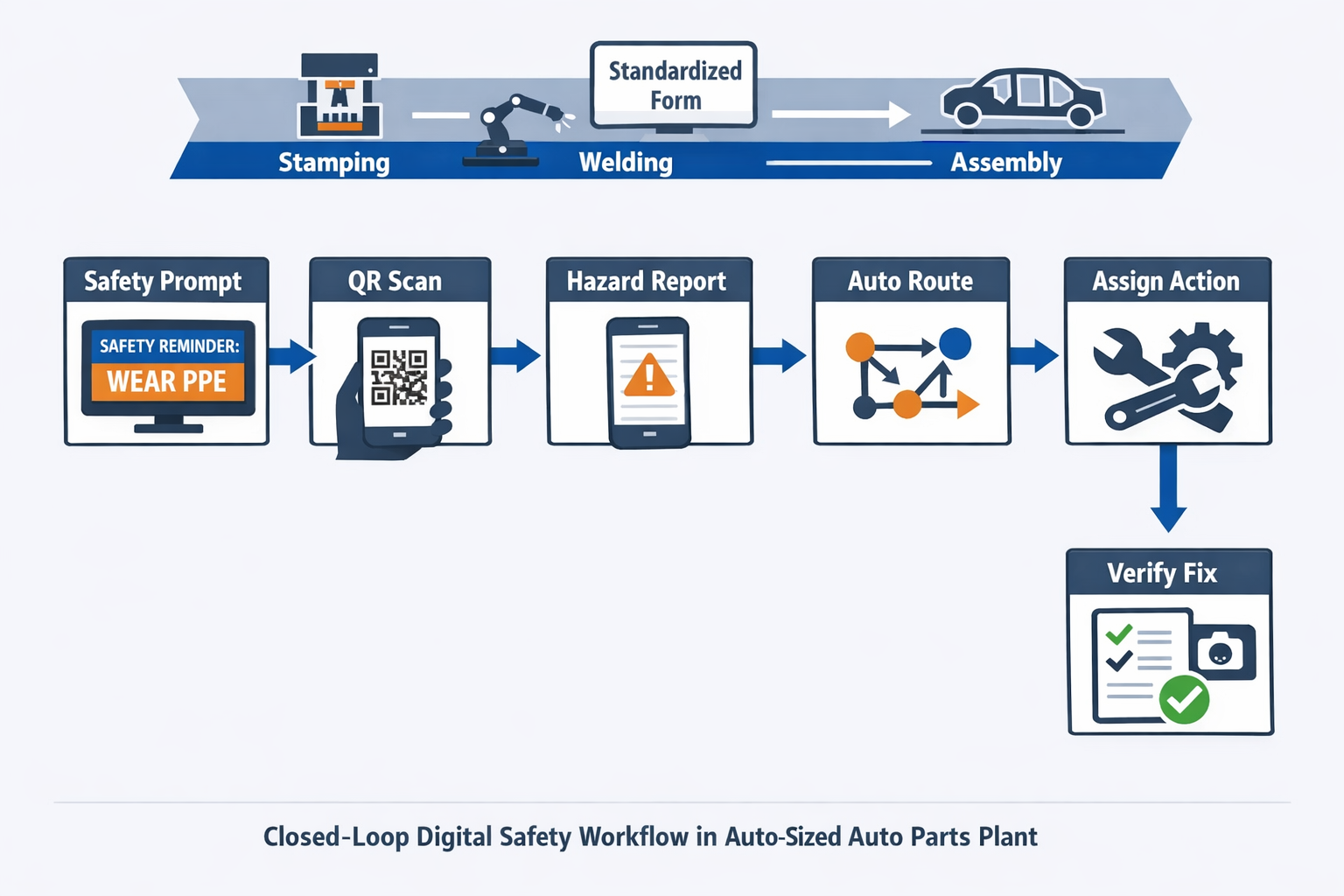
A strong safety quote can focus attention at the right moment, but awareness alone does not reduce risk unless workers know exactly what to do next. In practice, that means linking workplace safety quotes, daily safety reminders, and toolbox talk messages to a reporting path that is easy to use on the shop floor. If a line supervisor shares “See it, report it, prevent it,” the team should be able to scan a QR code, open a mobile form, and submit a hazard or near-miss report in under two minutes. The message works best when it is connected to action, not left as a slogan.
In a mid-sized auto parts plant, for example, this can be built into the start-of-shift routine using Jodoo. A short manufacturing safety quote on the digital shift board is paired with a mobile hazard-report form that captures location, risk type, photo evidence, and immediate containment taken. Because the form is standardized, reports from stamping, welding, and assembly come in with consistent fields instead of fragmented WhatsApp messages or paper notes. That gives EHS and production leaders cleaner data from the first step.
Turn Reports Into Assigned Corrective Actions
Once a report is submitted, the system should route it automatically based on risk level, area, or issue type. A slip hazard in the material staging area may go to the warehouse supervisor, while repeated guarding concerns on a press line may route to maintenance, EHS, and the production manager at the same time. Jodoo Workflow helps plants build these approval and assignment rules without custom development, so corrective actions are not delayed by manual forwarding. The result is faster ownership and fewer reports that disappear after a safety meeting.
The auto parts plant example becomes more useful here because every near-miss submission triggers a clear chain: review, assign, correct, verify, close. If an operator reports an oil leak near a transfer cart route after hearing a daily safety reminder, the assigned owner receives a task with a due date, required photo evidence, and status tracking. EHS can then verify whether the leak was cleaned, the source repaired, and the area checked for recurrence before closure. This creates a closed-loop workflow from safety reminder to verified corrective action.
Verify Completion Instead of Assuming It Happened
Many plants are good at sharing safety meeting quotes and documenting observations, but weaker at confirming whether actions were actually completed on time. A digital workflow adds discipline by requiring proof of completion, escalation for overdue items, and a final verification step before the record is closed. That matters because unresolved issues are often not high-drama events; they are small repeat hazards that stay open across shifts. In manufacturing, those repeated misses are often the real warning sign.
For the auto parts plant, verification reduced ambiguity between departments. Maintenance could mark a machine guard adjustment as completed, but the task remained open until the area supervisor or EHS representative confirmed the fix in the system. If the same press generated three similar reports in 30 days, the workflow history made that pattern visible instead of burying it in separate files. This is where safety culture quotes start to support behavior: they reinforce attention, while the workflow enforces follow-through.
Use the EHS Dashboard to Manage Risk Trends
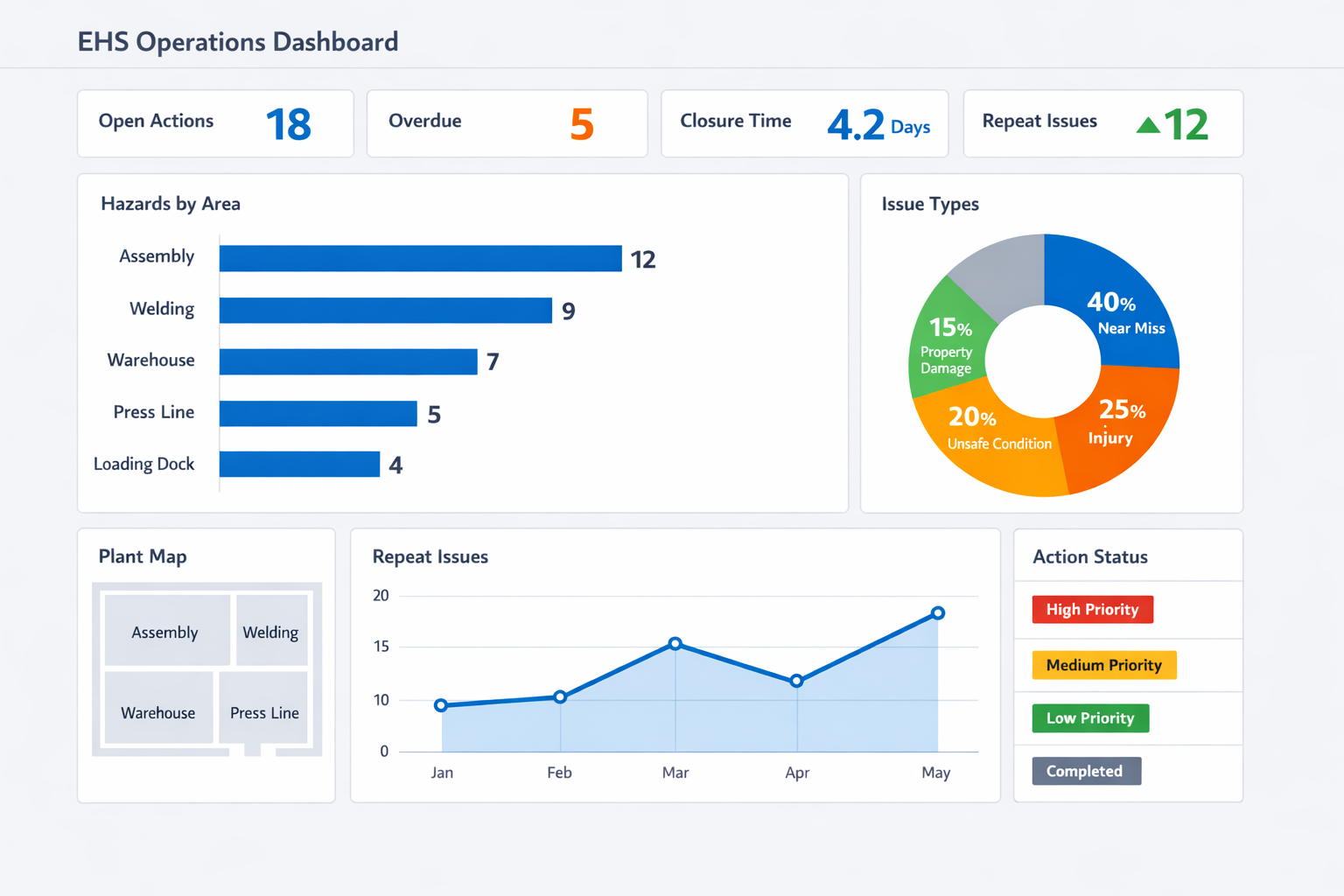
Once reporting and action tracking are digitized, managers need a live view of what is happening across the plant. Jodoo Dashboard can consolidate hazard submissions, open corrective actions, overdue items, closure time, and repeat issue categories into one operational view for EHS and plant leadership. Instead of reviewing static spreadsheets at the end of the month, supervisors can see whether one department is generating more housekeeping issues, whether a contractor area has delayed closures, or whether near-miss reporting has improved after new factory safety messages were introduced. That makes safety communication measurable.
In the auto parts plant, managers use the dashboard during weekly operations reviews to track open issues, overdue actions, and recurring risk themes by area. If line-side trip hazards spike in final assembly, they can respond with a targeted toolbox talk, a short retraining session, and a focused audit in that zone rather than sending another generic reminder to the whole plant. Over time, this helps separate one-off incidents from systemic risk patterns that need process changes. It also gives plant leaders evidence that safety communication is driving action, not just visibility.
Build a System That Frontline Teams Will Actually Use
The best digital safety process is the one that operators, supervisors, and EHS staff can use quickly during a real shift. That usually means mobile-friendly forms, simple status labels, automatic notifications, and role-based access so each person sees the tasks relevant to them. Jodoo is useful here because manufacturing teams can configure these workflows around their own approval rules, inspection steps, and reporting requirements without waiting on a long IT project. For plants trying to move beyond posters and manual follow-up, that is the point where safety quotes become part of an operating system.
If you want safety quotes to do more than decorate a notice board, connect them to a visible reporting and action process. A short message can trigger attention, but a structured workflow is what turns attention into prevention. In the next step, the real goal is to make that discipline part of everyday safety culture across teams and sites.
Make Safety Quotes Part of a Stronger Safety Culture
Safety quotes work best when they do more than sound good on a poster. On the manufacturing floor, their value comes from what happens next: a safer pre-start check, a near-miss report submitted on time, a supervisor follow-up that closes a recurring risk. In other words, the best safety quotes support behavior when they are tied to routines, ownership, and visible action.
That is the main takeaway from this article. Use short safety reminders for daily visibility, choose the right message for the right moment, and place it where teams will actually see and discuss it. Then back those messages with practical systems so safety communication does not stop at awareness. This matters because weak follow-through is one of the biggest gaps in plant safety programs, especially in fast-moving environments with multiple shifts, contractors, and line changes.
If you want to make everyday safety messaging more consistent across teams and sites, Jodoo can help. As a no-code lean manufacturing platform, Jodoo lets EHS and operations teams standardize safety reminders, digitize hazard reporting, assign corrective actions, and track follow-up in real time without heavy IT support. You can 無料トライアルを開始する または デモを予約する to see how it fits your plant’s safety workflow.