This 2026 guide is for small and mid-sized procurement, operations, and finance teams that still manage internal purchasing through email, chat, or spreadsheets and want a clearer way to standardize requests before approval begins.
A lot of procurement delays do not start with supplier negotiations or budget disputes. They start much earlier, when teams use inconsistent request forms, unclear approval paths, and scattered handoff notes.
That problem is still common. According to Ramp’s 2025 State of Procurement, 75% of business leaders still struggle with manual procurement processes. In practice, that usually means internal requests arrive incomplete, approvers lack context, and purchase decisions take longer than they should.
This guide explains what a purchase requisition is, how the process usually works, how it differs from a purchase order, and what procurement teams should include if they want to reduce back-and-forth before approval starts.
What is a purchase requisition?
A purchase requisition is an internal document used to request approval for a purchase before an order is placed with a supplier.
It is usually created by an employee, department manager, or requester who needs a product or service for business use. The purpose of the requisition is to explain what is needed, why it is needed, how much it may cost, and when it is required so that procurement, finance, or an approver can decide what should happen next.
In simple terms, a purchase requisition is an internal request to buy something. It is not the actual order sent to the vendor.
If your team still handles this step through informal emails or spreadsheet rows, a structured purchase request form can help standardize the information that moves into review.
Why purchase requisitions matter
Teams often treat requisitions as basic paperwork, but they serve an important control function. A strong requisition process helps answer a few critical questions before money is committed:
- What exactly is being requested?
- Who is asking for it?
- Why is it needed?
- Is the estimated spend reasonable?
- Does the request fit policy and budget?
- Who needs to approve it?
Without a clear requisition step, procurement teams often end up reviewing requests with missing details, unclear business purpose, or no obvious approval path. That slows down purchasing and creates unnecessary follow-up for everyone involved.
What information should a purchase requisition include?
A good purchase requisition should give the next reviewer enough information to make a decision without having to reconstruct the request from chat messages or attachments.
Most procurement teams should capture at least the following fields:
- requester name
- department or team
- item or service requested
- quantity
- required date
- business justification
- estimated cost or budget range
- preferred supplier, if known
- supporting documents or specifications
The exact field set may vary by category. Software, equipment, maintenance, and indirect spend usually require different levels of detail. But the principle stays the same: the requisition should be complete enough to move into approval with minimal clarification.
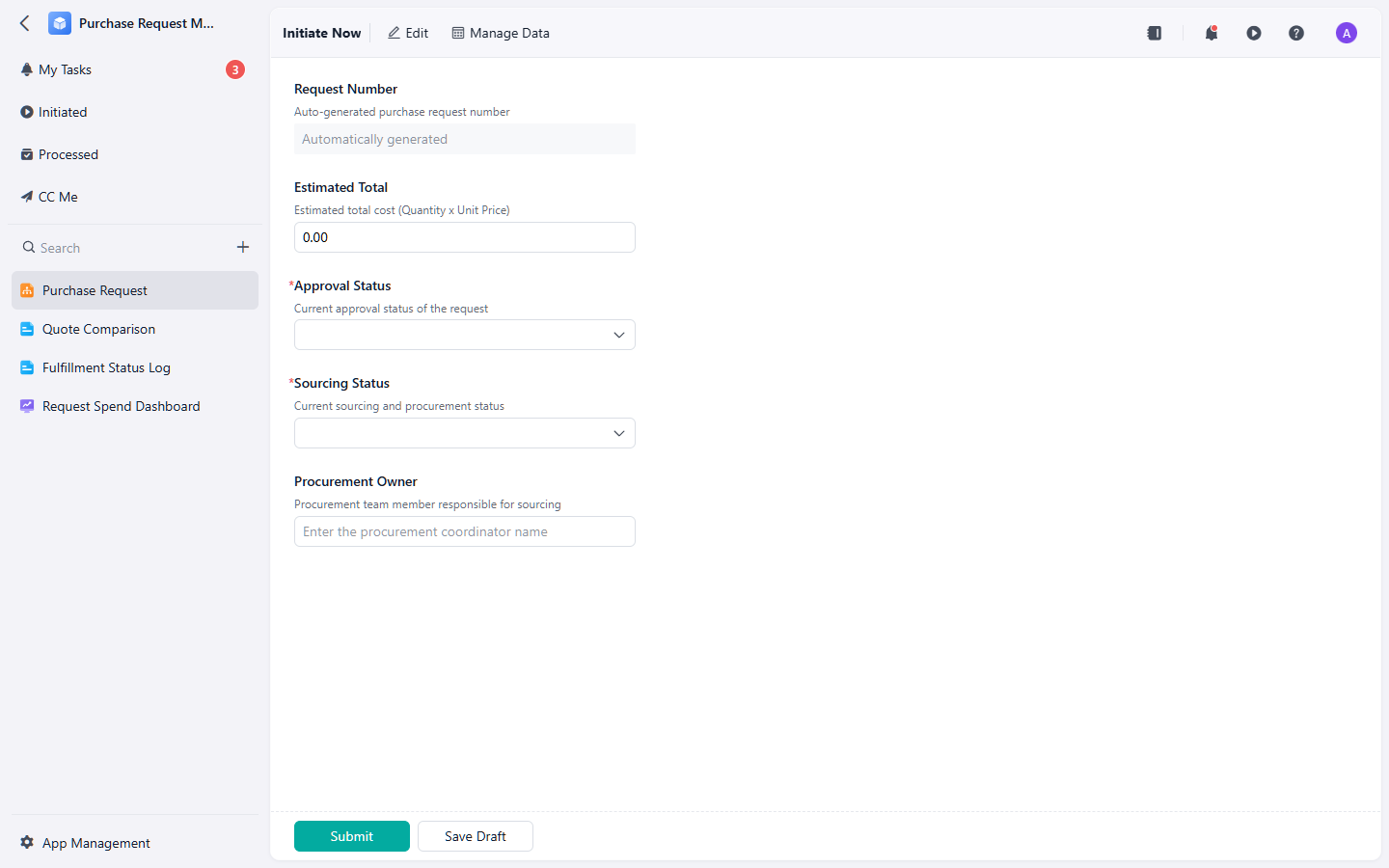
A structured requisition form makes it easier to capture request details, timing, and business context before approval starts.
What is the purchase requisition process?
The purchase requisition process is the internal workflow used to review a buying request before it becomes a purchase order.
In many organizations, the process looks like this:
1. Request submission: An employee or department submits a request for a product or service.
2. Initial review: Procurement, operations, or a manager checks whether the request includes the required information.
3. Budget and policy review: The request is assessed against budget, category rules, or policy requirements.
4. Approval routing: The requisition moves to the appropriate approver or approvers.
5. Procurement action: Once approved, the request can move into sourcing, supplier selection, or purchase order creation.
The exact workflow depends on company size, spend thresholds, and industry controls. But the most important requirement is consistency. If every department follows a different process, the procurement team ends up solving the same intake problem over and over again.
If approval is one of your slowest steps, a defined purchase order approval workflow can make status, ownership, and escalation paths much clearer.
Purchase requisition vs purchase order: what’s the difference?
The two terms are closely related, but they are not interchangeable.
| 범주 | Purchase Requisition | Purchase Order |
|---|---|---|
| Purpose | Internal request to buy something | Formal order sent to a supplier |
| Created by | Employee, team lead, or department requester | Procurement or authorized buyer |
| Audience | Internal stakeholders | External supplier |
| When used | Before approval and sourcing are complete | After approval, when the business is ready to place the order |
| Main goal | Capture need and request authorization | Commit the purchase to the vendor |
The easiest way to think about it is this: a purchase requisition asks for permission to buy, while a purchase order is the document used to actually buy.
Purchase requisition vs purchase request: are they the same?
Not always. Some companies use the terms interchangeably, but in many workflows, there is a subtle difference.
A purchase request is often the practical intake step where the requester submits what they need. A purchase requisition is the more formal internal record used for review, approval, and downstream procurement action.
In smaller teams, both may be combined into one form. In larger or more controlled environments, the request and requisition may be separate stages.
What matters most is not the label, but whether your team has a repeatable process for capturing complete information before approval begins.
Common purchase requisition mistakes
Even when teams already use a requisition process, a few recurring issues still slow things down:
- requests are submitted with missing item details
- business purpose is too vague for review
- required dates are unrealistic or missing
- budget context is unclear
- attachments are stored separately from the request
- approval ownership is not visible
These problems are usually not caused by a lack of effort. They are usually caused by a weak structure at the intake stage. When the requisition format is inconsistent, every reviewer ends up doing extra work.
When spreadsheets stop being enough
Spreadsheets can work for low-volume purchasing, especially when one team handles all review and follow-up. But they tend to become fragile when requisitions involve multiple approvers, attachments, budget checks, and repeated status updates.
That is when procurement teams start seeing the same symptoms:
- duplicate requests
- unclear status
- manual reminders
- approval delays
- poor handoff into purchasing or order tracking
A spreadsheet can store request data, but it usually does a poor job of managing request flow. Once teams spend too much time chasing missing information, the process usually needs a stronger structure rather than another spreadsheet tab.
Final takeaway
A purchase requisition is not just an internal form. It is the control point that helps procurement teams decide whether a request is complete, justified, and ready to move toward approval and purchasing.
When the requisition step is designed well, approvals are faster, request quality improves, and downstream procurement work becomes easier to manage.
If your team wants a more structured way to standardize request intake, approvals, and purchasing handoffs, Jodoo’s purchase request form template offers a practical starting point.