Browse by category

Introduction: Why Lean Manufacturing Digitalization Has Become a Shop-Floor Priority
Many factories still run core lean activities on paper, whiteboards, and disconnected spreadsheets, even though the cost of delay is rising. A plant may complete a daily Gemba walk, a layered process audit, and a Kaizen review, but if action items sit in email threads or handwritten logs, improvement slows down fast. That is why lean manufacturing digitalization has become a practical priority, not just another Industry 4.0 slogan. According to industry research, manufacturers lose significant productive time each week chasing missing information, re-entering data, and following up on unresolved issues.
Imagine a production manager at an automotive parts plant who spots the same recurring defect on two shifts, but the root-cause notes, containment actions, and audit findings are stored in three different places. The problem is not a lack of lean discipline; it is a lack of connected execution. In electronics and food manufacturing, the same gap shows up when manual checks are completed, yet nobody has real-time visibility into overdue corrective actions or line-level trends.
This article gives you a realistic roadmap for moving from paper-based lean to digital lean manufacturing. You will see where to start, which processes to digitize first, what data matters most, and how platforms like Jodoo can help standardize workflows, track improvements, and sustain results across lines or sites.
What Lean Manufacturing Digitalization Actually Means in Practice
Lean manufacturing digitalization means using digital tools to run lean processes more consistently, visibly, and at scale. In plain language, it is not about replacing lean with software. It is about taking proven lean routines—such as daily management, layered process audits, kaizen tracking, downtime reporting, defect logging, and action follow-up—and making them faster, easier to measure, and harder to ignore.
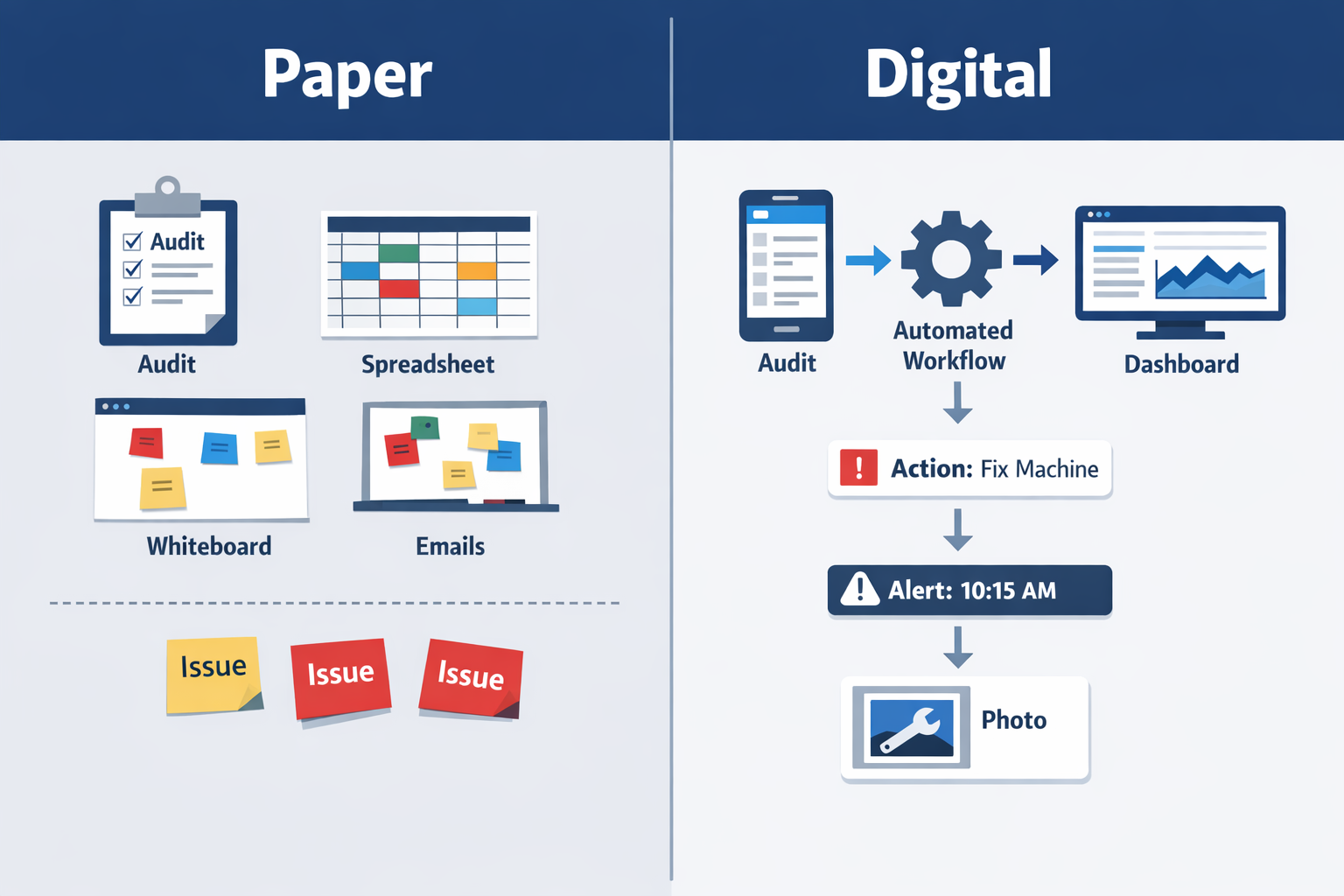
This is an important distinction for factory managers because lean manufacturing digitalization is not the same as a large digital transformation program. A full corporate transformation may involve ERP replacement, warehouse automation, robotics, or enterprise-wide data platforms. Digital lean manufacturing is much narrower and more practical: it focuses on the workflows that directly affect waste, flow, quality, and accountability on the shop floor.
It is also different from the idea many teams associate with expensive “smart factory” projects. You do not need to install advanced automation, industrial IoT across every machine, or a multi-million-dollar MES before you can digitize lean operations. In many plants, the first wins come from far simpler changes, such as replacing paper audit sheets with mobile forms, routing abnormality reports automatically, and showing open action items on a live dashboard.
Lean Still Comes First—Digital Makes It Stick
Lean principles stay the same whether you use a whiteboard or a tablet. You still focus on removing waste, standardizing work, solving root causes, and building a culture of continuous improvement. What digital tools add is execution discipline: better timestamps, faster escalation, cleaner data, and real-time visibility across shifts, lines, and departments.
In an automotive parts plant, a production manager may run a daily Gemba walk across machining, assembly, and final inspection. On paper, issues are often written down, discussed briefly, and then lost in notebooks or spreadsheets. With digital lean manufacturing, the same manager can log an abnormality on a mobile device, assign an owner immediately, attach a photo, set a due date, and track closure rates by area. The lean method has not changed, but the factory is now far more likely to sustain it.
This is why terms like lean digital transformation and Lean 4.0 matter. Both describe the effort to combine classic lean thinking with modern digital execution. The goal is not to digitize for its own sake, but to make lean systems more responsive, measurable, and repeatable in real production conditions.
How Digital Lean Manufacturing Works on the Shop Floor
In practice, digital lean manufacturing usually starts with a few high-friction processes. These are the routines where paper, Excel, and email create delays or hide problems. Common examples include first-pass yield reporting, maintenance response tracking, changeover checklists, nonconformance handling, layered process audits, and kaizen action management.
Take an electronics assembly plant as an example. If operators record defects manually at the end of a shift, quality issues may only be reviewed hours later, after hundreds more boards have been produced. By digitizing lean tools such as defect tags, escalation workflows, and line-level dashboards, supervisors can see recurring soldering defects in near real time, trigger containment earlier, and reduce the cost of poor quality. In high-mix environments, that speed can make the difference between a small correction and a large batch rework.
The same applies in food manufacturing, where compliance and traceability are tightly linked to lean execution. A quality lead may still use standard work and visual management, but digital forms can ensure every sanitation check, temperature verification, and corrective action is recorded consistently. If a CCP check is missed, the system can notify the responsible supervisor immediately instead of waiting for a paper review at the end of the shift.
What “Digitizing Lean Tools” Really Includes
When manufacturers talk about digitizing lean tools, they usually mean converting lean activities from static records into connected workflows. That can include digital 5S audits, A3 problem-solving forms, kaizen suggestion systems, action registers, TPM inspection checklists, and daily management boards. The value is not just that the form is now electronic; the value is that the data can trigger actions, feed dashboards, and create accountability automatically.
For example, a Lean Manager running monthly kaizen events across three plants may struggle to prove impact if all improvements are stored in separate Excel files. A no-code platform such as Jodoo can centralize improvement proposals, assign follow-up tasks, track overdue actions, and display savings, lead time reductions, or defect trends in one dashboard. That makes it much easier to show management which projects delivered results and which ones stalled after the workshop ended.
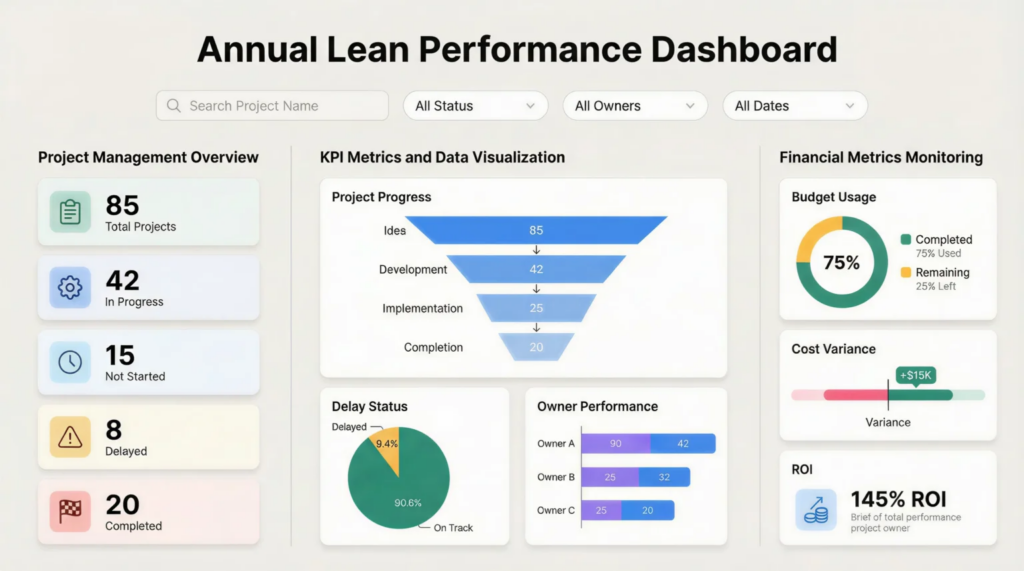
This matters because sustainment is where many lean programs fail. Industry research consistently shows that lack of follow-through is a major reason continuous improvement initiatives lose momentum after initial gains. If your action items are buried in email chains or local spreadsheets, it becomes difficult to maintain standard work and even harder to scale improvements across lines or sites.
Where Lean 4.0 Fits In
Lean 4.0 is best understood as the meeting point between lean thinking and Industry 4.0 capabilities. In practical manufacturing terms, that means using the right level of lean manufacturing technology to support flow, quality, and problem solving. It can include mobile data capture, workflow automation, dashboards, barcode scanning, machine-data integration, and role-based alerts—not just advanced robotics or AI.
For most plant managers, Lean 4.0 should begin with visibility and response time. A dashboard that shows downtime by line, repeated defect causes, overdue audit actions, and kaizen closure rates can help supervisors intervene much earlier. According to industry studies, manufacturers that improve real-time visibility and digital workflow adoption often see measurable gains in response speed, compliance consistency, and labor productivity, even before larger automation investments are made.
The key is to match the technology to the process problem. If your issue is missed inspections, start with digital audit workflows. If your issue is slow CAPA closure, start with automated action tracking and escalation. Effective lean manufacturing digitalization is not about buying the most advanced system; it is about building reliable execution into the lean routines your factory already depends on.
Common Pain Points That Slow Down Lean Digital Transformation
Many factories do not struggle with lean because their teams lack discipline or understanding. In reality, the bigger issue is that their systems are still built around paper, spreadsheets, whiteboards, and disconnected messages. That creates a gap between lean intent and daily execution, which is why lean manufacturing digitalization often stalls even when leadership supports continuous improvement.
This is a common pattern in automotive, electronics, and food plants. A factory may run Kaizen events, conduct layered process audits, and track defects every shift, yet still miss repeat issues because the data is scattered across too many places. In other words, the problem is not lean thinking itself; the problem is that outdated tools make digitizing lean tools slow, manual, and difficult to scale.
Paper Forms Keep Waste Invisible
Paper remains one of the biggest obstacles in digital lean manufacturing. Operators may still record hourly production, machine downtime, first-pass yield, or quality checks by hand, then pass those sheets to supervisors at the end of the shift. By the time someone enters the data into Excel, the line has already lost hours of response time.
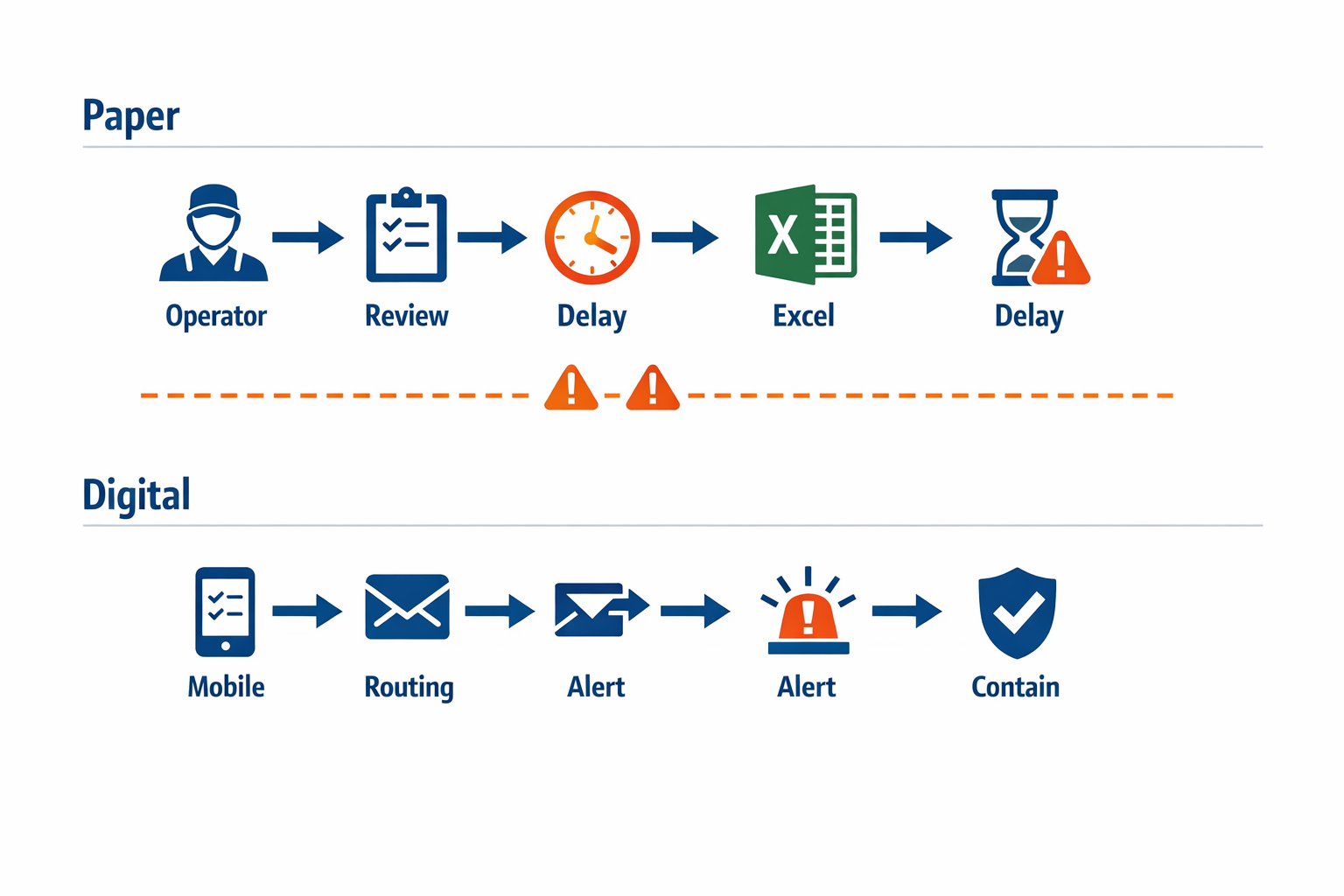
Suppose a production manager at an automotive parts plant sees a rise in burr defects on a stamping line during the morning shift.The operator notes it on a paper check sheet, the quality technician flags it later, and the supervisor only reviews it during the afternoon meeting. What should have been a 20-minute containment action becomes a half-day delay, increasing scrap, rework, and customer risk.
Paper also weakens standardization across lines and sites. One team writes detailed notes, another uses tick marks, and a third forgets to submit the form entirely. That inconsistency makes lean digital transformation harder because the factory cannot trust the basic data used for problem-solving.
Spreadsheet Sprawl Creates Confusion Instead of Control
Spreadsheets usually start as a quick fix, but over time they become a hidden source of waste. Lean managers often maintain separate files for Kaizen ideas, A3 reports, 8D investigations, action trackers, audit findings, and KPI summaries. Once these files are shared by email or stored in different folders, version control becomes a daily problem.
This is especially common in electronics manufacturing, where multiple teams may track defects, line balance losses, and engineering changes in parallel. One workbook shows a defect trend, another tracks corrective actions, and a third is used by quality for customer complaints. No one has a single source of truth, so teams spend time reconciling files instead of solving problems.
The cost is not just administrative frustration. According to industry estimates, knowledge workers can spend 20% to 30% of their time searching for information or recreating missing data. In a factory environment, that delay affects response speed, escalation quality, and the credibility of the lean program itself.
Delayed Approvals Slow Down Action
Lean improvements often depend on fast decisions. A fixture modification, temporary containment step, maintenance request, or process parameter change may require sign-off from production, quality, engineering, or EHS. When approvals move through paper forms, email chains, or chat messages, actions get stuck between departments.
A food manufacturing plant provides a good example. Suppose a line team identifies recurring underweight packs during a packaging shift and proposes a short-term calibration check plus a permanent machine setting revision. If the approval sits in an inbox until the next day, the factory continues producing risk inventory, even though the root cause is already known.
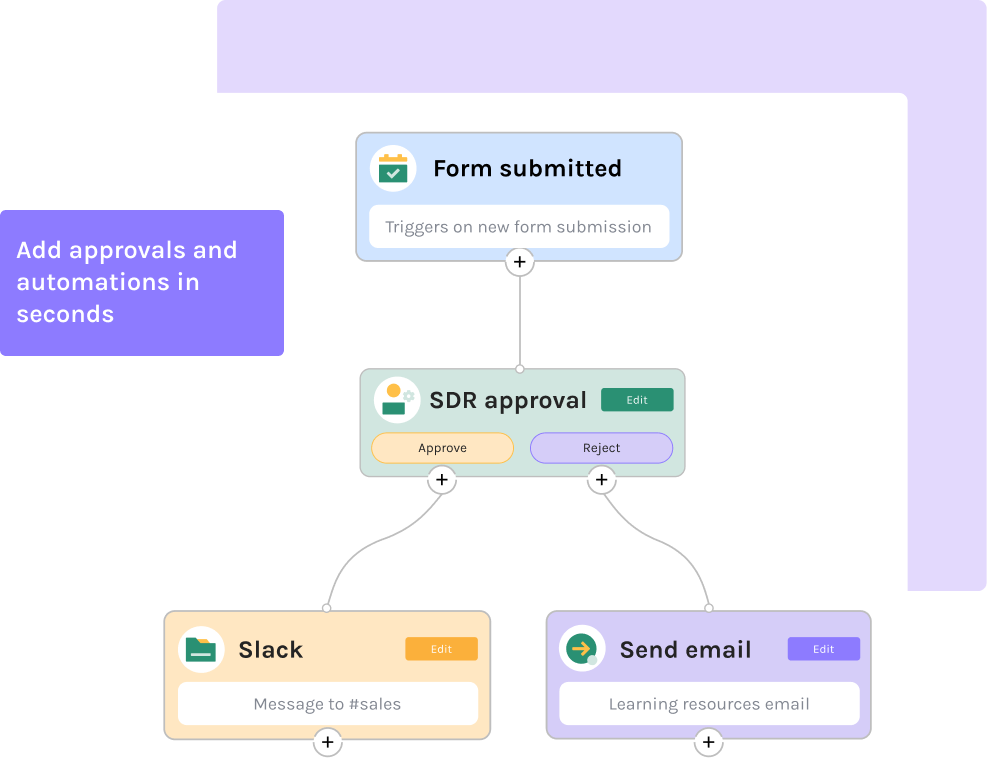
This is where many lean 4.0 initiatives lose momentum. The team may identify waste quickly, but the system around them cannot move at the same speed. Lean depends on short feedback loops, and delayed approvals stretch those loops until corrective action becomes reactive rather than preventive.
Disconnected Quality Logs Break the Feedback Loop
Quality data is often split across incoming inspection forms, in-process check sheets, nonconformance reports, customer complaints, and maintenance records. When those logs are not connected, factories cannot see how one issue links to another. A recurring defect may appear as isolated incidents instead of a systemic pattern.
For example, in an electronics assembly plant, solder bridge defects may be recorded by line inspectors, while rework details sit in a separate file and SMT maintenance settings are stored elsewhere. The production team sees yield loss, the quality team sees defects, and maintenance sees machine variation, but no one sees the full picture in one workflow. That disconnect makes root cause analysis slower and less accurate.
This is a major barrier to lean manufacturing technology adoption. Digital tools should make abnormalities easier to detect, escalate, and analyze, but many factories simply digitize forms without connecting the process behind them. As a result, they collect more data without improving decision-making.
Weak Traceability Makes Problem-Solving Harder
Traceability is essential for lean, especially when teams need to confirm where a defect started, which shift it affected, and whether containment was effective. Yet many plants still rely on handwritten batch numbers, manual lot tracing, and loosely linked records between production and quality. When an issue occurs, teams spend hours tracking down basic facts before they can even start solving the problem.
In food and beverage manufacturing, this can have serious operational impact. If a packaging seal failure is detected during final inspection, the plant needs to identify the product code, machine, operator, time window, and raw material batch quickly. If those details sit in different logs, the response becomes broader and more expensive than necessary, with more stock placed on hold and more production time lost.
Weak traceability also hurts accountability. If the factory cannot clearly connect an abnormality to a process step, it becomes harder to assign action owners, validate countermeasures, and prevent recurrence. That undermines one of the core goals of lean digital transformation: making problems visible early and actions measurable.
Stale KPI Boards Delay Daily Management
Visual management is central to lean, but many KPI boards are updated too slowly to support real-time control. In some plants, supervisors still copy hourly output, downtime, scrap, and OEE figures onto whiteboards, then summarize them in Excel after the shift ends. By the time managers review the numbers, they are looking at yesterday’s losses instead of today’s bottlenecks.
A line leader in a Tier 1 automotive supplier may know that changeover losses increased during the week, but if the dashboard only updates once a day, the team cannot respond during the affected shift. That delays escalation and weakens accountability during daily Gemba walks. Instead of managing by exception, leaders spend their time validating whether the numbers are even current.
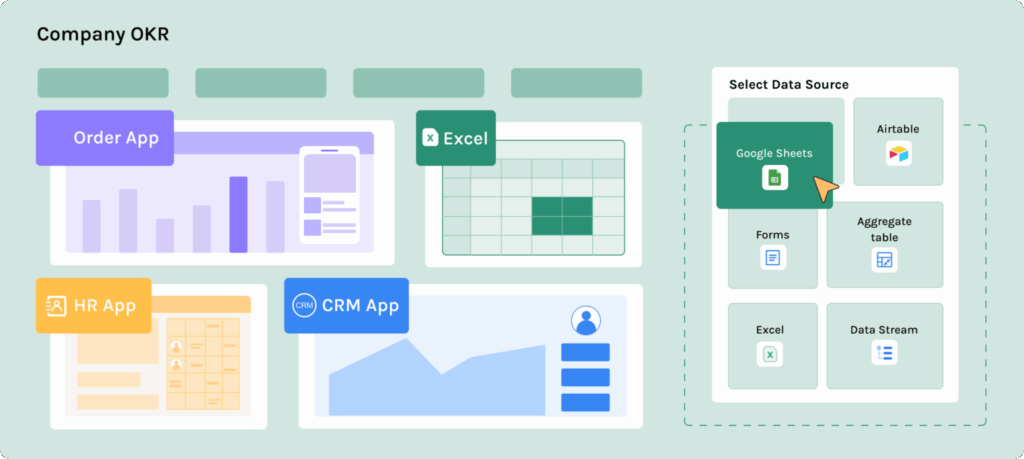
This is one reason many factories say they are pursuing digital lean manufacturing but still operate with lagging indicators. The issue is not dashboard design alone. The issue is that source data, workflows, and shop-floor reporting are not connected well enough to produce live operational visibility.
Corrective Actions Often Have No Follow-Through
One of the most common reasons lean programs lose credibility is poor closure discipline. Teams identify issues during audits, Kaizen events, safety walks, or problem-solving sessions, but the resulting action items are tracked informally. Some sit in meeting minutes, some in spreadsheets, and some in email threads that no one revisits.
Research across improvement programs consistently shows that execution is the hardest part of continuous improvement. In practice, many factories can identify dozens of opportunities each month, yet only a fraction are closed on time with verified effectiveness. That is why open action lists grow while repeat issues continue appearing on the same lines.
Take an electronics plant running a monthly layered process audit across three SMT lines as an example. The audit finds missing feeder verification, inconsistent ESD checks, and unclear rework labeling. If those findings are logged manually without automated ownership, reminders, escalation, and closure tracking, the same gaps will likely appear again next month.
The Real Problem Is Not Lean — It Is the Operating System Around Lean
When factories struggle with lean manufacturing digitalization, it is easy to assume the organization lacks commitment. In many cases, that is the wrong conclusion. The factory may already have strong lean methods, trained supervisors, and regular improvement routines, but those routines are still running on outdated systems that hide delays, variation, and missed handoffs.
That is why successful lean 4.0 programs usually start with practical workflow improvements, not large-scale technology rollouts. The goal is to reduce friction in the everyday processes that support lean: audits, quality checks, escalation, approvals, action tracking, and KPI reporting. Once those workflows are connected, waste becomes easier to see, and lean teams can spend less time chasing information and more time improving the process.
For plant managers and operations directors, the message is straightforward. If your lean initiatives are not sustaining results, the issue may not be your lean strategy at all. It may be that your current mix of paper, spreadsheets, and disconnected systems is preventing lean manufacturing technology from doing what it should: making abnormalities visible, speeding up response, and sustaining improvement at scale.
Which Lean Processes to Digitize First for Fast Wins
If you want lean manufacturing digitalization to deliver results quickly, do not start with a large MES rollout or a complex plant-wide system replacement. Start with the lean processes your supervisors, engineers, and operators already run every day, but currently manage with paper, spreadsheets, whiteboards, and WhatsApp messages. The best early candidates are workflows that are repetitive, cross-functional, time-sensitive, and difficult to sustain manually across shifts or lines.
A simple way to prioritize is to score each process on four factors: frequency, business impact, coordination complexity, and visibility gap. For example, a task done every shift, involving production, quality, and maintenance, with poor real-time tracking, should move to the top of your list. This is where digital lean manufacturing creates fast wins, because you reduce delays, standardize execution, and make problems visible before they grow into scrap, downtime, or missed deliveries.
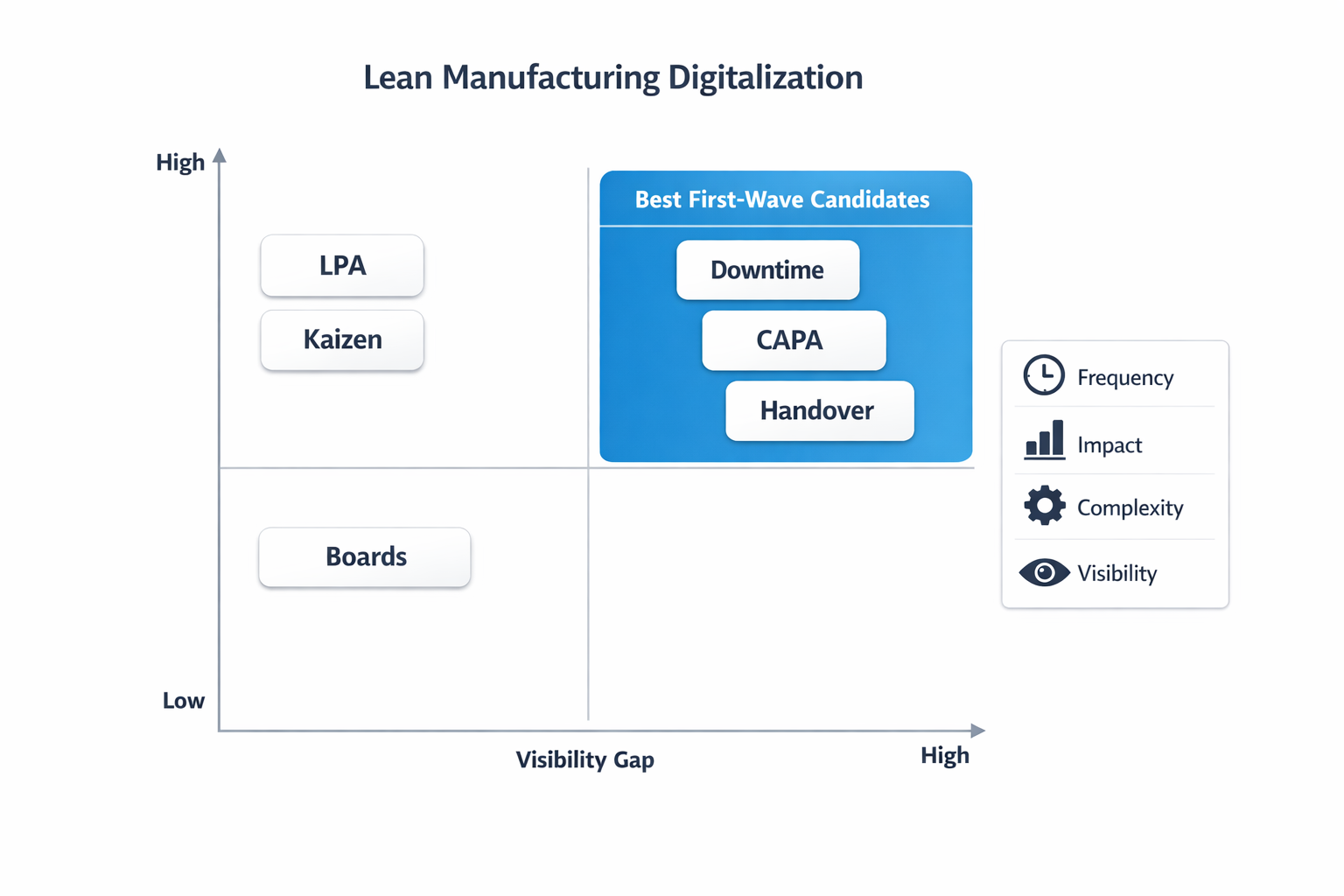
Use a Practical Prioritization Framework
A good first-wave shortlist usually includes processes with high manual effort and low data reliability. Think about where your team still rekeys data at the end of the shift, chases signatures, or loses action items after a meeting. In many factories, these are not strategic planning processes; they are execution processes on the shop floor.
You can ask five practical questions before digitizing lean tools. Does the process happen daily or weekly? Does it involve more than one department? Is follow-up often missed? Is reporting delayed or incomplete? Would a mobile form, workflow alert, or live dashboard immediately improve response time? If the answer is yes to most of these, the process is a strong candidate for lean digital transformation.
1. Layered Process Audits
Layered process audits are one of the clearest early wins because they are structured, repetitive, and often poorly sustained on paper. In an electronics assembly plant, imagine a production manager who expects team leaders, supervisors, and plant managers to complete LPAs on different frequencies, but paper checklists sit in binders and issues stay open for weeks. Digitizing LPAs allows each audit to be completed on mobile, with photos, timestamps, assigned owners, due dates, and escalation rules when corrective actions are overdue.
This matters because audits only drive improvement when findings lead to action. A digital workflow can automatically route a failed checkpoint to the responsible engineer, notify the line supervisor, and show open issues by area on a dashboard. For plants working under ISO 9001 or customer audit pressure, this improves traceability while making lean 4.0 feel practical rather than theoretical.
2. Kaizen Suggestions and Improvement Tracking
Many factories promote continuous improvement, but employee ideas disappear into email threads or a suggestion box with no feedback loop. That damages participation, because operators stop submitting ideas when they do not see decisions or results. A digital kaizen workflow makes it easier to submit ideas with photos, categorize waste types, route approvals, track implementation status, and measure savings in hours, scrap, or floor space.
At an automotive parts plant, operators may frequently spot small fixture changes that could reduce motion waste. On paper, these ideas may never get beyond the team board. With lean manufacturing technology, each idea can be logged on a phone, reviewed by engineering, approved by the area manager, and tracked until closed. This is a strong first step in lean digital transformation because it increases engagement while giving leadership a clear record of implemented improvements and ROI.
According to industry studies, employee-driven continuous improvement programs can generate significant gains when participation is sustained, yet many manufacturers struggle to move beyond single-event kaizen activity. The digital advantage is not just collecting more ideas; it is creating accountability and speed in the evaluation and closure process. That is why digitizing lean tools for kaizen often produces visible cultural and operational benefits within one quarter.
3. CAPA and Nonconformance Reporting
Corrective and preventive action tracking is another high-value starting point because it naturally connects quality, production, engineering, and management. In food manufacturing, for example, a packaging defect or labeling error can trigger rework, hold inventory, and urgent investigations across multiple teams. If the process is managed through disconnected Excel files and emails, actions slip, root causes stay unclear, and repeated issues continue.
A digital CAPA or nonconformance workflow standardizes what gets recorded: defect type, line, lot, shift, containment action, root cause, owner, and due date. It also creates a closed-loop system, so no issue is considered complete until verification is documented. For factories trying to strengthen digital lean manufacturing, this is an ideal use case because it turns problem-solving discipline into a trackable daily process instead of an after-the-fact quality exercise.
4. Downtime Logging and Escalation
Downtime data is often available, but not always accurate or actionable. In many plants, operators write machine stoppages on paper, supervisors summarize them later, and maintenance receives incomplete information long after the event. By then, the details are vague, the code is inconsistent, and the true top losses are hard to trust.
Digitizing downtime logging changes that immediately. An operator can log the stop reason, machine, duration, and photo evidence in real time from a tablet or mobile device, while automatic alerts notify maintenance for longer stops. In an automotive stamping plant, for instance, this can help operations distinguish between tooling issues, material shortages, minor stops, and waiting time, allowing the team to prioritize the biggest losses accurately. This is exactly how lean 4.0 should begin: with cleaner execution data that supports faster daily decisions.
5. Shift Handovers
Shift handover is one of the most underestimated lean workflows to digitize. Poor handovers cause repeated troubleshooting, missed maintenance follow-up, and inconsistent quality control between crews. When the outgoing supervisor leaves handwritten notes or sends fragmented chat messages, the incoming team starts the shift with partial information.
A digital shift handover form creates a standard structure for production status, safety issues, machine abnormalities, quality alerts, material shortages, and open actions. It can require mandatory fields, attach photos, and route unresolved items to the next shift lead and department heads. For plant managers focused on lean manufacturing digitalization, this is a practical use case because it improves daily discipline without changing the core production process.
6. Daily Management Boards
Many factories still run daily management using physical whiteboards updated manually once or twice a day. The visual discipline is useful, but the data is often delayed, inconsistent, and difficult to consolidate across multiple lines. If one supervisor defines downtime differently from another, the board may support discussion but not reliable decision-making.
Digital daily management boards keep the visual management principle while improving speed and accuracy. You can pull live data from audits, downtime logs, quality incidents, action trackers, and production reporting into one dashboard by line, shift, or plant. For an operations director overseeing multiple sites, this is one of the most effective forms of lean manufacturing technology because it provides a common operating picture without waiting for end-of-day spreadsheets.
Start with Execution, Then Expand
The biggest mistake in lean digital transformation is starting with a technology roadmap that is disconnected from daily plant routines. Successful teams begin with a handful of painful workflows that supervisors already want fixed, then standardize data, automate follow-up, and build dashboards around those processes. Once adoption is proven in LPAs, kaizen, CAPA, downtime, or shift handovers, it becomes much easier to expand into broader digital lean manufacturing initiatives.
This is also why no-code platforms are gaining traction in manufacturing. Instead of waiting months for custom development, operations teams can configure forms, workflows, and dashboards around their real SOPs and improve them as conditions change. With a platform like Jodoo, you can digitize lean tools step by step, connect action tracking across departments, and turn lean 4.0 into a practical operating system for the shop floor rather than a long-term IT project.
A Practical Roadmap for Digital Lean Manufacturing Rollout
Lean manufacturing digitalization works best when you treat it as an operations improvement program, not an IT project. Many factories already have strong lean methods on paper, but execution still depends on whiteboards, spreadsheets, shift books, and follow-up by email or WhatsApp. That gap is where delays, missed actions, and weak accountability appear. A practical roadmap helps you move from manual lean routines to digital lean manufacturing in a controlled, measurable way.
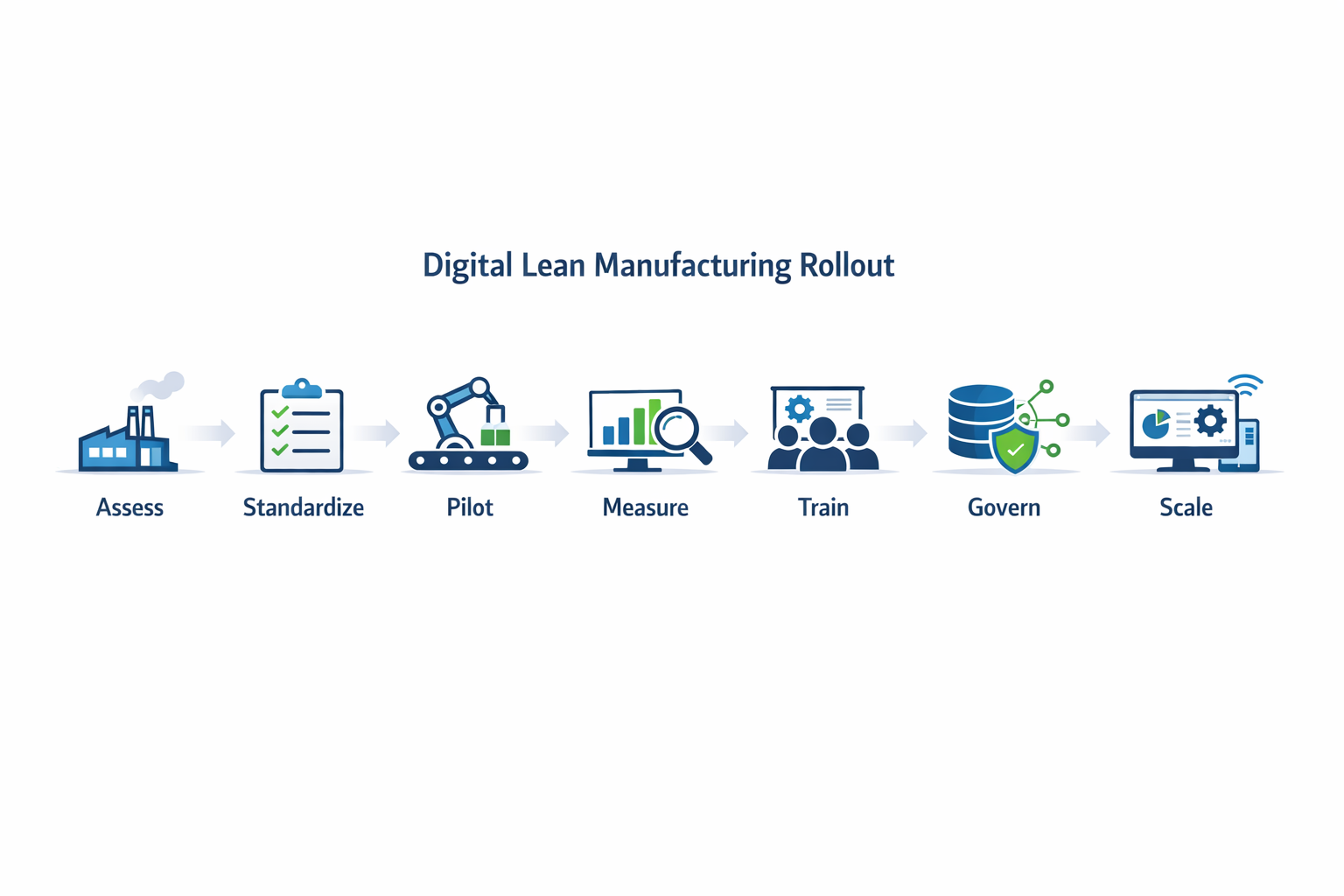
The key is sequencing. If you digitize unstable processes, you simply make waste move faster. If you standardize first, pilot carefully, and measure outcomes early, lean digital transformation becomes easier to justify and much easier to scale across lines, departments, and sites.
Step 1: Assess the Current State in Detail
Start by mapping how lean activities actually run today, not how the SOP says they should run. Look at daily management meetings, layered process audits, Kaizen suggestion handling, 5S checks, deviation escalation, CAPA follow-up, and production reporting. In many plants, the process is split across paper forms, Excel files, and supervisor memory, which makes cycle time hard to see and even harder to improve. Before selecting any lean manufacturing technology, document where data is created, who updates it, who approves it, and where action items get stuck.
A useful baseline includes metrics such as audit completion rate, average action closure time, number of overdue Kaizen tasks, first-pass yield, and response time to shop floor abnormalities. According to industry studies, manufacturers that use real-time operational data can improve decision speed significantly compared with paper-based environments, especially in quality and maintenance response. Even simple baseline numbers give you a way to prove whether lean manufacturing digitalization is delivering value within the first 30 to 90 days.
Step 2: Standardize the Process Before You Automate It
One of the most common mistakes in digital lean manufacturing is automating local variations that should have been aligned first. If one line uses a 5S checklist with 12 points, another uses 18 points, and a third has no clear scoring method, the issue is not software. The issue is process discipline and governance. Standard work must come first so the digital workflow reflects one agreed method, not five conflicting habits.
This is especially important when digitizing lean tools such as A3s, 8D workflows, LPAs, and Kaizen forms. Define the minimum required fields, escalation rules, ownership, closure criteria, and review cadence. For example, if a nonconformance found during an LPA must be assigned within 2 hours and closed within 72 hours, that rule should be explicit before it is built into a workflow. Good lean 4.0 execution starts with process clarity, not just better screens.
At this stage, involve supervisors, CI leaders, QA, and maintenance together. A food manufacturing plant may discover that hygiene inspection forms differ by shift, making audit trend analysis unreliable. By standardizing one digital checklist, one scoring structure, and one escalation path, the plant creates a common language for performance. That makes reporting more useful and coaching more consistent.
Step 3: Pilot One High-Impact Workflow First
Do not try to digitize your entire lean system in one phase. Start with one workflow that is frequent, visible, and operationally painful enough to show fast results. In many factories, the best pilot candidates are layered process audits, Kaizen action tracking, shift handover logs, defect escalation, or on-site inspection workflows. These processes happen daily or weekly, involve multiple roles, and often suffer from missing follow-up.
A strong pilot has clear boundaries. For example, an electronics assembly plant might choose to digitize LPA execution on one SMT line and one final assembly line. Auditors complete checklists on mobile devices, nonconformances trigger automatic task assignment, photos are attached at point of issue, and open items are tracked on a dashboard visible to production, quality, and engineering. This is a practical example of lean manufacturing digitalization because it connects standard work, issue management, and visibility in one closed-loop process.
Using a no-code platform such as Jodoo, operations teams can build this type of workflow without waiting for a long custom development cycle. You can configure forms for audits, automate routing for corrective actions, and create dashboards for overdue items and repeat findings. That matters because lean digital transformation often loses momentum when plants wait months for IT resources. Faster configuration helps the factory test, learn, and improve the process while the pilot is still relevant.
Step 4: Measure Time-to-Value, Not Just System Usage
A pilot should not be judged by login counts alone. You need to measure whether the new process improves operational outcomes. Good early indicators include shorter action closure time, fewer overdue issues, higher audit completion, faster escalation response, and lower manual reporting effort. These are the metrics that matter to plant managers because they connect directly to safety, quality, delivery, and labor efficiency.
For example, if a plant previously needed 6 hours each week to consolidate paper audit findings into Excel, and the digital workflow cuts that to 1 hour, the time saving is immediate and visible. If average corrective action closure drops from 10 days to 4 days, the value is even stronger because the process is now controlling problems faster. In one typical CI scenario, a plant can reduce open action items by 50% to 70% simply by making ownership, due dates, and escalation visible in real time. That is the kind of measurable win that builds support for broader lean 4.0 initiatives.
Time-to-value should be reviewed within the first month, then again at 60 and 90 days. This keeps the pilot honest and helps you refine workflow rules, notifications, and dashboard design. If operators are skipping fields or supervisors are closing issues without evidence, that is useful feedback. The purpose of the pilot is not to prove the first version is perfect; it is to prove the process can improve quickly with digital support.
Step 5: Build Change Management Into the Rollout
Even the best lean manufacturing technology will fail if operators and supervisors see it as extra admin work. Change management must be built into the rollout from day one. That means explaining why the workflow is changing, what problem it solves, what is expected from each role, and how success will be measured. People adopt digital tools faster when they see a direct benefit such as fewer duplicate entries, faster approvals, or clearer action ownership.
Training should be role-based and practical. Operators need to know how to submit issues, attach photos, and confirm actions on mobile devices. Supervisors need to know how to review exceptions and escalate blockers. CI and plant leadership need dashboard views that help them coach teams, not just monitor compliance. In an electronics or automotive plant running multiple shifts, short shift-based training sessions are usually more effective than classroom-heavy programs.
It also helps to appoint process owners, not just system admins. A Lean Manager may own the Kaizen workflow, while QA owns digital audit criteria and production owns shift review compliance. This governance model keeps lean digital transformation grounded in process accountability rather than leaving it as a software maintenance task.
Step 6: Put Governance and Data Discipline in Place
As the pilot expands, governance becomes critical. Without it, different departments will create duplicate forms, inconsistent KPI definitions, and parallel workflows that weaken standardization. Define who can change forms, who approves workflow updates, how KPIs are calculated, and which version of each checklist is the official one. This is especially important in regulated environments or plants certified to standards such as ISO 9001 or ISO 45001, where traceability and auditability matter.
A governance model for digital lean manufacturing should include version control, user permissions, audit trails, and regular review of workflow performance. For example, maintenance may need visibility of machine-related abnormalities, but not access to confidential HR-related records linked elsewhere in the platform. A system like Jodoo supports role-based access, workflow history, and centralized dashboards, which makes it easier to scale digital processes without losing control. Governance may sound administrative, but it is what allows a pilot to become a repeatable plant system.
Step 7: Scale Plant-Wide in Waves
Once one workflow is stable and delivering results, scale in waves rather than all at once. Start with similar processes in adjacent lines or departments, then expand to connected workflows. A plant that begins with digital LPAs might next digitize Kaizen idea management, A3 problem solving, shift handovers, and maintenance inspections. This approach creates a connected operational system instead of isolated digital forms.
Consider a food and beverage factory that starts with hygiene and GMP audit digitalization in one packaging area. After proving better compliance tracking and faster corrective action closure, the plant extends the same logic to changeover checks, downtime tagging, and daily management reviews across production. Because the forms, workflows, and dashboards are built on one platform, leaders can finally see recurring issues across departments rather than reviewing separate spreadsheets. That is where lean manufacturing digitalization begins to deliver strategic value, not just local process improvement.
At this stage, keep measuring cross-functional outcomes such as reduced response time, fewer repeated findings, lower admin hours, and stronger audit readiness. McKinsey and other industry analysts have reported that digital performance systems and connected frontline workflows can produce meaningful gains in productivity, quality, and management responsiveness when rolled out systematically. The lesson for factory managers is simple: scale only what has been standardized, proven, and governed.
What Success Looks Like
Successful lean manufacturing digitalization aligns people, process, and technology around a small set of measurable outcomes. You should be able to answer basic operational questions quickly: Which audits are overdue, which lines have recurring issues, which actions are stalled, and where is support needed today? If that visibility improves, decision-making improves with it. And when decision-making improves, the factory starts to sustain lean gains rather than losing them after each Kaizen event.
The factories that succeed with digital lean manufacturing are usually not the ones with the biggest software budget. They are the ones that start with a real process problem, standardize carefully, pilot one workflow, and scale with discipline. That is the practical path to lean digital transformation: not digitizing everything, but digitizing the right things in the right order.
What to Look for in Lean Manufacturing Digitalization Software
When you evaluate lean manufacturing digitalization software, the key question is not whether the platform has many features. The real question is whether it helps your team sustain daily improvement without adding more admin work, more spreadsheets, or more dependency on IT. In practice, the best lean manufacturing technology should make it easier to run Kaizen, audits, action tracking, and visual management across lines, shifts, and plants.
Many factories start digital lean manufacturing with a narrow tool for one use case, such as audits or checklists, then discover the data is trapped in another silo. That creates a new version of the old problem: paper is gone, but improvement work is still fragmented. If you want software that supports long-term lean digital transformation, you need to assess how well it connects frontline data capture, workflows, analytics, and accountability in one system.
Ease of Use for Frontline Teams
If operators, supervisors, and line leaders do not use the system consistently, the project will fail no matter how strong the feature list looks. Shop floor teams need simple screens, fast form entry, clear task lists, and mobile-friendly layouts that work during a busy shift. In manufacturing environments, even an extra 30 seconds per record can reduce adoption when a supervisor is already balancing output, quality, and manpower issues.
If a production manager at an automotive parts plant wants to digitize layered process audits across three shifts, the app needs to be fast and simple enough for supervisors to use consistently. If the audit app takes too many clicks, requires desktop access, or uses confusing field labels, supervisors will delay submissions until the end of the shift or skip details entirely. Good digitizing lean tools means the software fits actual factory behavior, not idealized office workflows.
No-Code Configurability Matters More Than Generic Templates
Lean processes are never identical from one plant to another. An electronics assembly site may need defect categories by SMT line, rework loop tracking, and escalation rules tied to customer severity, while a food plant may need hygiene checks, CCP verification, and approval routing aligned with QA and production. A rigid off-the-shelf tool often forces teams to adapt their lean process to the software, which weakens adoption and slows continuous improvement.
That is why no-code configurability is critical in lean 4.0 initiatives. Operations teams should be able to adjust forms, workflows, approval logic, KPI definitions, and action-tracking fields without waiting weeks for a developer. Platforms like Jodoo are designed for this kind of flexibility, allowing manufacturers to build and refine apps for Kaizen ideas, A3s, LPAs, CAPA, and shift handovers without creating a long IT queue.
Mobile Access Is Essential on the Shop Floor
A surprising number of software tools still work best at a desk, even though lean activities happen at the gemba. Audit findings, abnormality reports, 5S observations, and improvement ideas are most useful when captured immediately, with photos, timestamps, and the exact line or machine identified. Mobile access is not a convenience feature in digital lean manufacturing; it is what makes real-time response possible.
For example, in a food packaging plant, a team leader doing a sanitation check may need to attach a photo, scan a QR code on the machine, and trigger corrective action before the next run starts. If the software supports smartphones or tablets well, the issue can move from detection to assignment in minutes. If not, the team falls back to paper notes and delayed follow-up, which undermines the purpose of lean manufacturing digitalization.
Workflow Automation and Approvals Keep Improvements Moving
Most lean initiatives do not fail because teams cannot identify problems. They fail because follow-up actions stall between departments, priorities shift, and no one has visibility into overdue items. Good software should automate what happens after a finding is logged: assign owners, set deadlines, escalate late actions, notify approvers, and record closure evidence.
This matters especially in cross-functional environments such as electronics or Tier 1 automotive suppliers, where one issue may involve production, quality, maintenance, and engineering. Imagine an LPA finding that poka-yoke verification was skipped on one line. The right system should automatically route that issue to the production supervisor, require quality verification, notify maintenance if the device is faulty, and escalate to the operations manager if closure exceeds 48 hours.
Dashboards Should Show Action, Not Just Activity
A dashboard is useful only if it helps managers decide what to do next. Many tools show counts of completed audits or submitted forms, but lean leaders need visibility into trend lines, repeat findings, overdue actions, closure lead time, and recurring losses by line, shift, or product family. According to industry studies, poor visibility into operational data remains one of the main barriers to scaling manufacturing digitalization, especially in multi-site operations.
For a Lean Manager, the most valuable dashboard often includes a few specific views: open Kaizen actions by owner, top recurring LPA findings, audit completion rate by department, and average days to close corrective actions. In a palm oil processing facility or automotive stamping plant, that level of visibility helps leaders focus on bottlenecks instead of reviewing static reports at the end of the month. This is where lean digital transformation becomes measurable rather than theoretical.
Audit Trails and Permissions Are Non-Negotiable
In manufacturing, lean data often overlaps with quality, safety, and compliance requirements. If a record can be edited without traceability, or if the wrong user can close an action without review, the system creates risk instead of control. Strong audit trails should capture who submitted, edited, approved, rejected, or closed each record, along with timestamps and comments.
Permissions are equally important in larger plants or multi-site groups. A line leader may need to create and update audit findings, a department manager may approve countermeasures, and a plant manager may only need dashboard visibility across all departments. This level of role-based control supports governance while keeping the system practical for daily use, especially for companies working to align lean systems with ISO 9001 or ISO 45001 requirements.
Integration Flexibility Prevents New Data Silos
A lean platform should not become another isolated application. Improvement activity often depends on data from ERP, MES, maintenance, quality, HR, or even messaging tools used for shift coordination. If your lean manufacturing technology cannot exchange data with those systems, teams will keep re-entering information manually and managers will still struggle to connect improvement work to business outcomes.
Consider an electronics manufacturer where defect data sits in MES, maintenance history sits in a CMMS, and CI actions are tracked in spreadsheets. With the right integration approach, a defect trend can trigger an investigation workflow, link to machine history, and feed a dashboard showing scrap cost and closure status in one place. That is a practical example of lean 4.0: not just collecting more data, but connecting it so teams can act faster.
Look for a Platform That Removes IT Bottlenecks
One of the biggest mistakes in software selection is choosing a system that can only be changed by technical specialists. Lean processes evolve constantly as teams revise checklists, tighten escalation rules, add new KPI views, or standardize improvements across sites. If every adjustment requires a formal IT project, the software will lag behind the operation it is supposed to support.
The right platform should let operations and CI teams improve the system as they improve the process. That is especially important for companies scaling digitizing lean tools beyond pilot projects, where speed matters as much as control. A no-code platform such as Jodoo can help plant teams build forms, automate workflows, manage approvals, and create dashboards without heavy custom development, which makes continuous improvement easier to sustain over time.
How Jodoo Supports Digital Lean Manufacturing on the Factory Floor
For many factories, the biggest barrier to lean manufacturing digitalization is not strategy. It is execution. A plant may already run daily management, layered process audits, kaizen tracking, downtime logging, and nonconformance reporting, but those activities are often spread across paper forms, Excel files, WhatsApp messages, and disconnected ERP notes. Jodoo helps manufacturers bring those workflows into one no-code platform so plant teams can move faster without waiting for long IT development cycles.
This matters because lean programs often fail at the handoff between identifying a problem and closing the action. McKinsey has reported that many digital transformation efforts fall short of expected value, often because frontline adoption and process integration are weak. On the factory floor, that usually looks like audit findings with no owner, kaizen ideas with no follow-up, or production issues logged in one system and corrective actions tracked in another. Jodoo addresses that gap by connecting data capture, workflow, dashboards, and approvals in a single environment built for operational teams.
Turn Paper-Based Lean Tools Into Live Workflows
A practical digital lean manufacturing system starts with the tools supervisors and operators already use. Instead of forcing a plant to replace its lean methods, Jodoo allows teams to digitize existing forms and processes such as 5S checklists, LPA audits, A3 problem solving, 8D investigations, defect tagging, maintenance requests, and daily production boards. Because the platform is no-code, operations and CI teams can configure forms, rules, notifications, and dashboards without depending entirely on developers.
That shift is important because speed and traceability drive lean results. If an operator reports recurring tool wear on a CNC line, the issue can trigger a workflow that opens a corrective action, assigns due dates, and escalates overdue tasks automatically. Instead of searching through email threads at the next review meeting, the plant manager can see how many open issues exist by line, by category, and by aging status in real time. That is what digitizing lean tools should deliver: less admin work, faster response, and better control.
Centralize Issue Reporting, Audits, And CAPA
One of the most common breakdowns in lean digital transformation is fragmentation. Quality logs sit in one folder, audit findings in another, and CAPA actions in a separate spreadsheet maintained by someone in QA. Jodoo helps solve this by giving manufacturers a shared operational database where issue reporting, audit findings, root cause analysis, and corrective actions can all be connected.
For example, an electronics manufacturer can build a digital nonconformance workflow where an inspector scans a barcode, records the defect type, attaches a photo, and submits the case from the line. That submission can immediately notify the production supervisor, create a containment task for the affected lot, and open an 8D or CAPA record if defect thresholds are exceeded. Because every step is logged, the factory gains a clear audit trail that supports ISO 9001 requirements while also improving daily responsiveness.
Layered process audits are another strong fit. In many plants, LPA completion rates look acceptable on paper, but action closure is poor because findings are not tied to accountable workflows. With Jodoo, the audit itself is digital, findings are categorized at the point of inspection, and each nonconformance can generate an action item with owner, deadline, status, and escalation logic. That makes LPAs more than a compliance exercise; it turns them into an active management tool.
Support Daily Production Tracking And Escalation
Lean depends on visible abnormalities and fast decisions. Jodoo can support hourly production tracking, downtime capture, scrap logging, changeover verification, and shift handover workflows so teams see issues when they happen, not after end-of-day consolidation. This is especially valuable in high-mix environments where line conditions change quickly and supervisors cannot afford to wait for manual reports.
Consider a food manufacturing plant running multiple packaging lines. If Line 2 misses its hourly target because of frequent film jams, operators can record the loss reason on a tablet, attach a photo if needed, and submit it in under a minute. The data can feed a live dashboard showing target vs. actual output, top downtime causes, and open support requests by shift. Supervisors no longer need to ask three different people for updates before making a decision.
This type of visibility aligns closely with lean 4.0, where continuous improvement is supported by real-time operational data rather than delayed manual summaries. Research from Deloitte and the World Economic Forum has shown that digitally enabled factories can improve productivity, quality, and responsiveness when data is made actionable at the frontline. In practice, that means your daily management board should not only display yesterday’s problems; it should help you act on today’s problems before the shift ends.
Balance Frontline Agility With Governance
Many manufacturers worry that giving operations teams digital tools will create uncontrolled apps and inconsistent data. That concern is valid, especially in multi-site organizations or regulated sectors. Jodoo is designed to give plant teams the flexibility to build and adjust workflows quickly while maintaining governance through role-based permissions, approval logic, audit trails, and centralized data structures.
For a regional manufacturer with plants in Malaysia, Thailand, and Vietnam, this balance is critical. The group CI leader may want a standard kaizen submission form, common CAPA fields, and shared KPI definitions across sites, while each plant still needs to adapt workflows for local approval layers or department structure. Jodoo makes that possible by allowing a core app template to be deployed centrally and then adjusted in controlled ways at the site level.
This approach supports scale. A lean manager can start with one use case, such as kaizen idea management, then expand into LPA, on-site inspection, shift reporting, or maintenance request workflows without buying and integrating separate tools. Over time, the factory builds a connected lean manufacturing technology stack around its real operating processes, rather than forcing teams to work around rigid software.
A Practical Factory Scenario
Imagine a Tier 1 automotive supplier struggling with recurring action item delays after weekly Gemba walks. Supervisors write findings on paper, CI engineers re-enter them into Excel, and department heads review status only once a week. As a result, the plant has 120 open actions, many overdue, and no reliable view of which departments are creating repeat issues.
Using Jodoo, the plant digitizes the Gemba checklist, standardizes issue categories, and routes every finding into an action workflow with owner, due date, escalation rule, and verification step. A dashboard shows open actions by area, overdue rate, repeat findings, and closure lead time. Within a few months, the team can reduce manual reporting time significantly and improve closure discipline because issues are visible, assigned, and tracked from start to finish.
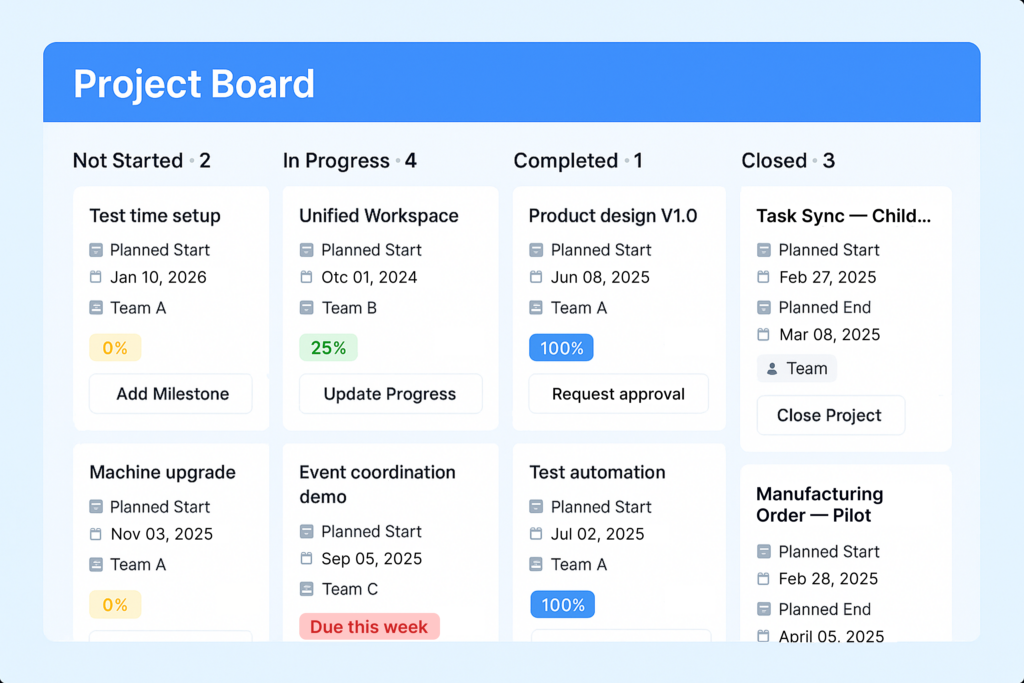
That kind of result is where digital lean manufacturing becomes practical rather than theoretical. The value does not come from adding another dashboard alone. It comes from linking frontline detection, problem solving, accountability, and management review in one system that people actually use.
Why No-Code Matters for Lean Teams
Factory processes change constantly. A defect code needs to be added, an approval path changes, a new production line starts, or a customer requires extra traceability. Traditional software projects are often too slow for these changes, which is why so many lean teams fall back to spreadsheets. Jodoo’s no-code approach allows operations teams to update forms, workflows, and dashboards quickly, so the system evolves with the plant instead of becoming outdated.
That flexibility is especially useful for CI managers trying to sustain gains after kaizen events. If a workshop creates a new standard check, escalation trigger, or daily accountability routine, the team can configure it directly in the platform and deploy it fast. This shortens the gap between improvement design and shop-floor execution, which is essential for successful lean digital transformation.
In short, Jodoo supports lean manufacturing digitalization by helping manufacturers standardize what matters, automate what slows teams down, and visualize what needs attention now. For plant managers and lean leaders, that means fewer disconnected tools, stronger action follow-up, and a more sustainable path to digitizing lean tools across lines, departments, and sites.
Conclusion: Start Small, Scale Smart, and Build Your Lean 4.0 Foundation with Jodoo
Lean manufacturing digitalization works best when you treat it as an extension of lean, not a replacement for it. Your plant still needs standard work, visual management, daily accountability, and disciplined problem-solving. What digital tools add is consistency, speed, and visibility across shifts, lines, and sites. That is especially important when improvement actions, audit findings, and production data are still trapped in paper forms, spreadsheets, or WhatsApp messages.
The most practical roadmap is to start with one high-friction process and prove the result quickly. Imagine a production manager at an electronics plant who begins by digitizing layered process audits, or a lean manager at an automotive parts plant who tracks Kaizen action items in one shared system instead of six Excel files. Once that process is stable, you can expand into A3 tracking, on-site inspections, maintenance workflows, and KPI dashboards. This step-by-step approach reduces risk and helps you show measurable gains in closure rates, response time, and audit compliance.
Jodoo gives manufacturers a practical way to begin lean manufacturing digitalization without heavy custom development. As a no-code lean manufacturing platform, it helps you build forms, workflows, dashboards, and action tracking that match how your factory actually runs. If you want to start with one process, one team, or one plant, you can start a free trial or book a demo to see what fits your operation.