Introduction: Why Lean Manufacturing Software Matters in 2026
Many manufacturers are still trying to run lean programs with paper checklists, Excel trackers, and disconnected messaging tools. That approach breaks down fast when you need real-time visibility across multiple lines, shifts, or plants. In fact, manufacturers lose an estimated 20% to 30% of productive capacity to operational inefficiencies such as downtime, rework, waiting, and poor coordination. That is why lean manufacturing software has become a practical priority in 2026, not just a digital nice-to-have.
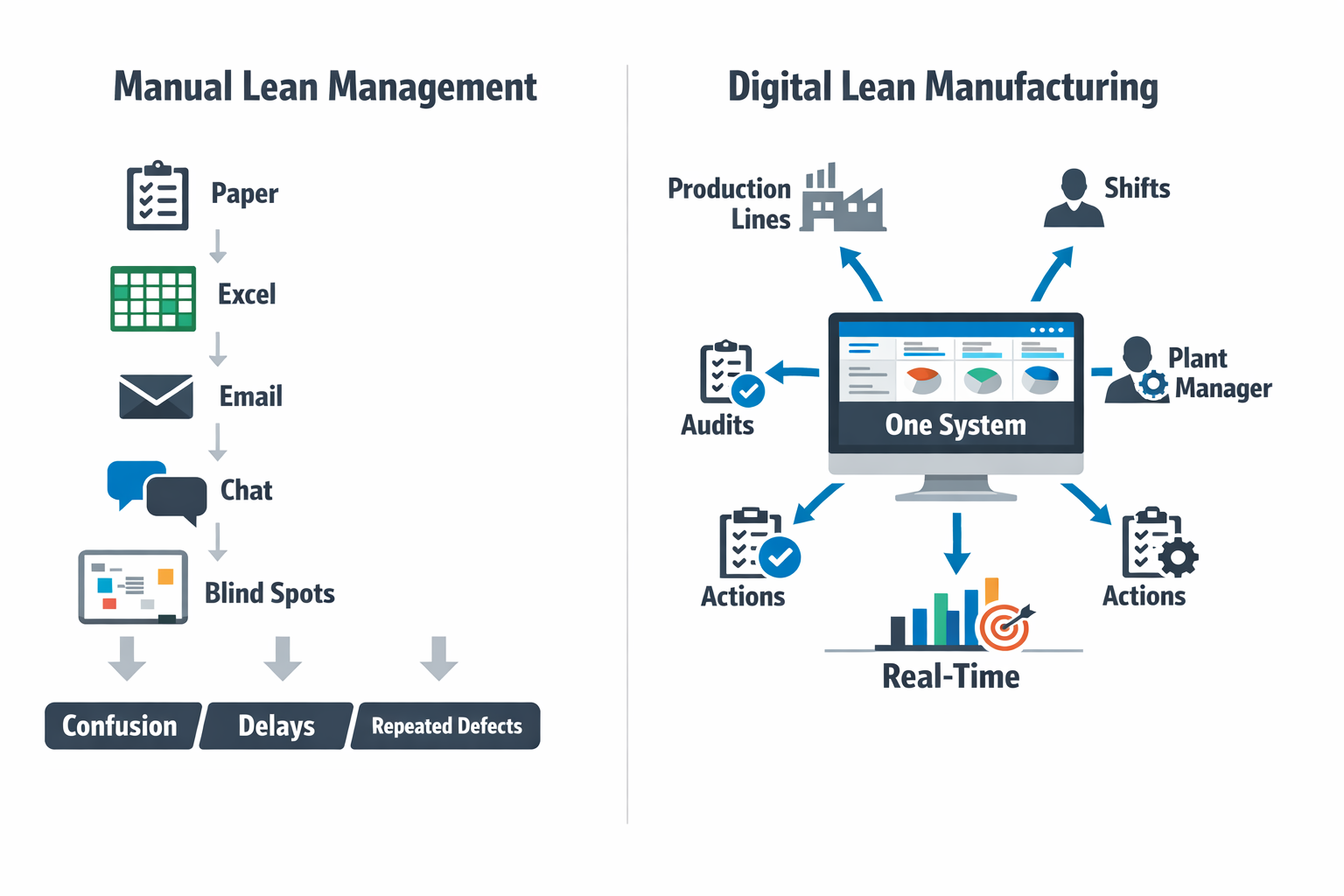
Imagine a production manager at an automotive parts plant who runs daily Gemba walks on paper, tracks Kaizen actions in spreadsheets, and follows up on audit findings by email. By the time action items are reviewed, the line has already repeated the same defects for three more shifts. The problem is not lean thinking. The problem is that the system for sustaining lean is too slow, fragmented, and hard to scale.
This buyer’s guide is written for plant managers, lean leaders, and operations directors evaluating lean management software and digital lean manufacturing platforms. You will learn what features matter most, how to compare tools, what pitfalls to avoid, and which systems fit different factory environments in 2026.
Common Pain Points That Push Manufacturers to Adopt Lean Manufacturing Software
Many manufacturers do not start looking for lean manufacturing software because they want another IT project. They start looking because their current lean system is too dependent on spreadsheets, paper checklists, whiteboards, and follow-up through WhatsApp or email. The result is familiar on the shop floor: teams run Kaizen events, record audit findings, and open corrective actions, but weeks later no one has a reliable view of what was completed, what slipped, and what is driving repeat losses.
This is where software moves from “nice to have” to operational necessity. Whether you call it lean management software, lean production software, or part of a broader digital lean manufacturing strategy, the goal is the same: make improvement work visible, trackable, and sustainable across lines, shifts, and plants. Below are the pain points that most often trigger the search.
Disconnected Spreadsheets Create Blind Spots
In many factories, continuous improvement data lives in too many places at once. A Lean Manager may track Kaizen ideas in Excel, supervisors may record 5S findings on paper, maintenance may log actions in a separate system, and quality may manage NCRs in email threads. That fragmentation makes it almost impossible to see whether problems are linked, duplicated, or unresolved.
Imagine a production manager at an automotive parts plant who is trying to reduce changeover losses on three stamping lines. One line records downtime in a spreadsheet, another in a daily shift report, and the third on a whiteboard photographed at the end of the shift. By the time the data is compiled, the team has already lost several days, and the root cause discussion is based on incomplete information rather than real-time facts.
This is a common reason manufacturers move toward lean manufacturing tools that centralize improvement data. When Kaizen ideas, audits, A3s, and action items sit in one system, teams spend less time chasing files and more time solving problems. It also gives plant leaders a single source of truth for lean factory performance.
Manual Audits Are Done, but Follow-Up Is Weak
Layered process audits, 5S checks, safety walks, and startup verification forms are critical to lean discipline. The problem is that in many plants, audits are completed manually and then filed away without structured follow-up. A supervisor may catch a recurring issue during an audit, but if there is no automatic escalation or ownership assignment, the same gap shows up again next week.
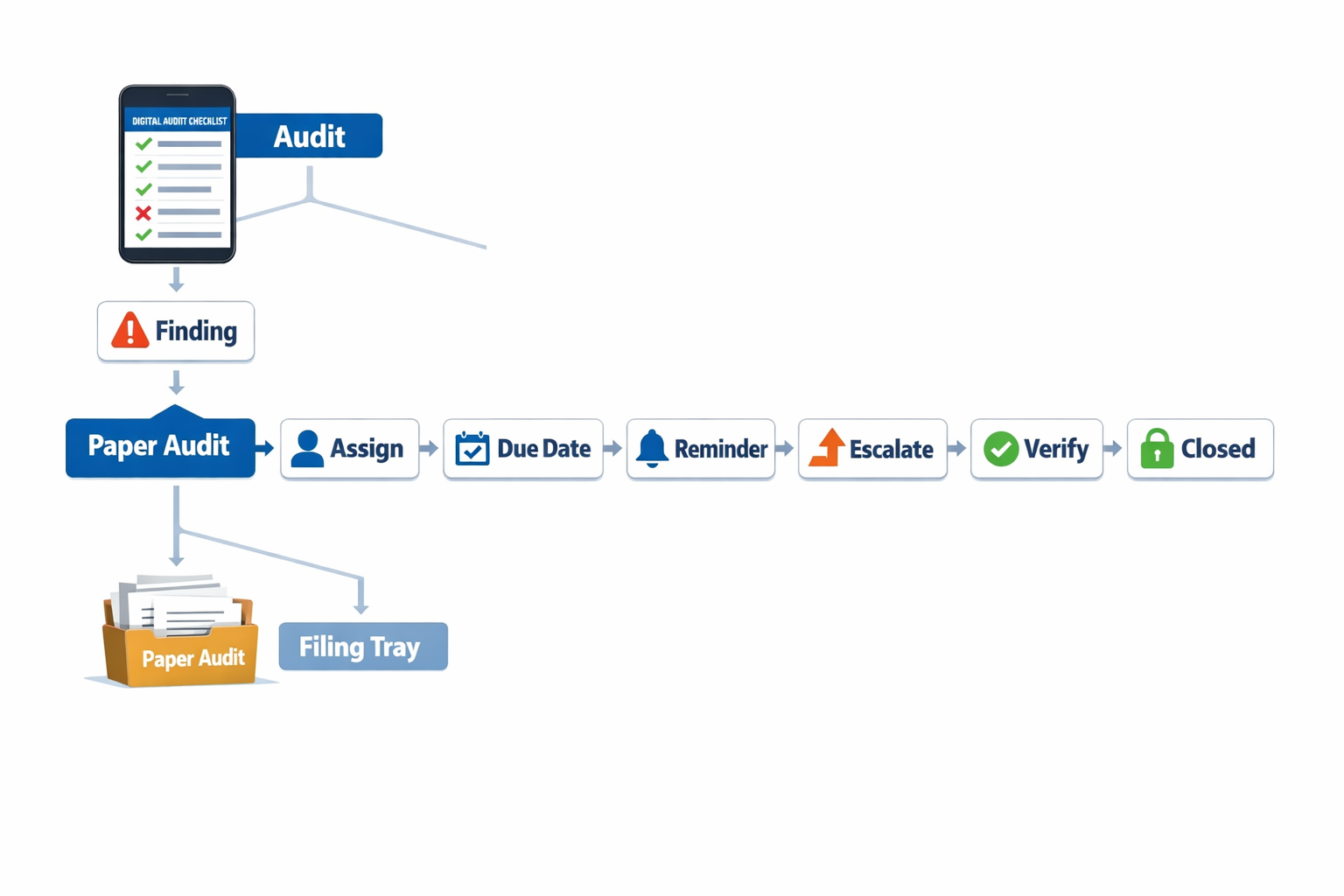
This is especially common in electronics and food manufacturing, where process compliance and standard checks happen frequently across multiple shifts. A paper-based audit can confirm that a problem exists, but it does not ensure that the right person is notified, a deadline is set, or closure is verified. That gap between detection and action is where continuous improvement breaks down.
Lean management software helps by turning audits into workflows instead of static records. An abnormal finding can automatically create a corrective action, notify the area owner, and escalate if it is overdue. In practice, that means audit compliance stops being a reporting exercise and starts becoming a control mechanism.
Delayed Issue Escalation Causes Small Problems to Become Big Losses
On the shop floor, delay is expensive. A minor recurring defect, missing tool, or machine setting deviation can stay local for hours because operators and supervisors are using informal communication channels. By the time the issue reaches engineering, quality, or maintenance, scrap has increased, output has dropped, and the team has lost the chance for early intervention.
Consider a food packaging plant where seal integrity failures start appearing during the night shift. Operators note the issue in a logbook, but the quality engineer only sees it during the morning review. That delay can mean thousands of rejected packs, rework labor, and missed delivery schedules, all from a problem that could have been escalated immediately with the right digital workflow.
This is why manufacturers adopt lean production software with mobile reporting, alerts, and escalation rules. Faster visibility shortens response time, which is one of the most practical benefits of digital lean manufacturing. In lean terms, it removes waiting, reduces defect spread, and supports quicker containment.
Weak KPI Visibility Makes Lean Progress Hard to Prove
One of the biggest frustrations for Lean Managers is that improvement work happens every day, but the results are hard to quantify for leadership. Teams may know they ran Kaizen activities, reduced motion waste, or improved audit scores, but if KPI reporting is delayed or inconsistent, the business impact stays unclear. That weakens support for future lean initiatives.
Industry research consistently shows that manufacturers with real-time performance visibility respond faster to disruptions and make better operational decisions. In practical terms, if your OEE, first-pass yield, audit closure rate, and action aging are updated only at the end of the week, you are managing the factory in hindsight. Lean systems work best when problems and trends are visible while there is still time to act.
A strong lean factory management platform gives each level of the organization the right view. Team leaders can see open actions by cell, production managers can track recurring losses by line, and operations directors can review plant-wide trends across safety, quality, delivery, and cost. That level of visibility is often the difference between a lean program that scales and one that remains stuck in pilot mode.
Inconsistent Standard Work Across Shifts and Sites
Standard work is at the heart of lean, but maintaining consistency is harder than most teams expect. Instructions are updated in one area but not another, operators use old checklists, and supervisors interpret audit standards differently across shifts. In a multi-line or multi-site operation, that inconsistency creates variation that directly affects quality, output, and training time.
Imagine an electronics assembly plant introducing revised torque verification steps after a customer complaint. The day shift gets the update during a morning briefing, but the night shift continues using an older paper instruction. Within days, the plant has different methods running in parallel, which increases the risk of defects and undermines the corrective action itself.
This is another trigger for adopting lean manufacturing software instead of relying on static documents. Digital standard work, controlled forms, revision history, and role-based access make it easier to ensure the latest process is the one being followed. For manufacturers pursuing ISO 9001 or customer-specific compliance requirements, that control is operationally important, not just administrative.
Corrective Actions Move Too Slowly
Most factories are not short on identified problems. They are short on disciplined closure. Teams open action items after audits, Gemba walks, customer complaints, and Kaizen events, but deadlines slip because ownership is unclear and status updates are manual. Over time, the backlog grows, and confidence in the improvement system drops.
A common scenario in an automotive supplier plant is this: a cross-functional team completes a root cause review on a defect issue and opens eight action items across production, maintenance, and quality. Two weeks later, only three are complete, two are still “in progress,” and no one is sure whether the remaining actions were even started. Without structured tracking, corrective action becomes more about reminders than execution.
This is where lean manufacturing tools with workflow automation make a measurable difference. They can assign owners, set due dates, send reminders, require evidence of completion, and flag overdue actions on a dashboard. Many manufacturers see faster closure rates simply because the process becomes visible and accountable instead of dependent on memory and meetings.
Continuous Improvement Participation Is Too Low
Lean depends on engagement from operators, supervisors, and support teams, but many suggestion programs fail because they are too hard to use. If employees must fill out paper forms, email supervisors, or wait for a monthly review board, participation stays low. Good ideas never enter the system, and improvement becomes something driven only by the CI team.
In a labor-intensive food or garment factory, frontline employees often see waste first: excess motion, waiting time, repetitive defects, or avoidable material loss. But if submitting an idea takes 15 minutes and offers no feedback loop, most people will stop contributing. A digital workflow with mobile forms, simple categories, photo uploads, and transparent status updates makes participation much easier.
This is an important part of digital lean manufacturing that is often overlooked. The best lean management software does not just track projects from managers; it creates a practical channel for everyday improvement from the shop floor. That helps manufacturers scale lean culture, not just lean reporting.
Why These Pain Points Lead to Software Adoption
When these problems stack up together, factories reach a clear limit with manual systems. Spreadsheets may work for one line, one engineer, or one short-term project, but they do not support sustainable lean factory management across multiple departments and shifts. What manufacturers need is not just a database, but a connected system for capturing issues, assigning action, monitoring KPIs, and reinforcing standard work.
That is why the search increasingly shifts toward lean production software that combines forms, workflows, dashboards, and mobile access in one environment. For manufacturers, the real value of lean manufacturing software is not simply digitizing paperwork. It is creating a faster, more disciplined improvement system that helps the shop floor respond, learn, and improve every day.
What Lean Manufacturing Software Should Actually Help You Improve
Too many buyers evaluate lean manufacturing software like a generic task management tool. That is a mistake. In a factory, lean is not just about assigning actions; it is about making waste visible, standardizing how teams respond, and proving that improvements hold over time.
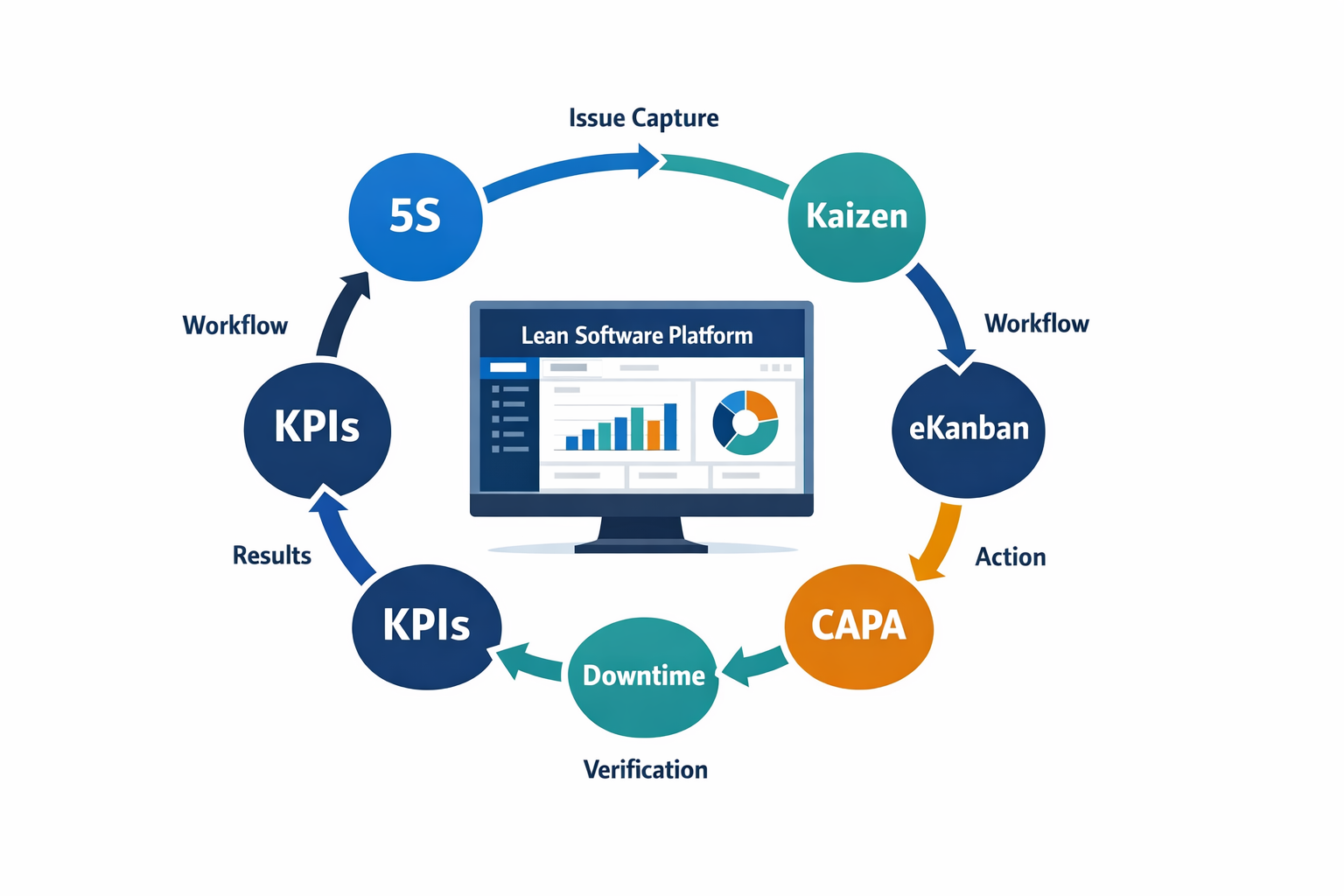
The best platforms support the daily operating system of a lean plant. That includes 5S audits, Kaizen idea tracking, eKanban, CAPA workflows, layered process audits, downtime reporting, and visual KPI management. If your software cannot connect these activities from problem detection to action closure to measurable results, it will not support real digital lean manufacturing.
It Should Support Core Lean Manufacturing Tools, Not Just To-Do Lists
A production manager does not need another app that simply logs tasks and sends reminders. They need a system that reflects actual lean manufacturing tools used on the shop floor, with structured forms, standard workflows, timestamps, ownership, escalation rules, and audit history. This matters because lean failures often happen after the improvement workshop ends, when action items live in spreadsheets and no one knows what is overdue.
Imagine a production manager at an automotive parts plant who runs a weekly 5S audit across stamping, machining, and final inspection. With basic software, they might record scores and manually email findings. With purpose-built lean management software, the audit can trigger corrective actions automatically, assign due dates by area owner, escalate overdue items to supervisors, and show repeat findings by line or shift in a dashboard.
It Should Reduce Waste in Daily Execution
Lean software should help you cut the wastes that operators and supervisors face every shift: waiting, motion, overprocessing, excess inventory, defects, and rework. For example, lean production software can digitize downtime reporting so that small stops are recorded at the machine, categorized consistently, and linked to root cause and follow-up actions. Without that structure, many plants only analyze major breakdowns and miss the chronic minor losses that quietly reduce OEE.
In electronics assembly, a line leader may lose 12 to 15 minutes per shift chasing missing material, unclear changeover status, and handwritten defect notes. A digital system can combine eKanban signals, issue logging, and response workflows in one place, reducing delays between problem detection and action. Even a 5% reduction in unplanned micro-stoppages can translate into significant annual output gains on high-volume lines.
It Should Standardize Audits and Leader Routines
One of the biggest benefits of lean factory management software is standardization. A layered process audit should not depend on who is on shift or whether a printed checklist is available. The system should present the right audit questions by role, line, or process, require photo evidence where needed, and automatically flag nonconformances for follow-up.
This is especially important in multi-line or multi-site operations. Research from industry quality programs consistently shows that poor standard work execution is a major driver of variation, defects, and safety incidents. When audits are digitized, managers can compare completion rates, recurring findings, and closure speed across departments instead of relying on anecdotal updates in morning meetings.
It Should Close the Loop Between Problems and CAPA
Many factories collect problems well but fail at closure. Operators raise issues, supervisors discuss them, and then the action disappears into WhatsApp chats, email chains, or someone’s notebook. Strong lean manufacturing software closes that loop by linking issue capture, root cause analysis, CAPA, verification, and KPI impact in one workflow.
Take a food manufacturing plant dealing with repeated seal integrity defects on one packaging line. A good system would let the quality team log the defect, attach photos, launch an 8D or CAPA workflow, assign engineering checks, verify corrective action effectiveness, and monitor whether defect rates fall over the next two weeks. That is a very different outcome from simply recording “machine adjusted” in a spreadsheet with no evidence of sustained improvement.
It Should Make Kaizen Measurable, Not Just Visible
A suggestion box is not a Kaizen system. If you want higher employee participation, your software should make it easy to submit ideas from mobile devices, route them for review, track implementation status, and quantify outcomes such as labor hours saved, scrap reduced, or floor space freed up. Plants with structured employee suggestion systems often see much higher engagement than sites that run CI programs through paper forms alone.
For example, imagine a supervisor in a beverage plant who proposes a new staging layout that cuts forklift travel near the filling area. In a proper lean management software workflow, the idea is submitted, evaluated, approved, trialed, and measured against baseline travel time and near-miss risk. Management can then see not only how many ideas were submitted, but which ones produced verified savings.
It Should Improve Visual Management and Decision Speed
Visual management is one of the clearest tests of whether a platform supports real lean operations. Dashboards should show live status on audit completion, open actions, downtime trends, defect Pareto, Kanban shortages, and overdue CAPA by area. If managers still need to export CSV files and build PowerPoint slides before every production review, the software is not helping enough.
In practical terms, digital visual management shortens response time. A plant manager can see that one SMT line has a spike in feeder-related stoppages, while another has recurring first-pass yield losses after changeovers. That lets the team focus on the biggest abnormality first, which is exactly what digital lean manufacturing should enable.
It Should Connect Frontline Data to Business Results
The strongest lean production software does not stop at activity tracking. It connects frontline actions to business outcomes such as OEE, scrap cost, on-time delivery, labor productivity, and customer complaints. This is critical because senior leaders do not fund lean based on the number of audits completed; they fund it based on measurable operational improvement.
If your software can show that overdue Kaizen actions dropped by 70%, average CAPA closure time fell from 21 days to 8 days, and recurring downtime on a bottleneck machine decreased by 18%, you have a much stronger case for scaling lean across the plant. That is where lean factory management becomes strategic, not administrative.
What to Look for in Practice
When evaluating lean manufacturing software, ask whether it helps your team do five things consistently. First, capture problems at the point of occurrence with structured data. Second, trigger the right workflow automatically, whether that is a 5S action, LPA follow-up, CAPA, or Kaizen review.
Third, assign ownership and deadlines with visible escalation. Fourth, measure whether the action actually improved performance. Fifth, display results clearly so line leaders, CI managers, and plant leadership can act quickly. If the platform cannot do all five, it may help with tracking, but it will not support mature lean manufacturing tools at scale.
For many manufacturers, this is why flexible platforms like Jodoo are gaining attention. Instead of forcing your plant to fit rigid workflows, you can build apps for 5S, layered audits, downtime reporting, Kaizen, CAPA, and KPI dashboards that match your actual process. That gives operations teams a practical path to digital lean manufacturing without waiting for heavy custom development.
What to Look for in Lean Management Software
Choosing lean manufacturing software is not the same as choosing a generic task management tool. In a factory, the software has to support daily problem-solving, standard work, audits, action tracking, and cross-functional follow-up under real production pressure. If it cannot handle the way manufacturing processes actually change on the shop floor, it will quickly become another disconnected system that operators ignore and managers update manually in Excel.
A good buying framework should help you separate true lean management software from software that only looks polished in a demo. The right system should make lean routines easier to sustain, not create extra admin work for supervisors and CI teams. For production managers and plant leaders, the key question is simple: will this software help you close more actions, surface problems faster, and sustain improvements across lines, shifts, and sites?
Usability on the Shop Floor Matters More Than Feature Count
Many software vendors lead with long feature lists, but plant teams care more about adoption than features on paper. If operators, team leaders, and supervisors cannot use the system in less than a few minutes of training, your Kaizen board, LPA checklist, and corrective action workflow will fall back to paper. In manufacturing, ease of use is not a nice-to-have; it directly affects participation rates and data quality.
Imagine a production manager at an automotive parts plant who asks line leaders to submit abnormality reports during every shift. If the system takes too many clicks, requires desktop access, or forces users to enter too much text, reports will be delayed or skipped entirely. The best lean manufacturing tools use simple forms, clear status views, and role-based screens so each user sees only what they need to act on.
Workflow Flexibility Is Critical for Real Lean Operations
Lean processes are structured, but they are not static. Your plant may run 5S audits one way today, then add photo evidence, escalation rules, and maintenance handoffs three months later. A rigid system that cannot adapt to these changes without costly development will slow your lean program instead of supporting it.
This is where many generic apps fail. They may handle basic task assignment, but they struggle with layered process audits, A3 reviews, CAPA ownership, or escalation rules tied to production areas and management levels. Strong lean production software should let you configure workflows for Kaizen ideas, nonconformance follow-up, 8D investigations, and audit findings without needing a full IT project every time the process evolves.
Mobile Data Capture Should Work in Real Factory Conditions
Lean data is created where the work happens, not in a meeting room. That means your software should support mobile inspections, quick issue logging, barcode or QR-based equipment checks, photo capture, signatures, and offline-friendly data entry where connectivity is weak. If mobile usage is poor, frontline teams will write notes on paper first and enter them later, which introduces delay and error.
This is especially important in sectors like electronics and food manufacturing. For example, a food plant supervisor performing a GMP and 5S walk should be able to log findings on a phone, attach a photo of an unlabelled material bin, assign a due date, and trigger a corrective action immediately. That is the difference between basic software and practical digital lean manufacturing capability.
Dashboards Should Show Action, Not Just Activity
One of the biggest frustrations for Lean Managers is having plenty of data but very little visibility into whether problems are being solved. Good dashboards should go beyond counting submitted forms or completed audits. They should show open action items by area, overdue corrective actions by owner, repeat findings by line, audit score trends, and the cycle time from issue identification to closure.
A McKinsey study has found that manufacturers using digital performance management effectively can improve productivity by 10% to 30%, especially when frontline decisions are supported by timely operational data. In practice, this means your lean factory management platform should help shift leaders and plant managers see where execution is breaking down. If a dashboard cannot tell you which department has the most overdue Kaizen actions or which line has recurring process discipline issues, it is not giving you operational control.
Approvals and Escalations Need to Match Plant Reality
Lean work often crosses departments. A simple improvement idea may need review from production, engineering, maintenance, and quality before it can be implemented safely. The software should support multi-step approvals, conditional routing, reminders, and escalation rules so actions do not stall in inboxes or verbal handoffs.
Consider an electronics assembly plant where an operator proposes a fixture change to reduce motion waste. The idea may need validation from industrial engineering, approval from quality, and a budget sign-off from operations. If your lean management software cannot route that workflow automatically and track each approval step, improvements will slow down and employee participation will drop.
ERP and MES Integration Prevents Data Silos
Lean software should not live in isolation from the rest of your factory systems. To be useful at scale, it should connect with ERP, MES, maintenance, and quality data where relevant. Without integration, teams end up rekeying work order numbers, production data, downtime causes, or defect references into separate systems, which creates inconsistencies and wastes time.
For example, if a Kaizen action is linked to a high-scrap process, the team should be able to trace that improvement against actual defect trends or production results. If an audit finding relates to a machine condition, it should be possible to hand off the issue into a maintenance workflow without email chains. This is what separates true lean manufacturing software from standalone work apps that only manage forms and tasks.
Scalability Matters if You Want to Sustain Lean Beyond One Pilot Line
Many plants start with one area, one use case, or one enthusiastic CI manager. The real test comes when you expand from one line to an entire plant, then to multiple sites. Software that works for 20 users may break down at 500 users if permissions, reporting structures, and performance are not designed for scale.
This matters for manufacturers with regional operations in Southeast Asia, where one group may want common audit templates across several factories but local flexibility in workflows and language fields. Strong lean manufacturing tools should support standardized core processes with site-level adaptation, while keeping all improvement records in one system. That balance is essential if you want to compare performance across plants and prove lean ROI to senior leadership.
Governance and Auditability Are Not Optional
Lean systems often touch quality, safety, and compliance workflows, so governance matters. You need role-based access, change history, audit trails, version control for forms, and clear ownership of actions. Without these controls, it becomes difficult to trust the data or defend decisions during ISO 9001 or ISO 45001 audits.
A practical example is layered process audits. If an LPA finding is edited after submission, managers should be able to see who changed it and when. If a corrective action is overdue, the system should show the owner, escalation path, and evidence of closure. This level of control is rarely strong in consumer-grade work management apps, but it is essential in manufacturing.
Time-to-Value Should Be Measured in Weeks, Not Quarters
Factories do not want a 12-month software project just to digitize audits and Kaizen actions. Buyers should ask how quickly the system can be configured, piloted, and rolled out to one production area. In many cases, the best results come from starting with a focused use case such as LPA, 5S audits, improvement proposals, or A3 tracking, then expanding once adoption is proven.
A practical benchmark is whether a plant can launch its first working workflow in 2 to 6 weeks, not six months. If the vendor requires heavy coding, long consulting cycles, or major IT dependency for every process change, your lean team will lose momentum. Good lean production software should deliver quick wins while still giving you room to grow into broader lean factory management later.
How to Spot Generic Work Management Software Disguised as Lean Software
Some platforms position themselves as lean solutions, but they are really generic task or project management systems with a manufacturing label added on top. They may look modern, but they often lack audit workflows, hierarchical approvals, frontline mobile forms, traceable action closure, and operational dashboards tied to plant KPIs. In short, they manage to-do lists, not lean execution.
You can usually spot this quickly during evaluation. Ask the vendor to show a full use case: an operator raises a problem, a supervisor verifies it, engineering reviews the root cause, a corrective action is assigned, due dates escalate automatically, and management sees closure status on a dashboard. If they cannot demonstrate that end-to-end flow in a realistic factory scenario, it is probably not true lean management software.
A Practical Checklist for Buyers
When you evaluate lean manufacturing software, use a checklist that reflects daily factory work:
- Can frontline teams submit audits, issues, and Kaizen ideas easily on mobile?
- Can workflows be changed without custom coding every time your process evolves?
- Can you track open actions, overdue items, repeat findings, and closure evidence in real time?
- Can the system support approvals across production, quality, maintenance, and engineering?
- Can it integrate with ERP, MES, or maintenance systems to reduce duplicate data entry?
- Can it scale across lines, departments, and multiple plants with role-based access?
- Does it provide audit trails, data governance, and controlled visibility for compliance?
- Can your team get value from the system within weeks, not after a long implementation cycle?
If the answer to several of these questions is no, the software may still be useful as a generic workflow tool, but it will not be strong enough for sustained digital lean manufacturing. The right platform should fit the rhythm of the shop floor, support continuous improvement across departments, and adapt as your lean maturity grows. That is what buyers should prioritize in 2026.
Best Lean Manufacturing Software in 2026: Comparison Criteria and Vendor Types
If you are evaluating lean manufacturing software in 2026, the biggest mistake is comparing every vendor as if they solve the same problem. In practice, they do not. A plant that needs digital layered process audits across three lines has very different requirements from a multi-site manufacturer trying to connect production planning, traceability, maintenance, and quality in one platform.
That is why the most useful way to compare lean manufacturing tools is by vendor type, not just by feature checklist. Some platforms are built as broad operational systems, some focus on one lean use case, and others give you a flexible way to build lean workflows around your actual factory processes. Your best fit depends on process maturity, IT capacity, rollout speed, and how much standardization you already have on the shop floor.
Start With These Comparison Criteria
Before looking at vendor categories, define what you actually need the software to improve. For most production and lean leaders, the shortlist should be based on six practical criteria: scope, speed of deployment, flexibility, frontline usability, reporting depth, and integration. If a tool looks impressive in a demo but cannot fit your escalation flow, audit cadence, or action-tracking process, it will struggle in a real factory environment.
First, check the software’s scope. Does it only digitize one activity like audits or idea submission, or can it also connect corrective actions, approvals, dashboards, and management review? A surprising number of plants buy software for one pain point, then end up back in Excel because the rest of the improvement process still lives in email and paper.
Second, look at deployment speed and configuration effort. A full enterprise platform may offer broad functionality, but implementation can take months and require external consultants. By contrast, more flexible lean management software or no-code platforms can often digitize high-value workflows such as Kaizen tracking, 5S audits, red-tag follow-up, or A3 approvals in weeks rather than quarters.
Third, assess usability on the shop floor. If operators, supervisors, and section leaders cannot complete tasks quickly on mobile devices, adoption will drop fast. In manufacturing, even small friction matters; when a line leader has less than two minutes between issues, software must support quick data capture, photos, QR scans, and simple status updates.
ERP and MES Platforms: Best for Enterprise-Wide Control
ERP and MES platforms are usually the right fit when your lean initiative is tightly tied to production execution, traceability, inventory accuracy, scheduling, and compliance. These systems are strong when you need one operational backbone across planning, quality, maintenance, and production. They are especially common in automotive, electronics, and regulated food manufacturing where process discipline and data consistency matter across multiple departments.
The trade-off is that these systems are not always the fastest route to better continuous improvement execution. Imagine a production manager at an automotive parts plant who wants to standardize daily management boards, layered audits, and open action tracking across four machining lines. An ERP or MES can support the surrounding operation, but configuring lean workflows inside it may require IT resources, change requests, and longer deployment cycles.
For mature organizations with strong internal IT and a clear digital roadmap, this category can make sense. It works best when lean is part of a broader smart factory or digital lean manufacturing strategy. But if your immediate problem is sustaining Kaizen actions, driving supervisor accountability, or increasing employee participation in improvement programs, ERP/MES can be more system than you need at the start.
Point Solutions: Best for Solving One Lean Problem Fast
Point solutions are focused tools designed for a narrow use case such as Kaizen ideas, daily management, OEE tracking, value stream mapping, or problem solving. Their biggest advantage is speed. If your plant has one urgent gap, such as poor visibility into open corrective actions after Gemba walks, a focused tool can deliver results quickly without a large transformation project.
This category often works well for plants in the early or middle stages of lean maturity. For example, an electronics assembly plant may want to increase employee suggestion participation because fewer than 15% of operators submit ideas each quarter. A dedicated improvement platform with simple submission forms, approval routing, and recognition tracking can lift engagement faster than a large enterprise rollout.
The limitation is fragmentation. Once you add one tool for Kaizen, another for audits, and another for dashboards, your CI data ends up scattered again. That undermines one of the core goals of lean factory management: making abnormalities, ownership, and results visible in one place.
Checklist and Audit Tools: Best for Standard Work and Compliance
Checklist and audit tools are ideal when your main challenge is discipline, verification, and follow-up. They are commonly used for layered process audits, 5S checks, startup verification, sanitation inspections, safety observations, and standard work confirmation. In food manufacturing especially, these tools help supervisors and quality teams digitize recurring checks while creating a cleaner audit trail for ISO 9001 or ISO 45001 aligned processes.
Their value comes from consistency. Research from multiple industrial digitization studies shows that digital inspections can reduce reporting delays by over 50% compared with paper-based processes, largely because issues are logged immediately and routed automatically. If you are still using printed check sheets that are keyed into spreadsheets at the end of the shift, this category can produce quick operational gains.
However, audit tools often stop at data capture. They may record a nonconformance, but they do not always manage the full improvement cycle from root cause analysis to countermeasure verification and KPI reporting. That is a problem when your goal is not just compliance, but sustained lean performance.
No-Code Lean Production Software: Best for Flexible, Process-Driven Rollouts
No-code lean production software is increasingly attractive for manufacturers that need something between rigid enterprise systems and narrow point solutions. This category is well suited to plants that already know their processes but do not want to wait for custom development. Instead of forcing your team into a fixed workflow, you configure apps, forms, approvals, dashboards, and alerts around how your factory actually runs.
This approach is particularly useful when lean processes vary by site, line, or product family. Imagine a plant manager at a food packaging factory who needs to digitize daily line checks, downtime escalation, Kaizen proposals, and corrective action reviews across three shifts. With a no-code platform like Jodoo, the team can build connected workflows for inspections, A3 tracking, layered audits, and KPI dashboards without starting a long IT project.
The main strength here is adaptability. You can start with one workflow, such as LPA management, then expand into 8D, maintenance requests, visual management dashboards, and production reporting on the same platform. For mid-sized manufacturers, this makes no-code one of the most practical forms of lean management software, because it supports standardization without locking the plant into a one-size-fits-all application.
Which Vendor Type Fits Your Plant Best?
If your plant is highly standardized, has strong IT support, and needs enterprise-wide integration, ERP or MES-led solutions are often the best long-term fit. If you need to solve one urgent problem fast, point solutions can work well, especially for idea management or daily accountability. If your biggest issue is recurring checks and audit discipline, checklist and audit software offers the fastest path away from paper.
If your lean systems are evolving and you need flexibility, no-code platforms are often the most practical option. They are especially effective for manufacturers that want to connect inspections, problem solving, action tracking, approvals, and dashboards in one environment. In other words, if your challenge is not just collecting data but turning improvement activity into a repeatable operating system, this is where modern digital lean manufacturing platforms stand out.
A good buying decision starts by matching software type to operational reality. The best lean manufacturing software is not the platform with the longest feature list. It is the one that fits your process maturity, gets used by frontline teams, and helps your plant sustain improvements month after month.
Why Jodoo Stands Out for Digital Lean Manufacturing
Many manufacturers already have ERP, MES, or quality systems in place, but those systems often do not handle daily continuous improvement work well. A plant may have production data in one system, audit checklists in paper files, corrective actions in Excel, and Kaizen ideas buried in email threads. That gap is exactly where lean manufacturing software needs to perform. Jodoo stands out because it gives operations teams a practical way to digitize the work between formal enterprise systems and the realities of the shop floor.
Built for the Processes Standard Software Often Misses
Traditional enterprise software is strong at transactions such as purchase orders, production planning, and inventory movements. It is usually much weaker at managing layered process audits, abnormality reporting, 8D follow-up, A3 reviews, shift handovers, and daily accountability boards. In many factories, these activities still depend on paper, WhatsApp messages, and disconnected spreadsheets, which slows response time and weakens traceability. Jodoo helps close that gap by letting teams build fit-for-purpose workflows without custom coding.
This matters because lean programs fail when improvement work is not easy to sustain. According to industry studies, poor visibility and weak follow-up are major reasons continuous improvement actions stall after initial workshops. Imagine a production manager at an automotive parts plant who finds the same recurring defect every month because audit findings were logged on paper but never linked to owners, due dates, or escalation rules. With Jodoo, that manager can turn the entire loop into a digital process, from issue capture to corrective action closure.
No-Code Flexibility for Real Factory Workflows
A major difference between Jodoo and more rigid systems is flexibility. Instead of forcing your plant to adapt to a fixed workflow, Jodoo allows you to configure apps, forms, approvals, dashboards, and alerts around how your operation actually runs. That is especially useful in digital lean manufacturing, where every site may use slightly different audit frequencies, escalation paths, and KPI definitions. Your CI team can adjust forms and workflows quickly as standards evolve, without waiting months for IT development.
For example, an electronics assembly plant may want separate digital checklists for startup verification, first-piece approval, hourly quality checks, and end-of-shift abnormality review. A food manufacturer may need sanitation inspections, CCP verification records, deviation workflows, and supervisor sign-off with photo evidence. These are not edge cases; they are daily management routines that require speed, mobility, and accountability. Jodoo supports them through no-code configuration, mobile access, structured forms, and automated workflow logic.
A Practical Layer Between ERP and the Shop Floor
Most factories do not need to replace their ERP to improve lean execution. What they need is a lighter, faster operational layer that connects frontline activity to management visibility. Jodoo works well in that role because it can capture real-time data from audits, inspections, issue logs, maintenance checks, and improvement suggestions, then route actions automatically to the right people. That makes it a useful option for manufacturers looking for lean management software that complements existing systems rather than competing with them.
In practice, this means a supervisor can submit an abnormality from a mobile phone, attach a photo, assign severity, and trigger an approval or response workflow in minutes. The maintenance team can receive the task immediately, while the production manager sees the open issue on a dashboard and the plant manager tracks recurring loss categories across lines. Instead of chasing updates through calls and spreadsheets, everyone works from one live system. This is where lean factory management becomes more disciplined and more scalable.
Strong Use Cases for Audits, Actions, and Continuous Improvement
Jodoo is especially well suited for the workflows that lean teams struggle to manage consistently across departments or multiple sites. These include layered process audits, Gemba findings, 5S inspections, Kaizen idea submission, CAPA tracking, 8D problem solving, and escalation of overdue actions. Because the platform combines forms, workflows, dashboards, and permissions in one environment, the process does not break when a handoff happens. Each action stays linked to its source, owner, deadline, and status.
Imagine a Lean Manager in a Tier 1 automotive supplier running weekly LPAs across three production cells. On paper, the audits are completed, but the recurring issue is that findings are not closed on time, and leaders cannot see which departments cause the most overdue items. With Jodoo, each failed checkpoint can automatically create an action item, notify the responsible engineer, set a due date, and escalate to the department head if it stays open beyond 48 hours. A dashboard can then show audit compliance, top recurring nonconformities, and closure rate by department, which is exactly the visibility lean teams need to sustain gains.
Better Visibility Than Spreadsheets and Paper
Many plants still use Excel as their default lean manufacturing tools stack. It is familiar and low-cost, but it creates version-control problems, delayed reporting, and weak accountability once improvement activity scales beyond one line or one department. Paper is even more limiting, especially when supervisors need fast escalation, photographic evidence, or audit trails for ISO 9001 and ISO 45001 requirements. Jodoo replaces those disconnected methods with structured digital records and live dashboards.
That visibility has direct operational value. If a plant is tracking first-pass yield, audit completion, open CAPAs, and repeat defects in separate files, leaders often make decisions based on yesterday’s data or incomplete summaries. With Jodoo, those metrics can update in real time as forms are submitted and workflows move forward. For operations directors, that means faster review cycles and clearer proof of whether lean initiatives are actually reducing waste, downtime, or quality loss.
Faster Improvement Cycles Without Heavy IT Dependency
One of the biggest barriers to implementing lean production software is speed. Operations teams know what they want to improve, but IT backlogs, software change requests, and rigid vendor roadmaps slow everything down. By the time a workflow is approved and deployed, the process on the floor may already have changed. Jodoo addresses this by giving non-technical teams a no-code environment to build and update workflows themselves while still maintaining governance, security, and role-based access.
This is particularly valuable for plants running frequent Kaizen activity. A CI engineer may want to add a root-cause field, revise an escalation rule, or create a new dashboard for weekly review meetings. In a traditional setup, those changes may require external consultants or internal developers. In Jodoo, they can often be configured directly by the operations team, reducing delay and helping improvement cycles move at the pace lean requires.
A Better Fit for Manufacturers With Evolving Processes
Lean systems should not become rigid themselves. As plants expand, add lines, launch new products, or tighten customer requirements, their workflows change. A semiconductor packaging site may need tighter deviation approval flows after a customer audit, while a food processing plant may need additional hygiene verification during peak season. Jodoo is well suited to these situations because teams can adapt apps and workflows without rebuilding the whole system.
That makes Jodoo a strong choice for manufacturers that find generic software too narrow and enterprise platforms too slow to modify. It combines the structure leaders need with the flexibility frontline teams need. For companies serious about digital lean manufacturing, that balance is critical. The goal is not just to digitize forms, but to create a connected improvement system that helps teams detect issues faster, act faster, and sustain results over time.
Real Customer Example: How a Manufacturer Uses No-Code Lean Manufacturing Software
Imagine a production manager at an automotive parts plant running three stamping lines and two assembly cells. The plant has solid lean practices on paper, but daily execution is inconsistent because nonconformance reports are logged in Excel, shift handoff notes sit in WhatsApp groups, and 5S audit findings are pinned to a notice board with no reliable follow-up. This is the kind of environment where lean manufacturing software stops being a nice-to-have and becomes necessary for controlling issues before they affect output, scrap, or customer delivery.
A representative Jodoo customer in this situation used the platform to replace manual lean workflows with a connected set of no-code apps. Instead of buying separate point solutions for audits, action tracking, and reporting, the team built a simple lean management software system tailored to its own process flow. The result was a more practical version of digital lean manufacturing: operators could report issues on mobile, supervisors could assign actions immediately, and managers could see unresolved items by line, shift, and owner in real time.
The Starting Problem: Too Many Gaps Between Detection and Action
Before digitization, the plant’s quality and operations teams were losing time at several points in the workflow. When an operator found a defect such as burrs on a stamped bracket or incorrect torque records in final assembly, the issue was first written on paper, then retyped into a spreadsheet later by a line leader. That delay meant engineering, maintenance, and quality often reacted hours after the problem started, which is a serious gap in a high-volume environment where one hour of undetected defects can create hundreds of suspect parts.
The same plant also struggled with accountability after audits. A 5S walk might identify blocked material lanes, missing visual labels, or oil leakage under a press, but action items were tracked separately in email or messaging threads. According to industry estimates, manufacturers can lose 5% to 20% of productive capacity through hidden process inefficiencies, waiting time, and rework, which is why disconnected follow-up is so costly in practice.
The Jodoo Workflow They Built
Using Jodoo, the plant created a no-code workflow that connected four processes into one system: nonconformance reporting, shift handoff, 5S audit tracking, and CAPA follow-up. Operators submitted issues from a tablet or phone using a structured form with fields for part number, line number, defect type, severity, photos, containment action, and affected quantity. Once submitted, the record automatically triggered a workflow that routed the case to the relevant supervisor, quality engineer, or maintenance technician based on the issue category.
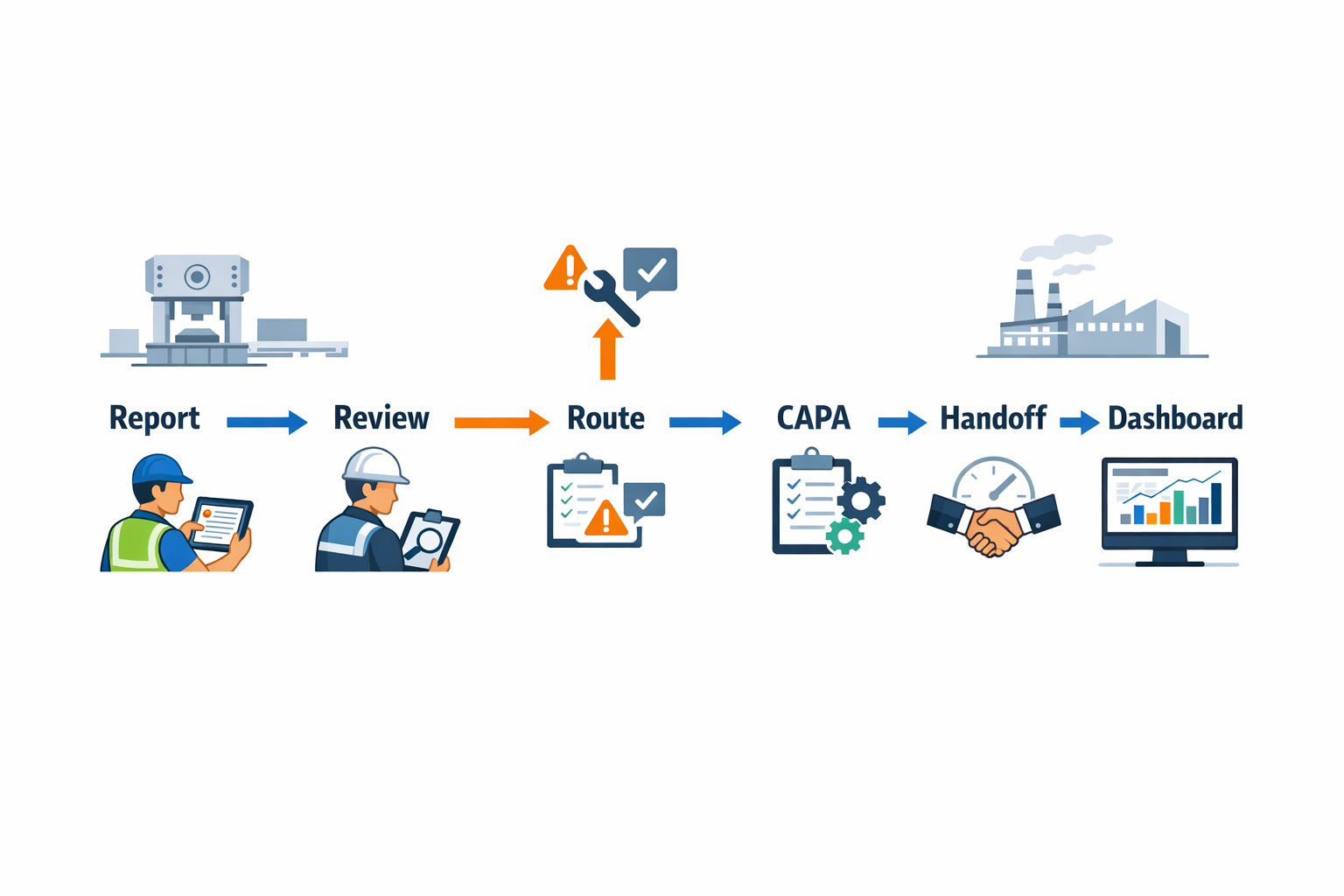
For shift handoffs, supervisors used a digital checklist instead of free-text chat messages. They logged machine status, open quality concerns, material shortages, temporary countermeasures, and priority tasks for the incoming shift. Because the handoff data sat in the same system as nonconformance and CAPA records, the next shift could see not only what happened, but also which actions were still open and who owned them.
Measurable Business Outcomes
The biggest improvement was speed. In this representative use case, average response time for production issues dropped from 4 hours to less than 1 hour because escalation no longer depended on someone re-entering data or forwarding messages manually. For a plant making thousands of parts per shift, cutting those hours directly reduced the volume of suspect inventory and avoided unnecessary line interruptions.
Accountability also improved because every action had an owner, deadline, status, and audit trail. The plant’s CI manager could see which corrective actions were overdue, which departments were closing actions fastest, and which recurring issues were reopening. In one quarter, the team reduced open corrective action items by more than 60%, largely because issues no longer disappeared after a meeting or audit.
KPI visibility changed how managers ran daily reviews. Instead of preparing separate spreadsheets for quality, production, and housekeeping findings, the plant used one dashboard to track defect trends, repeat nonconformances, 5S completion rates, closure time by department, and unresolved high-risk cases. This is where lean production software and lean factory management become operationally valuable: managers spend less time compiling reports and more time removing process waste.
Why No-Code Worked Better Than a Rigid System
The plant did not need a long software project or custom development team to get started. Its CI and operations leaders adjusted forms, escalation rules, and dashboards themselves as the process matured. That matters in lean environments because continuous improvement is iterative by nature; if your software cannot adapt to new audit criteria, new defect categories, or revised approval flows, people fall back to spreadsheets quickly.
Jodoo worked well here because it supported the real workflow rather than forcing the plant into a generic template. The team could add photo evidence, create role-based permissions, set automatic reminders for overdue CAPA tasks, and build dashboards for different users from operators to plant leadership. Compared with disconnected lean manufacturing tools, this created a more unified system for issue management and continuous improvement.
What This Example Means for Buyers
If you are evaluating lean manufacturing software in 2026, this example highlights a simple lesson: the value is not just in digitizing forms, but in connecting detection, assignment, follow-up, and reporting in one flow. Whether you start with nonconformance reporting, layered audits, or shift handoffs, the right lean management software should make problems visible faster and make ownership impossible to ignore. That is the foundation of sustainable digital lean manufacturing across lines, shifts, and sites.
Conclusion: How to Choose the Right Lean Manufacturing Software for Your Plant
The right lean manufacturing software should help you sustain improvement, not just document it. If your team still tracks Kaizen ideas in Excel, closes LPA findings by email, and reports KPI trends days late, the real issue is not a lack of lean tools. It is a lack of connected workflows, real-time visibility, and accountability across the plant.
When you evaluate software, focus on practical fit. Can it capture shop floor data quickly on mobile devices, route actions automatically, and show open issues by line, shift, or department? A production manager at an automotive parts plant who needs to track recurring defects, assign countermeasures, and prove that a Kaizen event reduced scrap by 15% over 60 days. The best platform makes that process simple, visible, and repeatable.
That is why many manufacturers are moving toward flexible, configurable systems instead of rigid point solutions. Jodoo is a no-code platform built for digital lean manufacturing, giving teams a practical way to build lean management apps for Kaizen, A3, LPA, audits, and KPI dashboards without heavy custom development.
If you want a more adaptable approach to lean factory management, explore Jodoo and see how it fits your plant. Start a free trial or book a demo to evaluate it with your real workflows.