Browse by category

Introduction: What a Smart Factory Really Means for Modern Manufacturers
Many manufacturers still lose hours each week chasing paper records, reconciling spreadsheet versions, or waiting for updates from the shop floor. That is a costly problem when even small delays can reduce output, slow response to defects, and weaken on-time delivery. In practical terms, a smart factory is not a fully unmanned plant filled with expensive robots. It is a factory where people, processes, and production data are connected well enough to support faster, more consistent decisions.
For operations, production, plant, and IT leaders, smart manufacturing is usually less about “lights-out” automation and more about building a connected factory step by step. A digital factory starts when frontline data is captured accurately, workflows move without manual chasing, and managers can see issues early instead of after the shift ends. That is the real value: better visibility, shorter response time, and tighter control across production, quality, maintenance, and inventory.
This article breaks that journey into practical stages. First, we will define the core building blocks of a smart manufacturing environment, then examine where factory digital transformation usually gets stuck, and finally outline how manufacturers can start with focused digital workflows and scale from there.
The Core Building Blocks of a Smart Manufacturing Environment
Connected Systems Create a Usable Digital Backbone
A smart manufacturing environment starts with connected information, not with expensive automation hardware. In a workable Industry 4.0 factory, production data, quality records, maintenance updates, inventory status, and shift reporting should move through linked systems instead of staying trapped in paper files or separate spreadsheets. That does not mean every machine must be fully integrated on day one. It means the connected factory has a reliable way to collect, share, and act on operational data across teams.
In practice, this often begins by linking the systems manufacturers already use. An ERP may hold production orders and material data, while a maintenance tool tracks equipment history and a quality team records inspection results. The digital factory becomes useful when these records can be aligned around the same job, batch, line, or asset, so supervisors are not making decisions from three different versions of the truth.
Mobile Data Capture Brings the Shop Floor Into the System
Shop floor digitization usually starts where the work happens: at the machine, line, warehouse aisle, or inspection station. If operators still write downtime reasons, defect counts, first-piece checks, or changeover completion times on paper, then even the best reporting system will run late. Mobile forms, tablets, barcode scanning, and simple operator terminals help capture structured data at the source, with less delay and fewer transcription errors.
A packaging plant, for example, may use mobile checklists for startup verification and hourly quality checks. Instead of waiting until the end of the shift for paper forms to reach the office, the line leader can see missed checks or abnormal readings immediately. This is a basic but important step in factory digital transformation: better input quality produces better operational control. Deloitte has noted that real-time visibility remains one of the strongest drivers behind digital manufacturing investment because it shortens response time on the floor.
Standardized Workflows Turn Data Into Action
Collecting data is not enough if nobody knows what should happen next. A smart factory needs standardized digital workflows that define the next step when a downtime event is logged, a defect threshold is exceeded, or a material shortage is reported. This reduces dependence on verbal handoffs and individual memory, which is especially important across shifts and departments.
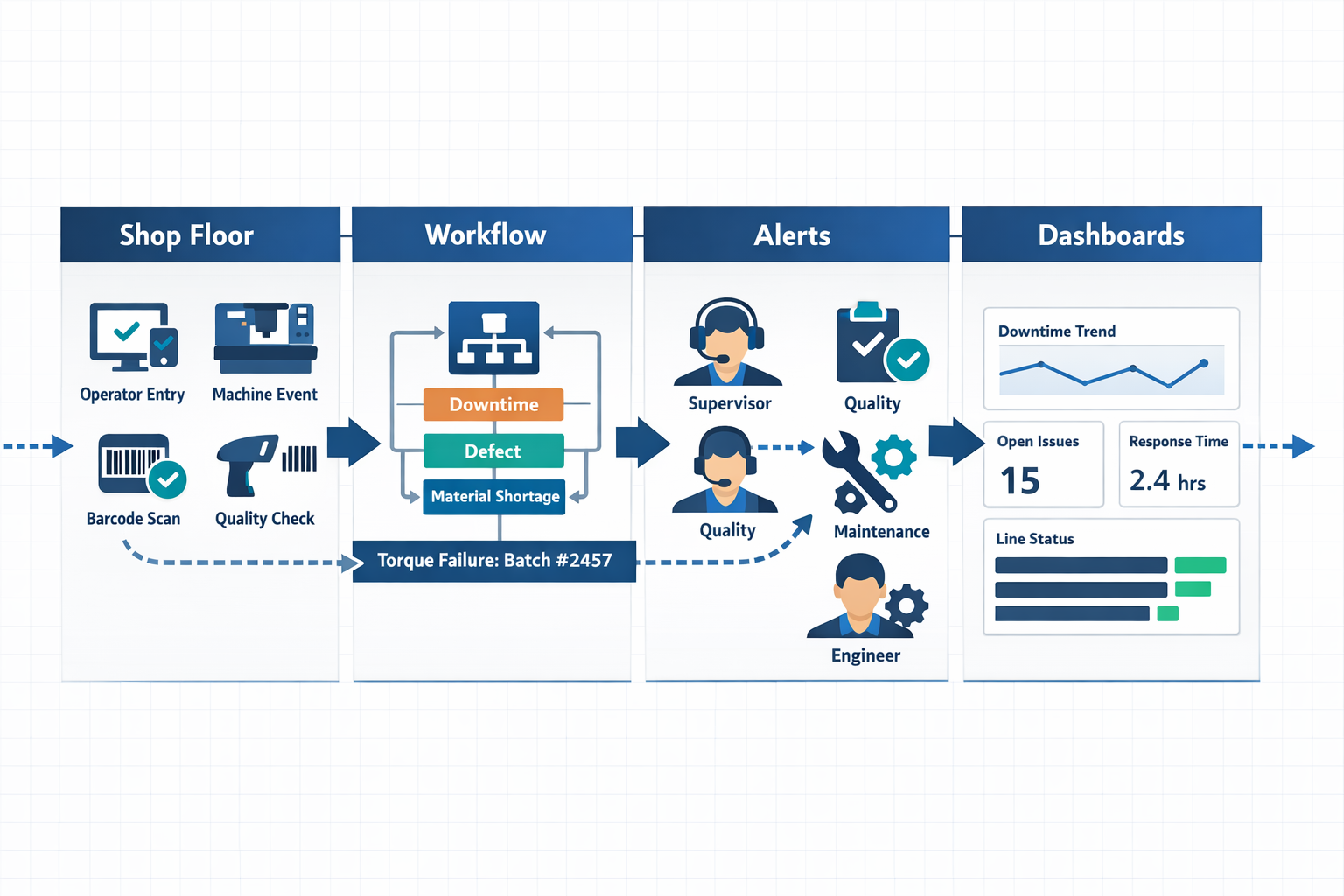
For example, when an operator records a repeated torque failure in an electronics assembly line, the system should automatically route the issue to quality and production engineering, attach the relevant batch information, and track closure. That workflow structure is what makes smart manufacturing practical rather than theoretical. It creates repeatability, which is the operational foundation of a connected factory.
Data then moves in a simple chain: operators and machines generate events, workflows route those events to the right people, and dashboards convert the resulting records into visible performance trends. This is how real-time production data becomes actionable instead of just available. A supervisor can see open stoppages by line, a maintenance planner can track recurring faults by asset, and a plant manager can review response times by shift from the same digital record stream.
Role-Based Alerts Keep Response Times Short
A smart factory also depends on timely escalation. If every alert goes to everyone, teams ignore them; if alerts go to no one clearly responsible, problems sit unresolved. Role-based notifications solve this by sending the right signal to the right person based on line, shift, severity, asset type, or issue category.
This matters most in fast-moving environments where minutes affect output. In an injection molding plant, for instance, a mold temperature deviation may need immediate attention from the shift technician, while a repeated deviation across several jobs should be escalated to the process engineer. Good alert logic supports faster containment without creating noise. That is one reason leading smart manufacturing programs focus on workflow design as much as data collection.
Dashboards Make Real-Time Production Data Operational
Dashboards are valuable when they help teams act, not when they simply display more charts. In a practical smart factory, dashboards should show live production status, downtime trends, quality exceptions, work order progress, and response aging in ways that match each role’s decisions. Operators need line-level visibility, department heads need trend analysis, and plant leaders need cross-functional performance views.
A food manufacturer, for example, may track OEE by line, sanitation completion by area, and hold-and-release status by batch in one operating view. That kind of visibility helps teams prioritize intervention before small disruptions become missed shipments or compliance risks. As smart manufacturing matures, dashboards become the control layer linking shop-floor digitization to daily management routines.
Where Factory Digital Transformation Usually Gets Stuck
The Problem Starts With Disconnected Shop-Floor Execution
Many factory digital transformation programs do not fail at the strategy level. They stall because daily execution still depends on paper forms, WhatsApp messages, Excel trackers, and verbal handovers that never become structured data. A manufacturer may have ERP, MES, or maintenance software in place, but if machine downtime, quality defects, and shift-end counts are first captured manually, the connected factory breaks at the source. In practice, the smart factory journey often gets stuck between enterprise systems and what operators actually do on the line.
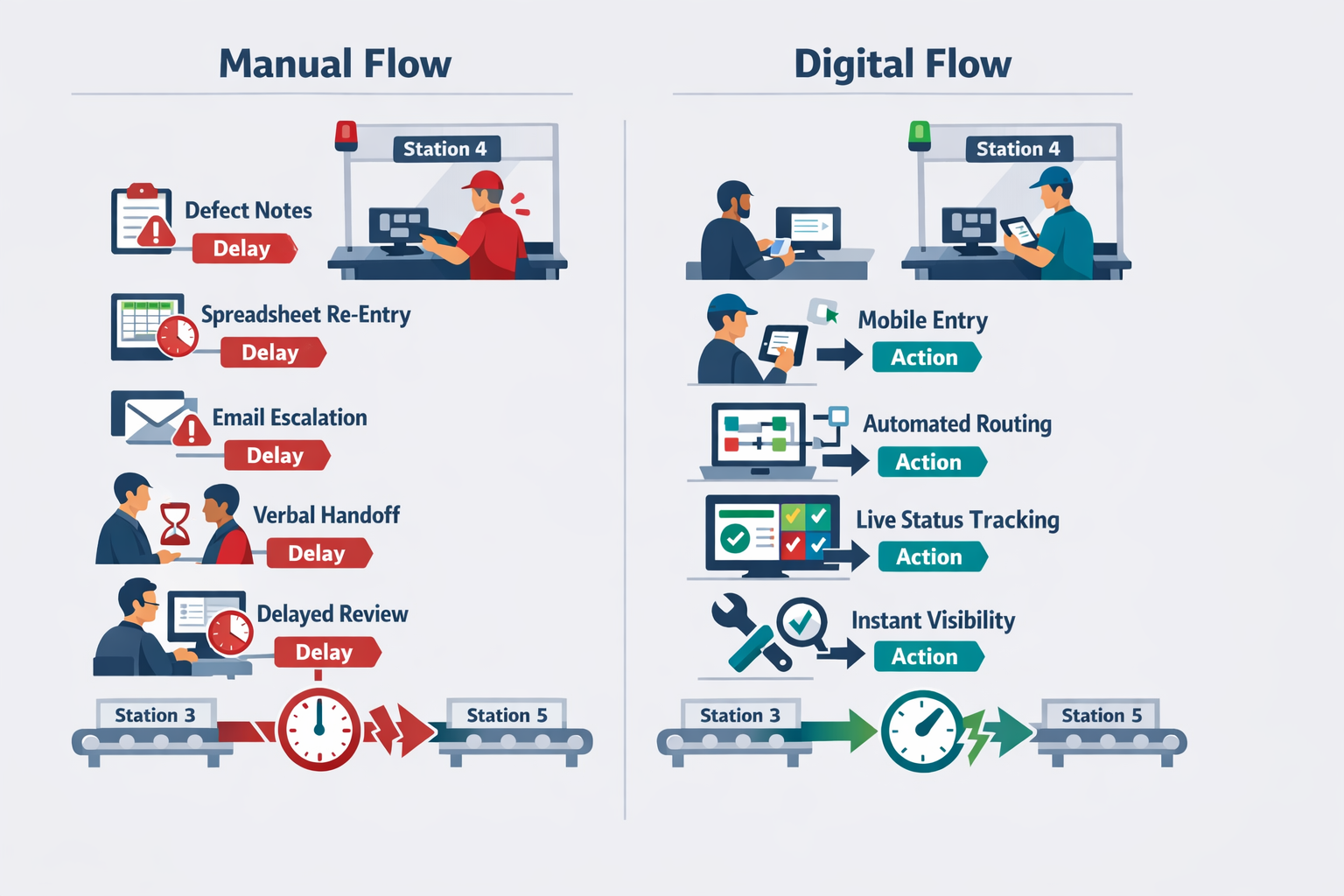
Consider a mid-sized electronics assembly plant trying to improve first-pass yield and response time to defects. Operators record defect codes on paper during the shift, supervisors re-enter totals into spreadsheets, and engineers review the data only at the next morning meeting. By then, several more batches may already be affected. The business may call this an Industry 4.0 factory initiative, but the frontline process is still largely manual.
The gap is usually not a lack of software at the top layer. It is the missing link between enterprise software and daily shop-floor work: the point where operators, line leaders, technicians, and quality staff generate the raw signals that should drive action. When that layer is weak, even expensive systems receive delayed, incomplete, or inconsistent inputs.
Disconnected Inputs Lead to Slow Decision Cycles
In the electronics plant, a soldering defect found at Station 4 should trigger an immediate response from quality and maintenance. Instead, the issue moves through a familiar chain: handwritten note, supervisor confirmation, spreadsheet update, email escalation, then a delayed review by engineering. Each handoff adds waiting time, and no one has a clean view of status, ownership, or recurrence. That is how a digital factory ends up running on lagging information.
This delay matters because production losses compound quickly. In high-mix manufacturing, even a 30-minute delay in escalation can affect multiple work orders, especially when the same tooling, material lot, or machine setting is shared across runs. Deloitte’s smart manufacturing research has shown that manufacturers investing in digital operations can improve productivity and responsiveness, but those gains depend on timely data capture and action, not just system deployment. If real-time production data arrives hours late, the factory is still managing by hindsight.
Approvals create another bottleneck. A quality hold, maintenance request, or deviation decision may require sign-off from production, QA, and engineering, yet many plants still route these through email threads or paper forms. The result is not just a slower response; it is unclear accountability. People know an issue exists, but they do not know who owns the next step.
Slow Decisions Turn Reporting Into Reconstruction
Once the plant loses speed at the point of action, reporting becomes an exercise in reconstruction. In our electronics example, the production manager asks for a daily defect summary by line, root cause category, and action closure status. The team then spends hours reconciling operator sheets, Excel versions, and technician notes just to produce a usable report. Instead of supporting smart manufacturing, reporting starts consuming the time needed to fix the process itself.
This is why many connected factory efforts produce dashboards that look impressive but are trusted only partially. If source data is entered late, categorized differently by each supervisor, or stored across separate files, reports cannot reliably show what happened on the line. A McKinsey analysis has noted that many digital manufacturing initiatives underperform because companies focus on isolated tools without fixing the operational data flow behind them. The dashboard is visible, but the process feeding it is still fragmented.
Limited IT bandwidth makes the problem worse. Most factories cannot wait months for custom development every time they need a new downtime form, escalation workflow, or shift report. So teams create local workarounds, which solve today’s problem but add more spreadsheets and more inconsistency tomorrow.
Weak Reporting Limits Continuous Improvement
When data is delayed and reporting is inconsistent, continuous improvement becomes harder to sustain. In the electronics plant, recurring defects at Station 4 may appear as separate incidents because operators use slightly different defect names, engineers log root causes in another file, and closure actions are tracked nowhere centrally. The plant discusses the same issue repeatedly, but cannot quantify frequency, response time, or corrective action effectiveness with confidence. That weakens the foundation of any smart factory program.
Lean improvement depends on stable facts. If the plant cannot see which losses happen most often, how long responses take, or which actions actually prevent recurrence, kaizen becomes opinion-driven instead of evidence-driven. This is where factory digital transformation often loses momentum: not because the vision is wrong, but because execution data is too slow and too fragmented to support disciplined improvement.
That is also why shop-floor digitization usually needs to start with process reliability, not grand automation. Before a manufacturer adds more advanced Industry 4.0 capabilities, it must first make sure frontline events are captured consistently, routed quickly, and reported in a way people trust. The next step is to turn that principle into a practical rollout model.
A Practical Roadmap to Start Building a Smart Factory
Start With One Process That Slows the Plant Down
The fastest way to start building a smart factory is not to digitize everything at once. High-performing manufacturers usually begin with one process that creates daily delays, rework, or management blind spots, then prove value before expanding. This keeps factory digital transformation tied to operational results instead of turning it into a broad IT program with unclear ownership. For most plants, the best starting point is a workflow that crosses shifts or departments, such as quality holds, maintenance requests, first-article approval, or production reporting.
In an automotive components plant, for example, a first-article inspection process is often a better pilot than a full machine connectivity project. If approval takes 45 minutes because operators must walk paper forms to quality and production supervisors, that delay directly affects changeover time and output. Digitizing that single flow creates a measurable improvement in response time, accountability, and record accuracy. That is a practical smart manufacturing gain, even before any advanced automation is added.
Build in Phases
A workable roadmap usually follows five phases: choose one high-friction process, standardize the data captured, digitize approvals and routing, make exceptions and KPIs visible, then roll the model out to similar processes, lines, or plants. This phased approach matters because a connected factory is built through reliable information flow, not only through capital-intensive equipment upgrades. It also gives operations and IT teams a clear way to evaluate progress using cycle time, closure rate, adherence to SOPs, and escalation speed. In other words, the early signs of an Industry 4.0 factory are often workflow discipline and faster decisions.
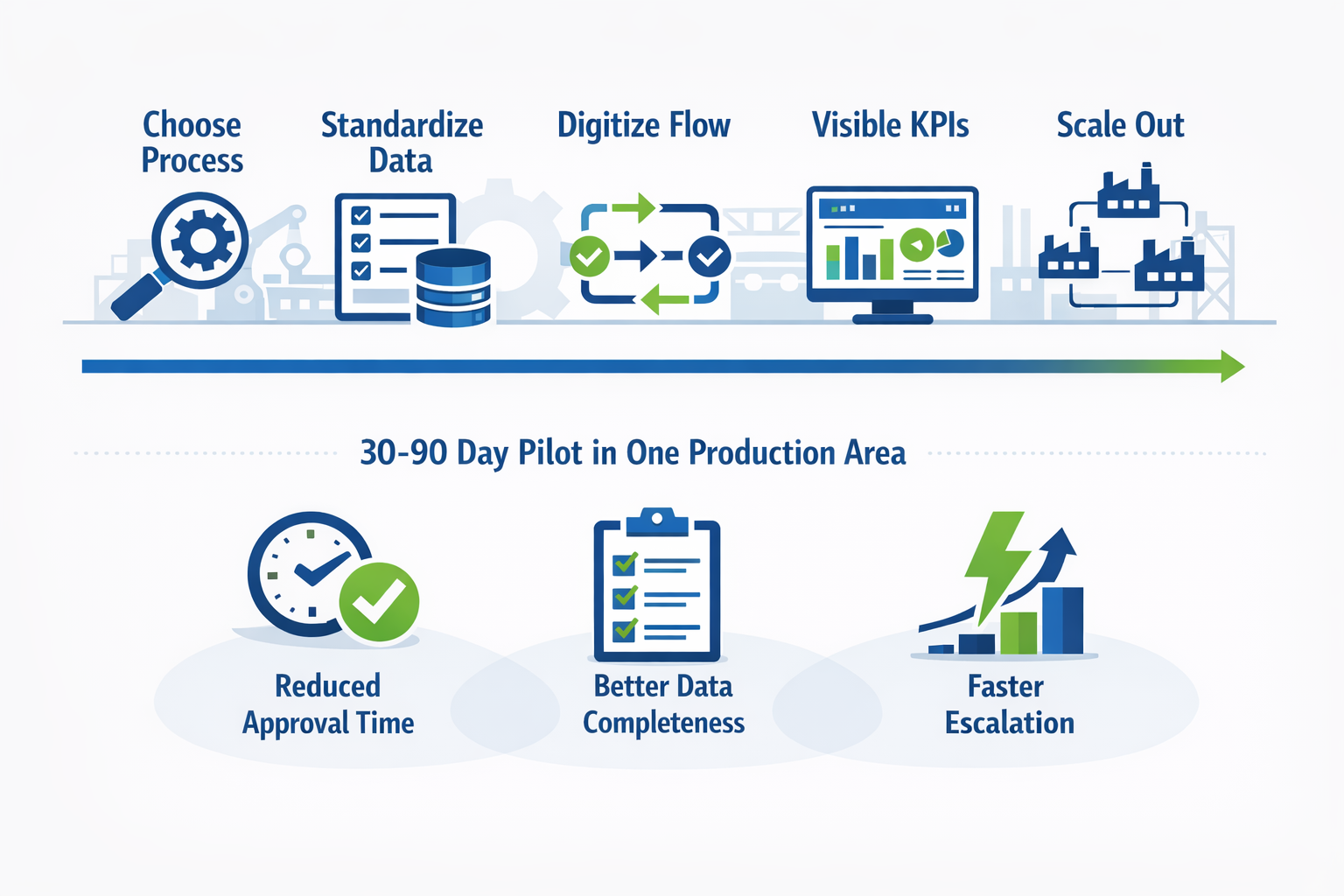
A pilot should normally run in one production area for 30 to 90 days, depending on process complexity and shift coverage. If the pilot reduces approval time, improves data completeness, and gives supervisors cleaner real-time production data, the business case for expansion becomes much easier to defend. After that, the same logic can be applied across adjacent workflows rather than starting from zero each time. This is how a digital factory grows in a controlled way.
Standardize Data Before You Chase Automation
Many smart factory initiatives lose momentum because teams automate bad inputs. Before you add alerts, dashboards, or machine triggers, make sure operators, technicians, and supervisors are capturing the same fields in the same format at the same decision point. Standardized downtime codes, defect categories, shift handover notes, and disposition reasons create the data foundation that smart manufacturing systems depend on. Without that consistency, reports look modern, but decisions still rely on interpretation.
An electronics assembly plant offers a good example. If one line records solder defects by part number, another by product family, and a third as free-text comments, engineering cannot see pattern trends fast enough to act. Standardizing the defect capture format across lines does not look dramatic, but it immediately improves traceability and root-cause analysis. In practice, that is often a more important step than adding another dashboard.
Digitize Decisions That Affect Response Time
Once data inputs are consistent, the next step is to digitize the approvals and handoffs that determine how fast the plant reacts. This is where smart factory progress becomes visible in day-to-day execution: a maintenance request reaches the right technician faster, a quality deviation is escalated with evidence attached, and a production exception does not wait for the next meeting. Plants that improve response time usually improve schedule adherence as well, because fewer issues sit unowned between departments. That is a core advantage of shop floor digitization.
In a discrete manufacturing environment, an abnormal tool wear report can move from machine operator to production leader to maintenance planner within minutes instead of hours. If the workflow includes standard fields, priority rules, and escalation timing, supervisors can intervene before scrap rises or an unplanned stop occurs. The value here is not just digital recordkeeping. It is faster, more consistent operational action.
Make Performance Visible, Then Scale What Works
After the workflow is running reliably, make its performance visible to the people who manage it. The most useful metrics at this stage are simple: average approval time, open issues by status, repeat defects, overdue responses, and closure by shift or line. These indicators help plant leaders see whether the new process is actually improving execution, not just creating more digital records. Real-time production data becomes valuable when it changes priorities on the same day.
Scaling should come only after the pilot process is stable and the ownership model is clear. A plant that succeeds with digital nonconformance handling on one line can extend the same design principles to layered audits, maintenance dispatch, or changeover confirmation across the site. Over time, those connected workflows form the operational backbone of a connected factory. That is how most manufacturers move toward a smarter factory in practice: one reliable process at a time.
How No-Code Platforms Help Digitize the Shop Floor Faster
Why No-Code Matters at the Execution Layer
Once a manufacturer knows which process to digitize, speed becomes the next constraint. Traditional software projects often take months because every form, approval rule, and dashboard request has to pass through IT backlogs, vendor change queues, or ERP customization cycles. No-code platforms shorten that gap by letting operations teams configure the execution layer themselves, then refine it as production realities change. That makes shop floor digitization more practical for plants that need fast wins, not a multi-year Industry 4.0 factory program.
In a smart factory, many critical workflows sit between systems rather than inside one system. A quality alert may start with an operator, move to a supervisor for disposition, trigger maintenance, and then require production follow-up before the line returns to standard conditions. No-code tools are useful here because they can capture structured input, automate routing, time-stamp actions, and feed real-time production data into dashboards without waiting for custom code. That helps turn a digital factory plan into day-to-day operating discipline.
Where No-Code Fits Alongside ERP and MES
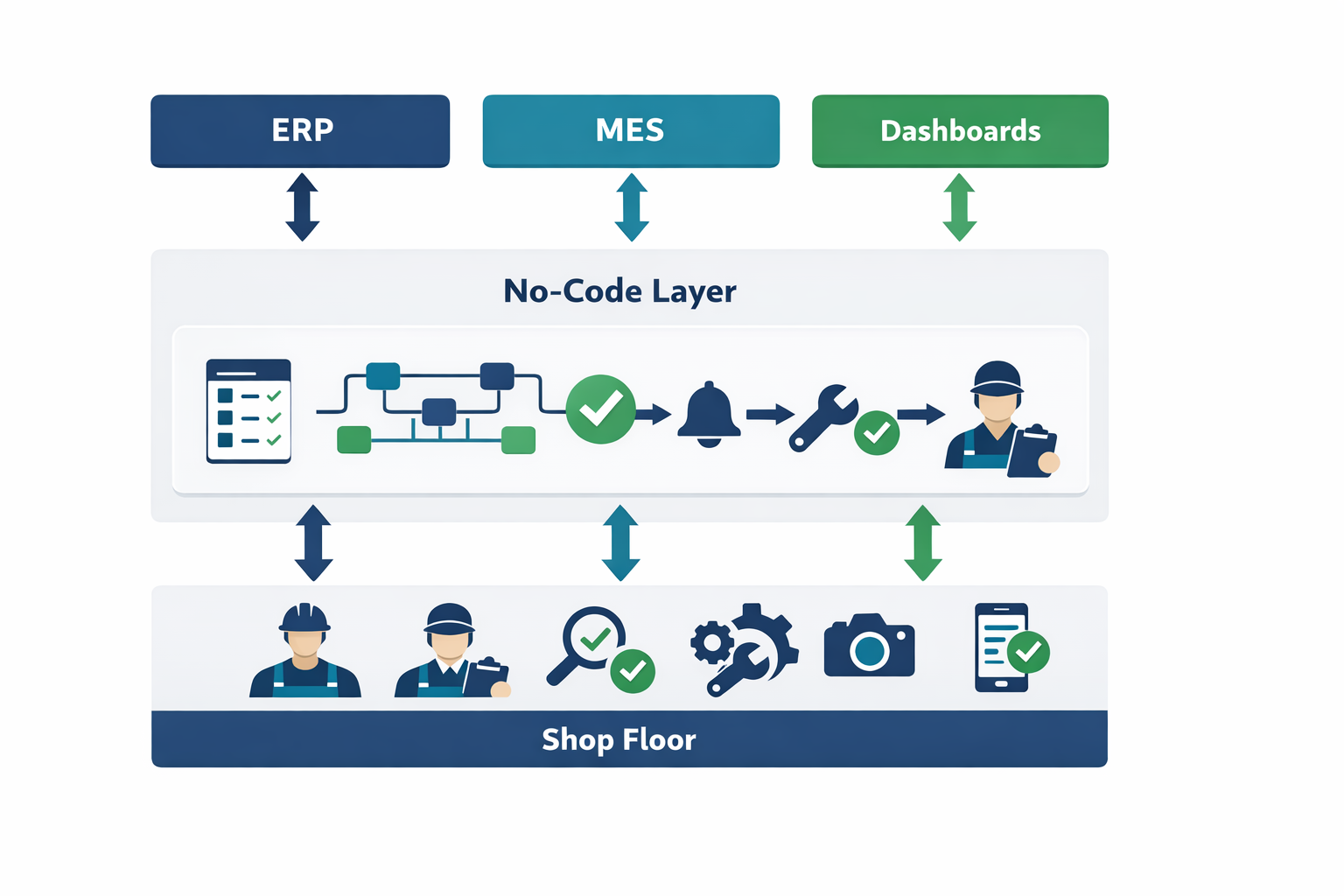
ERP and MES still play central roles in smart manufacturing, but they are not designed to handle every frontline variation quickly. ERP is strong for transactions, planning, and master data, while MES is strong for production control, traceability, and machine-linked execution. The gap usually appears in plant-specific workflows such as layered audits, deviation approvals, maintenance requests, red-tag handling, or first-piece inspection escalation. No-code platforms fit that gap by connecting people, decisions, and records around the core systems already in place.
Compared with spreadsheets, no-code workflow apps add control, audit trails, and role-based actions. Compared with ERP customization, they are faster to configure and easier to change when a line adds a new check, approval step, or exception rule. Compared with heavier manufacturing systems, they are less disruptive when the goal is to digitize one high-friction process first and scale from there. For many plants, that makes them a practical building block in a connected factory rather than a replacement for existing enterprise platforms.
A Practical Example: Replacing Paper Quality Checks and Maintenance Requests
Consider a discrete manufacturer running several assembly lines with paper-based quality checks at the start of each shift. Operators record inspection results by hand, supervisors review them later, and abnormal findings are often relayed through calls or messaging groups. When the issue involves equipment, a separate maintenance request is created, which slows containment and weakens traceability. The result is a delayed response, incomplete records, and limited visibility into repeat failures.
Using Jodoo, the plant can replace that manual flow with mobile forms for shift quality checks and machine issue reporting. Operators submit inspection results from a phone or tablet, attach photos, and trigger conditional workflows when a reading falls outside standard. The system routes the case automatically to the line supervisor, quality engineer, or maintenance team based on defect type, asset, or severity level. Each step is logged, which gives the plant a cleaner record of response time and follow-up discipline.
Because Jodoo also includes dashboards and workflow tracking, the same manufacturer can monitor open issues, overdue actions, repeat defects, and downtime causes in one place. That gives production, quality, and maintenance teams a shared view instead of separate spreadsheets and inboxes. If the plant already uses ERP or MES, Jodoo can sit above those systems as a flexible workflow and data-capture layer for processes that need faster adaptation. This is often how factory digital transformation gains momentum: one controlled workflow at a time, built around actual shop-floor decisions.
Conclusion: Start Your Smart Factory Journey with a Practical First Step
A smart factory is not the same as a fully automated factory. For most manufacturers, it starts with something more practical: accurate frontline data, faster approvals, visible exceptions, and repeatable workflows that help teams respond in real time. That is what turns disconnected production activity into a connected operating system for the plant.
The key lesson is simple: digitization works best when you start with one process that causes daily friction, then expand from there. It may be quality checks, maintenance requests, downtime reporting, shift handovers, or production tracking. When those workflows become digital, standardized, and visible, response time improves, reporting becomes more reliable, and continuous improvement has better data behind it.
If you want to move toward a smart factory without waiting for a large IT project, Jodoo offers a practical starting point. As a no-code lean manufacturing platform, Jodoo helps manufacturers build mobile forms, approval workflows, issue tracking, dashboards, and connected shop-floor apps that work alongside ERP and MES systems. You can start a free trial or book a demo to see how your first workflow can be digitized quickly.