Browse by category

Introduction: Why VSM Software Matters in Modern Manufacturing
Many factories still run value stream mapping workshops on whiteboards, then lose momentum when the output ends up as a photo, a PDF, or an Excel file no one updates. That is a major problem, because manufacturers lose 20% to 30% of productivity through inefficiencies linked to poor process design, waiting time, rework, and unnecessary movement. VSM software helps solve that gap by turning value stream maps into live, shareable systems that teams can update, analyze, and act on in real time.
Imagine a production manager at an automotive parts plant who maps a stamping-to-assembly flow during a Kaizen event. The current-state map identifies excessive WIP, long changeover delays, and bottlenecks at final inspection, but two weeks later the action list is buried in email threads. Digital value stream mapping changes that by linking process data, owners, timelines, and improvement tasks in one place.
In this article, you will see how value stream mapping software helps Lean Managers, IE Engineers, and Operations Managers visualize end-to-end flow, spot waste faster, and manage follow-up actions more effectively. We will also cover what features matter most, how digital mapping compares with manual methods, and how platforms like Jodoo can support continuous improvement beyond the workshop.
What Is Value Stream Mapping Software and How Does a Digital VSM Work?
Value stream mapping software is a digital tool used to visualize how materials and information move through a manufacturing process from supplier to customer. In lean manufacturing, the goal is not just to draw boxes and arrows, but to expose waste, delays, excess inventory, rework loops, and communication gaps that increase lead time. A value stream mapping software platform helps lean teams build, update, and share these maps in a more structured way than paper, whiteboards, or disconnected Excel files. For operations managers and IE engineers, that matters because the map becomes a working system for analysis, not just a workshop output pinned to a wall.
At a basic level, a value stream map shows two connected flows. The first is material flow: how raw material, components, semi-finished goods, and finished products move through each process step. The second is information flow: how production schedules, purchase orders, forecasts, quality alerts, and replenishment signals trigger work across departments. A good value stream mapping tool manufacturing teams use should make both flows visible together, because many bottlenecks come from poor planning signals, not just machine capacity.
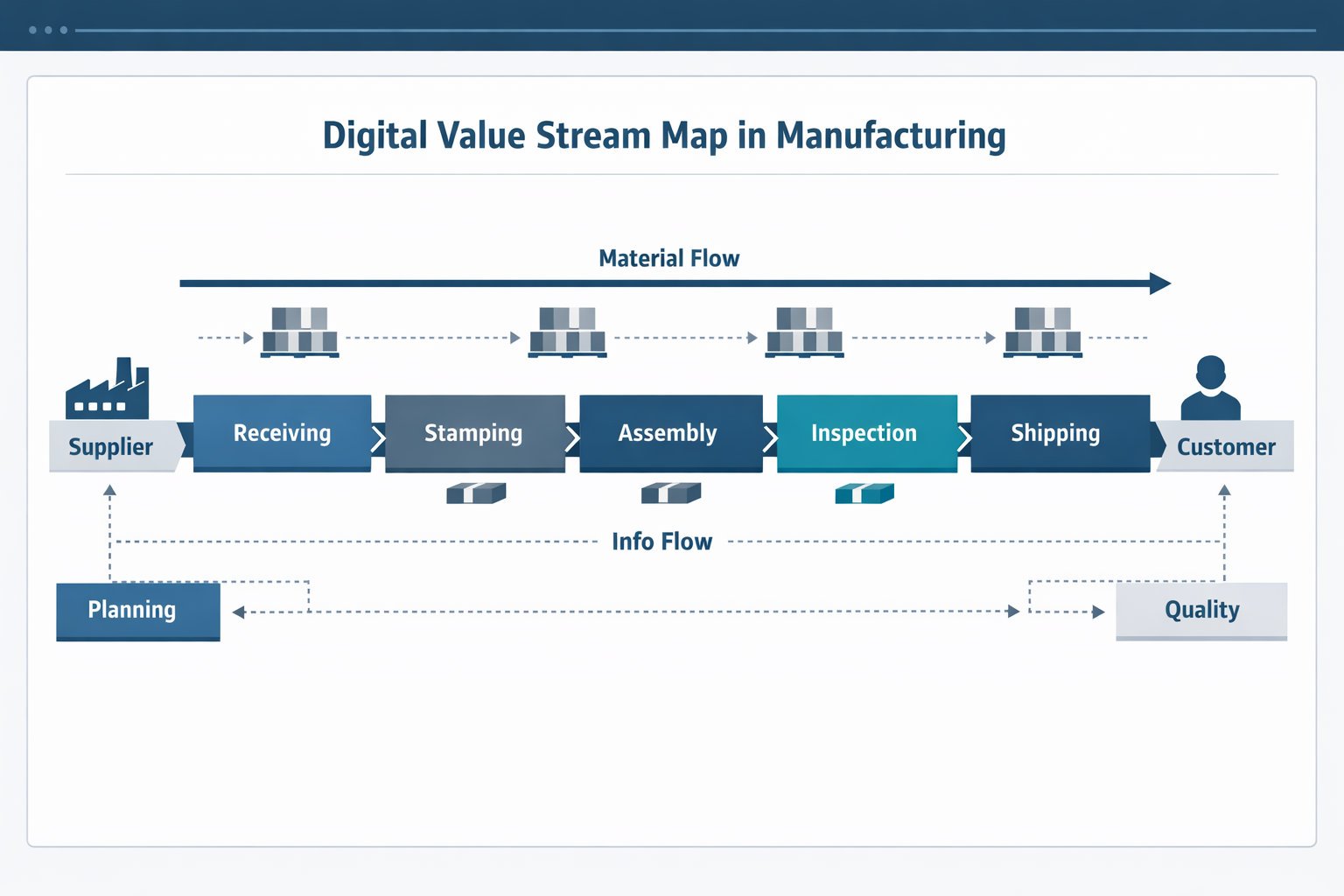
Current-State Vs. Future-State Mapping
Most VSM work starts with a current-state map, which captures how the process actually runs today. This includes each production step, changeover points, inspection gates, transport movements, queues, and handoffs between departments such as planning, warehouse, production, and quality. The purpose is to document reality, including delays and inefficiencies, rather than an ideal SOP. In practice, this is where teams often discover that actual waiting time is much higher than expected, even when individual machine cycle times look acceptable.
The future-state map then shows how the process should operate after improvement. This may include reduced batch sizes, supermarket pull systems, fewer manual approvals, shorter transport routes, better line balancing, or digital escalation for quality issues. Imagine a production manager at an automotive parts plant who finds that stamped parts wait 18 hours before moving to welding because production planning releases work in large batches once per shift. In a future-state digital VSM, the team may redesign the flow around smaller replenishment intervals and visual triggers, cutting queue time without adding labor or equipment.
The Core Metrics a Digital VSM Tracks
A digital VSM is only useful if it captures the metrics that explain performance. The most common metric is cycle time, which is the actual time needed to complete one unit or one batch at a process step. Another critical metric is lead time, which measures the total elapsed time from order receipt to shipment, including both processing and waiting time. In many factories, lead time can be 10 to 50 times longer than total value-added processing time, which is why VSM is so effective in exposing hidden waste.
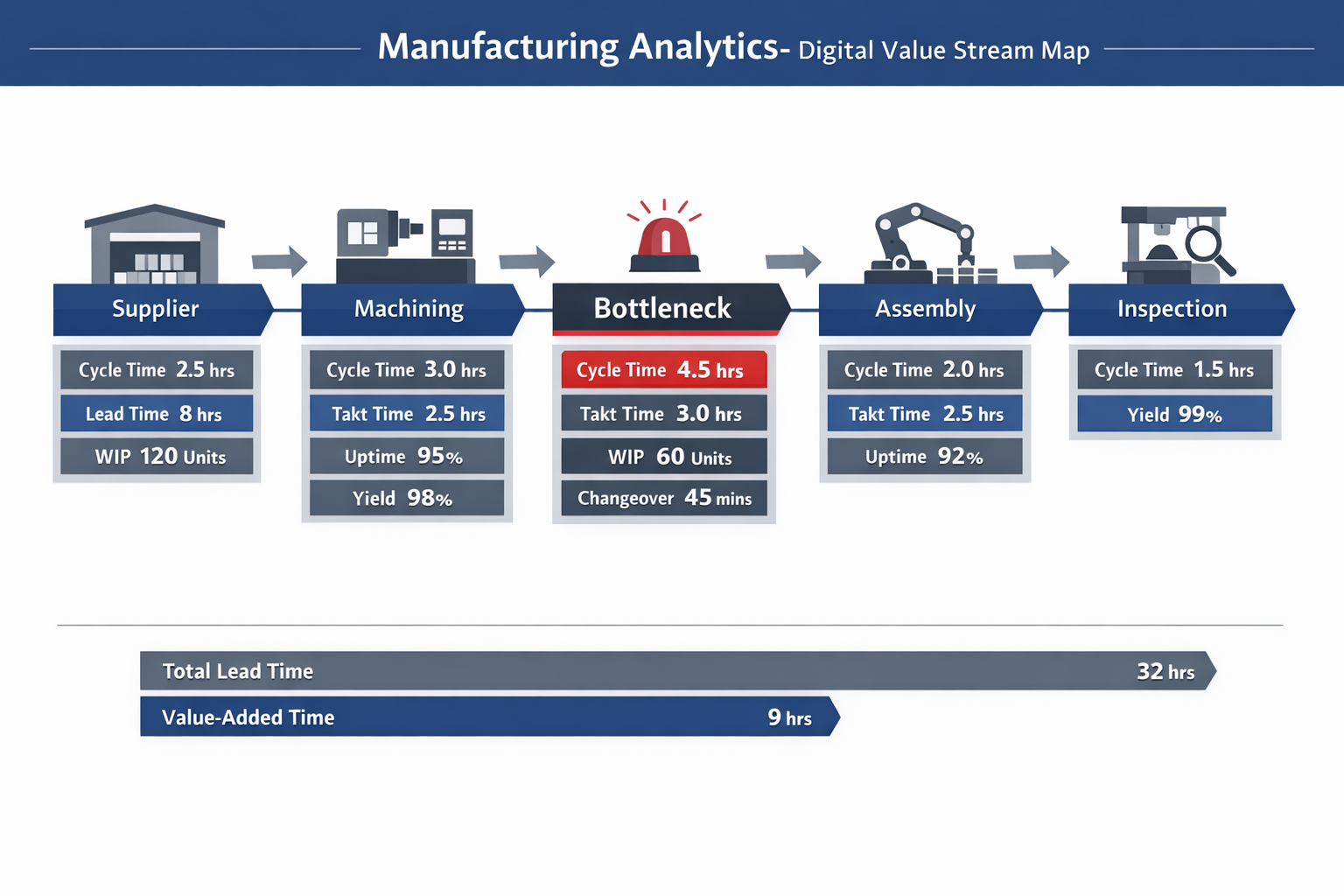
Work in process (WIP) is another core metric because excess inventory often hides instability, unbalanced capacity, and scheduling issues. A food manufacturer, for example, may find that packaging has only a 45-second cycle time, but upstream mixing creates large intermediate queues because release timing does not match downstream demand. Takt time helps put this into context by showing the production pace needed to meet customer demand. If takt time is 60 seconds per unit and one assembly station runs at 78 seconds, the map immediately highlights a likely constraint.
A strong VSM analysis tool should also let teams record uptime, changeover time, first-pass yield, operator count, batch size, and inventory days where relevant. These details matter because bottlenecks are rarely caused by one number alone. For example, an electronics assembly line may appear balanced on average cycle time, but frequent feeder changeovers and inspection holds create erratic output across shifts. When those variables are captured digitally, teams can see a more realistic picture of the full value stream.
How a Digital VSM Differs From Manual Mapping
Manual mapping still has value during kaizen workshops because it is fast and encourages discussion at the gemba. However, the problem starts after the workshop ends. Paper maps get outdated quickly, handwritten data becomes hard to standardize, and improvement actions often end up in separate spreadsheets or email chains. That makes it difficult to compare lines, revisit assumptions, or prove whether the future-state design actually delivered results.
A digital VSM solves this by making the map easier to maintain as operations change. If cycle time improves, WIP drops, or a process step is rearranged, the data and flow can be updated without redrawing the entire map from scratch. This is especially useful in multi-line or multi-site operations, where teams need consistent formats and revision control. Instead of asking each plant to create its own version of a VSM in PowerPoint or on paper, a VSM tool digital platform helps standardize how data is captured and reviewed.
Collaboration is another major difference. In a manual setup, production, planning, quality, and warehouse teams often review the map only during the workshop itself. In contrast, value stream mapping software can support shared access, comments, approval workflows, linked action items, and dashboard reporting. That means the map can stay connected to real operational follow-up, such as assigning a material replenishment redesign to logistics or tracking overdue kaizen actions from a future-state workshop.
Why Digital VSM Matters for Manufacturing Teams
For lean managers, the real benefit of digital mapping is not just cleaner visuals. It is the ability to turn VSM into a repeatable management process rather than a one-time event. A digital map can connect process data, action tracking, audit findings, and KPI dashboards in one system, which makes it easier to sustain improvements over time. This is important because many lean initiatives lose momentum when the analysis sits in one file and the execution sits somewhere else.
With a platform like Jodoo, manufacturers can go beyond static mapping and build a practical digital VSM workflow. You can create forms to capture current-state process data on the shop floor, route improvement actions through workflows, and monitor lead time, WIP, and bottleneck trends on dashboards. For a lean team managing several production lines, that creates a more scalable way to standardize analysis and keep future-state actions visible. In other words, the VSM software becomes part of daily operations, not just an improvement workshop deliverable.
Common Pain Points With Traditional VSM Tools in Manufacturing
Many manufacturers do not struggle with creating a value stream map once. They struggle with keeping it useful after the workshop ends. On paper, in spreadsheets, or in Visio-style files, the map often becomes a static snapshot instead of a live operational management tool. That is the gap modern VSM software is meant to close.
Static Maps Go Out of Date Fast
In most factories, the current state changes faster than the map. A routing update, a shift pattern change, a new inspection step, or a supplier lead time issue can make last month’s map inaccurate. When teams rely on paper sheets pinned to a CI board or a desktop file saved by one engineer, the map quickly stops reflecting what is actually happening on the floor.
Imagine a production manager at an automotive parts plant who maps a machining-to-assembly flow during a Kaizen week. Two weeks later, the team adds an in-process inspection gate after customer complaints, and WIP starts building before final assembly. If the map is not updated immediately, the team is making decisions on old assumptions about cycle time, queue time, and bottlenecks. That turns the exercise into documentation, not improvement.
Version Control Becomes a Hidden Waste
One of the biggest weaknesses of traditional tools is version confusion. Teams often end up with “Final_VSM_v2,” “Final_VSM_v2_latest,” and “Final_VSM_v2_latest_edit” saved across email, shared drives, and laptops. This is common when manufacturers use drawing tools or generic office software instead of purpose-built value stream mapping software.
For lean managers running projects across multiple lines or plants, this creates real operational risk. The industrial engineering team may be reviewing one version, while production supervisors are acting on another. In a multi-site electronics manufacturer, even a small mismatch in takt time or changeover assumptions can lead to the wrong improvement priorities being approved. A proper digital VSM environment reduces this waste by keeping one controlled source of truth.
Collaboration Is Too Limited for Real Shop-Floor Use
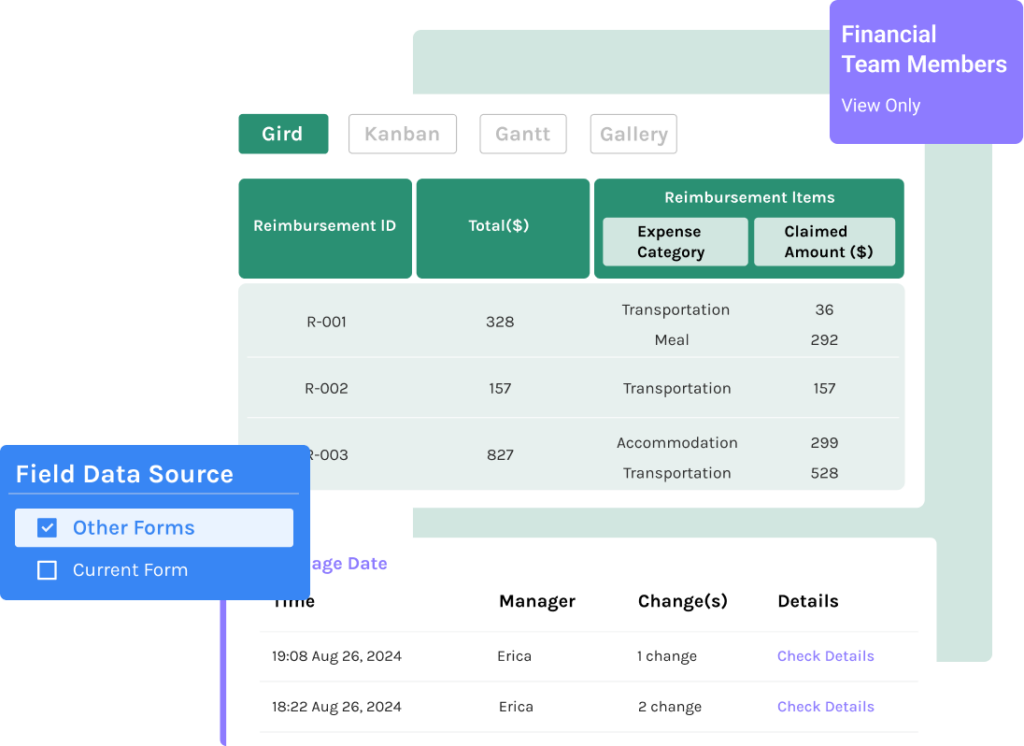
Traditional mapping methods usually depend on one person to build and maintain the file. That may work for a one-day workshop, but it does not work well when production, quality, maintenance, planning, and logistics all need to contribute updates. Lean improvement is cross-functional by nature, yet many old-school VSM methods are still single-user and offline.
This is especially visible in food manufacturing, where process changes can involve QA hold points, packaging constraints, and cold-chain timing. A planner may know the schedule variability, maintenance knows the unplanned downtime pattern, and QA knows where rework is actually happening. If only one IE engineer can edit the map, critical insights stay in conversations instead of becoming part of the value stream mapping tool manufacturing teams rely on for decisions.
Data Collection Is Still Manual and Inconsistent
A map is only as good as the data behind it. In many factories, cycle time, uptime, changeover time, scrap rate, and inventory data are still captured manually from handwritten notes, whiteboards, and Excel logs. That makes updates slow, and it also introduces inconsistency between what the team observed during the workshop and what operations data shows over time.
Industry studies often estimate that knowledge workers spend around 20% to 30% of their time searching for or reconciling information across systems. In manufacturing CI teams, that usually means checking paper records, MES exports, maintenance logs, and spreadsheet trackers before updating one map. Instead of acting as a useful VSM analysis tool, the map becomes another document that needs manual rework. That delays action and weakens trust in the numbers.
Workshop Momentum Breaks Down After the Event
This is where many improvement efforts fail. Teams complete the current-state map, discuss waste, design a future state, and list actions on flip charts or sticky notes. But once everyone returns to daily production pressure, there is no system to assign owners, monitor due dates, or confirm whether the changes delivered results.
For example, an electronics assembly plant may identify that material replenishment delays are adding 90 minutes of waiting time per shift. The team agrees on three countermeasures: supermarket redesign, milk-run timing changes, and barcode-based replenishment triggers. Without a connected VSM tool digital workflow, these actions often sit in meeting notes or spreadsheets with no accountability. Six weeks later, the map exists, but the lead time reduction does not.
Generic Diagram Tools Do Not Support Continuous Improvement
Many teams try to manage VSM in tools that were never designed for lean execution. A drawing app can create icons and arrows, but it cannot easily connect the map to real-time KPI data, action tracking, audit results, or approval workflows. In practice, that means the map remains isolated from the daily management system.
That is why many manufacturers move from generic files to a more structured value stream mapping software approach. The goal is not just to draw a cleaner map. It is to build a digital VSM process that links current-state data, future-state plans, Kaizen actions, and dashboard follow-up in one environment. When that connection is missing, the VSM exercise may look complete, but operationally it is still unfinished.
The Real Problem Is Sustainment, Not Mapping
Most lean teams already know how to run a mapping workshop. The harder challenge is keeping the map current, collaborative, and tied to measurable improvement. If your current VSM analysis tool cannot support ongoing updates, cross-functional ownership, and follow-through, it becomes another lean artifact that fades after the event.
In other words, the issue is not whether you can create a map. It is whether your VSM software can help the plant use that map week after week to reduce lead time, cut WIP, improve flow, and sustain gains. That is the difference between a one-time workshop output and a digital management system for continuous improvement.
How to Create and Manage a Digital VSM From Current State to Future State
A digital value stream map should do more than replace sticky notes with boxes on a screen. For lean teams, the real value of VSM software is that it connects mapping, action tracking, and performance monitoring in one workflow. That matters because many factories complete a current-state map during a workshop, identify obvious waste, and then lose momentum once the team goes back to daily firefighting. A good value stream mapping software setup helps you move from analysis to execution without rebuilding the process in spreadsheets, emails, and whiteboards.
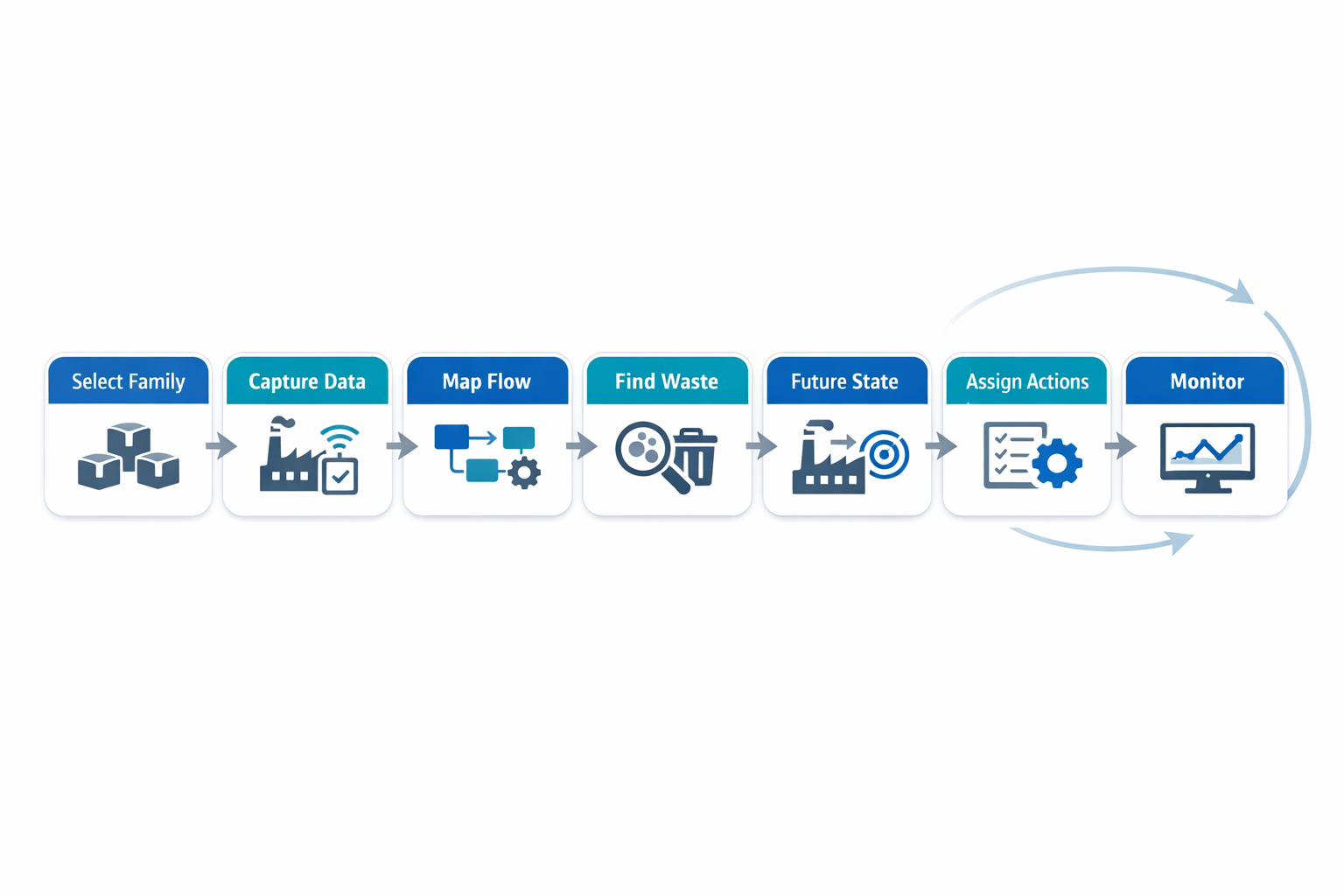
Step 1: Select the Right Product Family
Start with one product family that follows a similar routing, uses shared equipment, and has enough volume to justify improvement effort. This is a critical first step because mapping too broad a scope, such as an entire plant, usually creates a diagram that looks impressive but is too complex to manage. Most lean practitioners group parts by common process steps, takt profile, and customer demand pattern. In a high-mix electronics plant, for example, you might choose one family of PCB assemblies that all pass through SMT, AOI, manual insertion, and final test.
Your VSM analysis tool should let you define scope clearly before data collection begins. That includes the start and end points, the production line or cell involved, shift pattern, customer demand, and linked suppliers or internal feeders. If you are mapping a food manufacturing line, you may define the stream from raw material receiving to cooking, filling, packaging, and palletizing for one SKU family. This makes the map useful for decision-making because cycle times, changeovers, quality losses, and inventory points can be compared on a like-for-like basis.
Step 2: Capture Current-State Data at the Gemba
Once scope is set, collect current-state data directly from the shop floor rather than relying only on ERP standards or outdated SOPs. A current-state map is only as good as the data behind it, and many factories discover that actual cycle times differ from planned times by 10% to 30% once operators are observed in real conditions. Capture process time, waiting time, changeover time, uptime, scrap rate, staffing, batch size, WIP, information flow, and shipment frequency. If the plant runs multiple shifts, note where performance changes by shift, especially in quality escapes, line stoppages, and response time to material shortages.
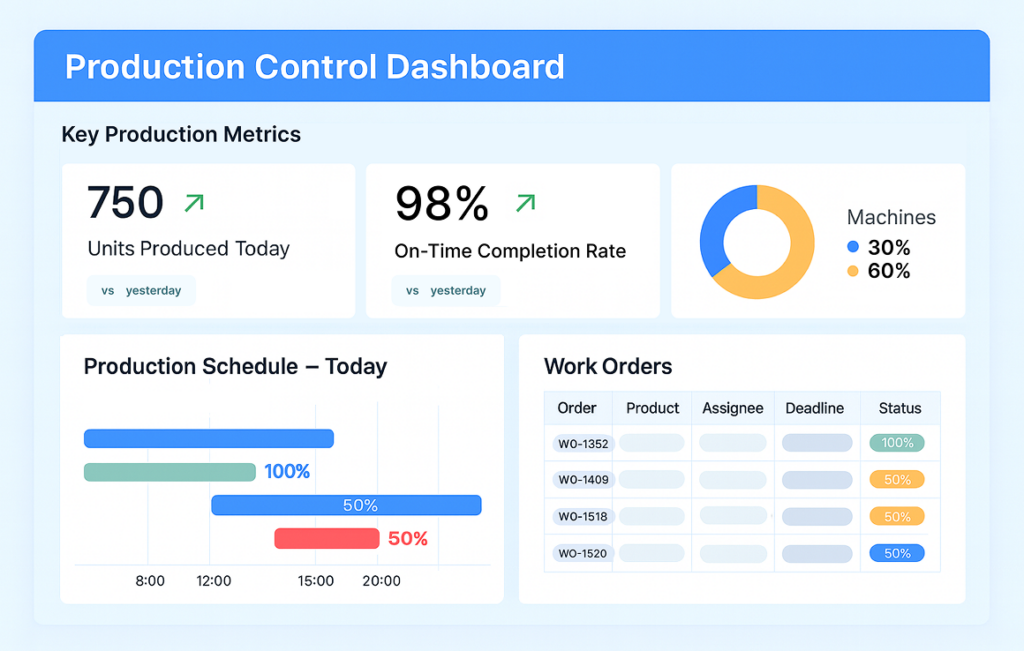
A strong VSM tool digital should make this data collection structured and repeatable. Instead of writing times on paper and retyping them later, teams should be able to enter values through mobile forms, attach photos, log timestamps, and link each process box to real data records. In an electronics assembly plant, for instance, the SMT line may show a cycle time of 18 seconds per board, but the queue before functional test may reveal a 14-hour waiting period due to operator availability and uneven scheduling. That kind of visibility is what separates a useful digital VSM from a presentation graphic.
Step 3: Map Material Flow and Information Flow Together
Many teams focus heavily on process boxes and inventory triangles but under-map information flow. That is a mistake because poor planning, late schedule changes, and disconnected approvals often create as much waste as machine downtime. Your current-state map should show how orders are released, how production is scheduled, how replenishment signals move, and where manual handoffs delay response. In factories using a mix of ERP, WhatsApp, spreadsheets, and whiteboards, those delays are often hidden until the map is built end to end.
A practical value stream mapping tool manufacturing should support both layers. You need to see not only where material waits, but also where information stalls decisions, such as tooling approval, QA release, or maintenance response. Imagine a food processing plant where packaging materials arrive on time, but product release is delayed because QC records are still reviewed manually at the end of the shift. On the map, the processing step may look efficient, while the information flow reveals the real bottleneck.
Step 4: Identify Waste, Constraints, and Bottlenecks
After the current-state map is built, use it to isolate the few issues that drive most of the delay. In many value streams, one or two process steps create the majority of queue time, while a separate information bottleneck drives rework or schedule instability. Review the map for classic lean wastes, including waiting, overproduction, excess WIP, transport, motion, defects, and overprocessing. Then quantify the impact in business terms such as hours lost per week, WIP value in USD, missed shipments, or OEE drag.
This is where VSM software should function as more than drawing software. A good VSM analysis tool helps you compare takt time against actual cycle time, highlight process imbalance, calculate total lead time versus touch time, and flag inventory accumulation points automatically. For example, if an automotive stamping line feeds welding in batches of 1,000 pieces, but welding consumes at a much lower and less stable rate, the map should make that imbalance clear. If that buffer holds 2.5 days of stock, you now have a measurable target for the future state.
Step 5: Design the Future-State Map Around Flow and Control
The future-state map should answer a practical question: how should this value stream operate if you want better flow, lower lead time, and more predictable output? That means deciding where continuous flow is possible, where supermarkets are needed, where pacemaker scheduling should happen, and how demand signals should trigger replenishment. The future state should also define operating rules, not just visuals, such as target batch size, pitch, replenishment frequency, and escalation triggers. Without those details, the future-state map becomes a concept poster rather than a management tool.
In a real factory setting, this often means making trade-offs. Imagine an electronics manufacturer producing control boards for industrial equipment. The current-state map shows large transfer batches from SMT to final test, creating one full day of queue time. The future state may reduce batch size, shift test staffing to match takt windows, and introduce a pull signal between assembly and test so WIP does not keep growing. A capable value stream mapping software platform should let you document those design decisions, not just draw arrows between boxes.
Step 6: Turn the Future State Into Actionable Improvement Plans
This is the step where many VSM efforts fail. The team finishes the workshop, agrees on the future state, takes a photo of the board, and then nothing happens because actions are not assigned clearly. Every future-state gap should become a tracked improvement item with an owner, due date, target metric, and status. Typical actions include reducing changeover time, rebalancing labor, redesigning kanban loops, changing inspection frequency, or adding maintenance triggers for chronic downtime points.
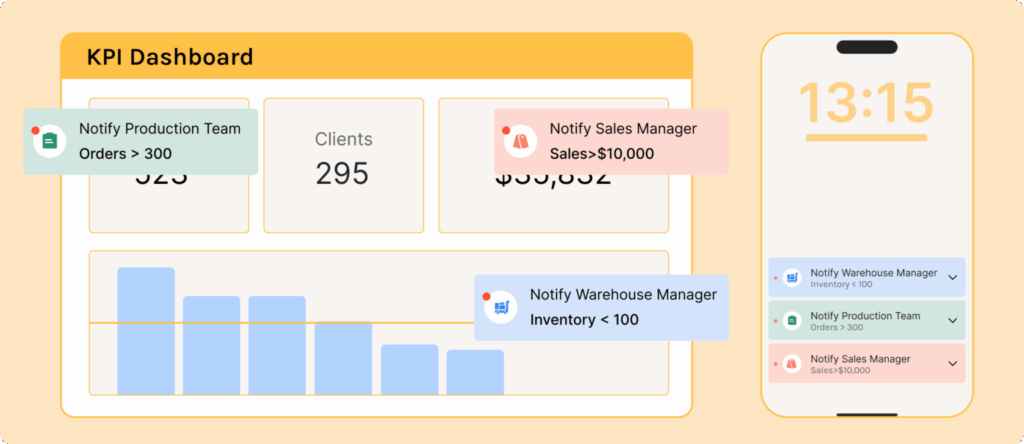
Your digital VSM should connect directly to task and workflow management. For example, if the future state calls for reducing changeover on a filling line from 45 minutes to 25 minutes, the system should break that into SMED observations, fixture redesign, standard work updates, operator training, and audit checks. This is where a platform like Jodoo becomes useful, because the map can feed structured action lists, approval workflows, on-site inspections, and dashboards without forcing the team back into disconnected files. That closes the gap between lean analysis and daily execution.
Step 7: Monitor Progress After the Map Is Built
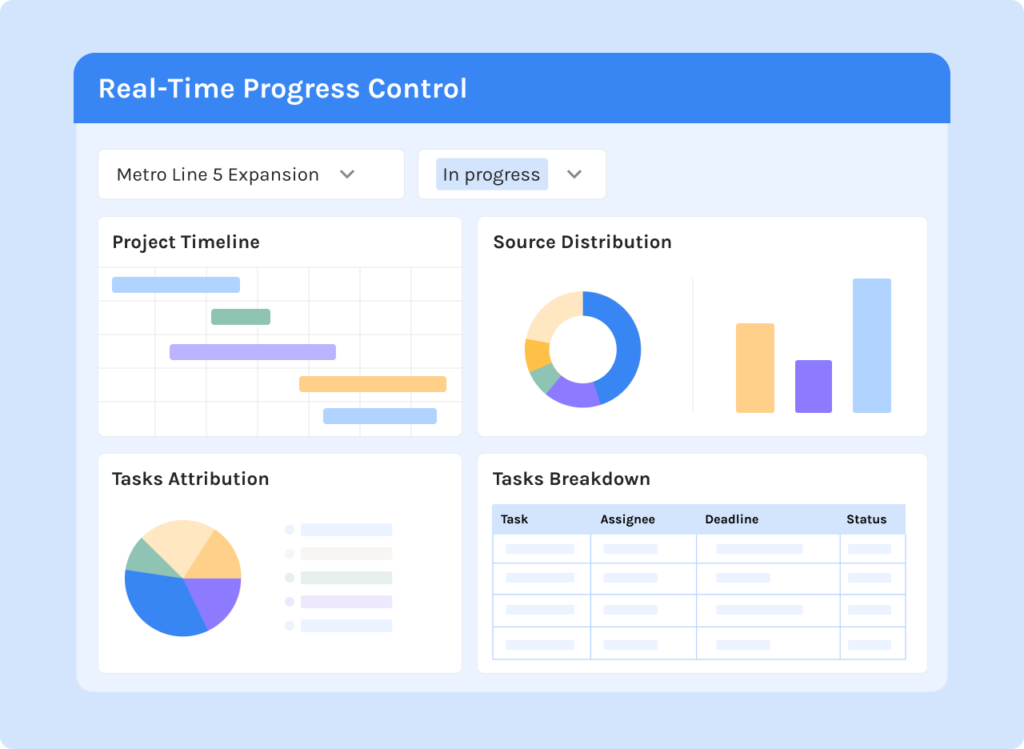
A value stream map is only useful if it stays connected to actual performance after implementation begins. Once actions are underway, track a small set of metrics tied directly to the future-state design, such as lead time, WIP by buffer, on-time delivery, first-pass yield, changeover time, and schedule adherence. Industry studies regularly show that digital performance tracking improves follow-through because teams can see open actions and trend lines in real time instead of reviewing stale data in monthly meetings. In lean terms, the map becomes a control point, not just a diagnosis tool.
Consider a food packaging plant trying to improve a sauce filling line. The current-state map shows 9 days of end-to-end lead time, with nearly 6 days tied up in raw material waiting, QC release delay, and finished goods staging. After the team implements supermarket controls and digital QC release workflows, lead time drops to 6.5 days within eight weeks, while open action items fall by 60% because owners receive automatic reminders and supervisors can review status by line. That is the difference between a static map and a managed VSM tool digital environment.
What a Manufacturing Team Should Expect From VSM Software
If you want lasting results, choose VSM software that supports the full improvement cycle. At minimum, the platform should help you collect process data, build current- and future-state maps, assign actions, automate follow-ups, and report progress in dashboards. For operations teams, mobile access is especially useful because engineers, supervisors, and quality staff can update observations directly on the shop floor. Role-based permissions also matter in larger plants where production, IE, quality, and management need different views of the same value stream.
The best value stream mapping software for manufacturing also fits into existing operational routines. It should connect with kaizen tracking, A3 problem solving, layered process audits, and KPI reviews so improvements do not sit in isolation. In a multi-line automotive or electronics plant, that allows you to standardize how value streams are analyzed across sites while still adapting forms and workflows to each factory’s process. In other words, the right value stream mapping tool for manufacturing should help you build the map, run the improvement plan, and sustain the gains long after the workshop ends.
What to Look for in VSM Software for Manufacturing Teams
Not all VSM software is built for manufacturing. Some tools only let you draw boxes, arrows, and icons, which is useful for workshops but limited once the kaizen event ends. If your goal is to reduce lead time, cut waiting, and sustain gains across lines or plants, you need more than a diagramming app. You need a value stream mapping software platform that connects the map to real shop-floor data, actions, and accountability.
A good buying question is simple: does the tool help your team only document the current state, or does it help you manage the future state as work changes every week? In many factories, the first map is created during a lean workshop, but within 30 days it is already outdated because cycle times shift, changeovers increase, or a bottleneck moves upstream. That is why strong digital VSM capabilities matter. The best systems turn a static map into a living operational record.
Easy Map Creation for Cross-Functional Teams
The first requirement is still usability. A VSM tool digital platform should make it easy for lean managers, IE engineers, production supervisors, and quality teams to build current-state and future-state maps without depending on IT or a specialist designer. Standard VSM symbols, drag-and-drop layout, process boxes, data boxes, inventory triangles, information flows, and takt-time references should be simple to configure.
This matters because most value stream mapping sessions involve people from different functions who need to work fast. Imagine a production manager at an automotive parts plant who is mapping a stamping-to-assembly flow with maintenance, logistics, and quality in the room. If the software is hard to edit, the team will fall back to whiteboards and spreadsheets. Good value stream mapping tool manufacturing platforms reduce setup friction so teams can focus on waste, not formatting.
Live Data Capture Instead of Manual Rework
One of the biggest differences between a basic drawing tool and true VSM software is data capture. In a manual setup, teams collect cycle time, uptime, WIP, scrap, and changeover data on paper, then re-enter it into Excel, then manually update the map. That creates delays and errors, especially when multiple lines are being tracked at once. A stronger VSM analysis tool lets teams capture process data directly from forms, tablets, or mobile devices and feed it into the map or related records.
This is especially useful in electronics and food manufacturing, where conditions change by shift, SKU mix, or operator allocation. For example, in a food packaging plant, filler downtime during one shift may push waiting time into secondary packing and palletizing. If operators or line leaders can log downtime reasons and output data in real time, the value stream map reflects actual constraints rather than assumptions from last month’s workshop. That gives CI teams a much more reliable basis for improvement.
Built-In Metrics for Lead Time, Cycle Time, and Waste Analysis
A proper value stream mapping software solution should help teams analyze performance, not just illustrate a process. At minimum, you should be able to track cycle time, lead time, waiting time, WIP, changeover time, first-pass yield, uptime, and manpower by step. If those numbers sit outside the tool in separate files, your map quickly becomes a visual summary with no analytical depth.
For lean teams, this is where a real VSM analysis tool earns its value. Studies across manufacturing sectors consistently show that waiting, transport, and excess inventory can account for a large share of non-value-added time, and in many plants total lead time is often far higher than actual touch time. A digital platform should make these gaps visible so teams can prioritize the biggest losses first. That is far more useful than a neat-looking map with no measurable baseline.
Workflow Automation to Turn Findings Into Action
A common failure point in value stream mapping is follow-up. Teams identify 15 to 30 improvement actions during a workshop, but ownership is unclear, deadlines slip, and the map never gets updated. This is why VSM software should include workflow automation for action tracking, reminders, escalations, and status changes.
Suppose an electronics assembly plant identifies three major issues in its future-state map: feeder setup delays, incoming material shortages, and excessive QA hold time. If each issue becomes a tracked action with an owner, due date, approval path, and progress status, the lean manager can see which improvements are moving and which are stuck. That is a major difference between a basic digital VSM board and a system that supports continuous improvement execution. In practice, this is how teams avoid the common problem of kaizen results fading within weeks.
Collaboration and Version Control Across Teams and Sites
Manufacturing value streams rarely sit within one department. Purchasing affects material availability, maintenance affects uptime, quality affects flow release, and warehouse practices affect replenishment. The right value stream mapping software should support multi-user collaboration, comments, shared access, and version control so teams can work on one source of truth.
This becomes even more important for regional operations with more than one plant. A Lean Manager supporting two electronics plants in Malaysia and one in Thailand may want to compare similar SMT or final assembly flows across sites. If each map lives in PowerPoint or on a local laptop, standardization is almost impossible. A connected VSM tool digital environment makes it easier to compare current-state maps, copy best-practice templates, and align improvement priorities across facilities.
Dashboards That Show Whether the Future State Is Working
A future-state map is only valuable if you can measure whether it is actually being achieved. That is why dashboards matter. Good VSM software should let you visualize key metrics such as lead time reduction, WIP trend, on-time completion of improvement actions, bottleneck recurrence, and process stability by line or product family.
For example, if a plant sets a target to reduce order-to-ship lead time from 12 days to 8 days, the dashboard should show progress weekly, not just after the next quarterly review. In many factories, senior management supports lean in principle but asks for proof in numbers. A dashboard connected to your digital VSM records makes it easier to show ROI, whether that is lower inventory, higher throughput, or reduced changeover losses. That level of visibility is what helps CI leaders defend budgets and scale successful projects.
Mobile Access for Shop-Floor Validation
Many mapping activities happen at the gemba, not at a desk. Your value stream mapping tool manufacturing shortlist should include mobile access so supervisors, engineers, and auditors can update observations on the shop floor. If the tool only works well on desktop, data collection will drift back to paper notes and later transcription.
This is particularly practical during line walks, time studies, and layered process audits. Imagine a maintenance engineer at a beverage plant identifying recurring micro-stoppages on a labeling machine during a shift audit. With mobile access, the issue can be logged immediately, linked to the relevant process step, and routed for follow-up. That keeps the value stream tied to actual operating conditions rather than delayed reporting.
Approvals and Governance for Standardized Improvement
In larger manufacturers, not every future-state change can be implemented informally. Process changes may need approval from operations, quality, engineering, or EHS, especially in regulated food and electronics environments. A strong VSM software platform should support approval workflows so proposed changes move through the right review steps before implementation.
This matters for control and compliance as much as speed. If a team wants to change inspection frequency, supermarket sizing, or line-side material replenishment rules, the decision should be documented and traceable. That is where a more complete VSM analysis tool goes beyond mapping. It becomes part of how the organization governs lean change, not just how it visualizes it.
Integration With Quality, Maintenance, and CI Processes
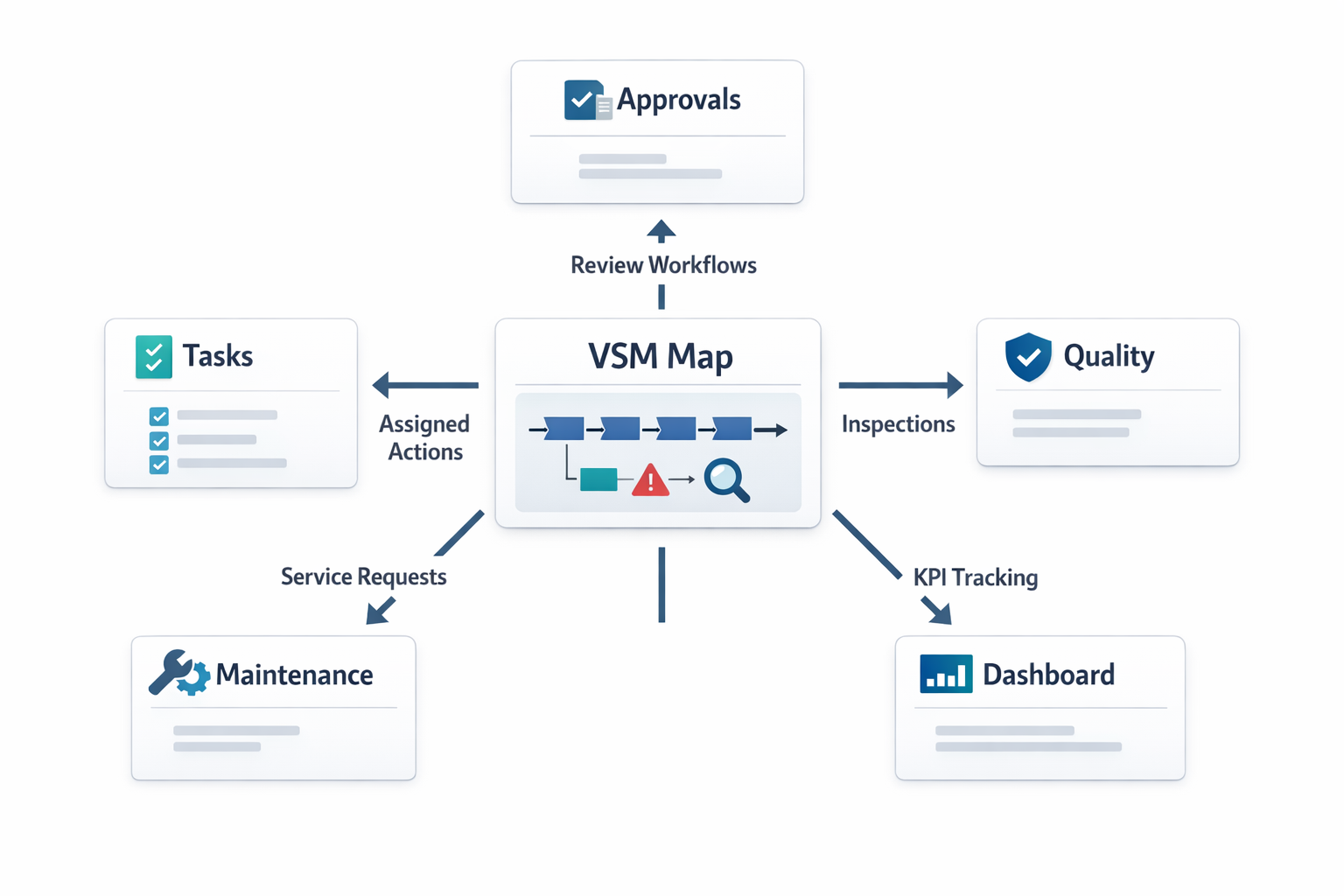
The most valuable value stream mapping software does not operate in isolation. It should connect with related processes such as nonconformance management, CAPA, maintenance requests, layered process audits, A3 reports, and kaizen tracking. In manufacturing, flow problems rarely belong to one function alone, so the software should reflect that reality.
Consider an automotive supplier where a bottleneck in machining is driven by both tooling wear and repeated first-off rejection. If the map can link directly to maintenance work orders and quality records, the team gets a much clearer view of root causes. This is where a no-code platform like Jodoo is useful: instead of using one tool for mapping, another for action tracking, and another for audits, you can build a connected workflow around the value stream itself. That makes digital VSM much more sustainable over time.
The Difference Between Drawing Software and a True VSM System
A simple diagramming app helps you visualize a process once. A true VSM software platform helps you capture data, analyze waste, assign actions, track execution, and measure whether the future state is being sustained. That distinction is critical for lean teams under pressure to show measurable results, not just run workshops.
If you are evaluating tools, look beyond symbol libraries and layout options. Ask whether the system supports live data, workflows, dashboards, mobile use, approvals, and integration with daily manufacturing processes. The best value stream mapping software does not stop at documentation. It helps your team turn mapping into a repeatable operating system for continuous improvement.
How Jodoo Turns Digital Value Stream Mapping Into Operational Execution
Most VSM software helps you document the current state and design a better future state. The real challenge starts after that workshop ends. In many factories, the value stream map is saved as a PDF, the action list sits in Excel, and follow-up happens through emails, WhatsApp messages, or shift meeting notes. That disconnect is why many lean teams struggle to sustain gains after a Kaizen event or a value stream redesign.
Jodoo is different because it works as more than value stream mapping software. It gives manufacturers a no-code way to turn mapping insights into daily operational workflows, assigned actions, approval steps, inspection records, and KPI dashboards. Instead of stopping at analysis, teams can use Jodoo to build a connected system that links lean planning with execution across production, quality, maintenance, and supplier coordination.
From Digital VSM to Actionable Workflows
A good digital VSM should show where waste exists, but an effective system should also trigger what happens next.
This matters because execution discipline is often where lean initiatives fail. According to industry studies, as much as 60% to 70% of improvement actions lose momentum after initial workshops when ownership and follow-up are unclear. By turning value stream findings into structured workflows, Jodoo helps teams reduce that drop-off. Each bottleneck, delay, or defect pattern identified in the map can be tied to a live record instead of a static note.
Build a Value Stream Mapping Tool for Manufacturing Without Heavy IT Support
Many manufacturers do not need another rigid application with fixed templates and long implementation cycles. They need a value stream mapping tool manufacturing teams can adapt to their own routing logic, approval chains, plant layout, and reporting needs. Jodoo’s no-code platform allows lean managers, IE engineers, and operations leaders to configure forms, apps, and workflows without waiting months for custom development.
That flexibility is especially useful in multi-department environments. An electronics manufacturer may want one workflow for SMT line bottlenecks, another for supplier shortages, and a third for reflow oven downtime affecting takt adherence. With Jodoo, each team can standardize its process while still feeding data into a common dashboard. This makes the platform practical for both single-site pilots and multi-plant rollouts.
Connect VSM Findings Across Production, Quality, and Maintenance
One weakness of standalone VSM analysis tool platforms is that they often stop at visualization. In real factories, waste rarely belongs to one department only. A long lead time may be caused by material staging delays, machine breakdowns, first-pass yield issues, or supplier delivery variation. If your system cannot connect these functions, your future-state plan remains incomplete.
Jodoo helps connect those functions in one operational environment. A bottleneck found during VSM analysis can lead to a maintenance work request, a quality investigation, or a supplier follow-up workflow depending on root cause. For example, in a food manufacturing plant, a map may show waiting time before packaging caused by repeated seal-check failures. Instead of just flagging the issue on the map, Jodoo can route corrective actions to quality, trigger verification checks on the line, and display recurring failure trends on a dashboard for the production manager.
Turn Improvement Opportunities Into Trackable Corrective Actions
Lean teams often know what needs to improve, but not whether actions are actually closed on time. That is where a VSM tool digital approach becomes more valuable than a static mapping application. In Jodoo, you can build corrective action workflows with clear owners, deadlines, escalation rules, supporting photos, approval logs, and status visibility across departments.
In an electronics assembly plant, the value stream map may show repeated waiting at final test because failure analysis is still handled offline. With Jodoo, the team can log each issue, attach defect images, assign engineering review, and require line leader sign-off before closure. If an action remains open past the target date, the workflow can escalate automatically to the production superintendent or CI manager. This creates accountability that a spreadsheet-based follow-up process usually cannot maintain.
Use Real-Time Dashboards to Prove Lean ROI
One of the biggest pain points for lean leaders is proving that improvement activity is delivering measurable business results. Jodoo addresses this by pairing workflow execution with real-time dashboards. Once actions, delays, defects, and approvals are captured in the system, teams can visualize lead time reduction, action closure rate, recurring bottlenecks, downtime causes, and process adherence in one view.
For example, a supplier coordination dashboard could show how many late material issues are linked to a specific supplier, how long each issue takes to resolve, and which production orders were affected. A plant manager does not need to wait for a monthly presentation to see whether the future-state design is working. This is where Jodoo becomes more than a value stream mapping software option. It becomes a management layer for sustaining the improvements identified in the map.
A Practical Fit for Manufacturers Running Lean at Scale
Jodoo is especially useful for manufacturers that have already outgrown paper forms, isolated Excel trackers, and one-off workshop files. If you are managing multiple production lines, multiple shifts, or more than one site, the problem is usually not knowing lean principles. The problem is enforcing follow-up consistently. Jodoo gives teams a configurable way to standardize how value stream issues are captured, assigned, reviewed, and reported without relying heavily on IT.
That makes it a strong fit for companies that need a digital VSM approach tied to daily management. Whether you are mapping a machining cell in automotive, a PCB assembly flow in electronics, or a packaging line in food manufacturing, Jodoo helps convert insights into repeatable execution. For lean managers and operations directors, that is the real difference between mapping value streams and actually improving them.
Example Use Case: Using a Digital VSM to Improve Production Flow and Kaizen Follow-Through
At an automotive parts plant supplying stamped brackets and welded assemblies to a Tier 1 customer, a production manager is dealing with recurring late deliveries on one product family. The plant has recurring late deliveries on one product family, even though line utilization looks acceptable on paper. The lean team runs a value stream mapping workshop and quickly finds the familiar problem: the current-state map is completed on a wall, photographed, then forgotten as action items spread across Excel files, WhatsApp messages, and supervisor notebooks.
This is where VSM software changes the outcome. Instead of treating the map as a one-time workshop output, the team uses a digital VSM as a live operational record that connects process data, bottlenecks, owners, and deadlines in one place. The result is not just a cleaner map, but a system the plant can actually use to improve flow and sustain Kaizen actions over time.
The Factory Scenario: Delays Hidden Between Processes
In this case, the product moves through blanking, stamping, deburring, welding, inspection, and packing. On the whiteboard, the process looked straightforward, with a total processing time of less than 12 minutes per unit. But once the team used value stream mapping software to capture actual queue times, machine downtime, first-pass yield, and approval delays for rework decisions, the picture changed.
The biggest issue was not machining speed or labor productivity. It was waiting time between welding and final inspection, where batches often sat for 6 to 10 hours before quality release. In addition, rework approvals for dimensional defects required multiple phone calls and paper sign-offs, adding another 2 to 4 hours before parts could move forward.
How the Team Used a Digital VSM on the Shop Floor
Using a VSM tool digital workflow, the IE engineer created a current-state map with linked data fields for cycle time, changeover time, uptime, WIP, scrap rate, and information flow. Supervisors updated queue volumes from tablets during each shift, while quality inspectors entered defect codes and release times directly from the inspection area. This turned the map from a static exercise into a daily decision-making tool.
Because the value stream mapping tool manufacturing team selected was tied to forms, workflows, and dashboards, every gap on the map could immediately become an assigned improvement action. For example, the welding bottleneck was assigned to the production supervisor, while the quality release delay went to the QA manager with a target completion date and escalation rule. Instead of a Kaizen event ending with a photo of sticky notes, the plant now had visible owners, timestamps, and status tracking for every follow-up item.
What the VSM Analysis Revealed
The team’s VSM analysis tool showed three clear causes of poor flow. First, inspection release was operating as a batch process, even though upstream welding had already moved to smaller lot sizes. Second, rework disposition depended on one engineer who was not always available on shift. Third, there was no real-time alert when WIP between welding and inspection exceeded the standard buffer.
These findings mattered because delays in manufacturing are often administrative, not just mechanical. Industry studies regularly show that only a small share of total lead time is true processing time, while more than 90% can be waiting, transport, queue, and rework delays in traditional factories. A digital VSM makes those hidden losses measurable instead of anecdotal.
Turning the Map Into Kaizen Execution
After the map was approved, the plant launched three Kaizen actions directly from the same system. The first was a new digital quality disposition workflow, so minor defects could be reviewed and approved within a defined response window instead of waiting for paper signatures. The second was a WIP trigger that notified the line leader and QA team when queue inventory exceeded the target level. The third was a daily review dashboard showing actual lead time, inspection response time, and open Kaizen items by owner.
This is where VSM software becomes more than mapping software. It supports governance. Lean managers can see which actions are overdue, operations managers can check whether lead time is improving, and plant leadership can review whether the future-state design is actually being implemented instead of remaining a workshop slide.
Results After Eight Weeks
Within eight weeks, the plant reduced average waiting time between welding and inspection from 8.2 hours to 2.7 hours. Rework approval turnaround dropped by 68%, and total lead time for the mapped product family fell by 22%. Most importantly, open Kaizen actions older than 30 days were reduced by more than 70%, because each task now had a named owner, deadline, and escalation path.
For a lean manager, that last result is often the real breakthrough. Many factories are good at identifying waste during workshops, but weak at sustaining execution afterward. A value stream mapping software platform that links maps to workflows and dashboards helps close that gap between insight and action.
Why This Matters Across Manufacturing Sectors
The same approach applies beyond automotive. In an electronics assembly plant, a digital VSM can reveal that the main delay is waiting for first-article approval after changeover, not SMT placement speed. In a food manufacturing plant, the issue may be hold time between filling and QA release, especially when paper records slow traceability checks and batch approvals.
In each case, a practical value stream mapping tool manufacturing teams can operate should do four things well: capture real process data, visualize current and future state flow, assign corrective actions, and track whether improvements are sustained. If your team still maps in PowerPoint and manages follow-up in spreadsheets, you may be improving visibility during the workshop but losing control during execution. That is exactly the gap a connected VSM tool digital platform is meant to close.
Conclusion: Choose VSM Software That Helps You Improve, Not Just Map
The real value of VSM software is not in drawing a cleaner current-state map. It is in helping your team turn bottlenecks, waiting time, excess WIP, and handoff delays into tracked actions with owners, deadlines, and measurable results. In practice, that means your digital map should connect directly to improvement workflows, shop floor data, audit follow-up, and KPI dashboards. If it does not support execution, it becomes another static document that looks good in a workshop but delivers little after week one.
A production manager at an electronics plant may identify a 14-hour queue between SMT and final assembly, while a lean manager at an automotive parts plant may find repeated changeover delays on a shared machine. The best VSM software helps them do more than record the issue. It helps them assign countermeasures, monitor lead time reduction, and keep improvement activity visible across shifts, lines, and sites.
If you want to move from paper maps and Excel trackers to a connected digital lean system, Jodoo is a practical option. As a no-code lean manufacturing platform, Jodoo helps you build digital VSM workflows, action tracking, approvals, and real-time dashboards without complex custom development. Start a free trial or book a demo to see how Jodoo can support your lean transformation.