Browse by category

Introduction: Why Asset Management Has Become a Strategic Manufacturing Priority
Unplanned downtime still costs manufacturers heavily. Across industrial operations, studies from Siemens and industry analysts have estimated that large plants can lose thousands of dollars per minute when critical equipment stops unexpectedly. That is why asset management is no longer just a maintenance recordkeeping task. It has become a plant-level discipline for protecting uptime, controlling total lifecycle cost, and extending the useful life of production assets.
Poor asset management shows up as familiar problems: repeat breakdowns, rushed spare-parts purchases, incomplete maintenance history, and replacement decisions made with limited data. Many factories work hard on maintenance, yet still stay trapped in reactive repair because asset information is scattered across paper forms, spreadsheets, and disconnected systems. The result is not just higher downtime, but lower planning accuracy and weaker capital decisions.
This article explains how manufacturers can move toward a more structured, data-driven approach. First, we will look at what asset management in manufacturing actually covers across the full equipment lifecycle. Then we will break down the most common operational barriers, practical ways to improve performance, and where lightweight digital tools can support better maintenance workflows and asset visibility.
What Asset Management in Manufacturing Really Covers Across the Equipment Lifecycle
In manufacturing, asset management is the discipline of controlling how physical assets are selected, documented, operated, maintained, improved, and eventually replaced. It covers more than repair history. It links shop-floor reliability decisions with cost, capacity, safety, compliance, and capital planning across the full life of each asset.
The scope usually includes fixed production equipment such as CNC machines, presses, mixers, filling lines, and conveyors, as well as utilities like air compressors, boilers, chillers, and transformers. It also includes tooling, dies, molds, inspection devices, forklifts, pallets with traceable value, and other mobile equipment that affects output and uptime. For many plants, the benefits of enterprise asset management come from putting all of these assets into one governed system instead of treating only major machines as worth tracking.
Commissioning: Where Lifecycle Control Starts
A manufacturing asset’s lifecycle typically moves through five connected stages: commissioning, operation, maintenance, optimization, and replacement. Commissioning establishes the baseline with equipment specifications, manuals, spare parts lists, warranty terms, performance standards, and acceptance records. Operation generates the usage data, maintenance preserves condition, optimization improves performance and cost, and replacement closes the loop by using lifecycle evidence to support capital decisions rather than assumptions.
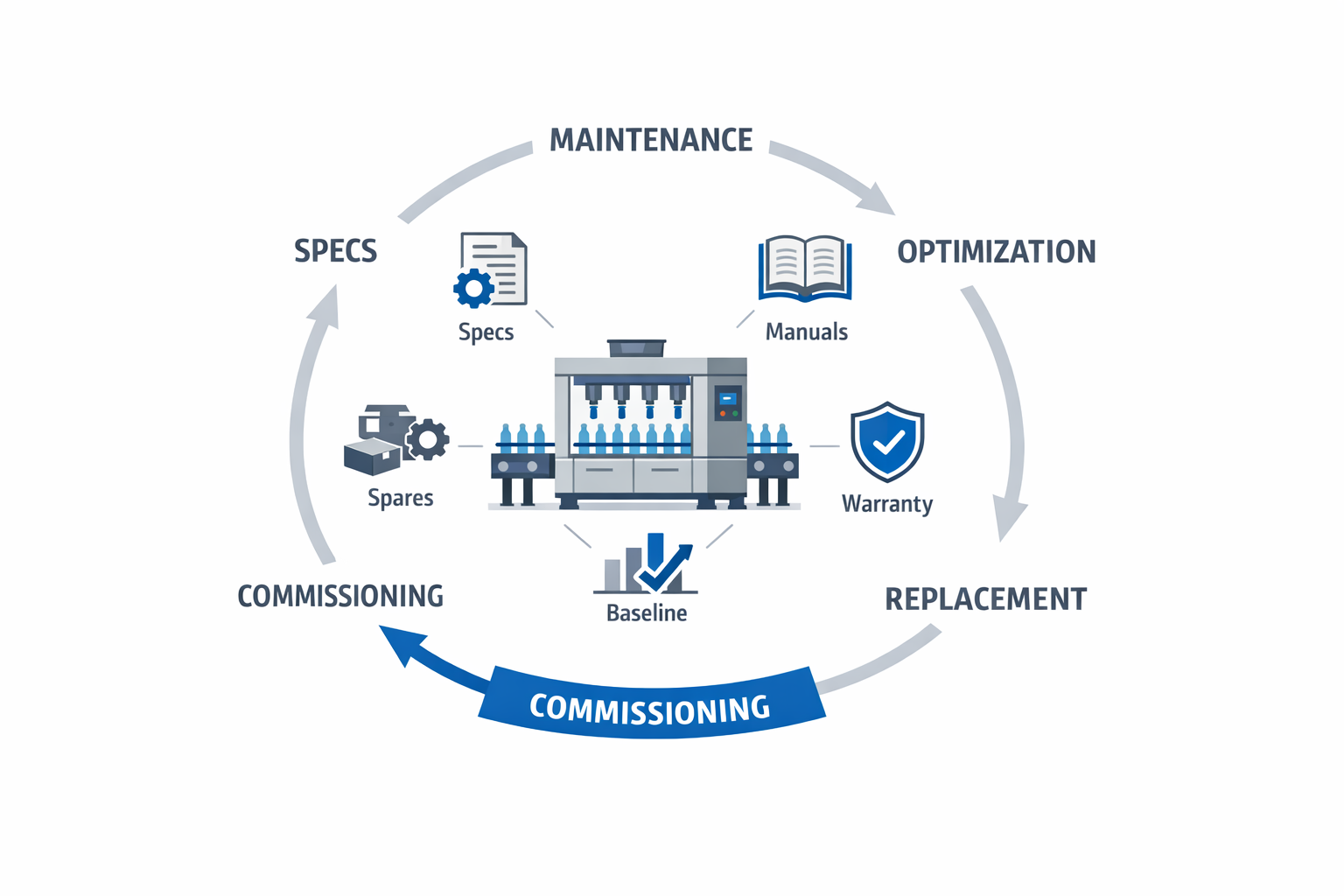
Take a high-speed beverage filling machine as a running example. If the machine enters production with incomplete commissioning records—missing lubrication points, unclear sensor calibration standards, and no agreed baseline for output and reject rate—the plant starts its asset management process with a blind spot. That early gap may seem minor during startup, but it usually becomes expensive later when technicians troubleshoot repeat faults without knowing the original design condition.
Operation and Maintenance: Building a Reliable Asset Record
Once an asset is live, management shifts from setup to controlled operation. This includes tracking runtime, load patterns, changeover frequency, operating parameters, minor stops, quality losses, and operator checks. In practice, best practices for equipment lifecycle management depend on treating operating data as part of the asset record, not as a separate production issue.
For the filling machine, daily operation data should show whether recurring jams happen only on one SKU, one speed range, or one shift. Without that context, maintenance teams may replace parts repeatedly while the real cause is operating outside the machine’s validated window. This is one reason manufacturers trying to improve asset management need cross-functional records that connect machine condition with production behavior.
Maintenance is the most visible part of asset management, but it is only one stage within the larger system. It includes inspections, preventive tasks, corrective work, spare parts usage, failure coding, calibration, and technician notes that build a reliable service history over time. That history is what allows a plant to move from isolated repairs to evidence-based lifecycle control.
In the filling line example, missing commissioning data creates weak maintenance decisions downstream. If technicians do not know the original settings for filling heads or the approved wear limits for seals and guides, work orders become dependent on tribal knowledge. Over several years, the plant may accumulate many repair records but still lack the standardized history needed to see whether the machine is deteriorating normally or failing because of poor setup discipline from day one.
Optimization and Replacement: Using Lifecycle Data to Make Better Decisions
Optimization is where asset management starts influencing throughput, energy use, and total cost of ownership. Plants use lifecycle data to refine maintenance intervals, remove chronic losses, improve spare parts strategy, and decide whether upgrades will deliver better returns than continued repair. This is also where the broader benefits of enterprise asset management become measurable, because data from engineering, maintenance, and operations starts supporting the same decisions.
Replacement decisions should be the result of lifecycle evidence, not just machine age or frustration after a major breakdown. A well-managed asset record should show maintenance cost trends, downtime impact, parts obsolescence, energy inefficiency, and whether reliability improvements are still economically justified. This is the point where day-to-day maintenance connects directly to long-term capital planning.
Why So Many Manufacturers Struggle to Improve Asset Management
Fragmented Records and Siloed Maintenance History Create Invisible Risk
Many factories do not struggle with asset management because their teams are careless. They struggle because asset information is scattered across Excel files, paper checklists, maintenance notebooks, OEM manuals, and technician memory. When an operations director asks for a full history of a filler, air compressor, or CNC machine, the answer is often incomplete, delayed, or inconsistent. That makes it difficult to improve asset management in manufacturing because decisions are being made from partial records.
In a packaging plant, for example, the asset list may show machine model and serial number but not the latest change parts, sensor upgrades, or repeated stop causes. A maintenance team may still respond quickly to breakdowns, yet miss patterns that would have justified a redesign or preventive replacement months earlier. The issue is not effort alone; it is the absence of a reliable operating record. Without that foundation, even experienced teams end up reacting instead of improving.
A second barrier is that maintenance history rarely lives in one usable system. Operators log abnormalities during the shift, technicians record repairs in a separate file, and spare parts consumption sits in stores data that no one links back to the asset. As a result, plants cannot see the full story of what happened, what it cost, and whether the intervention actually improved reliability. This is where many expected benefits of enterprise asset management fail to materialize in practice: the process is disconnected before the software question is even addressed.
In a machining shop, one spindle may show frequent vibration alarms, but the condition notes are stored in operator logs while balancing work is recorded only in the maintenance team’s worksheet. Purchasing may know that bearing orders have increased, yet that data never feeds back into machine-level review. The plant sees recurring symptoms but not the asset-level pattern. That gap delays root cause analysis and pushes lifecycle decisions further out than they should be.
Reactive Work Orders Hide the Real Failure Pattern
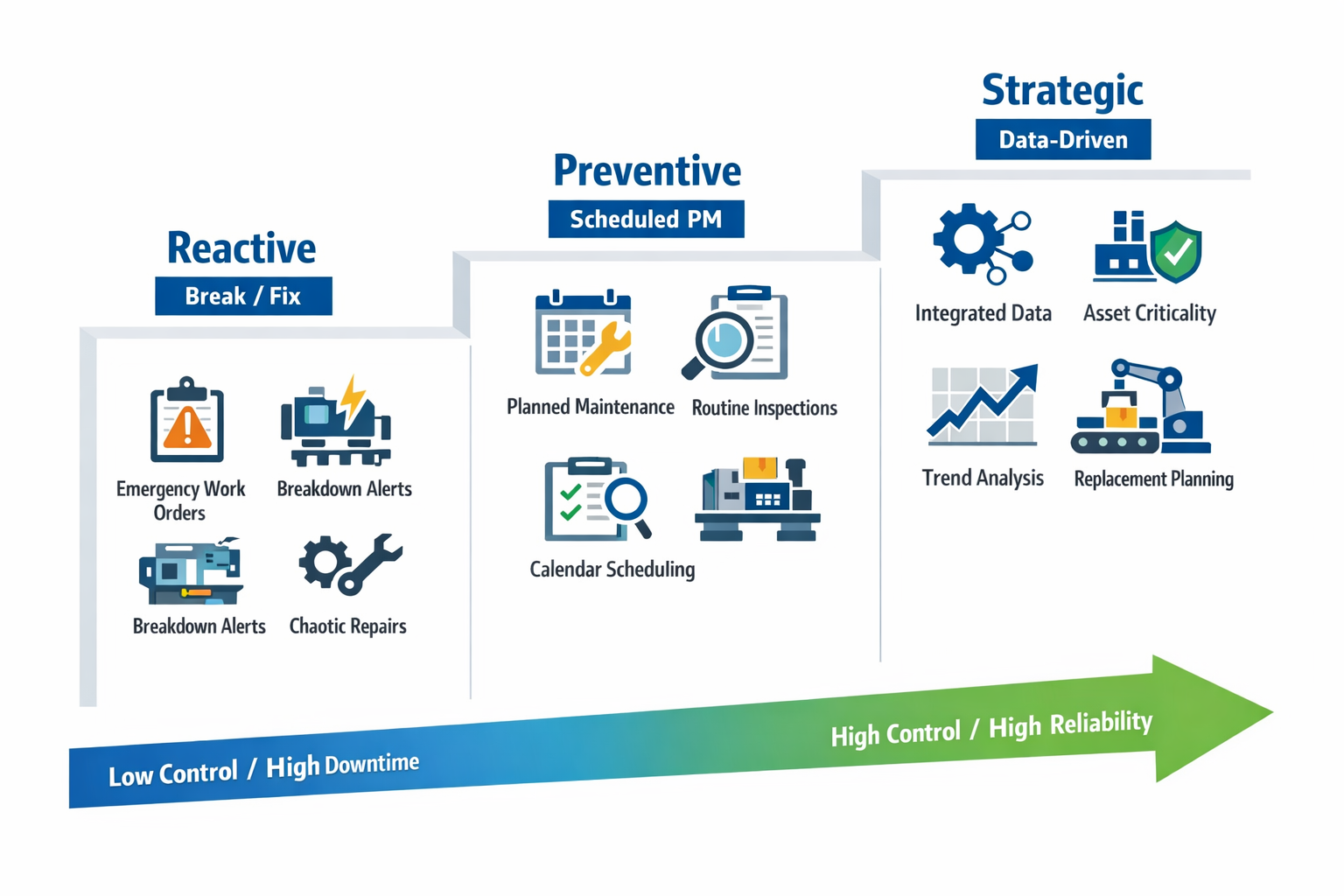
Most manufacturers say they want preventive maintenance, but many still run on reactive work orders in daily practice. Urgent jobs naturally get attention first, especially when production targets are tight and maintenance labor is limited. Over time, this creates a loop where teams become efficient at firefighting but weak at preventing repeat failures. The result is not only higher downtime, but also faster equipment wear, overtime cost, and unstable production planning.
Weak Shift Handoffs Break the Workflow
Even when inspections and repairs happen on time, weak shift handoffs can still undermine performance. If the night shift notices rising motor temperature but passes the message verbally, the day team may not understand the severity, the operating context, or whether the issue is escalating. Small abnormalities then disappear between shifts until they become a stop event. In asset management, downtime often starts with these broken workflow links rather than a single major technical failure.
Poor Visibility Makes Prioritization Almost Impossible
Plants also struggle because they lack a practical view of asset health across the factory. They may know yesterday’s downtime hours, but not which assets are consuming the most maintenance labor, generating the most repeat faults, or approaching end-of-life cost thresholds. When everything feels urgent, nothing gets prioritized well. Maintenance managers then spend more time defending resource decisions than improving reliability.
The common thread across these problems is workflow fragmentation. Asset records are created in one place, issues are reported in another, repairs are tracked elsewhere, and performance review happens only after a major breakdown. That disconnect prevents manufacturers from seeing whether maintenance activity is actually extending equipment life or simply keeping production running for one more week. It also explains why many plants ask how to improve asset management in manufacturing when the real problem is not maintenance volume, but maintenance coordination.
Before any plant can capture the full benefits of enterprise asset management, it needs consistent asset data, closed-loop work execution, and shared visibility between production, maintenance, and stores. Those are operational design issues first. The next step is turning that diagnosis into a practical improvement plan that extends equipment lifespan without adding unnecessary administrative burden.
Practical Ways to Improve Asset Management and Extend Equipment Lifespan
Improving asset management in manufacturing works best when you treat it as an operating system, not a one-time maintenance project. The practical goal is simple: make every asset easier to identify, inspect, maintain, evaluate, and eventually replace based on evidence. The steps below show how to improve asset management in manufacturing in a way that lifts uptime, reduces avoidable maintenance costs, and supports better equipment lifecycle decisions.
Standardize the Asset Registry First
Start with one controlled asset register that includes asset ID, location, make and model, serial number, commissioning date, warranty terms, maintenance standard, spare parts list, and current condition status. If those fields are inconsistent, every downstream activity—from work orders to replacement planning—becomes slower and less reliable. Plants with a clean registry typically shorten troubleshooting and planning time because technicians no longer waste effort confirming what machine they are working on.
Set Asset Criticality Tiers
Not every asset deserves the same maintenance strategy, response time, or inventory coverage. Rank assets by production impact, safety risk, quality effect, repair lead time, and replacement cost, then group them into clear criticality tiers. This helps maintenance teams protect the machines that drive throughput instead of spreading resources evenly across the plant.
A boiler feed pump, for example, may have fewer breakdowns than a conveyor motor but a much higher operational consequence if it fails. Once criticality is assigned, you can align inspection frequency, escalation rules, and spare parts stocking to real business risk. This is one of the clearest benefits of enterprise asset management: it turns maintenance prioritization into a plant-level decision, not a daily argument.
Digitize Inspections and Link Spare Parts to Each Asset
Inspection routines should capture actual asset condition, not just prove that a checklist was completed. Digital inspections allow operators and technicians to record vibration, temperature, lubrication condition, leak observations, photos, and abnormal sounds in a structured format that can be reviewed over time. That gives you trend data instead of isolated notes.
Spare parts control should be linked directly to the asset record, not managed as a separate spreadsheet with weak references. For each critical asset, document approved parts, minimum stock, lead times, substitute parts, and failure-related consumption patterns. This helps planners avoid the common situation where a repair is diagnosed quickly but delayed because the right component is not available.
Shift Preventive Maintenance From Calendar-Only to Risk-Based Scheduling
Calendar schedules are useful, but they are often too blunt for high-use or variable-load equipment. The stronger approach is to combine time-based tasks with runtime, cycle count, condition triggers, and asset criticality. This avoids both under-maintenance on heavily used equipment and unnecessary work on lightly used assets.
A compressor running 20 hours a day should not follow the same service logic as an identical backup unit used only during peak demand. By matching PM intervals to actual operating conditions, plants usually improve wrench time and reduce planned maintenance that adds little value. Over time, this raises planned work as a share of total maintenance, which is a strong sign that asset management maturity is improving.
Track the KPIs That Change Decisions
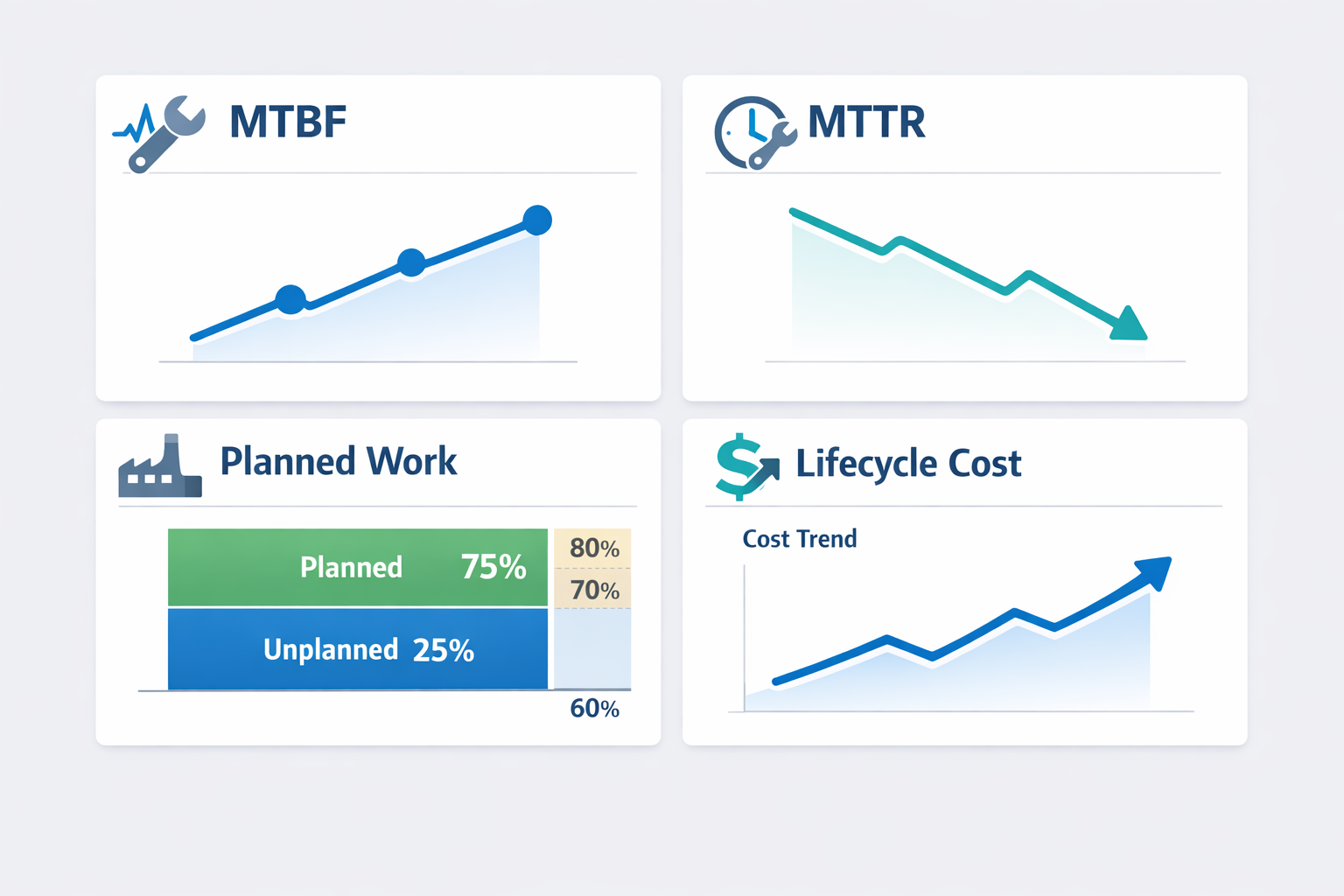
A useful KPI framework should connect reliability, maintainability, planning discipline, and total cost. Four metrics are especially practical: MTBF to measure reliability, MTTR to measure repair efficiency, planned vs. unplanned work to assess maintenance control, and asset lifecycle cost to evaluate whether an asset is still economical to keep. When reviewed together, these indicators show whether performance problems come from frequent failures, slow repairs, poor planning, or aging equipment economics.
Set End-of-Life Rules and Review the System on a Regular Cadence
Replacement decisions should be based on thresholds, not intuition. Set rules around cumulative maintenance cost, downtime impact, parts obsolescence, energy efficiency, and quality risk, so teams know when an asset should move from “maintain” to “replace.” This is where best practices for equipment lifecycle management connect maintenance data to capital planning.
Asset management improves when plants review the whole system on a fixed cadence. A quarterly review should check registry accuracy, PM compliance, recurring failure modes, spare parts gaps, KPI trends, and replacement candidates. This keeps the program aligned with operational reality instead of allowing standards to drift.
For maintenance managers and operations directors, this review cycle is where strategy becomes measurable. You can see whether your actions are extending equipment lifespan, lowering unplanned downtime, and improving lifecycle cost control. Those are the results that make asset management valuable beyond the maintenance department.
When Lightweight EAM Works Better: How Jodoo Supports Modern Manufacturing Asset Management
Traditional CMMS and enterprise asset management platforms can be powerful, but they are not always a good fit for plants that need fast rollout, flexible workflows, and broad frontline use. In many mid-sized factories, the real gap is not a lack of features but a lack of usable process design across operators, maintenance, production, and supervisors. When teams are still relying on paper tags, WhatsApp messages, and disconnected spreadsheets, a lightweight EAM approach often improves adoption faster than a long software deployment.
This is where Jodoo fits well. Instead of forcing teams into a rigid maintenance module, it lets manufacturers build the exact asset management workflow they need around their equipment, approval logic, and reporting structure. That makes it practical for companies looking at how to improve asset management in manufacturing without waiting months for IT-led customization.
Build a Usable Equipment Registry First
A lightweight EAM system only works if the asset registry is structured well from the start. With Jodoo, teams can create a centralized equipment database that captures machine ID, model, location, commissioning date, criticality, spare parts links, inspection standards, and service history in one place. Because the forms are configurable, plants can align records to their own best practices for equipment lifecycle management rather than adapt to a generic template.
In a mid-sized electronics factory, for example, each SMT machine and reflow oven can be assigned a QR code linked to its record. That gives technicians and operators one source of truth for the asset, while supervisors can control permissions so only authorized users change key master data. The result is a cleaner foundation for maintenance planning, audit readiness, and lifecycle tracking.
Connect Operators, Technicians, and Supervisors Through QR-Based Workflows
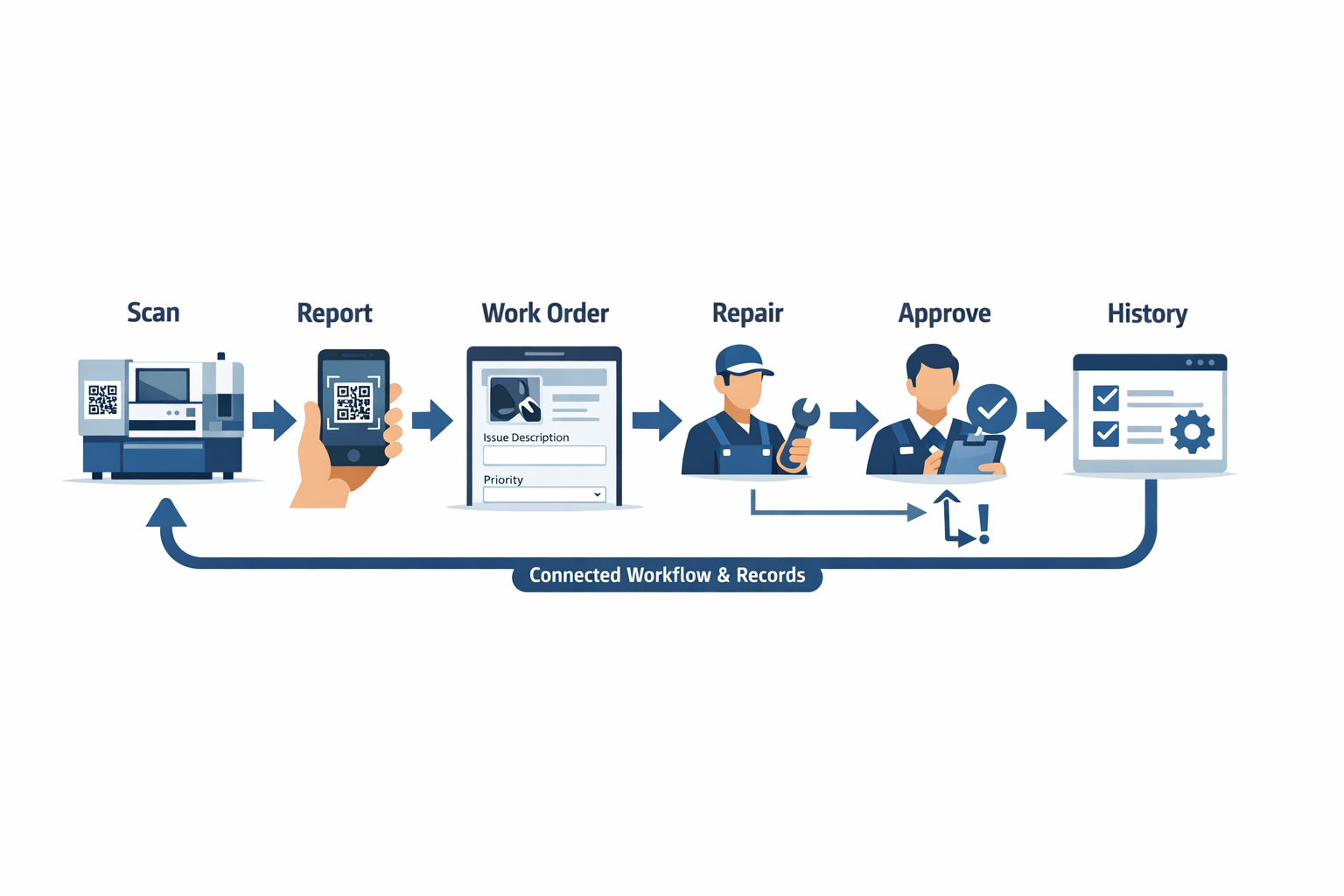
Once the registry is in place, the next step is to make reporting and response easy on the shop floor. In Jodoo, an operator can scan a machine QR code, open a mobile form, log an abnormal vibration or feeder alarm, attach a photo, and submit the issue in less than a minute. That submission can automatically create a maintenance request, notify the assigned technician, and route exceptions to a supervisor if the asset is classified as critical.
Because the workflow, form, and record sit in one system, maintenance history builds automatically against the correct machine. Technicians can update diagnosis, parts used, downtime minutes, and completion status from mobile or desktop, while supervisors can review delays, approvals, or repeat failures in context. This kind of connected flow delivers one of the main benefits of enterprise asset management: reliable asset records that support action, not just storage.
Automate the Steps That Usually Slow Maintenance Down
Many maintenance delays happen between the issue report and the actual repair decision. Jodoo helps remove that lag by automating task assignment, escalation, approvals for outsourced service, and notifications when repair time exceeds target. For plants with lean maintenance teams, this matters because response discipline often has more impact on uptime than adding another standalone system.
Turn Maintenance Data Into an Asset Health View
A lightweight EAM system becomes far more valuable when plant leaders can see trends without exporting data into separate spreadsheets. Jodoo dashboards can display asset-level KPIs such as repeat breakdowns, open work orders, response time, downtime by line, preventive completion rate, and maintenance cost by machine group. For operations directors, that creates a reporting layer that supports both daily review and longer-term replacement planning.
In the same factory, once operators submit issues and technicians close jobs in Jodoo, the dashboard updates automatically. A supervisor can see that one reflow oven has rising fault frequency over the last 90 days, while another machine shows stable performance after preventive actions were tightened. This makes the benefits of enterprise asset management visible in operational terms: faster response, clearer accountability, and better timing on repair-versus-replace decisions.
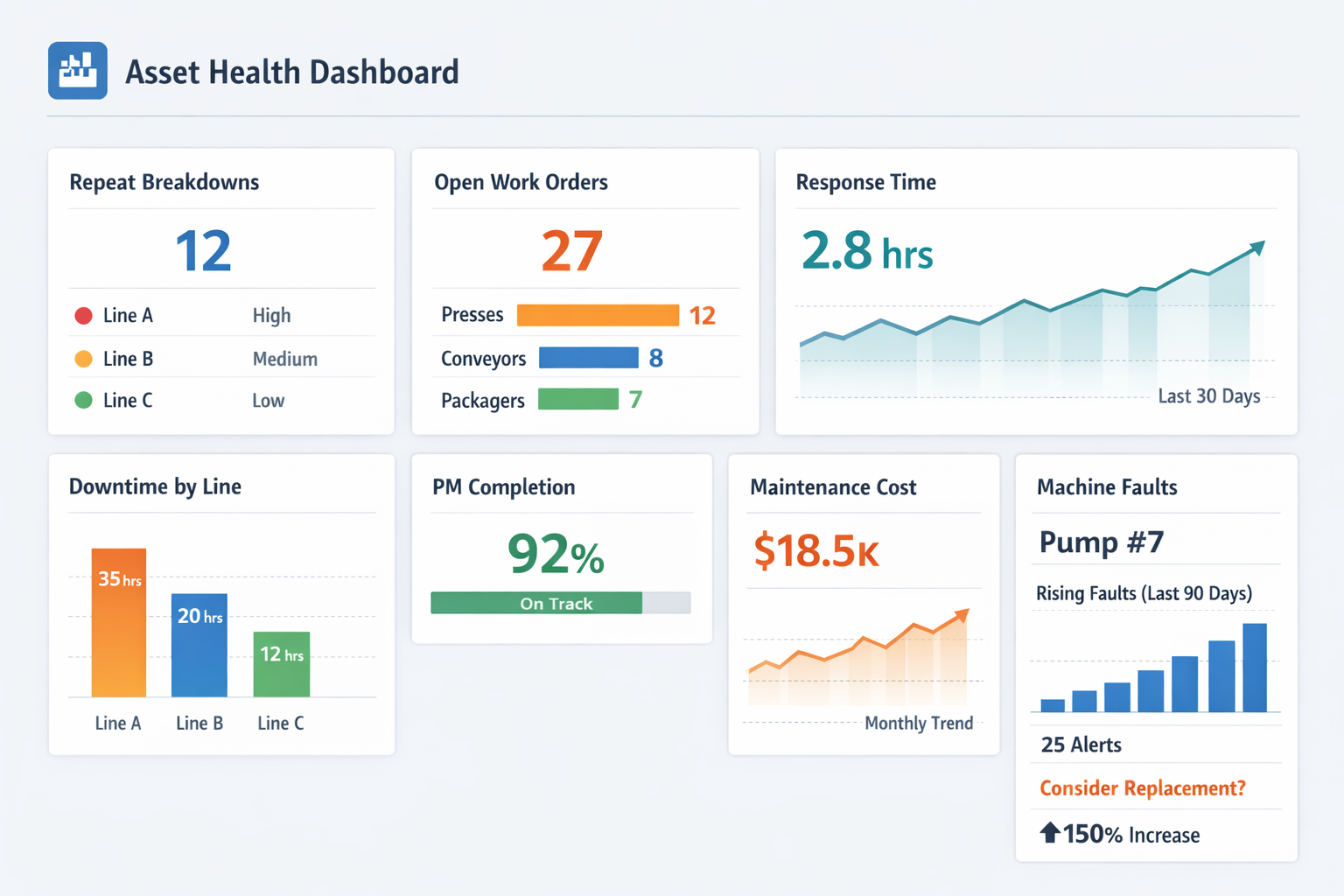
For many manufacturers, the best asset management setup is not the heaviest platform, but the one people actually use every shift. Jodoo supports that by combining asset records, QR-based reporting, approvals, and dashboards in one configurable environment that operations teams can adapt without a long development cycle. If you need a practical digital layer between spreadsheets and a complex EAM rollout, this lightweight model can be a strong fit.
Conclusion: Build a More Reliable Asset Management System
Strong asset management in manufacturing is not just about generating more maintenance work orders. It depends on having clear lifecycle visibility, from commissioning and service history to performance trends, spare parts usage, and replacement timing. When that information is fragmented across paper forms, spreadsheets, and disconnected systems, even a capable maintenance team will struggle to improve uptime consistently.
The manufacturers that extend equipment lifespan most effectively usually do three things well: they maintain a clean asset registry, run disciplined preventive and corrective workflows, and use operational data to make better repair-or-replace decisions. That is what turns asset management from an administrative task into a practical strategy for reducing downtime, controlling maintenance costs, and protecting production capacity. In many plants, even a 10% to 20% reduction in unplanned downtime can translate into meaningful output gains and lower overtime pressure.
If you want to digitize asset records, maintenance tracking, and asset health reporting without a long software project, Jodoo gives you a flexible no-code way to build around your existing operations. As a no-code lean manufacturing platform, it can help you standardize workflows, connect frontline reporting with maintenance action, and create dashboards your team will actually use. Start a free trial or book a demo to see how Jodoo can support a more reliable asset management system.