Browse by category

Introduction: Why Cycle Counting Matters in Manufacturing
Inventory errors are expensive, and they rarely stay inside the warehouse. A single mismatch in raw material, WIP, or finished goods can trigger line stoppages, expediting costs, missed shipments, and avoidable purchasing. Industry studies often place inventory record accuracy in many facilities below 90%, which is a serious problem when production plans depend on every transaction being right.
That is why the cycle count process matters in manufacturing. Instead of shutting down operations for a full physical inventory once or twice a year, cycle counting checks selected items, bins, or locations continuously during normal operations. For inventory managers and warehouse supervisors, the goal is straightforward: keep stock records accurate without freezing receiving, picking, staging, or production.
In this article, you will learn when cycle counting works better than physical inventory, how ABC counting applies in manufacturing, how to implement the process step by step, and how to digitize count workflows without replacing your ERP.
Cycle Counting vs. Physical Inventory
One Big Count vs. Continuous Control
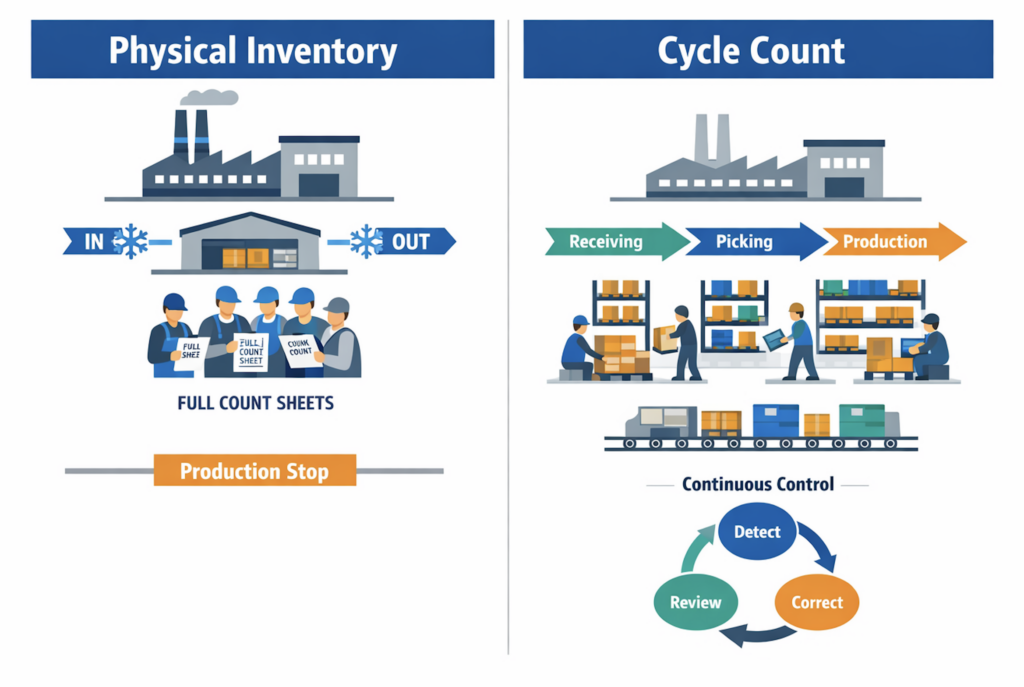
For inventory managers, the core difference is simple: a physical inventory concentrates effort into a shutdown event, while cycle counting spreads control across normal operations. Annual or semiannual counts often require production pauses, overtime, temporary labor, and a freeze on inventory movements so the numbers can be trusted. A cycle count program, by contrast, checks selected items or locations in smaller batches, allowing receiving, picking, and production to keep moving.
In practice, physical inventory gives you a snapshot, but cycle counting gives you a control loop. A full count may confirm that inventory was wrong, yet it usually does not show when the error started, who touched the material, or whether the same problem is still happening. Ongoing cycle counts detect issues closer to the point of failure, which makes root-cause analysis much easier. That matters more than the count itself, because inventory accuracy improves only when process errors are found early enough to correct.
Less Downtime, Better Use of Labor
A physical inventory typically pulls supervisors, warehouse staff, production operators, and finance into the same event, even when many of those hours add little long-term control value. Manufacturers often spend days preparing locations, printing sheets, reconciling exceptions, and then recounting under pressure. With cycle counting, the workload is smaller and easier to schedule around replenishment windows, shift handovers, or slower production periods. Instead of one disruptive surge, you create a repeatable routine that uses experienced staff where they add the most value.
This also improves count quality. Large shutdown counts tend to reward speed, which increases the risk of rushed checks, skipped bins, and posting errors. Smaller daily or weekly counts let supervisors review discrepancies while the transaction trail is still fresh. That is one reason companies exploring how to implement cycle counting often start with a narrow scope before scaling the program.
Faster Variance Detection in Real Manufacturing Conditions
Consider an electronics plant storing high-value reels of components in multiple sublocations. If one location has repeated unrecorded line-side withdrawals, an annual physical inventory may find the shortage months later, after several production orders and emergency purchases. A cycle count on those parts every week would surface the variance early, before planners overcommit stock or buyers pay expedite fees.
Stronger Inventory Control Between Counts
Cycle counting also supports better decision-making between major audits. Because the data is refreshed continuously, planners can trust on-hand balances more when releasing work orders, buyers can reduce safety stock padding, and warehouse teams can focus on the locations that generate the most errors. Whether you later use an ABC-based schedule or another model, the principle is the same: count often enough to control risk, not just to satisfy accounting.
ABC Cycle Counting Explained for Manufacturing Environments
How the ABC Method Works
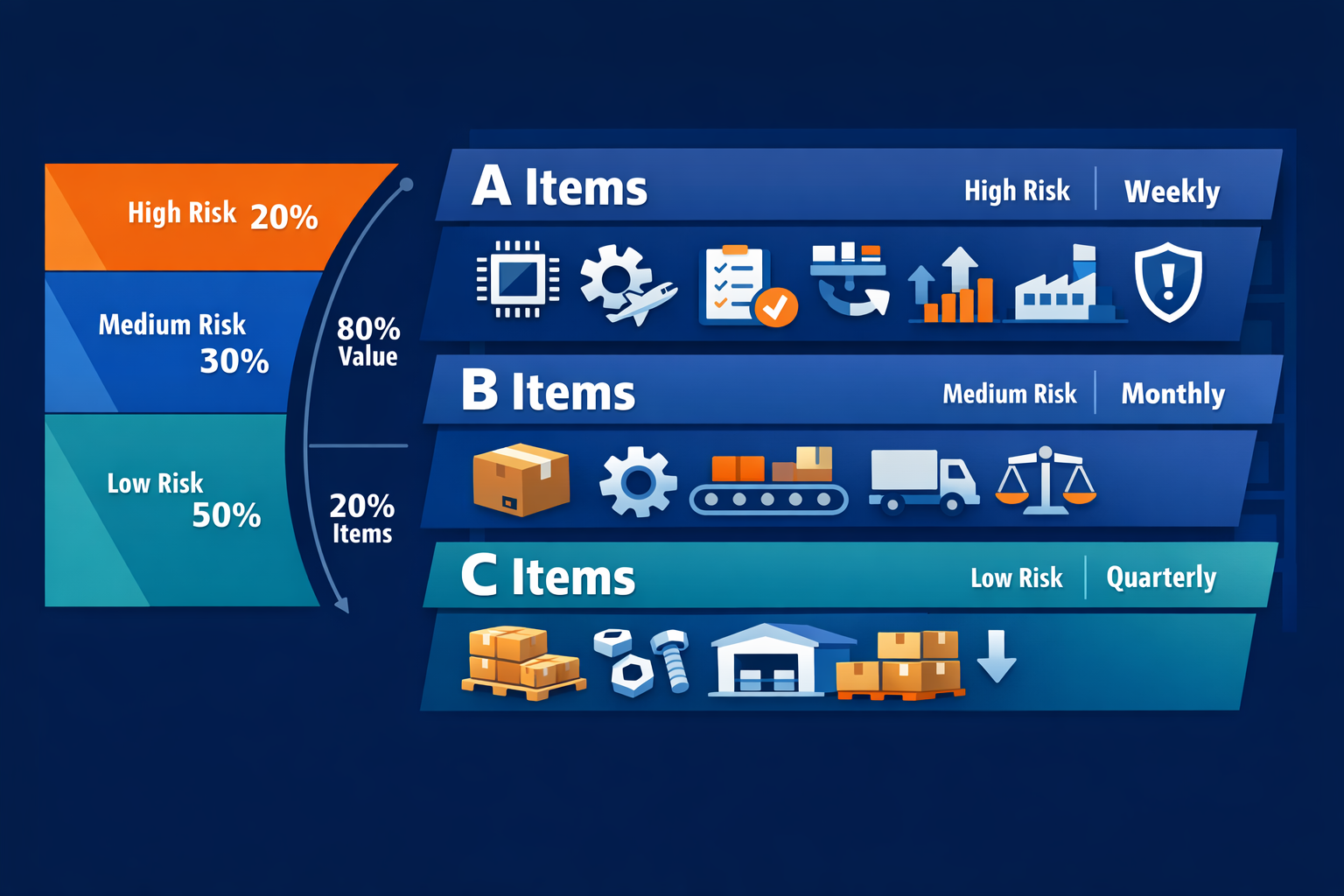
The ABC cycle counting method explained simply is this: not every SKU needs the same counting effort. Manufacturers group inventory into classes based on business impact, then count high-impact items more often than low-impact ones. In practice, this usually means evaluating each item by inventory value, movement frequency, production criticality, or control risk rather than relying on unit cost alone.
A common starting point is to classify A items as the small share of SKUs that drive the highest inventory value or operational exposure, B items as the middle tier, and C items as the large group of low-value or low-risk parts. Many plants use a rough 80/15/5 logic, where about 10–20% of items account for 70–80% of value. From there, count frequency follows business importance: A items may be counted weekly or monthly, B items monthly or quarterly, and C items quarterly, semiannually, or on a rotating basis.
Where ABC Needs Adjustment
Value is useful, but manufacturing environments often need a broader lens. A low-cost gasket can still shut down a line if it is missing, while a regulated resin or lot-tracked component may need tighter control because of traceability requirements. That is why many inventory managers adapt ABC rules to reflect usage rate, stockout impact, shelf life, traceability, and supplier lead time.
For example, an electronics manufacturer may place microchips in A class because they are expensive and supply-constrained, while a food processor may assign A status to packaging film because it is consumed daily and causes immediate downtime if unavailable. A chemical plant may elevate certain materials because expiry dates and batch compliance create higher audit risk.
Other Count Approaches Worth Knowing
Some companies use location-based counting, control-group counting, or zero-balance verification alongside ABC. Those methods can be useful for checking process discipline or targeting known problem zones. Still, for most manufacturers, ABC remains the most practical framework because it aligns counting effort with financial and operational risk while supporting the broader benefits of cycle counting over physical inventory.
How to Implement Cycle Counting Step by Step
Define Scope and Count Priorities
To show how to implement cycle counting in practice, start with a limited but operationally meaningful scope. In a mid-sized electronics plant, that usually means one warehouse, one line-side supermarket, and one finished-goods staging area rather than the entire site. Use the ABC framework already discussed to choose what gets counted first: high-value ICs, fast-moving connectors, and shortage-prone packaging should enter the first wave. This keeps the rollout controlled while testing whether locations, labels, and stock ownership rules are clean enough for routine counts.
Next, define count units and locations before you define frequency. If one item is stored by reel in the warehouse, by partial pack at the line, and by carton in finished goods, the team needs one agreed conversion logic, or variances will be manufactured by the process itself. Map every item to a primary storage bin and a responsible function, then exclude stock that is already under active receiving, kitting, or quarantine transactions during the count window. That discipline matters more than broad coverage in the first month.
Build the Count Calendar and Assign People
Once the scope is set, build a count calendar that matches production rhythm rather than office convenience. A practical schedule is daily A-item counts, weekly B-item counts, and monthly C-item counts, with short windows before shift start or after material replenishment. This is where the benefits of cycle counting over physical inventory become operational: the plant spreads effort across the month instead of creating one disruptive counting event. Keep daily count tasks small enough that each counter can complete them in 20 to 30 minutes with minimal interruption.
Staffing should separate counting, review, and approval responsibilities. In our electronics plant example, a warehouse operator counts, a warehouse supervisor reviews discrepancies, and the inventory controller approves adjustments above a set threshold. Counters should not audit their own picks from the same shift if avoidable, because familiarity often leads to assumption-based counting. Cross-training two or three backup counters also prevents the program from collapsing during leave, audits, or peak shipments.
Standardize Counting, Review, and Adjustment
Blind counts are essential if you want actual process control rather than system confirmation. The counter should see item code, description, location, and unit of measure, but not the ERP balance. After the count is entered, the supervisor compares physical quantity to system quantity, checks recent receipts, issues, returns, and transfers, and decides whether a recount is needed. The process should move from task creation to count entry, discrepancy review, recount, root-cause tagging, and approved adjustment.
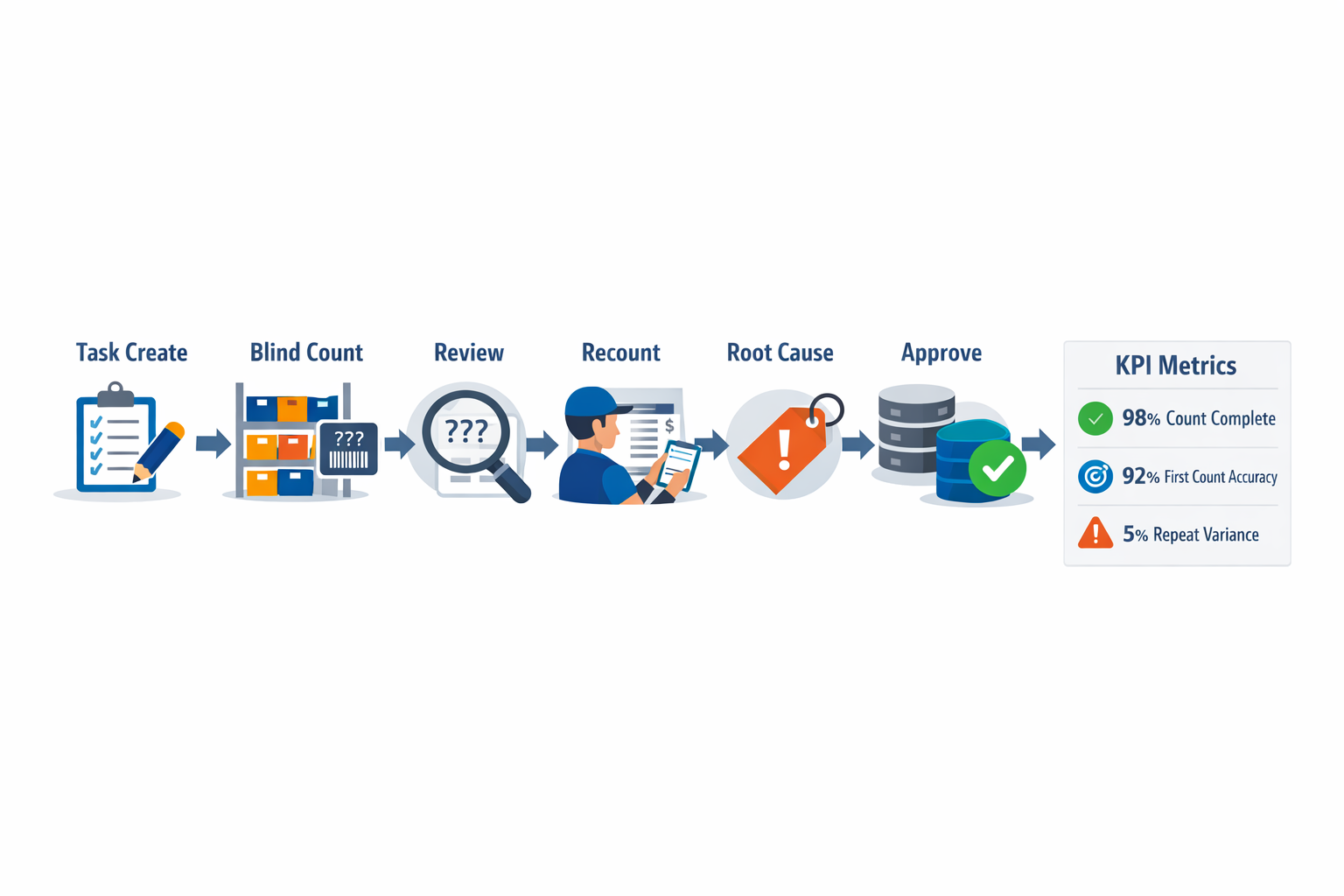
Set simple rules for recounts and inventory adjustments. For example, any A-item variance above 2% or any lot-controlled part mismatch triggers a same-day recount by a second person, while repeated errors in one bin trigger a location audit. Track a short KPI set: count completion rate, first-count accuracy, adjustment value, repeat variance by item, and root-cause distribution. If you want the ABC cycle counting method to keep working, those KPIs must feed back into count frequency, location discipline, and transaction training.
How to Digitize Cycle Counting Workflows Without Replacing Your ERP
Build a Mobile-First Layer Around Your Existing System
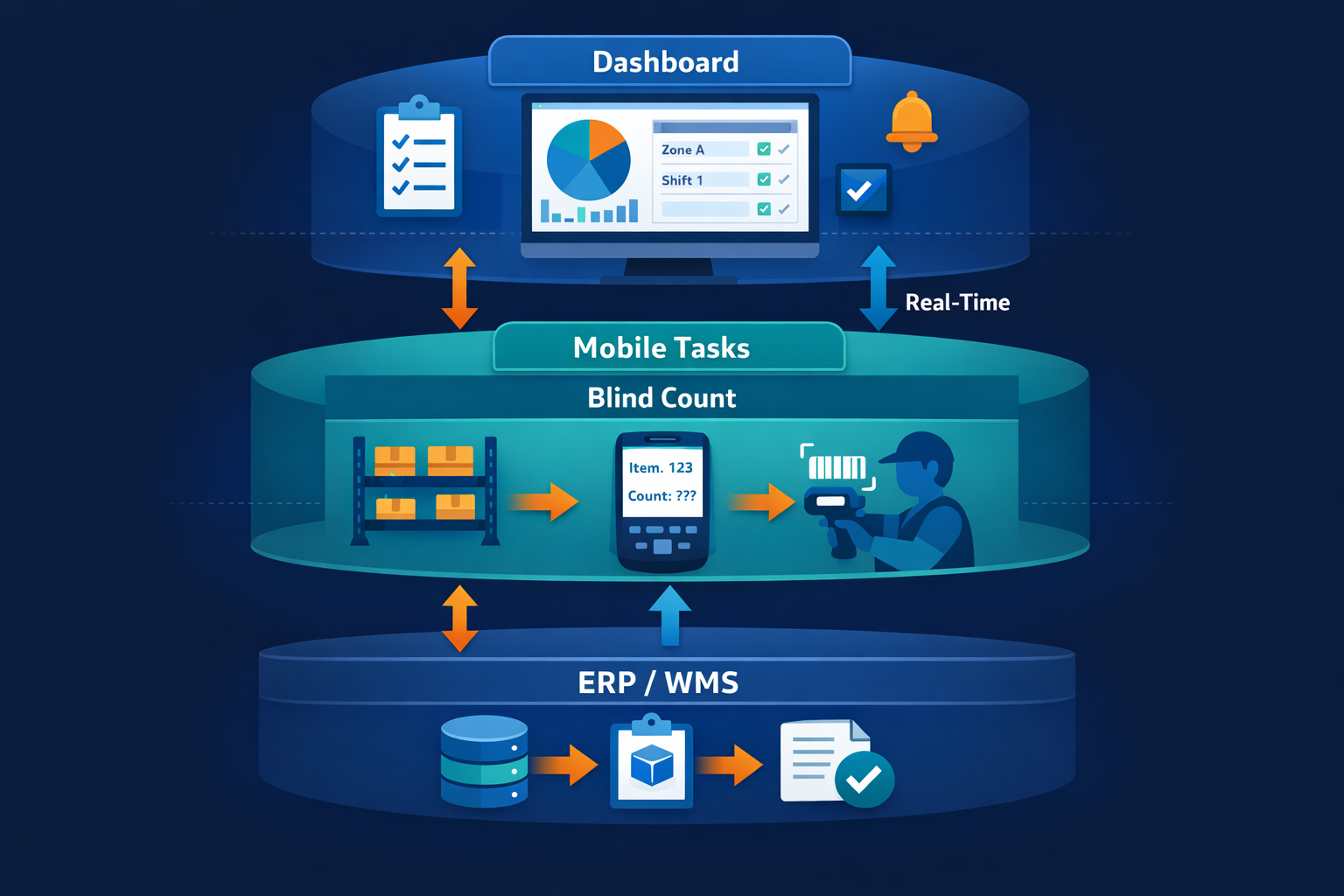
If you already know how to implement cycle counting on paper, the next step is not a full ERP replacement. Consider adding a workflow layer that standardizes execution on the shop floor while your ERP or WMS remains the system of record for item masters, stock balances, and approved adjustments. For most manufacturers, that means replacing spreadsheets, printed count sheets, and email follow-ups with one controlled digital process.
Take a mid-sized electronics plant using the ABC cycle counting method explained earlier. The ERP already stores part numbers, bin locations, and standard quantities, but daily counts are still assigned verbally, and variance notes are typed later into Excel. With Jodoo, the inventory team can build a cycle count app that pulls the day’s items or locations into structured tasks, assigns them by zone or shift, and sends them directly to counters on mobile devices.
Each task can include the item code, location, lot or batch field if needed, due time, and required scan step, while hiding the expected quantity to preserve blind counting discipline. Supervisors no longer need to print sheets or chase completion status because task progress updates in real time.
Standardize Counting, Scanning, and Exceptions
The biggest operational gain is consistency. Jodoo forms can require QR or barcode scans before a count is entered, restrict who can count which zones, and validate fields so incomplete records do not move forward. In practice, that means a counter in the capacitor warehouse scans bin E-14, enters the physical quantity, attaches a photo only if damage is found, and submits the record from a phone or handheld device.
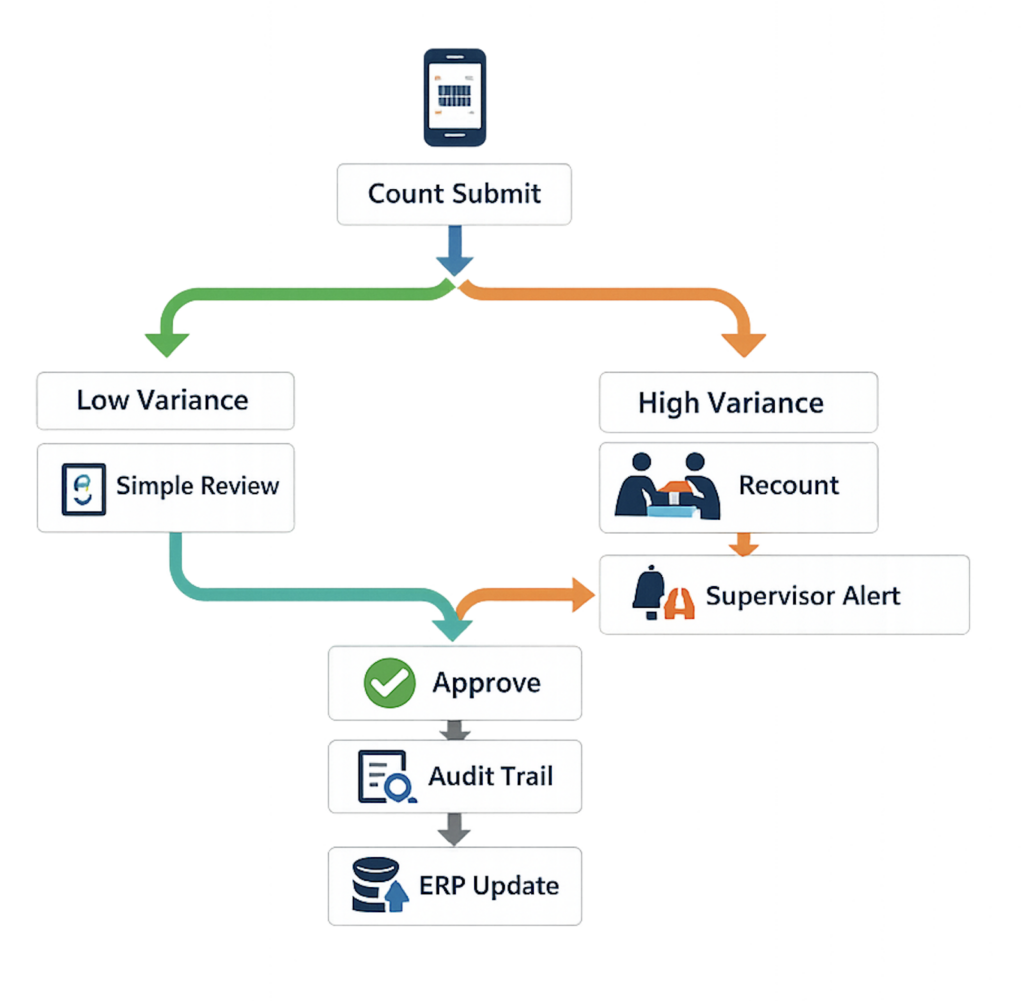
When the count result deviates from the expected balance beyond a defined threshold, Jodoo Workflow can trigger the next action automatically. A variance of 1% may route to simple review, while a variance of 8% on an A-class component can create an immediate recount task for a second counter and notify the warehouse supervisor. This is where the benefits of cycle counting over physical inventory become operationally measurable: exceptions are handled the same day, not at year-end.
Add Approval Logic and Audit Trails
After the recount, the workflow can escalate based on value, criticality, or traceability rules. For example, if the second count confirms a shortage on a high-value microcontroller, Jodoo can route the case to inventory control, require a reason code, and then send the approved adjustment back to the ERP team or through an integration step. That keeps approval authority intact while removing informal side channels like chat messages and handwritten notes.
Every step is time-stamped, user-stamped, and stored with comments, scans, and attachments. That matters for internal audits, ISO procedures, and root-cause reviews because you can see whether the issue came from picking errors, wrong bin labels, delayed receipts, or stock movements posted late. Instead of digitizing only the form, you digitize the full control loop around the cycle count.
Conclusion: Build a More Reliable Cycle Count Process With Jodoo
A strong cycle count process is not a once-a-year inventory event. It is a repeatable operating routine that helps you keep raw materials, WIP, and finished goods accurate while production continues. When manufacturers move from reactive stock checks to structured cycle counting, they usually gain faster variance detection, better root-cause visibility, and fewer surprises at month-end or audit time.
The practical path is straightforward: choose the right counting method, set clear count frequencies, define blind count and recount rules, and track KPIs such as inventory accuracy, adjustment value, and count completion rate. From there, the biggest improvement often comes from digitizing execution so tasks, approvals, and discrepancy handling follow the same standard every time. That is what turns cycle counting from a manual effort into a controlled workflow.
If you want to launch or standardize that workflow faster, Jodoo gives manufacturing teams a no-code lean manufacturing platform to build mobile cycle count forms, approval flows, dashboards, and audit trails without replacing your ERP. You can start small in one warehouse or plant, then scale the process across sites. Start a free trial or book a demo to see how Jodoo can help you build a more reliable cycle count process.