Browse by category

Introduction: Why a Structured Change Management Process Matters on the Shop Floor
A manufacturing change can fail long before the new method reaches full production. McKinsey has reported that roughly 70% of change programs fall short of their goals, and in factories the reason is often simple: the approved change does not translate into consistent operator execution. A structured change management process is what closes that gap between decision and daily work.
On the shop floor, change is constant. You may be updating a work instruction, replacing a fixture, switching a supplier material, adjusting routing, or adding an extra quality checkpoint after a customer complaint. Each of these changes can improve cost, throughput, or compliance, but each also creates risk if one shift is trained and another is not, or if old instructions remain in circulation during restart.
In manufacturing terms, a change management process is the controlled method for requesting, reviewing, approving, implementing, verifying, and closing operational changes. In the following sections, we will look at where change efforts break down, how to implement them step by step, and how digital workflows help ensure the new process is the only process used.
Where Manufacturing Change Efforts Break Down
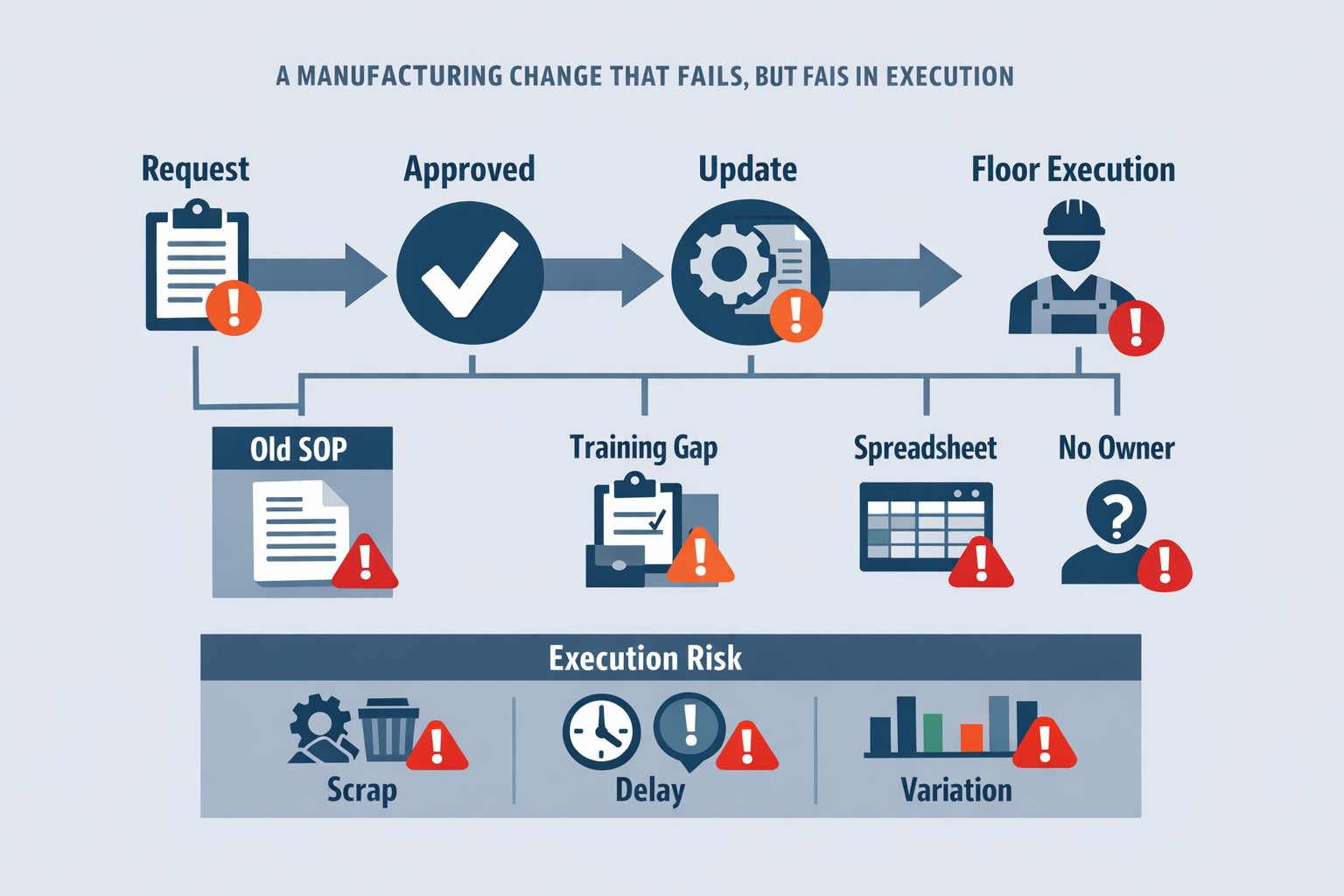
Outdated Instructions Stay in Circulation
One of the most common challenges in change management process is simple but costly: the new method is approved, yet the old instruction is still easier to access. Printed SOPs remain at the line, an older PDF sits on a shared drive, and a supervisor’s marked-up copy becomes the unofficial reference during a busy shift. In regulated sectors, document control failures are a direct compliance risk; in any plant, they increase variation, scrap, and rework. A quality change is not live when engineering signs off on it; it is live only when operators are using the correct version at the point of work.
Retraining Breaks Down Across Shifts
Training often reaches day shift first and everyone else later, if at all. That creates uneven execution, especially in plants running 2 to 3 shifts, contract labor, or high operator rotation across cells. A maintenance-led equipment adjustment may be understood by technicians but not by temporary packers, forklift drivers, or quality inspectors who touch the same process.
Vague Ownership
Many changes touch engineering, production, quality, maintenance, purchasing, and EHS at the same time, but responsibility is often defined too broadly. If everyone is “involved,” no one clearly owns line clearance, first article inspection, training records, or scrap disposition for old material. That ambiguity slows decisions and creates hidden delays close to launch. In practice, one missing owner can hold up an entire changeover more than the technical modification itself.
Approvals Move, but Execution Does Not
A plant can have a formal approval path and still fail on execution because approvals, documents, and training records are managed in different places. Engineering approves the revised setting sheet by email, quality updates the inspection frequency in a spreadsheet, and supervisors track retraining on paper sign-off sheets. By the time production starts, no one has one reliable view of what is approved, what is updated, and who is ready to run. This is why disconnected systems create execution gaps even when the intent behind the change management process is sound.
How to Implement a Change Management Process in Manufacturing
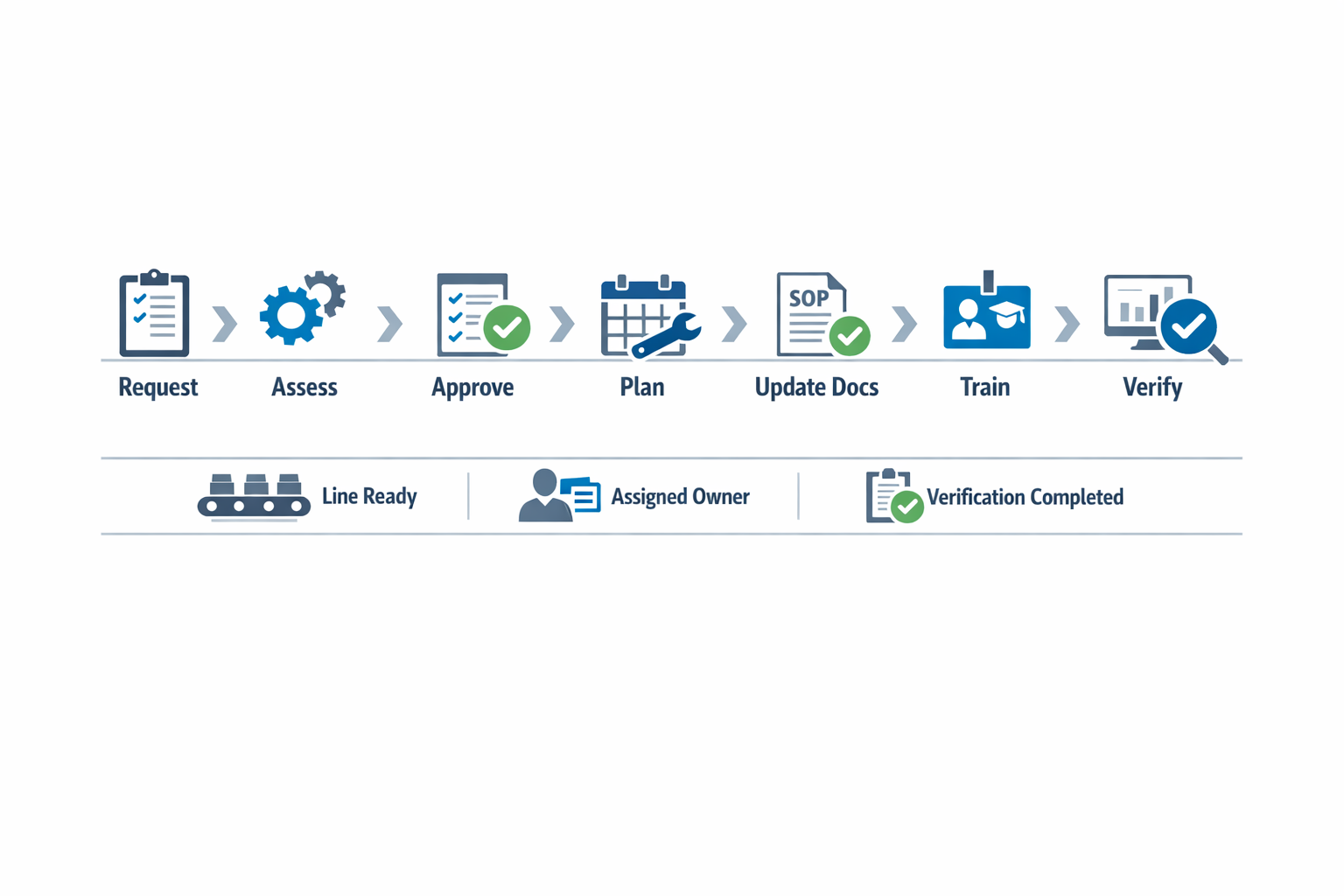
A practical change management process in manufacturing should move in a fixed sequence, not through informal emails or verbal coordination. For a packaging line tooling update, the workflow starts with a formal request, then moves through impact assessment, approvals, implementation planning, document updates, training, effectiveness checks, and closure. That sequence matters because each step answers a different operational question: should we make the change, what will it affect, who must act, and how do we prove the line is ready. If you are deciding how to implement a change management process, start by standardizing that sequence before you optimize anything else.
1. Submit the Change Request
The process begins when engineering, production, quality, or maintenance raises a structured change request. In the packaging line example, the request states that a new carton size requires a tooling change on the case erector and label applicator, with target start-up next month. The request should capture the business reason, affected line, urgency, expected benefits, and proposed timing.
2. Assess Operational Impact
Next, cross-functional owners assess what the change will touch before approving it. For the tooling update, production reviews changeover time and line capacity, maintenance checks installation requirements, quality reviews label placement and pack integrity risks, and planning checks whether customer orders can tolerate downtime. This is where you identify hidden dependencies such as spare parts, trial materials, or revised inspection points. Strong assessments prevent late surprises during installation week.
3. Route Approvals and Set Decision Rules
Once impacts are known, route the request to the right approvers with clear thresholds. A minor fixture adjustment may need only production and maintenance approval, while a packaging format change tied to customer specifications may also require quality, engineering, and commercial signoff. Approval rules should reflect risk, cost, downtime, and compliance exposure.
4. Plan Implementation in Detail
After approval, convert the decision into an execution plan with owners and dates. For the packaging line, that means scheduling tooling delivery, assigning installation technicians, booking a controlled trial, setting line stop and restart windows, and defining go/no-go criteria. The plan should also specify contingency actions if the first run fails, such as reverting to the old format for open orders.
5. Update Documents, Train, Verify, and Close
Before restart, update SOPs, setup sheets, visual standards, and first-piece inspection instructions so the new method is documented exactly once. Then train all affected operators, setters, quality inspectors, and shift supervisors, with acknowledgment captured by role rather than assumed through toolbox talks. After launch, verify effectiveness by checking start-up scrap, OEE impact, defect rates, and audit compliance for a defined period such as one to two weeks. Only close the change when results are stable, open actions are complete, and the old tooling method has been formally retired.
Best Practices for Managing Change in Manufacturing Without Slowing Production
Define Ownership by Role, Not by Department
One of the most useful best practices for managing change in manufacturing is assigning ownership at the role level. A change should have a request owner, impact reviewer, approver, implementation lead, training owner, and verification owner, even if some roles sit in the same function. This prevents a common failure in manufacturing change management: everyone assumes another team has covered operator readiness, document updates, or line clearance.
Phase Changes Around Real Production Windows
Many plants know how to implement a change management process on paper, but timing is where disruption starts. The right approach is to fit the change into the factory’s actual operating rhythm: planned maintenance shutdowns, model changeovers, weekend sanitation windows, or low-mix shifts. In a food packaging plant, for example, a label inspection change is better introduced during a scheduled SKU transition than mid-run, when operators are focused on throughput recovery. According to McKinsey, organizations that plan operational changes with clear stage gates are significantly more likely to meet schedule and performance targets than those that rely on informal coordination.
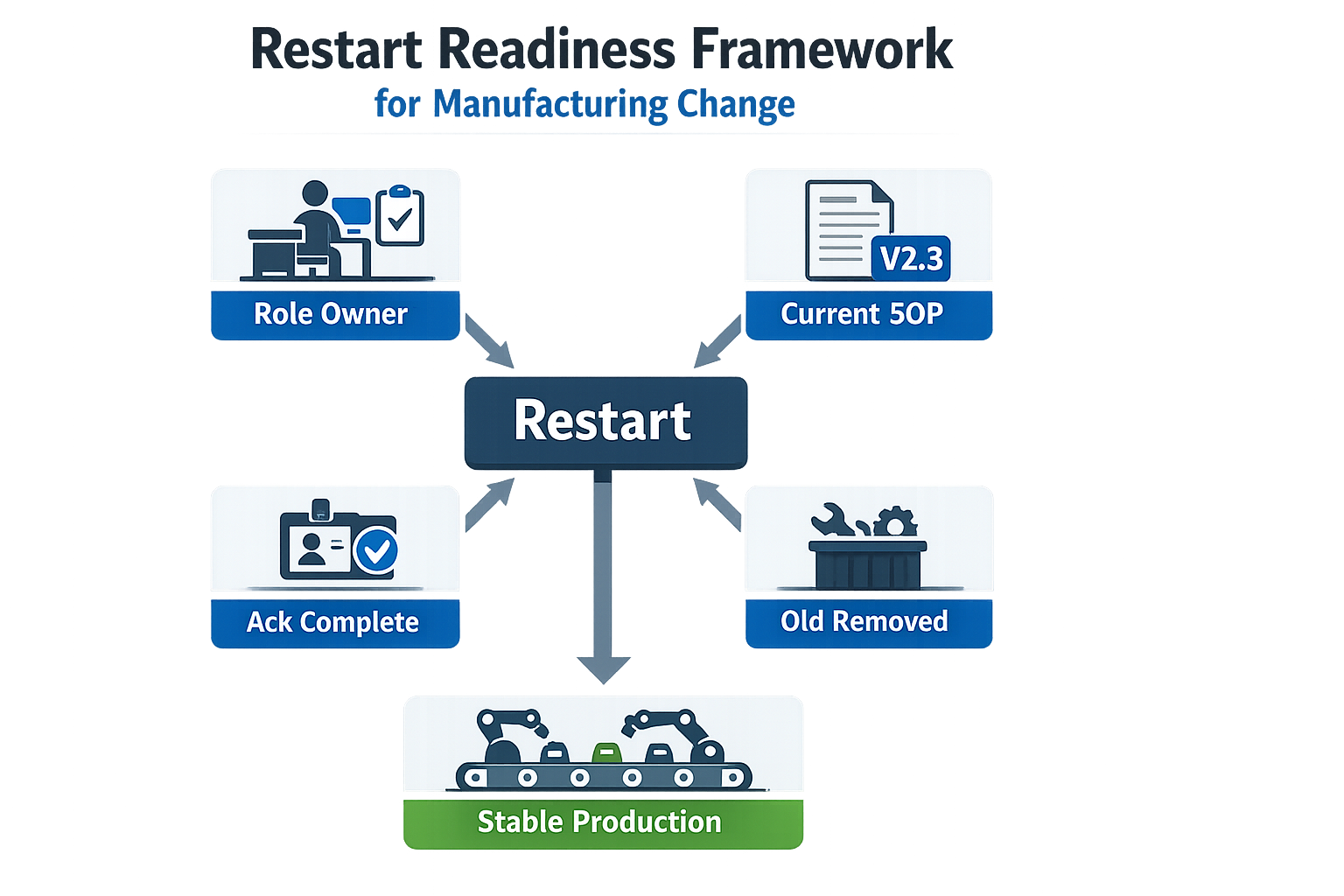
Strong change governance on the shop floor looks specific: one approved launch date, one current SOP version, one named restart authority, and one closure check after startup.
Control Documents Like You Control Product
Version control for SOPs, setup sheets, and checklists should be treated as a production control issue, not just an admin task. If a welding cell changes wire specification or torch angle standards, every related document must update together, with old copies removed from binders, shared folders, and machine-side holders. ISO-aligned manufacturers often audit document control for this reason: uncontrolled instructions create process variation even when the technical change itself is correct.
Require Worker Acknowledgment Before Restart
Training should not be marked complete because a supervisor gave a quick verbal briefing at shift handover. For affected workers, especially across multiple shifts, you need individual acknowledgment that the new method was received, understood, and applied. In an electronics assembly plant, a torque sequence change may affect only one station, but if three contract operators miss the briefing, defect rates can rise within hours. That is why good execution ties restart approval to confirmed acknowledgment, not assumed communication.
How Digital Workflows Help Execute and Track Manufacturing Changes
What a Manufacturing Change System Must Control
Once you know how to implement a change management process, the next requirement is system control. A manufacturing team needs one structured workflow that captures the change request, impact assessment, approvals, implementation tasks, training records, and verification results in the same chain. If those records sit in separate emails, shared folders, and paper sign-offs, the process becomes hard to govern at scale. That is where many common challenges in manufacturing change management reappear, even after the process has been redesigned.
In the packaging line tooling update from the previous section, the engineering lead submits a digital change request with the new tool specification, target line, SKU impact, planned cutover date, and risk notes. Required fields prevent incomplete requests from moving forward, which matters when changes affect setup parameters, inspection steps, and operator handling. The workflow can also attach drawings, photos, trial results, and revised setup sheets in one record. That creates a single source of truth before execution starts.
Route Approvals and Tasks Automatically
After submission, the system should route approvals based on rules rather than manual follow-up. For the tooling change, approvals may go first to engineering, then quality, then production, and finally maintenance if fixture modification is required. Due dates, reminders, and escalation logic keep the sequence moving if one approver delays beyond the allowed window.
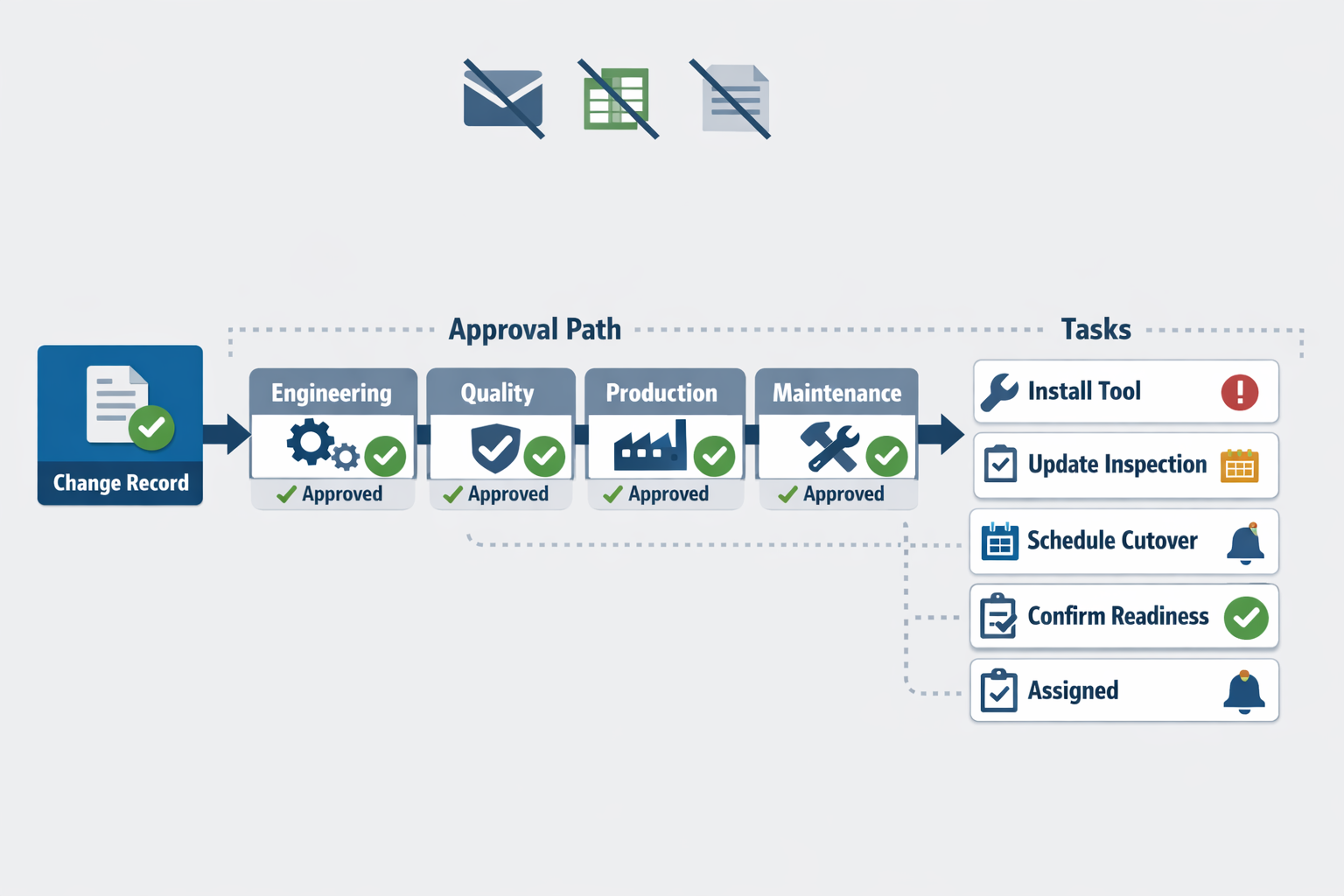
With Jodoo, operations teams can build these approval paths in a visual workflow and assign downstream tasks automatically once approval is complete. When the packaging line change is released, the system can create task records for maintenance to install the tool, for quality to update first-piece criteria, for planning to sequence the cutover window, and for supervisors to confirm shift readiness. Each task has an owner, deadline, status, and completion evidence. Instead of asking who has done what, the plant can see implementation progress in real time.
Push the Right Instructions to the Floor
Execution breaks down if approved changes do not reach operators in the correct format and at the correct time. Jodoo helps close that gap by linking the approved change record to updated digital work instructions, setup standards, and checklists, then pushing the current version to operator tablets or mobile devices. In the packaging example, once the new tool is installed, Line 3 operators see the revised changeover steps, torque values, and inspection checkpoints before startup. That sharply reduces the chance that an old printed instruction stays in circulation.
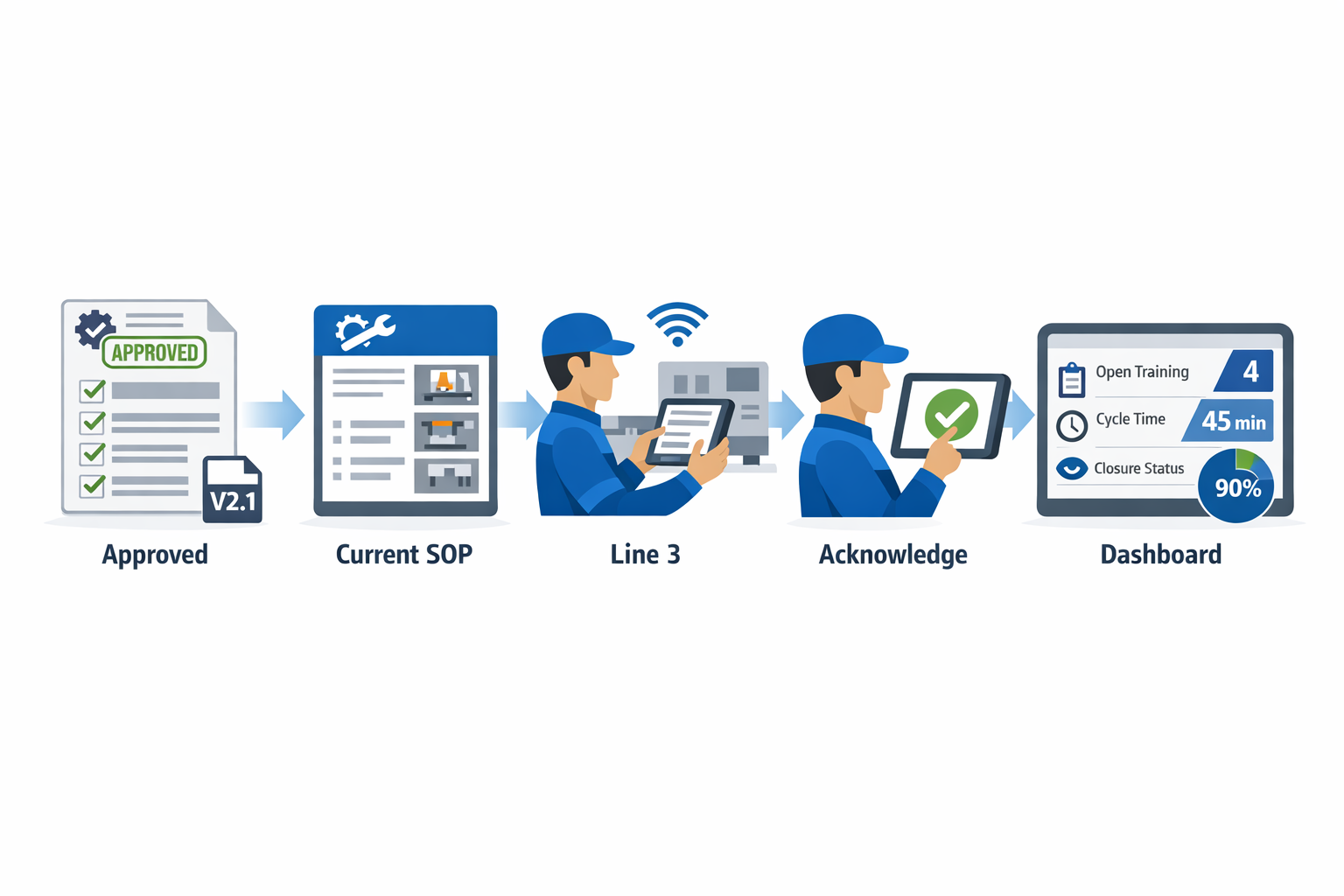
Training acknowledgment can be built into the same workflow, so affected operators and team leaders must confirm they reviewed the new method before the line restarts. For plant managers, dashboards then show change cycle time, overdue actions, open training items, and closure status by department or line. That visibility does not replace floor leadership, but it gives leaders faster control over execution quality.
Conclusion: Build a Continuous and Effective Change Management Process
A strong change management process in manufacturing does more than move a request through approvals. It ensures the new method is released in a controlled way, understood by the right people, verified on the floor, and sustained after startup. If operators still rely on outdated instructions, if one shift misses retraining, or if closeout happens before results are checked, the change is not complete no matter how quickly it was approved.
For operations and plant leaders, the practical priority is clear: control execution, not just documentation. That means assigning ownership, updating SOPs and work instructions by version, confirming training completion, checking effectiveness after launch, and keeping a traceable record of who approved, changed, trained, and verified each step. In regulated and high-mix environments, that traceability is often what separates a stable rollout from repeat disruptions.
If you want to digitize and scale this process faster than spreadsheets, email chains, and paper sign-offs allow, Jodoo gives manufacturing teams a no-code way to build change workflows, training records, approvals, and dashboards in one system. You can start a free trial or book a demo to see how Jodoo supports controlled operational change on the shop floor.