Browse by category

Introduction: Why Work in Process Matters More Than Most Manufacturers Realize
Studies of lean transformations have repeatedly shown that cutting excess WIP can reduce lead times by 50% or more, not because machines run faster, but because material stops waiting between steps. In plain terms, work in process(WIP) means goods that have started production but are not yet finished. On the shop floor, that includes parts between cutting, welding, assembly, testing, or packing.
This article answers two practical questions: how do you calculate WIP accurately, and how do you reduce it without hurting output? We will walk through the formula, the data you need, the common mistakes that distort WIP, and the lean control methods manufacturers use to bring it down. The goal is simple: better flow, clearer bottlenecks, lower inventory risk, and stronger operational and financial control.
What Work in Process Inventory Includes and Why Excess WIP Builds Up
What Belongs in Work in Process Inventory
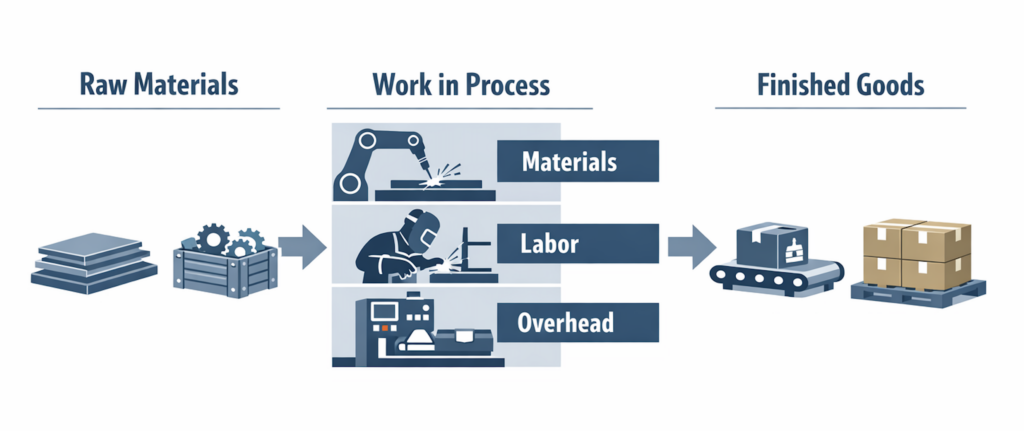
Work in process inventory includes any partially completed product that has already absorbed production cost but is not yet ready for sale. In accounting terms, that means three cost elements are sitting inside WIP: direct materials, direct labor, and manufacturing overhead. On the shop floor, this could be machined parts waiting for assembly, filled PCBs awaiting testing, or molded components queued for trimming and packing. For production managers, WIP reflects flow status; for financial controllers, it reflects capital already committed to unfinished goods.
The key distinction is timing and completion stage. Raw materials are items not yet issued into production, such as resin pellets in storage or steel coils still in inventory. Work in process begins once those materials are released and value is added through labor or machine time, but before the item is complete. Finished goods are fully manufactured, have passed required checks, and are ready to ship or book as saleable inventory.
Why Excess WIP Builds Up
One common cause is oversized batch release. When planners issue large work orders to keep machines busy, upstream processes often produce faster than downstream steps can absorb. A stamping department may complete 5,000 brackets in one run, while coating can only handle 1,500 per shift, leaving thousands of parts parked between processes. That looks efficient locally but creates excess WIP system-wide.
A second cause is unbalanced capacity across steps. In mixed-process factories, one slower operation often dictates actual line throughput, even if other departments have spare hours. For example, a furniture plant may cut and edge panels quickly, but final assembly and inspection may lag because of labor constraints. The result is a growing queue of half-finished orders that hides where the true constraint sits.
Machine downtime and quality holds also inflate WIP quickly. If a critical CNC machine stops for six hours, upstream jobs continue arriving unless release is controlled, and the queue grows immediately. Likewise, when semi-finished items are held for rework, test failure review, or customer deviation approval, they remain in WIP longer than planned.
A final driver is weak handoffs between departments, especially where updates rely on paper, spreadsheets, or delayed verbal communication. Jobs may be completed physically but not transferred administratively, or one team may not know the next process is blocked. That is why managing work in progress on the production floor requires more than counting pieces; it requires disciplined release, status visibility, and faster escalation across functions.
How to Calculate Work in Process Inventory Accurately
The Core WIP Formula
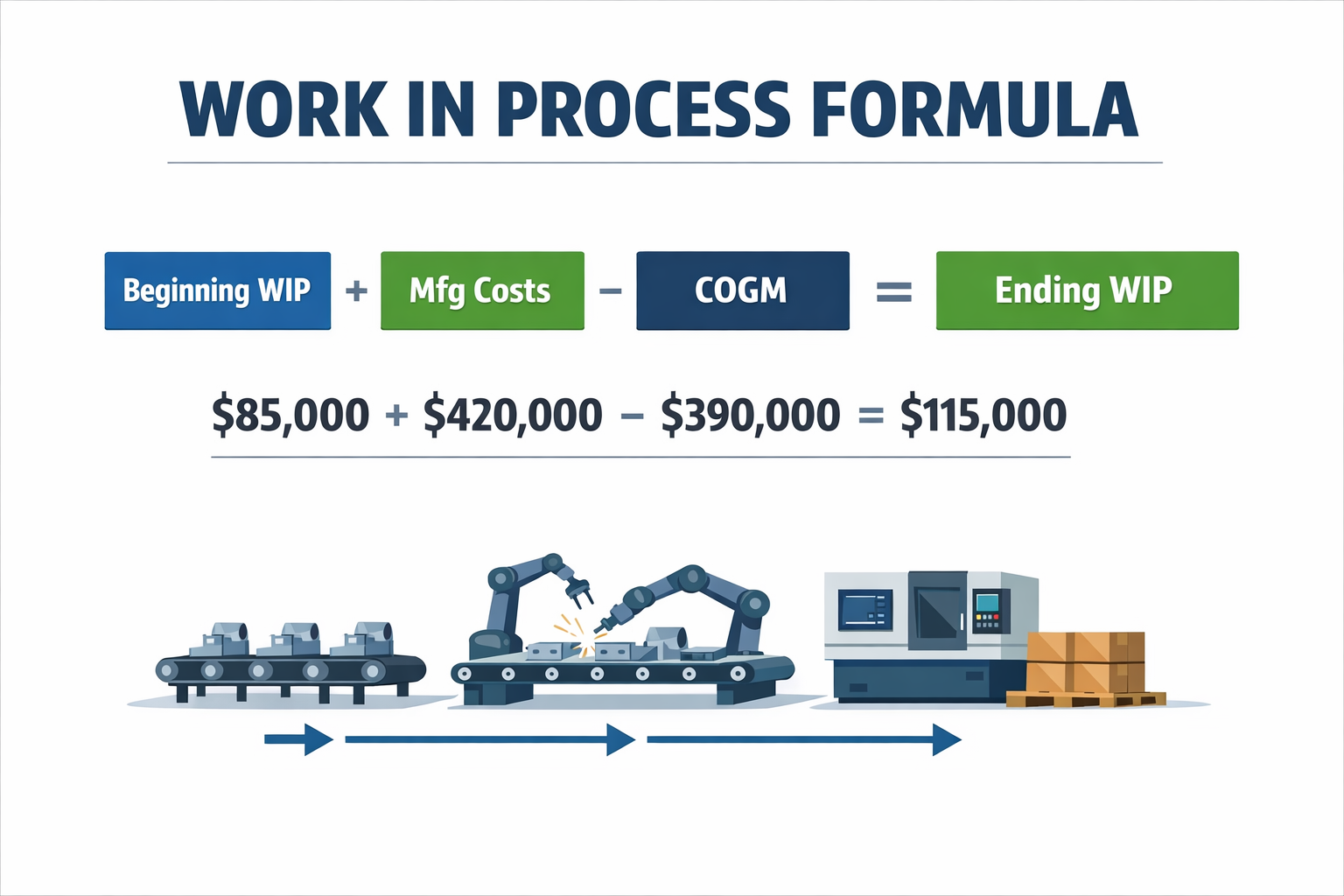
To calculate WIP inventory accurately, use the standard formula:
Beginning WIP Inventory + Manufacturing Costs – Cost of Goods Manufactured = Ending WIP Inventory.
In accounting terms, this tells you the value still sitting in partially completed production at the end of the period. For production teams, it should also match what is physically waiting, running, or staged between operations on the floor.
A simple example makes the formula easier to use. Suppose a metal parts plant starts the month with $85,000 in beginning WIP, adds $420,000 in manufacturing costs during the month, and transfers $390,000 worth of completed parts to finished goods. The ending WIP is $115,000.
What Inputs You Need to Gather
The first input is the beginning WIP inventory, which comes from the prior period’s ending WIP balance. The second is manufacturing costs added during the period, usually grouped into direct materials, direct labor, and applied manufacturing overhead. The third is the cost of goods manufactured, meaning the cost of units completed and moved out of WIP into finished goods.
Using the same metal parts example, imagine the plant is producing machined housings across cutting, drilling, deburring, and inspection. At month-end, some batches have finished cutting and drilling but are still waiting for deburring, while others are in final inspection. Those incomplete batches are what the $115,000 ending WIP value should represent, not planned work orders that have not yet been released.
Where Manufacturers Get the Calculation Wrong
The most common mistake is timing. Materials may be issued to a job, labor may be booked late, or completed units may remain in WIP because the transfer to finished goods was not posted on time. That creates a mismatch between accounting records and actual production status.
Another mistake is treating all open production orders as equally complete. A batch that has consumed all material but only 30% of labor is not at the same stage as a batch awaiting final packing. If you want cleaner WIP numbers, percentage of completion, and routing-stage status must line up.
How to Make the Number Reliable
A reliable WIP calculation depends on disciplined data collection, not just a correct formula. Finance needs accurate cost postings, while production needs timely updates when jobs move from one operation to the next.
In practice, review WIP at a fixed cutoff, reconcile open jobs by routing step, and verify that completed quantities have been transferred correctly. When those controls are in place, your WIP figure becomes useful for both month-end reporting and daily production decisions.
Why Reducing WIP Matters in Manufacturing Operations and Financial Performance
Excess WIP Slows Flow, Not Just Storage
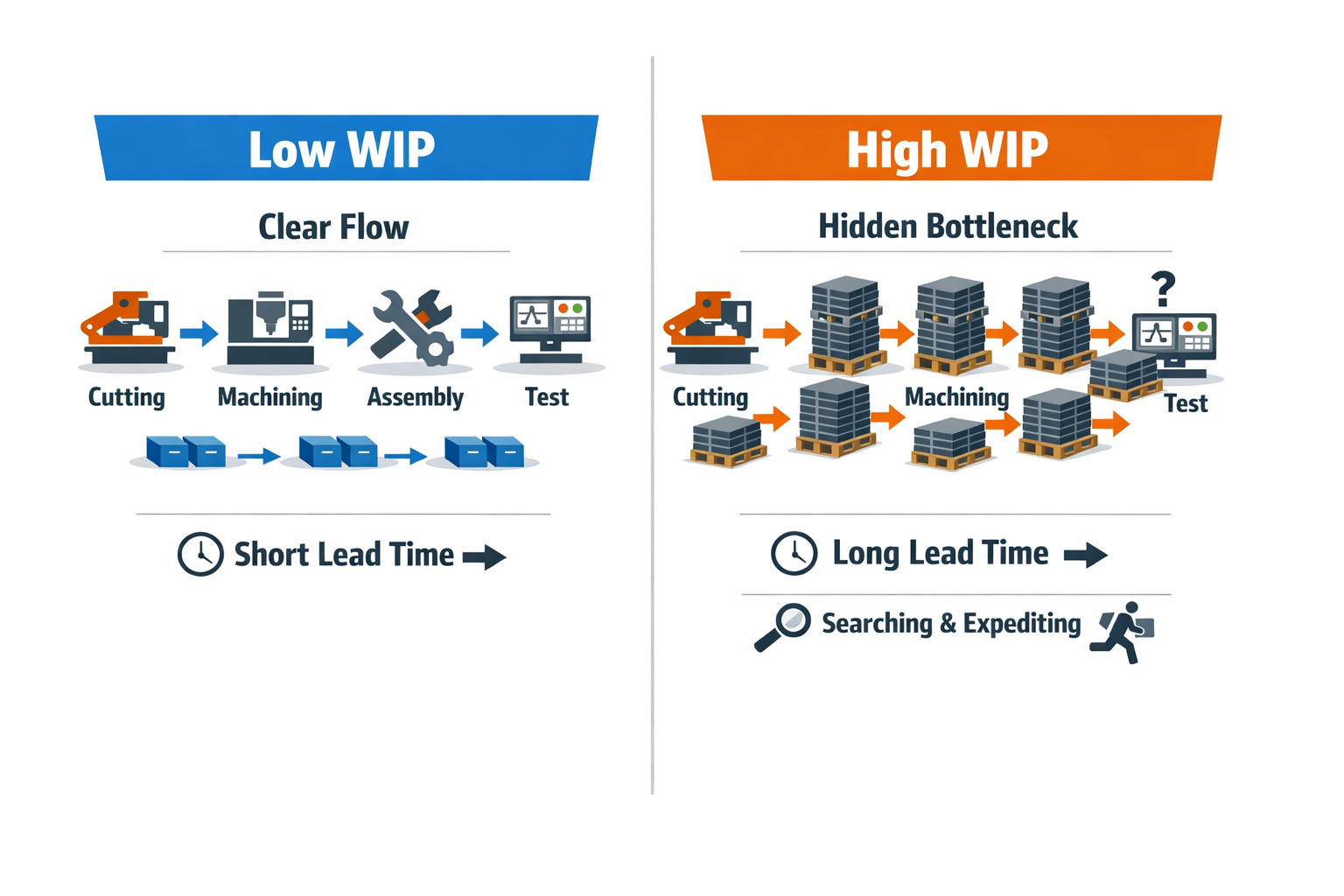
Many plants treat high WIP as a safety buffer, but in practice, it often reduces throughput instead of protecting it. When too many jobs sit between cutting, machining, assembly, or testing, operators spend more time searching, moving, and reprioritizing than actually processing. That extra queue time stretches the total manufacturing lead time even if touch time at each station stays unchanged.
Excess WIP also makes bottlenecks harder to see. If every area has pallets of half-finished parts, supervisors cannot easily tell whether the real constraint is a press, a paint booth, an inspection station, or changeover loss. A cable harness plant, for example, may look busy everywhere, while completed output still misses plan because final electrical testing is overloaded. High inventory between processes creates the illusion of productivity while the true restriction remains buried.
Excess WIP Creates Schedule Instability
Once WIP gets too high, planning accuracy usually drops. Jobs released early compete for shared machines, urgent orders jump queues, and material handlers spend the day expediting instead of following a stable dispatch list. The result is frequent resequencing, partial runs, and missed promised dates even when total capacity has not changed. For production managers, high WIP often means less control over output, not more.
This instability spreads across departments. In a metal fabrication shop, laser cutting may keep feeding work to bending to stay “efficient,” while bending already has two shifts of backlog waiting. Purchasing sees open orders, finance sees rising inventory value, and sales hears that production is busy, yet customer shipments still slip.
Excess WIP Ties Up Cash and Blurs Financial Signals
For financial controllers, WIP is not just an operations metric; it is cash that has been committed but not yet converted into shipped revenue. Every additional day that partially completed goods sit on the floor increases carrying cost through space, handling, insurance, and the cost of capital. Depending on interest rates and storage burden, annual inventory carrying costs often run 15% to 30% of inventory value. High WIP therefore weakens cash flow even before scrap or rework is considered.
It also reduces margin visibility. If production status is unclear, overhead absorption can look acceptable on paper while jobs are actually aging, waiting for rework, or consuming extra handling labor.
Managing Work in Progress on the Production Floor
Once you know how to calculate WIP inventory, the next step is controlling what actually enters and stays in production. On the floor, that means replacing informal expediting with simple release rules, visible limits, and fast escalation. Consider a metal parts factory where laser cutting, bending, welding, and powder coating share one production stream. The plant is not short of orders; the problem is too many open jobs moving unevenly between processes.
Limit Work Order Release
The first control is to stop launching every approved order as soon as material is available. Supervisors should release work based on the capacity of the constraint process, not on sales pressure or planner convenience. In the metal parts example, if welding can complete 240 units per shift, releasing 400 units from cutting only creates queues upstream of welding. A practical rule is to release the next batch only when the downstream queue drops below a defined threshold.
Set WIP Caps by Process Step
WIP caps make flow visible and force action before queues become normal. Set a maximum number of jobs, pallets, or hours of work allowed at each line, cell, or process step, then review breaches during every shift handover. In the same factory, bending may be limited to 6 open jobs, welding to 4, and powder coating to 2 days of demand. When a cap is hit, upstream operators pause release or switch to another scheduled item instead of continuing to pile up semi-finished stock.
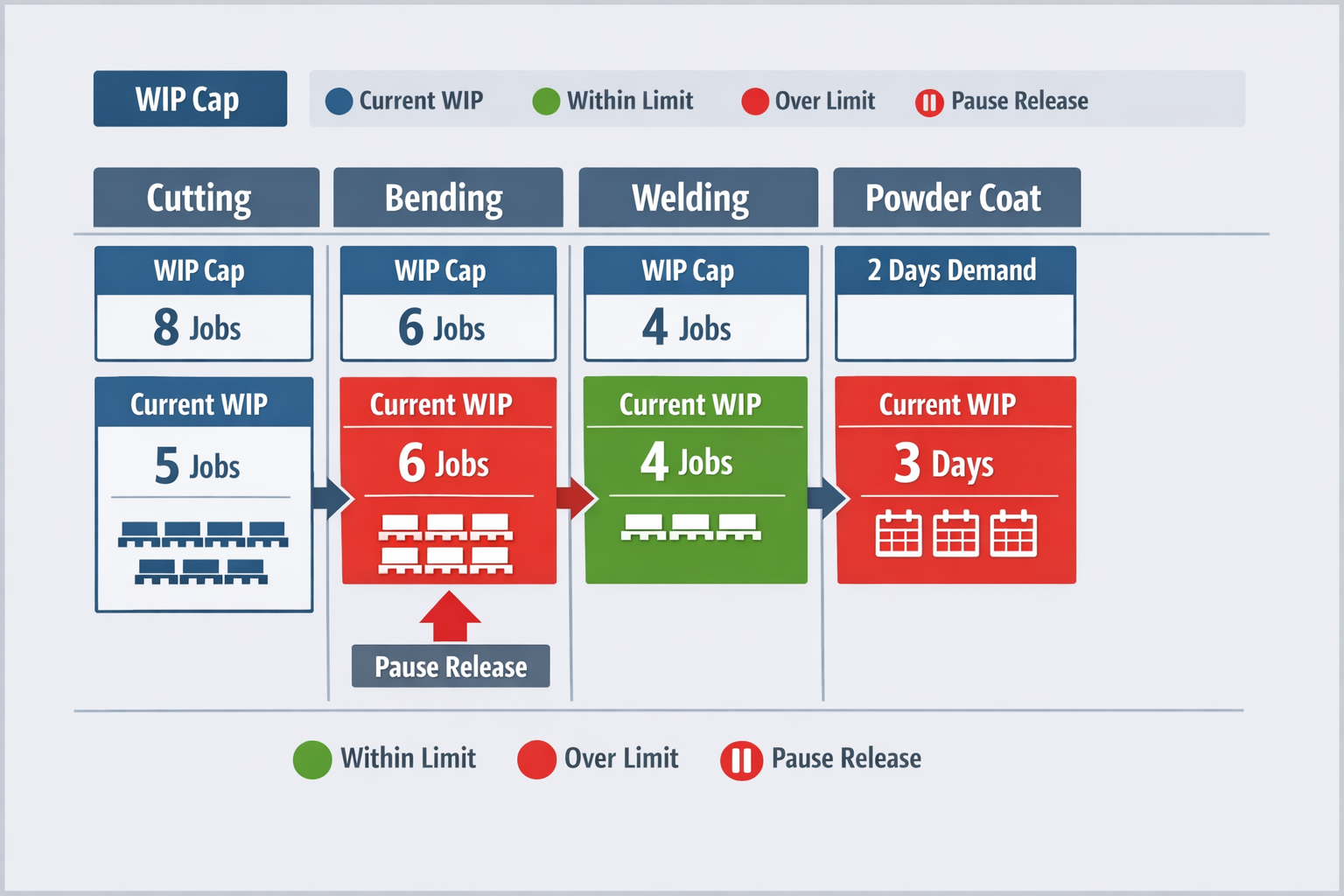
These caps should be displayed where operators and supervisors can see them, not buried in a planning file. Use whiteboards, floor tags, or digital dispatch lists showing current WIP against the limit in real time.
Shrink Batch Sizes and Tighten Scheduling
Large batches often look efficient on one machine but slow the total flow across the plant. In the metal parts example, reducing a release from 200-piece batches to 50-piece batches lets welding start earlier, exposes problems faster, and shortens queue time between steps. Smaller batches do require better changeover control, so schedule families of similar parts together and protect setup standards. The goal is not maximum local utilization; it is steadier end-to-end throughput.
Conclusion: Build Real-Time WIP Control With Jodoo
WIP should never be treated as a rough estimate or a necessary side effect of staying busy. For both production managers and financial controllers, the goal is the same: measure WIP accurately, control it deliberately, and reduce it by improving flow, not by pushing more jobs onto the floor. When WIP stays too high, it usually signals deeper problems in scheduling, handoffs, downtime response, or quality containment.
That is why better WIP control depends on timely, shared visibility. With Jodoo, manufacturers can replace paper travelers and manual status checks with digital routing forms, capture live production updates at each process step, and give supervisors and finance teams access to real-time dashboards that show queue buildup, aging jobs, and blocked orders before they turn into delivery risk.
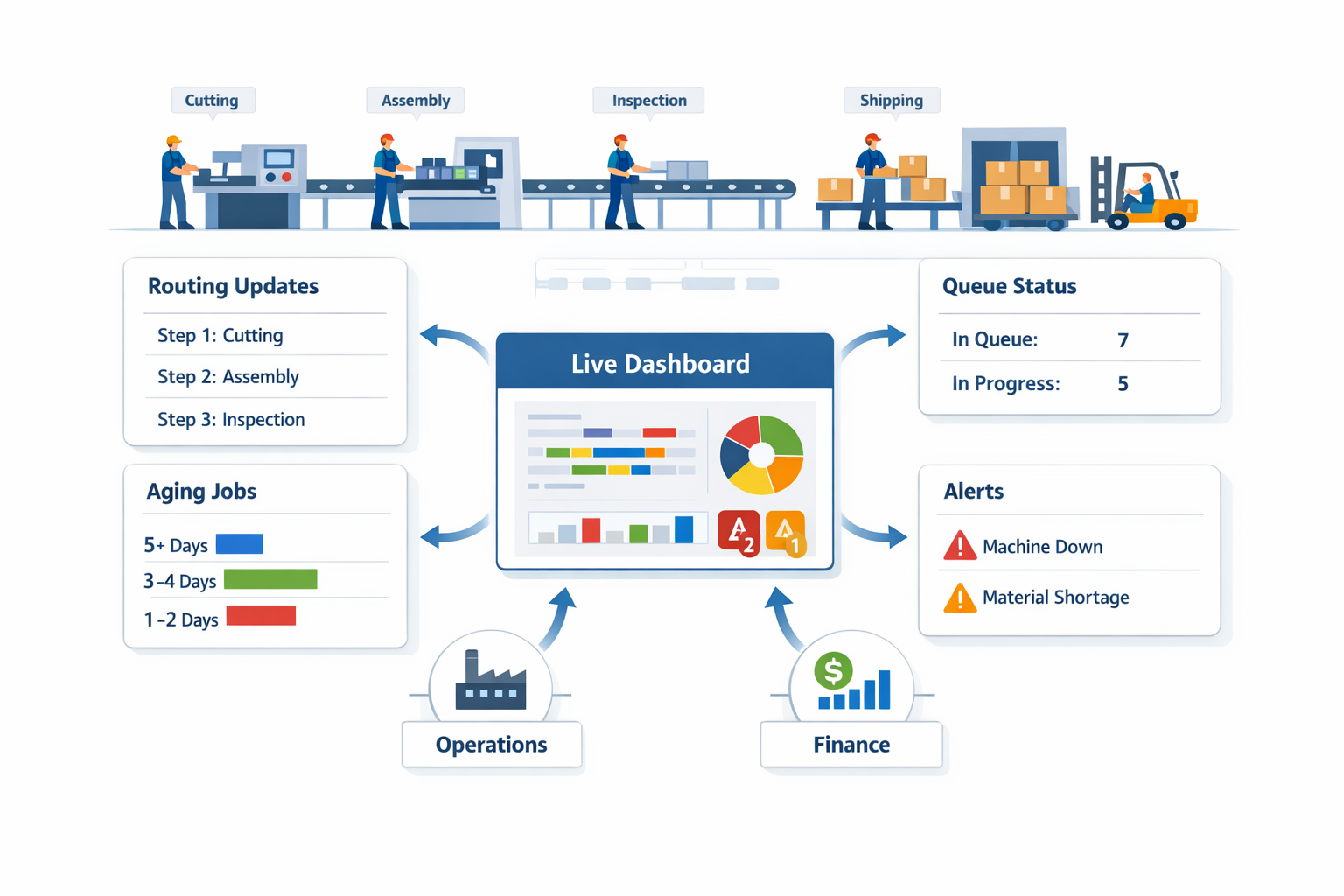
Because Jodoo is a no-code lean manufacturing platform, operations teams can launch WIP control workflows without waiting for a full MES or ERP overhaul. You can standardize updates, trigger alerts when jobs exceed WIP limits, and create a more reliable picture of production in days, not months. If you want tighter WIP control with faster implementation, start a free trial or book a demo with Jodoo.