Nach Kategorien durchsuchen

Introduction: Why ESG Data Management Matters on the Plant Floor
Many manufacturers discover their ESG-Daten problem only when the reporting season starts and basic records do not line up across sites. One plant tracks electricity by meter, another by monthly invoice, and a third keeps waste records in email attachments and spreadsheets. By that point, the issue is not just about the reporting format. It is whether the underlying ESG data can be trusted as a controlled operational record.
This matters because most sustainability disclosures, customer requests, lender questionnaires, and assurance checks depend on plant-level inputs collected long before any report is drafted. In manufacturing, those inputs sit across utilities, EHS logs, maintenance records, HR files, procurement documents, and supplier declarations. If ownership is unclear and collection methods vary by site, data quality becomes uneven even inside the same company.
This guide focuses on the operating model behind sustainability data management. It will show you how to define the records that matter, assign ownership, standardize collection across plants, and build review controls that reduce gaps, rework, and late corrections. The goal is practical: help multi-site manufacturers manage ESG data with the same discipline they apply to quality, maintenance, and production records.
What ESG Data Is
ESG Data Means Controlled Operational Records
Für Hersteller, ESG-Daten is the set of recorded facts that describe environmental, social, and governance performance at the plant, site, supplier, and company levels. In plain language, it includes items such as electricity consumption, diesel use, wastewater test results, injury logs, training completion, overtime records, waste shipment notes, supplier declarations, and board-policy acknowledgments. The key point is that if the ESG data cannot be traced back to a source record, owner, period, and boundary, it is not yet reliable ESG data.
This matters because different teams touch different parts of the record. EHS may own incident logs and hazardous waste manifests; maintenance may hold meter readings and boiler run hours; HR may track workforce and training records; and procurement may collect supplier labor or conflict-minerals declarations. Good sustainability data management brings these records into a structured system without changing what they fundamentally are: controlled business records created through day-to-day operations.
What ESG Data Is Not
ESG data is not the same as an ESG report. A sustainability report is a communication output that selects, aggregates, and explains underlying records for investors, customers, regulators, lenders, or internal leadership. The report may include narratives, targets, methodology notes, and year-on-year commentary, but those are downstream uses of the data rather than the data itself.
ESG data is also not the same as a greenhouse gas calculation. For example, a monthly natural gas bill, a fuel tank issue log, or a refrigerant top-up record can feed an emissions calculation, but the calculation applies factors, assumptions, and formulas after the source data is collected. In the same way, a lost-time injury record is data, while a Total Recordable Incident Rate is a derived metric built from those records.
The same separation applies to ESG ratings, assurance, and compliance determinations. A rating agency score is an external assessment based on selected inputs and methodology. Assurance is a review process that tests whether records, controls, and calculations are supportable. Compliance status is a legal or regulatory judgment, often requiring interpretation of permits, thresholds, and local rules. Manufacturers should treat each of these as a use of ESG data, not a substitute for it.
Why This Separation Matters Operationally
When teams confuse records with reports, they often focus too early on presentation instead of control. A plant may spend weeks formatting an annual disclosure, yet still have inconsistent site data collection, missing attachments, or unapproved estimates in the underlying files. Strong ESG-Daten quality comes from managing the original records well enough that reporting, analysis, and assurance become easier later.
A simple example is water use. The controlled ESG record is the monthly meter reading, invoice, or laboratory result, linked to the correct facility, date range, unit of measure, and evidence file. Water intensity, disclosure tables, customer questionnaires, and benchmark analysis all sit downstream of that record.
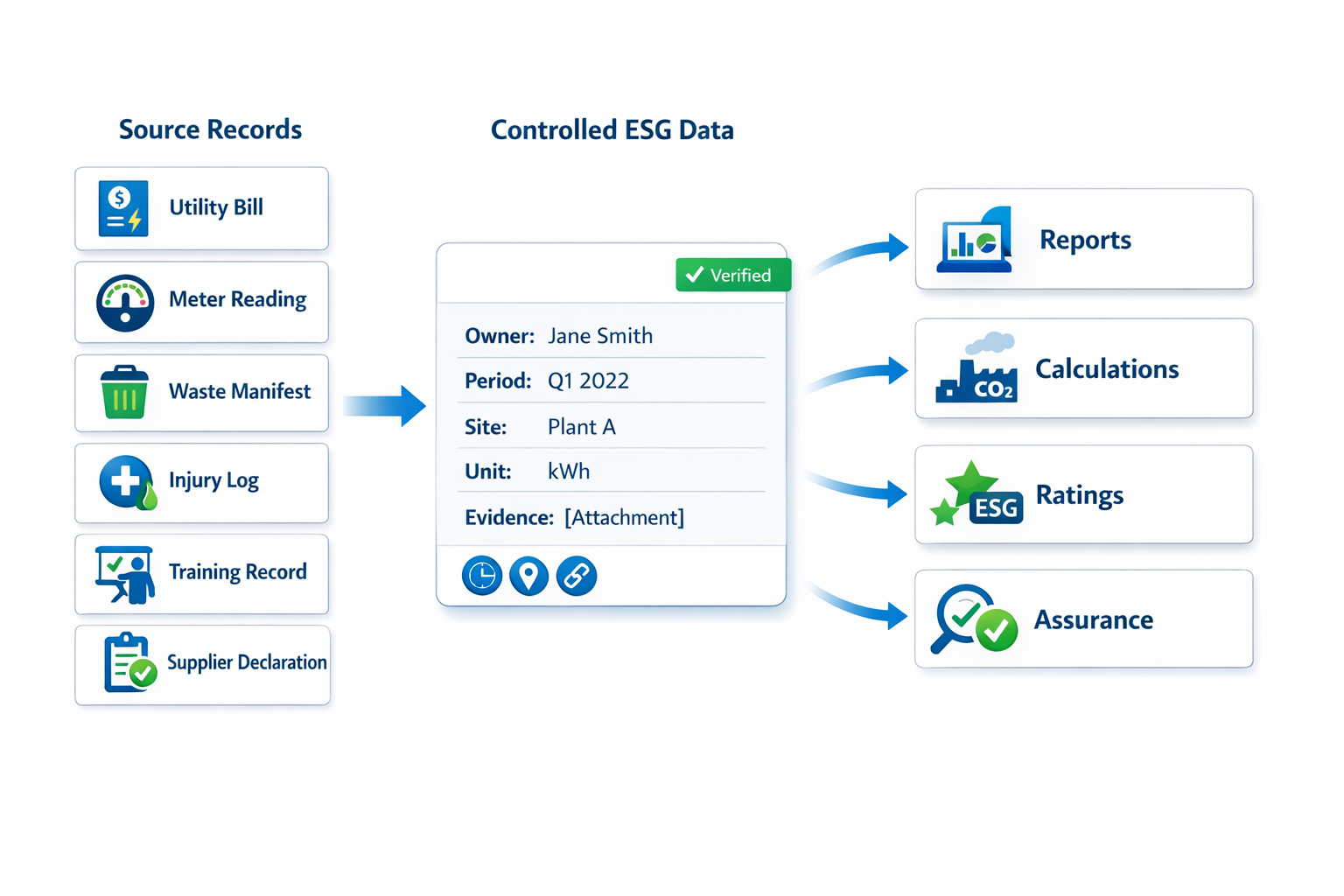
That is why manufacturers should first define what counts as a controlled ESG record, who owns it, how it is captured, and what evidence supports it. Once those basics are in place, the same records can feed emissions calculations, audit requests, board updates, customer submissions, and sustainability reporting with far less rework. The next step is to identify exactly which records matter across sites and functions, then standardize them before adding more advanced data governance controls.
Map the Manufacturing ESG Data You Need Across Sites and Functions
ESG Data Sits in Many Operational Systems
In der Fertigung, ESG-Daten rarely comes from one team or one system. Energy, water, fuel, refrigerants, waste, incidents, training, overtime, supplier declarations, and policy approvals are usually captured by different functions on different schedules. That is why sustainability data management starts with mapping where records originate, who touches them, and how often they are updated. If you skip that mapping step, site data collection stays informal, and ESG data quality becomes inconsistent across plants.
Consider a multi-site manufacturer with three reporting groups: a machining plant, a process facility, and corporate support functions. The machining plant tracks electricity by production area, compressed air losses, scrap metal recovery, coolant disposal, machine safety incidents, and operator training records. The process facility tracks steam, natural gas, wastewater parameters, hazardous waste manifests, environmental permit readings, and maintenance logs for treatment equipment. Corporate teams own travel, fleet fuel cards, supplier questionnaires, board approvals, grievance records, and policy training completion.
Different Metrics Have Different Owners and Rhythms
The key point is that not all ESG data moves at the same pace. Utility meter readings may be daily or monthly, waste manifests may appear per shipment, training records may be updated by session, and supplier declarations may be renewed annually. In the example company, the machining plant’s electricity data is pulled monthly from utility invoices and submeter files, while scrap recovery is logged per shift and consolidated weekly. At the process site, wastewater test results follow lab release dates, while permit readings may require operator entry at fixed intervals.
Ownership also changes by metric. EHS may own incident logs, facilities may own water and electricity, maintenance may own leak inspections, HR may own training completion, procurement may own supplier code acknowledgments, and legal or corporate affairs may own governance records. A practical map should therefore connect each metric to both a function and a site, because the same metric family can have different collection methods across plants. That structure improves site data collection without yet getting into the review workflow.
Build a Manufacturing Metric Inventory
To standardize ESG-Daten, create a metric inventory before you standardize forms. For each metric, define the metric name, business definition, unit of measure, reporting period, organizational boundary, physical boundary, source record, owner, reviewer, and required evidence. Add two more useful fields: whether estimates are allowed and what aggregation rule applies across sites. This turns a broad ESG list into a controlled operating catalog.
In the running example, “electricity consumption” cannot remain a vague corporate label. The machining plant may define it as grid electricity consumed within the plant fence line, measured in kWh, reported monthly, sourced from invoices plus submeters, owned by facilities, reviewed by the plant controller, with invoices attached as evidence. The process facility may use the same unit but a different source hierarchy because on-site generation and steam allocation affect the boundary. Corporate support functions may not report this metric at all, which is also an important rule to document.
Standardize Before You Scale
A good inventory prevents sites from making local assumptions that later create reconciliation work. If one plant records waste in tons, another in bags, and a third mixes hazardous and non-hazardous waste in one line, your ESG data quality problem begins long before reporting. The same applies to labor metrics, supplier records, and governance evidence. Standardization at the metric level gives later data governance controls a stable foundation.
Design Data Governance Controls for High-Quality ESG Records
Assign Clear Roles for Every Record
Once a manufacturer has defined its ESG metric inventory, the next control layer is Rollenklarheit. Each record needs an accountable owner, one or more contributors, a reviewer, and an escalation path for late or incomplete data. In practice, that means the machining plant’s electricity record may be prepared by a utilities technician, reviewed by the site EHS manager, and owned by the plant controller for monthly sign-off. This structure improves ESG-Daten quality because missing data is no longer “everyone’s problem” and therefore no one’s responsibility.
For the multi-site manufacturer in our example, role design varies by metric and site. The process facility assigns wastewater and hazardous waste entries to EHS coordinators because they manage manifests and disposal documentation, while HR owns training and workforce records at the corporate level. Supplier declarations on recycled content or conflict minerals sit with procurement, but sustainability reviews completeness before the data is accepted into the reporting record. Good sustainability data management depends on matching record ownership to the team that actually controls the source evidence.
Standardize Submission, Review, and Approval
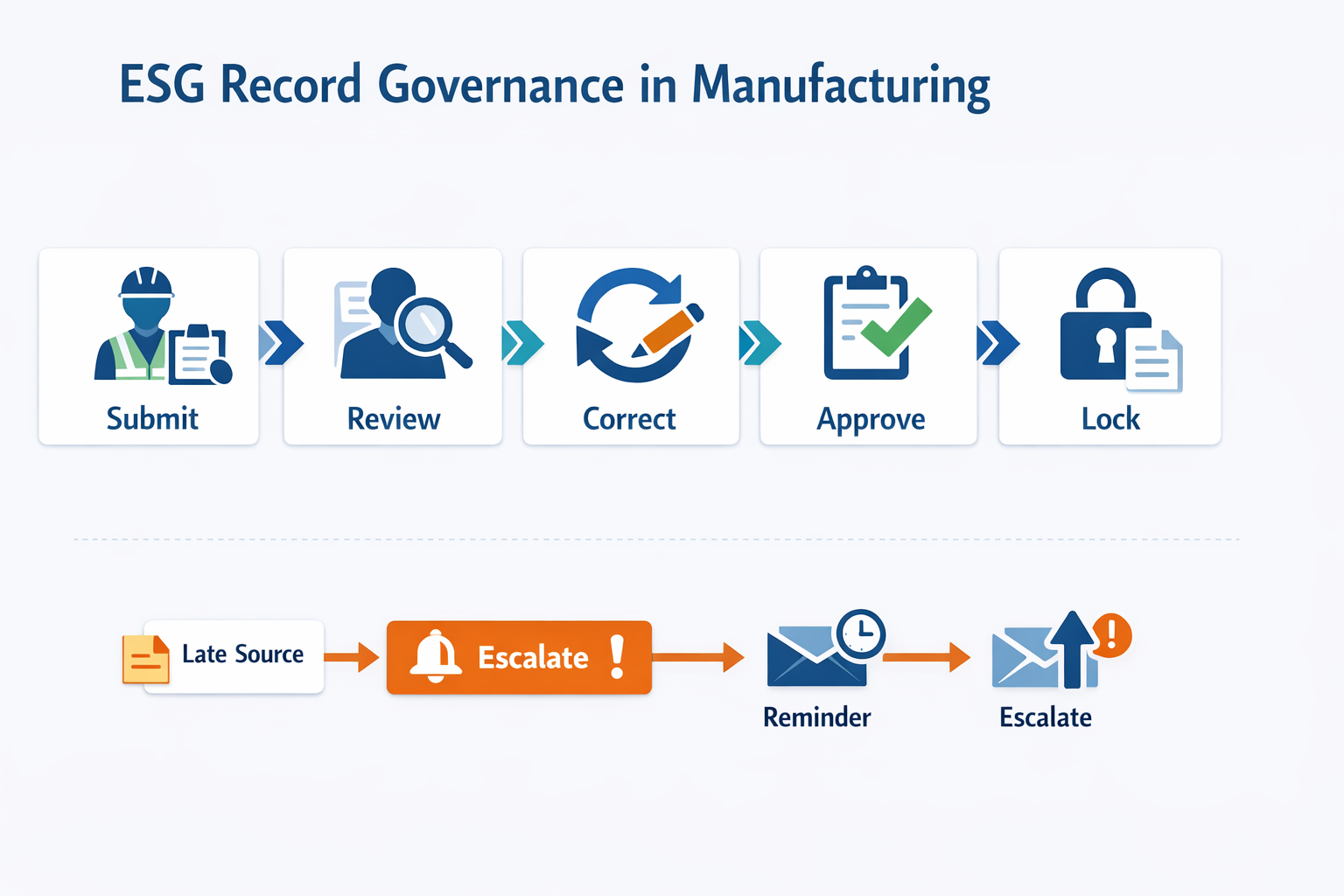
High-quality ESG records come from a controlled workflow, not from month-end spreadsheet chasing. A practical flow is submission, first-line review, correction if needed, approval, and then lock or controlled revision. Required fields should include period, site, metric name, unit, source document, preparer, submission date, and commentary for unusual values. If a manufacturer runs 10 plants, this is what makes site data collection comparable across locations rather than being shaped by local habits.
In the running example, the machining plant submits its monthly electricity reading two days late because the landlord’s utility statement has not arrived. Instead of leaving the record blank, the contributor submits the form with a “late source” status, expected receipt date, and a note explaining the delay. The reviewer can accept the temporary status, trigger a reminder, and escalate automatically if the source document is still missing after the agreed cutoff. That is a stronger data governance control than informal follow-up by email because the delay, owner, and next action are visible in the record itself.
Build Validation and Exception Handling Into Daily Work
Validation should happen at the point of entry, not weeks later during consolidation. Good controls include unit checks, allowed value ranges, mandatory attachments, duplicate detection, period locks, and logic rules such as preventing a waste quantity from being submitted without a disposal vendor reference. These checks do not eliminate human judgment, but they reduce avoidable errors before reviewers spend time chasing corrections.
At the process facility, one hazardous waste value must be estimated because the disposal vendor’s final weighbridge ticket is delayed. The form allows submission, but only if the preparer selects “estimated,” enters the estimation method, states the expected replacement date, and attaches interim evidence such as container counts. If the next month opens and the estimate has not been replaced by an actual value, the record is flagged as an exception for follow-up. That is how you keep ESG-Daten quality high without freezing operations when source documents are temporarily unavailable.
Preserve Traceability for Corrections and Evidence
A controlled ESG record should show what changed, who changed it, when it changed, and why. This matters most when a reviewer challenges a figure or when corporate asks a plant to support a number several months later. Change history, approval logs, attachment records, and comment trails create the auditability that sustainability data management needs before any external assurance begins. Without that Rückverfolgbarkeit, corrected data may be more accurate but less defensible.
The same rule applies to supplier declarations. In our example, procurement receives a recycled-material declaration from a resin supplier, but the document is missing the validity period and authorized signatory. The reviewer rejects the submission; the system returns it for correction, and the supplier-facing owner uploads the revised declaration with the missing fields completed. That closed-loop process turns a weak document into a controlled ESG data record rather than an unverified file sitting in someone’s inbox.
How to Roll Out Sustainability Data Management from Pilot to Scale
Start With a Narrow, Material Pilot
A workable rollout starts by reducing scope, not expanding it. Choose 8 to 15 material metrics that already matter to operations and leadership, such as electricity use, natural gas, water withdrawal, hazardous waste, recordable injuries, training completion, and selected supplier declarations. This gives your sustainability data management program enough complexity to test ownership, evidence, and review cycles without overwhelming site teams. For most manufacturers, a narrow pilot produces better ESG-Daten quality than a broad first launch that mixes too many metrics, plants, and reporting rhythms.
Your first pilot sites should represent different operating realities, but not every edge case in the business. A practical mix is one mature plant with relatively stable systems, one site with more manual site data collection, and one function outside operations, such as procurement or HR. That combination exposes gaps in forms, roles, and evidence handling early, while keeping the pilot small enough to manage. If you start with five plants and 40 metrics, you will spend the first quarter chasing exceptions rather than improving the process.
Build the Pilot in a Clear Sequence
Use a staged rollout sequence: select material metrics, pick pilot sites, define owners and reviewers, configure standard forms and evidence requirements, run one or two reporting cycles, measure exceptions and rework, then expand by plant, metric family, or business unit. Each step should be completed before the next one scales, because weak controls replicate faster than good ones. The goal is not speed alone, but repeatability across different factories and teams.
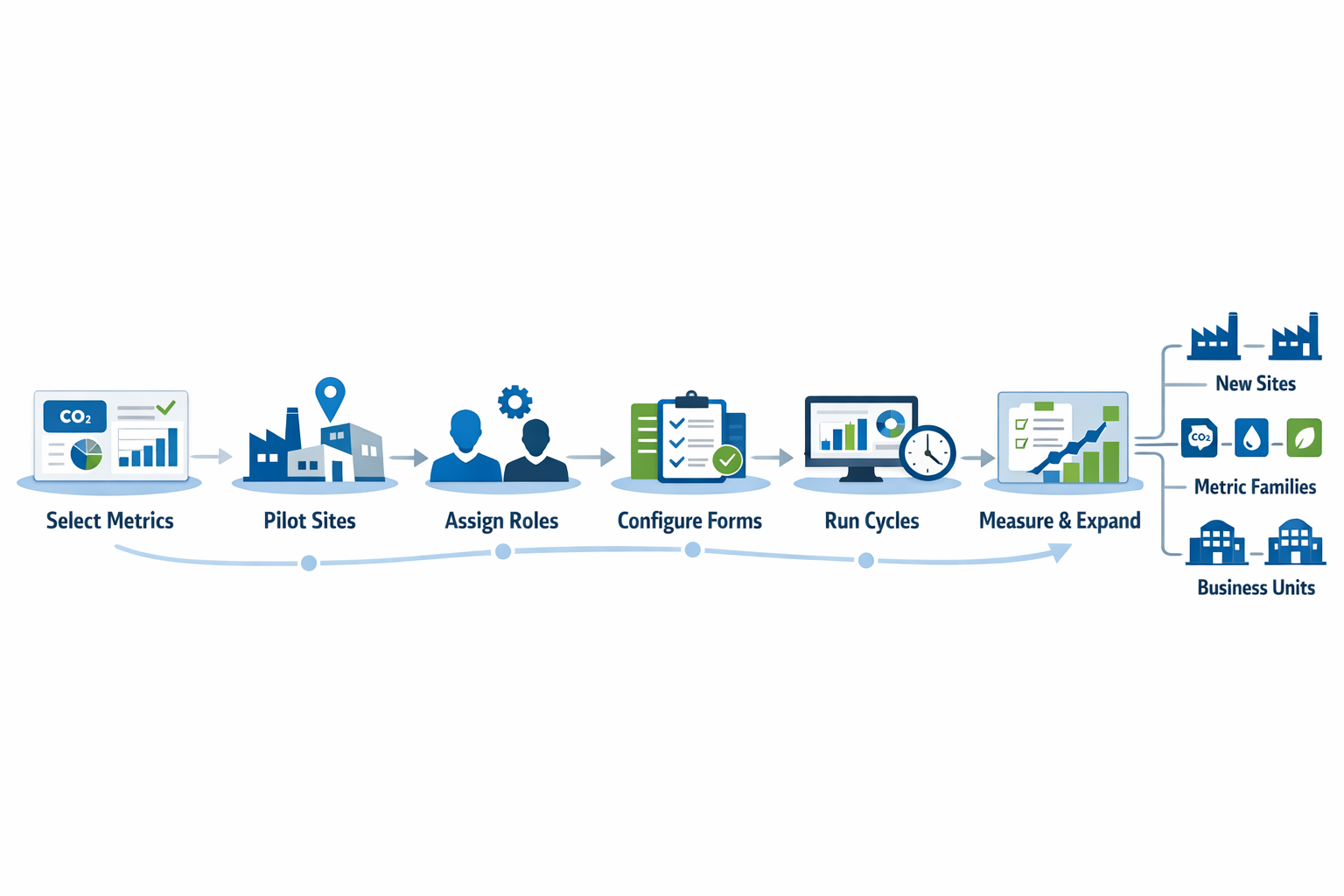
A packaging manufacturer, for example, might begin with monthly utility data at two converting plants and quarterly supplier packaging declarations from procurement. After two cycles, the team may discover that one plant needs clearer meter-level instructions, while procurement needs stricter document naming rules and reviewer deadlines. Those are useful pilot findings because they improve the operating model before the rollout expands. By contrast, if the company had launched all environmental and social metrics company-wide at once, those issues would have multiplied across every site.
Refine Roles, Forms, and Review Timing
Once the pilot is live, focus on the mechanics that drive data quality. Check whether plant engineers, EHS coordinators, finance staff, and functional reviewers all understand exactly what they submit, by when, and with what supporting evidence. If the same field is interpreted differently across sites, revise the form, not just the training note. Strong data governance controls depend on forms and workflows that make the correct action easier than the inconsistent one.
Review timing deserves its own test because many failures are not technical; they are calendar failures. Monthly utility data may need a three-day submission window after invoice receipt, while injury logs may need weekly review and supplier documents may need a quarterly approval cycle. Set deadlines based on the real availability of source records rather than the ideal reporting calendar. That reduces late submissions and cuts avoidable rework loops.
Measure Pilot Success Before You Scale
Pilot success should be measured with operating metrics, not broad statements about readiness. Track timeliness by on-time submission and approval rates, completeness by required fields filled, evidence coverage by records with valid attachments, and rework by the percentage of submissions returned for correction. You can also monitor exception types, such as missing invoices, inconsistent units, or unsupported estimates, to see where controls need adjustment. These measures show whether your ESG-Daten process is becoming reliable enough to scale.
Only after performance stabilizes should you expand the model. Some manufacturers scale by site, adding plants within one region first; others add a new metric family such as waste, then training, then supplier records. A third option is to expand by business unit, where operating processes are similar. The right path is the one that preserves control while increasing coverage.
Conclusion: Build a Controlled ESG Data Process with Jodoo
For manufacturers, good ESG-Daten management starts long before disclosure, assurance, or ratings. It depends on controlled operational records: clear metric definitions, named owners, standardized site-level collection, required evidence, and review workflows that show what was submitted, corrected, approved, or flagged. When those controls are missing, multi-site reporting becomes slow, inconsistent, and difficult to defend.
That is why the most practical approach is to treat ESG data like any other critical plant record. If utility readings, waste logs, training records, supplier declarations, and incident data are captured with consistent rules, your sustainability team can work from a stronger base. In practice, this improves timeliness, reduces rework, and gives operations, EHS, and corporate teams a shared version of the data.
Jodoo can support that operating model as a no-code lean manufacturing platform. You can build structured forms for site submissions, apply role-based permissions, trigger reminders and approvals, attach supporting files, monitor completeness through dashboards, enable mobile data capture, and connect records to other systems through APIs. It does not replace emissions calculation tools or assurance processes, but it can help you build the controlled ESG data workflow that those processes rely on. Starten Sie eine kostenlose Testphase oder Demo buchen Jetzt.