This 2026 guide is for procurement, operations, finance, and supplier management teams that want a more consistent way to compare vendors before selection, renewal, or higher-stakes purchasing decisions.
Vendor decisions often look simple at first. One supplier is cheaper. Another has better lead times. A third seems easier to work with. But once teams compare vendors without a shared method, the decision usually becomes subjective, hard to explain, and difficult to repeat.
That is why a vendor comparison process matters. A structured comparison helps teams evaluate suppliers against the same criteria, reduce bias, and make trade-offs more visible before a final decision is made.
This guide explains how to compare vendors fairly, what criteria to include, how to use scorecards effectively, and which mistakes make supplier selection less reliable than it should be.
Why vendor comparison often goes wrong
Many supplier decisions are influenced by partial information. One team focuses on price. Another focuses on delivery speed. Another remembers past frustrations with a supplier, but has no consistent record to support that view.
Without a common framework, vendor comparison usually runs into the same problems:
- teams use different evaluation standards
- price outweighs more important operational risks
- evidence is scattered across email, notes, and spreadsheets
- final decisions are hard to justify later
- supplier selection varies too much between reviewers
A fair comparison process does not remove judgment. It improves the quality of judgment by making criteria explicit.
What does it mean to compare vendors fairly?
Comparing vendors fairly means evaluating each supplier against the same decision criteria, using the same review logic, with enough evidence to support the final choice.
Fair comparison does not mean every supplier is equal. It means every supplier is assessed through a consistent method.
That usually requires three things:
- clear evaluation criteria
- a structured scoring approach
- written notes or evidence behind important ratings
Without those three elements, vendor comparison tends to drift into opinion instead of process.
What criteria should you use to compare vendors?
The right criteria depend on your category, spend level, and business risk. But most procurement teams should compare vendors across more than just price.
일반적인 기준은 다음과 같습니다.
- pricing and total cost
- 품질 일관성
- 배송 신뢰성
- responsiveness and communication
- compliance and documentation readiness
- capacity or scalability
- issue resolution and support
- commercial terms and risk exposure
Not every criterion needs the same weight. For example, a packaging supplier for a low-risk category may be compared differently from a strategic supplier that affects delivery timelines, compliance, or customer commitments.
Step 1: Define the purpose of the comparison
Before scoring vendors, teams should clarify what decision they are trying to make.
Are you:
- choosing a new supplier?
- renewing or replacing an existing supplier?
- comparing vendors after performance issues?
- reviewing multiple quotes for the same requirement?
This matters because the decision context affects what should be prioritized. A supplier replacement decision may put more weight on reliability and transition risk. A routine sourcing comparison may focus more on pricing, lead time, and documentation readiness.
Without a defined purpose, teams often compare vendors without agreeing on what “better” actually means.
Step 2: Use the same information set for every vendor
Fair vendor comparison starts with consistent inputs.
At a minimum, teams should try to collect the same type of information for each supplier, such as:
- pricing details or quoted cost
- scope of supply or service
- lead time or delivery commitments
- compliance documents or certifications
- references, history, or prior performance
- commercial terms
If one vendor is scored with detailed information and another is assessed from incomplete notes, the comparison is already uneven.
If your team still gathers supplier information informally, a structured 벤더 온보딩 양식 can help make supplier records more complete before comparison begins.
Step 3: Assign clear evaluation criteria
Once the information is collected, each vendor should be reviewed against the same defined criteria.
A practical method is to create a shortlist of the criteria that matter most for the category. For example:
- 가격: Is the total cost acceptable relative to alternatives?
- Quality: Can the vendor meet specifications consistently?
- Delivery: Can the vendor meet required timelines reliably?
- Compliance: Are the required records, certifications, or policies in place?
- Responsiveness: Does the vendor communicate clearly and handle follow-up well?
The more specific the criteria are, the more useful the comparison becomes. Vague labels like “good supplier” or “better fit” are hard to defend later.
Step 4: Use a scorecard to make trade-offs visible
A vendor scorecard helps teams compare suppliers in a more structured way.
The scorecard does not need to be complex. Many teams use:
- simple 1-5 ratings by category
- low/medium/high labels for risk-related criteria
- weighted scoring where some categories matter more than others
The advantage of a scorecard is not that it makes the decision automatic. The advantage is that it makes trade-offs visible. A vendor may be cheapest, but weaker on compliance. Another may be more expensive, but stronger in terms of delivery reliability and support.
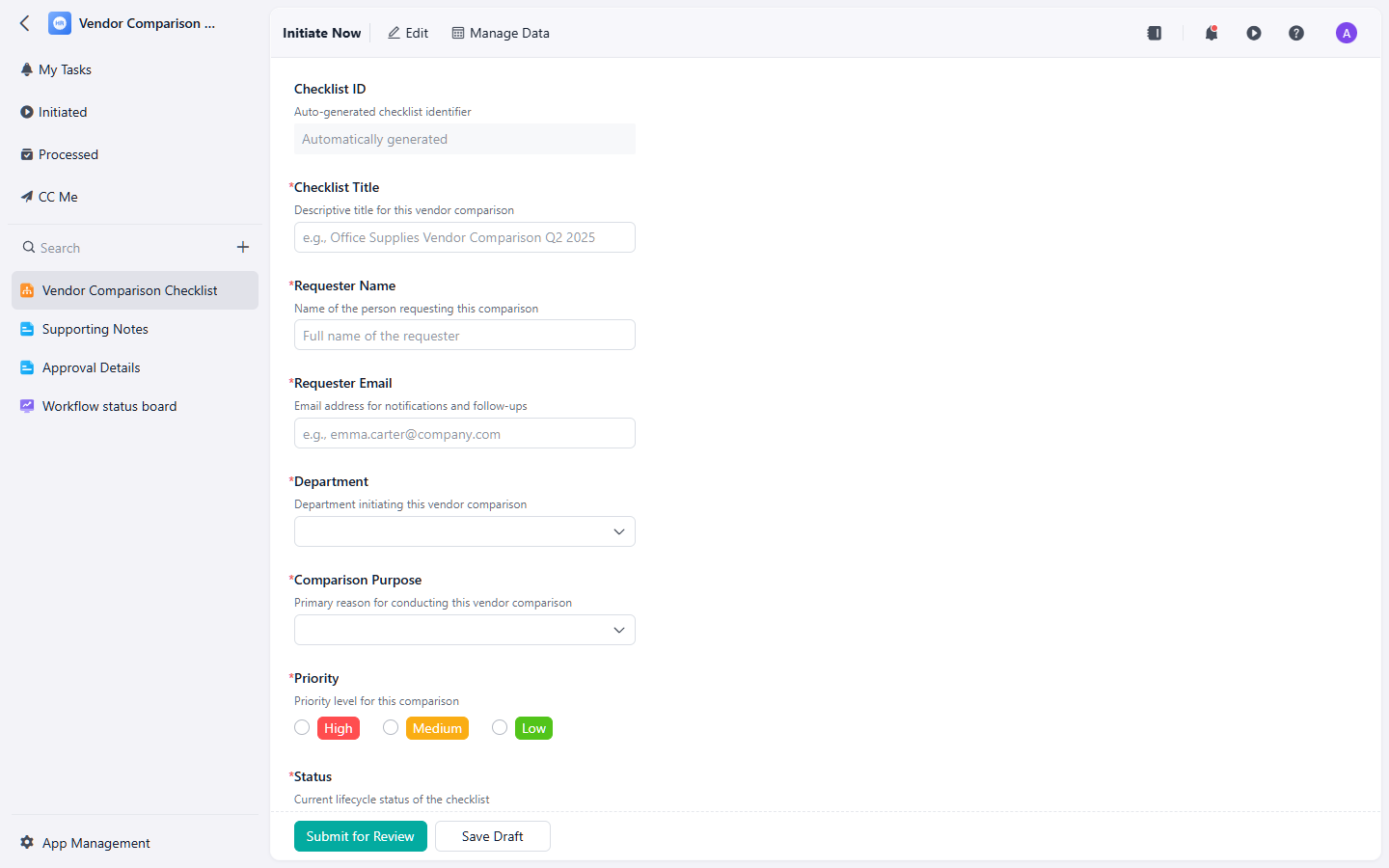
A structured vendor comparison checklist helps teams review suppliers against the same standards instead of relying on scattered impressions.
If your team wants a structured way to compare vendors side by side, this vendor comparison checklist is a practical reference.
Step 5: record notes, not just scores
One common mistake is using numbers without explanation.
If a vendor receives a lower score for quality, delivery, or compliance, the reviewer should record why. That written context matters because it helps teams:
- justify the decision later
- spot patterns across vendors
- review disagreements more objectively
- update decisions when supplier conditions change
A score alone may show that a supplier is weaker. A note explains whether the weakness is minor, temporary, or serious enough to affect selection.
Step 6: Separate performance review from vendor preference
It is normal for internal teams to have preferences. Someone may prefer a familiar vendor, a known contact, or the supplier that caused the fewest issues in the past.
But fair comparison requires those preferences to be checked against structured evidence.
This is where documented supplier performance becomes especially useful. If your team has prior review data, it should inform the comparison instead of relying on memory alone.
A 공급업체 평가 양식 can help teams capture vendor performance, risk notes, and recommendation logic in a more repeatable way.
How supplier risk fits into vendor comparison
Vendor comparison should not focus only on cost and convenience. Risk should also be part of the decision.
For example, procurement teams should consider questions such as:
- Is the supplier financially stable?
- Are the required documents complete and current?
- Has the vendor shown repeated delivery or quality issues?
- Would failure from this supplier create major disruption?
Even if two vendors appear similar commercially, one may create more operational or compliance risk than the other.
If vendor risk assessment is a recurring part of your review process, a structured 공급업체 평가 양식 can support that work alongside comparison scoring.
Common mistakes when comparing vendors
Even when teams try to compare suppliers carefully, a few common mistakes can weaken the process:
- using inconsistent criteria across suppliers
- focusing too heavily on unit price
- ignoring compliance or documentation gaps
- scoring vendors without enough evidence
- treating all categories as equally important
- failing to document why a supplier was chosen or rejected
These issues do not usually come from a lack of effort. They come from a comparison process that is too informal to support repeated decisions well.
How to make vendor comparison decisions easier to defend
A good comparison process should make supplier selection easier to explain, not just easier to complete.
That usually means:
- defining the decision purpose early
- collecting consistent supplier information
- using shared criteria across all vendors
- keeping scoring simple enough to apply consistently
- recording notes behind important ratings and final recommendations
When those elements are in place, teams are less likely to repeat the same debates every time a vendor decision comes up.
최종 요약
Comparing vendors fairly is not about removing judgment. It is about giving judgment a stronger structure.
When procurement teams use clear criteria, consistent scorecards, and written evidence, supplier selection becomes easier to compare, easier to defend, and easier to improve over time.
If your team wants a more structured way to compare suppliers side by side, Jodoo’s vendor comparison checklist 실질적인 출발점을 제공합니다.