Browse by category

Introduction: Why Lockout Tagout Procedures Matter in Modern Manufacturing
A machine that looks stopped is not always safe to touch. OSHA reports that failure to control hazardous energy contributes to thousands of workplace injuries each year, and an unexpected startup can turn a routine maintenance task into a crushing, electrical, or entanglement incident in seconds. That is why Lockout Tagout (LOTO) Procedures are a necessary part of maintenance safety in modern manufacturing.
In plain language, lockout tagout procedures are the steps used to shut equipment down, isolate every energy source, lock those isolation points, and confirm the machine is at a zero-energy state before work begins. In a general manufacturing plant, that may mean isolating electrical panels and compressed air lines on a conveyor. In automotive plants, it often includes hydraulic and robotic motion hazards, while in electronics facilities, technicians may need to control electrical, pneumatic, and stored capacitor energy on SMT equipment.
This article will walk you through the standard LOTO steps and the practical elements of implementing a lockout tagout program that works consistently across machines, shifts, and teams. The goal is simple: safer maintenance, fewer procedural gaps, and more reliable control on the shop floor.
The 6 Core Steps of a LOTO Procedure in Manufacturing Facilities
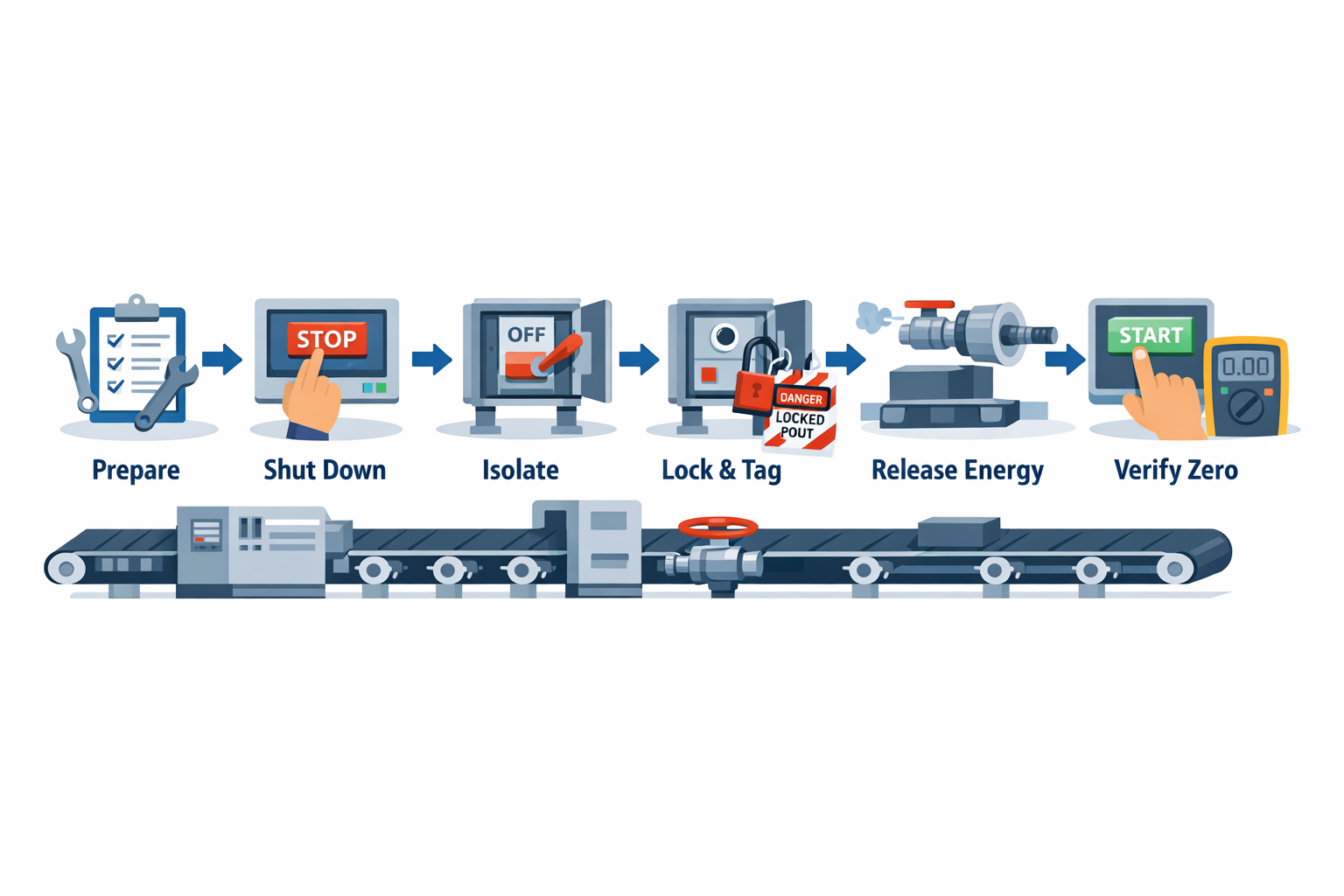
For most manufacturing sites, Lockout Tagout procedures follow the same six-step logic: prepare, shut down, isolate, lock and tag, release stored energy, and verify a zero-energy state before work starts. This is the practical backbone behind the steps for energy isolation in manufacturing, whether you are servicing a conveyor, press, robot, or packaging cell. Some plants document restart and employee notification as separate steps, but the core safety sequence does not change. In this section, we will follow one example: a maintenance technician replacing a failed servo motor inside an automated conveyor cell.
Prepare for Shutdown
Preparation starts before anyone touches the stop button. The technician reviews the machine-specific procedure, identifies all energy sources, confirms the scope of work, and gathers the correct lockout devices, tags, and test tools. In our conveyor cell example, that means checking the electrical disconnect, pneumatic air supply, and any gravity or spring-loaded movement in the transfer mechanism. This step is also where authorized employees align the job with OSHA LOTO requirements and confirm that affected operators know maintenance is about to begin.
Shut Down the Equipment Normally
Next, the machine must be stopped using its normal operating controls. That usually means following the standard shutdown sequence through the HMI, stop button, or local control station rather than cutting power first. On the conveyor cell, the technician stops production, clears in-process cartons, waits for the conveyor to come to a complete stop, and confirms the robot is in a safe parked position. A controlled shutdown reduces the chance of equipment damage, trapped product, or unexpected motion during isolation.
Isolate Every Energy Source
Once the equipment is stopped, each hazardous energy source must be physically isolated from the machine. For the conveyor cell, the technician opens the main electrical disconnect, closes the pneumatic supply valve, and isolates any secondary feeds linked to the servo drive cabinet. This is where many LOTO failures happen, especially on interconnected equipment with more than one feed or shared utilities. Good energy isolation depends on exact isolation points, not assumptions based on how the line usually operates.
Apply Lockout and Tagout Devices
After isolation, the authorized employee applies a personal lock and identification tag to every energy-isolating device. The lock prevents re-energization, and the tag tells everyone who applied it, why it is there, and when it was placed. In the conveyor example, the technician locks the disconnect handle in the off position and secures the air valve with a lockout device. If multiple technicians are involved, each person applies their own lock through a hasp or group lock box so no one depends on another person’s protection.
Release or Restrain Stored Energy
Isolation alone is not enough if hazardous energy remains inside the system. The technician must bleed residual air pressure, discharge capacitors where required by procedure, block any suspended movement, and confirm that rotating parts have fully stopped. On the conveyor cell, this includes venting the pneumatic line and checking that the transfer arm cannot drift or drop. This step is critical because stored energy causes many serious injuries even after the main disconnect is locked.
Verify the Zero-Energy State
Before work begins, the technician verifies that the machine is truly at zero energy. On the conveyor cell, that means trying the normal start command, confirming there is no response, and using the appropriate meter or test method required by the procedure. Verification must confirm the equipment cannot move, start, or release energy unexpectedly. If you want to know how to implement a lockout tagout program effectively, this is the standard that has to be executed the same way every time.
How to Implement a Lockout Tagout Program Across Shifts, Machines, and Teams
Assign Clear Ownership and Governance
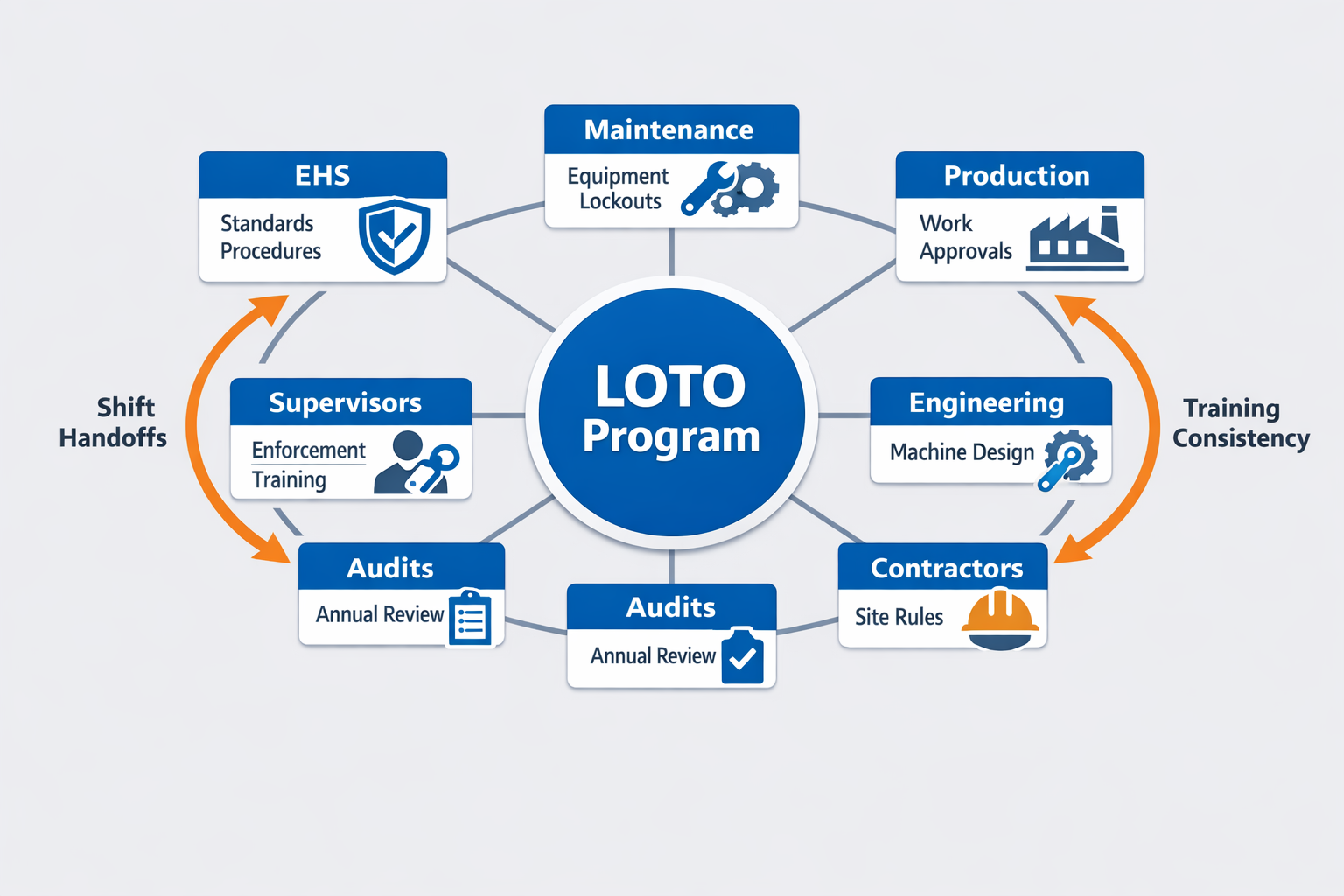
If you want to know how to implement a lockout tagout program at plant level, start with governance, not forms. One role must own the program standard, usually EHS or the Safety Officer, while Maintenance owns machine-specific procedures and Production owns compliance in daily execution. Engineering should approve changes that affect energy isolation points, and supervisors should confirm that only current procedures are used on the floor. Without this structure, plants often end up with three versions of the same procedure across maintenance, production, and contractor files.
A workable governance model also defines review and audit frequency. Many manufacturers review machine-specific LOTO procedures annually at minimum, and immediately after equipment modification, incident investigation, or line relocation. OSHA LOTO requirements also expect periodic inspections of energy control procedures, typically at least once a year, performed by an authorized employee other than the one using the procedure. In a multi-line plant, that means assigning named reviewers, approval dates, and escalation rules when audits find missing isolation points or outdated photos.
Standardize Training and Authorization
Training should separate what different people need to do, not just what they need to know. Authorized employees need hands-on practice with machine isolation, stored-energy release, and verification, while affected employees need to recognize lockout status and understand restart restrictions. Refresher training should follow near misses, procedure changes, or evidence that employees are bypassing steps for energy isolation in manufacturing. In practice, a short annual slide deck is rarely enough for high-mix plants with varied equipment.
Authorization should also be specific, not blanket. A technician may be authorized for packaging conveyors but not for servo-driven assembly stations or ammonia utility systems. This matters in facilities where one maintenance team supports multiple departments with very different energy profiles. A skills matrix tied to equipment families makes the authorization boundary visible for supervisors scheduling work.
Control Contractors and Temporary Labor
Contractor control is where many otherwise strong programs become inconsistent. Before shutdown work begins, contractors should be briefed on site-specific lockout rules, group lock box methods, permit expectations, and who has authority to remove locks. Their procedures should be compared with the plant standard before work starts, especially during turnarounds or machine installation projects. A mismatch between contractor practice and site rules can create gaps even when both parties believe they are compliant.
Temporary labor creates a different issue: they may be affected employees without understanding visual signals, restricted zones, or restart communication rules. On an electronics assembly floor, for example, operators brought in for peak demand may see a tagged reflow oven as idle equipment and try to clear material unless line leaders explain lockout status at shift start. That is a program failure, not an individual one.
Build Reliable Shift Handoffs and Audit Loops
Shift handoffs need written rules for unfinished maintenance, group lock continuity, and restart authority. If a repair on a filling line crosses from day shift to night shift, the incoming authorized employee must formally assume responsibility before the outgoing employee removes a personal lock. Plants that rely on verbal updates alone are more likely to miss partial work, bypass verification, or restart adjacent equipment too early.
Finally, audits should test execution, not just paperwork. Observe whether crews follow the approved sequence, whether machine-specific instructions match actual field conditions, and whether supervisors enforce exceptions consistently across departments. In many plants, the biggest risk is not the absence of procedures but uneven execution between lines, shifts, and teams.
Why Manufacturers Are Replacing Paper LOTO Binders with Digital, Machine-Specific Workflows
Paper Control Fails Faster
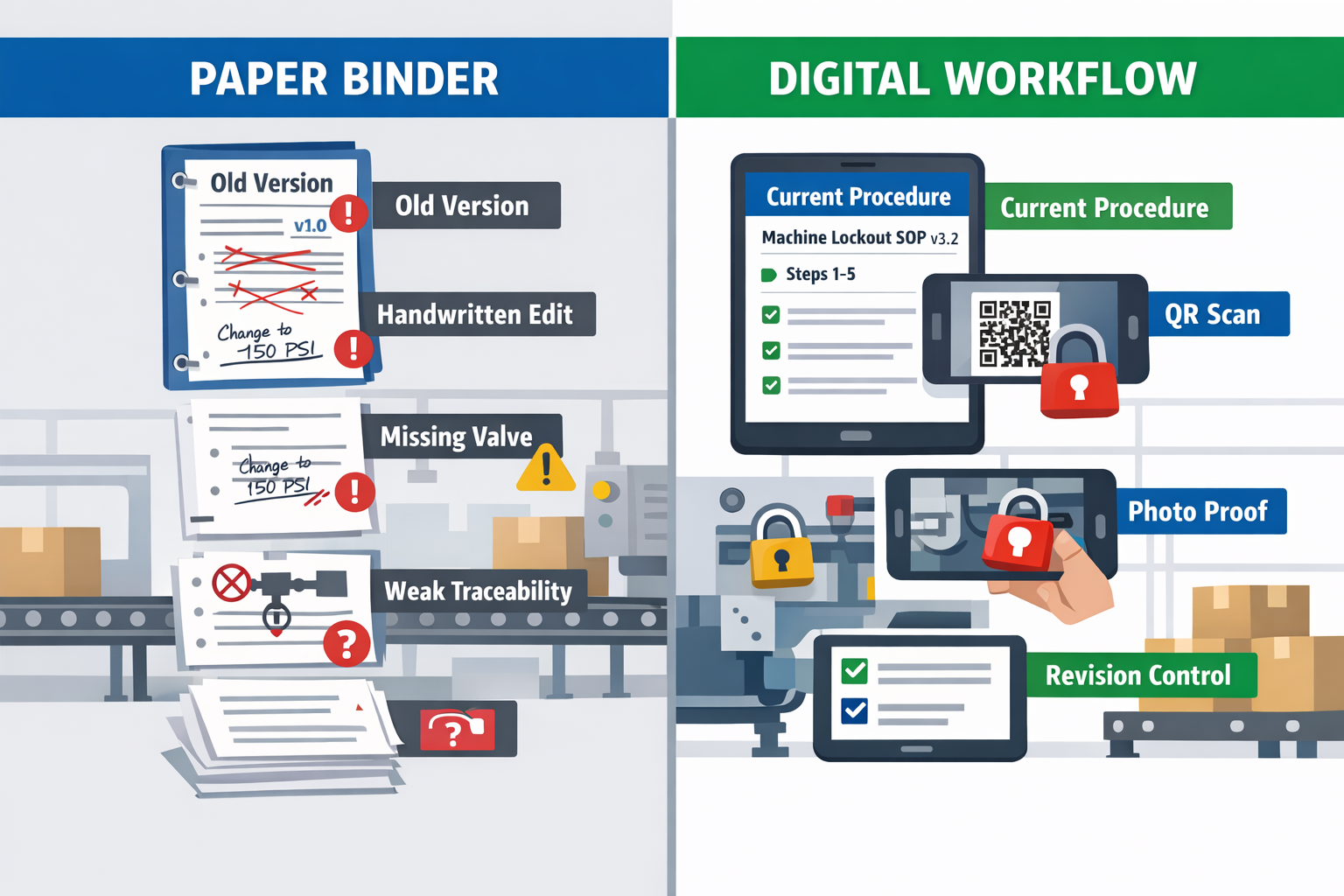
A paper LOTO binder may satisfy documentation on day one, but it often fails under daily operating pressure. Pages get photocopied, handwritten edits appear without approval, and technicians keep personal “working versions” that no longer match the master procedure. In plants with frequent tooling changes, utility rerouting, or machine upgrades, that gap becomes a direct compliance risk under OSHA LOTO requirements.
Take the robotic packaging cell from the earlier example. After a conveyor motor replacement and a new pneumatic diverter install, the original binder page still shows the old isolation map and misses one added air shutoff. A maintenance technician following that outdated sheet can complete the visible steps for energy isolation in manufacturing and still leave residual pneumatic risk in the cell.
The difference with a digital, machine-specific workflow is revision control tied to the actual asset record. Instead of flipping through a cabinet binder, the technician opens the latest approved procedure on a phone or tablet, sees current isolation points, and follows mandatory fields before the job can move forward. That gives safety and maintenance leaders a more reliable way to implement a lockout/tagout program across changing equipment.
Verification Needs More Than a Signature Line
Paper procedures usually rely on initials, signatures, and supervisor spot checks, but those methods do not prove the lock was applied to the correct disconnect or valve. If a plant runs multiple similar cells, technicians can easily record completion while standing in front of the wrong panel or using a lock number that was never verified. That weakens both execution discipline and incident investigation.
With Jodoo, manufacturers can turn each procedure step into a required digital action. A technician can be prompted to upload a photo of the applied lock, scan a machine QR code, enter the lock number, and capture a timestamp and user identity before proceeding to the next step. This creates stronger evidence than a paper checkmark, especially when a safety officer needs to confirm whether the procedure followed the approved sequence.
In the packaging-cell example, the technician must confirm the electrical disconnect, main air valve, and stored-pressure release point with separate photo records. If one image is missing or attached to the wrong step, the workflow remains incomplete and the job cannot be closed. That kind of rule-based control helps standardize execution without custom development or heavy IT support.
Live Visibility Changes Plant-Level Control
Paper binders also give supervisors almost no live visibility into which machines are currently locked out, who owns each lock, or whether work has reached verification or restart readiness. During shift changes, production may assume a line is available while maintenance still has an active isolation in place. That disconnect slows coordination and increases restart risk.
A live dashboard in Jodoo solves this by showing current lockouts by area, asset, owner, time opened, and status. Maintenance managers can filter by department, see overdue lockouts, and identify equipment waiting for verification or supervisor release. For plants learning how to implement a lockout tagout program consistently, that visibility turns LOTO from static paperwork into an active operating control.
In the same packaging area, the dashboard lets the shift supervisor see that Cell 3 remains locked out for sensor alignment, while Cell 4 has completed verification and is pending restart approval. Instead of calling three departments or checking a binder station, the team works from one current status view. That improves response time, audit readiness, and confidence that machine-specific procedures are being followed as designed.
Conclusion: Build Safer, More Reliable LOTO Procedures with Jodoo
Effective lockout tagout procedures are not built on signage or paperwork alone. They depend on disciplined energy isolation, machine-specific instructions, and consistent execution every time maintenance, cleaning, setup, or troubleshooting is performed. For Safety Officers and Maintenance Managers, the real challenge is not defining the steps once, but making sure the right version is followed across every shift, machine, and team.
That is why strong LOTO performance requires both procedure control and operational visibility. When isolation points, verification steps, approvals, and audit records are standardized, plants reduce the chance of missed energy sources, informal shortcuts, and inconsistent handoffs. In practical terms, better LOTO execution supports both injury prevention and equipment reliability, especially in complex environments with shared assets and frequent intervention.
If you want to move beyond paper binders and manual follow-up, Jodoo gives you a practical way to digitize LOTO workflows without custom development. As a no-code lean manufacturing platform, Jodoo can help you build machine-specific procedures, capture verification records on mobile devices, and monitor live lockout status across the plant floor. Start a free trial or book a demo to see how Jodoo can help you standardize safer LOTO execution.