Browse by category

Introduction: Why Manufacturing Operations Management Matters in 2026
A factory can hit its monthly output target and still lose margin every week through hidden downtime, scrap, rework, expedited shipments, and slow decision-making. That is why manufacturing operations management has moved from a plant-floor improvement topic to a board-level priority in 2026. Across automotive, electronics, and food manufacturing, operations leaders are being asked to produce more with tighter labor availability, higher customer quality expectations, and less tolerance for inventory waste or production delays.
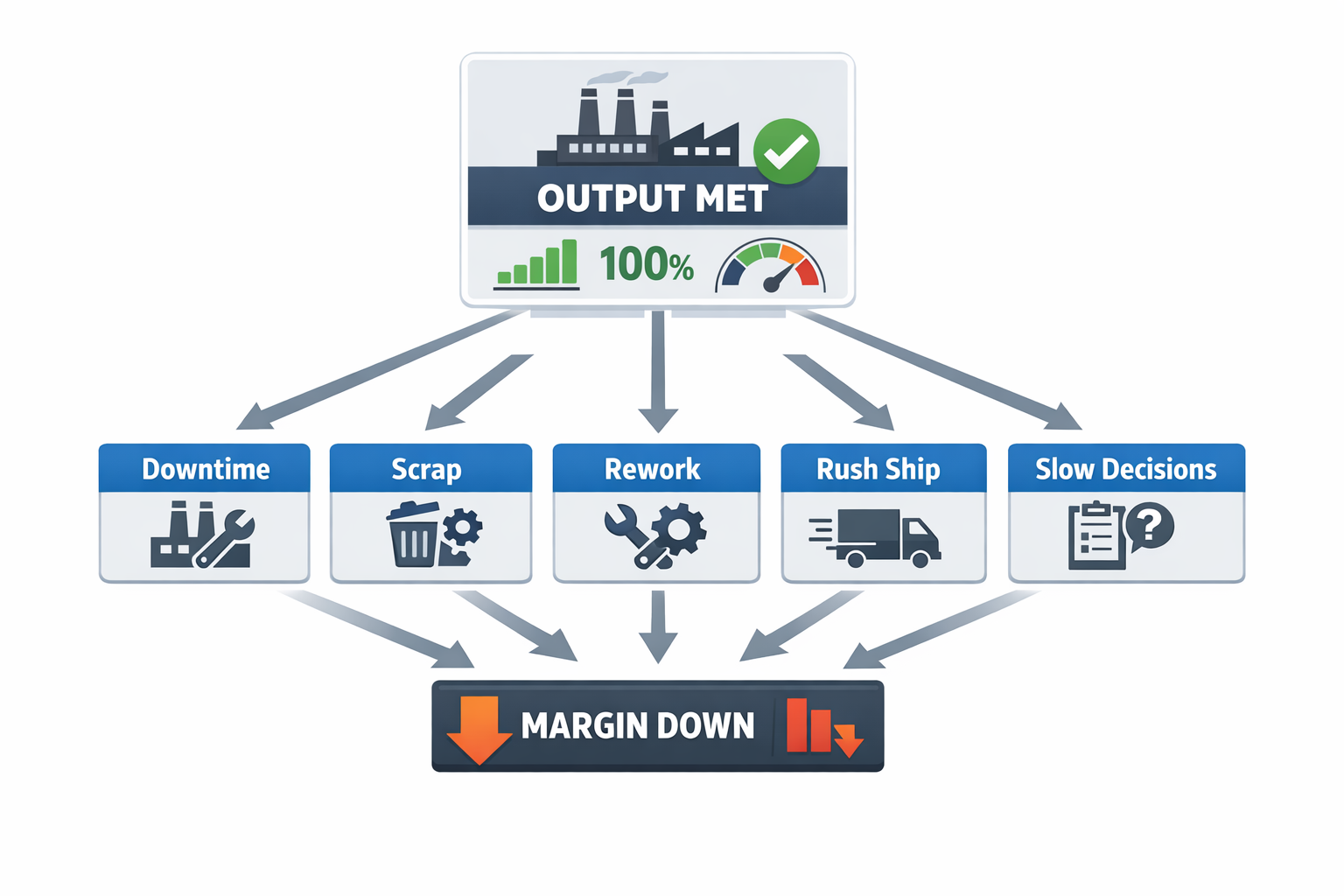
Imagine a production manager at an automotive parts plant who can see OEE by line, but still relies on spreadsheets for shift handovers, maintenance follow-ups, and nonconformance tracking. The data exists, but the operation remains fragmented. This gap is expensive: unplanned downtime alone costs industrial manufacturers billions globally each year, while poor quality can consume 5% to 15% of sales in many operations when scrap, returns, and rework are added up.
This guide explains what manufacturing operations management means in practical terms, how it connects production, quality, maintenance, inventory, and people management, and what strong execution looks like in 2026. You will also see how manufacturers improve operational excellence in manufacturing by combining standard work, real-time visibility, and flexible digital systems that fit the way the factory actually runs.
What Is Manufacturing Operations Management? Core Scope, Pillars, and Role in Factory Operations
Manufacturing operations management is the system a factory uses to run production in a controlled, measurable, and repeatable way every day. In simple terms, it connects planning, execution, people, materials, machines, and data so the plant can produce the right output at the right time and at the right quality level. If ERP plans the business and the shop floor carries out the work, manufacturing operations management sits in the middle and makes sure daily factory operations stay aligned.
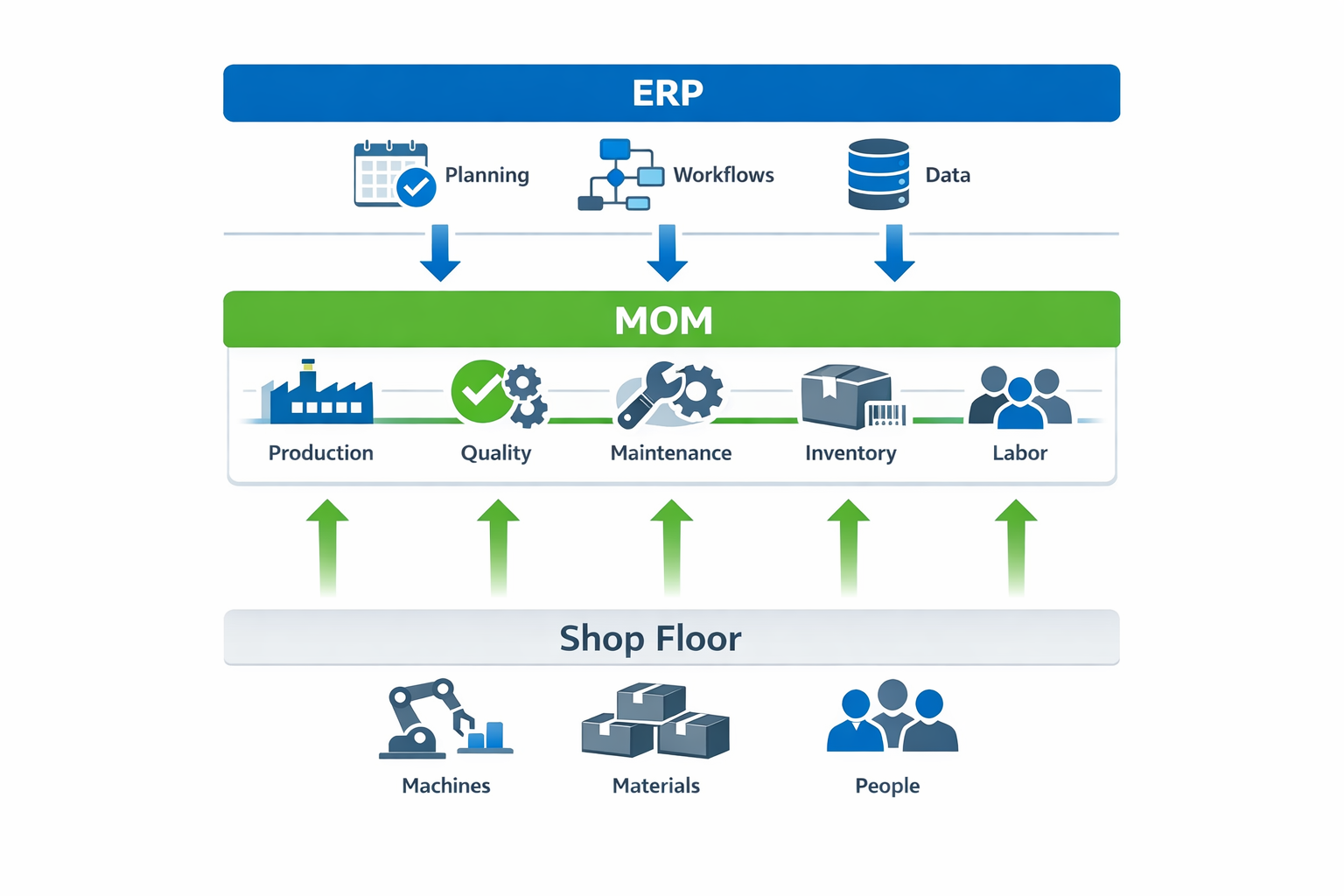
In practice, manufacturing operations management is not just one department or one dashboard. It is the operating layer that coordinates what should be made, what is being made now, what resources are available, what quality results are coming in, and what actions supervisors need to take next. Many manufacturers support this layer with MOM software, often alongside a manufacturing execution system, digital work instructions, maintenance workflows, and real-time production dashboards.
The Core Scope of Manufacturing Operations Management
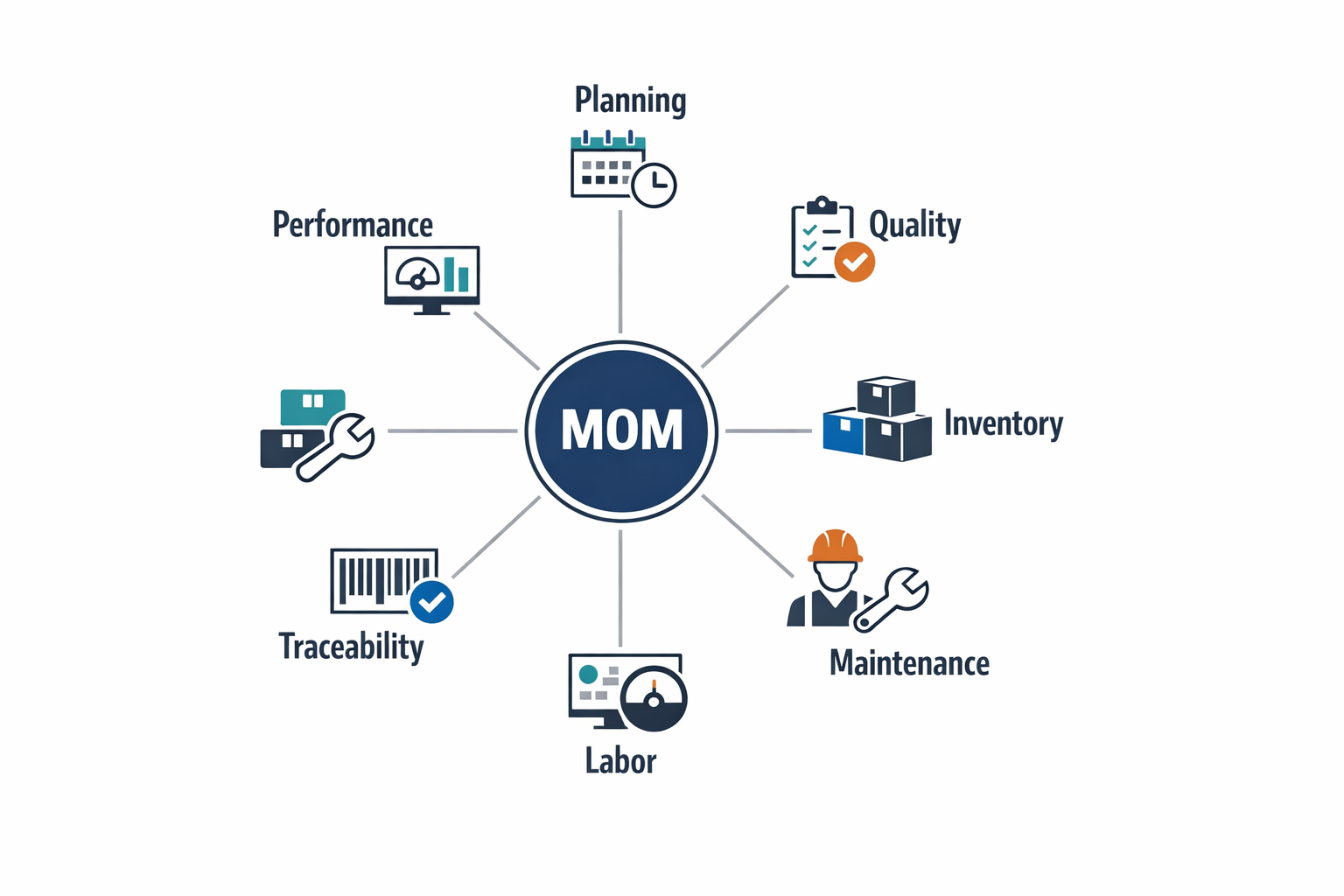
The scope of manufacturing operations management covers the full rhythm of plant execution. It starts before a job reaches the line, continues through production, and extends into reporting, traceability, and improvement actions after the shift ends. For operations directors, this is the discipline that turns production targets into stable, visible, and improvable daily work.
Imagine a production manager at an electronics assembly plant who needs to run five SMT lines, balance feeder availability, monitor first-pass yield, and respond quickly when a component reel is rejected. Manufacturing operations management gives the manager a structured way to schedule work orders, track line output, verify quality checkpoints, manage operator assignments, and see whether corrective actions are actually improving performance. That is why it plays such a central role in modern factory operations.
The Core Pillars of Manufacturing Operations Management
Production Planning and Scheduling
Production planning and scheduling translate demand into executable work on the shop floor. This includes sequencing jobs, assigning lines or machines, setting shift targets, and adjusting schedules when changeovers, machine downtime, or urgent orders affect output. In high-mix environments, this pillar is critical because even small scheduling errors can reduce capacity utilization and disrupt downstream delivery.
For example, in a packaged food plant running short shelf-life products, planners may need to sequence allergen-sensitive products carefully to reduce cleaning time and avoid cross-contamination risks. A strong manufacturing operations management approach links production orders, sanitation windows, labor availability, and packing capacity into one execution view. That makes schedule changes faster and more controlled, especially when demand shifts within the same day.
Quality Management
Quality within manufacturing operations management is about building control into daily execution, not only inspecting defects at the end. It includes in-process checks, deviation handling, nonconformance tracking, CAPA follow-up, and standardized response workflows when results fall outside limits. This is where quality moves from being a separate function to being part of how production is managed hour by hour.
In many factories, poor quality costs more than scrap alone. According to ASQ estimates, the cost of poor quality can range from 15% to 20% of sales revenue in some organizations, which shows why quality visibility must be embedded in operations. When quality data is connected to production runs, supervisors can see whether a defect trend is tied to a machine, material lot, operator, or shift condition and respond before losses spread.
Inventory and Material Flow
Inventory and material flow ensure the right materials reach the right location in the right quantity at the right time. This includes raw material staging, WIP tracking, replenishment signals, batch control, line-side delivery, and finished goods movement. In manufacturing operations management, inventory is not viewed only as a financial number but as a live part of execution.
Consider a beverage bottling facility where caps, labels, bottles, and syrup must all arrive at the line in sync. If one material is delayed or issued incorrectly, the line may stop even if the rest of the inventory looks sufficient in the ERP system. MOM software helps close that gap by making material status visible at the point of use, not just in back-office records.
Maintenance Coordination
Maintenance is a core pillar because production performance depends on equipment readiness, not just operator effort. Manufacturing operations management supports planned maintenance, autonomous maintenance checks, breakdown response, spare parts coordination, and equipment condition reporting. This creates a tighter link between production targets and machine reliability.
In discrete manufacturing, unplanned downtime is still one of the largest hidden capacity losses. Industry studies often estimate that unplanned downtime can cost manufacturers thousands of dollars per minute, especially in highly automated lines. When maintenance workflows are integrated with production status and shift reporting, teams can prioritize interventions based on actual operational impact rather than isolated maintenance logs.
Labor Coordination
Labor coordination covers who is assigned where, what skills are needed, what work instructions apply, and how shift handovers are managed. In many plants, this also includes attendance confirmation, training status, task escalation, and supervisor approvals for exceptions. It is a practical pillar because production plans fail quickly when labor deployment is not visible.
Imagine a garments factory launching a new style with different stitching requirements and tighter quality tolerances. Supervisors need to know which operators are trained for the operation, which line leaders are available, and whether output targets should be adjusted during ramp-up. Manufacturing operations management provides that operating structure, so labor planning supports stable execution rather than constant firefighting.
Traceability and Genealogy
Traceability allows manufacturers to track what happened, where, when, and with which materials, equipment, and operators. In regulated or quality-sensitive sectors, this includes lot genealogy, serial tracking, process history, inspection records, and digital sign-offs. It is a core requirement for compliance, recall readiness, and root cause analysis.
This is where a manufacturing execution system often works closely with broader manufacturing operations management processes. For example, in medical electronics or specialty food production, traceability may need to connect raw material lots, machine settings, operator IDs, test results, and shipment records. When that chain is digital and searchable, investigations that once took hours can be completed in minutes.
Performance Monitoring
Performance monitoring turns raw production data into action. It includes output, OEE, schedule attainment, scrap, rework, downtime, labor productivity, on-time completion, and shift-level exceptions. The goal is not more reports for their own sake, but faster decisions on the shop floor and clearer priorities for improvement.
A useful benchmark is that manufacturers using real-time visibility tools often improve response speed to abnormalities because supervisors no longer wait until end-of-shift summaries to act. When live dashboards show line status, quality trends, and downtime reasons in one place, the plant can move from reactive review to active control. That is one of the clearest ways manufacturing operations management supports operational excellence in daily practice.
How Manufacturing Operations Management Supports Day-to-Day Factory Operations
At the daily level, manufacturing operations management creates structure for execution. It helps planners release the right jobs, supervisors allocate labor, technicians respond to machine events, quality teams capture in-process results, and managers review performance using the same data set. This shared operating model reduces decision lag and improves coordination across departments without forcing every issue back through IT or manual spreadsheets.
For example, a shift leader in a snack food factory may start the day by reviewing planned output by line, checking whether cleaning release is complete, confirming material availability, and verifying that critical control checks are scheduled. During the shift, the same operating system can capture downtime events, trigger quality holds, and update completion status in real time. By the end of the day, management can see not only what happened, but which actions should be prioritized next shift.
The Link to Continuous Improvement and Operational Excellence
Continuous improvement depends on stable, trustworthy operational data. Manufacturing operations management provides that foundation by standardizing how execution is recorded, how deviations are escalated, and how performance is reviewed. Without that layer, improvement teams often spend more time reconciling data than improving the process itself.
This is why manufacturing operations management is a practical foundation for operational excellence in manufacturing. It makes daily management routines more disciplined, supports root cause analysis with better evidence, and helps plants convert improvement ideas into repeatable workflows. Over time, that creates a factory environment where planning, execution, control, and improvement are connected rather than managed as separate activities.
For manufacturers digitizing these processes, platforms like Jodoo can help operations teams build tailored apps for production reporting, quality checks, maintenance requests, traceability forms, workflow approvals, and real-time dashboards without heavy custom development. That gives plants a flexible way to strengthen manufacturing operations management while matching the realities of their own processes and governance model.
The Biggest Operational Pain Points MOM Solves on the Plant Floor
A strong manufacturing operations management approach matters most where daily execution breaks down: between shifts, across departments, and in the lag between an issue happening and someone acting on it. On many plant floors, the problem is not a lack of effort. It is the lack of a shared, real-time operating picture for supervisors, maintenance, quality, warehousing, and production planning.
This is where manufacturers start looking beyond isolated tools and spreadsheets. While a manufacturing execution system or broader MOM software can support this operational layer, the underlying goal is simpler: improve response speed, standardize decisions, and create accountability across factory operations. For companies focused on operational excellence in manufacturing, these pain points are often the tipping point for modernization.
Shift Handoffs That Lose Critical Context
Poor shift handoffs create hidden instability even in plants with solid output numbers. If one shift logs machine adjustments in a notebook, another updates a spreadsheet, and the next team gets a verbal summary, important details disappear. That leads to repeated troubleshooting, inconsistent setups, and a longer time to recover when the same issue returns.
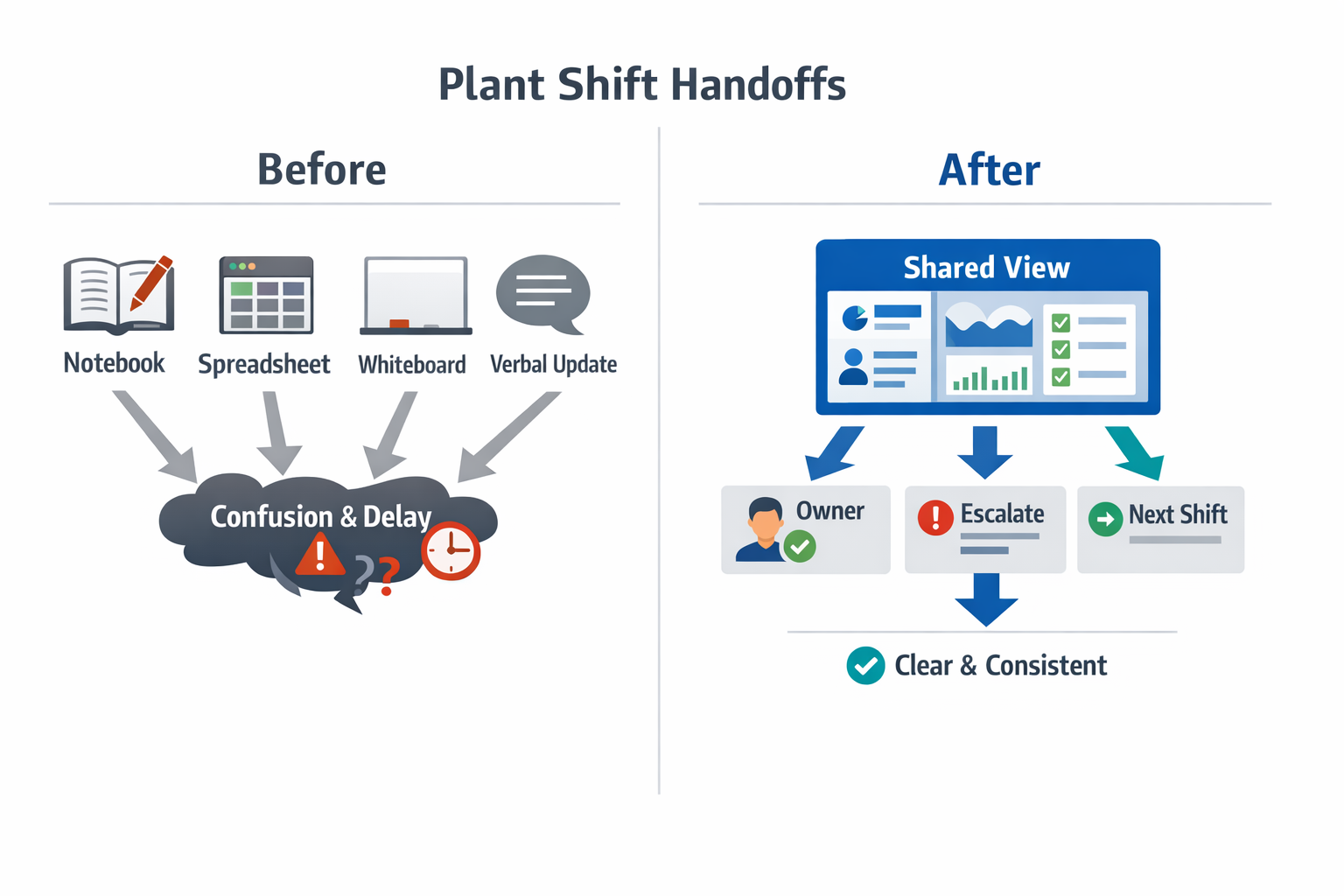
Imagine a production manager at an electronics assembly plant who starts the morning shift with three SMT lines running below target. The night team noted feeder jams and first-pass yield drift, but the information sits in separate files and on a handwritten board near the line. By the time engineering confirms what happened, two more hours of capacity are gone, and output commitments are already at risk.
Delayed Escalation Slows Down Recovery
On the plant floor, speed matters more than perfect reporting. A minor stoppage, material shortage, or out-of-spec measurement can become a major disruption when escalation depends on phone calls, walkarounds, or someone noticing an email late. The result is not only longer downtime, but also slower containment and higher scrap risk.
In food processing, this often shows up during changeovers and sanitation windows. If a packaging line restart fails quality checks and the issue is not escalated immediately to quality and maintenance, the plant can lose an entire production slot for a short shelf-life product. Industry studies regularly show that unplanned downtime costs manufacturers thousands of dollars per hour, and in high-volume sectors, the cost can be far higher once labor, waste, and missed delivery windows are included.
Inconsistent Reporting Distorts Performance
Many factories still close the day with production numbers assembled manually from line sheets, whiteboards, ERP entries, and supervisor messages. The issue is not only the time spent compiling reports. It is that different departments often work from different definitions of downtime, yield loss, rework, or completed output.
That makes decision-making slower and less reliable. If operations says a line achieved 92% attainment, maintenance says it lost 70 minutes, and quality says the real issue was hold stock waiting for disposition, leadership does not have one version of the truth. A disciplined manufacturing operations management framework creates common data definitions, so daily reviews focus on action instead of arguing over numbers.
Downtime Blind Spots Hide the Real Losses
Not all downtime is dramatic. In many plants, the larger loss comes from small interruptions that never trigger a formal incident record. Short stops, waiting for tools, delayed material replenishment, and repeated resets can quietly erode OEE without appearing in monthly summaries.
A garment factory is a good example. Sewing lines may not report five-minute stoppages caused by missing trims, machine needle replacements, or late bundle movement from cutting. Individually, these events look minor, but across multiple lines and shifts, they can remove a significant share of productive time. MOM-driven visibility helps teams capture these micro-losses and connect them to the right owner, whether that is production control, maintenance, or internal logistics.
Weak Cross-Functional Coordination Creates Execution Gaps
Some of the most expensive plant-floor problems sit between functions rather than within one department. Production may be ready to run, but maintenance has not closed a recurring fault, quality is waiting on a deviation review, and stores have not confirmed material lot availability. Each team may be doing its job, yet the plant still misses the schedule because coordination happens too late.
This is especially common in batch and mixed-model environments where priorities change daily. In an industrial components plant, for example, a late engineering change can affect routing, inspection points, and packaging instructions at the same time. Without structured coordination, supervisors improvise locally, which increases the chance of rework, shipment delays, or non-conformance.
What Improves When MOM Matures
When manufacturing operations management becomes more disciplined, the plant gains faster issue visibility, clearer ownership, and better follow-through. Teams can see what happened, who is responsible, what status an action is in, and whether the problem is contained before it affects the next shift or the next order. That is a practical step toward operational excellence in manufacturing, not an abstract transformation goal.
Over time, this improves more than reporting quality. It strengthens schedule adherence, shortens response time to line issues, and helps leaders spot recurring failure patterns before they become chronic losses. Whether a company uses a manufacturing execution system, standalone MOM software, or a broader digital operations stack, the operational value comes from making plant-floor execution visible and coordinated in real time.
MOM Software vs Manufacturing Execution System vs ERP: How to Evaluate the Right Fit
If you are comparing manufacturing operations management, a manufacturing execution system, ERP, and lighter workflow tools, the biggest mistake is treating them as interchangeable. They overlap, but they are designed for different layers of factory operations. A good evaluation starts by asking one practical question: which decisions and workflows must the system control on the shop floor, and which ones only need to be tracked, approved, or reported? For mid-size manufacturers, that distinction usually determines both implementation success and total cost.
What Each System Is Designed to Do
MOM software is the broadest category in this comparison. It typically covers multiple operational layers, including production tracking, quality management, maintenance coordination, traceability, scheduling support, labor visibility, and performance reporting. In practice, MOM software is used when a manufacturer wants one operational system to coordinate how work is executed, measured, and improved across departments.
A manufacturing execution system is usually more focused on real-time production execution. It sits closer to the line and manages activities such as work order dispatching, machine and operator status, WIP tracking, batch or serial traceability, electronic work instructions, and production data capture. If MOM is the broader umbrella, MES is often the core engine for controlling what happens during production.
ERP plays a different role. It is built to manage enterprise-wide transactions such as purchasing, finance, sales orders, inventory valuation, procurement planning, and high-level production planning. ERP is essential, but it usually does not handle line-level execution with the detail or speed required for modern factory operations.
Lighter workflow platforms fill another gap. These tools are not full MOM software or a full manufacturing execution system, but they can digitize targeted operational processes quickly. That includes shift handovers, nonconformance approvals, layered process audits, maintenance requests, first-article inspections, CAPA workflows, and production reporting dashboards without a long MES rollout.
A Simple Comparison for Mid-Size Manufacturers
A useful way to compare these systems is by scope and control level. ERP answers questions like what was ordered, what was purchased, and what should be produced at a planning level. A manufacturing execution system answers what is running now, who is working on it, what lot was used, and whether the job met process rules. MOM software connects those execution activities with broader operational control, governance, and continuous improvement. A lighter workflow platform supports fast digitization where the goal is standardization, visibility, and approvals rather than deep machine-level control.
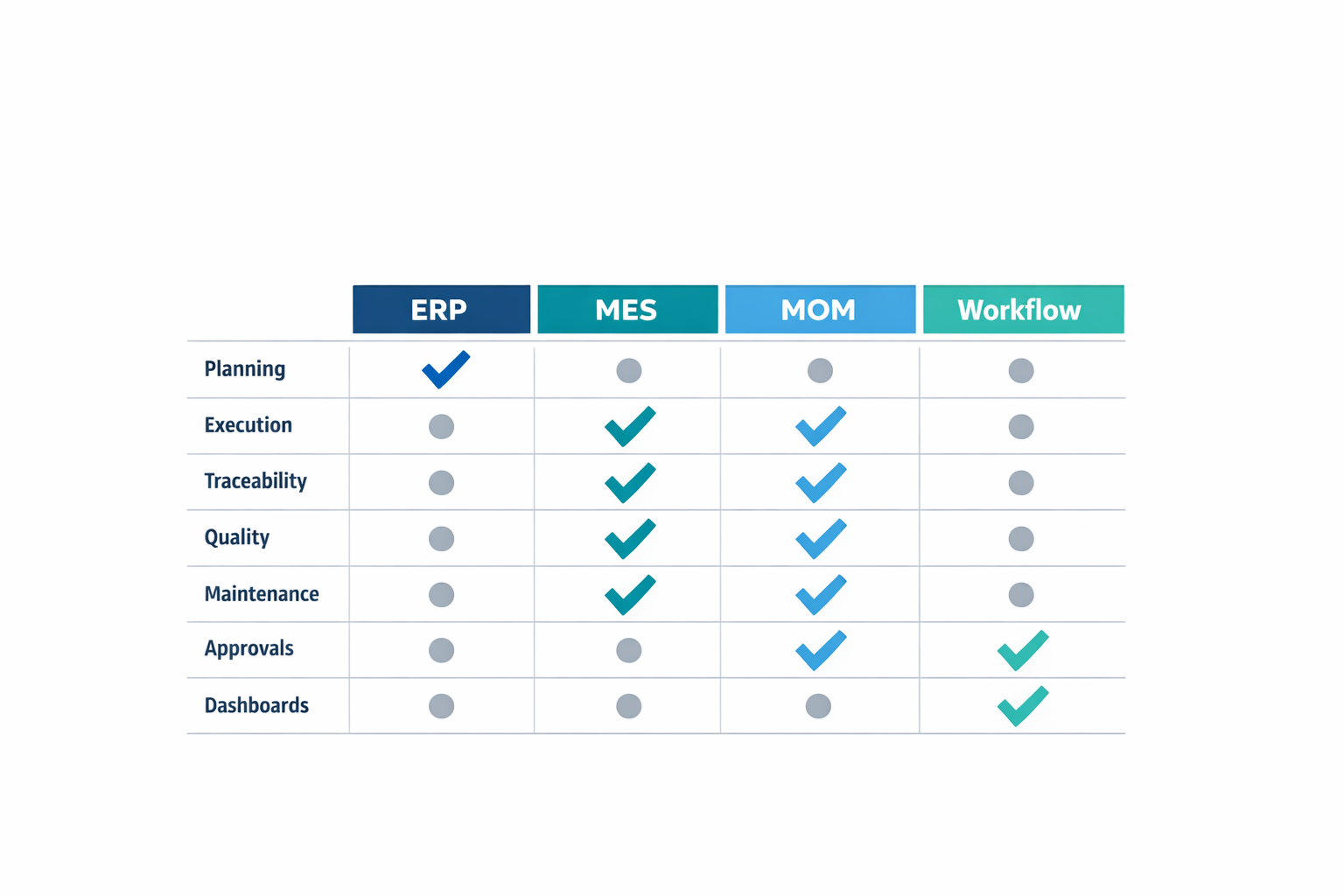
Imagine a production manager at an electronics assembly plant that builds industrial control boards in high-mix, low-volume batches. If the priority is real-time route enforcement, component traceability, test status capture, and operator instructions at each station, a manufacturing execution system is likely the right fit. If the same plant also wants to standardize quality escalation, maintenance coordination, engineering change acknowledgments, and cross-site KPI dashboards, broader MOM software may be more appropriate.
Now consider a food processing manufacturer running multiple packaging lines for sauces and ready-to-eat products. If ERP already manages recipes, purchasing, and finished goods inventory, the next need may not be a full MES rollout. A lighter workflow platform may be enough to digitize sanitation checks, batch release approvals, downtime logging, metal detector verification, and deviation workflows while integrating key records back into ERP.
Where Lighter Platforms Make Sense
Mid-size manufacturers do not always need to start with a full manufacturing execution system. In many plants, the highest-value opportunities sit in process orchestration around production rather than in direct machine control. That is especially true when teams want faster implementation for quality, maintenance, audit readiness, shift management, or visual performance management.
This is where a no-code platform such as Jodoo fits well. Instead of replacing ERP or forcing a full MES deployment on day one, operations teams can build apps for inspection forms, production reporting, approval workflows, maintenance requests, digital checklists, and live dashboards on one platform. For companies pursuing operational excellence, that approach is often a practical step because it improves control and visibility quickly while leaving room to integrate with ERP, IoT, or other manufacturing systems later.
How to Evaluate the Right Fit
Deployment Speed
Deployment speed matters because manufacturing priorities change faster than most software projects. A traditional manufacturing execution system can take months or longer when it requires equipment interfaces, routing logic, validation, and extensive change management. A lighter workflow platform can often go live much faster for targeted use cases, especially when the first phase is focused on forms, approvals, exception handling, and dashboarding.
For example, a garment manufacturer with multiple sewing lines may not need full station-level MES control immediately. If the immediate objective is to digitize line-start checks, in-line quality approvals, rework requests, and supervisor escalation workflows before peak season, a configurable workflow platform can deliver value in weeks rather than quarters. That speed can be decisive for mid-size firms with limited IT bandwidth.
Flexibility
Flexibility becomes critical when processes vary by product family, plant, or customer requirement. MES and MOM software are powerful, but some are rigid if your operation has frequent routing changes, mixed manual and semi-automated steps, or customer-specific compliance records. You should test how easily the system can adapt when an approval path, inspection form, or production rule changes.
Ask vendors to show how a process change is made, not just how the standard workflow looks in a demo. If your quality manager needs to add a photo field, extra approval step, or supplier containment workflow without a formal development cycle, that is a strong signal of operational fit. In mid-size environments, flexibility often determines whether a system becomes a daily tool or an expensive reporting layer.
Integration Needs
The right choice also depends on how much data must flow across systems. ERP usually remains the system of record for master data, purchasing, cost, and financial control, while MES or MOM may own execution data and traceability records. Lighter platforms are most effective when they can connect these layers without forcing duplicate entry.
A practical evaluation checklist should include order sync, BOM or recipe sync, item master alignment, user authentication, maintenance data exchange, and dashboard consolidation. If the business only needs to connect production logs, quality approvals, and exception records into ERP or BI tools, a configurable platform with APIs, webhooks, or no-code integrations may be sufficient. If you need second-by-second machine feedback, automated station control, or highly regulated electronic batch records, a more specialized manufacturing execution system may be required.
Process Coverage
Process coverage is where many buying decisions go wrong. Some manufacturers buy ERP extensions expecting shop-floor discipline, while others buy MES when they mainly need structured workflow control outside the line. The better approach is to map the exact processes you want covered in the next 12 to 24 months.
Separate them into four groups: production execution, quality management, maintenance, and management control. If most of your required use cases are work instruction enforcement, machine state capture, genealogy, and routing control, a manufacturing execution system is the stronger fit. If the list is broader and includes audits, approvals, deviation handling, corrective actions, and plant-wide KPI governance, broader MOM software or a flexible workflow platform may deliver better value.
Usability on the Shop Floor
Usability should be tested with supervisors, line leaders, technicians, and quality staff, not just with IT or senior management. In manufacturing, adoption depends on whether a task can be completed in seconds on a tablet, kiosk, or phone under real production conditions. If a system is too complex for frontline users, the result is workarounds, delayed entries, and inconsistent data.
Look for role-based screens, simple data entry, barcode or QR support where relevant, offline resilience if connectivity is uneven, and fast exception logging. A good system should make the correct action obvious for each role. This is especially important in plants with rotating shifts or multilingual workforces, where clarity directly affects execution quality.
Governance and Control
Strong governance matters even in highly flexible systems. Operations directors need confidence that forms, workflows, dashboards, and approvals are standardized, version-controlled, and auditable across sites. At the same time, local plants often need some freedom to adjust processes for product, customer, or regulatory differences.
That means you should evaluate permissions, approval hierarchies, record history, e-signatures where needed, and the ability to separate global templates from local adaptations. In practice, the best-fit platform is not the one with the most features. It is the one that gives your organization enough control to scale without turning every small process change into an IT project.
Total Cost of Ownership
License price alone rarely tells you the full story. Total cost includes implementation services, integrations, training time, validation effort, support, change requests, and the internal resources needed to maintain the system. For mid-size manufacturers, these hidden costs often determine whether a project expands successfully or stalls after phase one.
Industry studies regularly show that digital manufacturing projects struggle when rollout complexity exceeds internal change capacity, even when the software itself is capable. That is why many companies now phase investments: ERP remains the transactional backbone, while targeted MOM software, a manufacturing execution system, or a no-code workflow layer is added, where it creates measurable operational impact first. This staged model usually reduces risk and supports more sustainable operational excellence in manufacturing.
A Practical Shortlist Approach
If you are building a shortlist, start with the use case rather than the category label. Choose ERP if your main gap is enterprise planning and financial control. Choose a manufacturing execution system if you need deep, real-time control of production execution and traceability. Choose broader MOM software if you want to coordinate execution, quality, maintenance, and performance management at an operational level. Choose a lighter platform like Jodoo if your priority is to digitize and standardize operational workflows quickly, integrate data across systems, and improve visibility without waiting for a large-scale core-system rollout.
For many mid-size manufacturers, the answer is not one system replacing all others. It is a layered architecture where each tool handles the jobs it is best at. The real objective is not buying the biggest platform. It is building a system landscape that improves decision speed, execution discipline, and measurable performance across factory operations.
How Jodoo Supports Manufacturing Operations Management Without a Full MES Rollout
For many manufacturers, improving manufacturing operations management does not have to start with a large, multi-year manufacturing execution system project. In practice, many plants first need a reliable digital layer for the workflows that sit around production: quality escalations, maintenance coordination, inspection records, shift communication, and action tracking. This is where Jodoo fits well as a practical foundation for stronger factory operations, whether you are preparing for a future MES, extending an existing one, or filling process gaps that traditional MOM software often leaves too rigid or too expensive to customize.
Jodoo gives operations teams a no-code way to build workflow-driven apps that match how the plant already runs. Instead of forcing a standard template onto every line, you can configure forms, approvals, alerts, dashboards, and integrations around your own SOPs, escalation rules, and reporting structures. That makes it especially useful for manufacturers pursuing operational excellence manufacturing goals, where consistency, response speed, and visibility matter as much as the core production transaction itself.
Digitize the Workflows That Matter Most on the Shop Floor
A traditional manufacturing execution system is designed to control and track production execution, but many important operational processes still happen outside it. For example, an electronics assembly plant may have strong traceability on the line yet still manage nonconformance reporting through spreadsheets and supervisor emails. With Jodoo, the plant can create a structured nonconformance app that captures defect category, station, shift, photo evidence, containment action, and responsible owner in one mobile form.
The same approach works for CAPA workflows, where speed and accountability are critical. Imagine a food packaging factory that needs quality, production, and engineering to align on corrective actions after repeated seal integrity failures. A Jodoo workflow can route the case automatically from initial incident logging to root-cause review, approval, deadline tracking, and closure verification, while dashboards show open actions by line, owner, or aging status.
Maintenance requests are another high-impact use case, especially in plants where maintenance teams need faster triage rather than more paperwork. A garments factory, for instance, can use a mobile request form for sewing machine faults, attach photos or short videos, assign priority levels, and push alerts to technicians immediately. Instead of relying on verbal reporting between shifts, the maintenance team gets a timestamped queue with status updates, completion records, and a usable history for recurring asset issues.
A Practical Alternative to All-or-Nothing MOM Software
Jodoo is not positioned as a replacement for every function of enterprise MOM software or a full manufacturing execution system. Its value is that it lets manufacturers digitize high-friction operational workflows quickly, without waiting for heavy custom development or a plant-wide platform overhaul. In many mid-sized factories, that means operations leaders can improve governance and response times in weeks, then decide later which processes should stay in Jodoo and which should connect to ERP, CMMS, or MES platforms.
This staged approach is often more realistic for plants managing multiple improvement priorities at once. You can start with inspection forms, downtime approvals, or shift handoff logs, then add dashboards and workflow rules as the process matures. Because Jodoo supports forms, workflow automation, dashboards, and integrations in one environment, it becomes a flexible operating layer around production and support processes rather than another disconnected point tool.
Example: Replacing Email-and-Excel Downtime Reporting
Consider a mid-size beverage factory where downtime events were previously logged by supervisors in Excel and shared by email at the end of each shift. Engineering, production, and quality teams all saw the same issue at different times, which made follow-up uneven and slowed cross-functional action. The plant replaced that process with a Jodoo downtime workflow that let line leaders submit an issue from a mobile form, route it instantly to the right department based on cause code, and track status, comments, and closure in one shared record.
The result was not just faster reporting, but better follow-up discipline across departments. Each downtime case had an owner, escalation path, due date, and visible audit trail, so recurring losses were less likely to disappear into inboxes. For operations directors, that kind of structured execution is often the missing link between improvement meetings and measurable gains in factory operations performance.
Conclusion: Building a Practical Roadmap to Operational Excellence Manufacturing with Jodoo
Manufacturing operations management delivers results when it moves beyond theory and becomes part of daily factory execution. The manufacturers that improve cost, quality, delivery, and responsiveness are usually the ones that standardize core processes, track a small set of meaningful KPIs, and give teams real-time visibility into what is happening on the shop floor. Imagine a production manager at an electronics plant who can see downtime trends by line, approve maintenance requests faster, and spot rising defect rates before they affect customer shipments. That is where operational excellence manufacturing becomes practical, not abstract.
The main takeaway is simple: you do not need to digitize the entire factory at once to improve manufacturing operations management. In many plants, the best starting point is one high-friction workflow such as production reporting, quality inspections, maintenance requests, shift handovers, or nonconformance tracking. Once those processes are digitized and measurable, it becomes much easier to scale standard work, reduce manual errors, and connect data across departments.
If you want a flexible way to start, Jodoo is a no-code lean manufacturing platform built to help manufacturers digitize operations quickly without heavy custom development. You can start small, adapt workflows as your plant changes, and build a scalable foundation for continuous improvement. Start a free trial or book a demo to see how Jodoo can support your path to operational excellence.