Browse by category

Introduction: What a Quality Management System Means in Manufacturing
A single escaped defect can cost far more than scrap. In automotive, the average cost of a product recall can run into the millions of dollars, while in electronics, one traceability gap can turn a localized defect into a full lot investigation. That is why a quality management system matters: it gives your plant a structured way to control how quality is planned, checked, documented, and improved.
In manufacturing, a quality management system is the set of processes, responsibilities, records, and controls used to ensure products consistently meet customer, regulatory, and internal requirements. For quality managers, it creates auditability and faster root-cause response. For plant managers, it reduces variation on the shop floor, improves handoffs between production and quality, and makes problems visible before they become customer complaints.
Most manufacturers are really asking a practical question: how do you build a system that improves control, traceability, and consistency without adding bureaucracy? This article answers that by breaking the topic into the core building blocks of a manufacturing QMS, the basics of ISO 9001, the step-by-step setup process, and the operational benefits of digital execution. Along the way, we will focus on four core principles: quality planning, quality control, quality assurance, and quality improvement.
The Key Elements of a QMS for Manufacturing Operations
A quality management system works only when its parts connect across planning, execution, verification, and review. The key elements of a QMS are not separate paperwork blocks; they form one control structure that links product specifications, operator actions, inspection decisions, issue escalation, and management follow-up. In practice, that means a work instruction should point to the right inspection standard, an inspection failure should trigger nonconformance handling, and repeated failures should feed CAPA and management review.
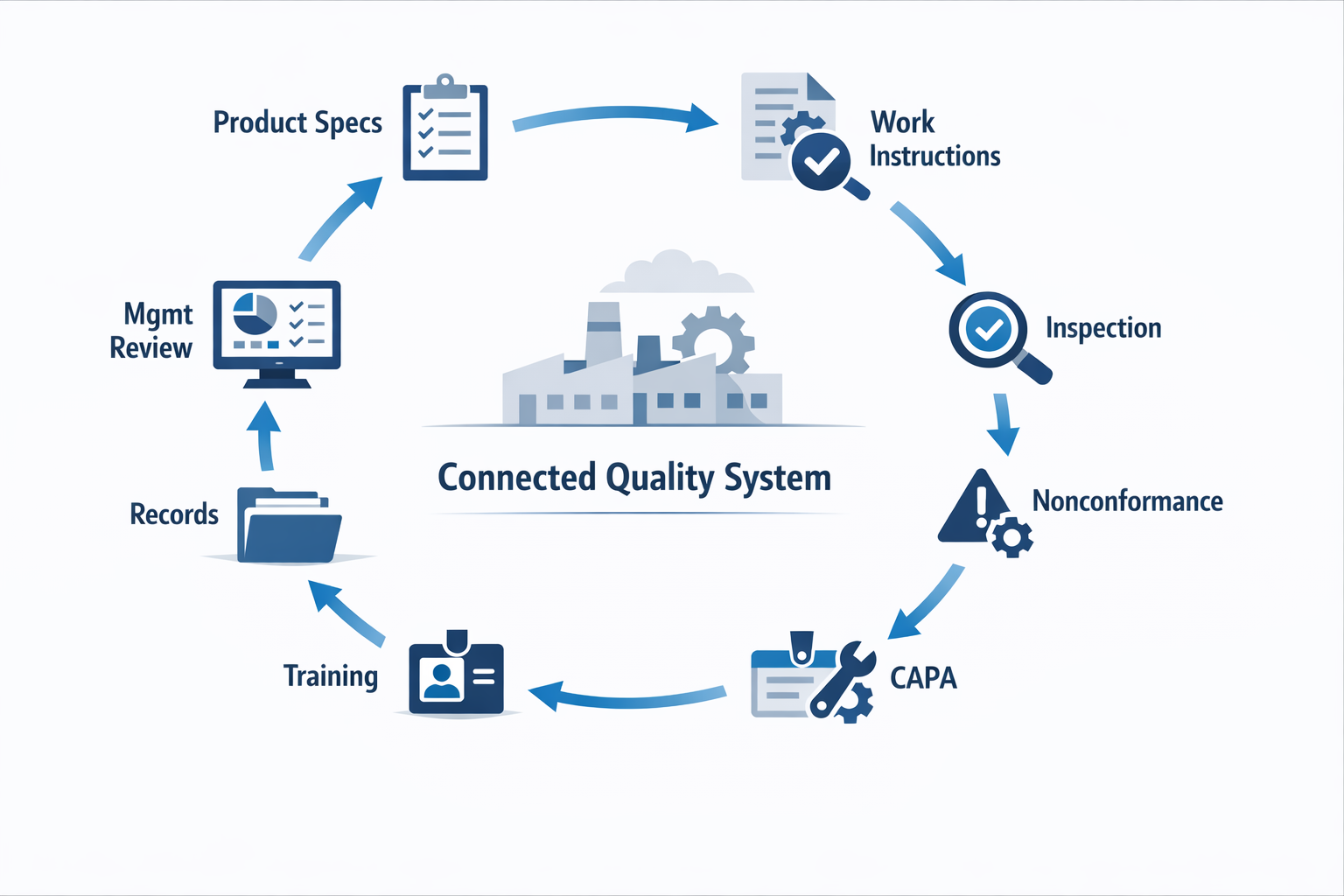
Process Mapping and Defined Ownership
Process mapping gives the QMS its operational backbone. It shows how quality requirements move from incoming material control to production, testing, packing, and shipment, with clear handoffs between production, quality, engineering, and warehouse teams. In an automotive components plant, mapping the PPAP-related flow for a brake bracket can reveal where gauge verification, first-piece inspection, and operator signoff must occur to prevent undocumented variation.
Roles and responsibilities turn that map into accountability. Every critical activity should have a named owner, including who approves specification changes, who releases nonconforming stock, and who closes corrective actions. In an electronics assembly plant, confusion between line leaders and quality technicians over who can stop a surface-mount line often causes delayed containment. A strong QMS removes that ambiguity before defects move downstream.
Document Control and Inspection Standards
Document control ensures that people use the current version of what the business has approved. That includes drawings, control plans, work instructions, inspection checklists, sampling plans, and supplier requirements. In regulated and export-driven manufacturing, uncontrolled documents create both compliance risk and scrap risk because operators may build to an outdated tolerance or test method. A controlled revision history also supports traceability during customer complaints and audits.
Inspection standards define what good looks like and how it will be verified. They should specify characteristics, methods, tools, frequency, acceptance criteria, and response rules when results fail. In a PCB assembly operation, for example, visual inspection criteria for solder bridges and tombstoning must align with the accepted workmanship standard used across incoming checks, in-process inspection, and final QA. Without that alignment, two inspectors can judge the same defect differently.
Nonconformance Handling and CAPA
Nonconformance handling is the discipline of identifying, segregating, documenting, and deciding the disposition of material or product that does not meet requirements. The core question is not only whether a defect exists, but whether the plant can contain it fast enough to protect the customer. In an automotive wiring harness plant, a mislabeled connector lot should be blocked from shipment, traced to affected work orders, and reviewed for rework, scrap, or concession. That speed is one of the practical benefits of implementing a QMS in manufacturing.
Corrective and preventive action, or CAPA, addresses the cause behind recurring or significant failures. A good CAPA process separates symptom correction from root-cause elimination by requiring investigation, action assignment, effectiveness checks, and closure evidence. In an electronics plant seeing repeated ICT failures on one model, replacing boards may solve today’s output problem, but CAPA should determine whether the real cause is stencil wear, feeder setup drift, or supplier variation in components. This is one of the most important QMS building blocks because it turns quality data into operational learning.
Training, Competence, and Controlled Records
Training in a QMS is not limited to onboarding sessions. It should show that employees are competent for the tasks they perform, understand the latest standards, and are retrained when processes change. In a plant introducing a new torque specification for seat-frame assembly, signed attendance alone is weak evidence; the stronger record is a combination of training completion, supervised verification, and audit confirmation on the line.
Records provide proof that the system is functioning as designed. Inspection results, calibration logs, training records, deviation approvals, CAPA evidence, and audit findings all create the traceability needed to defend quality decisions. For manufacturers serving OEMs or multinational customers, record integrity matters because missing data is often treated the same as work not done.
Management Review
Management review closes the loop between shop-floor execution and business oversight. It should evaluate defect trends, customer complaints, supplier performance, audit results, overdue actions, and whether quality objectives are being met. In practice, this is where leaders decide whether recurring solder defects justify equipment investment, added training, or a supplier development plan. Without management review, the other elements may exist, but they do not operate as a complete system.
ISO 9001 Basics and the Core Quality Principles Behind an Effective QMS
ISO 9001 is the most widely used framework for structuring a manufacturing quality management system, but plant teams do not need to memorize the standard clause by clause to use it well. What matters is understanding how its requirements shape daily work: how quality is planned before production starts, controlled during execution, assured through verification, and improved when gaps appear. If you are evaluating the key elements of a QMS or preparing for how to build a quality management system, ISO 9001 gives you a practical operating logic rather than just a certification checklist.
Customer Focus and Risk-Based Thinking
ISO 9001 starts with customer focus because quality is defined by whether the product consistently meets requirements, not by whether internal teams believe the process is acceptable. In manufacturing, that means translating customer drawings, tolerances, packaging rules, traceability requirements, and delivery expectations into process controls that operators can actually follow.
Risk-based thinking connects directly to quality planning. Instead of reacting only after defects appear, ISO 9001 expects manufacturers to identify where failures are most likely and where the consequences are highest, then build preventive controls into the process. An electronics assembler might flag solder joint defects, ESD exposure, and incorrect component loading as priority risks, then define inspection frequency, line clearance checks, and operator certification requirements around them.
How ISO 9001 Maps to the Four Quality Disciplines
The standard becomes easier to use when you map it to four core quality disciplines. Quality planning covers customer requirements, process design, risk assessment, and control plans; quality control covers inspections, in-process checks, testing, and nonconformance containment; quality assurance covers audits, document control, training verification, and management review; quality improvement covers root cause analysis, corrective action, and performance-driven change. This is the practical bridge between ISO 9001 requirements and shop-floor execution.
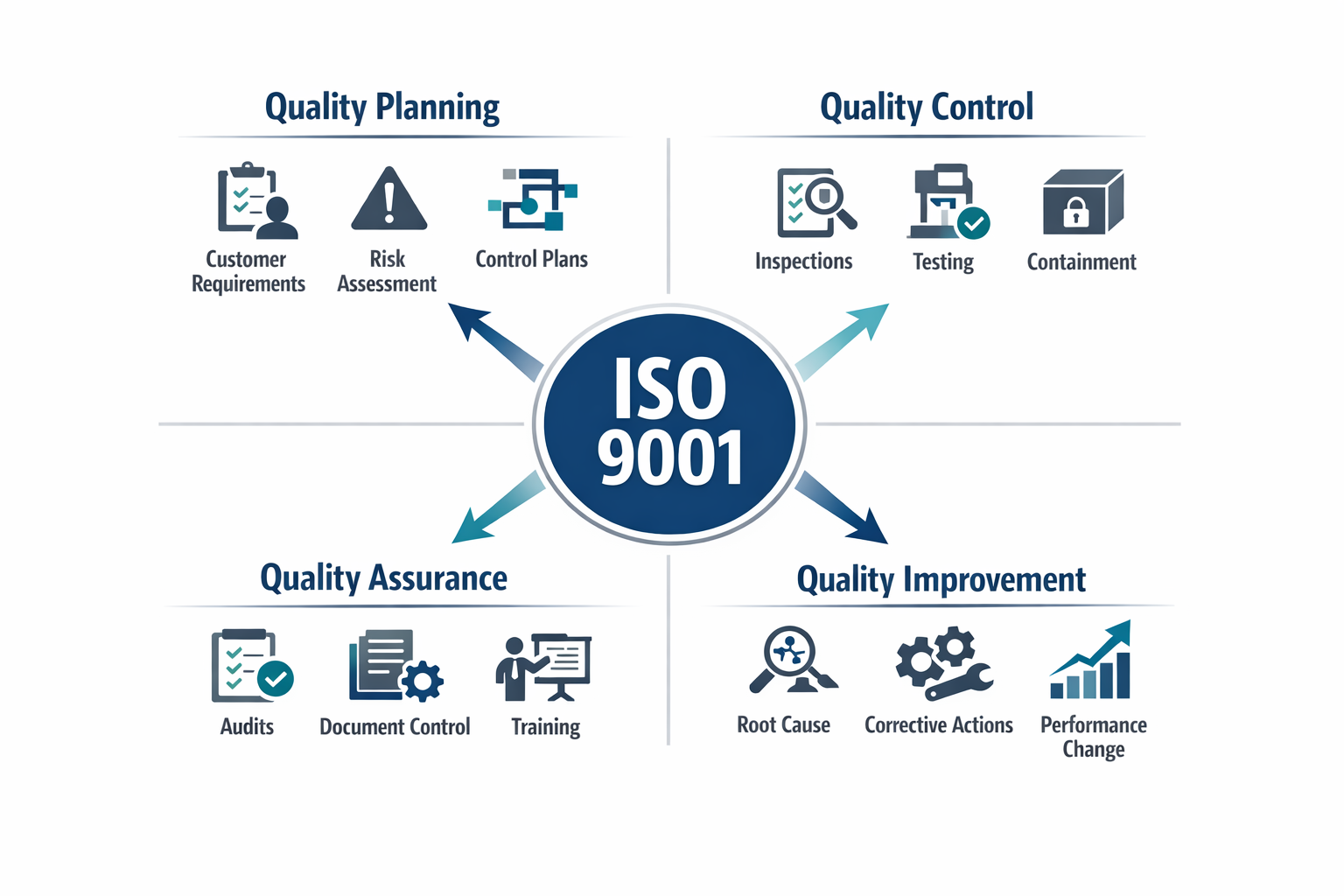
Documented Information That Supports Control
ISO 9001 uses the term documented information instead of the older language of manuals and procedures because not every process needs heavy paperwork. Manufacturers need controlled, current information where quality decisions happen: work instructions, inspection criteria, sampling plans, approved specifications, calibration records, and change histories. If operators are using outdated revision levels on the line, the system is already weak no matter how complete the quality manual looks.
In practice, documented information supports both control and assurance. A medical device component supplier, for instance, may maintain approved visual defect guides at each station, link final inspection records to lot numbers, and keep training acknowledgment records for every updated standard. That structure improves traceability and gives internal auditors clear evidence that the process being followed matches the process that was approved.
Internal Audits and Corrective Action
Internal audits are one of ISO 9001’s clearest assurance tools. Their purpose is not to “catch” departments, but to verify whether planned controls are actually working and whether records support that conclusion. A useful audit checks process adherence, revision control, training effectiveness, reaction plans, and whether prior corrective actions stayed closed in practice.
When audits, customer complaints, or production data reveal a problem, ISO 9001 expects corrective action, not just correction. Reworking one batch fixes the immediate issue; identifying why the issue happened and preventing recurrence is the corrective action step. In an electronics plant, repeated label mismatch defects may lead to a root cause finding that the print-and-verify step was skipped during shift change, which then requires a workflow, training, and verification update rather than another reminder email.
Continual Improvement in Daily Plant Management
Continual improvement is where the benefits of implementing a QMS in manufacturing become measurable. ISO 9001 does not require dramatic transformation projects every quarter; it requires evidence that the business reviews performance, identifies gaps, and improves systematically. Typical signals include falling internal PPM, shorter CAPA closure time, fewer repeat defects, better first-pass yield, or faster audit response.
For plant managers, this is the point where ISO 9001 moves from compliance into operating discipline. It turns quality data into decisions about staffing, process capability, supplier controls, and training priorities.
How to Build a Quality Management System Step by Step
For most plants, building a quality management system is less about writing a manual and more about turning scattered quality activities into one controlled operating method. Consider a mid-sized metal parts manufacturer supplying Tier 2 automotive customers. Its incoming checks were logged on paper, in-process defects were tracked in spreadsheets, and customer complaints were handled by email. The company already had many of the key elements of a QMS, but they were fragmented, hard to audit, and slow to improve.
A practical way to build a quality management system is to move through seven linked stages: assess the current state, define requirements, design processes, document controls, train users, roll out in phases, and measure results for improvement. This sequence helps quality and plant managers avoid a common mistake—documenting procedures before agreeing on ownership, escalation rules, and record structure. It also keeps the system tied to daily production decisions rather than compliance paperwork alone.
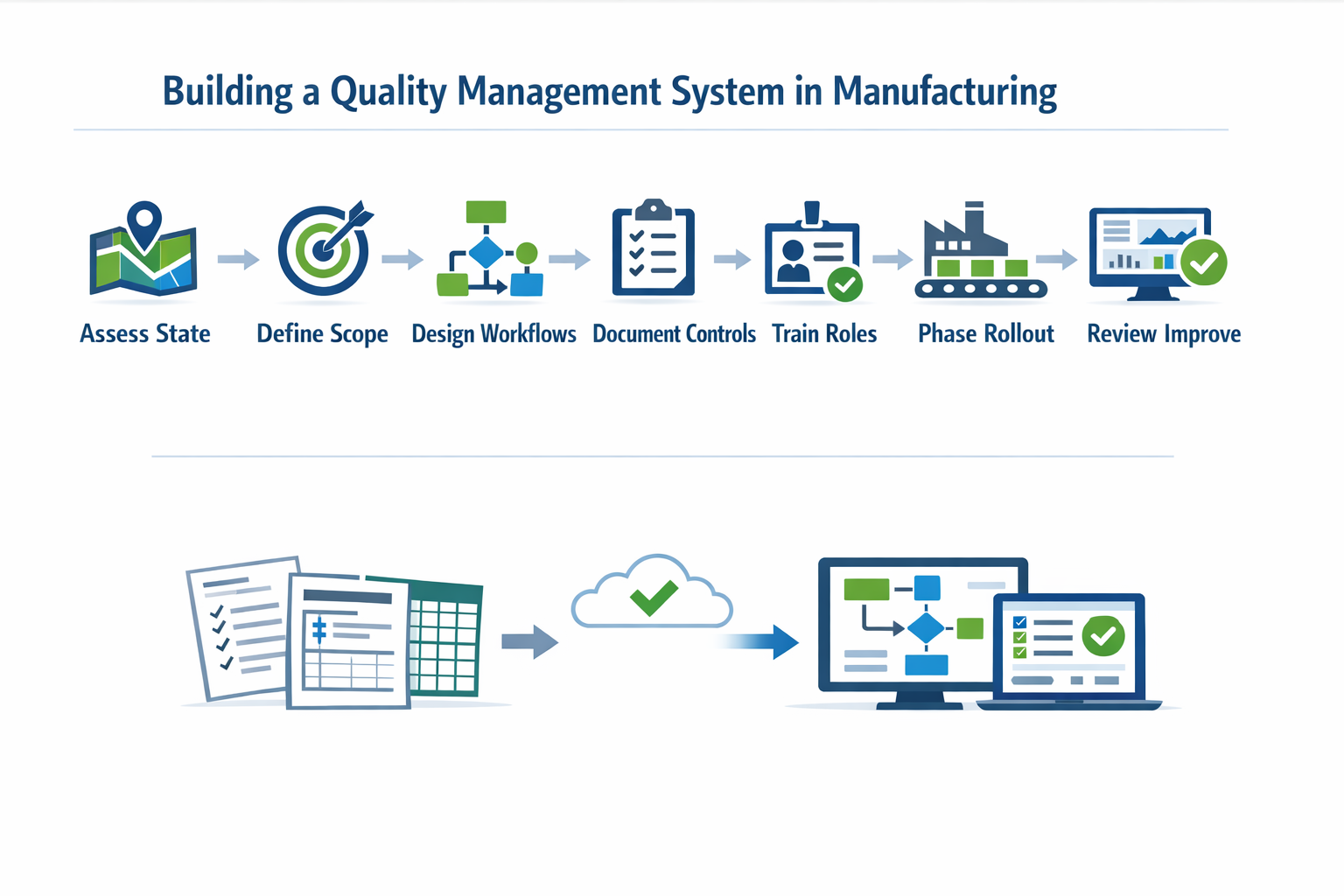
Assess the Current State and Quality Risks
The first step is to map how quality work actually happens today, not how SOPs say it should happen. In the metal parts plant, the quality manager followed one defect from incoming material receipt to customer return and found five separate records, three manual handoffs, and no single owner for closure. That baseline revealed where traceability broke down and where delays entered the process.
At this stage, focus on high-impact flows such as incoming inspection, first-article approval, in-process checks, nonconformance handling, CAPA, and complaint response. Capture cycle times, defect escape points, rework rates, and missing approvals. If you do this well, you create the factual base for how to build a quality management system around real operational risk instead of assumptions.
Define Requirements, Scope, and Ownership
Once the current state is visible, define what the system must control and who is accountable at each point. The metal parts manufacturer limited phase one to supplier quality, production inspection, nonconformance, and corrective action because those areas drove most audit findings and customer incidents. That scope prevented the team from overbuilding the system in its first release.
Requirements should cover customer-specific needs, internal escalation rules, approval levels, retention periods, and the records needed for traceability. Just as important, assign process owners early: production for process checks, quality for standards and disposition, engineering for root cause support, and plant leadership for review. Clear ownership is one of the fastest ways to realize the benefits of implementing a QMS in manufacturing.
Design the Core Workflows and Data Structure
With scope set, translate requirements into controlled workflows. In the example plant, the team designed one path for incoming defects, another for in-process nonconformance, and a third for customer complaints, each with defined statuses, response times, and approval points. They also standardized defect codes, containment actions, root cause categories, and closure evidence so records could be compared across shifts and lines.
This is where many teams discover that process design matters more than document volume. A short, well-structured workflow with clear decision rules is usually more effective than a long procedure nobody follows. If you plan to digitize later, designing the data fields now will also make forms, dashboards, and audit trails much easier to build.
Document Standards and Train by Role
After workflow design, document only what operators, inspectors, supervisors, and managers need to execute consistently. The metal parts manufacturer created controlled inspection instructions, defect classification criteria, reaction plans, and CAPA templates tied directly to each workflow step. That made the documentation usable on the shop floor rather than buried in a quality folder.
Training should also be role-based, not generic. Operators learned how to trigger containment and record defects, supervisors learned disposition and escalation rules, and quality engineers learned investigation and verification steps. Plants that train by task typically reach stable adoption faster than those that rely on classroom overviews alone.
Roll Out in Phases and Measure Early
A phased rollout reduces disruption and exposes weak points before the system scales. The manufacturer launched first on one machining line and one incoming inspection area, then reviewed completion rates, overdue actions, repeat defects, and record accuracy after 30 days. That pilot showed that supervisors were closing dispositions quickly, but root cause fields were being entered inconsistently.
Early measurement matters because the first version of a QMS is rarely the final one. Track a small set of operating indicators: defect response time, CAPA closure lead time, first-pass yield impact, audit finding recurrence, and training completion. If you digitize the process with a platform like Jodoo, you can configure forms, approvals, role-based access, and real-time dashboards without waiting for a full custom software project.
Improve the System Through Review and Control
Once the pilot is stable, expand the system across departments and lock in a review rhythm. In the example plant, monthly reviews combined defect trends, overdue CAPA actions, supplier issues, and customer complaint status into one management discussion. That shifted the QMS from static documentation to an active control system.
Continuous improvement should focus on exceptions, bottlenecks, and repeat causes, not wholesale redesign every quarter. As processes mature, refine workflows, tighten approval logic, and retire duplicate records. That is how a quality management system becomes durable: controlled enough for auditability, but flexible enough to improve with production reality.
Benefits of Implementing a QMS in Manufacturing—and Why Digital Execution Matters
Better Quality Outcomes, Not Just Better Documentation
The real benefits of implementing a QMS in manufacturing show up in daily operations: fewer defects, faster containment, more consistent decisions, and less dependence on individual experience. In a plastics component plant, for example, a controlled inspection plan and clear nonconformance workflow can stop a recurring molding defect from reaching final packing. That reduces scrap, rework, and customer complaints at the same time. A practical quality management system improves process discipline, not just paperwork.
A strong QMS also improves issue escalation speed. When operators, line leaders, quality engineers, and production managers follow the same escalation path, abnormal conditions do not sit in notebooks or inboxes for two days before action starts. In high-mix electronics assembly, that matters because one soldering deviation can affect multiple work orders within a single shift. Faster escalation shortens the time between detection, containment, root-cause analysis, and corrective action.
Clearer Ownership Across Functions
One of the less discussed benefits is clearer ownership. Many plants do not fail because standards are missing; they fail because responsibility is blurred between production, quality, engineering, maintenance, and suppliers. A good QMS assigns who detects, who approves, who investigates, who verifies, and who closes. That structure reduces the common “someone is already handling it” problem that slows response and weakens accountability.
This matters even more when supplier quality is involved. In an automotive parts factory, an incoming material defect may require action from purchasing, warehouse, incoming inspection, supplier quality, and the supplier itself. Without a defined system, each function may keep separate records and use different status labels. With aligned workflows and records, supplier claims, temporary deviations, replacement batches, and verification results stay connected, which helps protect production schedules and strengthens supplier coordination.
Audit Readiness and Stronger Data Integrity
A mature QMS makes audits easier because records are created as part of the process, not reconstructed afterward. During customer audits or ISO surveillance audits, plants are often asked to show training evidence, inspection results, deviation handling, CAPA status, and management review follow-up. If those records are incomplete or spread across folders, shared drives, and email chains, the audit risk increases. Good traceability turns audit preparation from a fire drill into a routine review.
Data integrity is another major operational gain. If the key elements of a QMS are executed consistently, you can trust timestamps, revision history, approval records, and inspection outcomes. That matters for trend analysis and decision-making because bad data creates false signals. A factory cannot improve first-pass yield or supplier ppm reliably if defect codes, closure dates, and disposition records are entered differently in five separate files.
Why Manual Execution Breaks Down at Scale
The problem is that many manufacturers design a quality management system on paper but execute it through spreadsheets, printed forms, phone photos, and email approvals. That may work for a single line or a small plant, but it becomes fragile as product mix, customer requirements, and audit pressure increase. Version control slips, approval delays grow, and people start maintaining shadow records outside the formal process. At that point, the system exists, but control does not.
Manual quality processes also make CAPA closure slower than it should be. Teams lose time chasing missing attachments, waiting for sign-off, and checking whether actions were completed. In a food packaging plant, a corrective action involving maintenance, sanitation, and production may require several handoffs across shifts. If status tracking depends on email and spreadsheets, overdue actions are easy to miss, and verification often happens late.
A digital, workflow-based approach changes that by making the process executable. Inspection findings can trigger nonconformance records automatically, route containment tasks to the right role, enforce approval steps, and alert owners when deadlines are missed. Instead of asking people to remember the process, the system drives the process.
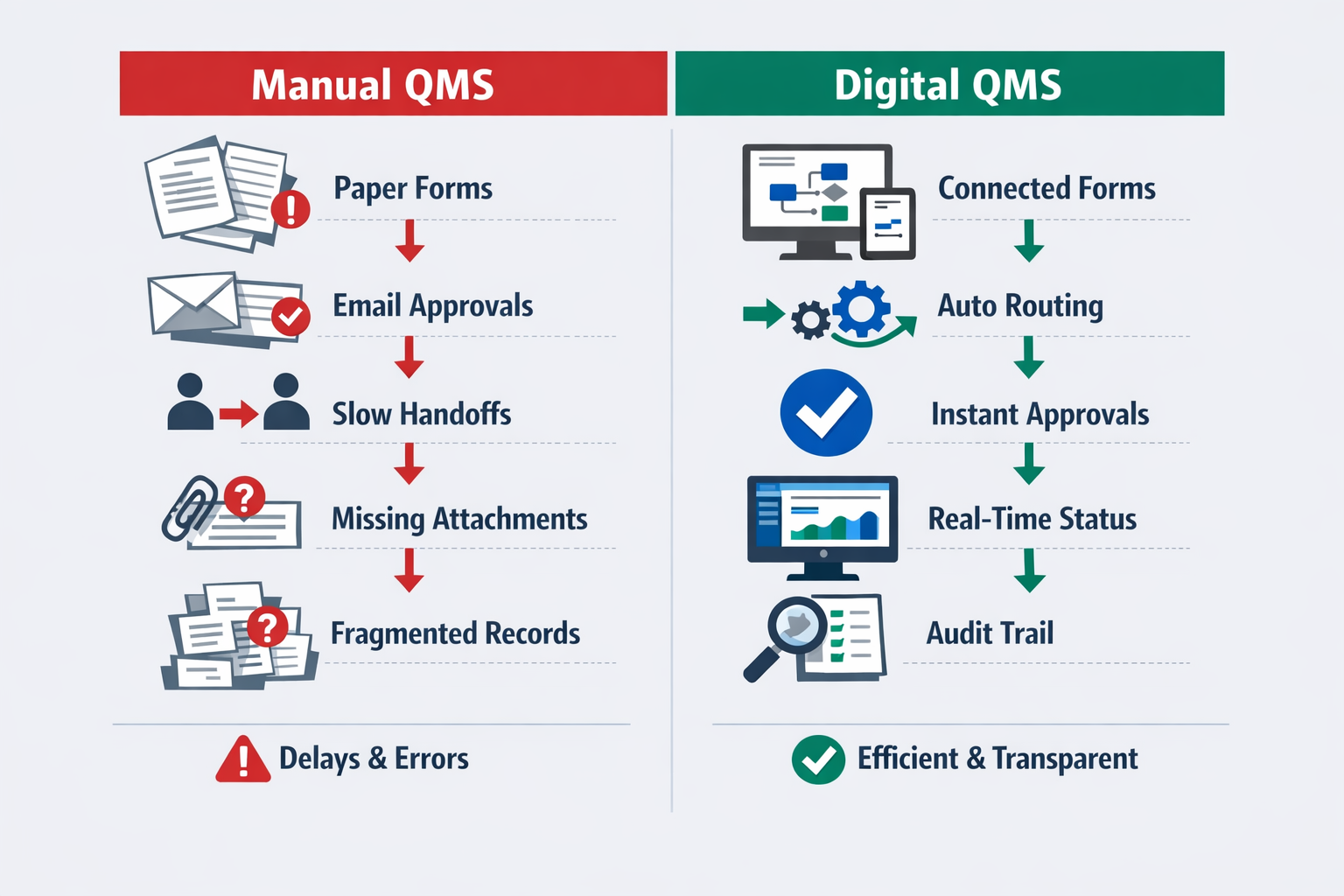
Why Digital QMS Execution Becomes a Practical Necessity
Digital execution matters because scale multiplies complexity. More SKUs, more lines, more suppliers, and more customer-specific requirements create more records, exceptions, and approvals. A manual system cannot absorb that complexity without slowing down. A digital QMS gives manufacturers structured data capture, real-time status visibility, and consistent workflow enforcement, which makes the system usable under real production conditions.
This is also where quality performance becomes easier to manage proactively. When records are connected, managers can see recurring defect categories, aging CAPAs, supplier-related nonconformances, and audit findings before they become chronic problems. That does not replace sound quality thinking, but it makes it operational. For most growing manufacturers, digital execution is no longer an upgrade to the QMS; it is what makes the QMS work.
Conclusion: Build a Digital Quality Management System with Jodoo
A quality management system in manufacturing should do more than store procedures for audits. It should function as a practical operating system for quality planning, quality control, quality assurance, and continuous improvement across daily production. When those four disciplines are connected, quality managers gain better traceability, plant managers get clearer ownership, and teams can respond faster to defects, deviations, and customer issues.
That is why many manufacturers move beyond paper forms, spreadsheets, and email-based approvals. A digital quality management system makes inspections easier to execute on the shop floor, speeds up nonconformance escalation, and keeps CAPA actions visible until closure. It also strengthens audit readiness by keeping records, approvals, comments, and status history in one controlled environment.
Jodoo helps manufacturers build that system without heavy custom development. As a no-code lean manufacturing platform, Jodoo can connect mobile inspection forms, nonconformance reporting, CAPA workflows, approval routing, dashboards, and traceable quality records in one place. If you want to standardize quality processes while staying flexible at the plant level, you can explore Jodoo templates, start a free trial, or book a demo to see how a digital QMS can fit your operation.