Browse by category

Introduction: Why Shift Management Software Matters in Manufacturing
A missed handover can cost more than a late shift replacement. In manufacturing, many unplanned stoppages, quality escapes, and safety incidents happen during shift changes, when critical information is passed verbally, written on paper, or buried in spreadsheets. For plants running three shifts, multiple production lines, and weekend overtime, shift management software manufacturing teams use is no longer just a scheduling tool. It has become a core system for keeping labor, production, quality, and compliance aligned across every hour of operation.
Imagine a production manager at an automotive parts plant who starts the morning shift without clear visibility into overnight machine downtime, absent operators, or pending quality holds. That gap creates delays immediately, from line balancing problems to missed output targets. In electronics and food manufacturing, where traceability and standard work matter on every shift, weak shift coordination can quickly lead to scrap, rework, or audit risk.
In this guide, you will learn which features matter most, from smart scheduling and attendance tracking to digital shift handover, compliance records, alerts, and real-time dashboards. The goal is simple: help you choose software that supports stable operations, not just prettier rosters.
Common Shift Management Pain Points in Manufacturing Operations
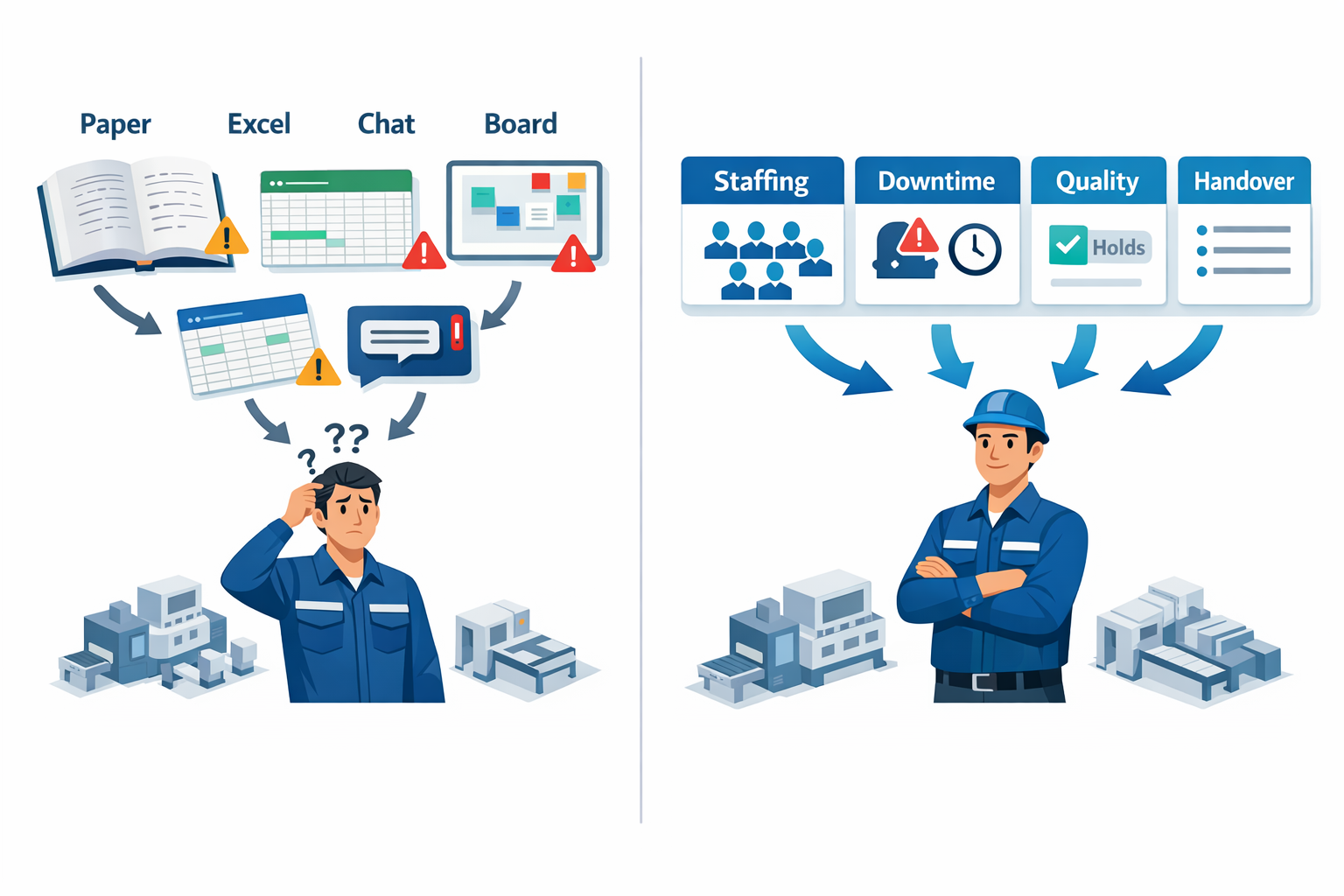
In many plants, shift management still depends on paper forms, whiteboards, phone calls, and Excel files shared across supervisors. That may work in a small workshop, but it breaks down quickly in a high-mix, high-volume factory running 2 or 3 shifts across production, maintenance, warehouse, and quality. When managers evaluate shift management software manufacturing teams actually use, they are usually trying to solve very specific operational gaps rather than simply digitize a schedule.
The cost of these gaps is real. Unplanned absenteeism, poor handovers, and inaccurate overtime tracking can directly affect output, labor cost, and compliance. In labor-intensive industries, overtime can account for a significant share of direct labor cost, and even small scheduling errors repeated across multiple lines can add up to thousands of USD per month. More importantly, when shift data is fragmented, plant leaders lose the speed they need to respond to breakdowns, quality issues, and manpower shortages.
Paper Logs and Excel Schedules Create Delays
Paper-based shift records are still common in automotive parts, electronics assembly, and food processing plants. A shift supervisor may write downtime reasons in a notebook, update attendance on a printed sheet, and then send production output by WhatsApp or email at the end of the shift. That means the production manager does not get a single reliable view of what happened until hours later, and by then the next shift is already reacting to outdated information.
Excel creates a different problem. It looks more organized than paper, but in practice, multiple versions of the same schedule often circulate at once. Imagine a production manager at an automotive parts plant who updates operator assignments for a last-minute customer order change, while HR is working from an older file and maintenance has no visibility at all. Without proper shift scheduling software factory teams can access in real time, confusion spreads across departments very quickly.
The same issue appears on the physical shift board manufacturing teams use at line level. Whiteboards are useful for visual control, but they are limited when information changes frequently or must be shared beyond one area. A board on Line 3 cannot automatically alert quality about recurring defects, or notify maintenance that a machine stoppage happened twice in the same shift. This creates blind spots that slow escalation and recovery.
Missed Handovers Between Shifts
One of the most expensive problems in manufacturing is a weak shift handover. When operators and supervisors do not clearly transfer information about machine condition, pending maintenance, quality holds, or material shortages, the next shift starts with uncertainty. That uncertainty often shows up as startup losses, repeated troubleshooting, and preventable defects in the first hour of the shift.
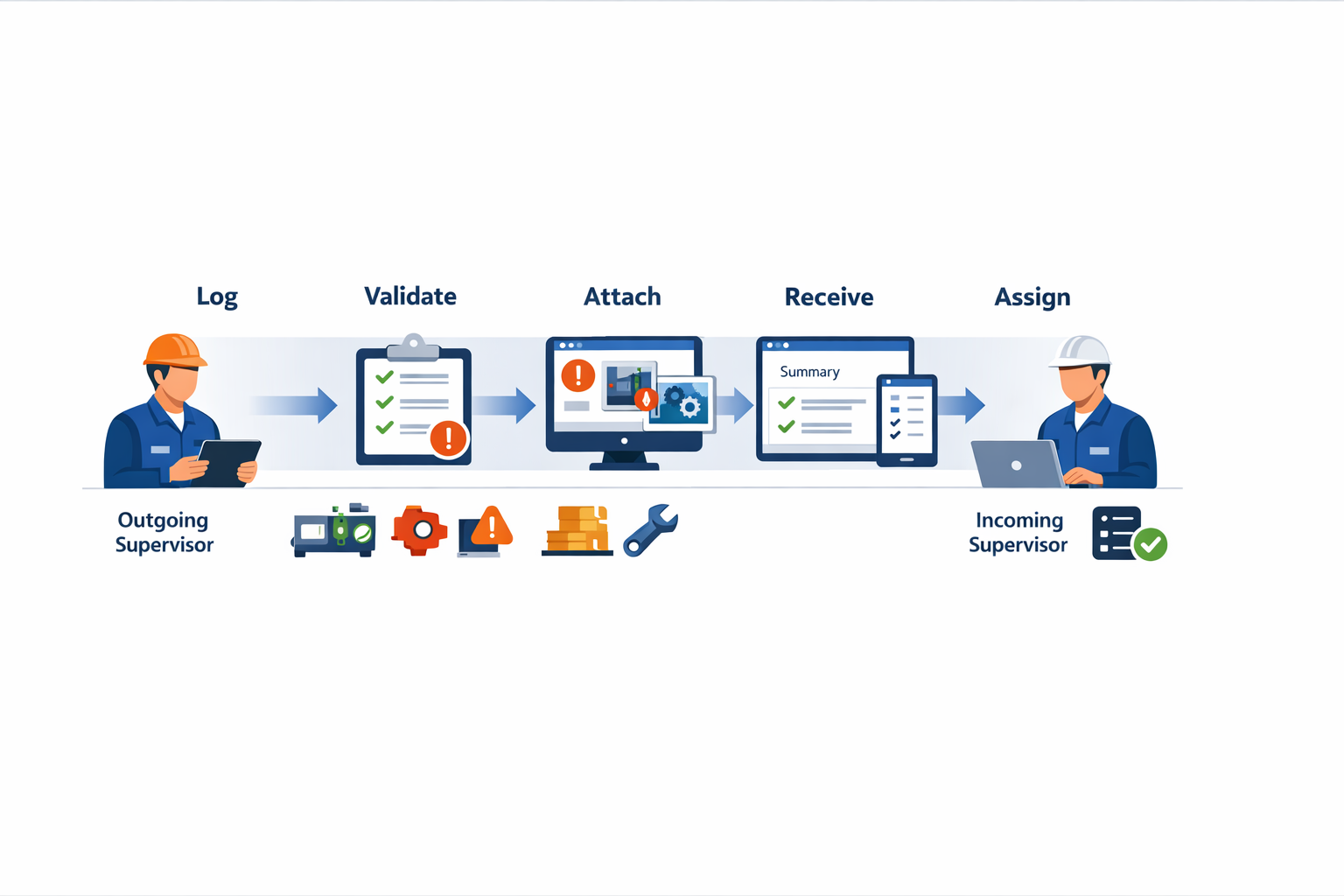
A proper digital shift handover process is critical because verbal updates are inconsistent. In a food manufacturing plant, for example, the night shift may mention that a filler was adjusted due to seal quality variation, but if that note is not formally captured, the morning team may restart production with the wrong settings. The result is rework, wasted packaging material, and avoidable downtime.
This is where many factories realize basic spreadsheets are not enough. They need structured logs, mandatory fields, timestamps, attachments, and accountability for who handed over what and when. Without that, handover quality depends too much on individual discipline rather than a repeatable process.
Overtime Leakage and Absenteeism Are Hard to Control
Labor planning in manufacturing is rarely stable for long. Sudden absenteeism, urgent orders, machine downtime, and quality sorting activities all force supervisors to reshuffle manpower during the day. If those changes are tracked manually, overtime decisions often happen reactively, with limited visibility into who is already near their limit, which lines are overstaffed, and where skills are actually needed.
Overtime leakage usually starts small. A supervisor extends two operators by one hour to finish a batch, another team adds extra support for rework, and maintenance stays back to close a breakdown. If those adjustments are not captured in a connected factory shift management system, the plant may only discover the cost impact when payroll is reviewed at week end.
Absenteeism creates another blind spot. In electronics manufacturing, where takt time and line balance are tight, even one absent trained operator can reduce output if a replacement is not qualified for the station. When attendance records, skill matrices, and line schedules sit in separate files, supervisors spend too much time calling around instead of making fast deployment decisions.
Production, Maintenance, and Quality Work in Silos
Many shift issues are not caused by scheduling alone. They happen because production, maintenance, and quality each record information in separate tools. A production supervisor may log a stoppage on paper, maintenance may enter a breakdown in another system later, and quality may record defects in a spreadsheet with no direct link to the affected shift. By the time someone compares the data, the root cause trail is already weak.
This silo problem matters because shift performance is cross-functional by nature. If a line misses target, managers need to know whether the loss came from absenteeism, changeover delay, machine failure, or first-pass yield issues. A standalone shift report software tool that only captures output numbers but cannot connect maintenance events or quality alerts will still leave major gaps in decision-making.
Imagine a shift supervisor in an electronics plant seeing repeated feeder stoppages during the late shift. Production reports lower output, maintenance says no major failure occurred, and quality later flags a rise in placement defects. If these records are disconnected, the team may spend the next morning meeting arguing over what happened instead of solving the actual issue.
Communication Breakdowns Slow Response Time
Fast response is one of the biggest advantages of digital manufacturing operations, yet many plants still rely on manual communication chains. A supervisor notices rising scrap, informs the line leader verbally, then messages the production manager, who later calls quality for support. Every handoff adds delay, and every delay increases the chance of more defects, missed output, or safety risk.
This is especially visible during shift changes, when multiple updates happen at once. Maintenance may need to complete a pending repair, quality may be waiting for approval to release material, and production may be trying to recover target after earlier downtime. Without a shared system, each department sees only part of the picture, which makes coordination slower than it should be.
A modern factory shift management system reduces this friction by centralizing updates, ownership, timestamps, and alerts. Instead of chasing information across whiteboards, spreadsheets, and chat messages, managers can see manpower status, line issues, handover notes, and pending actions in one place. That matters because in manufacturing, a 15-minute delay repeated across several lines and several shifts is no longer a minor issue; it becomes a productivity problem.
Outdated Tools Make Continuous Improvement Harder
Poor shift control does not just affect today’s schedule. It also weakens continuous improvement because the data is inconsistent and difficult to analyze. If downtime reasons are handwritten differently by each supervisor, or if shift notes are stored in emails and notebooks, CI teams cannot easily identify patterns by line, product family, crew, or time band.
For lean and operations leaders, this is a major limitation. You cannot improve what you cannot reliably measure, and you cannot sustain gains if the shift process itself remains manual. A connected system that combines shift board manufacturing visibility, standardized reporting, and digital shift handover records gives teams cleaner data for root cause analysis, labor planning, and daily management.
Why Shift Scheduling Software Alone Is Not Enough for the Factory Floor
Many manufacturers start with shift scheduling software factory teams can use to assign operators, balance headcount, and reduce overtime conflicts. That solves one part of the problem, but it does not solve the full reality of shift execution on the shop floor. In practice, shift management software for manufacturing teams must handle what happens before the shift starts, during the shift, and during handover to the next team. If your tool only answers “who is working,” it will miss the operational risks tied to “what happened,” “what is still open,” and “who must act next.”
Scheduling Covers Labor Allocation, Not Operational Control
A scheduling-only tool is mainly designed to place people into shifts, roles, and time slots. That is useful for HR and manpower planning, especially in factories with rotating shifts, high absenteeism, or seasonal demand swings. However, production managers and shift supervisors also need visibility into machine stoppages, quality issues, material shortages, safety incidents, and pending maintenance work. Without that layer, the software becomes a rostering tool, not a true factory shift management system.
Take an automotive parts plant scheduling 42 operators across stamping, welding, and inspection for the night shift. The schedule may look complete on screen, but the real risk appears when one press has recurring downtime, two inspectors are reassigned, and a material trolley has not arrived from the warehouse. If that information is not captured in the same system, the next shift starts blind. This is exactly where a broader shift management software manufacturing setup creates value.
The Factory Floor Runs on Handover Quality
In continuous manufacturing, poor handover is one of the fastest ways to lose productivity. Industry studies often estimate that ineffective shift handovers contribute to communication errors, delayed response, and repeated troubleshooting, especially in 24/7 operations. A proper digital shift handover process ensures each outgoing team records production output, downtime reasons, defects, unfinished changeovers, safety concerns, and action items before the next team takes over. That creates continuity that simple schedules cannot provide.
In an electronics assembly plant, for example, the day shift may detect a rising defect trend on one SMT line but still hit output targets by adjusting inspection frequency. If that finding stays in a notebook or WhatsApp message, the evening shift may continue running the same settings until rejects spike. With integrated shift report software, the issue can be logged, tagged to the specific line, attached with photos, and assigned to engineering or quality immediately. The shift schedule tells you who is on duty, but the handover record tells them what they must pay attention to.
Attendance Exceptions Need Fast Action, Not Just Records
Factories do not struggle with attendance data alone; they struggle with attendance exceptions that affect output in real time. Late arrivals, no-shows, skill mismatches, and unplanned reassignments can disrupt takt adherence within minutes. A scheduling tool may show that an operator was assigned, but it often does not trigger the operational response needed when that person does not arrive. A stronger factory shift management system should connect attendance exceptions to escalation and reassignment workflows.
For example, in a food manufacturing plant running high-speed packaging lines, one missing line leader can reduce output for the first hour of a shift if no backup is approved quickly. In a connected system, the supervisor can flag the absence, notify the production manager, request a replacement from a qualified pool, and document the temporary reassignment with approval history. That is much more useful than simply marking someone absent in a roster. It turns attendance from passive reporting into active control.
Escalation Workflows Keep Problems from Carrying Over
On the shop floor, unresolved issues rarely stay contained within one shift. A minor quality deviation can become a customer complaint, and a delayed tool change can become several hours of lost production. That is why shift scheduling software factory environments need escalation logic tied to real events, not just staffing plans. When abnormalities are logged, the system should route them to maintenance, quality, warehouse, or production engineering based on rules.
Consider a palm oil processing facility where the night shift reports abnormal vibration on a transfer pump. If the note stays on a whiteboard or verbal handover, the maintenance team may not see it until the equipment fails during the morning peak. With connected shift report software, the supervisor can log the abnormality, attach the asset number, escalate it automatically to maintenance, and track whether the issue was acknowledged before the next shift begins. That kind of response flow is impossible with scheduling alone.
Supervisor Signoff Matters for Accountability
Factories with ISO 9001 or ISO 45001 requirements need traceability, especially when a shift involves deviations, incidents, or temporary process changes. A schedule can show who was assigned, but it does not prove that a supervisor reviewed the shift summary, verified critical issues, and approved the handover. Digital signoff creates accountability and reduces the common problem of open issues being passed from one team to another without ownership. It also gives plant managers an auditable trail when investigating recurring downtime or safety nonconformities.
This is where a digital shift board manufacturing environment becomes more powerful than a physical whiteboard. A supervisor can review output versus target, check red-flag items, confirm action owners, and sign off before the next shift starts. If signoff is overdue, the system can send reminders or escalate automatically. That helps standardize discipline across lines, departments, and plants.
Cross-Functional Coordination Is What Separates Scheduling from Shift Management
Real shift management is cross-functional by nature. Production needs labor, but it also depends on maintenance response, quality release, warehouse replenishment, and engineering support. When these functions work from separate spreadsheets, paper logs, and messaging groups, handover quality drops and issue resolution slows down. A true factory shift management system connects these teams through one workflow instead of leaving supervisors to coordinate manually.
A good example is an injection molding plant where the night shift finishes production on one mold earlier than planned and requests a changeover. The next shift cannot start the new job unless tooling, materials, first-article inspection, and machine readiness are all confirmed. A broader shift management software manufacturing platform can capture each task, assign responsibility by department, and show live completion status on a central shift board manufacturing dashboard. That gives the incoming shift a clear view of readiness instead of relying on phone calls and handwritten notes.
What Manufacturers Should Look For Instead
If you are evaluating shift management software manufacturing teams can actually use on the shop floor, look beyond shift calendars and manpower grids. The system should combine scheduling with digital shift handover, exception handling, escalation workflows, supervisor signoff, mobile data entry, and cross-functional task tracking. It should also feed data into dashboards so plant leaders can see recurring handover failures, absenteeism patterns, unresolved issues, and response times by shift. That is how you move from basic scheduling to operational control.
In short, shift scheduling software factory teams use is necessary, but it is not sufficient. Modern manufacturing runs on speed, traceability, and coordination across every shift transition. If your current tool cannot capture handover details, trigger actions, and connect departments, it is only solving the easiest 20% of the problem. The remaining 80% is where a real factory shift management system delivers measurable impact.
Top Features to Look For in Shift Management Software for Manufacturing
When you evaluate shift management software manufacturing teams can actually use on the shop floor, focus less on generic HR scheduling features and more on production-critical capabilities. A plant does not just need to know who is on duty. It needs to know whether the right operator is on the right machine, whether the previous shift handed over accurate information, and whether supervisors can react quickly when output, quality, or safety conditions change.
This is why the best tools look more like an operational control layer than a simple roster app. In a real factory environment, shift planning connects directly to labor utilization, line stability, maintenance coordination, quality traceability, and daily management routines. If your current system still depends on whiteboards, spreadsheets, WhatsApp messages, and paper logbooks, the gaps usually show up as overtime leakage, missed handovers, delayed decisions, and weak accountability.
Configurable Scheduling for Real Production Conditions
A strong shift scheduling software factory teams can rely on should support the realities of manufacturing, not just standard office calendars. That means rotating shifts, split shifts, overtime, relief coverage, weekend patterns, and last-minute manpower changes across lines, cells, or departments. In automotive, for example, one stamping line may run a 3-shift pattern while sub-assembly runs 2 shifts, and your software should let you configure both without workarounds.
Look for scheduling rules that match your operation by line, process, machine group, and location. A production manager at an electronics plant who needs to rebalance operators during a sudden order spike should be able to drag, reassign, and confirm labor coverage in minutes. If the tool cannot handle shift templates, exceptions, and real-time updates, it will quickly become another spreadsheet in disguise.
Digital Shift Handover and Structured Shift Reporting
One of the highest-value features is digital shift handover. Poor handovers are a major source of downtime, repeated defects, and missed follow-up actions because critical information often stays in notebooks or verbal updates between supervisors. In continuous operations such as food processing or injection molding, even a 10-minute communication gap can create scrap, delayed changeovers, or safety risk.
Your system should include built-in shift report software capabilities so every outgoing shift captures the same required information. That usually includes production output, downtime reasons, quality issues, material shortages, machine abnormalities, pending maintenance actions, and open containment measures. A standardized handover form reduces variation and gives incoming supervisors immediate context instead of forcing them to chase updates across calls, chats, and paper sheets.
For example, imagine a production supervisor at a food packaging plant finishing the night shift. Instead of leaving handwritten notes about a sealer temperature fluctuation and two rejected batches, the supervisor logs the issue digitally, attaches photos, records corrective actions taken, and flags maintenance review for the morning team. The day shift receives a complete handover before startup, which reduces startup losses and improves traceability if a customer complaint appears later.
Mobile Forms for Fast Shop Floor Data Capture
Shop floor adoption depends heavily on ease of use, so mobile-first data capture is essential. Supervisors, line leaders, and technicians should be able to submit shift logs, attendance confirmations, downtime records, escalation notes, and incident reports from a phone or tablet on the floor. If workers must return to a desktop terminal or rewrite notes later, data quality drops and reporting delays increase.
The best tools support mobile forms with timestamps, user identification, attachments, signatures, and validation rules. This matters in manufacturing because incomplete records create downstream problems for quality, maintenance, and compliance teams. In a factory shift management system, a downtime record should not be submitted without cause code, machine ID, duration, and action owner if those fields are mandatory for root cause analysis.
Skill- and Certification-Based Assignment
In manufacturing, not every available operator is a qualified operator. A scheduling platform must account for skills, certifications, cross-training status, and authorization limits when assigning people to jobs. This becomes especially important in regulated or risk-sensitive environments such as forklift operation, allergen-controlled food lines, SMT programming, or lockout-tagout related maintenance support.
Look for software that lets you match personnel with required competencies automatically or at least flag mismatches clearly. A plant manager at an automotive parts factory should be able to see immediately if a heat-treatment furnace shift has only one certified operator scheduled when the SOP requires two. This prevents unsafe assignments, reduces compliance exposure, and helps HR and operations identify real training gaps instead of discovering them during an audit or a production disruption.
Approval Workflows for Overtime, Shift Swaps, and Exceptions
Manual approval chains slow plants down, especially when supervisors manage absenteeism, urgent overtime, and production changes across multiple departments. Good shift management software manufacturing environments should include configurable workflows for common approvals such as shift swap requests, overtime requests, relief assignments, and temporary cross-department moves. These workflows should follow your hierarchy and keep a full record of who approved what and when.
This matters because labor decisions affect cost, compliance, and output. In many plants, unapproved overtime or informal shift swaps create payroll disputes and weak labor traceability. With digital workflows, a shift supervisor can submit an overtime request tied to a production order backlog, route it to the production manager for approval, and notify HR automatically once it is confirmed.
Automated Alerts and Escalation Rules
A useful platform should not just store information; it should actively surface exceptions. Real-time alerts can notify supervisors when staffing falls below minimum headcount, when a certified operator is missing, when shift reports are overdue, or when critical downtime is logged during the last hour of a shift. These alerts help teams react before a local issue turns into a missed shipment or customer escalation.
Escalation logic is especially valuable in high-mix or high-volume operations. For example, if a handover note includes a recurring defect above threshold, the system should notify quality and production leadership automatically instead of waiting for the next meeting. According to industry studies on digital manufacturing adoption, companies that improve real-time visibility and response speed often see measurable reductions in unplanned downtime, which can cost manufacturers $10,000 to $50,000 per hour or more depending on the process.
Dashboards for Shift-Level Visibility
A modern factory shift management system should include dashboards that make shift performance visible at a glance. At minimum, you should be able to track attendance, manpower coverage, overtime, output by shift, downtime by reason, handover completion rates, and open action items. If your software cannot turn shift data into a live operational dashboard, managers will still export everything into Excel to understand what happened.
This is where digital tools support lean daily management. A shift dashboard can show which line had the highest minor stoppages on second shift, which department has repeated late handovers, or how overtime compares against plan by week. In one electronics factory scenario, that visibility helps the operations director spot that weekend overtime is rising not because of demand, but because one SMT line consistently loses startup time after poor Friday night handovers.
Audit Trails and Record History
Manufacturing teams need traceability, especially when labor, quality, and compliance records intersect. Any shift report software or scheduling tool you choose should maintain a full audit trail showing edits, approvals, timestamps, comments, and user actions. This is critical for ISO 9001 and ISO 45001 environments where you may need to demonstrate not just that a process exists, but that it was followed consistently.
Audit trails also reduce internal disputes. If a supervisor changes manpower allocation after a breakdown or updates a handover record after quality inspection, the system should preserve the history rather than overwrite it. That kind of transparency helps during customer audits, internal investigations, payroll validation, and continuous improvement reviews.
Integration With Production, HR, Maintenance, and Quality Systems
Shift management should not sit in isolation. The best shift management software manufacturing buyers choose can integrate with HR data, payroll, MES, ERP, maintenance systems, and quality workflows. Without integration, the same information gets entered multiple times, and operations teams lose confidence in the numbers.
For example, scheduled manpower should connect with actual attendance, overtime approvals should flow into payroll, and shift abnormality reports should create maintenance or quality follow-up tasks automatically. In a shift board manufacturing environment, this creates a much stronger daily management loop: the shift plan, actual staffing, downtime events, and corrective actions all connect in one system. That is far more useful than a static whiteboard photo sent over chat at the end of each shift.
A Practical Vendor Checklist
When comparing vendors, ask whether the system can handle the following without custom coding or heavy IT support:
- Configurable shift patterns by line, department, and site
- Built-in digital shift handover and structured shift reports
- Mobile forms with photos, signatures, and required fields
- Skill matrix and certification-based assignment rules
- Approval workflows for overtime, swaps, and exceptions
- Automated alerts for understaffing, overdue reports, or abnormal events
- Real-time dashboards for attendance, output, downtime, and handover compliance
- Full audit trails with time-stamped history
- Integration with HR, payroll, maintenance, MES, ERP, or quality systems
If a vendor only does scheduling, you may still need separate tools for handover, approvals, reporting, and follow-up actions. That usually leads back to the same fragmented process you were trying to fix in the first place.
Look for Flexibility, Not Just Features
Finally, evaluate how easily the software can adapt to your factory’s real process. A Tier 1 automotive supplier, an electronics EMS plant, and a food manufacturer all run shifts differently, so rigid software often forces teams into manual workarounds. The better approach is a platform that lets you configure forms, workflows, dashboards, and permissions around your own SOPs.
That is where a no-code platform like Jodoo can be valuable for manufacturers that need more than a basic roster tool. Instead of buying one fixed app for scheduling and another for reporting, you can build a connected factory shift management system that combines scheduling, shift report software, digital approvals, dashboards, and follow-up workflows in one place. For plants trying to replace paper records and disconnected spreadsheets, that flexibility is often the difference between a pilot that stalls and a system that scales across lines or sites.
How a Digital Shift Management System Improves Visibility, Compliance, and Productivity
A strong shift management software manufacturing setup does much more than assign operators to morning, afternoon, and night shifts. In practice, it gives production leaders a live view of who is working, what happened on the previous shift, where labor gaps are forming, and which issues still need action before they become downtime or quality escapes. For plants still relying on whiteboards, paper handover books, or disconnected Excel files, the biggest problem is not just administration time. It is the lack of timely, trusted information at the exact moment supervisors need to make decisions.
In manufacturing, even small shift coordination errors create expensive ripple effects. A missed handover on a critical press machine can delay startup by 20 minutes, while an outdated manpower sheet can trigger unnecessary overtime at the end of the week. According to industry estimates, labor can account for 20% to 30% of total manufacturing operating cost in many plants, so poor scheduling and weak handover discipline directly affect margin. That is why more factories are moving from manual methods to a connected factory shift management system that combines scheduling, reporting, approvals, and dashboards in one workflow.
Better Visibility Across Every Shift
The first major gain is visibility. With a digital system, plant managers no longer have to walk to a physical shift board manufacturing area, call multiple supervisors, or wait for end-of-shift summaries to understand what is happening. They can see staffing levels, absenteeism, overtime exposure, machine issues, and open action items in real time from a dashboard on a desktop, tablet, or phone.
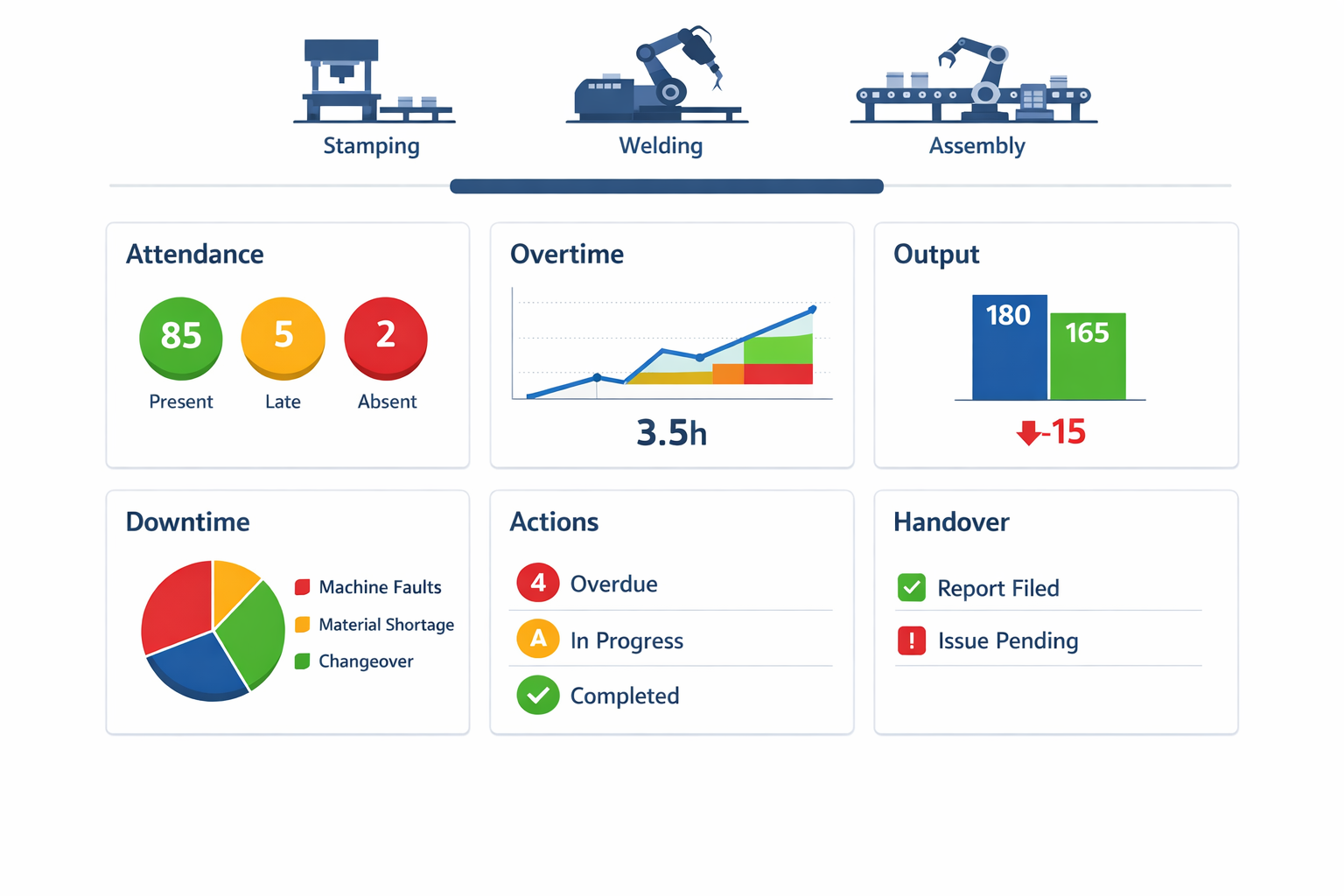
Imagine a production manager at an automotive parts plant who runs three shifts across stamping, welding, and assembly. On paper, each department may track attendance and line status differently, which makes cross-shift coordination slow and inconsistent. With a digital dashboard, that manager can immediately spot that the night shift in welding ran at 82% staffing due to two absences, while stamping exceeded planned overtime by four hours. Instead of discovering the issue the next morning, the manager can reassign trained operators earlier and avoid output loss.
This visibility also improves escalation. If a quality issue appears on Shift A but corrective action is still pending when Shift B starts, the issue stays visible in the system until it is closed. That is a major improvement over handwritten notes that get missed, misread, or buried in a logbook. For operations teams trying to sustain lean improvements, this kind of transparency creates a more reliable daily management routine.
Fewer Scheduling Errors and Lower Overtime
Manual scheduling often looks manageable until the plant grows more complex. Once you are dealing with multiple lines, skill matrices, relief operators, public holidays, maintenance shutdowns, and compliance rules on working hours, spreadsheets become fragile. One wrong formula or outdated version can result in double-booked workers, uncovered stations, or excess overtime that pushes labor costs above target.
A purpose-built shift scheduling software factory environment reduces those risks by standardizing how schedules are created, updated, and shared. Supervisors can assign people based on qualifications, shift patterns, and department needs, while managers can monitor exceptions before payroll is affected. This is especially useful in electronics manufacturing, where a line may require certified operators for SMT setup, testing, or final inspection, and the cost of assigning the wrong person is not just labor inefficiency but also product quality risk.
Overtime control becomes much more practical when labor data is current. Instead of reviewing overtime after the fact, a digital system can flag when a department is repeatedly extending shifts, relying on the same operators, or falling short on manpower planning. If one line in a food manufacturing plant has needed two extra packers for the last five Friday night shifts, that pattern becomes visible as operational data, not just anecdotal feedback. Leaders can then decide whether to rebalance labor, cross-train employees, or adjust the production plan.
Faster, More Reliable Digital Shift Handover
A well-run digital shift handover process is one of the clearest signs of operational maturity. In many factories, handovers still depend on verbal updates, handwritten books, or chat messages that are difficult to track later. That creates risk in environments where the next shift must know the exact machine status, material shortage, quality alerts, safety concerns, and pending maintenance actions before startup.
A digital handover record solves this by making every handover structured and searchable. Instead of writing free-form notes, supervisors enter standard fields such as output achieved, downtime minutes, scrap quantity, top loss reason, machine condition, and unresolved actions. In a beverage plant, for example, the outgoing supervisor can log that Filler Line 2 had 35 minutes of stoppage due to cap feeder jams, maintenance temporarily adjusted the setting, and the incoming shift must verify performance after the first production hour. That level of clarity reduces repeated troubleshooting and shortens startup delays.
This is where shift report software adds value beyond documentation. Once handover records are digitized, they become usable data for continuous improvement. You can trend recurring downtime by shift, compare scrap rates by crew, track handover compliance, and identify which issues remain open too long. For Lean or CI teams, this turns shift communication from a routine admin task into a data source for root cause analysis and daily accountability.
Stronger Compliance and Clearer Accountability
Manufacturing leaders also care about compliance, especially in plants working under ISO 9001, ISO 45001, customer audits, or internal governance requirements. Paper records make it hard to prove that handovers happened on time, that the right person acknowledged a safety issue, or that labor assignments followed qualification rules. Missing records are common, signatures are often incomplete, and audit preparation becomes a scramble.
A digital factory shift management system improves this by creating timestamps, user records, approval trails, and consistent documentation across departments. If a line supervisor records a safety observation during handover, the system can automatically notify the next supervisor, maintenance, or EHS team and log when the issue was reviewed. That matters during audits, but it also matters operationally because it closes the gap between reporting a problem and acting on it.
Accountability becomes clearer as well. When actions are assigned digitally, it is easier to see whether the issue belongs to production, maintenance, quality, or warehouse teams, and whether it is still overdue. In a manual environment, unresolved issues often get passed from shift to shift with no owner. In a digital system, there is a named owner, a due date, and a visible status, which is far more effective for keeping daily problems from becoming chronic losses.
Better Labor Utilization and Continuous Improvement
The long-term value of digitization is not just cleaner records. It is better labor utilization driven by better decisions. When scheduling data, absenteeism, overtime, and shift performance live in one system, managers can see patterns that would otherwise stay hidden in separate files and notebooks.
For example, an electronics contract manufacturer may discover that one production line consistently underperforms on the night shift when two temporary operators are assigned to testing. A manual shift board manufacturing process might show only that output was missed. A digital system shows the fuller picture: staffing mix, training level, downtime events, rework volume, and supervisor comments. That makes it easier to act on the real constraint, whether that means retraining, changing allocation rules, or adjusting standard work.
This also supports lean management in a very practical way. If your plant is running Kaizen, layered audits, or daily Gemba reviews, digital shift records provide hard evidence instead of memory-based discussion. You can connect recurring handover losses to A3 problem solving, monitor whether countermeasures reduce repeat issues, and show management measurable outcomes such as lower overtime, fewer missed handovers, and faster closure of open actions. For many manufacturers, that is the real payoff of moving from paper logs to a connected shift report software workflow.
How Jodoo Helps Manufacturers Build a Flexible Factory Shift Management System
Most manufacturers do not run the same shift model, even within the same industry. An automotive parts plant may use a 3-shift, 24/7 rotation with skill-based assignment rules, while an electronics factory may run 2 shifts plus overtime during peak demand, and a food plant may need extra hygiene checks during every handover. That is why many off-the-shelf tools fall short: they force operations teams into fixed templates that do not reflect real production constraints. Jodoo helps manufacturers build a factory shift management system around their own SOPs, approval logic, and reporting needs instead of changing the plant to fit the software.
Build Plant-Specific Shift Workflows Without Heavy Coding
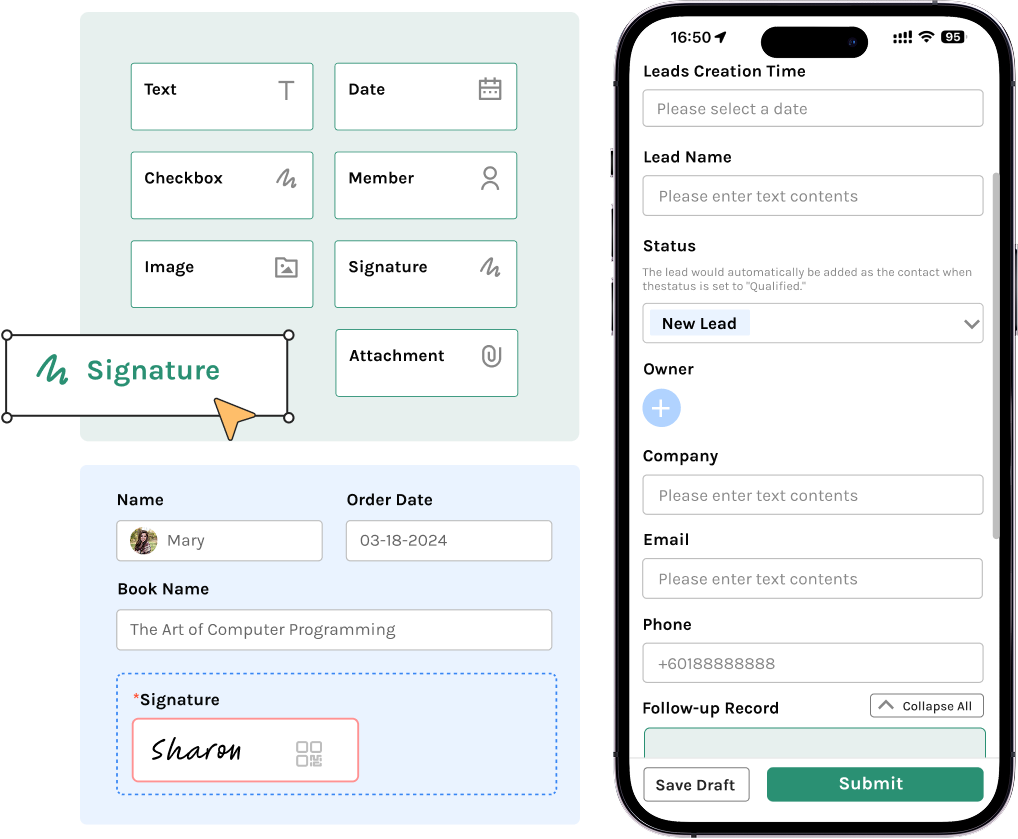
Jodoo is a no-code platform, so your operations or CI team can configure workflows without waiting months for custom development. You can create digital apps for shift attendance, manpower allocation, line startup checks, overtime requests, operator substitution, and daily production reporting in one connected system. For manufacturers evaluating shift management software manufacturing options, this matters because shift control is rarely just about who is on duty. It also includes quality checks, maintenance updates, material shortages, safety incidents, and escalation rules that vary by line, department, and site.
Imagine a production manager at an automotive parts plant who runs stamping, welding, and assembly across three shifts. Each department has different staffing rules, machine readiness checks, and handover priorities, but the plant still wants one standardized process. With Jodoo, the team can build separate forms and workflows for each department while keeping data centralized for plant-wide reporting. That gives supervisors flexibility on the shop floor without losing control at management level.
Digitize Shift Handover and Reporting
One of the biggest weak points in manual systems is the handover between outgoing and incoming teams. When handovers happen through paper logs, WhatsApp messages, or verbal updates, key details are often missed, especially around machine abnormalities, scrap spikes, delayed orders, or open maintenance actions. A structured digital shift handover process reduces that risk by making critical information mandatory before the shift closes. In practical terms, that means the next supervisor sees the exact status of output, downtime, quality alerts, and unresolved issues before the first machine starts.
Jodoo can be configured as shift report software that captures production output, rejects, downtime reasons, labor attendance, tooling changes, and safety observations in a mobile-friendly form. Supervisors can attach photos of defects, record line stoppages, and log root-cause notes directly from the shop floor. In a food manufacturing environment, for example, the handover form can also include sanitation confirmation, temperature checks, allergen cleaning status, and pending QA release items. This creates a more reliable record than paper shift books and supports audit readiness for standards such as ISO 9001 and ISO 45001.
Create a Visual Shift Board for Manufacturing Operations
Many plants still rely on whiteboards to track manpower, absenteeism, line assignments, and daily output targets. Whiteboards are simple, but they become a problem when supervisors across departments need the same information in real time. Jodoo can support a digital shift board manufacturing setup that displays live staffing status, open issues, line performance, and pending approvals on TVs, tablets, or supervisor desktops. This is especially useful in plants where team leaders need to rebalance labor quickly during absenteeism or urgent production changes.
For example, an electronics assembly plant may need to move trained operators between SMT lines and final test stations during a surge order. A digital shift board can show who is present, which lines are under-resourced, what the hourly output is versus target, and whether any machine downtime is blocking the plan. Because the board pulls from the same data entered in shift forms and workflows, teams are not updating separate spreadsheets just to prepare management meetings. That saves time and improves response speed during the first hour of every shift, when most daily disruptions surface.
Add Approval Routing for Real Factory Exceptions
Shift planning in manufacturing is full of exceptions, not just schedules. Supervisors may need approval for overtime, contractor support, shift swaps, temporary skill waivers, or emergency maintenance call-ins. In rigid shift scheduling software factory tools, these exceptions often sit outside the system and get handled through email or chat, which makes traceability difficult. Jodoo lets you build approval routing that matches your actual authority matrix, whether approval depends on department, cost center, plant, or type of request.
Take a packaging line in a food plant that suddenly loses two operators during the night shift. The shift supervisor may need to request overtime for trained relief staff and notify HR and production planning at the same time. With Jodoo, that request can trigger an automated workflow that routes approval to the right manager, updates the manpower record, and logs the decision in the same system. This reduces delays and gives plant leaders a clearer view of how often exceptions happen and what they cost.
Connect Shift Data to Dashboards and Existing Systems
A strong factory shift management system should not stop at data entry. Plant managers need dashboards that show overtime trends, absenteeism by department, recurring downtime by shift, output versus target, and unresolved handover issues. Jodoo’s dashboard capability makes it possible to turn shift-level records into visual KPIs that help leaders spot patterns quickly. This is critical because labor and shift losses are expensive: unplanned absenteeism and poorly managed overtime can directly affect throughput, on-time delivery, and labor cost per unit.
Jodoo can also integrate with ERP, MES, and HR systems so you do not create another standalone tool. For example, employee master data can sync from HR, work orders can come from ERP, and actual production results can connect with MES or line monitoring data. In an automotive supplier environment, that means your shift workflow can align labor assignments with live production schedules instead of relying on yesterday’s spreadsheet. The result is a more connected approach to shift management software manufacturing, where scheduling, handover, reporting, and performance tracking work as one process instead of four disconnected tasks.
Why This Matters for Continuous Improvement
From a lean perspective, shift management is not just an admin process. It affects response time, accountability, standard work, and the ability to sustain improvements across shifts. If your Kaizen actions, maintenance follow-ups, and quality concerns disappear between handovers, the plant will keep repeating the same losses. By digitizing forms, workflows, approvals, and dashboards in one platform, Jodoo helps manufacturers build a more disciplined and measurable shift process.
Real-World Example: What a Digitized Shift Handover and Reporting Workflow Looks Like
At an automotive parts plant running three shifts across stamping, machining, and final inspection, a production manager may still rely on a mix of Excel rosters, whiteboards, and paper handover books before digitization. Before digitization, each team relied on a mix of Excel rosters, a whiteboard in the supervisor office, paper handover books, and WhatsApp messages for urgent issues. The result was predictable: maintenance follow-ups were missed, quality defects were repeated on the next shift, and supervisors spent the first 20 to 30 minutes of every shift just figuring out what had happened earlier. This is exactly where shift management software manufacturing teams need starts to deliver measurable value.
Before: Information Was Scattered Across Too Many Tools
In the old setup, the day shift supervisor updated manpower allocation in a spreadsheet, while the night shift checked a printed copy that was often already outdated. Handover notes were written by hand, but details such as machine downtime codes, rejected part quantities, or rework status were usually incomplete. If a CNC machine alarm appeared near shift end, the outgoing team might mention it in a chat group, but that message could easily get buried under other updates. In a busy factory, this creates a weak link between shifts, especially when OEE, scrap, and delivery performance depend on fast reaction times.
After: A Digital Workflow Connects Scheduling, Handover, and Escalation
Now imagine the same plant using a factory shift management system built around one digital workflow. The shift schedule is maintained in a shared system instead of separate files, so every supervisor sees the latest operator assignments, overtime coverage, and absentee replacements in real time. This functions as both shift scheduling software factory teams can rely on and a live operational record tied to actual production activity. When someone calls in sick, the system automatically notifies the relevant supervisor and updates the manpower plan for that line.
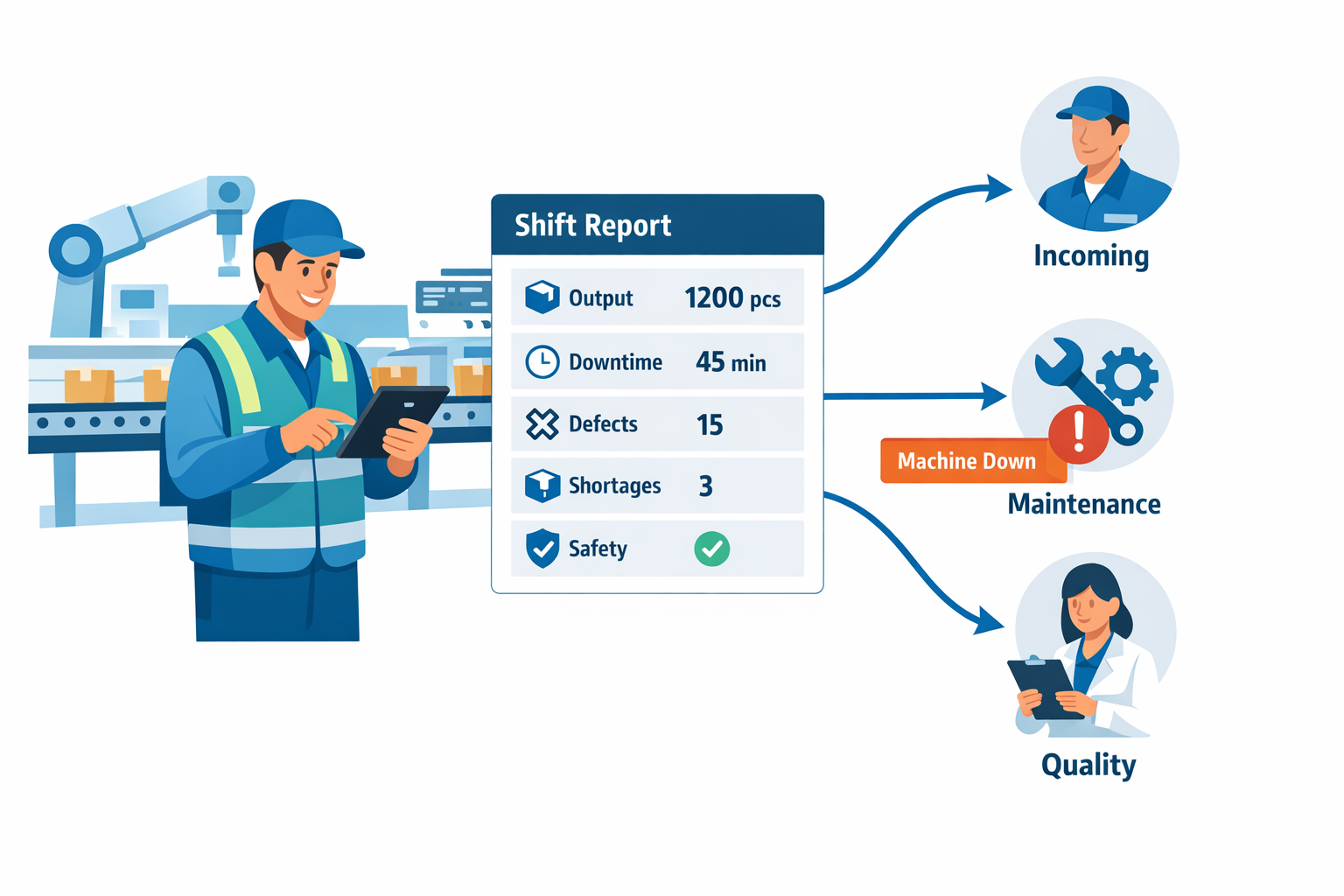
At shift end, the outgoing supervisor completes a structured digital shift handover form on a tablet or mobile device. Instead of writing free-text notes only, the form requires key fields such as production output, downtime by cause, quality issues, material shortages, pending maintenance actions, safety incidents, and start-up risks for the next shift. Photos of defects, machine alarms, or blocked pallets can be attached directly to the record. That makes the handover clearer and more actionable than a paper notebook or verbal summary.
What the Workflow Looks Like on the Shop Floor
A practical workflow usually starts with the shift roster and line assignment screen. Supervisors can see who is assigned to Line 1, which relief operator is covering an absent employee, and whether overtime approval has been confirmed. In many plants, this replaces the physical shift board manufacturing teams traditionally use near the production office. The difference is that the digital board is always current and visible from a phone, tablet, or supervisor station.
Next comes the handover report itself. At 6:45 a.m., for example, the outgoing night-shift supervisor submits a report showing that Press Machine 4 lost 42 minutes due to die alignment issues, 180 parts were quarantined for burr defects, and one forklift battery needs replacement before the next material run. The system routes that report instantly to the incoming supervisor, maintenance lead, and quality engineer based on predefined rules. No one has to search emails or scroll through chat history to understand the situation.
If an issue crosses a threshold, the workflow escalates it automatically. For example, if downtime exceeds 30 minutes or rejected quantity exceeds the plant’s escalation limit, a task is created for engineering or maintenance with a due time and owner. This is where shift report software becomes more than a reporting tool; it becomes an execution tool. Instead of “noted for follow-up,” the issue is assigned, tracked, and visible until closure.
Example: Electronics Assembly Plant
Consider an electronics manufacturer running SMT and final assembly lines for consumer devices. During the evening shift, the outgoing leader records that Feeder Bank B on SMT Line 2 caused repeated placement errors, creating a defect spike from 0.8% to 2.1% over four hours. In a manual environment, that information might sit in a notebook until the morning meeting, by which point another shift has already produced more suspect boards.
With a digital workflow, the line leader submits the handover in minutes, attaches photos from AOI, and flags the issue as “quality-critical.” The incoming shift supervisor receives the alert before line start, maintenance gets an automatic task to inspect the feeder, and quality sees the trend on a dashboard linked to the same record. That kind of digital shift handover improves continuity because each team starts with the same verified information, not different versions of the story.
Supervisor Reporting Becomes Faster and More Reliable
One of the biggest gains is in daily supervision and review. Instead of collecting paper sheets from each department, the production manager opens a dashboard with live summaries by shift, line, and department. Output, downtime, absenteeism, scrap, and open issues are already consolidated because they come from the same workflow. In many factories, that can cut report preparation time by 50% or more, while also improving data accuracy because figures are entered once at the source.
For lean and CI teams, this matters even more. When shift loss data, recurring handover issues, and unclosed actions are captured in one system, it becomes easier to identify chronic causes instead of isolated incidents. A CI manager can quickly see that the same packaging line had handover comments about film tension on five shifts in one week, which points to a process issue worth solving permanently. That is much harder to spot when information is split between whiteboards, spreadsheets, and chat threads.
Why This Matters for Continuity Between Shifts
A good handover is not just about documentation. It is about reducing the reset time between outgoing and incoming teams so production can continue with fewer surprises. In a plant with three shifts, even saving 10 minutes of confusion per handover adds up to 30 minutes per day, or more than 180 hours per year on one line alone. When you multiply that across several lines or departments, the operational impact becomes significant.
This is why buyers evaluating shift management software manufacturing solutions should look beyond simple scheduling. The strongest systems combine shift planning, handover capture, issue escalation, and reporting in one connected process. When that happens, your shift board manufacturing view, your supervisor notes, and your action tracking all work from the same data. That is what turns a basic scheduling tool into a practical factory shift management system that supports continuity, accountability, and better performance on every shift.
Conclusion: How to Choose the Right Shift Management Software for Manufacturing
Choosing the right shift management software manufacturing teams can rely on comes down to one question: can it support the way your plant actually runs, not just how a generic scheduler is designed. The best systems do more than assign operators to Day, Night, and Weekend shifts. They also help you manage attendance, skill matching, overtime control, leave approvals, handovers, escalation workflows, and real-time reporting across lines and departments.
Imagine a production manager at an electronics plant who needs to fill a last-minute absentee gap on SMT Line 3. A basic tool may only show who is available, but a stronger solution shows who is certified, who is already near overtime limits, and who should receive the handover checklist automatically. That matters because labor shortages, unplanned absences, and compliance issues can quickly affect output, quality, and safety.
If you want a system that fits your factory instead of forcing process changes, Jodoo is worth considering. As a no-code lean manufacturing platform, Jodoo helps you build a flexible and scalable shift management system that connects scheduling with approvals, production reporting, audits, and dashboards. You can start a free trial or book a demo to see how Jodoo can match your manufacturing workflows.