Browse by category

Introduction: Why Sustainability Reporting Is Now an Operations Challenge
For many manufacturers, sustainability reporting breaks down long before the report is drafted. The real problem starts on the shop floor, where utility data sits in different systems, waste records stay with site EHS teams, and supporting documents move through email, spreadsheets, and shared folders. In a multi-site business, that fragmentation turns a reporting deadline into a plant-by-plant data chase.
This is why sustainability reporting is no longer just a communications or compliance exercise. It is an operational process that depends on consistent inputs, clear ownership, review discipline, and traceable evidence across plants. That matters because investors, customers, regulators, and group leadership increasingly expect disclosures that are timely, comparable, and backed by records rather than last-minute estimates.
This article will show how to define reporting boundaries, map disclosure requirements to source records, standardize site submissions, and manage review and approval cycles across facilities.
Set the Reporting Purpose, Audience, and Disclosure Boundary Before Collecting Any Data
Many manufacturers begin sustainability reporting by asking each plant for utility data, waste totals, and incident counts. That usually creates rework because the harder questions come first: why the report exists, who will read it, which legal entities and sites are included, and which disclosures must be answered. Until those decisions are fixed, data requests are only assumptions.
Define Why You Are Reporting
Your reporting purpose determines what “complete” means. A manufacturer preparing a customer-facing sustainability report will emphasize operational impacts, policies, targets, and plant-level performance trends. A group preparing investor-facing disclosures may need tighter linkage between sustainability topics, business risks, governance, and financial implications. If the company is subject to specific regulatory requirements, the report must also align with the applicable disclosure framework and filing expectations.
Identify the Primary Readers and Decision-Makers
A sustainability report usually has more than one audience, but one audience should lead the design. If your primary readers are investors, lenders, or board members, they will expect consistency between the sustainability narrative and management reporting. If your primary readers are customers, auditors, or major OEM buyers, they may focus more on site-level evidence, supplier controls, and operational metrics. That choice influences the level of detail, the approval path, and the records each plant must submit.
It also affects timing. A board review cycle, bank covenant discussion, or customer qualification process can drive different deadlines long before the annual report is drafted. That is why the reporting calendar should be considered at the boundary-setting stage, even if the detailed submission schedule is built later.
Set the Disclosure Boundary Before Defining Data Requests
A reporting boundary answers four practical questions: which entities, which sites, which time period, and which disclosures are in scope. Data collection scope is narrower. It defines the actual records needed from each location to support those chosen disclosures, such as electricity invoices, wastewater test reports, or injury logs.
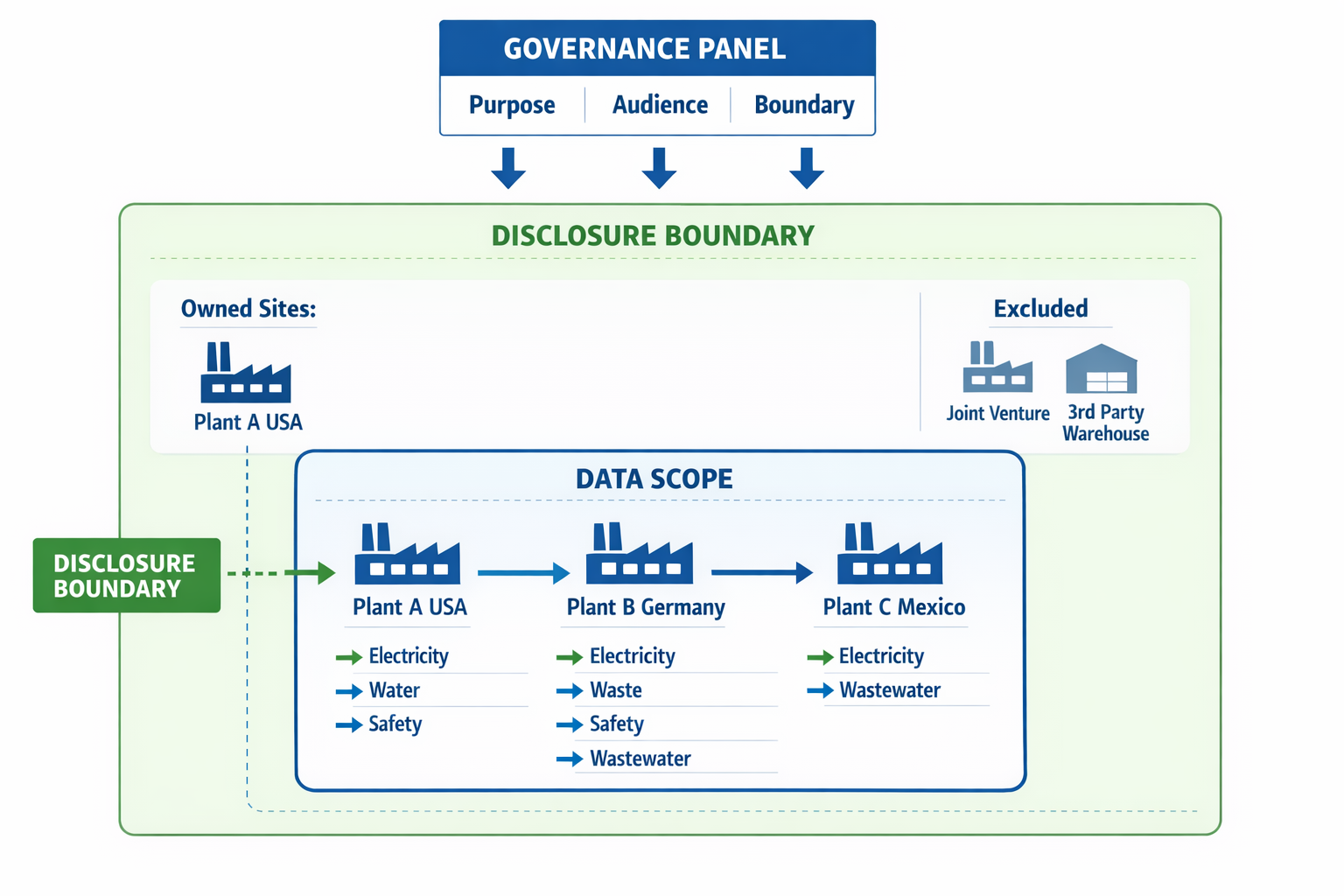
Example: One Manufacturer, Different Site Requirements
Consider a regional electronics manufacturer with three plants: a PCB assembly site in Malaysia, a final assembly plant in Vietnam, and a plastics component plant in Thailand. The parent company wants one annual sustainability report for the wholly owned manufacturing entities, aimed primarily at customers and lenders. It decides to use GRI as the main structure and add selected climate-related disclosures aligned with IFRS S2.
That boundary immediately changes plant obligations. The Malaysian PCB site must submit electricity, water, chemical waste, wastewater compliance, and EHS training records because those are material to its process and the chosen disclosures. The Vietnam final assembly plant may not need wastewater records if it has no relevant discharge activity, but it still submits electricity, labor training, safety, and waste segregation records. The Thailand plastics site must add resin scrap, refrigerant logs for cooling systems, and process energy intensity context because its operational profile differs.
The key point is that plants are not submitting “everything ESG-related.” They are submitting records tied to a defined disclosure set, entity boundary, and reporting audience. That discipline is what makes later consolidation, review, and disclosure evidence management workable across multiple sites.
Translate Disclosure Requirements Into a Manufacturing Sustainability Disclosure Record Map
Once your reporting boundary is set, the next task in sustainability reporting is to convert each disclosure requirement into a record requirement. That means identifying what document, log, system entry, or calculation supports each answer, who owns it, and how often it must be submitted. In practice, strong manufacturing sustainability disclosure depends less on narrative writing and more on whether every site can produce the same class of evidence in the same format. If that translation step is weak, consolidation becomes manual and inconsistent.
Start With a Disclosure-to-Record Mapping Table
A useful record map works like a control sheet between disclosure language and plant-level evidence. For each required disclosure, list the metric or statement to be reported, the source record, the owning function, the submission frequency, the required unit, and the acceptable evidence type. You should also note whether the figure is entered directly, calculated from raw records, or imported from another system. This turns abstract framework requirements into an operational reporting production workflow.
For example, electricity consumption may map to monthly utility bills, meter exports, or landlord statements for leased facilities. Hazardous waste generated may map to transporter manifests, weighbridge records, disposal certificates, and internal waste logs. Safety training completion may map to LMS records, sign-in sheets, or contractor induction forms, depending on how the site actually runs training. A good table makes these differences visible before the collection cycle starts.
Define What Counts as Acceptable Site-Level Evidence
Not every file attached by a site should count as usable reporting evidence. Acceptable evidence should be complete, traceable, dated, and linked to the reporting period and facility in scope. If a plant submits a spreadsheet summary with no underlying bill, manifest, or log extract, that may help internal tracking, but it is not strong disclosure evidence management. At minimum, the record map should distinguish between primary evidence, derived calculations, and supporting commentary.
This matters because many sustainability data points are not captured in a single source. Refrigerant emissions, for instance, often require service logs, refill quantities, equipment IDs, and the global warming potential of each gas used. If one site reports only “top-up completed” and another reports kilograms by refrigerant type, the group cannot reliably consolidate climate data. The record map should therefore specify the exact fields required from each source, not just the document category.
Capture Owners, Frequency, and Production Context
Each mapped record needs a named owner at the level where the data originates. Utility data may sit with facilities, waste with EHS, supplier declarations with procurement, and incident records with HR or safety teams. Ownership should be assigned to the person or role that can access the source first, not the corporate team that needs the final number. That reduces chasing and shortens the reporting workflow.
Frequency should also reflect how the data is produced, not only how the final report is published. A manufacturer may report annually, but electricity bills arrive monthly, waste manifests per shipment, and training logs per session. If you only request everything at year-end, missing records accumulate. Aligning submission frequency with record creation also makes the later reporting calendar more realistic.
Production context is the field many teams forget. Output volume, operating days, product mix, and major process changes help explain why water, energy, scrap, or waste intensity moved. In a metal finishing plant, a new pretreatment line can materially change water use and sludge generation. In a food factory, seasonal production runs may change wastewater loading even when total annual tonnage looks stable.
Adjust the Record Map by Facility Type
Different factories need different record architectures even when the disclosure topic is the same. A cold-chain food processor may need ammonia or HFC refrigerant leak logs, compressor maintenance records, and defrost-cycle data. A plastics converter may need resin supplier declarations, scrap regrind records, and packaging material weights. An electronics assembly site may rely more heavily on supplier substance declarations, solder consumption logs, and outsourced waste treatment evidence.
That variation is normal, but the reporting structure still needs consistency. Corporate teams should standardize the submission fields and evidence rules while allowing site-specific source records underneath. This is where a configurable tool such as Jodoo becomes useful: you can build role-based forms, required attachments, and structured evidence fields that reflect each disclosure while preserving a common data model across sites.
Build a Standardized Site Submission Process With Owners, Validations, and Exception Handling
Once disclosure requirements have been translated into site-level records, the next step is to make every plant submit data in the same way. Corporate sustainability teams should define one submission structure for each reporting topic, not let each site decide its own format, units, and evidence package. That means standard forms, fixed field logic, clear owners, and due dates aligned to the reporting production workflow. In manufacturing sustainability reporting, consistency at the submission stage matters more than speed.
Standardize What Every Site Must Submit
A workable submission template usually includes five elements: the metric value, the unit of measure, the reporting period, the required attachment, and the named owner. For example, electricity use should always be submitted in a predefined unit such as kWh, with the source document attached and the plant utility owner identified. Waste data should use controlled category lists and disposal methods rather than free-text descriptions. This prevents one site from reporting “general waste,” another “municipal solid waste,” and a third “landfill waste” for the same underlying stream.
Required fields should also reflect how the metric is actually reviewed. If diesel consumption is estimated rather than billed, the form should force the site to state the calculation method and upload supporting logs. If refrigerant top-ups are reported, the form should capture equipment ID, gas type, quantity, and maintenance evidence. Good disclosure evidence management starts here, because review quality depends on whether supporting records arrive in a structured way.
Assign Owners and Deadlines by Role
Standardization fails when ownership is generic. “Plant EHS” is usually too broad, especially in larger sites where waste, energy, water, and training records sit with different teams. A stronger model assigns a record preparer, a site reviewer, and a corporate reviewer for each disclosure line, with explicit due dates and escalation paths for non-submission.
In the multi-site manufacturer from the earlier section, the Vietnam plant’s monthly electricity and water submission is prepared by the facilities engineer, reviewed by the plant EHS manager, and then routed to the corporate sustainability lead. The Thai plant follows the same role structure even though the local org chart differs. That role-based design keeps the reporting calendar consistent across sites without forcing identical job titles.
Build Review Logic Into the Workflow
A controlled workflow should catch errors before data reaches consolidation. At minimum, validation rules should flag late entries, missing attachments, unit mismatches, incomplete methodology notes, and values outside expected ranges. For high-variability metrics such as natural gas use or hazardous waste generation, exception thresholds should trigger a review rather than auto-rejection, because legitimate production shifts can explain real changes.
In the same example, the Vietnam plant submits April electricity use at 18% above the prior three-month average. The form accepts the value but flags it for explanation because the threshold is set at 10%. The facilities engineer adds a note that a new SMT line started mid-month and attaches the commissioning record plus the utility bill. The plant EHS manager reviews the explanation, confirms the production change, and forwards it without sending the submission back for manual clarification.
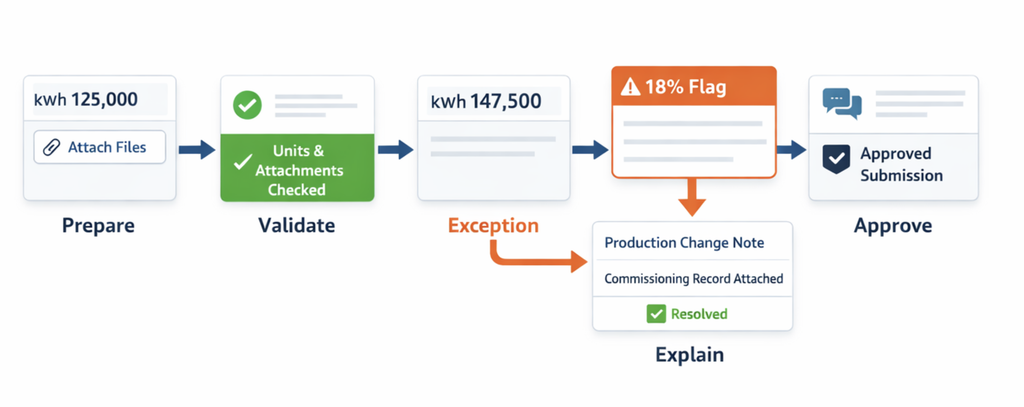
This step-by-step site submission and exception workflow is what reduces rework later. A plant submits data; the system checks completeness and range logic; the site reviewer resolves exceptions, and only then does corporate see a cleaner record. Instead of chasing emails for missing PDFs or asking whether “tons” means metric tons or short tons, the corporate team reviews standardized, traceable entries.
Handle Real Exceptions Without Breaking Control
Not every anomaly is an error, and not every site can follow the same method in every period. A plant may change waste contractors, replace a faulty water meter, or shift from estimated to invoiced fuel data during the year. The process should allow these plant-specific exceptions, but only through structured fields for reason codes, commentary, effective date, and approving reviewer.
Conclusion: Use a Configurable Workflow Layer to Make Sustainability Reporting Repeatable Across Sites
For manufacturers, sustainability reporting works best when it is managed as an operating process, not an annual document exercise. The companies that reduce reporting friction are usually the ones that make five decisions early: set a clear reporting boundary, translate disclosures into required records, standardize site submissions, enforce review and approval rules, and run the whole cycle on a recurring calendar. That structure matters even more in multi-site operations, where inconsistent units, missing evidence, and late submissions can slow consolidation and weaken confidence in the final report.
A configurable workflow layer helps turn that structure into daily practice. Instead of chasing spreadsheets across plants, teams can use Jodoo to build controlled submission forms, assign record owners, require attachments, trigger reminders, route approvals, manage permissions, and track version history in one place. Because dashboards and traceable records sit on the same platform, sustainability, EHS, operations, and compliance teams can see reporting status earlier and resolve exceptions before disclosure deadlines.
If you want to make reporting more repeatable without custom development, you can start a free trial or book a demo to see how Jodoo supports site-based disclosure workflows.