Browse by category

Introduction: What an Audit Trail Means for ESG Data in Manufacturing
Many manufacturing teams discover their ESG reporting problem only when a reviewer asks a simple question: Where did this number come from? That is a real risk. In one KPMG survey, 96% of the world’s largest 250 companies reported on sustainability. In this context, an audit trail is not just a system log. It is a traceable record chain that shows how ESG data moved from source to report across plants, people, and decisions.
In manufacturing, that chain often starts with a meter reading, waste manifest, boiler fuel record, inspection form, or supplier document. It then passes through collection, validation, correction, approval, consolidation, and final retrieval by internal reviewers, compliance teams, or external assurance providers. If any step is handled through disconnected spreadsheets, email threads, or missing attachments, the record may still exist, but the evidence behind it becomes hard to trust.
This article explains what a practical audit trail looks like in a multi-site manufacturing environment. It will break down data lineage, change history, approval records, and evidence management so you can see not only the final ESG figure but the full story behind it.
What an Audit Trail Covers in ESG Data Management
In ESG data management, an audit trail is the record-level history that shows where a number came from, who entered or changed it, what evidence supports it, and how it moved through review. For manufacturers, that usually includes source documents, timestamps, user actions, linked attachments, and approval records tied to a specific emissions, waste, water, or safety-related data point. The focus is not the final report alone, but the underlying chain of provenance that makes the report defensible.
That scope matters because ESG data is often assembled from production logs, utility bills, lab reports, maintenance records, and supplier submissions. A usable audit trail helps reviewers reconstruct the path from source to reported value without relying on memory or scattered email threads. It also supports data lineage by showing how a plant-level record was transformed, combined, or adjusted before appearing in a site summary or corporate disclosure. This is especially important when one metric passes through several functions before sign-off.
An audit trail is not the same as an audit. An audit is a formal review activity; the audit trail is part of the evidence that auditors may inspect. It is also not the same as independent assurance, which tests whether reported information and controls are reliable enough for an external conclusion. Certification is also different because it usually confirms compliance with a defined standard or management system requirement, while a cybersecurity log mainly records system access, login attempts, or network events rather than ESG record provenance.
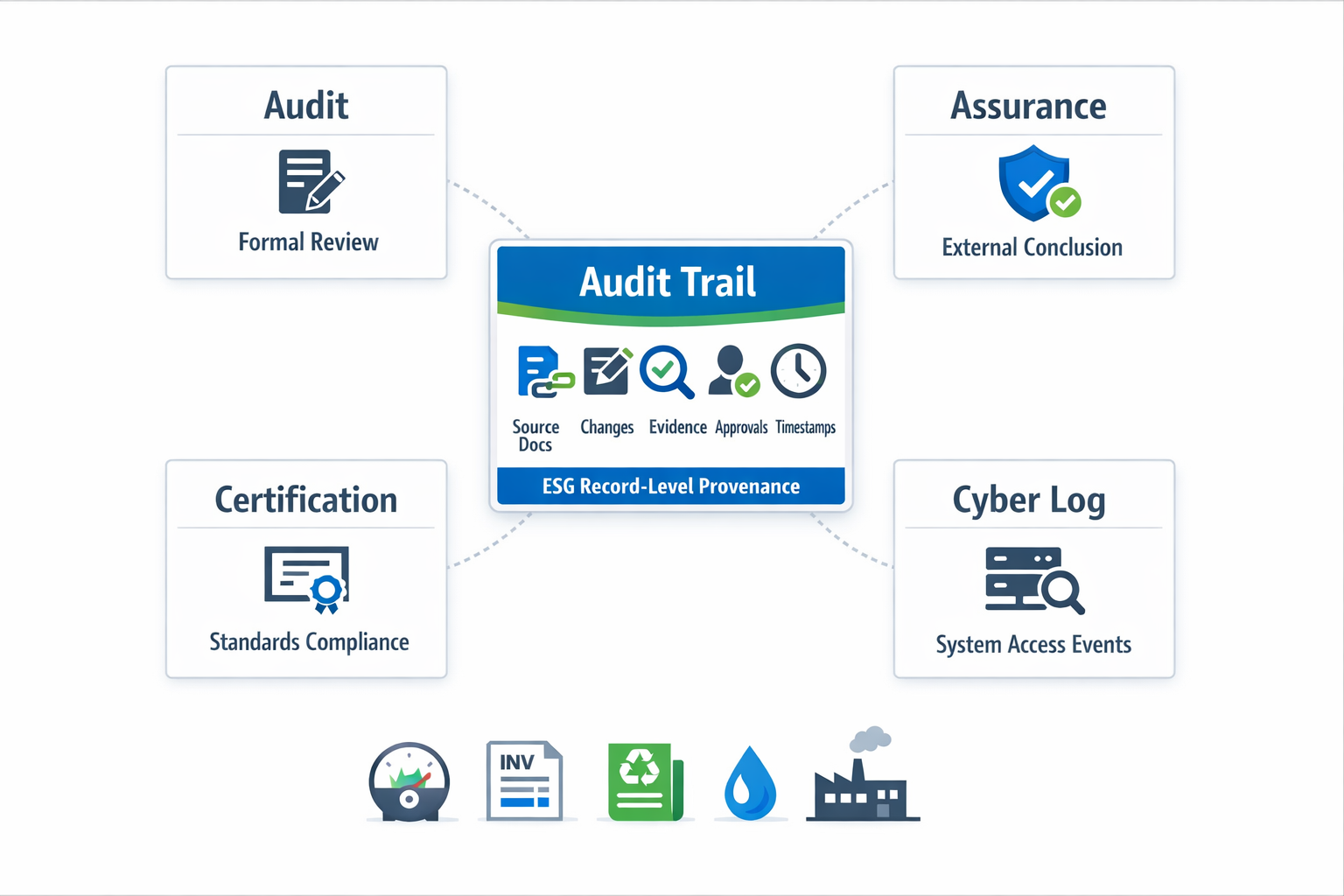
If a plant manager says, “We have an audit trail,” but means only that the server keeps login records, the sustainability team still may not know which invoice supported a Scope 2 electricity figure or why a waste quantity changed after review. Likewise, a company can complete assurance work on selected metrics and still have a weak change history at the record level. Good evidence management supports audits and assurance, but it does not replace them.
The key unit here is the individual record, not the entire ESG program. If a wastewater reading is updated, a proper trail should show the original value, revised value, user, date, reason, and supporting attachment. If an emissions factor is changed, the documentation should point to the method reference used at that time. That is what makes change history usable during internal review, not merely visible.
How the Audit Trail Chain Works Across Plants, Suppliers, and Review Teams
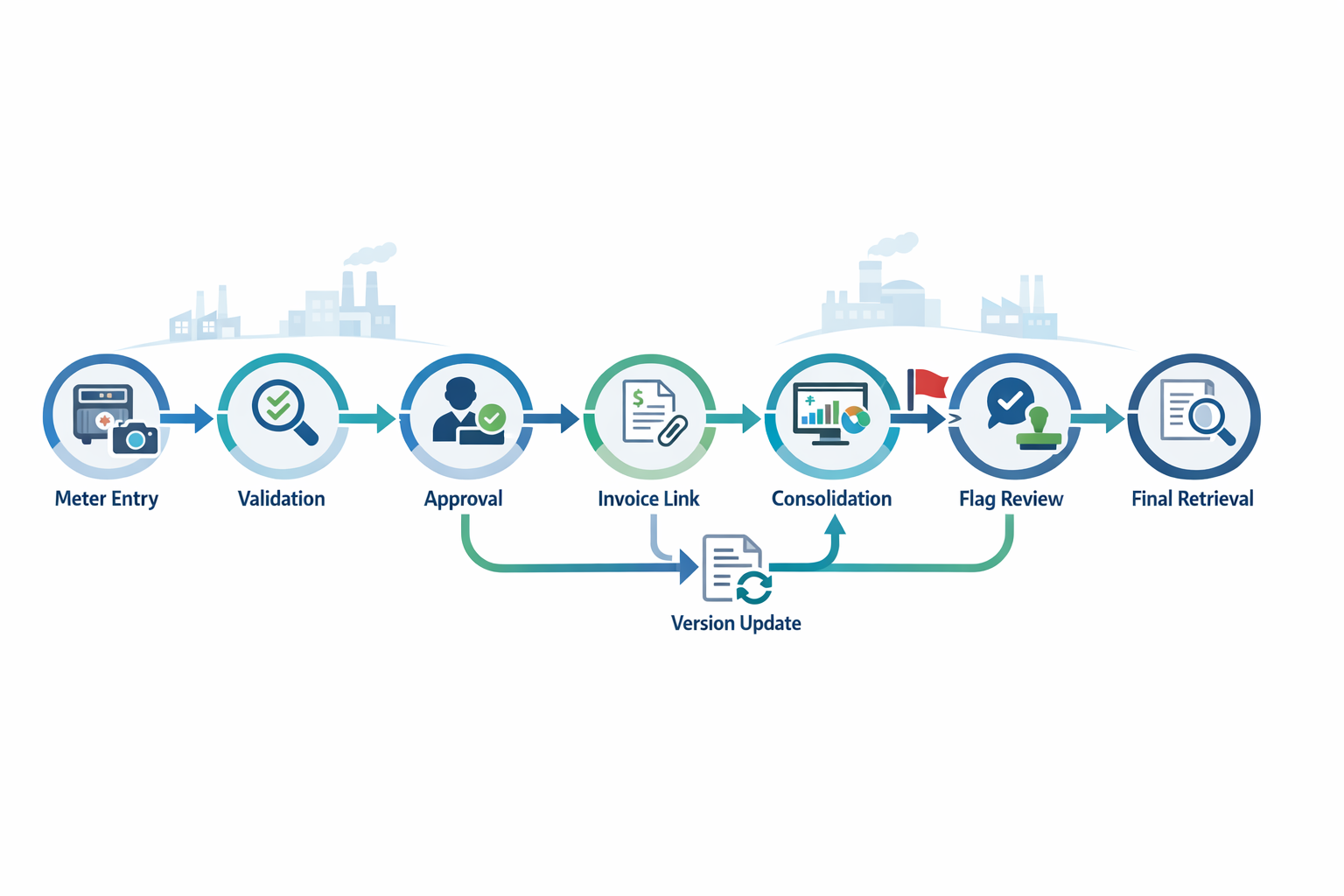
A usable audit trail in manufacturing ESG reporting is a chain of custody for each record as it moves across teams, systems, and review steps. In a multi-site business, that chain often starts on the shop floor, passes through plant validation, picks up supplier evidence, and ends in a regional or corporate review file. To make this concrete, follow one running example: a monthly natural gas consumption record from Plant A that feeds Scope 1 emissions reporting and later needs internal review.
Source Capture at the Plant Level
The record begins when a utilities technician at Plant A enters the month-end gas meter reading and uploads a photo of the meter face. The submission includes the meter ID, reading date, unit of measure, and a link to the site utility account, giving the record a clear origin instead of a disconnected number in a spreadsheet. At this stage, good evidence management means the raw reading, attachment, and submitting user are tied together from the start.
A second layer of context is usually added by the plant EHS or facilities coordinator. In our example, the coordinator checks whether the reading aligns with production hours and confirms that the meter was active for the full month. That validation step does not overwrite the original entry; it adds a review action, timestamp, and comment, which is where data lineage starts to become visible across handoffs.
Validation, Approval, and Cross-Functional Handoffs
Once validated locally, the record moves to plant management for approval because the value will be used in formal ESG reporting. If the plant manager approves it, the record now carries approval records that show who reviewed it, when the decision was made, and whether any comments or conditions were attached. If the manager rejects it, the submission returns to the coordinator with the original value still preserved.
The same record may also need outside evidence. Suppose the procurement team receives the supplier utility invoice three days later and attaches it to the existing gas record rather than saving it in a separate email thread. That simple link matters because it extends data lineage from a physical meter reading to a third-party commercial document without breaking the traceable chain.
From there, the sustainability team consolidates Plant A’s gas data with other plants in the reporting period. They do not just see a final number; they can trace the record back through source capture, plant validation, manager approval, and supplier documentation, then determine whether it is ready for group reporting or needs follow-up.
Corrections and Consolidation Without Breaking Lineage
Now assume the sustainability analyst spots an abnormal 18% month-on-month increase while reviewing all sites. The analyst flags the Plant A record, and the workflow routes it back to the plant with the prior approval status, comments, and attachments still visible. That preserves change history while keeping the review context attached to the same record.
The plant team then discovers that one digit was transposed during entry. Instead of replacing the old figure without explanation, the corrected value is submitted as a tracked update linked to the original reading, with a reason note and supporting image check. When the revised record is reapproved, reviewers can see both the current value and the path it took.
Final Retrieval for Internal Review
By the time internal reviewers, compliance teams, or IT data owners retrieve the record, they should be able to filter by site, period, status, and document type and reconstruct the full chain in minutes. In practice, that means one record can answer five questions at once: where it came from, who touched it, what changed, what evidence supports it, and who approved it for reporting. That is what makes an audit trail operationally useful across plants, suppliers, and review teams.
The Traceability Fields Every ESG Record Should Capture
A usable audit trail for ESG data starts at the record level. Every emissions factor update, wastewater test result, waste shipment note, or electricity reading should carry the same minimum traceability fields so reviewers can reconstruct what happened without searching across inboxes and folders. In practice, this turns ESG reporting from a document hunt into a controlled evidence management process.
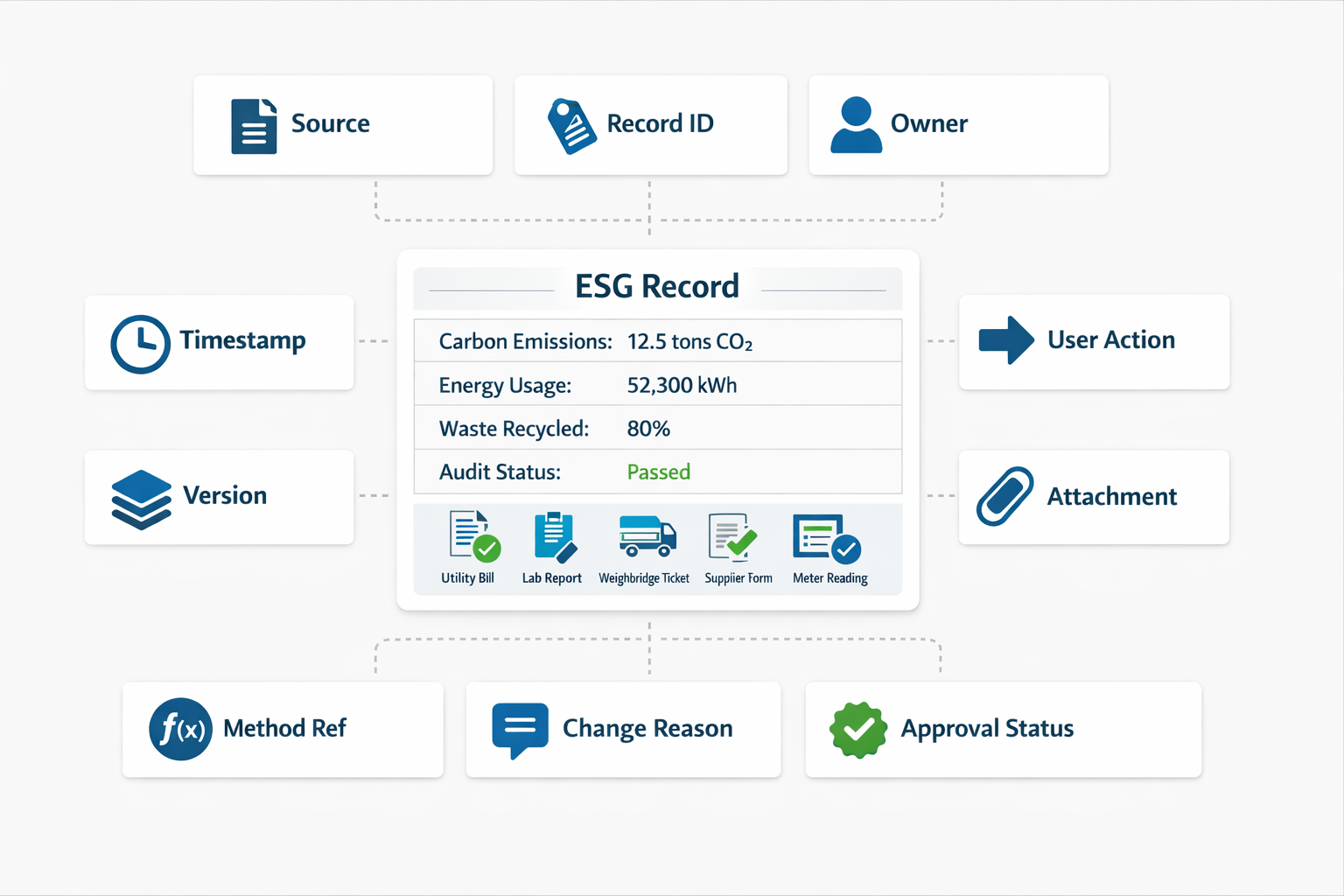
The recommended schema is simple: source, record identifier, owner, timestamp, user action, version, change reason, attachment, method or assumption reference, and approval status. If these fields are captured consistently, you create usable data lineage from origin to report, preserve change history when values move, and keep approval records tied to the exact record being reviewed.
Source, Record Identifier, and Owner
The source field tells reviewers where the record came from: a utility bill, submeter export, lab report, weighbridge ticket, supplier declaration, or inspection form. This matters because two records can contain the same number but carry very different evidentiary strength. A source field also helps teams separate direct plant data from estimates or third-party submissions.
A record identifier field gives each ESG entry a unique reference that does not change, even if the value does. This can be a form number, batch-linked transaction ID, meter-reading ID, or document control number. Without it, duplicate rows and copied spreadsheet tabs quickly break data lineage and make reconciliations unreliable.
The owner field assigns accountability to a person or role, such as the utilities engineer, EHS officer, or procurement coordinator. Ownership is not only about blame; it tells reviewers who can explain the context, supply missing support, or confirm whether a correction is valid. In multi-site manufacturing, this is essential when corporate teams review local records months later.
Timestamp, User Action, and Version
A timestamp field should record when the data was created, submitted, edited, approved, or rejected, depending on the event. This is what makes the audit trail chronological rather than descriptive. For monthly reporting, timestamps also show whether a figure was entered on time or backfilled later.
The user action field captures what happened to the record, not just who touched it. Typical actions include creating, importing, editing, commenting, approving, returning, or archiving. This gives reviewers a readable change history instead of a vague note that “the file was updated.”
A version field preserves sequence when the same record changes over time. Version control matters when a March electricity reading is first entered from a manual log, then updated after the final utility invoice arrives. The key point is that version 2 should not erase evidence that version 1 ever existed.
Change Reason, Attachment, and Method Reference
A change reason field explains why a record moved from one value or status to another. Good reasons are specific: “invoice received after estimated entry,” “lab corrected COD result,” or “supplier resubmitted declaration with missing stamp.” This short note often determines whether a correction looks controlled or arbitrary.
An attachment links the supporting file to the record itself. For evidence management, that means the bill, photo, signed form, certificate, or email-approved document is retrievable from the same record, not stored separately with uncertain naming conventions.
A method or assumption reference documents how the figure was derived when the source is not purely raw data. Examples include estimation rules, allocation logic, unit conversions, or emission-factor references. This prevents spreadsheets from carrying unexplained formulas that no reviewer can interpret later.
Approval Status Completes the Record
The final field is approval status: pending, approved, rejected, returned for correction, or superseded. This ties approval records directly to the data entry and makes it clear which version was accepted for reporting. When these fields are standardized, traceability becomes operational rather than dependent on memory.
How to Handle Corrections, Method Changes, and Boundary Shifts Without Losing Context
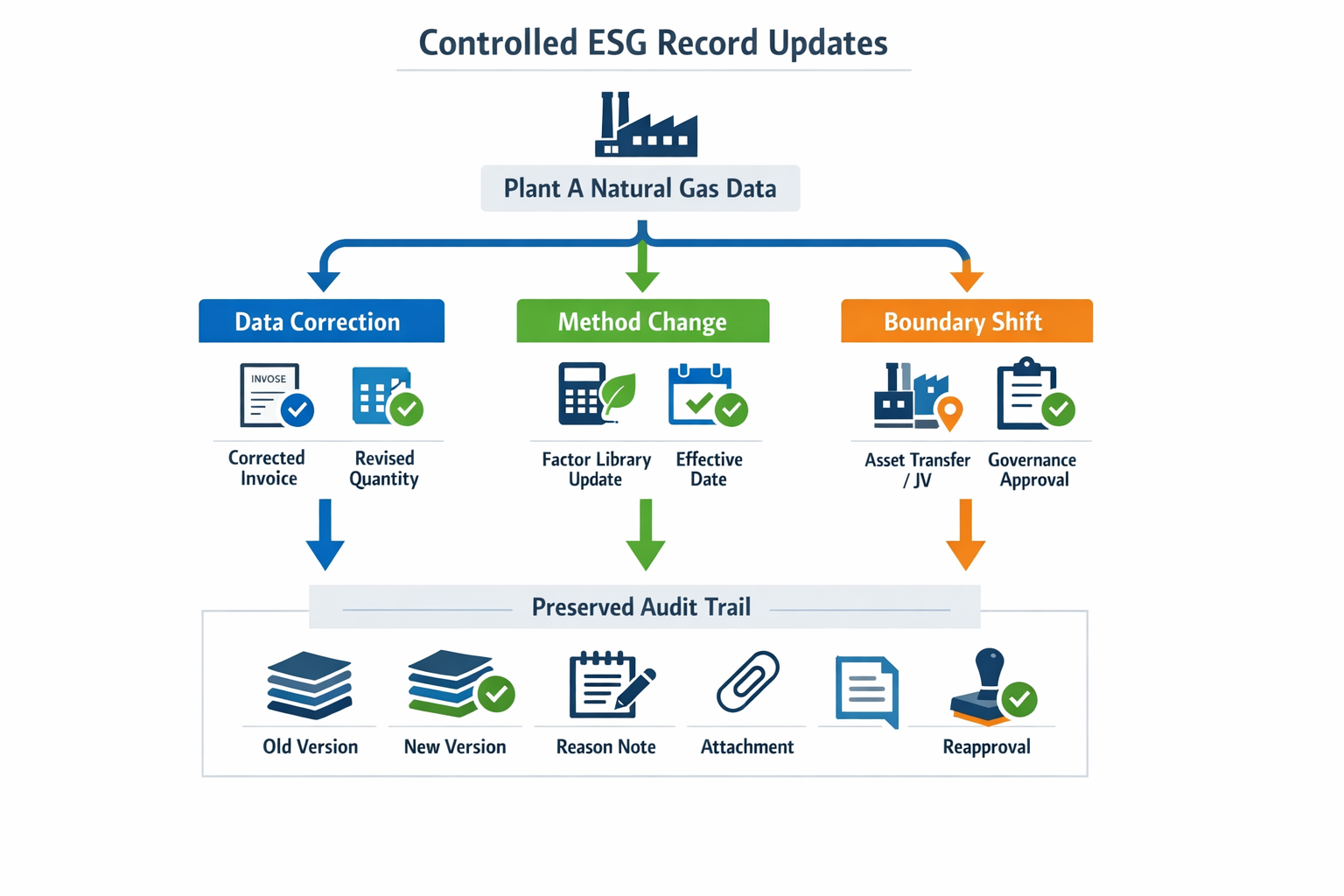
In a manufacturing ESG workflow, corrections are normal. Utility invoices are reissued, supplier declarations are replaced, emission factors are updated, and reporting boundaries change after acquisitions or line transfers. The problem is not that records change, but that many teams overwrite the latest number and erase the decision path behind it. A reliable audit trail keeps the original record visible, preserves the full change history, and shows reviewers why the current value is different.
To continue the running example, assume Plant A submitted monthly natural gas consumption for its heat-treatment furnace, and the group sustainability team used that record in the consolidated Scope 1 file. Two weeks later, the plant accountant receives a corrected gas invoice because the supplier had estimated part of the bill. At the same time, corporate EHS updates the emission factor reference for that fuel category. A month after that, one furnace line is reassigned to a joint venture entity and leaves the reporting boundary for the next reporting period.
Treat Every Update as a New Version, Not a Replacement
When the corrected invoice arrives, the plant team should not delete the earlier value. They should create a new version tied to the same record identifier, keep the previous quantity, and log who made the revision, when it was made, and the reason for the change. This protects data lineage from the source document to the reported figure and gives internal reviewers a usable record of what happened. In practice, the old value becomes superseded, not invisible.
A sound correction workflow also updates approval records rather than assuming the first approval still applies. If the original gas figure was approved by the plant manager and later used in sustainability reporting, the revised value should trigger a controlled re-review based on materiality rules. That way, reviewers can compare prior values, current values, attached invoices, and approval decisions in one place instead of searching email chains.
Separate Data Corrections From Method Changes
Not every update is the same. A corrected meter reading or replacement invoice is a source-data correction, while a revised emission factor or changed calculation logic is a method change. These should be linked, but not blended, because reviewers need to distinguish whether the activity data changed, the conversion method changed, or both changed at once.
In the furnace example, the revised invoice changes fuel consumption for March, while the new emission factor changes how that fuel is translated into emissions. The record should therefore reference both the updated source attachment and the method note that explains which factor library, version, and effective date were applied. This makes evidence management much stronger during internal review or external assurance preparation.
Document Boundary Shifts as Governance Decisions
Boundary changes need even more context because they affect comparability across periods. If the furnace line moves into a joint venture structure, the team should not simply stop reporting the associated fuel use without explanation. The audit trail should capture the effective date, organizational reason, affected assets, approver, and whether prior periods were restated or left unchanged with disclosure. That preserves both decision context and approval records.
For manufacturing groups with multiple plants, this step is critical because organizational changes often happen outside the ESG team. Procurement, finance, or legal may trigger a boundary shift, but sustainability and plant operations must still retain the supporting documents and the final decision trail. If later reviewers question a sudden drop in site emissions, the answer is already in the record.
Conclusion: Building a Practical Audit Trail With Jodoo
A practical audit trail for manufacturing ESG data is not just a system log. It is an operational record structure that shows who owned the data, where it came from, what changed, when it changed, why it changed, and who approved it across the reporting process. For plant and sustainability teams, that means traceability must work across forms, attachments, corrections, approvals, and site-level handoffs, not only in the final report.
In practice, the strongest setup combines clear ownership, structured evidence management, complete change history, retrievable approval records, and usable data lineage from plant capture through central review. That is what allows an internal reviewer to trace one emissions factor update, one waste manifest, or one supplier declaration back to its source without chasing spreadsheets and email threads. In multi-site manufacturing, that level of retrieval is what makes ESG reporting more defensible and less disruptive.
Jodoo supports this with configurable forms, file attachments, role-based permissions, approval workflows, reminders, dashboards, mobile data capture, and API-connected process records built around your real operating flow. As a no-code lean manufacturing platform, it gives teams a practical way to start with one audit trail workflow, prove it at one plant, and then scale across sites. Start a free trial or book a demo to see how your ESG records can become easier to track, review, and manage.