Browse by category

Introduction: Why ESG Framework Selection Is a Manufacturing Operations Decision
Manufacturers are under growing pressure to report sustainability data, but the hard part is rarely the report template. It is the factory data behind it. In a multi-site business, ESG frameworks quickly become an operations issue because the required evidence sits across production, EHS, procurement, finance, and IT, often in different systems and different plants.
That challenge is especially visible in manufacturing. Energy use, Scope 1 and 2 emissions, water withdrawal, injury records, supplier due diligence, and waste data are typically owned by different teams, collected at different frequencies, and reviewed under different controls. A discrete manufacturer with five plants may need utility data from facilities teams, scrap and rework figures from production, safety incidents from EHS, and supplier information from procurement before finance can finalize disclosures.
This article will help you separate three things that are often mixed together: a reporting framework, a disclosure standard, and a jurisdictional reporting rule. From there, we compare GRI Standards, IFRS Sustainability Disclosure Standards, and ESRS, then walk through a practical workflow manufacturers can use to choose, organize, and operationalize the right reporting approach.
ESG Frameworks, Disclosure Standards, and Reporting Rules
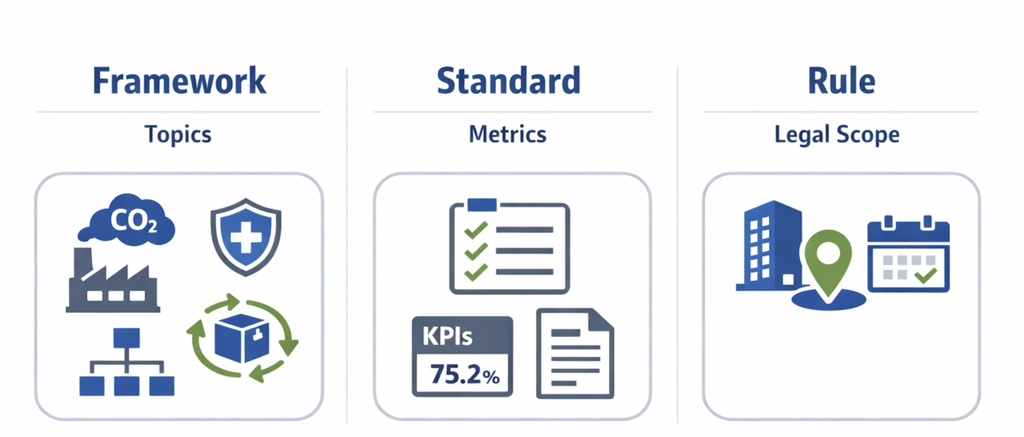
In manufacturing, teams often use “ESG frameworks” as a catch-all term, but the distinction matters. A reporting framework gives you an overall structure for organizing sustainability information. A disclosure standard defines what information should be disclosed and how it should be described. A jurisdictional reporting rule is the legal or regulatory requirement that tells a company whether it must report, when, and under which system.
Why Manufacturers Need This Distinction
Multi-site manufacturers rarely report to just one audience. Finance leaders may need investor-facing sustainability disclosures, EHS teams may track operational indicators for internal management, and procurement may need supplier-related information for customer requests. If these audiences are blended too early, companies either collect too much low-value data or miss disclosures that matter to a specific reporting use case.
Consider a regional electronics manufacturer with plants in Malaysia and Vietnam, plus a sales entity in Europe. The plant teams may collect energy, waste, and incident data monthly for operational control. The European entity may face reporting expectations shaped by local regulation, while the parent company may prioritize investor-oriented climate and risk disclosures. Without separating framework choice from legal obligation, the business can end up duplicating requests across sites and creating inconsistent data definitions.
Where GRI, IFRS, and ESRS Fit
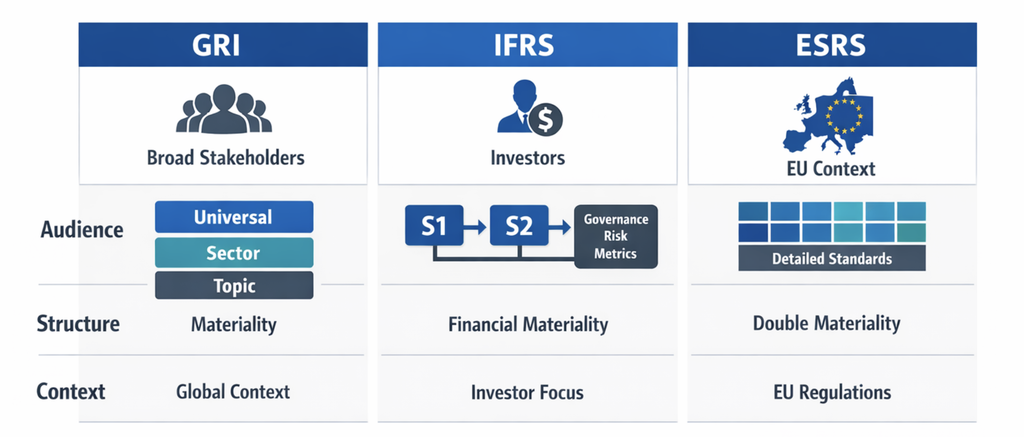
The GRI Standards are best understood as a broad sustainability reporting system designed to support reporting on an organization’s impacts on the economy, environment, and people. They are organized through Universal Standards, Sector Standards, and Topic Standards, which help companies build a structured report around material sustainability topics. For manufacturers, that often makes GRI useful when the audience includes customers, communities, employees, and other non-investor stakeholders.
IFRS Sustainability Disclosure Standards sit in a different position. IFRS S1 and IFRS S2 are investor-focused sustainability-related financial disclosure standards, with a strong link to risks and opportunities that could affect enterprise value. In practice, manufacturers often use them when finance, audit committees, and capital market stakeholders need decision-useful disclosures connected to governance, strategy, risk management, and metrics.
European Sustainability Reporting Standards, or ESRS, belong to a European reporting context and are commonly discussed alongside double materiality. They are not just a voluntary architecture for general communication; they are tied to a broader regulatory environment. For a manufacturer with EU operations, ESRS may become relevant because of where the company operates or which entity falls into scope, not because the sustainability team prefers that format.
Use the Right Layer for the Right Decision
A useful way to think about selection is this: choose the reporting architecture for the audience, then identify the disclosure standard that fits that audience, and finally confirm the reporting rule that applies to each legal entity. This sequence helps manufacturing groups avoid mixing plant-level data collection design with board-level disclosure decisions.
Comparing GRI Standards, IFRS Sustainability Disclosure Standards, and ESRS for Manufacturers
To compare major ESG frameworks in a way that helps manufacturers choose, focus on four points: who the reporting is for, how the content is organized, what materiality lens is used, and in what reporting context it is typically applied. Consider one example throughout this section: a multi-site electronics components manufacturer with plants in Malaysia, Thailand, and Vietnam, a European sales entity, and customers that include global OEMs and institutional investors. The underlying operations are the same, but the reporting emphasis changes depending on whether the company uses GRI Standards, IFRS Sustainability Disclosure Standards, or ESRS.
Intended Users and Decision Purpose
GRI Standards are generally built for a broad stakeholder audience rather than investors alone. In practice, that means the electronics manufacturer may report on emissions, wastewater, worker safety, supplier labor practices, and community impacts in a way that helps employees, customers, communities, lenders, and NGOs understand its wider sustainability impacts. This makes GRI useful when the company needs a fuller public sustainability report, especially if customer questionnaires and supply chain requirements extend beyond finance-focused disclosure.
IFRS Sustainability Disclosure Standards are more narrowly oriented toward investors and capital markets. IFRS S1 addresses sustainability-related financial disclosures more broadly, while IFRS S2 focuses specifically on climate-related disclosures. For the same manufacturer, the reporting question shifts from “What are our major sustainability impacts?” to “Which sustainability and climate matters could reasonably affect enterprise value, cash flows, access to finance, or cost of capital?”
ESRS sits in a European reporting context and is often associated with double materiality. That means the manufacturer’s European entity may need to consider not only how sustainability issues affect the business but also how the business affects people and the environment. For a Southeast Asia-based group supplying Europe, ESRS often becomes relevant because reporting obligations can flow through corporate structure, listing exposure, or customer and parent-company requirements.
Organizing Principles and Structure
The three systems also differ in how they are built. GRI Standards use a modular structure of Universal Standards, Sector Standards, and Topic Standards, which gives manufacturers a practical way to assemble a report based on company-wide foundations, sector-specific expectations, and issue-level disclosures. For the electronics manufacturer, that structure helps organize topics like energy, occupational health and safety, waste, and procurement into a report that reflects actual operational impacts.
IFRS Sustainability Disclosure Standards are structured as disclosure standards rather than a broad reporting architecture for multiple stakeholder groups. IFRS S1 provides the general requirements for sustainability-related financial information, and IFRS S2 provides climate-specific disclosure requirements. In the manufacturer example, this pushes the reporting team to connect plant-level energy use, refrigerant leakage, and supplier concentration risks back to financial planning, risk management, and governance disclosures.
ESRS is more granular and extensive in the European context, with topic-specific standards that operate within a broader regulatory architecture. In the same company, ESRS typically drives a more formal cross-functional process because environmental, social, and governance topics must be assessed, documented, and linked to reporting boundaries and evidence.
Materiality Lens and Implementation Context
For the electronics manufacturer, GRI may lead with operational impacts across plants and suppliers; IFRS may prioritize financially material climate and sustainability risks; and ESRS may require both views to be assessed together. That does not mean one system is “stricter” in every case; it means each asks a different primary reporting question. For manufacturers, the practical implication is clear: framework selection is less about finding a universal winner and more about matching reporting logic to users, structure, and reporting context.
How Materiality and Users Shape ESG Framework Selection
Who Will Use the Report First?
Once you understand the architecture of ESG frameworks, the next filter is user need. A lender, a public-market investor, a major customer, and a regulator do not ask the same questions, even when they all want “ESG data.” For manufacturers, that matters because the same underlying facts may need to be organized differently depending on who will read, compare, or rely on the report. In practice, user groups often narrow the choice between GRI Standards, IFRS Sustainability Disclosure Standards, and European Sustainability Reporting Standards faster than long feature comparisons do.
Audience also changes the level of decision-usefulness expected from the report. Finance-led users usually prioritize how sustainability issues affect enterprise value, cash flow resilience, capex planning, and risk exposure. Broader stakeholder audiences may expect more detail on workforce conditions, environmental impacts beyond climate, local community effects, and supply chain practices. That is why framework selection is not only a sustainability decision; it is also a reporting-governance decision.
Single Materiality in Plain Language
Single materiality asks a focused question: which sustainability topics could reasonably affect the company’s financial position, performance, access to capital, or long-term value? Under this lens, a manufacturer starts by looking at issues such as energy price volatility, carbon costs, regulatory exposure, climate disruption to raw materials, or safety incidents that can stop production. This is the logic many teams associate with investor-oriented reporting, including the IFRS Sustainability Disclosure Standards.
A semiconductor packaging plant in Penang offers a useful example. If the company depends heavily on grid electricity and process cooling, energy availability and electricity price shifts become financially material quickly because they affect margins and delivery reliability. Worker safety is also financially material if incidents lead to shutdowns, compensation costs, or lost customer confidence. Supplier labor conditions might enter scope too, but mainly when customer contracts, disruption risk, or reputational exposure could affect revenue.
Double Materiality Expands the Scope
Double materiality adds a second question: not only how sustainability matters affect the business, but also how the business affects people and the environment. That broader lens is commonly associated with the European Sustainability Reporting Standards and changes topic scoping materially for manufacturers. A topic may matter because it creates financial risk for the company, because the company creates significant external impact, or both.
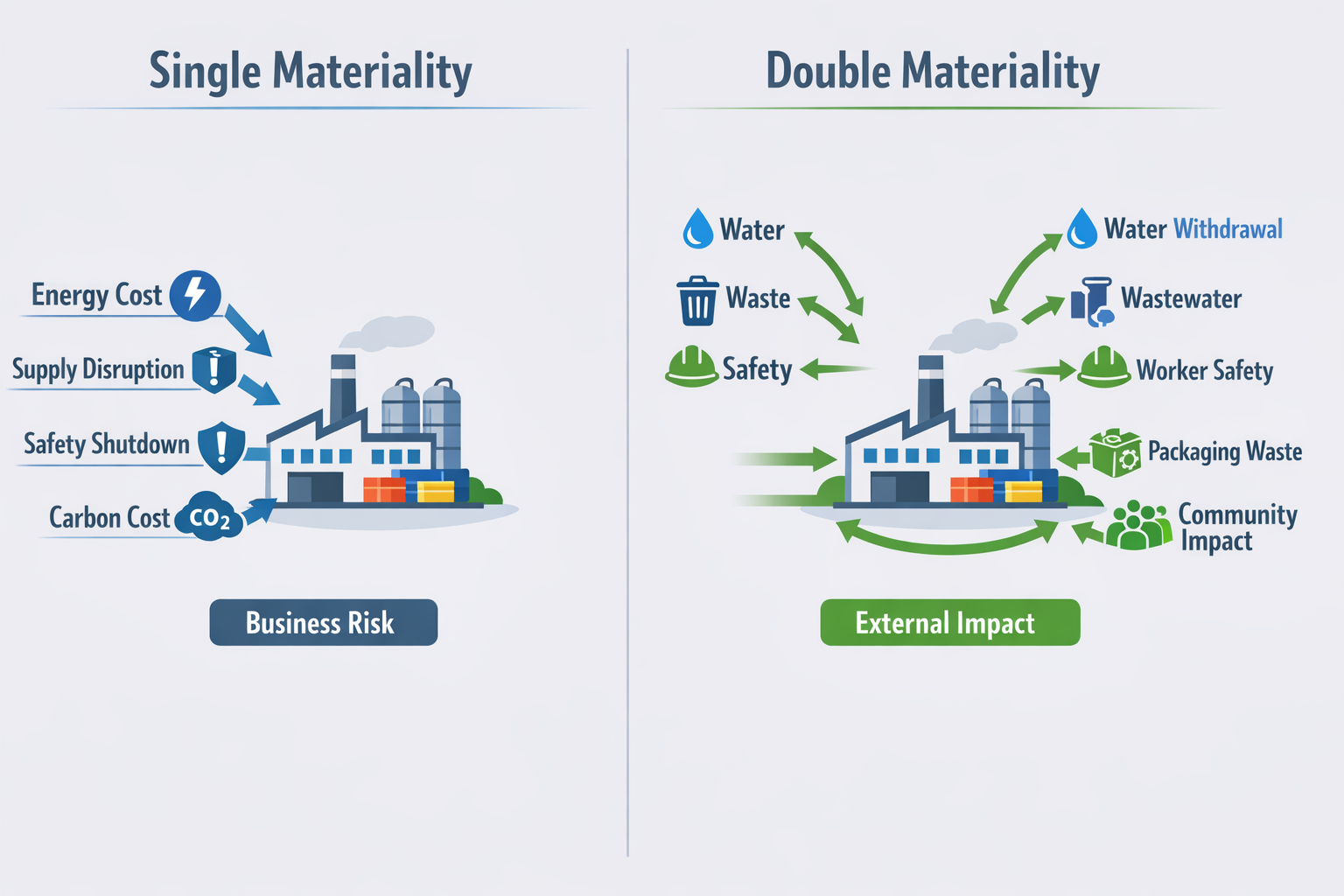
For a food-processing manufacturer, wastewater discharge, packaging waste, and local water withdrawal may become reportable priorities even before they create immediate balance-sheet effects. Worker health and safety remain important, but the assessment also considers the company’s impact on contractors, surrounding communities, and upstream agricultural suppliers. This is where double materiality often produces a wider topic set than a finance-only lens, especially across emissions, labor practices, biodiversity-related pressures, and community impacts.
Jurisdiction Decides What Is Optional
The user needs narrow options, but jurisdiction determines what is discretionary and what is mandatory. A Southeast Asian manufacturer exporting into Europe may still prepare management reporting using GRI Standards or investor-facing disclosures aligned to IFRS Sustainability Disclosure Standards, yet its legal entity structure or customer requirements may pull parts of the business toward European Sustainability Reporting Standards. Selection, therefore, is rarely a pure preference exercise.
This is why many manufacturing groups end up with a layered approach rather than a single-label answer. One reporting system may anchor general stakeholder reporting, while another informs investor disclosures or regional compliance. The important point is to decide from obligations and users outward, not from popularity inward.
Topic Priorities Should Follow Operational Reality
Material topics in manufacturing usually cluster around a manageable set of operational themes: energy, Scope 1 and 2 emissions, process waste, water, worker safety, supplier practices, and community effects near plants or logistics corridors. The right framework choice depends on which of these topics are genuinely significant for your footprint, process type, and reporting audience. A metal stamper, an apparel factory, and a chemical producer may all discuss emissions, but the materiality case and disclosure depth will differ sharply.
That is the practical test for ESG framework selection. If your primary users are capital providers, financially material sustainability risks will likely dominate the structure. If your reporting context requires a broader impact view, double materiality will widen the scope and evidence base.
A Practical Selection Workflow for Multi-Site Manufacturers
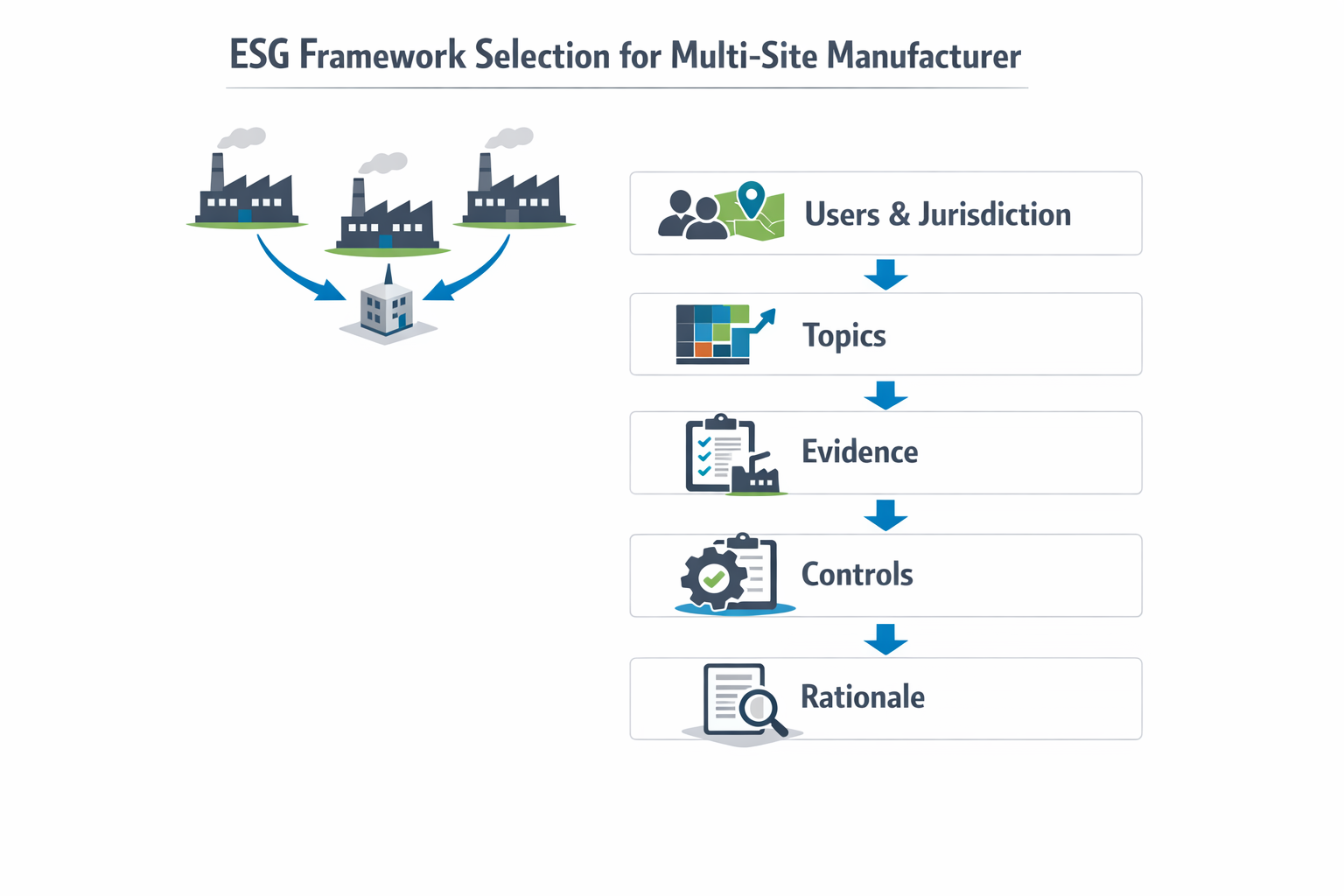
A workable ESG framework selection process should be simple enough to run across plants but structured enough to stand up to internal review. For a multi-site manufacturer, that usually means five steps: identify users and jurisdiction, assess material topics, map evidence and owners, establish controls, and document the rationale.
Identify Users and Jurisdiction First
Take a regional electronics components manufacturer with plants in Malaysia, Thailand, and Vietnam, plus a European sales entity. Its finance team needs investor-facing climate- and sustainability-related financial disclosures; its European entity must monitor ESRS-related obligations; and corporate sustainability wants broader stakeholder reporting that may align with GRI Standards. That mix immediately narrows the selection logic because one company can face different reporting audiences at the same time.
At this stage, assign a framework led by the reporting audience rather than by topic alone. Finance may lead IFRS Sustainability Disclosure Standards interpretation, sustainability may coordinate GRI topic coverage, and legal or compliance may track European Sustainability Reporting Standards requirements linked to the group structure. The output is not a finished report; it is a responsibility map showing who is selecting for which use case.
Assess Material Topics at Group and Plant Level
Next, test material topics at two levels: enterprise-wide and site-specific. The electronics manufacturer may identify group-wide topics such as Scope 1 and 2 emissions, electricity consumption, worker safety, conflict minerals due diligence, and wastewater compliance, while one plating facility has elevated chemical handling risks that do not apply equally to all sites. This is where double materiality can affect scope if the company is working in a European reporting context, because operational impacts and financial effects may both need structured review.
The practical mistake is forcing every plant into the same checklist too early. Instead, build a topic matrix that distinguishes common indicators from plant-specific evidence requirements. That makes later mapping cleaner and prevents EHS teams from collecting records that are irrelevant to a given framework or facility.
Map Evidence, Owners, and Source Records
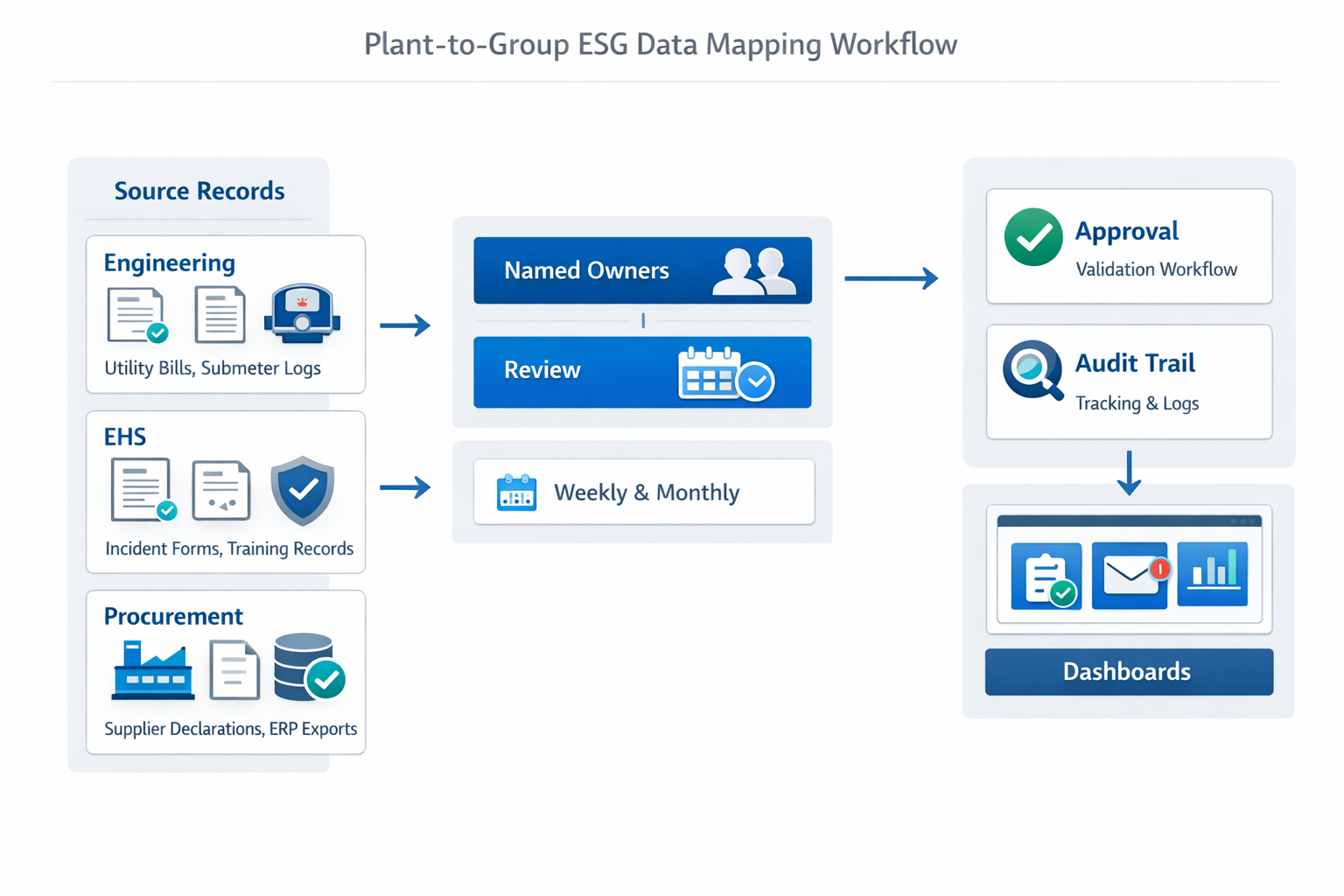
Once topics are set, translate each disclosure need into operational evidence. For the Malaysian plant, energy data may come from monthly utility bills and submeter logs owned by engineering; safety data may come from incident forms and training records owned by EHS; supplier screening data may sit with procurement in ERP exports and signed declarations. The point is to connect each topic to a named owner, a source system, a review cadence, and a record format.
This is also where mapping reduces duplication across GRI Standards, IFRS Sustainability Disclosure Standards, and ESRS. A single electricity-consumption record can support multiple reporting streams, but that does not mean the disclosures are equivalent, conforming, or compliant by default. Mapping is an internal organization method, not proof that one set of answers satisfies all requirements.
Establish Controls Across Plants and Functions
After mapping, formalize controls around submission, review, approval, and retention. In the electronics manufacturer example, plant engineers submit monthly energy forms, site finance validates cost ties, EHS reviews incident classifications, and corporate sustainability approves the consolidated record before reporting use. This creates a traceable chain instead of a year-end spreadsheet chase.
Jodoo fits at this implementation stage because teams can configure plant-specific forms, role-based permissions, approval flows, attachment rules, and reminder schedules without building a custom system from scratch. That matters when one framework-mapped data point needs mobile photo evidence at the plant, finance review at headquarters, and a documented audit trail across functions.
Document the Rationale and Keep It Reviewable
The last step is to record why each framework was chosen, how topics were scoped, which entities were included, and where evidence sits. For multi-site manufacturers, this decision log is often as important as the data because reporting obligations, ownership, and plant boundaries change over time. A documented rationale also helps the next reporting cycle start from controlled logic instead of memory.
Conclusion: Turning ESG Framework Decisions Into a Workable System With Jodoo
For manufacturers, choosing among ESG frameworks is not about finding one universal template. It is about matching the right reporting approach to your users, jurisdictions, material topics, evidence sources, and control requirements. A plant group reporting to investors, regulators, customers, and internal leadership will often need a structured combination of standards, disclosures, and reporting rules rather than a simplified one-framework answer.
That is why the practical question is not only which ESG framework you reference, but also how your sites will collect, review, and trace the underlying records. If energy logs sit in spreadsheets, safety incidents stay on paper, and supplier declarations move through email, reporting quality becomes hard to scale across plants. The stronger your workflow discipline, the easier it is to build repeatable ESG reporting cycles.
Jodoo can support that operating model as a no-code platform for manufacturing teams. You can configure framework-mapped forms, role-based permissions, approval workflows, reminders, attachments, mobile data capture, dashboards, and integrations so that plant, EHS, procurement, finance, and IT teams work from the same system of record.
If you want to turn ESG reporting into a more controlled plant-to-group workflow, you can start a free trial or book a demo with Jodoo.